REVIEW 3 major objections 5 minor 37 references
$B_c$, $B_s$ and $D_s$ production at lepton-hadron colliders
T0 review · 3 major / 5 minor · reviewed 2026-08-10 · deepseek-v4-flash
Pith's one-line read The paper claims that electroproduced $B_c$ mesons should be observable at the EIC, predicting 5–28 reconstructed events per year, while HERA cannot accumulate a reconstructable sample.
desk verdict First NRQCD electroproduction estimates for Bc, Bs, Ds at ep colliders; the Bc EIC rate is new but rests on an unverified LO amplitude, so treat the event numbers as indicative. read the letter →
The pith
A machine-rendered reading of the paper's core claim, the machinery that carries it, and where it could break.
The reading
What carries the argument
The calculation rests on the NRQCD factorisation formula $d\sigma = \int dx\, f_{g/p}(x,\mu^2)\, d\hat\sigma\, \langle O_M(n)\rangle$, which splits the process into a gluon PDF, a perturbative hard part, and a long-distance matrix element $\langle O_M\rangle = 2(2J+1)N_c |R(0)|^2/4\pi$. The hard part is built from 24 tree-level $\gamma^* g \to q\bar q' + q + \bar q'$ diagrams evaluated with covariant projection operators ($\gamma_5$ for pseudoscalar, $\not\epsilon$ for vector), with the leptonic tensor folded in and the four-body phase space decomposed into sequential two-body phase spaces for Monte Carlo efficiency. The long-distance matrix elements are fixed at leading order by $|R(0)|^2$ from a potential-model wave function for $B_c$ and from the decay constants $f_{B_s}$, $f_{D_s}$ for the single-heavy mesons; heavy-quark spin symmetry gives vector and pseudoscalar mesons the same $R(0)$. The comparison numbers come from the CT10 gluon PDF, HERA cuts ($p_T>1$ GeV, $0.3<z<0.9$, $2<Q^2<100$ GeV$^2$) and EIC Yellow Report cuts ($Q^2>1$ GeV$^2$, $20<W<80$ GeV, $0.05<z<0.9$).
What would settle it
Run the EIC for one nominal year (about 315 fb$^{-1}$) and search for $e+p\to e+B_c+\bar c+b$ with $B_c^\pm\to J/\psi\pi^\pm$ and $J/\psi\to l^+l^-$: fewer than about five reconstructed events, or a central cross-section value more than a factor of three below 5.44 fb, would falsify the central claim. Before any collider data exist, a lattice-QCD determination of the $B_c$ decay constant that contradicts the potential-model input $|R_{B_c}(0)|^2 = 1.642$ GeV$^3$ would undercut the same prediction.
Extended reading notes
Core claim
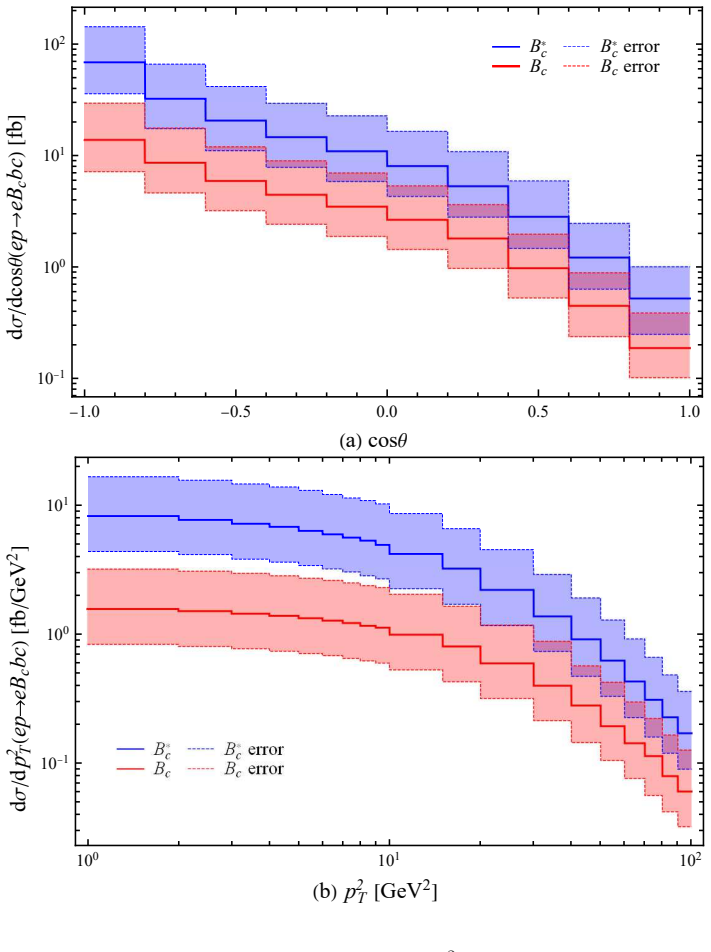
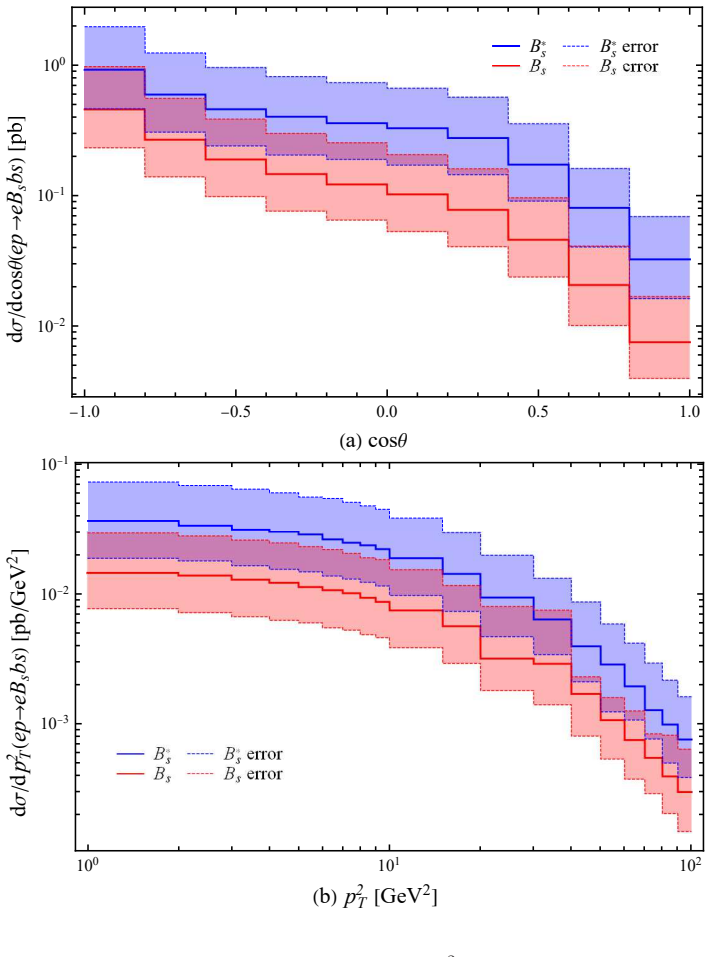
The central claim is that leading-order NRQCD electroproduction of the $B_c$ meson at the EIC is observable: with all $B_c^*$ decays feeding $B_c$, the predicted cross sections $\sigma(B_c)=5.44$ fb and $\sigma(B_c^*)=22.12$ fb translate into 3922–19209 $B_c$ mesons per year and, after the $B_c\to J/\psi\pi^\pm$ (0.5%) and $J/\psi\to l^+l^-$ (12%) branching cuts and counting both charge states, about 5–28 reconstructed events per year. The same calculation at HERA gives a larger cross section (42.13 fb) but insufficient accumulated events for reconstruction, while at the proposed EicC the cross section is below 0.03 fb. For $B_s$ and $D_s$, the paper reports that HERA produces them abundantly ($\sigma(B_s)=0.29$ pb, $\sigma(D_s)=9.35$ pb at leading order) but that these predictions are highly sensitive to the strange-quark mass and renormalisation scale, a sensitivity the authors read as a possible experimental window rather than as a failure.
Load-bearing premise
The whole rate estimate stands or falls on the assumption that a leading-order, colour-singlet NRQCD calculation, seeded by a potential-model wave function at the origin with $|R_{B_c}(0)|^2 = 1.642$ GeV$^3$ and assuming every $B_c^*$ decays to $B_c$, is accurate to within a factor of about three.
Editorial extensions
If this is right
- At the EIC, the predicted 3922–19209 $B_c$ mesons per year translate into roughly 5–28 reconstructed $B_c^\pm$ events per year through $B_c\to J/\psi\pi^\pm$ with $J/\psi\to l^+l^-$, making the $B_c$ a reachable target for the first time in electroproduction.
- At HERA the $B_c$ cross section is larger in absolute terms (42.13 fb) but the integrated luminosity is insufficient for reconstruction, so HERA cannot test the prediction.
- The proposed EicC collider is ruled out for this purpose: its $B_c$ cross section is below 0.03 fb.
- At HERA, $B_s$ and $D_s$ production is plentiful (roughly 48–189 $B_s^0$, 119–476 $B_s^*$, 1575–5100 $D_s^+$, and 3465–11440 $D_s^{*+}$ events per 315 pb$^{-1}$), enough for the main decay channels.
- An order-of-magnitude luminosity upgrade (HL-EIC) would raise the expected $B_c$ yield correspondingly, strengthening the case for observation.
Reading between the lines
- The event-number claim is effectively a leading-order, colour-singlet estimate; if next-to-leading-order or colour-octet corrections shift the cross section down by roughly a factor of three, the 5–28 event prediction would essentially vanish, so the estimate is best read as an order-of-magnitude target awaiting NLO confirmation.
- Because the $B_c^*$ cross section is about four times the $B_c$ one and feed-down is assumed complete, the same calculation predicts the EIC sample to be dominated by $B_c$ from vector-meson decay; a polarisation or momentum-distribution measurement of reconstructed $B_c$ would test that feed-down assumption directly.
- The dramatic quark-mass sensitivity of the $B_s$ and $D_s$ cross sections (greater than 200% for a 0.1 GeV mass shift) could be inverted: precision $D_s$ electroproduction data at a future $ep$ collider would constrain the strange-quark mass or delimit where NRQCD's velocity expansion breaks down for single-heavy mesons.
Editorial analysis
A structured set of objections, weighed in public.
Referee Report
Summary. The paper presents leading-order (LO) NRQCD predictions for the electroproduction of Bc, Bc*, Bs, Bs*, Ds, and Ds* in electron-proton collisions at HERA and at the EIC. The calculation uses standard color-singlet factorization with a gluon PDF, covariant projection operators, and long-distance matrix elements taken from potential-model wave functions for Bc and from decay constants for Bs and Ds. The central phenomenological claim is that Bc production is observable at the EIC, with a predicted cross section of 5.44 fb plus a Bc* cross section of 22.12 fb (Section III, Eq. 10), yielding roughly 5 to 28 reconstructed Bc -> J/psi pi -> l+l- events per year. The paper also reports much larger but strongly parameter-sensitive cross sections for Bs and Ds at HERA.
Significance. If the numerical predictions are correct, the paper provides a concrete, falsifiable observable for the EIC and fills a gap in LO electroproduction calculations for mesons containing one or two heavy quarks. The work has several strengths: the formalism is standard NRQCD; the input parameters are taken from external sources rather than fitted to the target observables; the paper explicitly separates quark-mass and scale uncertainties; and it gives differential distributions in cos(theta) and pT^2. The central event-rate estimate, however, rests on an amplitude calculation that the authors report required manual patching of FeynCalc's Dirac contractions, and no independent verification or code is provided. Since the EIC observability claim scales linearly with the LO cross section, the numerical security of that claim is presently unverified.
major comments (3)
- [Section II and Eq. (10)] The central Bc cross-section prediction, and hence the 5 to 28 reconstructed events per year at the EIC, depends entirely on the LO squared amplitude for gamma* + g -> Bc + cbar + b. In Section II the authors state that 'Feyncalc seems to give wrong results when contracting long chains of Dirac gamma matrix, and can be solved by manually add contracting rules.' No code, ancillary file, or independent amplitude check is provided, so the reader cannot verify that the manual contraction rules do not introduce a sign or factor error. An O(1) error would change the quoted cross sections in Eq. (10) by a factor that could remove or greatly inflate the observability claim. I therefore request an independent verification, for example a comparison of the squared amplitude in a known kinematic limit, a helicity-amplitude check, or release of the calculation code, before the central claim can be assessed.
- [Section III, Eq. (10)] The quoted Bc and Bc* cross sections are LO color-singlet predictions only; NLO QCD corrections and color-octet contributions are omitted. Because the event-rate estimate is directly proportional to the LO cross section, the absence of any estimate of these corrections leaves the central claim with an unquantified systematic uncertainty. The large scale variation in Eq. (10) (the +6.36/-1.91 fb band on the Bc cross section) already spans a factor of several, and NLO corrections in comparable quarkonium leptoproduction calculations are known to be substantial. The authors should either provide an estimate of the expected size of NLO/octet contributions or explicitly restrict the conclusion to 'an LO estimate suggests observability.'
- [Section III, Eq. (11) and Bs/Ds discussion] For Bs and Ds, the NRQCD velocity expansion is applied to mesons containing a strange quark with ms = 0.5 GeV, for which v is not parametrically small. The paper itself demonstrates the fragility of this assumption: Eq. (11) shows that a 0.1 GeV change in quark mass can alter the Bs cross section by more than 200%, and the total uncertainty bands are very wide. The abstract and conclusion describe these Bs and Ds cross sections as 'notably significant,' but without a discussion of the convergence of the NRQCD expansion for light strange quarks, the quoted event numbers are difficult to interpret as more than order-of-magnitude estimates. I recommend either adding a quantitative discussion of the v-expansion validity for cs and bs systems or softening the claims accordingly.
minor comments (5)
- [Abstract and affiliations] There are several typos: 'chromodyn amics' should be 'chromodynamics', and the affiliation 'University of Chinese Academy of Science s' has an extra 's'.
- [Eq. (11)] The lower uncertainty for sigma_Ds is printed as '-3,03 pb' and should presumably be '-3.03 pb'.
- [Section III, figure captions] The figure captions for Figs. 2-4 describe the upper/lower bounds in terms of specific quark mass combinations, but it would be clearer to state that the upper/lower curves correspond to the full mass-and-scale envelope rather than to a single combination.
- [Section III, EicC discussion] The statement that the EicC cross section is 'less than or similar to 0.03 fb' is given without a formula or reference; a brief derivation or citation would improve transparency.
- [Eq. (3)] The phase-space decomposition notation in Eq. (3) is hard to follow; in particular the meaning of the integration limits 'E2/(4m^2)' and 'M^2/m^2' is not explained. A sentence defining M and the limits would help.
Circularity Check
No circularity: the cross-section predictions use external LDMEs and decay constants and are not fitted to the target observables.
full rationale
The derivation chain is: NRQCD factorization (Eq. 1), the leptonic tensor formula (Eq. 2), covariant projection for the q-qbar pair (Eq. 4), LO Feynman diagrams generated with FeynArts/FeynCalc, and numerical integration. The inputs are the gluon PDF, quark masses, the one-loop running coupling, and the LDMEs. For Bc the LDME is taken from a potential-model calculation, |R_Bc(0)|^2 = 1.642 GeV^3 (Eq. 8); for Bs and Ds the LDMEs come from PDG decay constants through Eq. (7). None of these inputs is derived from the ep -> e + Bc + cbar + b (or Bs/Ds) cross sections being computed, and the predicted HERA and EIC rates (Eqs. 9-11) are not used to adjust any parameter. The quark-mass and renormalization-scale variations are uncertainty estimates, not fits to data. The event-number estimate additionally uses external branching ratios, BR(Bc -> J/psi pi) = 0.5% and BR(J/psi -> l+l-) = 12%, which are independent of the computed cross sections. The passage noting that FeynCalc seemed to give wrong results for long Dirac chains and was handled by manually adding contraction rules is a numerical verification concern, not a circularity, because it does not make the output equivalent to an input. The self-citations, Ref. [12] and Ref. [13], appear only in the historical review of Bc hadroproduction and are not load-bearing for the electroproduction predictions. No circular step can be exhibited, so the circularity score is 0.
Assumptions & free parameters
free parameters (4)
- charm quark mass mc =
1.5 GeV (varied +/-0.1 GeV)
- bottom quark mass mb =
4.9 GeV (varied +/-0.1 GeV)
- strange quark mass ms =
0.5 GeV (varied +/-0.03 GeV)
- renormalization/factorization scale mu =
mT (varied from mT/2 to 2mT)
assumptions (5)
- domain assumption NRQCD factorization for electroproduction of heavy mesons (Eq. (1))
- domain assumption Heavy-quark spin symmetry: vector and pseudoscalar mesons share |R(0)| at leading order in v (Section III after Eq. (8))
- domain assumption Buchmuller-Tye potential model determines |R_Bc(0)|^2 = 1.642 GeV^3 (Eq. (8))
- domain assumption Decay-constant extraction of |R_Bs(0)|^2 = 0.299 GeV^3 and |R_Ds(0)|^2 = 0.124 GeV^3 from PDG f_Bs and f_Ds (Eqs. (6)-(8))
- standard math One-loop running coupling with Lambda_QCD = 297 MeV (nf=4) and 214 MeV (nf=5) and CT10 PDFs
Cite this review
Pith. "Pith review of $B_c$, $B_s$ and $D_s$ production at lepton-hadron colliders." pith.science (2026). https://pith.science/paper/T4FP24VS
@misc{pith2026250100550,
  author       = {Pith},
  title        = {Pith review of: $B_c$, $B_s$ and $D_s$ production at lepton-hadron colliders},
  year         = {2026},
  howpublished = {\url{https://pith.science/paper/T4FP24VS}},
  note         = {Machine review of arXiv:2501.00550}
}
abstract
Within the framework of nonrelativistic quantum chromodynamics, this study examines the electroproduction processes $e+p\to e+B_c+\overline{c}+b$, $e+p\to e+B_s+\overline{s}+b$, and $e+p\to e+D_s+\overline{c}+s$ at lepton-hadron colliders. The differential cross sections in $\cos\theta$ and $p_T^2$ at HERA are presented. The results indicate that the production of $B_c$ is feasible at the EIC, whereas it is not at HERA. The cross sections for $B_s$ and $D_s$ are notably significant at HERA, yet they exhibit sensitivity to variations in quark mass and renormalization scale.
Figures

Figures from the paper (1 more)

Reference graph
Works this paper leans on
-
[1]
Experimental Observation of a Heavy Particle J,
J. J. Aubert et al. [E598], “Experimental Observation of a Heavy Particle J,” Phys. Rev. Lett. 33 (1974), 1404-1406
work page 1974
-
[2]
Discovery of a Narrow Resonance in e+e− Annihilation,
J. E. Augustin et al. [SLAC-SP-017], “Discovery of a Narrow Resonance in e+e− Annihilation,” Phys. Rev. Lett. 33 (1974), 1406-1408
work page 1974
-
[3]
Observation of a Dimuon Resonance at 9.5 GeV in 400 G eV Proton- Nucleus Collisions,
S. W. Herb et al. [E288], “Observation of a Dimuon Resonance at 9.5 GeV in 400 G eV Proton- Nucleus Collisions,” Phys. Rev. Lett. 39 (1977), 252-255
work page 1977
-
[4]
Rigorous QCD an alysis of inclusive annihilation and production of heavy quarkonium,
G. T. Bodwin, E. Braaten and G. P. Lepage, “Rigorous QCD an alysis of inclusive annihilation and production of heavy quarkonium,” Phys. Rev. D 51 (1995), 1125-1171 [erratum: Phys. Rev. D 55 (1997), 5853] [arXiv:hep-ph/9407339 [hep-ph]]
arXiv 1995
-
[5]
Observation of the Bc meson in p¯p collisions at √s = 1. 8 TeV,
F. Abe et al. [CDF], “Observation of the Bc meson in p¯p collisions at √s = 1. 8 TeV,” Phys. Rev. Lett. 81 (1998), 2432-2437 [arXiv:hep-ex/9805034 [hep-ex]]
arXiv 1998
-
[6]
Observation of an Excited B± c Meson State with the ATLAS Detec- tor,
G. Aad et al. [ATLAS], “Observation of an Excited B± c Meson State with the ATLAS Detec- tor,” Phys. Rev. Lett. 113 (2014) no.21, 212004 [arXiv:1407.1032 [hep-ex]]
arXiv 2014
-
[7]
Impro ving the Weizsacker- Williams approximation in electron-proton collisions,
S. Frixione, M. L. Mangano, P. Nason and G. Ridolfi, “Impro ving the Weizsacker- Williams approximation in electron-proton collisions,” P hys. Lett. B 319 (1993), 339-345 [arXiv:hep-ph/9310350 [hep-ph]]
arXiv 1993
-
[8]
I. F. Ginzburg, G. L. Kotkin, V. G. Serbo and V. I. Telnov, “ COLLIDING GAMMA E AND GAMMA GAMMA BEAMS ON THE BASIS OF SINGLE COLLISION ELECTR ON POSITRON ACCELERATORS. (IN RUSSIAN),” Yad. Fiz. 38 (1983), 372-384
work page 1983
Show all 37 references
-
[9]
Hadronic production of the Bc meson at TeV energies,
C. H. Chang and Y. Q. Chen, “Hadronic production of the Bc meson at TeV energies,” Phys. Rev. D 48 (1993), 4086-4091
1993
-
[10]
On hadro nic production of the B(c) meson,
C. H. Chang, Y. Q. Chen, G. P. Han and H. T. Jiang, “On hadro nic production of the B(c) meson,” Phys. Lett. B 364 (1995), 78-86 [arXiv:hep-ph/9408242 [hep-ph]]. 12
1995 arXiv
-
[11]
Hadronic production of the P-wave excited Bc- states(B∗ cJ,L =1),
C. H. Chang, J. X. Wang and X. G. Wu, “Hadronic production of the P-wave excited Bc- states(B∗ cJ,L =1),” Phys. Rev. D 70 (2004), 114019 [arXiv:hep-ph/0409280 [hep-ph]]
2004 arXiv
-
[12]
examined the color octet mechanism (COM) in Bc strong production. Ref. [13] also provided a detailed analysis of Bc strong production driven by intrinsic heavy quarks within 2 colliding hadrons. Note, the heavy quark fragmentation method [14 , 15] is also widely used in produc...
-
[13]
The Color- octet contributions to P- wave Bc meson hadroproduction,
C. H. Chang, C. F. Qiao, J. X. Wang and X. G. Wu, “The Color- octet contributions to P- wave Bc meson hadroproduction,” Phys. Rev. D 71 (2005), 074012 [arXiv:hep-ph/0502155 [hep-ph]]
2005 arXiv
-
[14]
Hadronic p roduction of Bc(B∗ c ) meson induced by the heavy quarks inside the collision hadrons,
C. H. Chang, C. F. Qiao, J. X. Wang and X. G. Wu, “Hadronic p roduction of Bc(B∗ c ) meson induced by the heavy quarks inside the collision hadrons,” P hys. Rev. D 72 (2005), 114009 [arXiv:hep-ph/0509040 [hep-ph]]
2005 arXiv
-
[15]
Mele and P
B. Mele and P. Nason, Nucl. Phys. B 361 (1991), 626-644 [erratum: Nucl. Phys. B 921 (2017), 841-842]
1991
-
[16]
Perturbative QC D fragmentation functions for Bc and B∗ c production,
E. Braaten, K. m. Cheung and T. C. Yuan, “Perturbative QC D fragmentation functions for Bc and B∗ c production,” Phys. Rev. D 48 (1993) no.11, R5049 [arXiv:hep-ph/9305206 [hep-ph]]
1993 arXiv
-
[17]
B. A. Kniehl, G. Kramer, I. Schienbein and H. Spiesberge r, Phys. Rev. Lett. 96 (2006), 012001 [arXiv:hep-ph/0508129 [hep-ph]]
2006 arXiv
-
[18]
Cacciari, S
M. Cacciari, S. Frixione, N. Houdeau, M. L. Mangano, P. N ason and G. Ridolfi, JHEP 10 (2012), 137 [arXiv:1205.6344 [hep-ph]]
2012 arXiv
-
[19]
Bc Meson Production around the Z 0 Peak at a High Luminosity e+e− Collider,
Z. Yang, X. G. Wu, G. Chen, Q. L. Liao and J. W. Zhang, “ Bc Meson Production around the Z 0 Peak at a High Luminosity e+e− Collider,” Phys. Rev. D 85 (2012), 094015 [arXiv:1112.5169 [hep-ph]]
2012 arXiv
-
[20]
Production mechan isms for B(c) mesons in photon- photon collisions,
K. Kolodziej, A. Leike and R. Ruckl, “Production mechan isms for B(c) mesons in photon- photon collisions,” Phys. Lett. B 348 (1995), 219-225 [arXiv:hep-ph/9412249 [hep-ph]]
1995 arXiv
-
[21]
Photo nic production of P wave states of B(c) mesons,
A. V. Berezhnoy, V. V. Kiselev and A. K. Likhoded, “Photo nic production of P wave states of B(c) mesons,” Phys. Lett. B 381 (1996), 341-347 [arXiv:hep-ph/9510238 [hep-ph]]
1996 arXiv
-
[22]
NonAb elian nature of asymmetry for the B(c) meson production in gluon photon interaction,
A. V. Berezhnoy, V. V. Kiselev and A. K. Likhoded, “NonAb elian nature of asymmetry for the B(c) meson production in gluon photon interaction,” Phys. A tom. Nucl. 61 (1998), 252-259 [arXiv:hep-ph/9710429 [hep-ph]]
1998 arXiv
-
[23]
Bc meson enhancement and the momentum dependence in Pb + Pb collisions at energies available at the CERN Large H adron Collider,
Y. Liu, C. Greiner and A. Kostyuk, “ Bc meson enhancement and the momentum dependence in Pb + Pb collisions at energies available at the CERN Large H adron Collider,” Phys. Rev. C 87 (2013) no.1, 014910 [arXiv:1207.2366 [nucl-th]]
2013 arXiv
-
[24]
Quarkonium and Bc mesons from Pb + Pb at LHC energies,
E. Norbeck, J. Nachtman and Y. Onel, “Quarkonium and Bc mesons from Pb + Pb at LHC energies,” J. Phys. Conf. Ser. 458 (2013), 012026 13
2013
-
[25]
Inelastic Production of J/psi Mesons in Photoproduc tion and Deep Inelastic Scattering at HERA,
F. D. Aaron et al. [H1], “Inelastic Production of J/psi Mesons in Photoproduc tion and Deep Inelastic Scattering at HERA,” Eur. Phys. J. C 68 (2010), 401-420 [arXiv:1002.0234 [hep-ex]]
2010 arXiv
-
[26]
Science Requirements and Detector Con- cepts for the Electron-Ion Collider: EIC Yellow Report,
R. Abdul Khalek, A. Accardi, J. Adam, D. Adamiak, W. Aker s, M. Albaladejo, A. Al-bataineh, M. G. Alexeev, F. Ameli and P. Antonioli, et al. “Science Requirements and Detector Con- cepts for the Electron-Ion Collider: EIC Yellow Report,” Nu cl. Phys. A 1026 (2022), 122447 [arX...
2022 arXiv
-
[27]
Electron Ion Collider: The Next QCD Frontier: Understanding the glue that binds us all,
A. Accardi, J. L. Albacete, M. Anselmino, N. Armesto, E. C. Aschenauer, A. Bacchetta, D. Boer, W. K. Brooks, T. Burton and N. B. Chang, et al. “Electron Ion Collider: The Next QCD Frontier: Understanding the glue that binds us all,” Eur . Phys. J. A 52 (2016) no.9, 268 [arXiv:...
2016 arXiv
-
[28]
Electron-ion collider in China,
D. P. Anderle, V. Bertone, X. Cao, L. Chang, N. Chang, G. C hen, X. Chen, Z. Chen, Z. Cui and L. Dai, et al. “Electron-ion collider in China,” Front. Phys. (Beijing) 16 (2021) no.6, 64701 [arXiv:2102.09222 [nucl-ex]]
2021 arXiv
-
[29]
QCD leading order study of the J/ψ leptoproduction at HERA within the nonrelativistic QCD framework,
Z. Sun and H. F. Zhang, “QCD leading order study of the J/ψ leptoproduction at HERA within the nonrelativistic QCD framework,” Eur. Phys. J. C 77 (2017) no.11, 744 [arXiv:1702.02097 [hep-ph]]
2017 arXiv
-
[30]
Feyn Arts: Computer Algebraic Generation of Feyn- man Graphs and Amplitudes,
J. Kublbeck, M. Bohm and A. Denner, “Feyn Arts: Computer Algebraic Generation of Feyn- man Graphs and Amplitudes,” Comput. Phys. Commun. 60 (1990), 165-180
1990
-
[31]
FEYN CALC: Computer al gebraic calculation of Feyn- man amplitudes,
R. Mertig, M. Bohm and A. Denner, “FEYN CALC: Computer al gebraic calculation of Feyn- man amplitudes,” Comput. Phys. Commun. 64 (1991), 345-359
1991
-
[32]
CUBA: A Library for multidimensional numeric al integration,
T. Hahn, “CUBA: A Library for multidimensional numeric al integration,” Comput. Phys. Commun. 168 (2005), 78-95 [arXiv:hep-ph/0404043 [hep-ph]]
2005 arXiv
-
[33]
Review of particle physics,
S. Navas et al. [Particle Data Group], “Review of particle physics,” Phys. Rev. D 110 (2024) no.3, 030001
2024
-
[34]
Mesons with beauty and charm : Spectroscopy,
E. J. Eichten and C. Quigg, “Mesons with beauty and charm : Spectroscopy,” Phys. Rev. D 49 (1994), 5845-5856 [arXiv:hep-ph/9402210 [hep-ph]]
1994 arXiv
-
[35]
Quarkonia and Quantum Ch romodynamics,
W. Buchmuller and S. H. H. Tye, “Quarkonia and Quantum Ch romodynamics,” Phys. Rev. D 24 (1981), 132
1981
-
[36]
New parton distributions for collider physics,
H. L. Lai, M. Guzzi, J. Huston, Z. Li, P. M. Nadolsky, J. Pu mplin and C. P. Yuan, “New parton distributions for collider physics,” Phys. Rev. D 82 (2010), 074024 [arXiv:1007.2241 [hep-ph]]. 14
2010 arXiv
-
[37]
The Decays of B(c) meson,
C. H. Chang and Y. Q. Chen, “The Decays of B(c) meson,” Phy s. Rev. D 49 (1994), 3399-3411 15
1994
Reviewed August 10, 2026 · model on record in the stance chip above.
Discussion (0). Continue with ORCID to comment.