REVIEW 5 major objections 4 minor 75 references
A disturbance in the force. How force fluctuations hinder dynamical friction and induce core stalling
T0 review · 5 major / 4 minor · reviewed 2026-08-15 · deepseek-v4-flash
Pith's one-line read This paper claims that core stalling—the premature halting of a massive object's orbital decay near the center of a galaxy or cluster—is caused by force fluctuations from the system's finite particle number, so the stalling radius shrinks…
desk verdict A solid N-body study that directly measures rs ∝ N^-1/2 and credibly ties core stalling to granularity, though the high-N extrapolation rests on a white-noise approximation the authors themselves flag as rough. read the letter →
The pith
A machine-rendered reading of the paper's core claim, the machinery that carries it, and where it could break.
The reading
What carries the argument
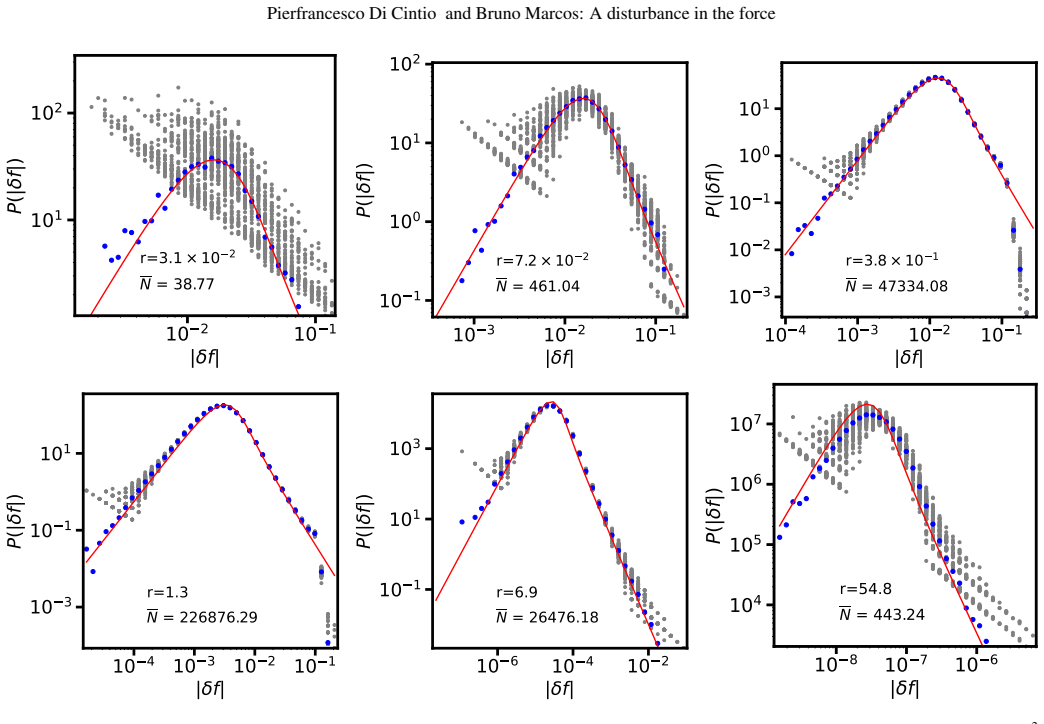
The load-bearing object is a stochastic equation of motion for the tracer, $\ddot{\mathbf r} = -\nabla\Phi(\mathbf r) - \eta\mathbf v + \delta\mathbf f(\mathbf r)$, in which $-\eta\mathbf v$ is the Chandrasekhar dynamical-friction drag and $\delta\mathbf f$ is a random force per unit mass sampled from the Holtsmark distribution, normalized by the local density and particle mass. The paper anchors this model in the discrete dynamics by computing the force-fluctuation field in $N$-body snapshots as the difference between the discrete and smooth-potential accelerations and showing that the empirical distribution is close to Holtsmark across radii. The argument is carried by the identity $r_s \approx C r_c \sqrt{m/m_t}$, the same scaling as the wander radius of a heavy particle undergoing Brownian motion in the cluster core, so the stalling radius is interpreted as the point where noise-induced random walking balances friction-driven infall.
What would settle it
Run tracer-only simulations in a cored $\gamma=0$ model at fixed $m_t/M=10^{-3}$ with $N=10^7$ and $10^8$, at a fixed softening below the predicted $r_s$, with two timesteps differing by a factor of two; if $r_s$ follows the $N^{-1/2}$ line in both, the granularity mechanism holds, while a plateau at the $r_s\approx r_c/2$ level would favor the resonance-buoyancy explanation. Separately, measure the force autocorrelation time $\tau_c$ in an $N$-body snapshot sequence and check whether adding it to the stochastic equation moves $r_s$ beyond the run-to-run scatter.
Extended reading notes
Core claim
At fixed $m_t/M$ and nearly circular initial orbits, the stalling radius in the cored $\gamma=0$ and mildly cuspy $\gamma=1$ spherical models obeys $r_s \approx C r_c \sqrt{m/m_t} = C r_c \sqrt{M/(N m_t)}$, hence $r_s \propto N^{-1/2}$, across $10^4 \le N \le 3\times10^6$ (Section 3.2, Fig. 6), both with and without field-particle self-gravity. The authors verify that the per-shell force-fluctuation distribution matches the Holtsmark form, reproduce the $N$-body orbital decay with a Langevin equation combining local Chandrasekhar friction and Holtsmark-distributed noise, and show that this stochastic model extends the $N^{-1/2}$ law for both models to $N=10^{13}$, with the cored case flattening to a nearly $N$-independent $r_s$ above about $10^9$ particles. Contrary to the common view that stalling is special to flat cores, the suppression shows up in the cuspy $\gamma=1$ model as well, at smaller radii. They further report that the super-Chandrasekhar phase seen in earlier cored-model work appears only at $N \lesssim 3\times10^5$, which they attribute to enhanced collisionality at low resolution rather than to a physical breakdown of the standard friction formula.
Load-bearing premise
The load-bearing premise is that the finite-$N$ background can be treated as uncorrelated Poissonian noise: force fluctuations drawn independently from a Holtsmark distribution at every time step, with no memory; the paper itself notes that force fluctuations cannot be fully uncorrelated because the density fluctuations that source them integrate to zero at fixed total mass, so a non-negligible correlation time could shift the noise-friction balance that sets the stalling radius.
Editorial extensions
If this is right
- At fixed tracer mass fraction, doubling the particle number shrinks the stalling radius inward by about $\sqrt{2}$, so stalling radii measured in $N\sim10^5$-$10^6$ simulations are not directly transferable to real stellar systems with $N\gtrsim10^{11}$ particles.
- The super-Chandrasekhar drag phase seen in earlier cored-model simulations is a low-resolution artifact appearing only for $N\lesssim3\times10^5$, and should not be treated as a physical enhancement of dynamical friction.
- The self-gravitating wake or polarization cloud is not the controlling agent: switching off field-particle self-gravity leaves the stalling radius nearly unchanged for $3\times10^{-4}\lesssim m_t/M\lesssim10^{-2}$.
- Core stalling and heavy-particle wander share the same mass-ratio dependence ($r\propto\sqrt{m/m_t}$), so they are the same granularity phenomenon approached from different initial conditions.
- In the stochastic model, cored systems show a resolution floor: for $m_t/M=10^{-3}$ the stalling radius becomes nearly $N$-independent above about $N=10^9$, whereas cuspy systems keep shrinking until the model's slope change near $10^9$.
Reading between the lines
- Because the argument identifies the mass ratio $m_t/m = m_t N/M$ as the control variable, a natural test is to fix $N$ and vary $m_t$ over two decades in tracer-only runs, checking that $r_s/(r_c\sqrt{m/m_t})$ collapses onto one constant; if the collapse fails, a resonance contribution is still present at fixed granularity.
- The authors flag the delta-correlated noise assumption as approximate; measuring the force-fluctuation autocorrelation time in the $N$-body snapshots and re-running the Langevin equation with colored noise would show whether the $N^{-1/2}$ law survives beyond the simplest noise model.
- The unexplained $N^{-1/6}$ slope change in cuspy models above $N\approx10^9$ can be probed directly with high-resolution tracer-only runs, which the paper notes are feasible on parallel hardware; a time-step convergence study would separate a physical regime from a numerical artifact.
Signed reviews
Editorial analysis
A structured set of objections, weighed in public.
Referee Report
Summary. The paper studies the stalling of a massive tracer subject to dynamical friction in spherical stellar systems, using N-body simulations (N=10^4 to 3x10^6) and single-particle Langevin integrations. The authors report that the stalling radius scales as rs ∝ rc N^{-1/2} at fixed mt/M in both cored (γ=0) and cuspy (γ=1) models, that the same scaling holds in self-consistent and non-interacting-tracer runs, and that a Langevin model with locally normalized Holtsmark force fluctuations reproduces the trend and allows extrapolation to N~10^13. They interpret core stalling as a granularity-induced balance between friction and force fluctuations, relating rs to the known wander-radius scaling, and argue that the result is compatible with, rather than contradictory to, resonance-based explanations of core stalling.
Significance. If the central N-body result holds, it provides a concrete, quantitative explanation for the long-debated resolution dependence of core stalling and connects it to the known wander-radius scaling of a heavy particle in a granular potential. The paper's direct N-body measurements over two decades in N (Figs. 6 and 7) are a valuable contribution, and the empirical validation of the Holtsmark form of force fluctuations in Fig. 2 is a genuine strength. The comparisons between self-consistent and non-interacting-tracer runs also help isolate the role of the wake. However, the high-N extrapolation and the proposed noise-friction balance interpretation rest on the delta-correlated approximation in Eq. (14), which the authors themselves describe as a rough approximation, so the extrapolated slope changes should be regarded as tentative until the colored-noise issue is addressed.
major comments (5)
- [Section 2.3, Eq. (14), and Fig. 10] The extrapolation of rs(N) to N~10^13, including the slope changes around N~10^7-10^9, is entirely based on the Langevin equation with delta-correlated Holtsmark noise. The paper explicitly states in Section 2.3, in the paragraph following the description of the Mannella integrator, that force fluctuations cannot be completely delta-correlated because the space-integrated density fluctuations integrate to zero and a correlation time tau_c would be needed. This is not a cosmetic caveat: in the near-harmonic core the stalling radius is controlled by the integrated autocorrelation of the noise, not only by the one-point distribution plotted in Fig. 2. The cited works by Pogorelov & Kandrup and Terzic & Kandrup are not shown to cover this parameter regime, so they do not license the quantitative slope changes in Fig. 10. I recommend implementing a colored-noise variant with tau_c varied over the relevant range, or deriving an analytic correction to the white-noise limit, before the high-N predictions are presented as results rather than as extrapolations under an acknowledged approximation. The paper's own statement that the origin of the slope change 'remains unclear' and could be numerical reinforces this concern.
- [Section 3.2, Figs. 6 and 7] The direct N-body scaling is the paper's central claim, but at the high-N end the measured rs is only marginally above the softening length; the text reports rs > epsilon for all N, and Section 3.3 notes that at N~10^8 the associated rs is around epsilon. The softening length therefore provides a conceivable floor that could bias the fitted N^{-1/2} slope. The paper mentions runs with varying epsilon but does not show them, and Figs. 6 and 9 have no error bars from realization-to-realization scatter or from the time-averaging window used to define rs. Please add (i) a quantitative demonstration that rs(N) at fixed N is insensitive to epsilon for epsilon values below the standard 2x10^-3 rc, at least for the highest N shown, and (ii) error bars on rs in Figs. 6 and 9. Without this, the apparent N^{-1/2} trend at the high-N end is not fully distinguishable from a softening floor.
- [Section 3.2, paragraph beginning 'Aiming at comparing with the idealized Chandrasekhar DF'] The claim that the super-Chandrasekhar regime appears only for N ≲ 3x10^5 is not supported by any quantitative criterion in the paper. From Fig. 7 alone the reader cannot determine how 'super-Chandrasekhar' is defined, for example whether it means that the actual infall time is shorter than the local-Maxwellian Chandrasekhar prediction by some stated factor, and with which choice of bmax and velocity distribution the comparison is made. Because this claim is used to argue that the super-Chandrasekhar phase is a low-resolution artifact, it needs a reproducible metric and a plot of that metric versus N for both gamma=0 and gamma=1.
- [Section 3.3, Figs. 11 and 12] The proposed physical interpretation via a balance between the Holtsmark force scale alpha^{2/3} and the drag eta v_c is not quantitatively consistent with the reported N^{-1/2} scaling. For gamma=0 in the harmonic core, alpha^{2/3} is proportional to m^{1/3} and hence to N^{-1/3} at fixed M and rc, while eta v_c is nearly N-independent for mt/M=10^-3 and N>=10^4; the crossing radius in Fig. 12 would then scale as N^{-1/3}, not N^{-1/2}. The N^{-1/2} law instead matches the wander-radius scaling rwan proportional to sqrt(D/eta) with D proportional to m, i.e. a diffusion-coefficient balance rather than a typical-force balance. Please state clearly which of these two criteria the stochastic integrations actually determine, and reconcile the crossing-point discussion in Fig. 12 with the measured rs(N).
- [Section 3.3, Fig. 10 and surrounding text] The extrapolated results are presented without error bars or realization statistics, and the stochastic runs are not described in enough detail for the reader to assess convergence. In particular, the number of independent stochastic realizations per N, the time step used, and the criterion for assigning rs from the integrated trajectories should be reported, because Fig. 10 is the only evidence for the high-N slope changes and the claimed N-independence of rs in cored models above N~10^9.
minor comments (4)
- [Section 2.3, Eq. (22)] The paper writes log for the Coulomb logarithm in Eq. (22) but ln in Eq. (1); the notation should be unified to avoid ambiguity about the base.
- [Section 3.1 after Fig. 4] There is a typo in the phrase 'via stronger field particles ejection (see Fif. 4)', which should read 'Fig. 4'.
- [Section 2.2] The statement that the test particle mass ranges from 2x10^-4 to 10^-2 M is followed by figures using intermediate values; it would be helpful to state explicitly in Fig. 8 which mass values are shown and how many realizations were used for each curve.
- [Section 4, Outlook] The sentence 'observing the onset of a resonance-driven core stalling in N-body experiments remains a challenging task' is useful, but the proposed test with a distribution function composed entirely of circular orbits should be described more concretely, since such a distribution would not be self-consistently stable and the paper does not say how the test would be carried out in practice.
Circularity Check
No circular derivation: the N^{-1/2} stalling-radius scaling is measured directly in N-body runs and reproduced by a stochastic model whose noise is validated independently; the only self-citation is a non-load-bearing method reference.
full rationale
The central result is empirical: rs/rc is measured from N-body decays (Figs. 6-7) and exhibits rs ∝ N^{-1/2}; this scaling is not imposed by the models. The stochastic equation (14) takes as inputs the smooth potential, the Chandrasekhar friction coefficient with a local Maxwellian Ξ(v), and a Holtsmark noise whose normalization α is set by local ρ and m = M/N. No stalling radius is fed into Eq. (14), and the Holtsmark one-point distribution is checked against the independently measured force-fluctuation histograms (Fig. 2). The constant C in rs = C rc sqrt(m/mt) (Fig. 9) is a fit to the measured trend, used for comparison with the wander radius rwan, not an input to the stochastic integrations; the same N^{-1/2} law is recovered in Sec. 3.3 without tuning to rs. The only self-citation is methodological: Sec. 2.3 adopts the Langevin framework 'following the approach of Sartorello et al. (2025)', a paper sharing an author, but the framework is explicitly presented as an assumption and is benchmarked against the paper's own N-body runs; the authors also flag the delta-correlated-noise idealization as a rough approximation. That is a correctness/extrapolation caveat (a finite correlation time could affect the high-N slopes), not a circular reduction. Score 2 reflects the minor self-citation only; the derivation itself is self-contained.
Assumptions & free parameters
free parameters (3)
- Softening length epsilon =
2e-3 rc (fixed)
- Dimensionless constant C in rs = C rc sqrt(m/mt) =
of order unity (not quoted precisely)
- Coulomb logarithm parameters (bmax = r*, bmin from sigma) =
ln(1 + (r* sigma^2 / (G(mt+m)))^2)
assumptions (3)
- domain assumption Chandrasekhar dynamical friction formula (Eq. 1) with local density and velocity dispersion remains a valid description of the smooth drag on the tracer inside cores.
- domain assumption The granularity of the finite-N system is statistically equivalent to a delta-correlated force noise with a local Holtsmark distribution (Eq. 15).
- domain assumption Field particles in the 'tracer' runs may be propagated in the fixed smooth potential without self-gravity, and wake/polarization effects on DF are negligible in the explored mass range.
Cite this review
Pith. "Pith review of A disturbance in the force. How force fluctuations hinder dynamical friction and induce core stalling." pith.science (2026). https://pith.science/paper/T4GA27R3
@misc{pith2026250504505,
  author       = {Pith},
  title        = {Pith review of: A disturbance in the force. How force fluctuations hinder dynamical friction and induce core stalling},
  year         = {2026},
  howpublished = {\url{https://pith.science/paper/T4GA27R3}},
  note         = {Machine review of arXiv:2505.04505}
}
abstract
Dynamical friction is an important phenomena in stellar dynamics resulting in the slowing down of a test particle upon many two-body scatters with background particles. Chandrasekhar's original formulation, developed for idealized infinite and homogeneous systems, has been found to be sufficiently accurate even in models of finite extent and radially dependent density profiles. However, in some cases $N-$body simulations evidenced a breakdown of Chandrasekhar's formalism. In particular, in the case of cored stellar systems, the analytical predictions underestimate the rate of in-fall of the test particle. Several explanations for such discrepancy have been proposed so far, in spite of this it remains unclear whether the origin is a finite N effect or an effect arising from the resonance of the orbits of the test and field particles, which is independent on $N$, such as dynamical buoyancy. Here we aim at shedding some light on this issue with tailored numerical experiments. We perform ad hoc simulations of a massive tracer initially placed on a low eccentricity orbit in spherical equilibrium models with increasing resolution. We use an $N-$body code where the self-consistent interaction among the background particles can be substituted with the effect of the static smooth potential of the system's continuum limit, so that the higher order contributions to the dynamical friction arising from the formation of a wake can be neglected if needed. We find that, contrary to what reported in the previous literature, a suppression of dynamical friction happens in both cuspy and cored models. When neglecting the interaction among field particles we observe in both cases a clear $N^{-1/2}$ scaling of the radius at which dynamical friction ceases to be effective. This hints towards a granularity-induced origin of the so-called core-stalling of the massive tracer in cored models.
Figures


Figures from the paper (9 more)


Reference graph
Works this paper leans on
-
[1]
Agekyan, T. A. 1962, Soviet Ast., 5, 809
work page 1962
- [2]
- [3]
-
[4]
Arena, S. E. & Bertin, G. 2007, A&A, 463, 921
work page 2007
-
[5]
E., Bertin, G., Liseikina, T., & Pegoraro, F
Arena, S. E., Bertin, G., Liseikina, T., & Pegoraro, F. 2006, A&A, 453, 9
work page 2006
-
[6]
Bahcall, J. N. & Wolf, R. A. 1976, ApJ, 209, 214
1976
-
[7]
& van den Bosch, F
Banik, U. & van den Bosch, F. C. 2021, ApJ, 912, 43
2021
- [8]
Show all 75 references
-
[9]
Bekenstein, J. D. & Maoz, E. 1992, ApJ, 390, 79
1992
-
[10]
2003, A&A, 405, 73 Bílek, M., Combes, F., Nagesh, S
Bertin, G., Liseikina, T., & Pegoraro. 2003, A&A, 405, 73 Bílek, M., Combes, F., Nagesh, S. T., & Hilker, M. 2024, A&A, 690, A119
2003
-
[11]
& Tremaine, S
Binney, J. & Tremaine, S. 2008, Galactic Dynamics: Second Edition
2008
-
[12]
Bontekoe, T. R. & van Albada, T. S. 1987, MNRAS, 224, 349
1987
-
[13]
2011, MNRAS, 418, 1308
Brockamp, M., Baumgardt, H., & Kroupa, P. 2011, MNRAS, 418, 1308
2011
-
[14]
2007, SIAM Journal on Scientific Comput- ing, 29, 245
Burrage, K., Lenane, I., & Lythe, G. 2007, SIAM Journal on Scientific Comput- ing, 29, 245
2007
-
[15]
& von Neumann, J
Chandrasekhar, S. & von Neumann, J. 1942, ApJ, 95, 489
1942
-
[16]
& von Neumann, J
Chandrasekhar, S. & von Neumann, J. 1943, ApJ, 97, 1
1943
-
[17]
2003, ApJ, 592, 32
Chatterjee, P., Hernquist, L., & Loeb, A. 2003, ApJ, 592, 32
2003
-
[18]
& Kataria, S
Chiba, R. & Kataria, S. K. 2024, MNRAS, 528, 4115
2024
-
[19]
& Marcos, B
Chiron, D. & Marcos, B. 2019, Journal of Mathematical Physics, 60, 052901
2019
-
[20]
2021, Introduction to Stellar Dynamics
Ciotti, L. 2021, Introduction to Stellar Dynamics
2021
-
[21]
R., Dehnen, W., Read, J
Cole, D. R., Dehnen, W., Read, J. I., & Wilkinson, M. I. 2012, MNRAS, 426, 601
2012
-
[22]
C., Weinberg, M
Dattathri, S., van den Bosch, F. C., Weinberg, M. D., & Banik, U. 2025, arXiv e-prints, arXiv:2505.23905
2025 arXiv
-
[23]
1993, MNRAS, 265, 250
Dehnen, W. 1993, MNRAS, 265, 250
1993
-
[24]
2000, ApJ, 536, L39 Del Popolo, A
Dehnen, W. 2000, ApJ, 536, L39 Del Popolo, A. 1996a, A&A, 305, 999 Del Popolo, A. 1996b, A&A, 311, 715 Di Cintio, P., Ciotti, L., & Nipoti, C. 2015, Journal of Plasma Physics, 81, 495810504 Di Cintio, P., Ciotti, L., & Nipoti, C. 2020, in IAU Symposium, V ol. 351, Star Cluster...
2000
-
[25]
A., Everitt, M
El-Zant, A. A., Everitt, M. J., & Kassem, S. M. 2019, MNRAS, 484, 1456
2019
-
[26]
2014, Phys
Gabrielli, A., Joyce, M., & Morand, J. 2014, Phys. Rev. E, 90, 062910
2014
-
[27]
Gardiner, C. W. 1994, Handbook of stochastic methods for physics, chemistry and the natural sciences
1994
-
[28]
2024, MNRAS, 534, 957
Genina, A., Springel, V ., & Rantala, A. 2024, MNRAS, 534, 957
2024
-
[29]
Gilbert, I. H. 1970, ApJ, 159, 239
1970
-
[30]
I., & Stadel, J
Goerdt, T., Moore, B., Read, J. I., & Stadel, J. 2010, ApJ, 725, 1707
2010
-
[31]
I., Stadel, J., & Zemp, M
Goerdt, T., Moore, B., Read, J. I., Stadel, J., & Zemp, M. 2006, MNRAS, 368, 1073
2006
-
[32]
2018, MNRAS, 481, 2041
Hamilton, C., Fouvry, J.-B., Binney, J., & Pichon, C. 2018, MNRAS, 481, 2041
2018
-
[33]
1990, ApJ, 356, 359
Hernquist, L. 1990, ApJ, 356, 359
1990
-
[34]
2017, MNRAS, 469, 4193
Heyvaerts, J., Fouvry, J.-B., Chavanis, P.-H., & Pichon, C. 2017, MNRAS, 469, 4193
2017
-
[35]
1919, Annalen der Physik, 363, 577
Holtsmark, J. 1919, Annalen der Physik, 363, 577
1919
-
[36]
Huang, S., Dubinski, J., & Carlberg, R. G. 1993, ApJ, 404, 73
1993
-
[37]
2011, MNRAS, 416, 1181
Inoue, S. 2011, MNRAS, 416, 1181
2011
-
[38]
Kalnajs, A. J. 1972, in Astrophysics and Space Science Library, V ol. 31, IAU Colloq. 10: Gravitational N-Body Problem, ed. M. Lecar, 13
1972
-
[39]
Kandrup, H. E. 1980, Phys. Rep., 63, 1
1980
-
[40]
Kandrup, H. E. 1983, Ap&SS, 97, 435
1983
-
[41]
& Sridhar, S
Kaur, K. & Sridhar, S. 2018, ApJ, 868, 134
2018
-
[42]
& Stone, N
Kaur, K. & Stone, N. C. 2022, MNRAS, 515, 407
2022
-
[43]
J., Karydas, T
Kavanagh, B. J., Karydas, T. K., Bertone, G., Di Cintio, P., & Pasquato, M. 2025, Phys. Rev. D, 111, 063071
2025
-
[44]
2004, ApJ, 601, 37
Kazantzidis, S., Magorrian, J., & Moore, B. 2004, ApJ, 601, 37
2004
-
[45]
2003, Memorie della Societa Astronomica Italiana Supplementi, 1, 18
Londrillo, P., Nipoti, C., & Ciotti, L. 2003, Memorie della Societa Astronomica Italiana Supplementi, 1, 18
2003
-
[46]
& Kalnajs, A
Lynden-Bell, D. & Kalnajs, A. J. 1972, MNRAS, 157, 1
1972
-
[47]
F., Kelley, L
Ma, L., Hopkins, P. F., Kelley, L. Z., & Faucher-Giguère, C.-A. 2023, MNRAS, 519, 5543
2023
-
[48]
2004, Physical Review E, 69
Mannella, R. 2004, Physical Review E, 69
2004
-
[49]
2017, Phys
Marcos, B., Gabrielli, A., & Joyce, M. 2017, Phys. Rev. E, 96, 032102
2017
-
[50]
Marochnik, L. S. 1968, Soviet Ast., 11, 873
1968
-
[51]
2007, AJ, 133, 553
Merritt, D., Berczik, P., & Laun, F. 2007, AJ, 133, 553
2007
-
[52]
& Merritt, D
Mikkola, S. & Merritt, D. 2006, MNRAS, 372, 219
2006
-
[53]
2015, ApJ, 799, 44
Miocchi, P., Pasquato, M., Lanzoni, B., et al. 2015, ApJ, 799, 44
2015
-
[54]
Mulder, W. A. 1983, A&A, 117, 9
1983
-
[55]
T., Gualandris, A., Read, J
Nasim, I. T., Gualandris, A., Read, J. I., et al. 2021, MNRAS, 502, 4794
2021
-
[56]
2006, MNRAS, 370, 681
Nipoti, C., Londrillo, P., & Ciotti, L. 2006, MNRAS, 370, 681
2006
-
[57]
& Di Cintio, P
Pasquato, M. & Di Cintio, P. 2020, A&A, 640, A79
2020
-
[58]
2018, ApJ, 867, 163
Pasquato, M., Miocchi, P., & Yoon, S.-J. 2018, ApJ, 867, 163
2018
-
[59]
Peebles, P. J. E. 1972, ApJ, 178, 371
1972
-
[60]
Petrovskaya, I. V . 1986, Soviet Astronomy Letters, 12, 237
1986
-
[61]
A., Gualandris, A., & Read, J
Petts, J. A., Gualandris, A., & Read, J. I. 2015, MNRAS, 454, 3778
2015
-
[62]
A., Read, J
Petts, J. A., Read, J. I., & Gualandris, A. 2016, MNRAS, 463, 858
2016
-
[63]
Plummer, H. C. 1911, MNRAS, 71, 460
1911
-
[64]
Pogorelov, I. V . & Kandrup, H. E. 1999, Phys. Rev. E, 60, 1567
1999
-
[65]
I., Goerdt, T., Moore, B., et al
Read, J. I., Goerdt, T., Moore, B., et al. 2006, MNRAS, 373, 1451
2006
-
[66]
A., & Pasquato, M
Sartorello, S., Di Cintio, P., Trani, A. A., & Pasquato, M. 2025, A&A, 698, A28
2025
-
[67]
1987, Dynamical evolution of globular clusters
Spitzer, L. 1987, Dynamical evolution of globular clusters
1987
-
[68]
1969, ApJ, 158, L139
Spitzer, Jr., L. 1969, ApJ, 158, L139
1969
-
[69]
& Kandrup, H
Terzic, B. & Kandrup, H. E. 2003, arXiv e-prints, astro
2003
-
[70]
Trani, A. A. & Di Cintio, P. 2025, arXiv e-prints, arXiv:2506.02173
2025
-
[71]
O., Byun, Y .-I., et al
Tremaine, S., Richstone, D. O., Byun, Y .-I., et al. 1994, AJ, 107, 634
1994
-
[72]
& Weinberg, M
Tremaine, S. & Weinberg, M. D. 1984, MNRAS, 209, 729 van Albada, T. S. & Szomoru, A. 2020, in IAU Symposium, V ol. 351, Star Clus- ters: From the Milky Way to the Early Universe, ed. A. Bragaglia, M. Davies, A. Sills, & E. Vesperini, 532–535
1984
-
[73]
Weinberg, M. D. 1985, MNRAS, 213, 451
1985
-
[74]
White, S. D. M. 1983, ApJ, 274, 53
1983
-
[75]
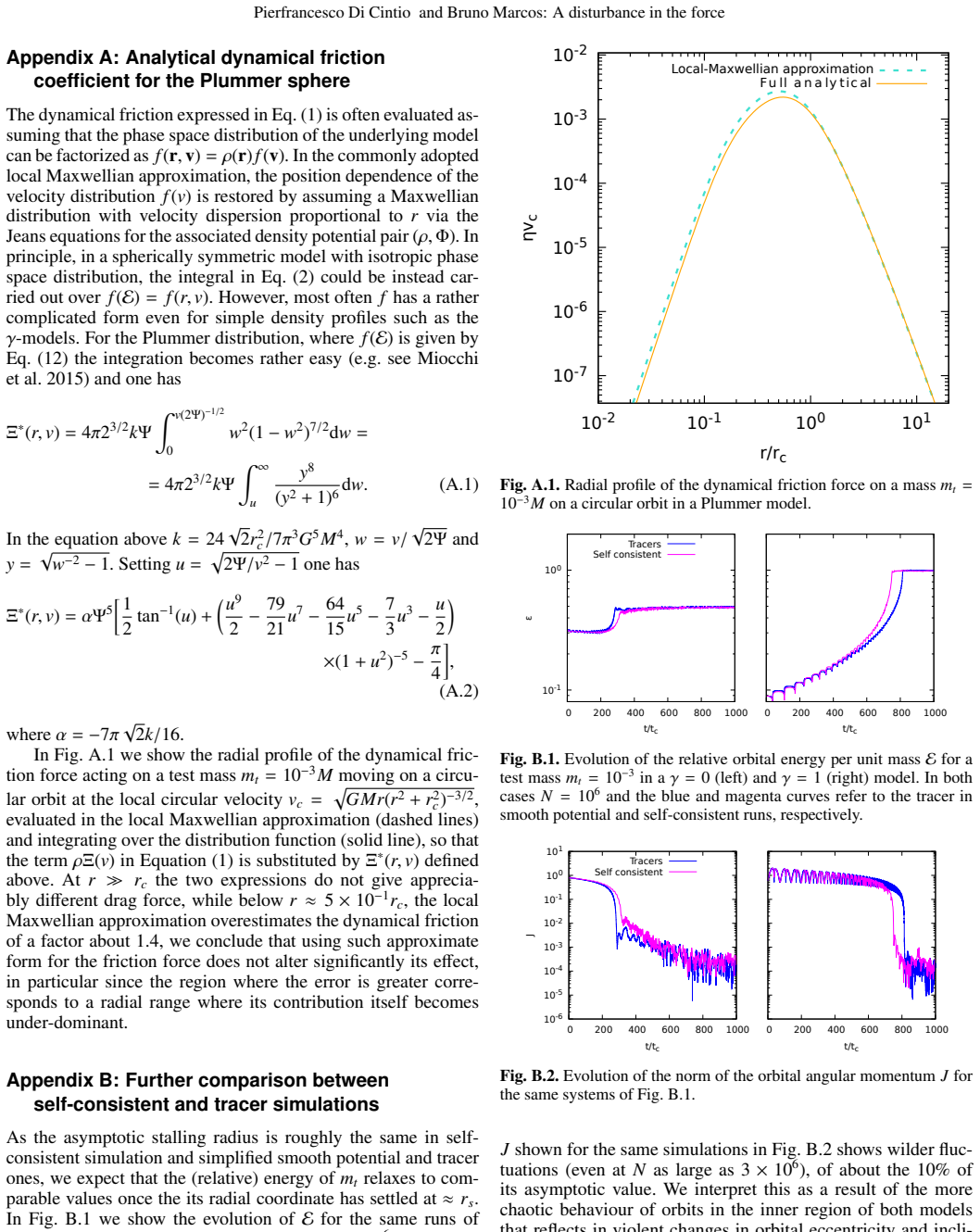
Zelnikov, M. I. & Kuskov, D. S. 2016, MNRAS, 455, 3597 Article number, page 12 of 13 Pierfrancesco Di Cintio and Bruno Marcos: A disturbance in the force Appendix A: Analytical dynamical friction coefficient for the Plummer sphere The dynamical friction expressed in Eq. (1) is...
2016
Reviewed August 15, 2026 · model on record in the stance chip above.
Discussion (0). Continue with ORCID to comment.