REVIEW 3 major objections 6 minor 44 references
Modeling continuous-time stochastic processes using $\mathcal{N}$-Curve mixtures
T0 review · 3 major / 6 minor · reviewed 2026-08-14 · deepseek-v4-flash
Pith's one-line read A mixture of N-Curves—Bézier curves with Gaussian control points—represents a continuous-time stochastic process and produces smooth, multi-modal n-step forecasts in one forward pass.
desk verdict N-Curves are a genuine new idea and the paper is worth refereeing, but the reported NLL is a composite likelihood, not the model's likelihood, and the empirical claims need stronger support. read the letter →
The pith
A machine-rendered reading of the paper's core claim, the machinery that carries it, and where it could break.
The reading
What carries the argument
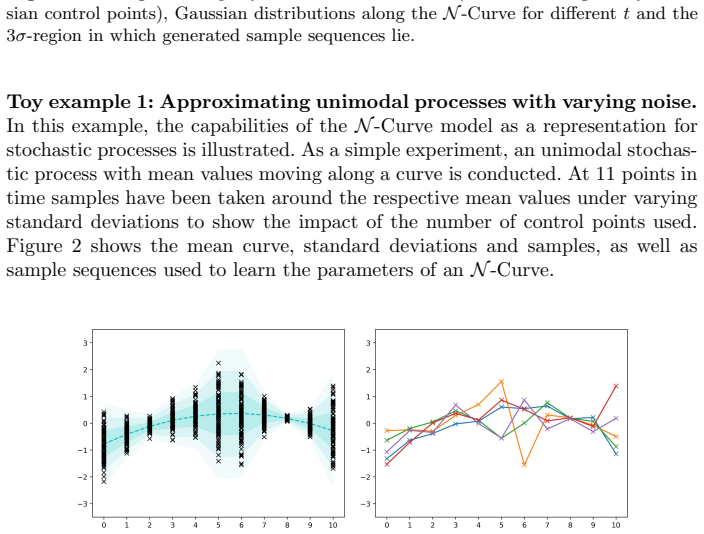
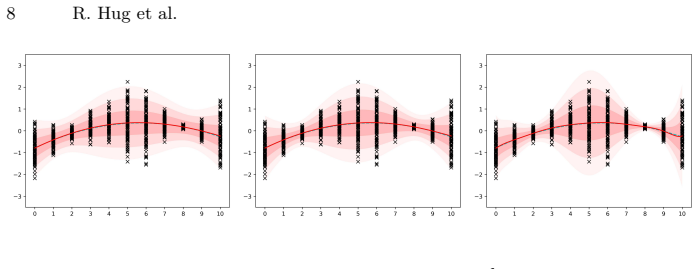
The central object is the N-Curve, a Bézier curve of degree $N$ defined by Gaussian control points $\psi=(\mu_\mathcal{P},\Sigma_\mathcal{P})$, where each control point is a Gaussian random variable with its own mean and covariance. Each point of the curve is the Gaussian $B_N(t,\psi)=(\mu_\psi(t),\Sigma_\psi(t))$, with Bernstein polynomials $b_{i,N}(t)=\binom{N}{i}(1-t)^{N-i}t^i$ carrying the linear combination. A mixture $\Psi$ of $K$ N-Curves with weights $\pi_k$ defines a Gaussian mixture at every $t$, and this mixture is what the model actually emits. An LSTM reads the observed prefix and maps it to $(\pi_k,\psi_k)$; training minimizes the negative log-likelihood, which factorizes over time as a product of Gaussian densities. This factorization makes the objective simple to compute, and the parametric curve is what makes inference a single forward pass.
What would settle it
Train the same N-Curve mixture on synthetic sequences generated from a process with known temporal correlation, such as a Brownian motion or an Ornstein-Uhlenbeck process sampled at the same $m+n$ times. If the model's implied joint density, or the correlation between residuals at different forecast times, deviates substantially from the known correlation while a model with an explicit temporal covariance achieves better held-out likelihood, then the claim that the mixture captures the continuous-time stochastic process rather than only its time-marginals is falsified.
Extended reading notes
Core claim
On its own terms, the discovery is that a stochastic process over $[0,1]$ can be parameterized by a small set of Gaussian control points. Because a linear combination of Gaussian random variables is Gaussian, every point of an N-Curve is Gaussian with mean $\mu_\psi(t)=\sum_i b_{i,N}(t)\mu_i$ and covariance $\Sigma_\psi(t)=\sum_i b_{i,N}(t)^2\Sigma_i$; the Bernstein weights make the mean and covariance vary smoothly along the curve. A mixture of $K$ such curves gives each time marginal $p_t(x)=\sum_{k=1}^K \pi_k \mathcal{N}(x \mid \mu_{\psi_k}(t), \Sigma_{\psi_k}(t))$. With an LSTM encoder and a mixture-density-network output layer, the model conditions this process on the observed prefix and predicts the entire remaining sequence at once. The benchmark results are offered as evidence that the representation preserves multimodality and smoothness while eliminating Monte Carlo roll-out at inference.
Load-bearing premise
The load-bearing assumption is that the Gaussian random variables at different times along each N-Curve are independent during training, so if the real sequences carry temporal correlations, the model can misestimate uncertainty and the training loss is not the likelihood of the true process.
Editorial extensions
If this is right
- At inference, an $n$-step multi-modal forecast is obtained in one forward pass; no particle filtering, sequential sampling, or iterative decoding is required.
- Because the output is a parametric curve, adjacent time steps share control-point structure and the predicted means and variances vary smoothly, avoiding the jagged predictions common in per-step autoregressive models.
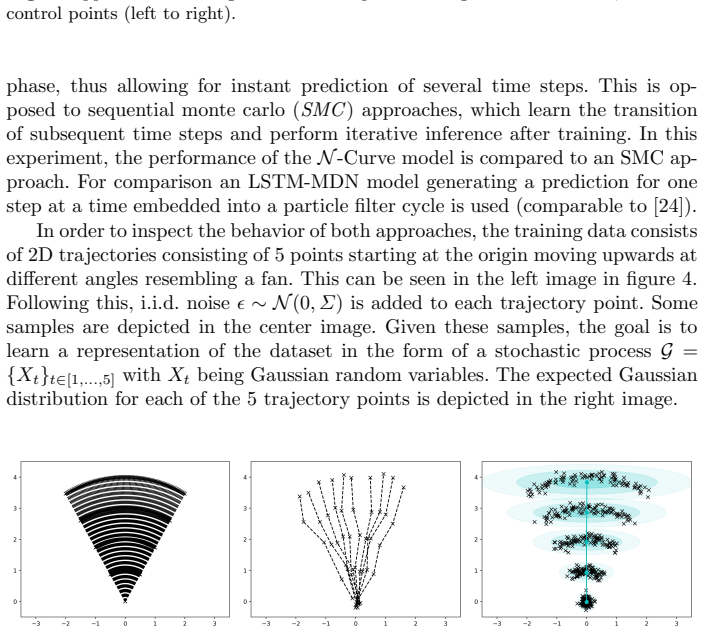
- The same parameterization works for any output dimension, as demonstrated on 2D trajectories and 59-dimensional skeletal poses, by choosing the dimensionality of the Gaussian control points.
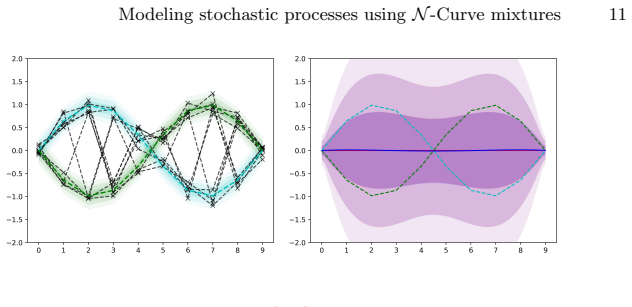
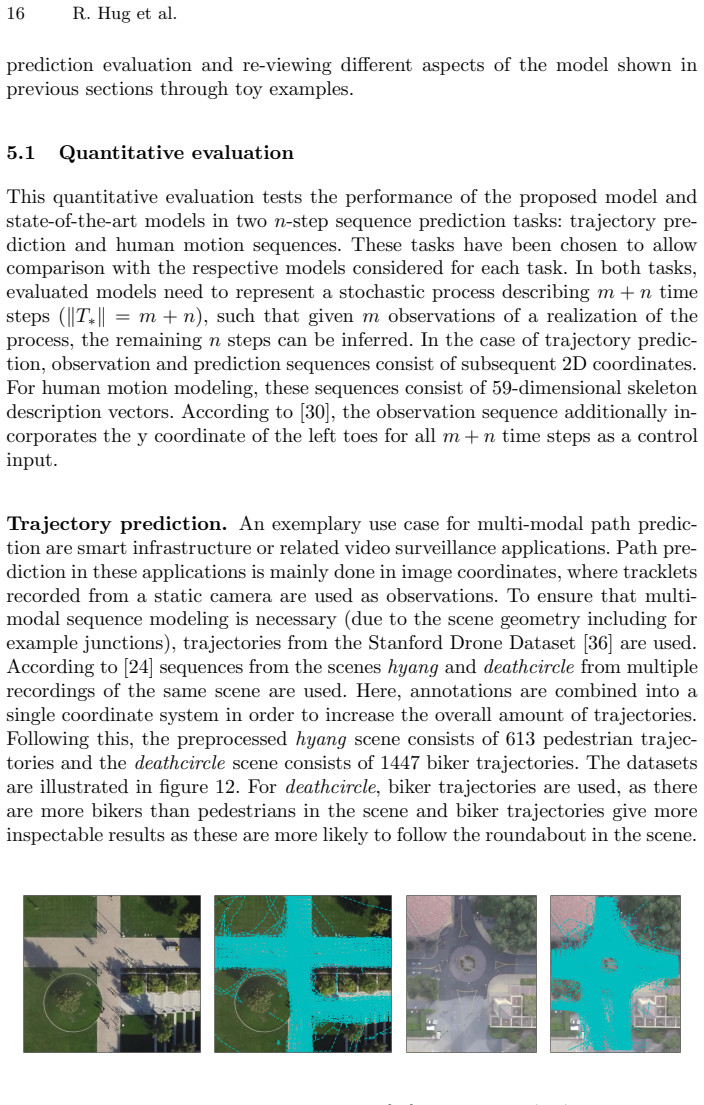
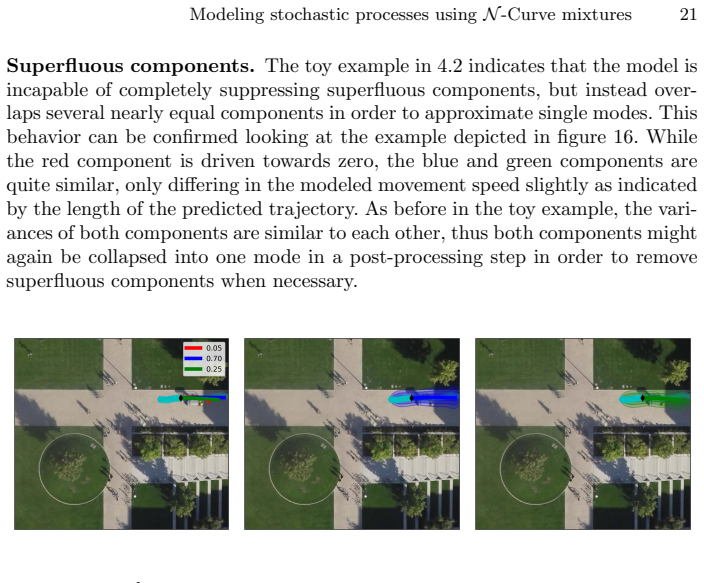
- When the data contain distinct path alternatives, the mixture components separate by path and their weights approximate the empirical path probabilities, such as straight, turn-left, and turn-right in pedestrian scenes and distinct roundabout exits in the cyclist scene.
- The representation also covers the observation portion of the sequence, so the model reports uncertainty over the whole $m+n$ window rather than only the forecast part.
Reading between the lines
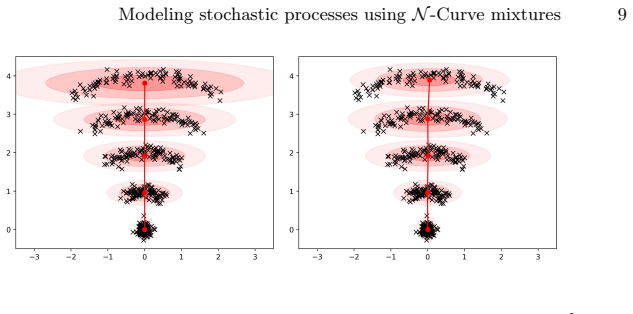
- Editorial inference: because the training loss factors as a product over time, the model captures each time marginal but not the covariance between distinct times; on data with strong temporal correlation this could misplace uncertainty, which is testable by comparing the model's implied joint distribution with sample covariances.
- Editorial inference: the fixed index set $t \in [0,1]$ restricts the model to fixed-length sequences, but a piecewise or recurrent chain of N-Curves would extend the same single-pass property to variable-length and streaming data.
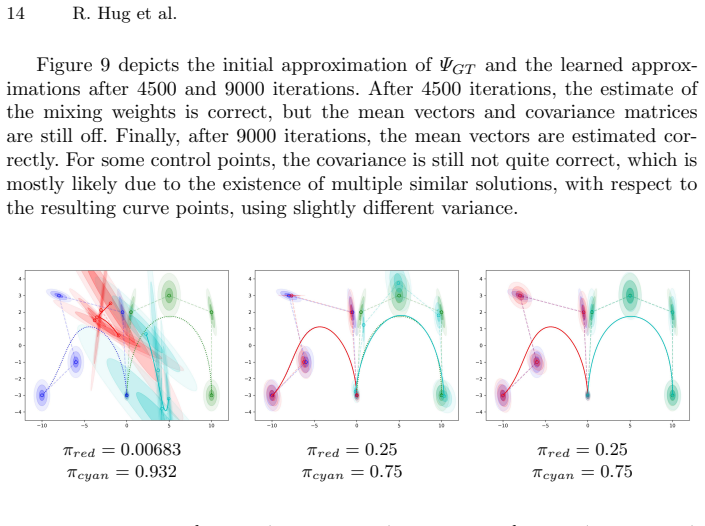
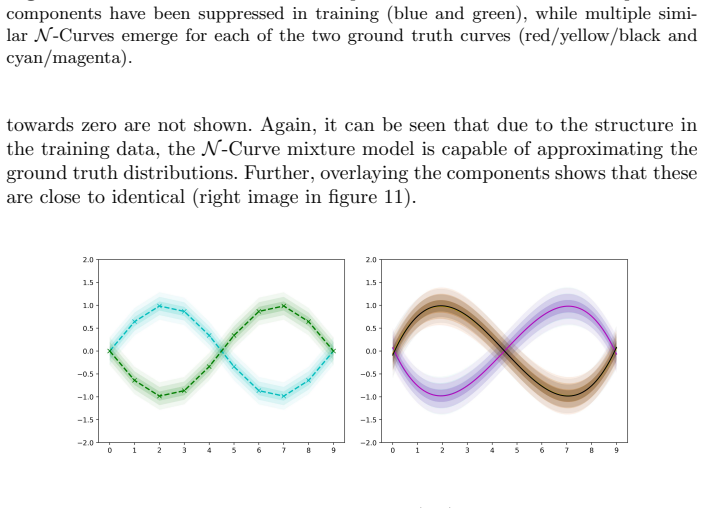
- Editorial inference: the observed tendency of surplus mixture components to duplicate a mode instead of vanishing suggests that a post-processing merge step, or a sparsity penalty on the mixture weights, would yield cleaner multi-modal forecasts on real data.
Signed reviews
Editorial analysis
A structured set of objections, weighed in public.
Referee Report
Summary. The paper proposes the N-Curve mixture, a parametric probabilistic curve model based on Bezier curves with Gaussian control points, for continuous-time stochastic processes and multi-step sequence prediction. The model is trained via a Mixture Density Network that maps an observed sequence to the parameters of a mixture of N-Curves, generating a full prediction horizon in a single forward pass. The authors derive marginal Gaussian distributions along the curve, introduce an independence assumption for training, and evaluate the approach on two real-world tasks: pedestrian trajectory prediction on the Stanford Drone Dataset and human motion modeling on CMU motion capture data, reporting improvements over baseline methods in FDE/NLL and RMSE respectively. The paper also includes several toy experiments illustrating properties such as smoothing, multi-modality, and handling of superfluous mixture components.
Significance. The core idea of optimizing in function space via probabilistic parametric curves is a useful and relatively novel contribution, and the single-inference-step property is practically appealing for multi-step prediction. The derivation of the marginal Gaussian distributions at each curve point (Eq. 4) is correct under the stated independence of control points, and the empirical results are competitive against external baselines on standard datasets. The paper is also commendable for including a range of toy examples that probe model behavior. However, the stochastic-process claim is undercut by the absence of a defined joint distribution and by a training loss that is a composite likelihood rather than the true likelihood of the model. The quantitative evaluation would be more convincing with repeated runs, confidence intervals, and a consistent NLL computation across models. These issues are substantive enough to require a major revision before the central claims can be accepted.
major comments (3)
- [Section 4, Eq. (12)] The training loss assumes temporal independence across time points: pψ(Sj) is set equal to the product of marginal Gaussian densities. However, the N-Curve with independent Gaussian control points defines a continuous-time Gaussian process whose finite-dimensional distributions have nonzero cross-covariance, e.g., Cov(X_s, X_t) = Σ_i b_{i,N}(s) b_{i,N}(t) Σ_i. Thus the objective in Eq. (12) is not the log-likelihood of the proposed stochastic process; it is a composite likelihood that ignores the temporal dependence induced by shared control points. Consequently, the NLL values reported in Table 1 are not true model likelihoods, and the trained model is not a maximum-likelihood estimate of the N-Curve stochastic process. The authors should either use the proper joint Gaussian likelihood, which is tractable because the curve is a linear combination of independent Gaussians, or explicitly present the training objective as a composite-likelihood approximation and analyze its effect on uncertainty calibration.
- [Section 5.1, Tables 1 and 2] The quantitative evaluation lacks error bars, confidence intervals, or multiple random restarts, so it is unclear whether the reported improvements (e.g., 0.088 vs 0.129 FDE on Hyang, 0.794 vs 0.822 RMSE) are statistically significant. The trajectory evaluation uses a single subset of 200 randomly selected tracklets, and the human motion test set is truncated to 70 points; no sensitivity analysis is provided. In addition, the NLL values are computed with different procedures for different models: the N-Curve MDN's NLL is its composite likelihood from Eq. (15), while LSTM-BMS and Particle LSTM-MDN NLLs are computed from clustered samples. This makes the NLL comparison potentially unfair and hard to interpret.
- [Section 3.1 and Section 4] The paper never defines the joint distribution over multiple time points of the proposed stochastic process. The marginal distributions at each t are specified in Eq. (4), but the joint distribution is essential for a claim of modeling a stochastic process and for defining a true likelihood. The independence assumption in Eq. (11) is introduced as a 'simplification' without stating what approximation is being made or what information is discarded. The authors should rigorously define the finite-dimensional distributions of the N-Curve process (which are multivariate Gaussian), use the associated likelihood for training, or justify the composite-likelihood approach with an analysis of its consequences, particularly for predictive uncertainty and calibration over time.
minor comments (6)
- [Section 3.1, Eq. (4)] The covariance formula in Eq. (4) implicitly assumes that the Gaussian control points are independent. This assumption should be stated explicitly at this point, and the cross-covariance formula Cov(X_s, X_t) = Σ_i b_{i,N}(s) b_{i,N}(t) Σ_i should be provided if the joint process is to be claimed.
- [Section 5.1, Table 1] The very large NLL value for Particle LSTM-MDN on Hyang (18.552) compared to the other models suggests that the NLL computation may be sensitive to small variances; the authors should describe exactly how NLL is computed for each baseline and ensure the comparison is on equal footing.
- [Section 5.2] The statement that path probabilities from the dataset are 15% blue, 60% red, and 25% green is informal; the authors should specify how these probabilities were estimated and over what subset of trajectories.
- [Throughout] The paper repeatedly uses 'continuous-time' but restricts the index set to [0,1] with fixed-length sequences; the abstract and introduction should qualify this limitation more clearly.
- [Section 2.1] There is a typo: 'Bayesian Neuronal Networks' should be 'Bayesian Neural Networks'.
- [Section 5.1] The description of the control input for the human motion task is ambiguous: 'the observation sequence additionally incorporates the y coordinate of the left toes for all m+n time steps' should be clarified to indicate whether this coordinate is part of the observed data or an external control signal.
Circularity Check
No circularity: the N-Curve derivation is self-contained and the empirical claims are tested against external benchmarks.
full rationale
The paper's central derivation (Sec. 3.1) applies the standard affine transformation rule for Gaussian random variables to Bezier control points; no fitted quantity is later renamed as a prediction. The training loss in Eq. (12) explicitly states that 'independence of Gaussian distributions along the N-Curve is assumed', so the product form is a stated modeling simplification rather than a hidden re-use of the target result. This independence assumption means the reported NLL is a composite likelihood rather than the true joint likelihood of the Gaussian process defined by Eq. (4), and it may misestimate uncertainty; however, that is a correctness or calibration concern, not a circularity. The real-world evaluation in Sec. 5.1 compares against external baselines on external datasets, and the only self-citation is the Particle LSTM-MDN baseline [24], which is a comparison system rather than a load-bearing support for the N-Curve construction. No uniqueness theorem or prior-work ansatz is invoked to force the model choice. Hence no circular step is present.
Assumptions & free parameters
free parameters (3)
- Number of control points N =
6 (trajectory), 10 (motion)
- Number of mixture components K =
3 (trajectory), 1 (motion)
- Evaluation subset size =
200 randomly selected tracklets
assumptions (3)
- domain assumption Independence of Gaussian random variables at different curve points
- standard math Each point on the curve is marginally Gaussian with mean and covariance given by weighted combinations of control point parameters
- domain assumption Sequences have fixed length with index set [0,1]
invented entities (1)
-
N-Curve (Bezier curve with Gaussian control points)
independent evidence
Cite this review
Pith. "Pith review of Modeling continuous-time stochastic processes using $\mathcal{N}$-Curve mixtures." pith.science (2026). https://pith.science/paper/T4MFHWLI
@misc{pith2026190804030,
  author       = {Pith},
  title        = {Pith review of: Modeling continuous-time stochastic processes using $\mathcalN$-Curve mixtures},
  year         = {2026},
  howpublished = {\url{https://pith.science/paper/T4MFHWLI}},
  note         = {Machine review of arXiv:1908.04030}
}
abstract
Representations of sequential data are commonly based on the assumption that observed sequences are realizations of an unknown underlying stochastic process, where the learning problem includes determination of the model parameters. In this context the model must be able to capture the multi-modal nature of the data, without blurring between modes. This property is essential for applications like trajectory prediction or human motion modeling. Towards this end, a neural network model for continuous-time stochastic processes usable for sequence prediction is proposed. The model is based on Mixture Density Networks using B\'ezier curves with Gaussian random variables as control points (abbrev.: $\mathcal{N}$-Curves). Key advantages of the model include the ability of generating smooth multi-mode predictions in a single inference step which reduces the need for Monte Carlo simulation, as required in many multi-step prediction models, based on state-of-the-art neural networks. Essential properties of the proposed approach are illustrated by several toy examples and the task of multi-step sequence prediction. Further, the model performance is evaluated on two real world use-cases, i.e. human trajectory prediction and human motion modeling, outperforming different state-of-the-art models.
Figures

Figures from the paper (14 more)






Reference graph
Works this paper leans on
-
[1]
In: Proceedings of the IEEE conference on computer vision and pattern recognition
Alahi, A., Goel, K., Ramanathan, V., Robicquet, A., Fei-Fei, L., Savarese, S.: Social lstm: Human trajectory prediction in crowded spaces. In: Proceedings of the IEEE conference on computer vision and pattern recognition. pp. 961–971 (2016)
2016
-
[2]
Expert Systems with Applications 36(3), 5932– 5941 (2009)
Atsalakis, G.S., Valavanis, K.P.: Surveying stock market forecasting techniques– part ii: Soft computing methods. Expert Systems with Applications 36(3), 5932– 5941 (2009)
work page 2009
-
[3]
arXiv preprint arXiv:1803.01271 (2018)
Bai, S., Kolter, J.Z., Koltun, V.: An empirical evaluation of generic convolutional and recurrent networks for sequence modeling. arXiv preprint arXiv:1803.01271 (2018)
arXiv 2018
-
[4]
John Wiley & Sons, Inc., New York, NY, USA (2002)
Bar-Shalom, Y., Kirubarajan, T., Li, X.R.: Estimation with Applications to Track- ing and Navigation. John Wiley & Sons, Inc., New York, NY, USA (2002)
work page 2002
-
[5]
In: 2018 24th International Conference on Pattern Recognition (ICPR)
Bartoli, F., Lisanti, G., Ballan, L., Del Bimbo, A.: Context-aware trajectory pre- diction. In: 2018 24th International Conference on Pattern Recognition (ICPR). pp. 1941–1946. IEEE (2018)
work page 2018
-
[6]
Bhattacharyya, A., Schiele, B., Fritz, M.: Accurate and diverse sampling of se- quences based on a “best of many” sample objective. In: Proceedings of the IEEE Conference on Computer Vision and Pattern Recognition. pp. 8485–8493 (2018)
work page 2018
-
[7]
Oxford university press (1995)
Bishop, C.M.: Neural networks for pattern recognition. Oxford university press (1995)
work page 1995
-
[8]
Springer-Verlag New York, Inc., Secaucus, NJ, USA (2006)
Bishop, C.M.: Pattern Recognition and Machine Learning (Information Science and Statistics). Springer-Verlag New York, Inc., Secaucus, NJ, USA (2006)
2006
Show all 44 references
-
[9]
arXiv preprint arXiv:1505.05424 (2015)
Blundell, C., Cornebise, J., Kavukcuoglu, K., Wierstra, D.: Weight uncertainty in neural networks. arXiv preprint arXiv:1505.05424 (2015)
2015 arXiv
-
[10]
bioRxiv (2015)
Campbell, K., Yau, C.: Bayesian gaussian process latent variable mod- els for pseudotime inference in single-cell rna-seq data. bioRxiv (2015). https://doi.org/https://doi.org/10.1101/026872
2015 doi
-
[11]
Space Weather 15(8), 1004–1019 (2017)
Chandorkar, M., Camporeale, E., Wing, S.: Probabilistic forecasting of the dis- turbance storm time index: An autoregressive gaussian process approach. Space Weather 15(8), 1004–1019 (2017)
2017
-
[12]
In: Artificial Intelligence and Statistics
Damianou, A., Lawrence, N.: Deep gaussian processes. In: Artificial Intelligence and Statistics. pp. 207–215 (2013)
2013
-
[13]
In: 2009 IEEE 12th International Conference on Computer Vision Workshops, ICCV Workshops
Ellis, D., Sommerlade, E., Reid, I.: Modelling pedestrian trajectory patterns with gaussian processes. In: 2009 IEEE 12th International Conference on Computer Vision Workshops, ICCV Workshops. pp. 1229–1234. IEEE (2009)
2009
-
[14]
Data Mining and Knowledge Discovery 33(4), 917–963 (2019)
Fawaz, H.I., Forestier, G., Weber, J., Idoumghar, L., Muller, P.A.: Deep learning for time series classification: a review. Data Mining and Knowledge Discovery 33(4), 917–963 (2019)
2019
-
[15]
arXiv preprint arXiv:1704.02798 (2017)
Fortunato, M., Blundell, C., Vinyals, O.: Bayesian recurrent neural networks. arXiv preprint arXiv:1704.02798 (2017)
2017 arXiv
-
[16]
In: international conference on machine learn- ing
Gal, Y., Ghahramani, Z.: Dropout as a bayesian approximation: Representing model uncertainty in deep learning. In: international conference on machine learn- ing. pp. 1050–1059 (2016)
2016
-
[17]
In: Advances in neural information processing systems
Goodfellow, I., Pouget-Abadie, J., Mirza, M., Xu, B., Warde-Farley, D., Ozair, S., Courville, A., Bengio, Y.: Generative adversarial nets. In: Advances in neural information processing systems. pp. 2672–2680 (2014)
2014
-
[18]
arXiv preprint arXiv:1308.0850 (2013) 24 R
Graves, A.: Generating sequences with recurrent neural networks. arXiv preprint arXiv:1308.0850 (2013) 24 R. Hug et al
2013 arXiv
-
[19]
In: Proceedings of the IEEE Conference on Computer Vision and Pattern Recognition (CVPR)
Gupta, A., Johnson, J., Fei-Fei, L., Savarese, S., Alahi, A.: Social gan: Socially acceptable trajectories with generative adversarial networks. In: Proceedings of the IEEE Conference on Computer Vision and Pattern Recognition (CVPR). pp. 2255–2264 (2018)
2018
-
[20]
arXiv preprint arXiv:1803.10122 (2018)
Ha, D., Schmidhuber, J.: World models. arXiv preprint arXiv:1803.10122 (2018)
2018 arXiv
-
[21]
Springer Science & Business Media (2006)
Hangos, K.M., Bokor, J., Szederk´ enyi, G.: Analysis and control of nonlinear process systems. Springer Science & Business Media (2006)
2006
-
[22]
arXiv preprint arXiv:1901.02000 (2019)
Hasan, I., Setti, F., Tsesmelis, T., Belagiannis, V., Amin, S., Del Bue, A., Cristani, M., Galasso, F.: Forecasting people trajectories and head poses by jointly reasoning on tracklets and vislets. arXiv preprint arXiv:1901.02000 (2019)
2019 arXiv
-
[23]
In: International Conference on Machine Learning
Hern´ andez-Lobato, J.M., Adams, R.: Probabilistic backpropagation for scalable learning of bayesian neural networks. In: International Conference on Machine Learning. pp. 1861–1869 (2015)
2015
-
[24]
In: 2018 21st International Conference on Intelligent Transportation Systems (ITSC)
Hug, R., Becker, S., H¨ ubner, W., Arens, M.: Particle-based pedestrian path prediction using lstm-mdl models. In: 2018 21st International Conference on Intelligent Transportation Systems (ITSC). pp. 2684–2691 (Nov 2018). https://doi.org/10.1109/ITSC.2018.8569478
2018
-
[25]
In: 2nd International Conference on Learning Representations, ICLR 2014, Banff, AB, Canada, April 14-16, 2014, Conference Track Proceedings (2014), http://arxiv.org/abs/1312
Kingma, D.P., Welling, M.: Auto-encoding variational bayes. In: 2nd International Conference on Learning Representations, ICLR 2014, Banff, AB, Canada, April 14-16, 2014, Conference Track Proceedings (2014), http://arxiv.org/abs/1312. 6114
2014
-
[26]
Pattern Recognition Letters 42, 11–24 (2014)
L¨ angkvist, M., Karlsson, L., Loutfi, A.: A review of unsupervised feature learning and deep learning for time-series modeling. Pattern Recognition Letters 42, 11–24 (2014)
2014
-
[27]
ROBOMECH journal 1(1), 1 (2014)
Lef` evre, S., Vasquez, D., Laugier, C.: A survey on motion prediction and risk assessment for intelligent vehicles. ROBOMECH journal 1(1), 1 (2014)
2014
-
[28]
In: Proceedings of the IEEE Conference on Computer Vision and Pattern Recognition (CVPR)
Makansi, O., Ilg, E., Cicek, O., Brox, T.: Overcoming limitations of mixture density networks: A sampling and fitting framework for multimodal future prediction. In: Proceedings of the IEEE Conference on Computer Vision and Pattern Recognition (CVPR). pp. 7144–7153 (2019)
2019
-
[29]
In: Proceedings of the IEEE Conference on Computer Vision and Pattern Recognition
Martinez, J., Black, M.J., Romero, J.: On human motion prediction using recurrent neural networks. In: Proceedings of the IEEE Conference on Computer Vision and Pattern Recognition. pp. 2891–2900 (2017)
2017
-
[30]
arXiv preprint arXiv:1511.06644 (2015)
Mattos, C.L.C., Dai, Z., Damianou, A., Forth, J., Barreto, G.A., Lawrence, N.D.: Recurrent gaussian processes. arXiv preprint arXiv:1511.06644 (2015)
2015 arXiv
-
[31]
John Wiley & Sons (2015)
Montgomery, D.C., Jennings, C.L., Kulahci, M.: Introduction to time series anal- ysis and forecasting. John Wiley & Sons (2015)
2015
-
[32]
Neal, R.M.: Bayesian training of backpropagation networks by the hybrid monte carlo method. Tech. rep., Citeseer (1992)
1992
-
[33]
Technical University of Denmark 7(15), 510 (2008)
Petersen, K.B., Pedersen, M.S., et al.: The matrix cookbook. Technical University of Denmark 7(15), 510 (2008)
2008
-
[34]
In: Summer School on Machine Learning
Rasmussen, C.E.: Gaussian processes in machine learning. In: Summer School on Machine Learning. pp. 63–71. Springer (2003)
2003
-
[35]
Philosophical Transactions of the Royal Society A: Mathematical, Physical and Engineering Sciences 371(1984), 20110550 (2013)
Roberts, S., Osborne, M., Ebden, M., Reece, S., Gibson, N., Aigrain, S.: Gaussian processes for time-series modelling. Philosophical Transactions of the Royal Society A: Mathematical, Physical and Engineering Sciences 371(1984), 20110550 (2013)
1984
-
[36]
In: European conference on computer vision
Robicquet, A., Sadeghian, A., Alahi, A., Savarese, S.: Learning social etiquette: Human trajectory understanding in crowded scenes. In: European conference on computer vision. pp. 549–565. Springer (2016) Modeling stochastic processes using N -Curve mixtures 25
2016
-
[37]
arXiv preprint arXiv:1905.06113 (2019)
Rudenko, A., Palmieri, L., Herman, M., Kitani, K.M., Gavrila, D.M., Arras, K.O.: Human motion trajectory prediction: A survey. arXiv preprint arXiv:1905.06113 (2019)
2019 arXiv
-
[38]
In: The IEEE Conference on Computer Vision and Pattern Recognition (CVPR) (June 2019)
Sadeghian, A., Kosaraju, V., Sadeghian, A., Hirose, N., Rezatofighi, H., Savarese, S.: Sophie: An attentive gan for predicting paths compliant to social and physical constraints. In: The IEEE Conference on Computer Vision and Pattern Recognition (CVPR) (June 2019)
2019
-
[39]
Institute of Math- ematical Statistics Textbooks, Cambridge University Press (2013)
S¨ arkk¨ a, S.: Bayesian Filtering and Smoothing. Institute of Math- ematical Statistics Textbooks, Cambridge University Press (2013). https://doi.org/10.1017/CBO9781139344203
2013 doi
-
[40]
In: 2018 IEEE International Conference on Robotics and Automation (ICRA)
Schmerling, E., Leung, K., Vollprecht, W., Pavone, M.: Multimodal probabilistic model-based planning for human-robot interaction. In: 2018 IEEE International Conference on Robotics and Automation (ICRA). pp. 1–9. IEEE (2018)
2018
-
[41]
In: Advances in neural information processing sys- tems
Sohn, K., Lee, H., Yan, X.: Learning structured output representation using deep conditional generative models. In: Advances in neural information processing sys- tems. pp. 3483–3491 (2015)
2015
-
[42]
International Journal of Computer Science & Engineering Technology 2(3), 71–83 (2011)
Soni, S.: Applications of anns in stock market prediction: a survey. International Journal of Computer Science & Engineering Technology 2(3), 71–83 (2011)
2011
-
[43]
In: Advances in neural information processing systems
Taylor, G.W., Hinton, G.E., Roweis, S.T.: Modeling human motion using binary latent variables. In: Advances in neural information processing systems. pp. 1345– 1352 (2007)
2007
-
[44]
In: Advances in neural information processing systems
Wang, J., Hertzmann, A., Fleet, D.J.: Gaussian process dynamical models. In: Advances in neural information processing systems. pp. 1441–1448 (2006)
2006
Reviewed August 14, 2026 · model on record in the stance chip above.
Discussion (0). Continue with ORCID to comment.