REVIEW 4 major objections 5 minor 43 references
MoFRR: Mixture of Diffusion Models for Face Retouching Restoration
T0 review · 4 major / 5 minor · reviewed 2026-08-06 · deepseek-v4-flash
Pith's one-line read MoFRR undoes face retouching, beating baselines by up to 6.44 dB in PSNR.
desk verdict A useful new task and architecture, but the headline PSNR gains may be inflated by train/test identity leakage given an image-level split over retouched variants of the same FFHQ originals. read the letter →
The pith
A machine-rendered reading of the paper's core claim, the machinery that carries it, and where it could break.
The reading
What carries the argument
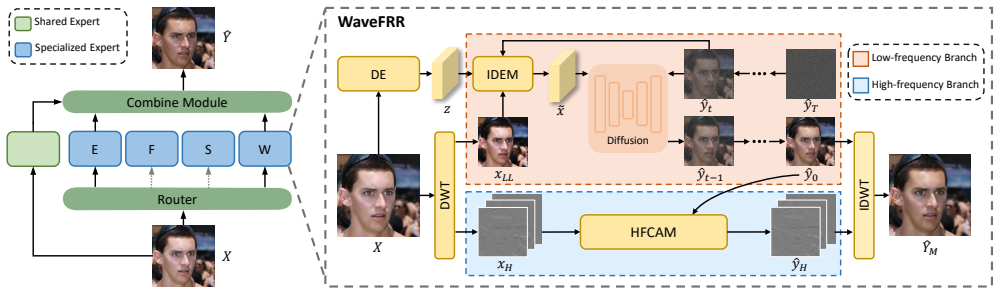
The load-bearing machinery is MoFRR, a mixture-of-experts model with four specialized WaveFRR experts (one per retouching type), a shared DDIM-based expert that captures universal retouching traces, a router (ResNet-MAM) that predicts which operations were applied, and a lightweight Combine Module (U-Net) that merges the expert outputs. Each WaveFRR expert decomposes the input via discrete wavelet transform, restores the low-frequency sub-band with a conditional DDIM guided by a degree estimator and the Iterative Distortion Evaluation Module (IDEM), refines the high-frequency sub-bands with a Cross-Attention High-Frequency module (HFCAM), and recombines via the inverse transform. The key identity is that retouching mainly modifies low-frequency content, so the diffusion process works on a half-resolution LL sub-band conditioned on a pixel-wise distortion map derived from the predicted degree.
What would settle it
Generate a test set where two or more retouching operations are applied by a novel engine in a deliberately non-additive order (e.g., smooth after eye enlargement, or lift after whitening) and measure whether MoFRR's composed experts still restore PSNR close to the multi-operation baseline. If the per-expert outputs fail to compose and the Combine Module cannot compensate, the independence premise is falsified.
Extended reading notes
Core claim
The central claim is that MoFRR accurately restores original faces from retouched ones, and that it outperforms existing methods by a substantial margin on multi-operation retouching: it surpasses the second-best method by 5.49 dB PSNR and achieves the highest improvement of 6.44 dB on the multi-operated subset. The paper further claims that decomposition into operation-specific experts plus a shared expert is what enables this gain, and that the dual-branch wavelet design—DDIM-based low-frequency restoration guided by a distortion estimate and cross-attention high-frequency refinement—is effective for single-operation restoration. As a direct corollary, the paper asserts that FRR should be evaluated not only by pixel fidelity but by feature-space identity similarity, where MoFRR also shows a sharp peak near perfect alignment.
Load-bearing premise
The load-bearing premise is that the impact of different face retouching operations is independent in the face images, so a router can activate a set of single-operation experts whose outputs compose into a correct multi-operation restoration.
Editorial extensions
If this is right
- If MoFRR works as claimed, retouched images on social platforms can be automatically reverted to their pre-edit state, giving regulators and platforms a tool to enforce disclosure rules.
- Because the router only selects experts, new retouching types can be handled by plugging in an additional expert without retraining the whole model, a cost saving the paper notes.
- The focus on low-frequency restoration suggests that FRR is fundamentally different from super-resolution or deblurring, and that frequency decomposition should be a default component of future FRR systems.
- The evaluation protocol—combining PSNR/SSIM with ArcFace and AdaFace cosine similarity—sets a template for forensic-grade restoration benchmarks.
Reading between the lines
- The independence assumption behind the router composition is only tested on API-generated mixtures from the same pipelines; a stress test on adversarial combinations (e.g., smoothing applied after eye enlargement in a way that changes geometry) would clarify whether the experts truly compose or the Combine Module is absorbing the interaction.
- The degree redefinition via PSNR distribution is data-driven but API-specific; a cross-API calibration study could test whether degree labels transfer to unseen retouching engines.
- If FRR reaches the accuracy claimed, it also raises a privacy tension: the same restoration that exposes deceptive advertising can be used to strip consented stylistic edits from portraits, so deployment norms may need to distinguish retouching-as-deception from retouching-as-expression.
- The 'shared expert' inspired by DeepSeek's expert isolation suggests that sparse activation in mixtures of experts can be repurposed from language modeling to low-level vision, potentially opening a general design pattern for restoration tasks with multiple degradation types.
Editorial analysis
A structured set of objections, weighed in public.
Referee Report
Summary. The paper introduces Face Retouching Restoration (FRR), a task of recovering original faces from retouched images, and proposes MoFRR, a mixture-of-experts framework with four operation-specific WaveFRR experts (whitening, smoothing, face lifting, eye enlarging), a shared DDIM-based expert, a router, and a Combine Module. It also presents RetouchingFFHQ++, an extension of RetouchingFFHQ with over one million retouched images from four commercial retouching APIs and PSNR-based degree labels. Experiments report substantial PSNR/SSIM gains over retrained baselines, especially 34.47 dB on multi-operation images, claimed to be 5.49 dB above the second-best method, with ablations and cross-API tests supporting the design.
Significance. If the empirical claims hold, MoFRR would be a useful first system for face retouching restoration, and RetouchingFFHQ++ is a substantial new resource for the community. The design is thoughtful: sparse activation of specialized experts, a shared expert inspired by DeepSeek, a wavelet-domain DDIM with IDEM and HFCAM, and a dual evaluation protocol combining PSNR/SSIM with biometric feature similarity. The ablation study and cross-API experiments are systematic in structure, and the authors are careful to retrain all baselines on their dataset. The main caveats are experimental validity: the reported split appears to allow identity leakage between training and test, no statistical significance or variance is reported, and the operation-independence premise is not directly tested. These issues affect the central quantitative claims and require a major revision.
major comments (4)
- [§3.1, §4.1, Table 2] The evaluation protocol does not rule out identity leakage. RetouchingFFHQ++ is generated from 57,910 FFHQ originals by applying 0–4 retouching operations via four APIs, yielding over 1.07 million retouched images (Table 1), so each original has many retouched versions. Section 4.1 states only that the dataset is divided 8:1:1 as training/evaluation/test, with no identity-disjoint split. Under a random image-level split the same original face almost certainly appears in both training and test, letting the model memorize the exact target and inflate PSNR/SSIM; this directly affects the headline Multi gain of 5.49 dB in Table 2. The cross-API test in Table 3 has the same issue because all API subsets share the same FFHQ originals. The authors should re-split by original identity and report all tables under that protocol, or provide evidence that the results are unchanged.
- [§4.2, Tables 2–4] No error bars, significance tests, or test-set sizes are reported for any quantitative comparison. The claimed superiority rests on point estimates whose spread is unknown; for example, the per-operation improvements in Table 2 range from about 0.5 to 4.0 dB, and the Multi gain is a single number. I ask for mean ± std over at least three training runs or bootstrap confidence intervals, together with the number of evaluation images per column. Without this, it is difficult to assess whether the reported improvements are stable or within noise.
- [§3.4, Table 4] The ablation narrative is contradicted by the table in the Multi column. The text says removing any one module degrades performance compared to the full model, but Table 4 shows w/o IDEM (32.94), w/o Degree (32.95), and w/o HFCAM (33.04) all outperform the full WaveFRR (31.09) on Multi before the Combine Module is applied. This suggests either the full WaveFRR was not trained to convergence for multi-operation inputs, or the ablation procedure differs from what the text describes. The claim as written is not supported by the table; please clarify, and if the Combine Module is what produces the final gain, state that explicitly.
- [§1, §3.4] The central modeling premise that 'the impact of different face retouching operations is independent in the face images' is not directly tested. Specialized experts are trained only on single-operation images, and multi-operation inputs are left to the router and Combine Module. Although the Combine Module is trained on multi-operation data and Table 4 shows that removing the router costs only 0.28 dB on Multi, the manuscript should validate composition on independently generated mixtures, for example by applying operations from different APIs to held-out originals or testing unseen operation combinations, and should report router precision/recall. This would separate the validity of the independence assumption from the learned Combine Module's capacity to compensate for nonlinear interactions.
minor comments (5)
- [§4.3] The claimed cross-API improvements of 1.2 dB and 3.87 dB do not match Table 3, where MoFRR exceeds the best baseline by 1.72 dB on Single and 4.49 dB on Multi; please correct the numbers or clarify which baseline is used for comparison.
- [§3.4] The shared expert is said to be trained on 'subset B', but subset B is never defined; please specify its composition, size, and how it relates to the overall RetouchingFFHQ++ split.
- [§3.1] The degree re-categorization by PSNR distribution with proportions 15/25/25/25/10 is presented without validation; please provide evidence that these labels correlate with perceptual or API-provided degrees, or discuss the limitation of this heuristic.
- [§3.4] The classification loss is written as a five-class cross-entropy, but the router is a multi-label binary classifier; please state the exact loss used for the router and the degree estimator separately.
- [References] Reference [1] is cited as 'Anthropic' for PortraitPro 24; the company name is Anthropics, not Anthropic, and the URL should be checked.
Circularity Check
No circularity: MoFRR is trained and evaluated against external FFHQ ground truth; no prediction reduces to a fitted input or self-citation chain.
full rationale
MoFRR's claimed derivation chain is empirical rather than analytic. The router, degree estimators, WaveFRR experts, shared expert, and Combine Module are all trained with losses defined against ground-truth FFHQ originals or ground-truth operation/degree labels; the final restored image is compared to the ground truth via L_hyb in Section 3.4. No equation defines an output in terms of the quantity it is claimed to predict. The degree labels are redefined from the PSNR distribution of the dataset, but the degree is only an auxiliary conditioning variable, and the degree estimator is trained and evaluated on the same labeling rule; this is a dataset-construction choice, not a circular reduction. The dataset extends the authors' prior RetouchingFFHQ, but the underlying originals are the external FFHQ dataset and all baselines are retrained on the same RetouchingFFHQ++ splits, so the self-citation does not alone force the reported improvements. The train/test identity-overlap concern raised by the skeptic is a potential benchmarking-validity risk, not a circularity: even if test identities overlap training, the model output is still compared with the held-out retouched-to-original pairs and does not equal the input by construction. No circular step can be quoted from the paper, so the score is 0.
Assumptions & free parameters
free parameters (4)
- Degree group proportions for re-labeling =
15%, 25%, 25%, 25%, 10% of ascending PSNR
- HFCAM loss weights lambda_1 and lambda_2 =
0.1 and 0.01
- Router activation threshold =
0.5
- Number of retouching types N =
4 (whitening, smoothing, face lifting, eye enlarging)
assumptions (5)
- domain assumption Retouching operations act independently on face images.
- standard math DDIM/DDPM Markov chain with learned noise predictor models the retouching removal distribution.
- standard math DWT provides an invertible decomposition into low and high frequency sub-bands sufficient for FRR.
- domain assumption RetouchingFFHQ++ generated with commercial APIs is representative of real-world retouching.
- ad hoc to paper PSNR-based degree re-categorization yields meaningful supervision for degree estimation.
Cite this review
Pith. "Pith review of MoFRR: Mixture of Diffusion Models for Face Retouching Restoration." pith.science (2026). https://pith.science/paper/T4OC5BX4
@misc{pith2026250719770,
  author       = {Pith},
  title        = {Pith review of: MoFRR: Mixture of Diffusion Models for Face Retouching Restoration},
  year         = {2026},
  howpublished = {\url{https://pith.science/paper/T4OC5BX4}},
  note         = {Machine review of arXiv:2507.19770}
}
read the original abstract
The widespread use of face retouching on social media platforms raises concerns about the authenticity of face images. While existing methods focus on detecting face retouching, how to accurately recover the original faces from the retouched ones has yet to be answered. This paper introduces Face Retouching Restoration (FRR), a novel computer vision task aimed at restoring original faces from their retouched counterparts. FRR differs from traditional image restoration tasks by addressing the complex retouching operations with various types and degrees, which focuses more on the restoration of the low-frequency information of the faces. To tackle this challenge, we propose MoFRR, Mixture of Diffusion Models for FRR. Inspired by DeepSeek's expert isolation strategy, the MoFRR uses sparse activation of specialized experts handling distinct retouching types and the engagement of a shared expert dealing with universal retouching traces. Each specialized expert follows a dual-branch structure with a DDIM-based low-frequency branch guided by an Iterative Distortion Evaluation Module (IDEM) and a Cross-Attention-based High-Frequency branch (HFCAM) for detail refinement. Extensive experiments on a newly constructed face retouching dataset, RetouchingFFHQ++, demonstrate the effectiveness of MoFRR for FRR.
Figures


Figures from the paper (4 more)


Reference graph
Works this paper leans on
-
[23]
Pasd: A performance analysis approach through the statistical debugging of kernel events
Mohammed Adib Khan, Morteza Noferesti, and Naser Ezzati-Jivan. Pasd: A performance analysis approach through the statistical debugging of kernel events. In2023 IEEE 23rd International Working Conference on Source Code Analysis and Manipulation (SCAM), pages 151–161. IEEE, 2023. 1
work page 2023
-
[1]
Portraitpro 24.https : / / www
Anthropic. Portraitpro 24.https : / / www . anthropics.com/portraitpro/, 2024. 3
work page 2024
-
[2]
Khadijah Ateq, Mohammed Alhajji, and Noara Alhusseini. The association between use of social media and the devel- opment of body dysmorphic disorder and attitudes toward cosmetic surgeries: a national survey.Frontiers in Public Health, 12:1324092, 2024. 1
work page 2024
-
[3]
Aparna Bharati, Richa Singh, Mayank Vatsa, and Kevin W Bowyer. Detecting facial retouching using supervised deep learning.IEEE Transactions on Information Forensics and Security, 11(9):1903–1913, 2016. 1
work page 1903
-
[4]
A survey on mixture of experts.arXiv preprint arXiv:2407.06204, 2024
Weilin Cai, Juyong Jiang, Fan Wang, Jing Tang, Sunghun Kim, and Jiayi Huang. A survey on mixture of experts.arXiv preprint arXiv:2407.06204, 2024. 2
arXiv 2024
-
[5]
Stanley H Chan, Ramsin Khoshabeh, Kristofor B Gib- son, Philip E Gill, and Truong Q Nguyen. An aug- mented lagrangian method for total variation video restora- tion.IEEE Transactions on Image Processing, 20(11):3097– 3111, 2011. 5
work page 2011
-
[6]
Pairedcyclegan: Asymmetric style transfer for apply- ing and removing makeup
Huiwen Chang, Jingwan Lu, Fisher Yu, and Adam Finkel- stein. Pairedcyclegan: Asymmetric style transfer for apply- ing and removing makeup. InProceedings of the IEEE con- ference on computer vision and pattern recognition, pages 40–48, 2018. 2, 5, 6, 7
work page 2018
-
[7]
Auto- matic facial makeup detection with application in face recog- nition
Cunjian Chen, Antitza Dantcheva, and Arun Ross. Auto- matic facial makeup detection with application in face recog- nition. In2013 international conference on biometrics (ICB), pages 1–8. IEEE, 2013. 1
work page 2013
Show all 43 references
-
[8]
Makeup- go: Blind reversion of portrait edit
Ying-Cong Chen, Xiaoyong Shen, and Jiaya Jia. Makeup- go: Blind reversion of portrait edit. InProceedings of the IEEE International Conference on Computer Vision, pages 4501–4509, 2017. 2
2017
-
[9]
Truth in advertising act of 2014, 2014.https://www.congress.gov/bill/ 113th-congress/house-bill/4341
United States Congress. Truth in advertising act of 2014, 2014.https://www.congress.gov/bill/ 113th-congress/house-bill/4341. 1
2014
-
[10]
Attentional feature fusion
Yimian Dai, Fabian Gieseke, Stefan Oehmcke, Yiquan Wu, and Kobus Barnard. Attentional feature fusion. InProceed- ings of the IEEE/CVF winter conference on applications of computer vision, pages 3560–3569, 2021. 4
2021
-
[11]
Antitza Dantcheva, Cunjian Chen, and Arun Ross. Can facial cosmetics affect the matching accuracy of face recognition systems? In2012 IEEE Fifth international conference on biometrics: theory, applications and systems (BTAS), pages 391–398. IEEE, 2012. 1
2012
-
[12]
Arcface: Additive angular margin loss for deep face recognition
Jiankang Deng, Jia Guo, Niannan Xue, and Stefanos Zafeiriou. Arcface: Additive angular margin loss for deep face recognition. InProceedings of the IEEE/CVF con- ference on computer vision and pattern recognition, pages 4690–4699, 2019. 3, 8
2019
-
[13]
An image is worth 16x16 words: Trans- formers for image recognition at scale.arXiv preprint arXiv:2010.11929, 2020
Alexey Dosovitskiy, Lucas Beyer, Alexander Kolesnikov, Dirk Weissenborn, Xiaohua Zhai, Thomas Unterthiner, Mostafa Dehghani, Matthias Minderer, Georg Heigold, Syl- vain Gelly, et al. An image is worth 16x16 words: Trans- formers for image recognition at scale.arXiv preprint ar...
2010 arXiv
-
[14]
The marketing control act.https: //www.forbrukertilsynet.no/english/the- marketing-control-act, 2021
Forbrukertilsynet. The marketing control act.https: //www.forbrukertilsynet.no/english/the- marketing-control-act, 2021. 1
2021
-
[15]
Ladn: Local adversarial disentangling net- work for facial makeup and de-makeup
Qiao Gu, Guanzhi Wang, Mang Tik Chiu, Yu-Wing Tai, and Chi-Keung Tang. Ladn: Local adversarial disentangling net- work for facial makeup and de-makeup. InProceedings of the IEEE/CVF International conference on computer vision, pages 10481–10490, 2019. 2
2019
-
[16]
Vqfr: Blind face restoration with vector-quantized dictionary and parallel de- coder
Yuchao Gu, Xintao Wang, Liangbin Xie, Chao Dong, Gen Li, Ying Shan, and Ming-Ming Cheng. Vqfr: Blind face restoration with vector-quantized dictionary and parallel de- coder. InEuropean Conference on Computer Vision, pages 126–143. Springer, 2022. 2
2022
-
[17]
Deep residual learning for image recognition
Kaiming He, Xiangyu Zhang, Shaoqing Ren, and Jian Sun. Deep residual learning for image recognition. InProceed- ings of the IEEE conference on computer vision and pattern recognition, pages 770–778, 2016. 4
2016
-
[18]
Denoising dif- fusion probabilistic models.Advances in neural information processing systems, 33:6840–6851, 2020
Jonathan Ho, Ajay Jain, and Pieter Abbeel. Denoising dif- fusion probabilistic models.Advances in neural information processing systems, 33:6840–6851, 2020. 4
2020
-
[19]
Image-to-image translation with conditional adver- sarial networks
Phillip Isola, Jun-Yan Zhu, Tinghui Zhou, and Alexei A Efros. Image-to-image translation with conditional adver- sarial networks. InProceedings of the IEEE conference on computer vision and pattern recognition, pages 1125–1134,
-
[20]
Detecting gans and retouching based digital alter- ations via dad-hcnn
Anubhav Jain, Puspita Majumdar, Richa Singh, and Mayank Vatsa. Detecting gans and retouching based digital alter- ations via dad-hcnn. InProceedings of the IEEE/CVF Con- ference on Computer Vision and Pattern Recognition Work- shops, pages 672–673, 2020. 1
2020
-
[21]
Hierarchical mixtures of experts and the em algorithm.Neural computation, 6(2): 181–214, 1994
Michael I Jordan and Robert A Jacobs. Hierarchical mixtures of experts and the em algorithm.Neural computation, 6(2): 181–214, 1994. 2
1994
-
[22]
A style-based generator architecture for generative adversarial networks
Tero Karras, Samuli Laine, and Timo Aila. A style-based generator architecture for generative adversarial networks. InProceedings of the IEEE/CVF conference on computer vi- sion and pattern recognition, pages 4401–4410, 2019. 3
2019
-
[24]
Adaface: Quality adaptive margin for face recognition
Minchul Kim, Anil K Jain, and Xiaoming Liu. Adaface: Quality adaptive margin for face recognition. InProceedings of the IEEE/CVF conference on computer vision and pattern recognition, pages 18750–18759, 2022. 3, 8
2022
-
[25]
Kingma and Jimmy Ba
Diederik P. Kingma and Jimmy Ba. Adam: A method for stochastic optimization.CoRR, abs/1412.6980, 2015. 5
2015 arXiv
-
[26]
Blind face restoration via deep multi-scale component dictionaries
Xiaoming Li, Chaofeng Chen, Shangchen Zhou, Xianhui Lin, Wangmeng Zuo, and Lei Zhang. Blind face restoration via deep multi-scale component dictionaries. InEuropean conference on computer vision, pages 399–415. Springer,
-
[27]
Diff- bir: Toward blind image restoration with generative diffusion prior
Xinqi Lin, Jingwen He, Ziyan Chen, Zhaoyang Lyu, Bo Dai, Fanghua Yu, Yu Qiao, Wanli Ouyang, and Chao Dong. Diff- bir: Toward blind image restoration with generative diffusion prior. InEuropean conference on computer vision, pages 430–448. Springer, 2024. 1
2024
-
[28]
Deepseek-v3 technical report
Aixin Liu, Bei Feng, Bing Xue, Bingxuan Wang, Bochao Wu, Chengda Lu, Chenggang Zhao, Chengqi Deng, Chenyu Zhang, Chong Ruan, et al. Deepseek-v3 technical report. arXiv preprint arXiv:2412.19437, 2024. 2
2024 arXiv
-
[29]
Psgan++: Robust detail-preserving makeup transfer and removal.IEEE Transactions on Pat- tern Analysis and Machine Intelligence, 44(11):8538–8551,
Si Liu, Wentao Jiang, Chen Gao, Ran He, Jiashi Feng, Bo Li, and Shuicheng Yan. Psgan++: Robust detail-preserving makeup transfer and removal.IEEE Transactions on Pat- tern Analysis and Machine Intelligence, 44(11):8538–8551,
-
[30]
Supermodels without photoshop: Israel’s ‘pho- toshop law’ puts focus on digitally altered images, 2015
IBT News. Supermodels without photoshop: Israel’s ‘pho- toshop law’ puts focus on digitally altered images, 2015. http://goo.gl/3PvaEf. 1
2015
-
[31]
Prnu-based detection of facial retouching.IET Bio- metrics, 9(4):154–164, 2020
Christian Rathgeb, Angelika Botaljov, Fabian Stockhardt, Sergey Isadskiy, Luca Debiasi, Andreas Uhl, and Christoph Busch. Prnu-based detection of facial retouching.IET Bio- metrics, 9(4):154–164, 2020. 1
2020
-
[32]
U- net: Convolutional networks for biomedical image segmen- tation
Olaf Ronneberger, Philipp Fischer, and Thomas Brox. U- net: Convolutional networks for biomedical image segmen- tation. InMedical image computing and computer-assisted intervention–MICCAI 2015: 18th international conference, Munich, Germany, October 5-9, 2015, proceedings, par...
2015
-
[33]
Resdiff: Combining cnn and diffusion model for image super-resolution
Shuyao Shang, Zhengyang Shan, Guangxing Liu, LunQian Wang, XingHua Wang, Zekai Zhang, and Jinglin Zhang. Resdiff: Combining cnn and diffusion model for image super-resolution. InProceedings of the AAAI Conference on Artificial Intelligence, pages 8975–8983, 2024. 2, 5, 6, 8
2024
-
[34]
Denoising diffusion implicit models.arXiv preprint arXiv:2010.02502, 2020
Jiaming Song, Chenlin Meng, and Stefano Ermon. Denoising diffusion implicit models.arXiv preprint arXiv:2010.02502, 2020. 2, 4, 5
2010 arXiv
-
[35]
Ssat: A symmetric semantic-aware transformer network for makeup transfer and removal
Zhaoyang Sun, Yaxiong Chen, and Shengwu Xiong. Ssat: A symmetric semantic-aware transformer network for makeup transfer and removal. InProceedings of the AAAI Conference on artificial intelligence, pages 2325–2334, 2022. 2
2022
-
[36]
Content-style decoupling for unsupervised makeup transfer without generating pseudo ground truth
Zhaoyang Sun, Shengwu Xiong, Yaxiong Chen, and Yi Rong. Content-style decoupling for unsupervised makeup transfer without generating pseudo ground truth. InProceed- ings of the IEEE/CVF Conference on Computer Vision and Pattern Recognition, pages 7601–7610, 2024. 2
2024
-
[37]
Face behind makeup
Shuyang Wang and Yun Fu. Face behind makeup. InPro- ceedings of the AAAI Conference on Artificial Intelligence,
-
[38]
Image quality assessment: from error visibility to structural similarity.IEEE transactions on image processing, 13(4):600–612, 2004
Zhou Wang, Alan C Bovik, Hamid R Sheikh, and Eero P Si- moncelli. Image quality assessment: from error visibility to structural similarity.IEEE transactions on image processing, 13(4):600–612, 2004. 3, 5
2004
-
[39]
Restoreformer++: Towards real- world blind face restoration from undegraded key-value pairs.IEEE Transactions on Pattern Analysis and Machine Intelligence, 2023
Zhouxia Wang, Jiawei Zhang, Tianshui Chen, Wenping Wang, and Ping Luo. Restoreformer++: Towards real- world blind face restoration from undegraded key-value pairs.IEEE Transactions on Pattern Analysis and Machine Intelligence, 2023. 2
2023
-
[40]
Dr2: Diffusion-based robust degradation remover for blind face restoration
Zhixin Wang, Ziying Zhang, Xiaoyun Zhang, Huangjie Zheng, Mingyuan Zhou, Ya Zhang, and Yanfeng Wang. Dr2: Diffusion-based robust degradation remover for blind face restoration. InProceedings of the IEEE/CVF Conference on Computer Vision and Pattern Recognition, pages 1704– 171...
2023
-
[41]
One-step effective diffusion network for real-world image super-resolution.Advances in Neural Information Process- ing Systems, 37:92529–92553, 2024
Rongyuan Wu, Lingchen Sun, Zhiyuan Ma, and Lei Zhang. One-step effective diffusion network for real-world image super-resolution.Advances in Neural Information Process- ing Systems, 37:92529–92553, 2024. 1
2024
-
[42]
Retouchingffhq: A large-scale dataset for fine-grained face retouching detection
Qichao Ying, Jiaxin Liu, Sheng Li, Haisheng Xu, Zhenxing Qian, and Xinpeng Zhang. Retouchingffhq: A large-scale dataset for fine-grained face retouching detection. InPro- ceedings of the 31st ACM International Conference on Mul- timedia, pages 737–746, 2023. 1, 2, 3
2023
-
[43]
Restormer: Efficient transformer for high-resolution image restoration
Syed Waqas Zamir, Aditya Arora, Salman Khan, Mu- nawar Hayat, Fahad Shahbaz Khan, and Ming-Hsuan Yang. Restormer: Efficient transformer for high-resolution image restoration. InProceedings of the IEEE/CVF conference on computer vision and pattern recognition, pages 5728–5739,
Reviewed August 6, 2026 · model on record in the stance chip above.
Discussion (0). Sign in to comment.