REVIEW 4 major objections 5 minor 62 references
Towards Context-aware Convolutional Network for Image Restoration
T0 review · 4 major / 5 minor · reviewed 2026-08-11 · deepseek-v4-flash
Pith's one-line read A 4.26M-parameter convolutional network outperforms transformer-based models on three image restoration tasks.
desk verdict A compact CNN with strong reported numbers on dehazing/deblurring/desnowing, but the load-bearing LDIM receptive-field claim is under-specified and the RSAM is vestigial; deserves review with code. read the letter →
The pith
A machine-rendered reading of the paper's core claim, the machinery that carries it, and where it could break.
The reading
What carries the argument
The paper's two load-bearing mechanisms are the efficient residual star module (ERSM) and the large dynamic integration module (LDIM). The 'star operation' is element-wise multiplication of two feature vectors; ERSM makes it context-aware by feeding one branch through a large depth-wise convolution so that the multiplied features carry local contextual information before being projected into a high-dimensional nonlinear space. LDIM builds a wide square receptive field by composing horizontal strip attention (H-SA) of strip size $K$ with horizontal dilated strip attention (H-DSA) whose dilation rate is $d_r=(k+1)/2$, then repeating the pair vertically; because the first strip attention already mixes pixels along the strip, the subsequent dilated attention lets the module reach pixels far beyond a single kernel without quadratic cost. All attention weights are generated dynamically from the input by convolutions, and the module uses multi-scale receptive fields across feature groups to handle blurs of different sizes.
What would settle it
Inspect the implementation to read off $K$ and the dilation rates; if the effective receptive field of LDIM covers only a small fraction of the $256\times256$ training patches, or if removing LDIM changes PSNR by far less than the reported 2.36 dB on the SOTS-Indoor ablation, then the large-context explanation is not what carries the result.
Extended reading notes
Core claim
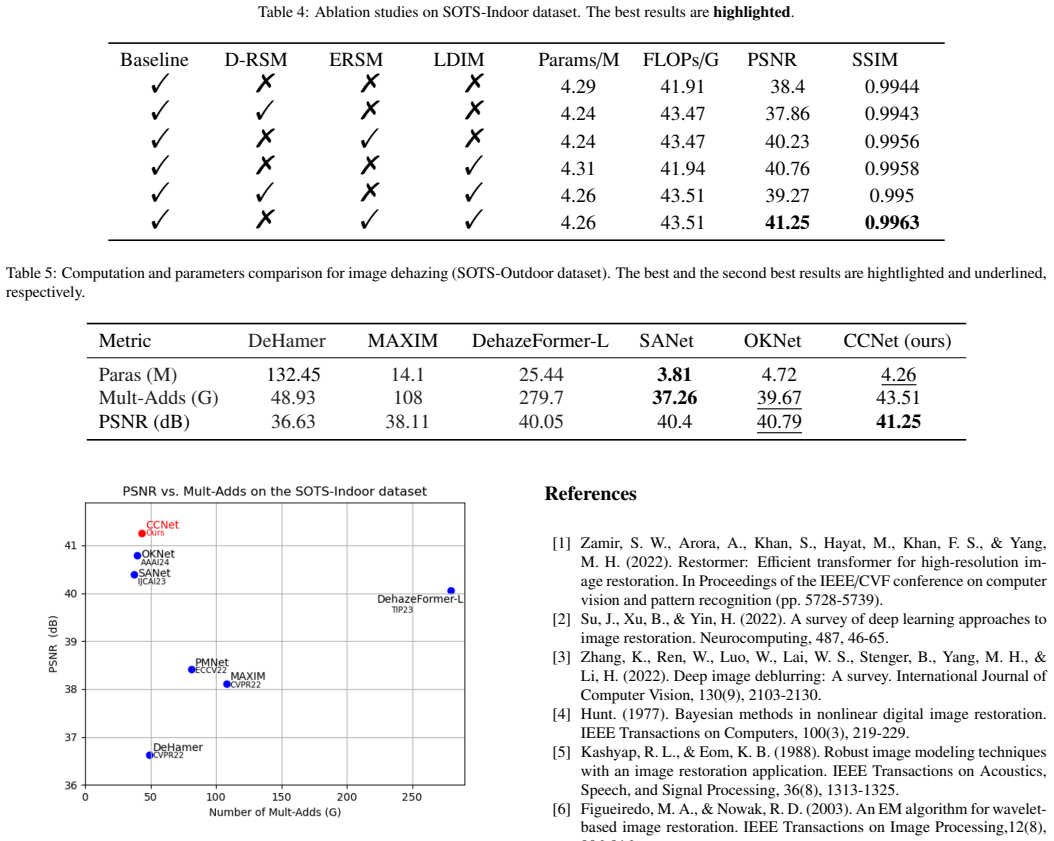
On its own terms, the paper claims that the efficient residual star module (ERSM) and the large dynamic integration module (LDIM), placed in a six-scale U-shaped encoder-decoder, yield a context-aware convolutional network that outperforms prior state-of-the-art restoration methods on image dehazing, motion deblurring, and desnowing. ERSM replaces a plain residual block with a context-aware star unit: one branch is a $1\times1$ convolution, the other is a $1\times1$ convolution followed by a large depth-wise convolution and GELU, and their element-wise product is refined by a $3\times3$ convolution with a skip connection. LDIM applies horizontal strip attention, then horizontal dilated strip attention, then the vertical equivalents, with all attention weights learned dynamically from the input features; the paper argues that the strip-then-dilate composition gives every operated pixel access to any input pixel over an extremely large square region. Ablations on SOTS-Indoor attribute 2.36 dB of the 2.85 dB total gain over the baseline to LDIM and show that ERSM adds another 0.49 dB, with the full model reaching 41.25 dB.
Load-bearing premise
The whole 'extremely large receptive field' argument depends on the strip size $K$ and the per-group dilation rates being large enough that the strip-then-dilated composition actually reaches across nearly the whole feature map; the paper never states these values or computes the resulting receptive field.
Editorial extensions
If this is right
- A convolutional restoration network with roughly 4.26 million parameters can outperform transformer-based models on the dehazing and motion-deblurring benchmarks reported here, which would lower the compute barrier for practical restoration.
- The strip-then-dilated attention composition offers a parameter-light way to obtain long-range context without quadratic self-attention, so similar modules could be dropped into other low-level vision networks.
- Because LDIM's weights are predicted from the input and applied at multiple scales, the network can adapt its context integration to blurred regions of different sizes, matching the variability found in real motion blur.
- The dual-domain $L_1$ loss (spatial plus frequency) combined with multi-input/multi-output supervision makes training stable enough that one U-shaped network handles three degradation types with task-specific block counts.
Reading between the lines
- If the receptive-field claim is verified, the same horizontal-then-vertical dilated strip composition could be applied to other long-range tasks such as single-image deraining or super-resolution, where the degradation is also spatially varying.
- A direct measurement of the effective receptive field, for example by gradient propagation or input perturbation, would show whether the benefit comes from true long-range integration or from the dynamic weighting alone; the paper does not provide that measurement.
- The ablation suggests LDIM contributes most of the gain, so a natural extension would be to test LDIM alone in a simple ResNet-style backbone, without the star module, to isolate how much of the improvement is due to context integration rather than the star operation.
Editorial analysis
A structured set of objections, weighed in public.
Referee Report
Summary. The paper proposes CCNet, a U-shaped convolutional network for image restoration, with two main components. The efficient residual star module (ERSM) uses element-wise multiplication ('star operation') together with a large depthwise convolution branch, and the large dynamic integration module (LDIM) combines horizontal and vertical strip attention with dilated strip attention to aggregate context. The authors report state-of-the-art PSNR/SSIM on SOTS dehazing, GoPro/HIDE motion deblurring, and CSD desnowing using about 4.3M parameters, and they provide ablations on SOTS-Indoor attributing the gains to ERSM and LDIM.
Significance. If the reported benchmark numbers are reproducible, the efficiency claim is practically significant: a 4.3M-parameter CNN outperforms several transformer-based methods, including Restormer on GoPro and DehazeFormer-L on SOTS-Indoor, while using substantially fewer parameters. The D-RSM versus ERSM comparison in Table 4 is a fair controlled test with matched parameter counts, and the multi-task evaluation across dehazing, deblurring, and desnowing is a strength. However, the paper's central architectural mechanism for LDIM is under-specified: Eq. (6) cannot be used to compute the claimed 'extremely large' receptive field, no values for K or D are given, and the proposed RSAM module in Section 3.4 is never evaluated. These issues make the significance conditional on additional clarification and verification.
major comments (4)
- [Section 3.3, Eq. (6)] Eq. (6) is ambiguous and prevents the reader from verifying the LDIM receptive field. The text describes multi-scale dilation applied across feature groups, but the equation sums only over k and writes d = 1,...,D without showing how d is assigned to channels or groups. As written, each output channel appears to use a single dilation rate, which does not match the group-wise description in the text and Fig. 4. The strip size K and dilation counts D are never specified anywhere in the paper, and no receptive-field size is computed. Please give the group split, report K and D, and provide an explicit formula or numerical value for the receptive field of one H-LDSI/V-LDSI and of the full LDIM.
- [Section 3.3, paragraphs after Eq. (8)] The claim that 'its operated pixels contain the contribution of any input pixel of the H-LDSI' and that LDIM possesses an 'extremely large square receptive field' is an overstatement. With strip size K and dilation dr = (K+1)/2, H-SA integrates over K neighboring pixels and H-DSA then samples those K positions, so each output pixel formally depends on a span of about K * dr = K(K+1)/2 pixels, not on any input pixel of the whole feature map. Unless K is large enough to cover the image, this is not global context. The paper should state the effective receptive field explicitly and temper the 'extremely large' claim accordingly, since the +2.36 dB gain of LDIM in Table 4 is attributed to this mechanism.
- [Section 3.4 and Table 4] The residual star attention module (RSAM) introduced in Section 3.4 is claimed to 'significantly boost model performance,' but it does not appear in the network architecture description of Section 3.1, in Fig. 2, or in any experiment or ablation in Table 4. The module is therefore unsupported by evidence. Either integrate RSAM into the actual architecture and ablate it, or remove Section 3.4 and the associated claim. As it stands, a reader cannot tell whether the reported CCNet includes RSAM at all.
- [Section 4.3, Table 4] The ablation evidence for the star operation's benefit is only conditional. The model with D-RSM alone (star unit without the context branch) drops to 37.86 dB, below the 38.40 dB baseline, while ERSM raises performance to 40.23 dB. This shows that the improvement comes from the added large depthwise convolutional context branch, not from the star operation per se. The abstract and Section 3.2 credit 'context-aware star operation' with high-dimensional, non-linear feature mapping; the paper should either temper this claim or add a control that isolates the star operation's contribution, for example ERSM without the star operation or with the star operation placed differently.
minor comments (5)
- [Table 2] The HIDE column headers read 'PSNR↓ SSIM↓' but these metrics should be the higher-the-better arrows (↑), as in the GoPro columns.
- [Section 4.2, Image Desnowing] The text cites the CSD dataset as [47], but reference [47] is the PyTorch software paper; the CSD dataset is defined by reference [46]. Please correct the citation.
- [Section 3.3, notation] The symbol k is used both for the summation index and for the strip size in dr = (k+1)/2, while the strip size is otherwise denoted K. Please use consistent notation, e.g., K for the strip size and k for the summation index.
- [Section 3.5, Eq. (11)] The loss equation defines s as a normalization denominator but then says 'S denotes the total elements'; the lowercase s and uppercase S are inconsistent. Use one symbol throughout.
- [Throughout] There are several typographical errors, including 'incluing' (Section 3.2), 'genarate' (Section 3.1), and 'ultilize' (Section 4.3). A copyedit pass is recommended.
Circularity Check
No circularity: CCNet's headline numbers are held-out benchmark measurements; the LDIM receptive-field claim follows from the paper's own composition equations, not from a fitted quantity or self-citation.
full rationale
The paper's central claims are empirical: Tables 1-3 report PSNR/SSIM on held-out SOTS, GoPro, HIDE, and CSD test sets for networks trained on the corresponding training splits, so there is no fitted parameter subsequently renamed as a prediction. The ERSM and LDIM contributions are validated by ablations (Table 4), not derived from the performance numbers. The 'extremely large' receptive-field claim for LDIM is a compositional property of Eq. (4) followed by Eq. (6): H-SA gives each output pixel access to a K-wide strip of inputs, and H-DSA then samples those integrated features over a dilated span, so the stated claim follows from the paper's own equations rather than from circular reasoning. The high-dimensional nonlinear mapping property of the star operation is attributed to the external StarNet result [42], not to the present authors' prior work, and it functions as a design rationale rather than as a forced conclusion. The ambiguous indexing in Eq. (6), the unspecified strip size K, and the unstated per-group dilation split are genuine reproducibility/correctness concerns about whether the implemented LDIM actually has the claimed receptive field, but they do not make the derivation circular. No self-citation chain, uniqueness import, or ansatz smuggled through the authors' own prior work appears.
Assumptions & free parameters
free parameters (4)
- number of ERSM blocks N per task =
3 (dehazing), 15 (deblurring), 5 (desnowing)
- LDIM strip size K and group dilation counts D =
not specified
- channel width C and LDIM group split =
not specified
- loss weight lambda =
0.1
assumptions (3)
- domain assumption Star operation maps inputs into exceedingly high-dimensional, non-linear feature spaces (per StarNet, ref [42]).
- standard math H-SA followed by H-DSA covers every input pixel of the strip, so dilation leaves no holes.
- domain assumption Dual-domain L1 loss with FFT improves restoration.
invented entities (1)
-
RSAM (Residual Star Attention Module)
Cite this review
Pith. "Pith review of Towards Context-aware Convolutional Network for Image Restoration." pith.science (2026). https://pith.science/paper/T4YZE22X
@misc{pith2026241211008,
  author       = {Pith},
  title        = {Pith review of: Towards Context-aware Convolutional Network for Image Restoration},
  year         = {2026},
  howpublished = {\url{https://pith.science/paper/T4YZE22X}},
  note         = {Machine review of arXiv:2412.11008}
}
read the original abstract
Image restoration (IR) is a long-standing task to recover a high-quality image from its corrupted observation. Recently, transformer-based algorithms and some attention-based convolutional neural networks (CNNs) have presented promising results on several IR tasks. However, existing convolutional residual building modules for IR encounter limited ability to map inputs into high-dimensional and non-linear feature spaces, and their local receptive fields have difficulty in capturing long-range context information like Transformer. Besides, CNN-based attention modules for IR either face static abundant parameters or have limited receptive fields. To address the first issue, we propose an efficient residual star module (ERSM) that includes context-aware "star operation" (element-wise multiplication) to contextually map features into exceedingly high-dimensional and non-linear feature spaces, which greatly enhances representation learning. To further boost the extraction of contextual information, as for the second issue, we propose a large dynamic integration module (LDIM) which possesses an extremely large receptive field. Thus, LDIM can dynamically and efficiently integrate more contextual information that helps to further significantly improve the reconstruction performance. Integrating ERSM and LDIM into an U-shaped backbone, we propose a context-aware convolutional network (CCNet) with powerful learning ability for contextual high-dimensional mapping and abundant contextual information. Extensive experiments show that our CCNet with low model complexity achieves superior performance compared to other state-of-the-art IR methods on several IR tasks, including image dehazing, image motion deblurring, and image desnowing.
Figures


Figures from the paper (8 more)


Reference graph
Works this paper leans on
-
[1]
W., Arora, A., Khan, S., Hayat, M., Khan, F
Zamir, S. W., Arora, A., Khan, S., Hayat, M., Khan, F. S., & Yang, M. H. (2022). Restormer: E fficient transformer for high-resolution im- age restoration. In Proceedings of the IEEE/CVF conference on computer vision and pattern recognition (pp. 5728-5739)
work page 2022
-
[2]
Su, J., Xu, B., & Yin, H. (2022). A survey of deep learning approaches to image restoration. Neurocomputing, 487, 46-65
work page 2022
-
[3]
Zhang, K., Ren, W., Luo, W., Lai, W. S., Stenger, B., Yang, M. H., & Li, H. (2022). Deep image deblurring: A survey. International Journal of Computer Vision, 130(9), 2103-2130
work page 2022
-
[4]
Hunt. (1977). Bayesian methods in nonlinear digital image restoration. IEEE Transactions on Computers, 100(3), 219-229
work page 1977
-
[5]
Kashyap, R. L., & Eom, K. B. (1988). Robust image modeling techniques with an image restoration application. IEEE Transactions on Acoustics, Speech, and Signal Processing, 36(8), 1313-1325
work page 1988
-
[6]
Figueiredo, M. A., & Nowak, R. D. (2003). An EM algorithm for wavelet- based image restoration. IEEE Transactions on Image Processing,12(8), 906-916
work page 2003
-
[8]
Lee, J., Son, H., Rim, J., Cho, S., & Lee, S. (2021). Iterative filter adap- tive network for single image defocus deblurring. In Proceedings of the IEEE/CVF conference on computer vision and pattern recognition (pp. 2034-2042)
work page 2021
-
[9]
Zou, W., Jiang, M., Zhang, Y ., Chen, L., Lu, Z., & Wu, Y . (2021). Sd- wnet: A straight dilated network with wavelet transformation for image deblurring. In Proceedings of the IEEE/CVF international conference on computer vision (pp. 1895-1904)
work page 2021
Show all 62 references
-
[11]
Cui, Y ., Ren, W., Yang, S., Cao, X., & Knoll, A. (2023). Irnext: Rethink- ing convolutional network design for image restoration. In International conference on machine learning
2023
-
[12]
& Gao, W
Chen, H., Wang, Y ., Guo, T., Xu, C., Deng, Y ., Liu, Z., ... & Gao, W. (2021). Pre-trained image processing transformer. In Proceedings of the IEEE/CVF conference on computer vision and pattern recognition (pp. 12299-12310)
2021
-
[13]
Liang, J., Cao, J., Sun, G., Zhang, K., Van Gool, L., & Timofte, R. (2021). Swinir: Image restoration using swin transformer. In Proceedings of the IEEE/CVF international conference on computer vision (pp. 1833-1844)
2021
-
[14]
Wang, Z., Cun, X., Bao, J., Zhou, W., Liu, J., & Li, H. (2022). Uformer: A 10 general u-shaped transformer for image restoration. In Proceedings of the IEEE/CVF conference on computer vision and pattern recognition (pp. 17683-17693)
2022
-
[15]
J., Peng, Y
Tsai, F. J., Peng, Y . T., Lin, Y . Y ., Tsai, C. C., & Lin, C. W. (2022, Oc- tober). Stripformer: Strip transformer for fast image deblurring. In Eu- ropean Conference on Computer Vision (pp. 146-162). Cham: Springer Nature Switzerland
2022
-
[16]
(2023, July)
Luo, P., Xiao, G., Gao, X., & Wu, S. (2023, July). LKD-Net: Large ker- nel convolution network for single image dehazing. In 2023 IEEE Inter- national Conference on Multimedia and Expo (ICME) (pp. 1601-1606). IEEE
2023
-
[17]
P., Myszkowski, K., & Chen, B
Ruan, L., Bemana, M., Seidel, H. P., Myszkowski, K., & Chen, B. (2023). Revisiting image deblurring with an e fficient ConvNet. arXiv preprint arXiv:2302.02234
2023 arXiv
-
[18]
Wang, Y ., Li, Y ., Wang, G., & Liu, X. (2024). Multi-scale attention net- work for single image super-resolution. In Proceedings of the IEEE/CVF Conference on Computer Vision and Pattern Recognition (pp. 5950- 5960)
2024
-
[19]
Cui, Y ., Tao, Y ., Jing, L., & Knoll, A. (2023). Strip attention for image restoration. In International Joint Conference on Artificial Intelligence, IJCAI
2023
-
[20]
(2024, March)
Cui, Y ., Ren, W., & Knoll, A. (2024, March). Omni-Kernel Network for Image Restoration. In Proceedings of the AAAI Conference on Artificial Intelligence (V ol. 38, No. 2, pp. 1426-1434)
2024
-
[21]
Li, B., Ren, W., Fu, D., Tao, D., Feng, D., Zeng, W., & Wang, Z. (2018). Benchmarking single-image dehazing and beyond. IEEE Transactions on Image Processing, 28(1), 492-505
2018
-
[22]
L., Yan, Q., Anwar, S., Cong, R., Ren, W., & Li, C
Guo, C. L., Yan, Q., Anwar, S., Cong, R., Ren, W., & Li, C. (2022). Image dehazing transformer with transmission-aware 3d position embedding. In Proceedings of the IEEE/CVF conference on computer vision and pattern recognition (pp. 5812-5820)
2022
-
[23]
Tu, Z., Talebi, H., Zhang, H., Yang, F., Milanfar, P., Bovik, A., & Li, Y . (2022). Maxim: Multi-axis mlp for image processing. In Proceedings of the IEEE/CVF conference on computer vision and pattern recognition (pp. 5769-5780)
2022
-
[24]
(2022, October)
Ye, T., Zhang, Y ., Jiang, M., Chen, L., Liu, Y ., Chen, S., & Chen, E. (2022, October). Perceiving and modeling density for image dehazing. In European conference on computer vision (pp. 130-145). Cham: Springer Nature Switzerland
2022
-
[25]
Ren, W., Liu, S., Zhang, H., Pan, J., Cao, X., & Yang, M. H. (2016). Single image dehazing via multi-scale convolutional neural networks. In Computer Vision–ECCV 2016: 14th European Conference, Amsterdam, The Netherlands, October 11-14, 2016, Proceedings, Part II 14 (pp. 154- ...
2016
-
[26]
Ren, W., Ma, L., Zhang, J., Pan, J., Cao, X., Liu, W., & Yang, M. H. (2018). Gated fusion network for single image dehazing. In Proceedings of the IEEE conference on computer vision and pattern recognition (pp. 3253-3261)
2018
-
[27]
& Knoll, A
Cui, Y ., Tao, Y ., Bing, Z., Ren, W., Gao, X., Cao, X., ... & Knoll, A. (2022, September). Selective frequency network for image restoration. In The Eleventh International Conference on Learning Representations
2022
-
[28]
Ronneberger, O., Fischer, P., & Brox, T. (2015). U-net: Convolutional networks for biomedical image segmentation. In Medical image comput- ing and computer-assisted intervention–MICCAI 2015: 18th international conference, Munich, Germany, October 5-9, 2015, proceedings, part I...
2015
-
[29]
(2023, June)
Chen, S., Ye, T., Liu, Y ., Liao, T., Jiang, J., Chen, E., & Chen, P. (2023, June). Msp-former: Multi-scale projection transformer for single image desnowing. In ICASSP 2023-2023 IEEE International Conference on Acoustics, Speech and Signal Processing (ICASSP) (pp. 1-5). IEEE
2023
-
[31]
Liu, X., Ma, Y ., Shi, Z., & Chen, J. (2019). Griddehazenet: Attention- based multi-scale network for image dehazing. In Proceedings of the IEEE/CVF international conference on computer vision (pp. 7314-7323)
2019
-
[32]
(2020, April)
Qin, X., Wang, Z., Bai, Y ., Xie, X., & Jia, H. (2020, April). FFA-Net: Feature fusion attention network for single image dehazing. In Proceed- ings of the AAAI conference on artificial intelligence (V ol. 34, No. 07, pp. 11908-11915)
2020
-
[33]
W., Arora, A., Khan, S., Hayat, M., Khan, F
Zamir, S. W., Arora, A., Khan, S., Hayat, M., Khan, F. S., Yang, M. H., & Shao, L. (2021). Multi-stage progressive image restoration. In Pro- ceedings of the IEEE /CVF conference on computer vision and pattern recognition (pp. 14821-14831)
2021
-
[34]
& Guo, B
Liu, Z., Lin, Y ., Cao, Y ., Hu, H., Wei, Y ., Zhang, Z., ... & Guo, B. (2021). Swin transformer: Hierarchical vision transformer using shifted windows. In Proceedings of the IEEE /CVF international conference on computer vision (pp. 10012-10022)
2021
-
[35]
Mao, X., Liu, Y ., Shen, W., Li, Q., & Wang, Y . (2021). Deep resid- ual fourier transformation for single image deblurring. arXiv preprint arXiv:2111.11745, 2(3), 5
2021 arXiv
-
[36]
S., Thomas, A.,
Fu, D., Arora, S., Grogan, J., Johnson, I., Eyuboglu, E. S., Thomas, A., ... & R´e, C. (2024). Monarch mixer: A simple sub-quadratic gemm-based architecture. Advances in Neural Information Processing Systems, 36
2024
-
[37]
Y ., Dao, T., Baccus, S.,
Poli, M., Massaroli, S., Nguyen, E., Fu, D. Y ., Dao, T., Baccus, S., ... & R ´e, C. (2023, July). Hyena hierarchy: Towards larger convolutional language models. In International Conference on Machine Learning (pp. 28043-28078). PMLR
2023
-
[38]
Gu, A., & Dao, T. (2023). Mamba: Linear-time sequence modeling with selective state spaces. arXiv preprint arXiv:2312.00752
2023 arXiv
-
[39]
N., & Lu, J
Rao, Y ., Zhao, W., Tang, Y ., Zhou, J., Lim, S. N., & Lu, J. (2022). Hornet: Efficient high-order spatial interactions with recursive gated convolutions. Advances in Neural Information Processing Systems, 35, 10353-10366
2022
-
[40]
H., Lu, C
Guo, M. H., Lu, C. Z., Liu, Z. N., Cheng, M. M., & Hu, S. M. (2023). Visual attention network. Computational Visual Media, 9(4), 733-752
2023
-
[41]
Yang, J., Li, C., Dai, X., & Gao, J. (2022). Focal modulation networks. Advances in Neural Information Processing Systems, 35, 4203-4217
2022
-
[42]
Ma, X., Dai, X., Bai, Y ., Wang, Y ., & Fu, Y . (2024). Rewrite the Stars. In Proceedings of the IEEE /CVF Conference on Computer Vision and Pattern Recognition (pp. 5694-5703)
2024
-
[43]
P., & Ba, J
Kingma, D. P., & Ba, J. (2014). Adam: A method for stochastic optimiza- tion. arXiv preprint arXiv:1412.6980
2014 arXiv
-
[44]
Nah, S., Hyun Kim, T., & Mu Lee, K. (2017). Deep multi-scale con- volutional neural network for dynamic scene deblurring. In Proceedings of the IEEE conference on computer vision and pattern recognition (pp. 3883-3891)
2017
-
[45]
Shen, Z., Wang, W., Lu, X., Shen, J., Ling, H., Xu, T., & Shao, L. (2019). Human-aware motion deblurring. In Proceedings of the IEEE/CVF Inter- national Conference on Computer Vision (pp. 5572-5581)
2019
-
[46]
T., Fang, H
Chen, W. T., Fang, H. Y ., Hsieh, C. L., Tsai, C. C., Chen, I., Ding, J. J., & Kuo, S. Y . (2021). All snow removed: Single image desnowing al- gorithm using hierarchical dual-tree complex wavelet representation and contradict channel loss. In Proceedings of the IEEE /CVF Inte...
2021
-
[47]
& Lerer, A
Paszke, A., Gross, S., Chintala, S., Chanan, G., Yang, E., DeVito, Z., ... & Lerer, A. (2017). Automatic differentiation in pytorch
2017
-
[48]
He, K., Sun, J., & Tang, X. (2010). Single image haze removal using dark channel prior. IEEE transactions on pattern analysis and machine intelligence, 33(12), 2341-2353
2010
-
[49]
& Hua, G
Chen, D., He, M., Fan, Q., Liao, J., Zhang, L., Hou, D., ... & Hua, G. (2019, January). Gated context aggregation network for image dehazing and deraining. In 2019 IEEE winter conference on applications of com- puter vision (W ACV) (pp. 1375-1383). IEEE
2019
-
[50]
Dong, H., Pan, J., Xiang, L., Hu, Z., Zhang, X., Wang, F., & Yang, M. H. (2020). Multi-scale boosted dehazing network with dense feature fu- sion. In Proceedings of the IEEE/CVF conference on computer vision and pattern recognition (pp. 2157-2167)
2020
-
[51]
Dong, J., & Pan, J. (2020). Physics-based feature dehazing networks. In Computer Vision–ECCV 2020: 16th European Conference, Glasgow, UK, August 23–28, 2020, Proceedings, Part XXX 16 (pp. 188-204). Springer International Publishing
2020
-
[52]
Wu, H., Qu, Y ., Lin, S., Zhou, J., Qiao, R., Zhang, Z., ... & Ma, L. (2021). Contrastive learning for compact single image dehazing. In Proceedings of the IEEE/CVF conference on computer vision and pattern recognition (pp. 10551-10560)
2021
-
[53]
Song, Y ., He, Z., Qian, H., & Du, X. (2023). Vision transformers for sin- gle image dehazing. IEEE Transactions on Image Processing, 32, 1927- 1941
2023
-
[54]
Kupyn, O., Martyniuk, T., Wu, J., & Wang, Z. (2019). Deblurgan-v2: Deblurring (orders-of-magnitude) faster and better. In Proceedings of the IEEE/CVF international conference on computer vision (pp. 8878-8887). 11
2019
-
[55]
Zhang, K., Luo, W., Zhong, Y ., Ma, L., Stenger, B., Liu, W., & Li, H. (2020). Deblurring by realistic blurring. In Proceedings of the IEEE/CVF conference on computer vision and pattern recognition (pp. 2737-2746)
2020
-
[56]
Zhang, H., Dai, Y ., Li, H., & Koniusz, P. (2019). Deep stacked hierar- chical multi-patch network for image deblurring. In Proceedings of the IEEE/CVF conference on computer vision and pattern recognition (pp. 5978-5986)
2019
-
[57]
N., & Boddeti, V
Purohit, K., Suin, M., Rajagopalan, A. N., & Boddeti, V . N. (2021). Spatially-adaptive image restoration using distortion-guided networks. In Proceedings of the IEEE /CVF international conference on computer vi- sion (pp. 2309-2319)
2021
-
[58]
J., Ji, S
Cho, S. J., Ji, S. W., Hong, J. P., Jung, S. W., & Ko, S. J. (2021). Rethink- ing coarse-to-fine approach in single image deblurring. In Proceedings of the IEEE/CVF international conference on computer vision (pp. 4641- 4650)
2021
-
[59]
Chen, L., Lu, X., Zhang, J., Chu, X., & Chen, C. (2021). Hinet: Half instance normalization network for image restoration. In Proceedings of the IEEE/CVF Conference on Computer Vision and Pattern Recognition (pp. 182-192)
2021
-
[60]
F., Jaw, D
Liu, Y . F., Jaw, D. W., Huang, S. C., & Hwang, J. N. (2018). Desnownet: Context-aware deep network for snow removal. IEEE Transactions on Im- age Processing, 27(6), 3064-3073
2018
-
[61]
Engin, D., Genc ¸, A., & Kemal Ekenel, H. (2018). Cycle-dehaze: En- hanced cyclegan for single image dehazing. In Proceedings of the IEEE conference on computer vision and pattern recognition workshops (pp. 825-833)
2018
-
[62]
T., & Cheong, L
Li, R., Tan, R. T., & Cheong, L. F. (2020). All in one bad weather removal using architectural search. In Proceedings of the IEEE /CVF conference on computer vision and pattern recognition (pp. 3175-3185)
2020
-
[63]
T., Fang, H
Chen, W. T., Fang, H. Y ., Ding, J. J., Tsai, C. C., & Kuo, S. Y . (2020). JS- TASR: Joint size and transparency-aware snow removal algorithm based on modified partial convolution and veiling e ffect removal. In Computer Vision–ECCV 2020: 16th European Conference, Glasgow, UK,...
2020
-
[64]
Valanarasu, J. M. J., Yasarla, R., & Patel, V . M. (2022). Transweather: Transformer-based restoration of images degraded by adverse weather conditions. In Proceedings of the IEEE /CVF Conference on Computer Vision and Pattern Recognition (pp. 2353-2363)
2022
-
[65]
(2022, October)
Chen, L., Chu, X., Zhang, X., & Sun, J. (2022, October). Simple baselines for image restoration. In European conference on computer vision (pp. 17-33). Cham: Springer Nature Switzerland. 12
2022
Reviewed August 11, 2026 · model on record in the stance chip above.
Discussion (0). Continue with ORCID to comment.