Reconfigurable Antennas for Next-generation Mobile Communication Networks: A Comprehensive Survey and Tutorial
Pith reviewed 2026-06-27 08:10 UTC · model grok-4.3
The pith
Reconfigurable antennas enable dynamic adjustments to gain, pattern, impedance and polarization to meet 6G requirements for ultra-reliable low-latency links and massive connectivity.
A machine-rendered reading of the paper's core claim, the machinery that carries it, and where it could break.
Core claim
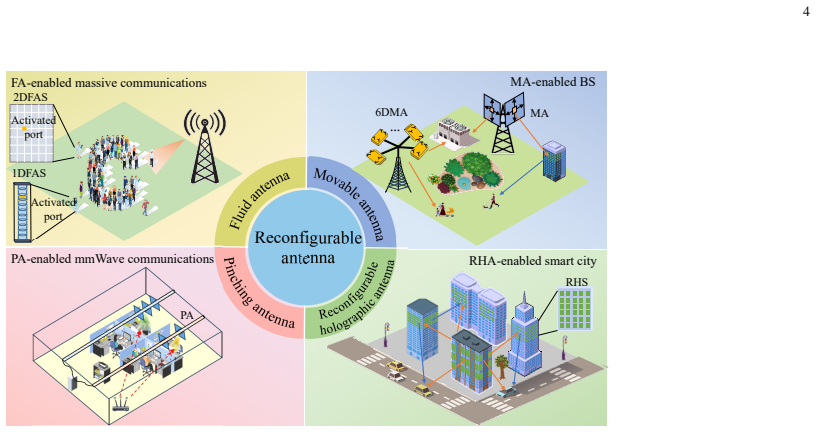
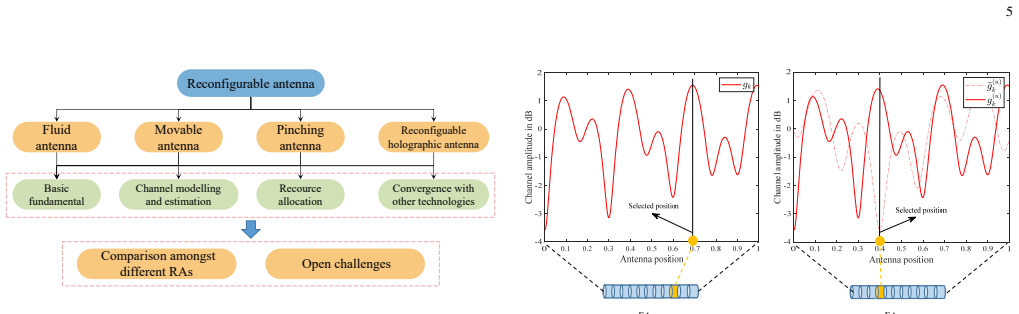
Reconfigurable antennas play a crucial role in achieving 6G objectives by enabling dynamic adjustments to RF characteristics such as gain, radiation pattern, impedance, and polarization. The survey examines fluid antennas, movable antennas, pinching antennas, and reconfigurable holographic antennas through channel modelling, performance analysis, resource allocation strategies, and synergy with other emerging wireless technologies, ending with a comparative analysis and discussion of open challenges and future research directions.
What carries the argument
The four reconfigurable antenna technologies—fluid antennas, movable antennas, pinching antennas, and reconfigurable holographic antennas—that alter radiation patterns and positions in response to varying communication environments.
If this is right
- Channel models for each antenna type must account for time-varying positions and shapes to enable accurate performance predictions.
- Resource allocation algorithms can exploit the extra degrees of freedom from reconfigurability to improve spectral efficiency and energy use.
- Integration with technologies such as intelligent reflecting surfaces or massive MIMO can multiply the benefits of dynamic antenna control.
- Comparative analysis reveals trade-offs in hardware complexity, cost, and reconfiguration speed across the four antenna classes.
- Future work must address open challenges in real-time control, estimation overhead, and hardware implementation for practical deployment.
Where Pith is reading between the lines
- Hardware designers could prioritize low-power actuation mechanisms for movable and fluid antennas to reduce overall network energy consumption.
- Standardization bodies may need new channel models that incorporate antenna mobility and shape change as standard parameters.
- Network operators could test hybrid deployments mixing fixed and reconfigurable antennas to balance cost against adaptability in early 6G rollouts.
Load-bearing premise
The paper assumes that fluid antennas, movable antennas, pinching antennas, and reconfigurable holographic antennas represent the key or most relevant reconfigurable antenna technologies for next-generation networks.
What would settle it
A real-world 6G deployment test showing that fixed-position antennas achieve equivalent reliability, latency, and connectivity without dynamic reconfiguration would undermine the claim that these reconfigurable types are essential.
Figures
read the original abstract
The transition to next-generation mobile communication networks, particularly 6G, demands advanced technologies to meet the requirements for ultra-reliable, low-latency communication, massive connectivity, and intelligent applications. Reconfigurable antennas (RAs) play a crucial role in achieving these objectives by enabling dynamic adjustments to the radio frequency (RF) characteristics of antennas, such as gain, radiation pattern, impedance, and polarization. Unlike traditional fixed-position antennas, RAs can alter both their radiation patterns and positions, offering flexibility in response to varying communication environments. This paper presents a comprehensive survey and tutorial on RAs, with a focus on fluid antennas (FAs), movable antennas (MAs), pinching antennas (PAs), and reconfigurable holographic antennas (RHAs), examining their potential in next-generation mobile networks. We explore the channel modelling and estimation, performance analysis, resource allocation strategies, and their synergy with other emerging wireless technologies for each type of RA. Finally, we provide a comparative analysis of different RAs and discuss the open challenges and future research directions, offering insights and guidance for future investigations in the exciting research area.
Editorial analysis
A structured set of objections, weighed in public.
Referee Report
Summary. The paper is a comprehensive survey and tutorial on reconfigurable antennas for 6G networks. It claims that RAs enable dynamic adjustments to RF characteristics (gain, pattern, impedance, polarization) to meet 6G requirements for ultra-reliable low-latency communication and massive connectivity. The survey focuses on four technologies—fluid antennas (FAs), movable antennas (MAs), pinching antennas (PAs), and reconfigurable holographic antennas (RHAs)—and examines channel modelling, performance analysis, resource allocation, synergies with other wireless technologies, a comparative analysis, open challenges, and future directions for each.
Significance. If the coverage is accurate and the scope justified, the survey would provide a useful consolidation of emerging RA variants for 6G, including their modelling approaches and integration potential. The promised comparative analysis and discussion of open challenges could serve as a reference point for researchers working on antenna reconfiguration and network optimization.
major comments (1)
- [Abstract] Abstract: the paper asserts that FAs, MAs, PAs, and RHAs are the focus for examining RA potential in next-generation networks, yet provides no selection criteria, taxonomy of RA classes, or explicit comparison to alternatives (e.g., switch-based pattern-reconfigurable antennas or varactor-tuned designs). This is load-bearing for the central claim, as the subsequent performance analysis and synergy sections cannot establish that these four variants are the relevant ones for meeting the stated 6G objectives without such justification.
Simulated Author's Rebuttal
We thank the referee for the constructive comment on the need for explicit justification of the paper's scope. We agree that the current manuscript lacks a clear taxonomy and selection criteria for the four RA variants, and we will revise accordingly to strengthen the central claims.
read point-by-point responses
-
Referee: [Abstract] Abstract: the paper asserts that FAs, MAs, PAs, and RHAs are the focus for examining RA potential in next-generation networks, yet provides no selection criteria, taxonomy of RA classes, or explicit comparison to alternatives (e.g., switch-based pattern-reconfigurable antennas or varactor-tuned designs). This is load-bearing for the central claim, as the subsequent performance analysis and synergy sections cannot establish that these four variants are the relevant ones for meeting the stated 6G objectives without such justification.
Authors: We acknowledge the validity of this observation. The four technologies were chosen as they represent emerging RA paradigms enabling continuous position or surface reconfiguration (fluidic movement, mechanical relocation, pinching, and holographic phase control), providing greater flexibility for 6G's ultra-reliable low-latency and massive connectivity needs than discrete traditional designs. However, the manuscript does not explicitly state selection criteria or provide a taxonomy. In revision, we will add a dedicated subsection (e.g., in the introduction or a new Section II) with: (i) a taxonomy classifying RAs by reconfiguration mechanism (discrete vs. continuous, fixed vs. movable position); (ii) selection criteria based on novelty for 6G, potential for dynamic channel adaptation, and coverage gaps in existing surveys; and (iii) a concise comparison noting that switch-based/varactor designs are mature and addressed elsewhere, while focusing here on these advanced variants. This will be reflected in an updated abstract as well. revision: yes
Circularity Check
No circularity: purely descriptive survey with no derivations or predictions
full rationale
This is a survey and tutorial paper. The abstract and structure describe existing technologies (FAs, MAs, PAs, RHAs), review channel modelling, performance analysis, and synergies, and discuss challenges. No equations, fitted parameters, predictions, uniqueness theorems, or ansatzes are present. The listed circularity patterns (self-definitional, fitted-input-called-prediction, self-citation load-bearing, etc.) require a derivation chain that reduces to its own inputs; none exists here. Scope choice (which RA variants to cover) is editorial, not a mathematical reduction. Score 0 is the appropriate non-finding.
Axiom & Free-Parameter Ledger
Reference graph
Works this paper leans on
-
[1]
6G wireless systems: Vision, requirements, challenges, insights, and opportunities,
H. Tataria, M. Shafi, A. F. Molisc, M. Dohler, H. Sj ¨oland, and F. Tufvesson, “6G wireless systems: Vision, requirements, challenges, insights, and opportunities,”Proc. IEEE, vol. 109, no. 7, pp. 1166– 1199, Mar. 2021
2021
-
[2]
On the road to 6G: Visions, requirements, key technologies, and testbeds,
C.-X. Wang, X. You, X. Gao, X. Zhu, Z. Li, C. Zhang, H. Wang, Y . Huang, Y . Chen, H. Haas, J. S. Thompson, E. G. Larsson, M. D. Renzo, W. Tong, P. Zhu, X. Shen, H. V . Poor, and L. Hanzo, “On the road to 6G: Visions, requirements, key technologies, and testbeds,” IEEE Communications Surveys & Tutorials, vol. 25, no. 2, pp. 905– 974, 2023
2023
-
[3]
Twelve scientific challenges for 6g: Rethinking the foundations of communications theory,
M. Chafii, L. Bariah, S. Muhaidat, and M. Debbah, “Twelve scientific challenges for 6g: Rethinking the foundations of communications theory,”IEEE Communications Surveys & Tutorials, vol. 25, no. 2, pp. 868–904, 2023
2023
-
[4]
5G-advanced toward 6G: Past, present, and future,
W. Chen, X. Lin, J. Lee, A. Toskala, S. Sun, C. F. Chiasserini, and L. Liu, “5G-advanced toward 6G: Past, present, and future,”IEEE Journal on Selected Areas in Communications, vol. 41, no. 6, pp. 1592–1619, 2023
2023
-
[5]
6G internet of things: A comprehensive survey,
D. C. Nguyen, M. Ding, P. N. Pathirana, A. Seneviratne, J. Li, D. Niyato, O. Dobre, and H. V . Poor, “6G internet of things: A comprehensive survey,”IEEE Internet of Things Journal, vol. 9, no. 1, pp. 359–383, 2022
2022
-
[6]
Blockchain and autonomous vehicles: Recent advances and future directions,
S. Jain, N. J. Ahuja, P. Srikanth, K. V . Bhadane, B. Nagaiah, A. Ku- mar, and C. Konstantinou, “Blockchain and autonomous vehicles: Recent advances and future directions,”IEEE Access, vol. 9, pp. 130 264–130 328, 2021
2021
-
[7]
A tutorial on extremely large-scale mimo for 6G: Fundamentals, signal processing, and applications,
Z. Wang, J. Zhang, H. Du, D. Niyato, S. Cui, B. Ai, M. Debbah, K. B. Letaief, and H. V . Poor, “A tutorial on extremely large-scale mimo for 6G: Fundamentals, signal processing, and applications,” IEEE Communications Surveys & Tutorials, vol. 26, no. 3, pp. 1560– 1605, 2024
2024
-
[8]
A tutorial on fluid antenna system for 6G networks: Encompassing communication theory, optimization methods and hardware designs,
W. K. New, K.-K. Wong, H. Xu, C. Wang, F. R. Ghadi, J. Zhang, J. Rao, R. Murch, P. Ram ´ırez-Espinosa, D. Morales-Jimenez, C.- B. Chae, and K.-F. Tong, “A tutorial on fluid antenna system for 6G networks: Encompassing communication theory, optimization methods and hardware designs,”IEEE Communications Surveys & Tutorials, vol. 27, no. 4, pp. 2325–2377, 2025
2025
-
[9]
A tutorial on movable antennas for wireless networks,
L. Zhu, W. Ma, W. Mei, Y . Zeng, Q. Wu, B. Ning, Z. Xiao, X. Shao, J. Zhang, and R. Zhang, “A tutorial on movable antennas for wireless networks,”IEEE Communications Surveys & Tutorials, pp. 1–1, 2025
2025
-
[10]
Holo- graphic MIMO communications: Theoretical foundations, enabling technologies, and future directions,
T. Gong, P. Gavriilidis, R. Ji, C. Huang, G. C. Alexandropoulos, L. Wei, Z. Zhang, M. Debbah, H. V . Poor, and C. Yuen, “Holo- graphic MIMO communications: Theoretical foundations, enabling technologies, and future directions,”IEEE Communications Surveys & Tutorials, vol. 26, no. 1, pp. 196–257, 2024
2024
-
[11]
Mimo evolution toward 6G: Modular massive MIMO in low-frequency bands,
J. Jeon, G. Lee, A. A. Ibrahim, J. Yuan, G. Xu, J. Cho, E. Ong- gosanusi, Y . Kim, J. Lee, and J. C. Zhang, “Mimo evolution toward 6G: Modular massive MIMO in low-frequency bands,”IEEE Com- munications Magazine, vol. 59, no. 11, pp. 52–58, 2021
2021
-
[12]
Hybrid digital and analog beamforming design for large-scale antenna arrays,
F. Sohrabi and W. Yu, “Hybrid digital and analog beamforming design for large-scale antenna arrays,”IEEE Journal of Selected Topics in Signal Processing, vol. 10, no. 3, pp. 501–513, 2016. 33
2016
-
[13]
Intelligent massive MIMO systems for beyond 5G networks: An overview and future trends,
O. Elijah, S. K. Abdul Rahim, W. K. New, C. Y . Leow, K. Cumanan, and T. Kim Geok, “Intelligent massive MIMO systems for beyond 5G networks: An overview and future trends,”IEEE Access, vol. 10, pp. 102 532–102 563, 2022
2022
-
[14]
A survey of beam management for mmWave and THz communications towards 6G,
Q. Xue, C. Ji, S. Ma, J. Guo, Y . Xu, Q. Chen, and W. Zhang, “A survey of beam management for mmWave and THz communications towards 6G,”IEEE Communications Surveys & Tutorials, vol. 26, no. 3, pp. 1520–1559, 2024
2024
-
[15]
Next generation advanced transceiver technologies for 6G and beyond,
C. You, Y . Cai, Y . Liu, M. Di Renzo, T. M. Duman, A. Yener, and A. Lee Swindlehurst, “Next generation advanced transceiver technologies for 6G and beyond,”IEEE Journal on Selected Areas in Communications, vol. 43, no. 3, pp. 582–627, 2025
2025
-
[16]
Intelligent reflecting surfaces for wireless networks: Deployment architectures, key solutions, and field trials,
Q. Wu, G. Chen, Q. Peng, W. Chen, Y . Yuan, Z. Cheng, J. Dou, Z. Zhao, and P. Li, “Intelligent reflecting surfaces for wireless networks: Deployment architectures, key solutions, and field trials,” IEEE Wireless Communications, vol. 32, no. 6, pp. 141–148, 2025
2025
-
[17]
IRS aided MEC systems with binary offloading: A unified framework for dynamic IRS beamforming,
G. Chen, Q. Wu, R. Liu, J. Wu, and C. Fang, “IRS aided MEC systems with binary offloading: A unified framework for dynamic IRS beamforming,”IEEE Journal on Selected Areas in Communications, vol. 41, no. 2, pp. 349–365, 2023
2023
-
[18]
Fluid antenna systems,
K. K. Wong, A. Shojaeifard, K. F. Tong, and Y . Zhang, “Fluid antenna systems,”IEEE Transactions on Communications, vol. 20, no. 3, pp. 1950–1962, Mar. 2021
1950
-
[19]
Modeling and performance analysis for movable antenna enabled wireless communications,
L. Zhu, W. Ma, and R. Zhang, “Modeling and performance analysis for movable antenna enabled wireless communications,”IEEE Trans- actions on Wireless Communications, vol. 23, no. 6, pp. 6234–6250, 2024
2024
-
[20]
A tutorial on six-dimensional movable antenna for 6G networks: Synergizing positionable and rotatable antennas,
X. Shao, W. Mei, C. You, Q. Wu, B. Zheng, C.-X. Wang, J. Li, R. Zhang, R. Schober, L. Zhu, W. Zhuang, and X. Shen, “A tutorial on six-dimensional movable antenna for 6G networks: Synergizing positionable and rotatable antennas,”IEEE Communications Surveys & Tutorials, vol. 28, pp. 3666–3709, 2026
2026
-
[21]
Flexible-antenna systems: A pinching-antenna perspective,
Z. Ding, R. Schober, and H. Vincent Poor, “Flexible-antenna systems: A pinching-antenna perspective,”IEEE Transactions on Communica- tions, pp. 1–1, 2025
2025
-
[22]
Reconfigurable holographic surfaces for ultra-massive mimo in 6G: Practical design, optimization and implementation,
R. Deng, Y . Zhang, H. Zhang, B. Di, H. Zhang, H. V . Poor, and L. Song, “Reconfigurable holographic surfaces for ultra-massive mimo in 6G: Practical design, optimization and implementation,” IEEE Journal on Selected Areas in Communications, vol. 41, no. 8, pp. 2367–2379, 2023
2023
-
[23]
Next-generation sub-6 GHz an- tenna solutions: A review on scalability and performance optimization of radiating elements,
S. Rialch, S. Sharma, and N. Jaglan, “Next-generation sub-6 GHz an- tenna solutions: A review on scalability and performance optimization of radiating elements,” in2025 7th International Conference on Signal Processing, Computing and Control (ISPCC), 2025, pp. 935–939
2025
-
[24]
Radiation pattern and polarization reconfigurable antenna using dielectric liquid,
J. Ren, Z. Zhou, Z. H. Wei, H. M. Ren, Z. Chen, Y . Liu, and Y . Z. Yin, “Radiation pattern and polarization reconfigurable antenna using dielectric liquid,”IEEE Transactions on Antennas and Propagation, vol. 68, no. 12, pp. 8174–8179, 2020
2020
-
[25]
Compact ultrathin wide- band pattern-reconfigurable antenna with enhanced operating band- width,
F. Zhang, L. Liu, Y . Zhang, and F. Zhang, “Compact ultrathin wide- band pattern-reconfigurable antenna with enhanced operating band- width,”IEEE Antennas and Wireless Propagation Letters, vol. 23, no. 12, pp. 4443–4447, 2024
2024
-
[26]
A radiation pattern reconfigurable fabry–p ´erot antenna based on liquid metal,
X. Yang, Y . Liu, H. Lei, Y . Jia, P. Zhu, and Z. Zhou, “A radiation pattern reconfigurable fabry–p ´erot antenna based on liquid metal,” IEEE Transactions on Antennas and Propagation, vol. 68, no. 11, pp. 7658–7663, 2020
2020
-
[27]
A survey on fluid antenna multiple access for 6G: A new multiple access technology that provides great diversity in a small space,
A. F. M. S. Shah, M. Ali Karabulut, E. Cinar, and K. M. Rabie, “A survey on fluid antenna multiple access for 6G: A new multiple access technology that provides great diversity in a small space,”IEEE Access, vol. 12, pp. 88 410–88 425, 2024
2024
-
[28]
A contemporary survey on fluid antenna systems: Fundamentals and networking perspectives,
H. Hong, K.-K. Wong, H. Xu, X. Guo, F. R. Ghadi, Y . Chen, Y . Xu, C.-B. Chae, B. Liu, K.-F. Tong, and Y . Zhang, “A contemporary survey on fluid antenna systems: Fundamentals and networking perspectives,” 2025. [Online]. Available: https: //arxiv.org/abs/2506.13317
arXiv 2025
-
[29]
Deep reinforcement learning-assisted resource allocation for fluid antenna system: Overview, research challenges and future trends,
M. C. Ho and S. Cho, “Deep reinforcement learning-assisted resource allocation for fluid antenna system: Overview, research challenges and future trends,” in2025 International Conference on Artificial Intelligence in Information and Communication (ICAIIC), 2025, pp. 0148–0150
2025
-
[30]
A tutorial on holographic MIMO communications—part I: Channel modeling and channel estimation,
J. An, C. Yuen, C. Huang, M. Debbah, H. Vincent Poor, and L. Hanzo, “A tutorial on holographic MIMO communications—part I: Channel modeling and channel estimation,”IEEE Communications Letters, vol. 27, no. 7, pp. 1664–1668, Jul. 2023
2023
-
[31]
A tutorial on holographic MIMO communications—part II: Performance analysis and holographic beamforming,
J. An, C. Yuen, C. Huang, M. Debbah, H. V . Poor, and L. Hanzo, “A tutorial on holographic MIMO communications—part II: Performance analysis and holographic beamforming,”IEEE Communications Let- ters, vol. 27, no. 7, pp. 1669–1673, 2023
2023
-
[32]
A tutorial on holographic MIMO communications—part III: Open opportunities and challenges,
——, “A tutorial on holographic MIMO communications—part III: Open opportunities and challenges,”IEEE Communications Letters, vol. 27, no. 7, pp. 1674–1678, 2023
2023
-
[33]
Fluid antenna system part I: Preliminaries,
K. K. Wong, W. K. New, X. Hao, K. F. Tong, and C. B. Chae, “Fluid antenna system part I: Preliminaries,”IEEE Communications Letters, vol. 27, no. 8, pp. 1919–1923, Aug. 2023
1919
-
[34]
Liquid metal antennas: Materials, fabrication and applications,
K. N. Paracha, A. D. Butt, A. S. Alghamdi, S. A. Babale, and P. J. Soh, “Liquid metal antennas: Materials, fabrication and applications,” Sensors, vol. 20, no. 1, 2020
2020
-
[35]
Continuous elec- trowetting surface-wave fluid antenna for mobile communications,
H. Wang, Y . Shen, K.-F. Tong, and K.-K. Wong, “Continuous elec- trowetting surface-wave fluid antenna for mobile communications,” inTENCON 2022 - 2022 IEEE Region 10 Conference (TENCON), 2022, pp. 1–3
2022
-
[36]
Pixel antenna optimization using the adjoint method and the method of moving asymptote,
T. Qiao, F. Jiang, S. Shen, Z. Zhang, M. Li, C.-Y . Chiu, Q. S. Cheng, and R. Murch, “Pixel antenna optimization using the adjoint method and the method of moving asymptote,”IEEE Transactions on Antennas and Propagation, vol. 71, no. 3, pp. 2873–2878, 2023
2023
-
[37]
Meta fluid antenna: Architecture design, performance analysis, experimental examination,
B. Liu, J. Huang, T. Wu, H. Meng, F. Mei, L. Ning, K.-K. Wong, H. Wong, K.-F. Tong, and K.-M. Luk, “Meta fluid antenna: Architecture design, performance analysis, experimental examination,” 2025. [Online]. Available: https://arxiv.org/abs/2509. 12032
2025
-
[38]
Performance limits of fluid antenna systems,
K. K. Wong, A. Shojaeifard, K.-F. Tong, and Y . Zhang, “Performance limits of fluid antenna systems,”IEEE Communications Letters, vol. 24, no. 11, pp. 2469–2472, 2020
2020
-
[39]
Closed-form ex- pressions for spatial correlation parameters for performance analysis of fluid antenna systems,
K. K. Wong, K. F. Tong, Y . Chen, and Y . Zhang, “Closed-form ex- pressions for spatial correlation parameters for performance analysis of fluid antenna systems,”Electronics Letters, vol. 58, no. 11, pp. 454–457, 2022
2022
-
[40]
A new analytical approximation of the fluid antenna system channel,
M. Khammassi, A. Kammoun, and M.-S. Alouini, “A new analytical approximation of the fluid antenna system channel,”IEEE Transac- tions on Wireless Communications, vol. 22, no. 12, pp. 8843–8858, 2023
2023
-
[41]
A new spatial block-correlation model for fluid antenna systems,
P. Ram ´ırez-Espinosa, D. Morales-Jimenez, and K.-K. Wong, “A new spatial block-correlation model for fluid antenna systems,”IEEE Transactions on Wireless Communications, vol. 23, no. 11, pp. 15 829–15 843, 2024
2024
-
[42]
Fast fluid antenna multiple access enabling massive connectivity,
K.-K. Wong, K.-F. Tong, Y . Chen, and Y . Zhang, “Fast fluid antenna multiple access enabling massive connectivity,”IEEE Communica- tions Letters, vol. 27, no. 2, pp. 711–715, 2023
2023
-
[43]
A modified model for the fading signal at a mobile radio channel,
T. Aulin, “A modified model for the fading signal at a mobile radio channel,”IEEE Transactions on Vehicular Technology, vol. 28, no. 3, pp. 182–203, 1979
1979
-
[44]
Channel measurement, modeling, and performance evaluation for terahertz fluid antenna systems,
Y . Wang, H. Shen, C. Han, and M. Tao, “Channel measurement, modeling, and performance evaluation for terahertz fluid antenna systems,”IEEE Journal on Selected Areas in Communications, pp. 1–1, 2025
2025
-
[45]
Skip-enabled lmmse-based chan- nel estimation for large-scale fluid antenna-enabled cellular net- works,
C. Skouroumounis and I. Krikidis, “Skip-enabled lmmse-based chan- nel estimation for large-scale fluid antenna-enabled cellular net- works,” inICC 2023 - IEEE International Conference on Communi- cations, 2023, pp. 2779–2784
2023
-
[46]
Fluid antenna with linear mmse channel estimation for large- scale cellular networks,
——, “Fluid antenna with linear mmse channel estimation for large- scale cellular networks,”IEEE Transactions on Communications, vol. 71, no. 2, pp. 1112–1125, 2023
2023
-
[47]
Fluid antenna-aided full duplex communications: A macro- scopic point-of-view,
——, “Fluid antenna-aided full duplex communications: A macro- scopic point-of-view,”IEEE Journal on Selected Areas in Communi- cations, vol. 41, no. 9, pp. 2879–2892, 2023
2023
-
[48]
Estimation of channel parameters for port selection in millimeter-wave fluid antenna systems,
R. Wang, Y . Chen, Y . Hou, K.-K. Wong, and X. Tao, “Estimation of channel parameters for port selection in millimeter-wave fluid antenna systems,” in2023 IEEE/CIC International Conference on Communications in China (ICCC Workshops), 2023, pp. 1–6
2023
-
[49]
Channel estimation for FAS-assisted multiuser mmWave systems,
H. Xu, G. Zhou, K.-K. Wong, W. K. New, C. Wang, C.-B. Chae, R. Murch, S. Jin, and Y . Zhang, “Channel estimation for FAS-assisted multiuser mmWave systems,”IEEE Communications Letters, vol. 28, no. 3, pp. 632–636, 2024
2024
-
[50]
Channel estimation and reconstruction in fluid antenna system: Oversampling is essential,
W. Kiat New, K.-K. Wong, H. Xu, F. Rostami Ghadi, R. Murch, and C.-B. Chae, “Channel estimation and reconstruction in fluid antenna system: Oversampling is essential,”IEEE Transactions on Wireless Communications, vol. 24, no. 1, pp. 309–322, 2025
2025
-
[51]
Successive bayesian reconstructor for FAS channel estimation,
Z. Zhang, J. Zhu, L. Dai, and R. W. Heath, “Successive bayesian reconstructor for FAS channel estimation,” in2024 IEEE Wireless Communications and Networking Conference (WCNC), 2024, pp. 1– 5
2024
-
[52]
Successive bayesian reconstructor for channel estimation in fluid antenna systems,
——, “Successive bayesian reconstructor for channel estimation in fluid antenna systems,”IEEE Transactions on Wireless Communica- tions, vol. 24, no. 3, pp. 1992–2006, 2025
1992
-
[53]
Sparse bayesian learning-based channel estimation for fluid antenna systems,
B. Xu, Y . Chen, Q. Cui, X. Tao, and K.-K. Wong, “Sparse bayesian learning-based channel estimation for fluid antenna systems,”IEEE Wireless Communications Letters, vol. 14, no. 2, pp. 325–329, 2025
2025
-
[54]
Learning-induced channel extrapolation for fluid antenna systems using asymmetric graph masked autoencoder,
H. Zhang, J. Wang, C. Wang, C.-C. Wang, K.-K. Wong, B. Wang, and C.-B. Chae, “Learning-induced channel extrapolation for fluid antenna systems using asymmetric graph masked autoencoder,”IEEE Wireless Communications Letters, vol. 13, no. 6, pp. 1665–1669, 2024. 34
2024
-
[55]
Accurate and fast channel estimation for fluid antenna systems with diffusion models,
E. Tang, W. Guo, H. He, S. Song, J. Zhang, and K. B. Letaief, “Accurate and fast channel estimation for fluid antenna systems with diffusion models,” 2025. [Online]. Available: https: //arxiv.org/abs/2505.04930
arXiv 2025
-
[56]
FAS-LLM: Large language model–based channel prediction for OTFS-enabled satel- lite–FAS links,
H. Yang, S. Lambotharan, and M. Derakhshani, “FAS-LLM: Large language model–based channel prediction for OTFS-enabled satel- lite–FAS links,”IEEE Journal on Selected Areas in Communications, pp. 1–1, 2025
2025
-
[57]
Continuous fluid antenna systems: Modeling and analysis,
C. Psomas, P. J. Smith, H. A. Suraweera, and I. Krikidis, “Continuous fluid antenna systems: Modeling and analysis,”IEEE Communica- tions Letters, vol. 27, no. 12, pp. 3370–3374, 2023
2023
-
[58]
On performance of fluid antenna system using maximum ratio combining,
X. Lai, T. Wu, J. Yao, C. Pan, M. Elkashlan, and K.-K. Wong, “On performance of fluid antenna system using maximum ratio combining,”IEEE Communications Letters, vol. 28, no. 2, pp. 402– 406, 2024
2024
-
[59]
Copula-based performance analysis for fluid antenna systems under arbitrary fading channels,
F. Rostami Ghadi, K.-K. Wong, F. J. L ´opez-Mart´ınez, and K.-F. Tong, “Copula-based performance analysis for fluid antenna systems under arbitrary fading channels,”IEEE Communications Letters, vol. 27, no. 11, pp. 3068–3072, 2023
2023
-
[60]
A simple method for the performance analysis of fluid antenna systems under correlated Nakagami-m fading,
J. D. Vega-S ´anchez, L. Urquiza-Aguiar, M. C. P. Paredes, and D. P. M. Osorio, “A simple method for the performance analysis of fluid antenna systems under correlated Nakagami-m fading,”IEEE Wireless Communications Letters, vol. 13, no. 2, pp. 377–381, 2024
2024
-
[61]
FAS-RIS communication: Model, analysis, and optimization,
J. Yao, J. Zheng, T. Wu, M. Jin, C. Yuen, K.-K. Wong, and F. Adachi, “FAS-RIS communication: Model, analysis, and optimization,”IEEE Transactions on Vehicular Technology, pp. 1–6, 2025
2025
-
[62]
Fluid antenna multiple access,
K.-K. Wong and K.-F. Tong, “Fluid antenna multiple access,”IEEE Transactions on Wireless Communications, vol. 21, no. 7, pp. 4801– 4815, 2022
2022
-
[63]
Slow fluid antenna multiple access,
K.-K. Wong, D. Morales-Jimenez, K.-F. Tong, and C.-B. Chae, “Slow fluid antenna multiple access,”IEEE Transactions on Communica- tions, vol. 71, no. 5, pp. 2831–2846, 2023
2023
-
[64]
Revisiting outage probability analysis for two-user fluid antenna multiple access system,
H. Xu, K.-K. Wong, W. K. New, K.-F. Tong, Y . Zhang, and C.- B. Chae, “Revisiting outage probability analysis for two-user fluid antenna multiple access system,”IEEE Transactions on Wireless Communications, vol. 23, no. 8, pp. 9534–9548, 2024
2024
-
[65]
A tractable approximation for evaluating the performance of slow fluid antenna multiple access,
J. D. Vega-S ´anchez, H. R. C. Mora, N. V . O. Garz ´on, and D. P. M. Osorio, “A tractable approximation for evaluating the performance of slow fluid antenna multiple access,”IEEE Open Journal of the Communications Society, vol. 6, pp. 3614–3623, 2025
2025
-
[66]
Opportunistic fluid antenna multiple access,
K.-K. Wong, K.-F. Tong, Y . Chen, Y . Zhang, and C.-B. Chae, “Opportunistic fluid antenna multiple access,”IEEE Transactions on Wireless Communications, vol. 22, no. 11, pp. 7819–7833, 2023
2023
-
[67]
Compact ultra massive antenna array: A simple open-loop massive connectivity scheme,
K.-K. Wong, C.-B. Chae, and K.-F. Tong, “Compact ultra massive antenna array: A simple open-loop massive connectivity scheme,” IEEE Transactions on Wireless Communications, vol. 23, no. 6, pp. 6279–6294, 2024
2024
-
[68]
Bridg- ing theory and practice in reconfigurable fluid antenna systems,
H. Yang, Y . Zhao, K.-K. Wong, H.-H. Chen, and C.-B. Chae, “Bridg- ing theory and practice in reconfigurable fluid antenna systems,”IEEE Wireless Communications, pp. 1–8, 2025
2025
-
[69]
Perfor- mance analysis of fluid antenna system aided OTFS satellite commu- nications,
H. Yang, M. Derakhshani, S. Lambotharan, and L. Hanzo, “Perfor- mance analysis of fluid antenna system aided OTFS satellite commu- nications,”IEEE Journal on Selected Areas in Communications, pp. 1–1, 2025
2025
-
[70]
An information-theoretic characterization of MIMO-FAS: Optimization, diversity-multiplexing tradeoff and q-outage capacity,
W. K. New, K.-K. Wong, H. Xu, K.-F. Tong, and C.-B. Chae, “An information-theoretic characterization of MIMO-FAS: Optimization, diversity-multiplexing tradeoff and q-outage capacity,”IEEE Trans- actions on Wireless Communications, vol. 23, no. 6, pp. 5541–5556, 2024
2024
-
[71]
Fluid antenna-assisted MIMO transmission exploiting statistical CSI,
Y . Ye, L. You, J. Wang, H. Xu, K.-K. Wong, and X. Gao, “Fluid antenna-assisted MIMO transmission exploiting statistical CSI,”IEEE Communications Letters, vol. 28, no. 1, pp. 223–227, 2024
2024
-
[72]
Joint beamforming and antenna design for near-field fluid antenna system,
Y . Chen, M. Chen, H. Xu, Z. Yang, K.-K. Wong, and Z. Zhang, “Joint beamforming and antenna design for near-field fluid antenna system,” IEEE Wireless Communications Letters, vol. 14, no. 2, pp. 415–419, 2025
2025
-
[73]
Capacity maximization for FAS-assisted multiple access channels,
H. Xu, K.-K. Wong, W. K. New, F. R. Ghadi, G. Zhou, R. Murch, C.- B. Chae, Y . Zhu, and S. Jin, “Capacity maximization for FAS-assisted multiple access channels,”IEEE Transactions on Communications, pp. 1–1, 2024
2024
-
[74]
Sum-rate maximization for fluid antenna enabled multiuser communications,
Z. Cheng, N. Li, J. Zhu, X. She, C. Ouyang, and P. Chen, “Sum-rate maximization for fluid antenna enabled multiuser communications,” IEEE Communications Letters, vol. 28, no. 5, pp. 1206–1210, 2024
2024
-
[75]
Uplink transmission design for fluid antenna-enabled multiuser MIMO systems with imperfect CSI,
L. Hu, L. Li, C. Pan, and H. Ren, “Uplink transmission design for fluid antenna-enabled multiuser MIMO systems with imperfect CSI,” 2025. [Online]. Available: https://arxiv.org/abs/2503.01668
arXiv 2025
-
[76]
Joint beamforming and antenna position optimization for fluid antenna-assisted MU-MIMO networks,
T. Liao, W. Guo, H. He, S. Song, J. Zhang, and K. B. Letaief, “Joint beamforming and antenna position optimization for fluid antenna-assisted MU-MIMO networks,” 2025. [Online]. Available: https://arxiv.org/abs/2503.04040
arXiv 2025
-
[77]
Power minimization of multiuser FAS-RIS downlink system,
B. Tang, H. Xu, K.-K. Wong, L. You, J. Tang, Y . Zhang, and H. Shin, “Power minimization of multiuser FAS-RIS downlink system,”IEEE Transactions on Vehicular Technology, pp. 1–6, 2025
2025
-
[78]
X. Zhang, D. Xu, J. Wang, S. Song, D. W. K. Ng, and M. Debbah, “Fluid antenna meets RIS: Random matrix analysis and two-timescale design for multi-user communications,” 2025. [Online]. Available: https://arxiv.org/abs/2503.06080
arXiv 2025
-
[79]
Energy-efficiency optimization for slow fluid antenna multiple access using mean-field game,
Y . Chen, S. Li, Y . Hou, and X. Tao, “Energy-efficiency optimization for slow fluid antenna multiple access using mean-field game,”IEEE Wireless Communications Letters, vol. 13, no. 4, pp. 915–918, 2024
2024
-
[80]
Energy efficiency maximization under delay-outage probability constraints using fluid antenna systems,
Y . Xu, Y . Chen, Y . Hou, K.-K. Wong, Q. Cui, and X. Tao, “Energy efficiency maximization under delay-outage probability constraints using fluid antenna systems,” in2023 IEEE Statistical Signal Pro- cessing Workshop (SSP), 2023, pp. 105–109
2023
discussion (0)
Sign in with ORCID, Apple, or X to comment. Anyone can read and Pith papers without signing in.