REVIEW 1 major objections 2 minor 1 cited by
Atomic Structure of Amorphous Optical Coatings of TiO$_2$-doped GeO$_2$ by Grazing-Incidence Total X-ray Scattering Measurements
T0 review · 1 major / 2 minor · reviewed 2026-06-29 · grok-4.3
Pith's one-line read Annealing reduces edge- and face-sharing polyhedra in TiO2-doped GeO2 films, showing the clearest link to lower mechanical loss.
desk verdict The paper supplies new grazing-incidence PDF data on TiO2-GeO2 films that tracks how annealing cuts edge- and face-sharing polyhedra while lowering mechanical loss, but the correlation leaves room for other unmeasured changes. read the letter →
The pith
A machine-rendered reading of the paper's core claim, the machinery that carries it, and where it could break.
The reading
What carries the argument
Pair distribution functions from grazing-incidence total X-ray scattering, combined with atomic modeling to quantify coordination numbers and polyhedral sharing statistics.
What would settle it
A controlled sample in which edge- and face-sharing polyhedra are reduced by a method other than annealing yet mechanical loss stays unchanged, or in which loss drops without a corresponding drop in shared polyhedra.
Extended reading notes
Core claim
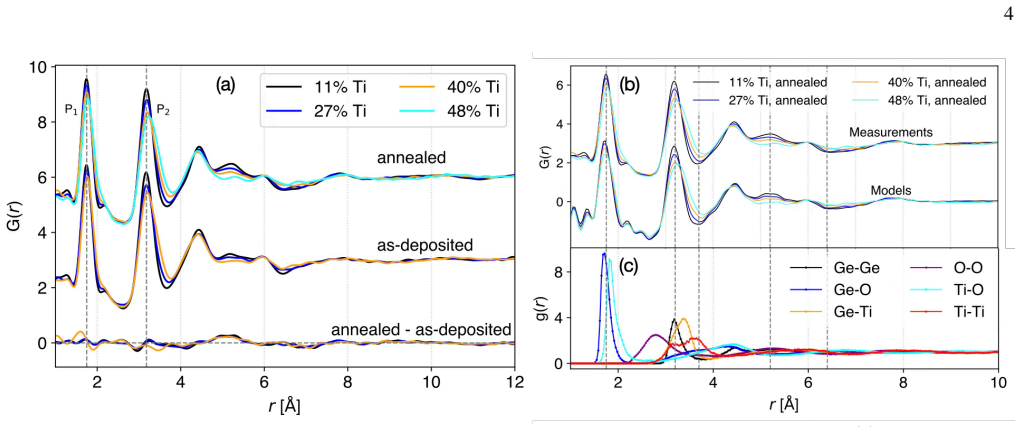
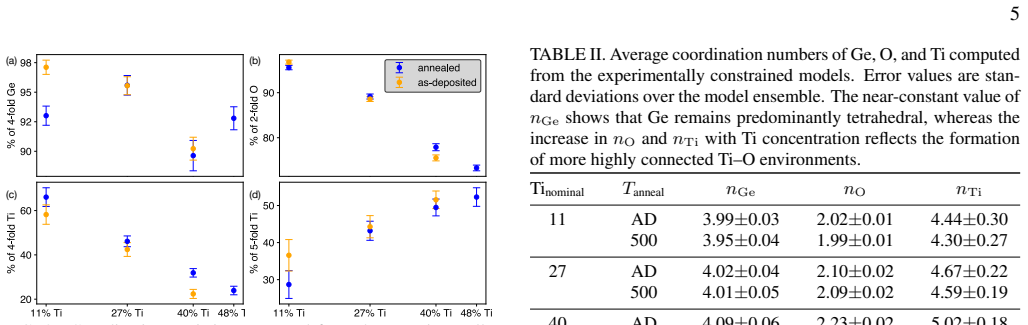
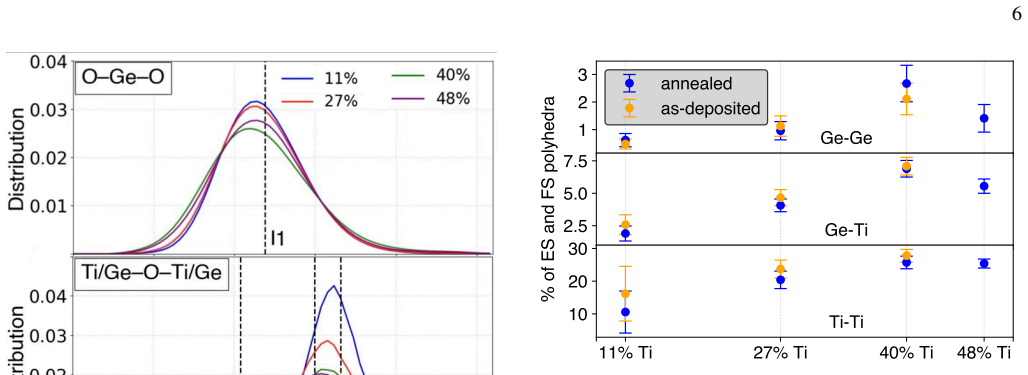
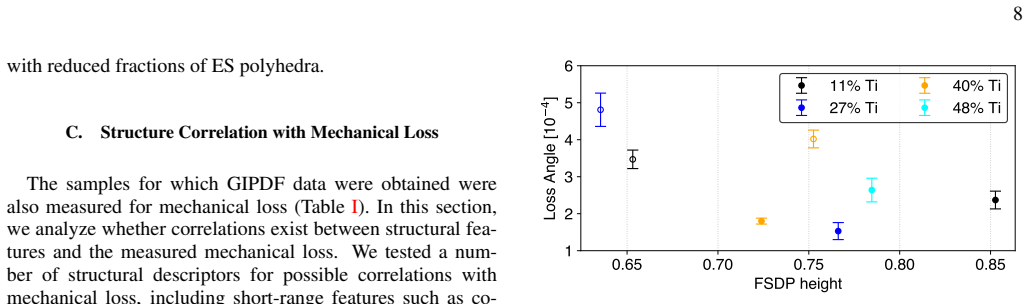
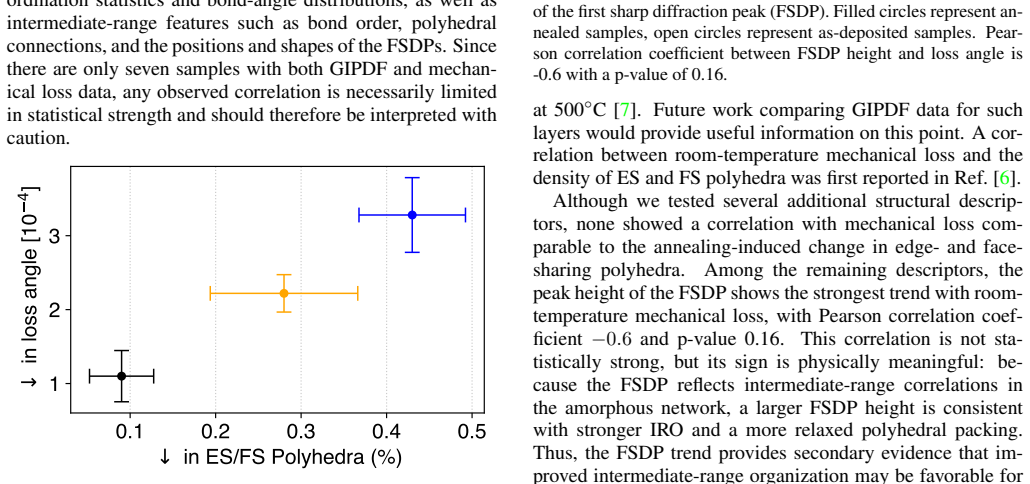
Increasing Ti content raises average Ti coordination and promotes edge- and face-sharing polyhedral connections while Ge remains predominantly fourfold coordinated. Annealing reduces these compact shared-polyhedron motifs and sharpens the first sharp diffraction peak. Among the structural descriptors examined, the clearest correlation with the annealing-induced reduction in mechanical loss is the decrease in edge- and face-sharing polyhedra.
Load-bearing premise
The chosen measures of local coordination and polyhedral connectivity are the main factors that set mechanical dissipation rather than other untracked features such as defects or impurities.
Editorial extensions
If this is right
- Raising Ti concentration systematically increases Ti coordination and compact polyhedral connections.
- Annealing relaxes the network by cutting edge- and face-sharing motifs and sharpening intermediate-range order.
- Mechanical-loss reduction after annealing tracks the decline in these shared polyhedra more closely than other tracked descriptors.
- The measured links between composition, annealing, structure, and dissipation supply concrete targets for tuning coating recipes.
Reading between the lines
- The same polyhedral-sharing metric could be checked in other amorphous oxides used for precision mirrors to test whether it predicts loss across chemistries.
- In-situ X-ray monitoring during annealing might allow real-time adjustment of heat-treatment schedules to reach a target level of shared polyhedra.
- If the correlation holds, models of dissipation could incorporate polyhedral connectivity as a design variable without needing full mechanical tests on every new composition.
Editorial analysis
A structured set of objections, weighed in public.
Referee Report
Summary. The paper reports grazing-incidence X-ray pair distribution function measurements and atomic modeling of amorphous TiO2-doped GeO2 films (Ti cation fraction ~11–48 %) before and after annealing. It finds that increasing Ti content raises average Ti coordination and promotes edge- and face-sharing polyhedra while Ge remains ~4-fold; annealing reduces these compact motifs, sharpens the first sharp diffraction peak, and that the reduction in edge- and face-sharing polyhedra shows the clearest correlation with the observed drop in mechanical loss.
Significance. If the reported correlation is robust, the work supplies concrete microscopic guidance for reducing coating thermal noise in gravitational-wave detectors by linking composition, annealing, and specific polyhedral motifs to dissipation. The grazing-incidence PDF approach on thin films is a technical strength that enables direct structural characterization of the relevant layers.
major comments (1)
- [Abstract / structural-analysis section] Abstract and structural-analysis section: the central claim that the decrease in edge- and face-sharing polyhedra is the clearest correlate with annealing-induced mechanical-loss reduction is load-bearing, yet the manuscript does not demonstrate that this descriptor dominates over unmeasured variables (point defects, OH content, or longer-range relaxations) known to control TLS density in a-TiO2:GeO2; without multivariate regression or additional controls, the correlation cannot isolate the polyhedral motif as the dominant factor.
minor comments (2)
- [Methods] Notation for coordination numbers and sharing statistics should be defined explicitly in the methods or first results paragraph to avoid ambiguity when comparing pre- and post-anneal data.
- [Experimental methods] The range of the measured PDF and the Q-resolution of the grazing-incidence setup should be stated so readers can assess the reliability of the intermediate-range order (FSDP) sharpening.
Simulated Author's Rebuttal
We thank the referee for their constructive comments and positive assessment of the work's significance. We respond to the single major comment below.
read point-by-point responses
-
Referee: [Abstract / structural-analysis section] Abstract and structural-analysis section: the central claim that the decrease in edge- and face-sharing polyhedra is the clearest correlate with annealing-induced mechanical-loss reduction is load-bearing, yet the manuscript does not demonstrate that this descriptor dominates over unmeasured variables (point defects, OH content, or longer-range relaxations) known to control TLS density in a-TiO2:GeO2; without multivariate regression or additional controls, the correlation cannot isolate the polyhedral motif as the dominant factor.
Authors: We agree that the observed correlation does not establish dominance or causality over unmeasured variables. The manuscript states only that the reduction in edge- and face-sharing polyhedra is the clearest correlation 'among the structural descriptors examined.' No multivariate regression or controls for point defects, OH content, or longer-range relaxations were performed because those quantities were not measured in the present grazing-incidence PDF study. The data do show that annealing systematically reduces these compact motifs while sharpening the FSDP, and that this structural change tracks the mechanical-loss reduction across the full composition range. We therefore consider the claim appropriately qualified as a correlation among measured descriptors rather than an assertion of dominance. No revision is required. revision: no
Circularity Check
No significant circularity in derivation chain
full rationale
The paper reports experimental grazing-incidence total X-ray scattering measurements yielding pair distribution functions, followed by standard atomic-structure modeling to extract coordination numbers, polyhedral sharing statistics, and FSDP features. The central claim is an empirical correlation between the annealing-induced decrease in edge- and face-sharing polyhedra and reduced mechanical loss; this is an observational result from measured data, not a quantity fitted to a subset and renamed as prediction, nor a self-definitional relation, nor dependent on load-bearing self-citations whose content reduces to the present inputs. No equations or ansatzes are invoked that make any reported descriptor equivalent to its inputs by construction. The derivation chain is self-contained against external benchmarks of PDF analysis.
Assumptions & free parameters
assumptions (1)
- domain assumption Pair distribution functions derived from grazing-incidence scattering faithfully represent bulk short- and intermediate-range order without significant surface or beam-geometry artifacts.
Cite this review
Pith. "Pith review of Atomic Structure of Amorphous Optical Coatings of TiO$_2$-doped GeO$_2$ by Grazing-Incidence Total X-ray Scattering Measurements." pith.science (2026). https://pith.science/paper/T54WMBHZ
@misc{pith2026260527462,
  author       = {Pith},
  title        = {Pith review of: Atomic Structure of Amorphous Optical Coatings of TiO$_2$-doped GeO$_2$ by Grazing-Incidence Total X-ray Scattering Measurements},
  year         = {2026},
  howpublished = {\url{https://pith.science/paper/T54WMBHZ}},
  note         = {Machine review of arXiv:2605.27462}
}
abstract
Reducing coating thermal noise in future gravitational-wave detectors requires identifying the atomic motifs that control mechanical loss in amorphous optical coatings. We combine grazing-incidence X-ray pair distribution function measurements with atomic-structure modeling to study amorphous TiO$_2$-doped GeO$_2$ films over Ti cation concentrations from $\sim$11 % to $\sim$48 %, before and after annealing. The structural analysis reveals systematic composition- and annealing-dependent changes in short- and intermediate-range order. Increasing Ti content raises the average Ti coordination and promotes edge- and face-sharing polyhedral connections, while Ge remains predominantly fourfold coordinated. Annealing reduces these compact shared-polyhedron motifs and sharpens the first sharp diffraction peak, indicating a more relaxed intermediate-range network. Among the structural descriptors examined, the clearest correlation with the annealing-induced reduction in mechanical loss is the decrease in edge- and face-sharing polyhedra. These results connect composition, annealing, atomic structure, and mechanical dissipation in TiO$_2$-doped GeO$_2$, providing microscopic guidance for optimizing low-noise mirror coatings.
Figures
Figures from the paper (7 more)
Forward citations
Cited by 1 Pith paper
-
Mechanical loss in amorphous solids: spatial correlations, interacting transitions, and annealed thermodynamic pathways
Atomic transitions causing mechanical loss in amorphous solids are spatially clustered and interact, requiring a connected-network description over independent two-level systems; flattening the energy landscape lowers...
Reference graph
Works this paper leans on
-
[1]
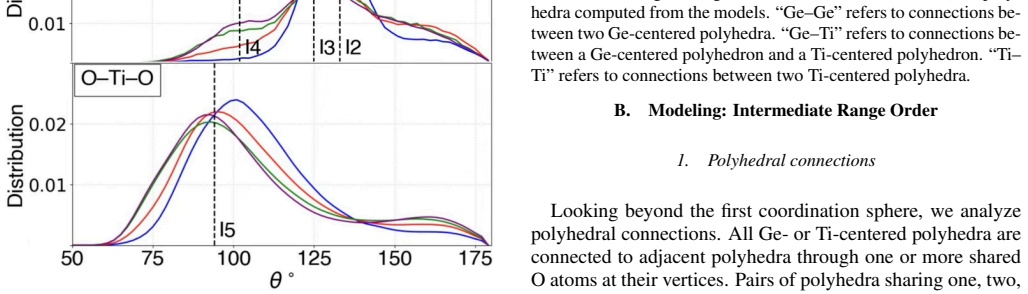
Ge–Ge” refers to connections be- tween two Ge-centered polyhedra. “Ge–Ti
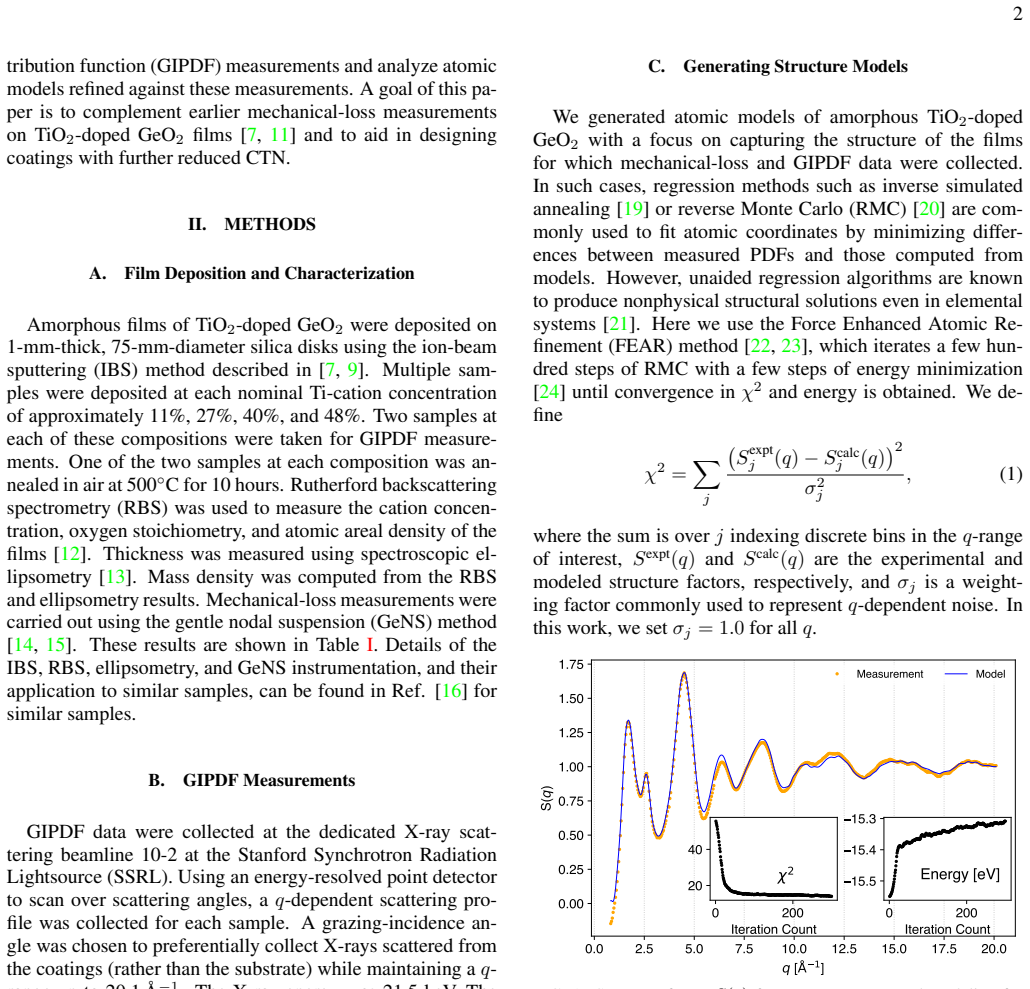
until convergence inχ 2 and energy is obtained. We de- fine χ2 = X j Sexpt j (q)−S calc j (q) 2 σ2 j ,(1) where the sum is overjindexing discrete bins in theq-range of interest,S expt(q)andS calc(q)are the experimental and modeled structure factors, respectively, andσ j is a weight- ing factor commonly used to representq-dependent noise. In this work, we ...
-
[2]
All Ge- or Ti-centered polyhedra are connected to adjacent polyhedra through one or more shared O atoms at their vertices
Polyhedral connections Looking beyond the first coordination sphere, we analyze polyhedral connections. All Ge- or Ti-centered polyhedra are connected to adjacent polyhedra through one or more shared O atoms at their vertices. Pairs of polyhedra sharing one, two, or three (or more) vertices are commonly referred to as corner- sharing (CS), edge-sharing (E...
-
[3]
Here,q 6 is a rotation- 7 0.0 0.2 0.4 0.6 0.8 q6 0 200 400Distribution anatase rutile q6 Ge 11% Ti 27% Ti 40% Ti 48% Ti FIG
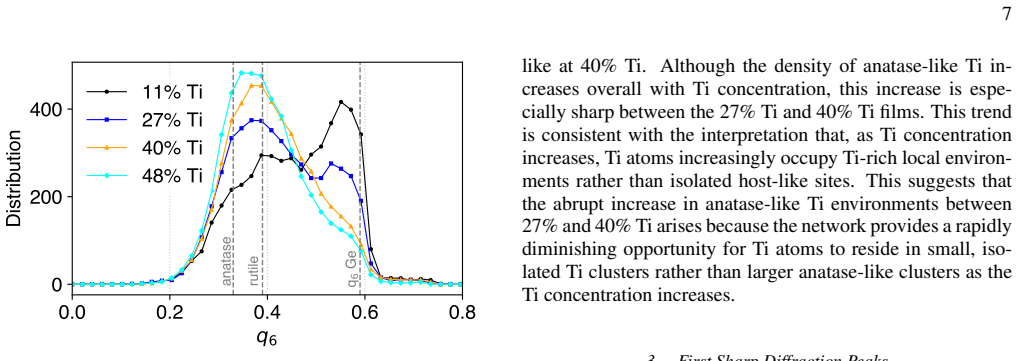
Bond-orientational order around Ti We analyze the Steinhardt bond-orientational order param- eters [32], focusing onq 6 for Ti atoms in the models, to assess the extent to which local Ti environments resemble those of common crystalline TiO2 polymorphs. Here,q 6 is a rotation- 7 0.0 0.2 0.4 0.6 0.8 q6 0 200 400Distribution anatase rutile q6 Ge 11% Ti 27% ...
-
[4]
A higher value ofq 6 for a given Ti atom indicates that its bond pattern projects more strongly onto sixfold angular sym- metry. The precise numerical value ofq 6 depends on how the neighbor shell is defined, such as the cutoff distance and/or the number of neighbors included; therefore, absolute values should be interpreted only within the same analysis ...
-
[5]
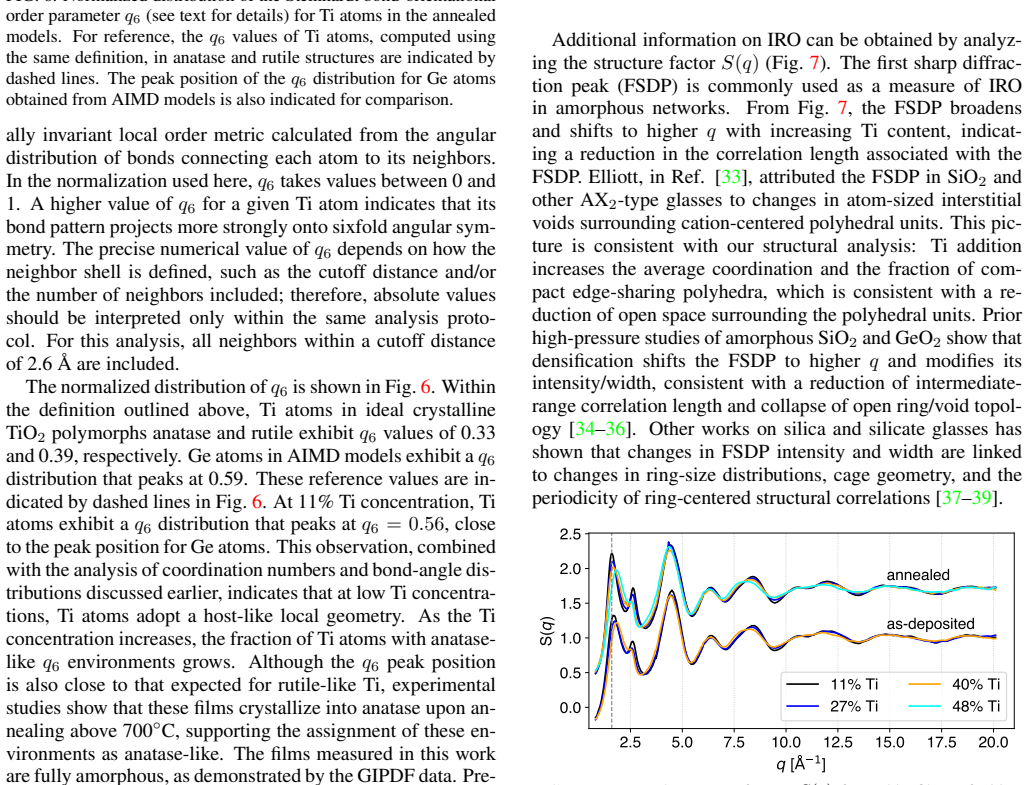
First Sharp Diffraction Peaks Additional information on IRO can be obtained by analyz- ing the structure factorS(q)(Fig. 7). The first sharp diffrac- tion peak (FSDP) is commonly used as a measure of IRO in amorphous networks. From Fig. 7, the FSDP broadens and shifts to higherqwith increasing Ti content, indicat- ing a reduction in the correlation length...
-
[6]
The BKS and Morse parameters are given in Table III
Long-range Coulomb interactions were evaluated using Ewald summation with a tolerance of10 −6. The BKS and Morse parameters are given in Table III. Cation–cation pairs were included through the Coulomb part of the interaction, with zero short-range Buckingham parameters. TABLE III. BKS and Morse two-body force-field parameters used for the oxide network. ...
-
[7]
D. V . Martynov, E. Hall, B. Abbott, R. Abbott, T. Abbott, C. Adams, R. Adhikari, R. Anderson, S. Anderson, K. Arai, et al., Physical Review D93, 112004 (2016)
2016
-
[8]
Buikema, C
A. Buikema, C. Cahillane, G. Mansell, C. Blair, R. Abbott, C. Adams, R. Adhikari, A. Ananyeva, S. Appert, K. Arai,et al., Physical Review D102, 062003 (2020)
2020
Show all 53 references
-
[9]
Granata, A
M. Granata, A. Amato, L. Balzarini, M. Canepa, J. Degallaix, D. Forest, V . Dolique, L. Mereni, C. Michel, L. Pinard,et al., Classical and Quantum Gravity37, 095004 (2020)
2020
-
[10]
Amato, S
A. Amato, S. Terreni, V . Dolique, D. Forest, G. Gemme, M. Granata, L. Mereni, C. Michel, L. Pinard, B. Sassolas,et al., Journal of Physics: Materials2, 035004 (2019)
2019
-
[11]
Punturo, M
M. Punturo, M. Abernathy, F. Acernese, B. Allen, N. Anders- son, K. Arun, F. Barone, B. Barr, M. Barsuglia, M. Beker,et al., Classical and Quantum Gravity27, 194002 (2010)
2010
-
[12]
Prasai, J
K. Prasai, J. Jiang, A. Mishkin, B. Shyam, S. Angelova, R. Bir- ney, D. Drabold, M. Fazio, E. Gustafson, G. Harry,et al., Phys- ical review letters123, 045501 (2019)
2019
-
[13]
Vajente, L
G. Vajente, L. Yang, A. Davenport, M. Fazio, A. Ananyeva, L. Zhang, G. Billingsley, K. Prasai, A. Markosyan, R. Bassiri, et al., Physical Review Letters127, 071101 (2021)
2021
-
[14]
Vajente, R
G. Vajente, R. Birney, A. Ananyeva, S. Angelova, R. Asselin, B. Baloukas, R. Bassiri, G. Billingsley, M. Fejer, D. Gibson, et al., Classical and Quantum Gravity35, 075001 (2018)
2018
-
[15]
L. Yang, G. Vajente, M. Fazio, A. Ananyeva, G. Billingsley, A. Markosyan, R. Bassiri, K. Prasai, M. M. Fejer, M. Chicoine, et al., Science advances7, eabh1117 (2021)
2021
-
[16]
Abernathy, A
M. Abernathy, A. Amato, A. Ananyeva, S. Angelova, B. Baloukas, R. Bassiri, G. Billingsley, R. Birney, G. Cagnoli, M. Canepa,et al., Classical and Quantum Gravity38, 195021 (2021)
2021
-
[17]
Khadka, A
S. Khadka, A. Markosyan, K. Prasai, A. Dana, L. Yang, S. Tait, I. Martin, C. Menoni, M. Fejer, and R. Bassiri, Classical and Quantum Gravity40, 205002 (2023)
2023
-
[18]
Chu,Backscattering spectrometry(Elsevier, 2012)
W.-K. Chu,Backscattering spectrometry(Elsevier, 2012)
2012
-
[19]
Fujiwara,Spectroscopic ellipsometry: principles and appli- cations(John Wiley & Sons, 2007)
H. Fujiwara,Spectroscopic ellipsometry: principles and appli- cations(John Wiley & Sons, 2007)
2007
-
[20]
Cesarini, M
E. Cesarini, M. Lorenzini, E. Campagna, F. Martelli, F. Pier- giovanni, F. Vetrano, G. Losurdo, and G. Cagnoli, Review of Scientific Instruments80(2009)
2009
-
[21]
Vajente, A
G. Vajente, A. Ananyeva, G. Billingsley, E. Gustafson, A. Hep- tonstall, E. Sanchez, and C. Torrie, Review of Scientific Instru- ments88(2017)
2017
-
[22]
Lalande, A
E. Lalande, A. Davenport, L. Marchand, A. Markosyan, D. Martinez, A. Paolone, M. Rezac, M. Bazzan, M. Chicoine, J. L. Colaux,et al., Classical and Quantum Gravity41, 115013 (2024)
2024
-
[23]
Shyam, K
B. Shyam, K. H. Stone, R. Bassiri, M. M. Fejer, M. F. Toney, and A. Mehta, Scientific reports6, 1 (2016)
2016
-
[24]
X. Qiu, J. W. Thompson, and S. J. Billinge, Journal of Applied Crystallography37, 678 (2004)
2004
-
[25]
J. H. Los and T. D. K ¨uhne, Physical Review B87, 214202 (2013)
2013
-
[26]
Keen and R
D. Keen and R. McGreevy, Nature344, 423 (1990)
1990
-
[27]
Drabold, The European Physical Journal B68, 1 (2009)
D. Drabold, The European Physical Journal B68, 1 (2009)
2009
-
[28]
Pandey, P
A. Pandey, P. Biswas, and D. Drabold, Physical Review B92, 155205 (2015)
2015
-
[29]
Pandey, P
A. Pandey, P. Biswas, and D. A. Drabold, Scientific Reports6, 1 (2016)
2016
-
[30]
Gu ´enol´e, W
J. Gu ´enol´e, W. G. N ¨ohring, A. Vaid, F. Houll ´e, Z. Xie, A. Prakash, and E. Bitzek, Computational Materials Science 175, 109584 (2020)
2020
-
[31]
Jiang, R
J. Jiang, R. Zhang, K. Prasai, R. Bassiri, J. N. Fry, M. M. Fejer, and H.-P. Cheng, Physical Review Materials9, 105604 (2025)
2025
-
[32]
Bernardes, Physical review112, 1534 (1958)
N. Bernardes, Physical review112, 1534 (1958)
1958
-
[33]
J. F. Ziegler and J. P. Biersack, inTreatise on Heavy-Ion Sci- ence: V olume 6: Astrophysics, Chemistry, and Condensed Mat- ter(Springer, 1985) pp. 93–129
1985
-
[34]
D. A. Keen, Applied Crystallography34, 172 (2001)
2001
-
[35]
Neuefeind and K.-D
J. Neuefeind and K.-D. Liss, Berichte der Bunsengesellschaft f¨ur physikalische Chemie100, 1341 (1996)
1996
-
[36]
Triana, C
C. Triana, C. M. Araujo, R. Ahuja, G. A. Niklasson, and T. Ed- vinsson, Physical Review B94, 165129 (2016)
2016
-
[37]
Zhang, R
R. Zhang, R. Osovsky, J. Jiang, J. N. Fry, M. M. Fejer, C. S. Menoni, and H.-P. Cheng, Physical Review Materials10, 013601 (2026)
2026
-
[38]
P. J. Steinhardt, D. R. Nelson, and M. Ronchetti, Physical Re- view B28, 784 (1983)
1983
-
[39]
Elliott, Physical review letters67, 711 (1991)
S. Elliott, Physical review letters67, 711 (1991)
1991
-
[40]
Sampath, C
S. Sampath, C. Benmore, K. Lantzky, J. Neuefeind, K. Leinen- weber, D. Price, and J. Yarger, Physical Review Letters90, 115502 (2003)
2003
-
[41]
Guthrie, C
M. Guthrie, C. Tulk, C. Benmore, J. Xu, J. Yarger, D. Klug, J. Tse, H. Mao, and R. Hemley, Physical Review Letters93, 115502 (2004)
2004
-
[42]
Benmore, E
C. Benmore, E. Soignard, S. Amin, M. Guthrie, S. Shastri, P. Lee, and J. Yarger, Physical Review B81, 054105 (2010)
2010
-
[43]
Guerette, M
M. Guerette, M. R. Ackerson, J. Thomas, F. Yuan, E. Bruce Watson, D. Walker, and L. Huang, Scientific reports 5, 15343 (2015)
2015
-
[44]
Y . Shi, J. Neuefeind, D. Ma, K. Page, L. A. Lamberson, N. J. Smith, A. Tandia, and A. P. Song, Journal of Non-Crystalline Solids516, 71 (2019)
2019
-
[45]
Kobayashi, M
K. Kobayashi, M. Okumura, H. Nakamura, M. Itakura, M. Machida, S. Urata, and K. Suzuya, Scientific Reports13, 18721 (2023)
2023
-
[46]
Trinastic, R
J. Trinastic, R. Hamdan, Y . Wu, L. Zhang, and H.-P. Cheng, The Journal of Chemical Physics139, 154506 (2013)
2013
-
[47]
Kresse and J
G. Kresse and J. Hafner, Physical Review B47, 558 (1993)
1993
-
[48]
Kresse and J
G. Kresse and J. Furthm ¨uller, Physical Review B54, 11169 (1996)
1996
-
[49]
P. E. Bl ¨ochl, Physical Review B50, 17953 (1994)
1994
-
[50]
J. P. Perdew, K. Burke, and M. Ernzerhof, Physical Review Letters77, 3865 (1996)
1996
-
[51]
Prasai, R
K. Prasai, R. Bassiri, H.-P. Cheng, and M. M. Fejer, APL Ma- terials11(2023)
2023
-
[52]
Nakano, R
A. Nakano, R. K. Kalia, and P. Vashishta, Journal of non- crystalline solids171, 157 (1994)
1994
-
[53]
Mora-Fonz and A
D. Mora-Fonz and A. L. Shluger, Physical Review B99, 014202 (2019)
2019
Reviewed June 29, 2026 · model on record in the stance chip above.
Discussion (0). Continue with ORCID to comment.