REVIEW 3 major objections 4 minor 42 references
Establishing Strong Baselines for the New Decade: Sequence Tagging, Syntactic and Semantic Parsing with BERT
T0 review · 3 major / 4 minor · reviewed 2026-08-14 · deepseek-v4-flash
Pith's one-line read This paper claims that a simple recipe—precomputed averaged BERT token embeddings fed into a plain Bi-LSTM-CRF tagger or a stripped-down biaffine parser—beats previous state-of-the-art systems on 11 of 12 English and Chinese benchmarks.
desk verdict Solid, reproducible BERT baseline paper whose '11 of 12 SOTA' claim is probably right but rests partly on unverified external scores, and the semantic-over-syntactic conclusion overreaches. read the letter →
The pith
A machine-rendered reading of the paper's core claim, the machinery that carries it, and where it could break.
The reading
What carries the argument
The load-bearing object is the average token-level BERT embedding: for each token split into WordPiece subwords, average the vectors of those subwords from BERT's last layer and treat the result as a static input feature for the downstream encoder. The paper chooses averaging over taking the last subword and over inserting BERT embeddings at a hidden layer, based on small pilot experiments on Prague semantic dependencies; either choice would change the results. This mechanism matters because it separates BERT from the downstream model, allowing BERT to act as a drop-in representation layer while the task model stays simple and fast. The same frozen feature is then concatenated with or substituted for pre-trained word embeddings in a Bi-LSTM-CRF for tagging and in a biaffine parser whose output loss changes from softmax to sigmoid to handle graph-structured semantic dependencies.
What would settle it
Take the best previously published system for each of the 12 datasets and run it on the exact tokenized inputs and official evaluation scripts used in this paper; if that system's score equals or exceeds the paper's BERT score on any of the 11 claimed datasets, the '11 of 12' claim fails for that dataset.
Extended reading notes
Core claim
We show that the year-2019 state of the art in tagging and parsing does not require task-specific depth: take BERT's last-layer hidden states for a token, average the subword vectors, and feed that fixed vector into a plain recurrent tagger or a biaffine parser. On the Penn Treebank and Penn Chinese Treebank for POS tagging and dependency parsing, and on the SemEval 2015/2016 semantic dependency parsing datasets, this recipe sets new best published results on 11 of 12 benchmarks, outperforming previous systems by 2.5 points on average and by 7.5 points in the largest case. The only dataset where BERT does not surpass the comparison is English POS tagging, where a character-level language-model embedding baseline remains ahead. The paper interprets the pattern as evidence that BERT encodes meaning more than morphology or surface syntax, and that its bidirectional masked-language pretraining gives it an advantage on long-distance dependencies.
Load-bearing premise
The comparison assumes that the previously published scores quoted in Tables 3–6 were produced on the same tokenization, data splits, and evaluation metrics, because those systems are not re-run; a mismatch for any dataset could make a 'new state-of-the-art' result an artifact of the comparison.
Editorial extensions
If this is right
- Precomputed, averaged BERT embeddings can replace task-specific embedding engineering and still beat published state of the art, so strong baselines do not require GPU-heavy joint fine-tuning of BERT.
- The same encoder skeleton works for word-level tags, tree-structured dependencies, and graph-structured semantic dependencies in two languages, suggesting the model choice is largely orthogonal to the representation choice.
- Semantic parsing gains are the largest, up to 7.5 points on Chinese textbook data, which fits the paper's conclusion that BERT embeddings are more semantic than syntactic.
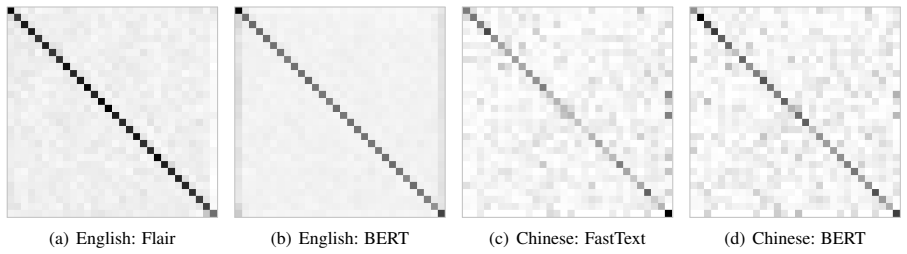
- On long sentences, BERT-based parsers lose less F1 than recurrent baselines as sentence length grows beyond about 20 tokens, so the embeddings mitigate the distance problem in dependency prediction.
- The English POS benchmark is the exception where BERT does not beat the character-level baseline, implying that morphological detail from character-level language models is still valuable for morphologically rich tagging.
Reading between the lines
- The frozen-embedding recipe suggests fine-tuning BERT on each downstream task might yield further gains, at the cost of far more compute; the paper does not test this because it deliberately decouples BERT from training.
- The '11 of 12' count depends on taking previously published scores at face value; an editor would want to re-run those systems on the identical tokenization and evaluation scripts before treating the count as stable.
- The attention-matrix evidence is observational; a causal test would be to feed BERT embeddings truncated to local context and see whether the long-sentence robustness disappears.
- If the released code reproduces the tables, the main contribution is a reusable strong baseline rather than a new architecture, which may be the more durable part of the paper.
Signed reviews
Editorial analysis
A structured set of objections, weighed in public.
Referee Report
Summary. The paper applies precomputed BERT token embeddings to three families of structured-prediction models: a Bi-LSTM-CRF tagger for POS tagging, a simplified biaffine parser for dependency parsing, and a biaffine semantic graph parser for semantic dependency parsing. Experiments cover 12 English and Chinese datasets. The authors report that their BERT-based models establish new state-of-the-art results on 11 of 12 datasets, with an average improvement of 2.5 percentage points. They also provide a qualitative analysis of BERT embeddings via self-attention matrices, a sentence-length robustness analysis, and a per-label analysis on one semantic formalism (PSD) leading to the claim that BERT embeddings are more related to semantics than syntax. The paper releases all models and source code and reports three-run averages with standard deviations.
Significance. If the empirical claims hold, the paper makes a valuable contribution: it demonstrates that relatively simple Bi-LSTM-CRF and biaffine models can outperform more complex prior systems on most evaluated benchmarks when supplied with precomputed BERT embeddings. The reproducibility measures are a strength: three independent runs, standard deviations, detailed data splits, hyperparameter tables, and a public code release. The direct comparison against previously published state-of-the-art systems across three tasks and two languages makes the paper a useful reference for future baseline work. The attention-based analysis, while qualitative, offers useful observations about where BERT embeddings help. The main limitation is that the central '11 of 12' claim depends on the comparability of scores reported by external systems that were not re-run, and two claimed wins have very thin margins.
major comments (3)
- [§4.2, Table 4(a) and §4.3, Table 5(b)] The central 'new state-of-the-art for 11 of 12 datasets' claim rests on the assumption that the previously published scores in Tables 3–6 were produced under the same data splits, preprocessing, and evaluation metrics as the authors' runs. Since the competing systems were not re-run, the comparison is an audit one. This matters concretely for two of the claimed wins: English dependency parsing LAS 95.29 vs. Clark et al. (2018) 95.0 (margin 0.29), and English out-of-domain PSD 79.48 vs. Dozat and Manning (2018) 79.4 (margin 0.08). These margins are smaller than typical differences introduced by dependency-conversion versions (the paper uses Stanford Parser 3.3.0, per Appendix A.2) or by semantic-scorer variants such as punctuation handling. The authors should either re-run the prior systems under their own pipeline, provide evidence that the external scores are directly comparable (e.g., same conversion and scorer), or explicitly soften the state-of-the-art claim to 'better than previously reported scores on the same official test sets' and identify the two fragile cases.
- [§3.4 and Appendix A.2] The biaffine parser input includes a lemma embedding e_LEM_i, but the manuscript does not state whether these lemmas are predicted by the model or taken from gold annotations. If gold lemmas are used, this would give the parser access to information that many prior systems (e.g., Clark et al. 2018, Ma et al. 2018) do not use, making the comparison unfair. The appendix specifies the source of POS tags (jackknifed predictions for English, gold for Chinese) but is silent on lemmas. The authors must state the lemma source; if gold lemmas are used, they should provide a version of the model without gold lemmas or at least discuss the impact.
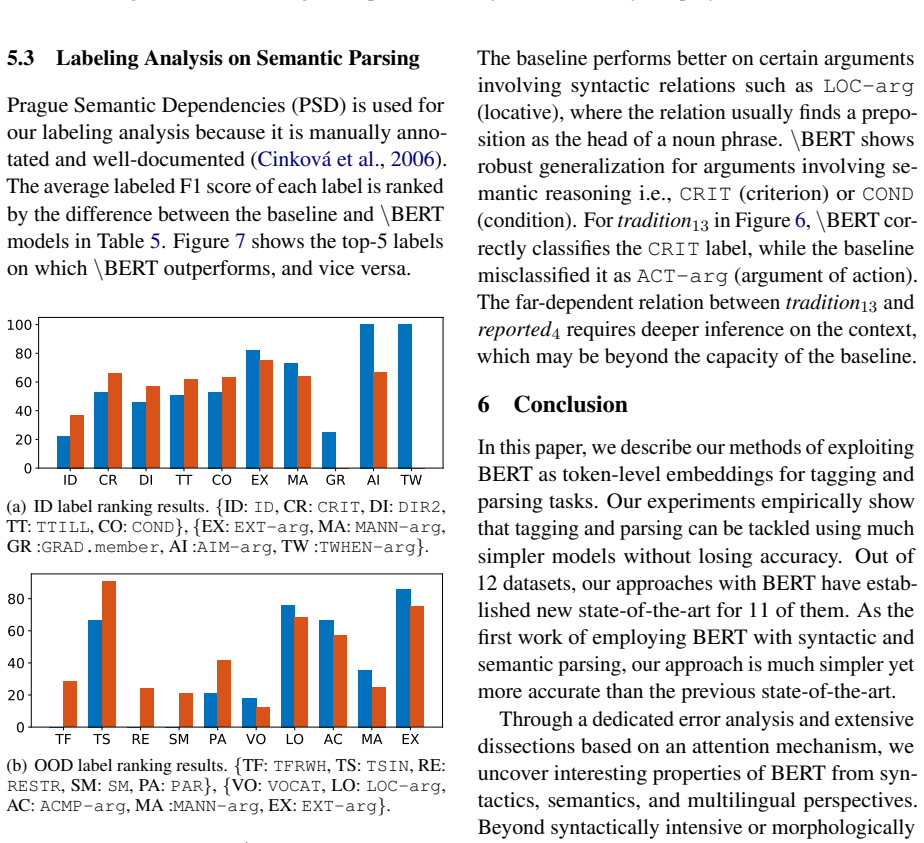
- [§5.3, Abstract, Conclusion] The paper's key finding that 'BERT embeddings are much more related to semantic than syntactic' is drawn entirely from the PSD formalism of the English semantic parsing data, using the difference in per-label F1 scores between baseline and \BERT. This is a single dataset and a single label-set; the conclusion is too broad. The claim appears in the abstract, introduction, and conclusion, so it is a load-bearing part of the paper's narrative. The authors should either restrict the conclusion to PSD (and note that other formalisms or tasks may behave differently) or support the claim with additional evidence, such as the same analysis on DM and PAS, or a comparison of BERT gains on POS versus semantic parsing tasks.
minor comments (4)
- [§3.3, Tables 3–6] The notation 'Baseline\ BERT' is confusing; it could be read as set subtraction or as a missing symbol. It is defined in the text, but a clearer label such as 'BERT-only' would improve readability.
- [Figure 4] The text immediately preceding Figure 4 contains a garbled line of '/uni00000033/...' characters that appears to be a PDF extraction artifact. This should be removed or corrected in the submitted version.
- [Abstract and §4] The abstract states 'outperform the previously best-performing models by 2.5% on average' without specifying how the average is computed across the 12 datasets. Please define the aggregation (e.g., macro-average over all 12 test sets of the difference between the best BERT model and the previous best score).
- [Table 14] The claim of model simplicity would be strengthened by reporting parameter counts or inference times alongside the training times, to support the 'simplified' characterization with quantitative evidence.
Circularity Check
No circularity: the paper's SOTA claims are empirical benchmark results measured against external datasets and published systems, not derived from its own assumptions.
full rationale
This paper is an empirical systems paper: its central claim is that simple taggers and biaffine parsers with precomputed BERT embeddings achieve new state-of-the-art scores on 11 of 12 benchmark datasets. The derivation chain is experimental measurement, not mathematical derivation. The BERT embeddings are an external pretrained resource cited from Devlin et al.; the baseline parsers and taggers are reimplementations of prior architectures; and the comparison scores are taken from published work on the same standard datasets. No fitted parameter is renamed as a prediction, no theory is justified solely by an author self-citation, and no uniqueness or forced-choice argument is imported from the authors' prior work. The only self-citations (e.g., NLP4J for auto-generated POS tags in Appendix A.2, Choi and McCallum for a transition system mentioned in Related Work) are ancillary tooling or background, not load-bearing. The analysis sections are post hoc interpretations of attention weights and sentence-length behavior, not predictions that would reduce by construction. Concerns about whether external published scores were produced under identical preprocessing or evaluation metrics are legitimate correctness or reproducibility risks, but they are not circularity: the paper does not define its SOTA target in terms of its own outputs, nor does it fit a quantity and then predict that same quantity. Therefore no circular step can be exhibited, and the appropriate score is 0.
Assumptions & free parameters
assumptions (3)
- domain assumption Standard benchmark datasets and splits are annotated correctly and are comparable across systems, including PTB3, CTB5.1, and SemEval 2015/2016.
- domain assumption Published previous state-of-the-art scores were obtained under the same preprocessing and evaluation protocols, or differences do not affect rankings.
- domain assumption The frozen BERT embeddings are treated as fixed inputs and are not task-fine-tuned, so improvements are attributed to BERT plus unchanged task models.
Cite this review
Pith. "Pith review of Establishing Strong Baselines for the New Decade: Sequence Tagging, Syntactic and Semantic Parsing with BERT." pith.science (2026). https://pith.science/paper/T57TC4KI
@misc{pith2026190804943,
  author       = {Pith},
  title        = {Pith review of: Establishing Strong Baselines for the New Decade: Sequence Tagging, Syntactic and Semantic Parsing with BERT},
  year         = {2026},
  howpublished = {\url{https://pith.science/paper/T57TC4KI}},
  note         = {Machine review of arXiv:1908.04943}
}
read the original abstract
This paper presents new state-of-the-art models for three tasks, part-of-speech tagging, syntactic parsing, and semantic parsing, using the cutting-edge contextualized embedding framework known as BERT. For each task, we first replicate and simplify the current state-of-the-art approach to enhance its model efficiency. We then evaluate our simplified approaches on those three tasks using token embeddings generated by BERT. 12 datasets in both English and Chinese are used for our experiments. The BERT models outperform the previously best-performing models by 2.5% on average (7.5% for the most significant case). Moreover, an in-depth analysis on the impact of BERT embeddings is provided using self-attention, which helps understanding in this rich yet representation. All models and source codes are available in public so that researchers can improve upon and utilize them to establish strong baselines for the next decade.
Figures


Figures from the paper (4 more)


Reference graph
Works this paper leans on
-
[1]
URL: " 'urlintro :=
ENTRY address author booktitle chapter edition editor howpublished institution journal key month note number organization pages publisher school series title type volume year eprint doi pubmed url lastchecked label extra.label sort.label short.list INTEGERS output.state before.all mid.sentence after.sentence after.block STRINGS urlintro eprinturl eprintpr...
-
[2]
write newline
" write newline "" before.all 'output.state := FUNCTION n.dashify 't := "" t empty not t #1 #1 substring "-" = t #1 #2 substring "--" = not "--" * t #2 global.max substring 't := t #1 #1 substring "-" = "-" * t #2 global.max substring 't := while if t #1 #1 substring * t #2 global.max substring 't := if while FUNCTION word.in bbl.in capitalize " " * FUNCT...
-
[3]
Alan Akbik, Duncan Blythe, and Roland Vollgraf. 2018. http://www.aclweb.org/anthology/C18-1139 Contextual String Embeddings for Sequence Labeling . In Proceedings of the 27th International Conference on Computational Linguistics, COLING'18, pages 1638--1649
work page 2018
-
[4]
Mariana S. C. Almeida and Andr\' e F. T. Martins. 2015. http://www.aclweb.org/anthology/S15-2162 Lisbon: Evaluating TurboSemanticParser on Multiple Languages and Out-of-Domain Data . In Proceedings of the 9th International Workshop on Semantic Evaluation, SemEval'15, pages 970--973
work page 2015
-
[5]
Artsiom Artsymenia, Palina Dounar, and Maria Yermakovich. 2016. http://www.aclweb.org/anthology/S16-1187 IHS-RD-Belarus at SemEval-2016 Task 9: Transition-based Chinese Semantic Dependency Parsing with Online Reordering and Bootstrapping . In Proceedings of the 10th International Workshop on Semantic Evaluation, SemEval'16, pages 1207--1211
work page 2016
-
[6]
Bernd Bohnet, Ryan McDonald, Gon \ A alo Sim \ A µes, Daniel Andor, Emily Pitler, and Joshua Maynez. 2018. http://www.aclweb.org/anthology/P18-1246 Morphosyntactic Tagging with a Meta-BiLSTM Model over Context Sensitive Token Encodings . In Proceedings of the 56th Annual Meeting of the Association for Computational Linguistics, ACL'18, pages 2642--2652
work page 2018
-
[7]
Piotr Bojanowski, Edouard Grave, Armand Joulin, and Tomas Mikolov. 2017. https://transacl.org/ojs/index.php/tacl/article/view/999 Enriching Word Vectors with Subword Information . Transactions of the Association for Computational Linguistics, 5:135--146
work page 2017
-
[8]
Wanxiang Che, Yanqiu Shao, Ting Liu, and Yu Ding. 2016. http://www.aclweb.org/anthology/S16-1167 SemEval-2016 Task 9: Chinese Semantic Dependency Parsing . In Proceedings of the 10th International Workshop on Semantic Evaluation, SemEval'16, pages 1074--1080
work page 2016
Show all 42 references
-
[9]
Do Kook Choe and Eugene Charniak. 2016. https://aclweb.org/anthology/D16-1257 Parsing as Language Modeling . In Proceedings of the Conference on Empirical Methods in Natural Language Processing, EMNLP'16, pages 2331--2336
2016
-
[10]
Jinho D. Choi. 2016. http://www.aclweb.org/anthology/N16-1031 Dynamic Feature Induction: The Last Gist to the State-of-the-Art . In Proceedings of the Conference of the North American Chapter of the Association for Computational Linguistics: Human Language Technologies, NAACL'...
2016
-
[11]
Choi and Andrew McCallum
Jinho D. Choi and Andrew McCallum. 2013. http://mirror.aclweb.org/acl2013/ Transition-based Dependency Parsing with Selectional Branching . In Proceedings of the 51st Annual Meeting of the Association for Computational Linguistics, ACL'13, pages 1052--1062
2013
-
[12]
Silvie Cinkov \'a , Jan Haji c , Marie Mikulov \'a , Lucie Mladov \'a , Anja Nedolu z ko, Petr Pajas, Jarmila Panevov \'a , Ji r \' Semeck \`y , Jana S indlerov \'a , Josef Toman, et al. 2006. https://ufal.mff.cuni.cz/techrep/tr35.pdf Annotation of English on the Tectogrammati...
2006
-
[13]
Manning, and Quoc Le
Kevin Clark, Minh-Thang Luong, Christopher D. Manning, and Quoc Le. 2018. http://www.aclweb.org/anthology/D18-1217 Semi-Supervised Sequence Modeling with Cross-View Training . In Proceedings of the Conference on Empirical Methods in Natural Language Processing, EMNLP'18, pages...
2018
-
[14]
Jacob Devlin, Ming-Wei Chang, Kenton Lee, and Kristina Toutanova. 2018. http://arxiv.org/abs/1810.04805 BERT: Pre-training of Deep Bidirectional Transformers for Language Understanding . arXiv, 1810.04805
2018 arXiv
-
[15]
Timothy Dozat and Christopher D. Manning. 2017. https://openreview.net/pdf?id=Hk95PK9le Deep Biaffine Attention for Neural Dependency Parsing . In Proceedings of the 5th International Conference on Learning Representations, ICLR'17
2017
-
[16]
Timothy Dozat and Christopher D. Manning. 2018. http://www.aclweb.org/anthology/P18-2077 Simpler but More Accurate Semantic Dependency Parsing . In Proceedings of the 56th Annual Meeting of the Association for Computational Linguistics, ACL'18, pages 484--490
2018
-
[17]
Yantao Du, Fan Zhang, Xun Zhang, Weiwei Sun, and Xiaojun Wan. 2015. http://www.aclweb.org/anthology/S15-2154 Peking: Building Semantic Dependency Graphs with a Hybrid Parser . In Proceedings of the 9th International Workshop on Semantic Evaluation, SemEval'15, pages 927--931
2015
-
[18]
Jun Hatori, Takuya Matsuzaki, Yusuke Miyao, and Jun'ichi Tsujii. 2011. http://www.aclweb.org/anthology/I11-1136 Incremental Joint POS Tagging and Dependency Parsing in Chinese . In Proceedings of 5th International Joint Conference on Natural Language Processing, IJCNLP'11, pag...
2011
-
[19]
Zhiheng Huang, Wei Xu, and Kai Yu. 2015. https://arxiv.org/abs/1508.01991 Bidirectional LSTM-CRF Models for Sequence Tagging . arXiv, 1508.01991
2015 arXiv
-
[20]
Zhongqiang Huang, Mary Harper, and Wen Wang. 2007. http://www.aclweb.org/anthology/D/D07/D07-1117 Mandarin Part-of-Speech Tagging and Discriminative Reranking . In Proceedings of the Joint Conference on Empirical Methods in Natural Language Processing and Computational Natural...
2007
-
[21]
Armand Joulin, Edouard Grave, Piotr Bojanowski, and Tomas Mikolov. 2017. https://www.aclweb.org/anthology/E17-2068 Bag of Tricks for Efficient Text Classification . In Proceedings of the 15th Conference of the European Chapter of the Association for Computational Linguistics, ...
2017
-
[22]
Urvashi Khandelwal, He He, Peng Qi, and Dan Jurafsky. 2018. http://www.aclweb.org/anthology/P18-1027 Sharp Nearby, Fuzzy Far Away: How Neural Language Models Use Context . In Proceedings of the 56th Annual Meeting of the Association for Computational Linguistics, ACL'18, pages...
2018
-
[23]
Adhiguna Kuncoro, Miguel Ballesteros, Lingpeng Kong, Chris Dyer, Graham Neubig, and Noah A. Smith. 2017. http://www.aclweb.org/anthology/E17-1117 What Do Recurrent Neural Network Grammars Learn About Syntax? In Proceedings of the 15th Conference of the European Chapter of the ...
2017
-
[24]
Shuhei Kurita, Daisuke Kawahara, and Sadao Kurohashi. 2017. http://aclweb.org/anthology/P17-1111 Neural Joint Model for Transition-based Chinese Syntactic Analysis . In Proceedings of the 55th Annual Meeting of the Association for Computational Linguistics, ACL'17, pages 1204--1214
2017
-
[25]
Wang Ling, Chris Dyer, Alan W Black, Isabel Trancoso, Ramon Fermandez, Silvio Amir, Luis Marujo, and Tiago Luis. 2015. http://aclweb.org/anthology/D15-1176 Finding Function in Form: Compositional Character Models for Open Vocabulary Word Representation . In Proceedings of the ...
2015
-
[26]
Thang Luong, Hieu Pham, and Christopher D. Manning. 2015. http://aclweb.org/anthology/D15-1166 Effective Approaches to Attention-based Neural Machine Translation . In Proceedings of the Conference on Empirical Methods in Natural Language Processing, EMNLP'15, pages 1412--1421
2015
-
[27]
Xuezhe Ma and Eduard Hovy. 2016. http://www.aclweb.org/anthology/P16-1101 End-to-end Sequence Labeling via Bi-directional LSTM-CNNs-CRF . In Proceedings of the 54th Annual Meeting of the Association for Computational Linguistics, ACL'16, pages 1064--1074
2016
-
[28]
Xuezhe Ma, Zecong Hu, Jingzhou Liu, Nanyun Peng, Graham Neubig, and Eduard Hovy. 2018. http://www.aclweb.org/anthology/P18-1130 Stack-Pointer Networks for Dependency Parsing . In Proceedings of the 56th Annual Meeting of the Association for Computational Linguistics, ACL'18, p...
2018
-
[29]
Marcus, Mary Ann Marcinkiewicz, and Beatrice Santorini
Mitchell P. Marcus, Mary Ann Marcinkiewicz, and Beatrice Santorini. 1993. http://aclweb.org/anthology/J93-2004 Building a Large Annotated Corpus of English: The Penn Treebank . Computational Linguistics, 19(2):313--330
1993
-
[30]
Tomas Mikolov, Ilya Sutskever, Kai Chen, Greg S Corrado, and Jeff Dean. 2013. https://papers.nips.cc/paper/5021-distributed-representations-of-words-and-phrases-and-their-compositionality.pdf Distributed Representations of Words and Phrases and their Compositionality . In Adva...
2013
-
[31]
Stephan Oepen, Marco Kuhlmann, Yusuke Miyao, Daniel Zeman, Silvie Cinkova, Dan Flickinger, Jan Hajic, and Zdenka Uresova. 2015. http://www.aclweb.org/anthology/S15-2153 SemEval 2015 Task 18: Broad-Coverage Semantic Dependency Parsing . In Proceedings of the 9th International W...
2015
-
[32]
Hao Peng, Sam Thomson, and Noah A. Smith. 2017. http://aclweb.org/anthology/P17-1186 Deep Multitask Learning for Semantic Dependency Parsing . In Proceedings of the 55th Annual Meeting of the Association for Computational Linguistics, ACL'17, pages 2037--2048
2017
-
[33]
Jeffrey Pennington, Richard Socher, and Christopher Manning. 2014. http://aclweb.org/anthology/D14-1162 GloVe: Global Vectors for Word Representation . In Proceedings of the conference on empirical methods in natural language processing, EMNLP'14, pages 1532--1543
2014
-
[34]
Matthew Peters, Mark Neumann, Mohit Iyyer, Matt Gardner, Christopher Clark, Kenton Lee, and Luke Zettlemoyer. 2018. http://www.aclweb.org/anthology/N18-1202 Deep Contextualized Word Representations . In Proceedings of the Conference of the North American Chapter of the Associa...
2018
-
[35]
Alec Radford, Karthik Narasimhan, Tim Salimans, and Ilya Sutskever. 2018. https://s3-us-west-2.amazonaws.com/openai-assets/research-covers/language-unsupervised/language_understanding_paper.pdf Improving Language Understanding by Generative Pre-training . Technical report, OpenAI
2018
-
[36]
Yuxuan Wang, Wanxiang Che, Jiang Guo, and Ting Liu. 2018. https://aaai.org/ocs/index.php/AAAI/AAAI18/paper/view/16549/16113 A Neural Transition-Based Approach for Semantic Dependency Graph Parsing . In Proceedings of the 32nd AAAI Conference on Artificial Intelligence, AAAI'18...
2018
-
[37]
Zhiguo Wang and Nianwen Xue. 2014. http://www.aclweb.org/anthology/P14-1069 Joint POS Tagging and Transition-based Constituent Parsing in Chinese with Non-local Features . In Proceedings of the 52nd Annual Meeting of the Association for Computational Linguistics, ACL'14, pages...
2014
-
[38]
Yonghui Wu, Mike Schuster, Zhifeng Chen, Quoc V Le, Mohammad Norouzi, Wolfgang Macherey, Maxim Krikun, Yuan Cao, Qin Gao, Klaus Macherey, et al. 2016. https://arxiv.org/abs/1609.08144 Google's Neural Machine Translation System: Bridging the Gap between Human and Machine Transl...
2016 arXiv
-
[39]
Naiwen Xue, Fei Xia, Fu-dong Chiou, and Marta Palmer. 2005. https://doi.org/10.1017/S135132490400364X The Penn Chinese TreeBank: Phrase Structure Annotation of a Large Corpus . Natural Language Engineering, 11(2):207--238
2005 doi
-
[40]
Meishan Zhang, Yue Zhang, Wanxiang Che, and Ting Liu. 2014. http://www.aclweb.org/anthology/P14-1125 Character-Level Chinese Dependency Parsing . In Proceedings of the 52nd Annual Meeting of the Association for Computational Linguistics, ACL'14, pages 1326--1336
2014
-
[41]
Yuan Zhang, Chengtao Li, Regina Barzilay, and Kareem Darwish. 2015. http://www.aclweb.org/anthology/N15-1005 Randomized Greedy Inference for Joint Segmentation, POS Tagging and Dependency Parsing . In Proceedings of the Conference of the North American Chapter of the Associati...
2015
-
[42]
Yue Zhang and Stephen Clark. 2008. http://www.aclweb.org/anthology/D08-1059 A Tale of Two Parsers: Investigating and Combining Graph-based and Transition-based Dependency Parsing . In Proceedings of the Conference on Empirical Methods in Natural Language Processing, EMNLP'08, ...
2008
Reviewed August 14, 2026 · model on record in the stance chip above.
Discussion (0). Continue with ORCID to comment.