REVIEW 2 major objections 5 minor 42 references
Barrier Function Overrides For Non-Convex Fixed Wing Flight Control and Self-Driving Cars
T0 review · 2 major / 5 minor · reviewed 2026-08-15 · deepseek-v4-flash
Pith's one-line read Approximate barrier overrides give reinforcement-learned aircraft and cars zero safety violations with reward close to unconstrained RL.
desk verdict Fixed-wing half is solid and the override comparison is useful, but the lead-vehicle barrier proof for the car has a real gap that must be fixed before the central safety claim for driving is credible. read the letter →
The pith
A machine-rendered reading of the paper's core claim, the machinery that carries it, and where it could break.
The reading
What carries the argument
The load-bearing objects are the evasive control laws and the terminal-position function $\eta$. For the fixed-wing system, the evasive control $e_u(s_k)=(e_T,e_n,0)$ keeps speed constant, raises pitch toward its upper limit, and preserves altitude; five margin functions $b_1,\dots,b_5$ are each improved by this same control, and Lemma 4 turns that common improvement into a barrier for their minimum. For the double integrator, $\eta(s_k,e_a)$ is the position where the vehicle would rest if it applied a chosen braking profile $\mathrm{eudbl}$ forever; continuity, one-step invariance, and monotonicity in velocity (Lemma 5) make $h_{L,dbl}=\min(p_k,\eta)-p_{\min}$ and the symmetric upper barrier DT-ECBFs. The car barrier reuses $\eta$ on the kinematic bicycle model, with $h_{j,lead}$ comparing the lead car's terminal position to the ego car's terminal position and the full $h_{car}$ combining lane, speed, and lead-vehicle conditions with max/min so that a lane change is allowed while at least one lane remains safe. The proof of Theorem 4 rests on the stated identity $\eta_{1,k}(v_{3,k})=\eta_{1,k+1}(v_{3,k}+\delta\,\mathrm{eudbl}_{1,k}(v_{1,k}))$; the paper attributes this to Lemma 5c, but Lemma 5c only establishes invariance under the braking law applied to the state's own speed, so for $v_{1,k}\ne v_{3,k}$ the identity is not a consequence of that lemma.
What would settle it
Run the double-integrator dynamics (21) with $v_{1,k}>v_{3,k}\ge0$ and compute both sides of $\eta_{1,k}(v_{3,k})$ and $\eta_{1,k+1}(v_{3,k}+\delta\,\mathrm{eudbl}_{1,k}(v_{1,k}))$ over a grid of speeds and timesteps. Any parameter instance where the two values differ falsifies the identity used in Theorem 4's Case 2b; the question would then be whether a weaker inequality involving the headway $\tau_{\rm head}$ can still make $c_{h_{1,lead}}\ge0$.
Extended reading notes
Core claim
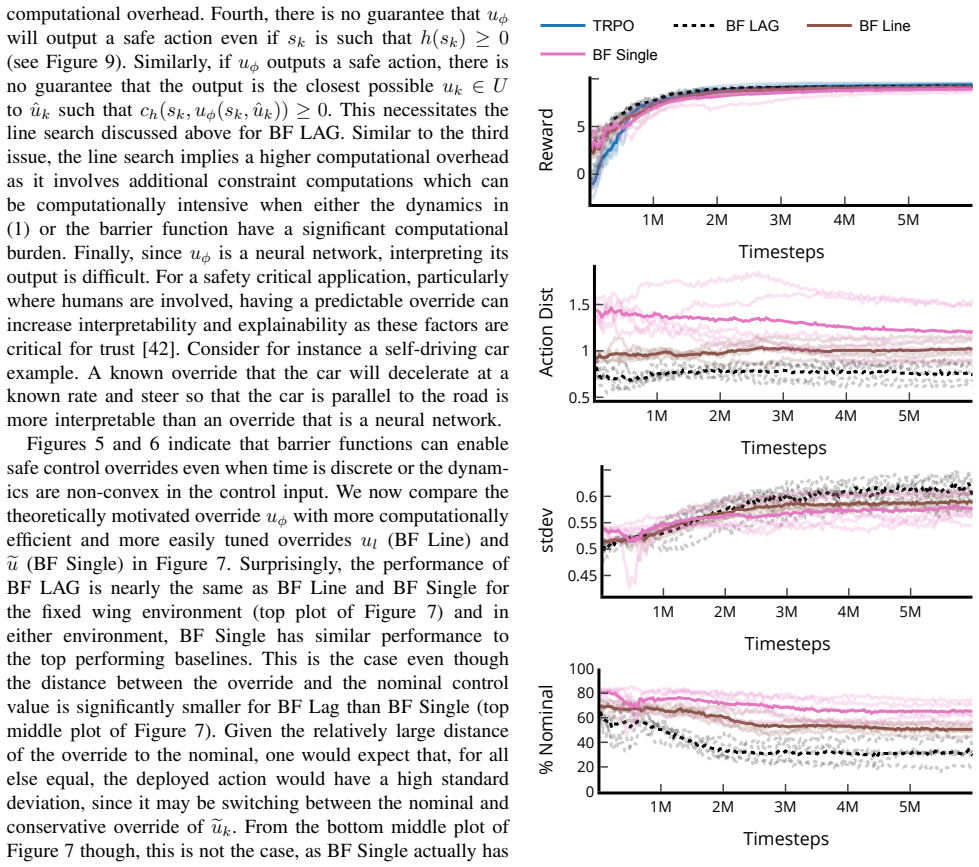
The paper's claim is that discrete-time exponential control barrier functions (DT-ECBFs) can be derived for fixed-wing aircraft and for self-driving cars in a lane-merging scenario, and that approximate safety overrides of the reinforcement-learning control input are enough to keep the system safe while preserving RL-level performance. A DT-ECBF is a state-dependent safety measure required not to fall faster than a fixed decay rate after one discrete step; if it starts nonnegative and that inequality is maintained, the safe set is invariant. For the aircraft, the barrier is the minimum of margins on speed, pitch, and altitude, kept invariant by an evasive control that holds speed, raises pitch, and preserves altitude. For the car, the barrier is a max/min composition of lane-boundary, speed-limit, and lead-vehicle stopping-distance conditions built from a terminal-position function for the kinematic bicycle model. The experimental finding is that a learned Lagrangian override, a line-search override, and the pure evasive maneuver all produce zero safety violations during training, and the pure evasive maneuver matches the best baseline's reward in both environments.
Load-bearing premise
The load-bearing premise is that a computed 'where the lead car would stop' quantity stays invariant when the ego car's speed is inserted into the lead car's braking update; the cited lemma only covers braking applied to the state's own speed, so this identity is not established and fails in simple parameter regimes, and without it the lead-vehicle barrier's safety guarantee is not proven.
Editorial extensions
If this is right
- A barrier-function override can be active during RL exploration, not only after training: in both environments the override methods report zero unsafe episodes, while every comparison baseline accumulates thousands.
- Practitioners do not need to solve the non-convex closest-safe-action problem: the fixed evasive override matches the best baselines, so the cheapest certified control can be used.
- Training with the override in the loop lets the policy adapt to it, which the paper suggests is why a crude override works: the override is applied rarely and the action variance stays low.
- For a non-convex system with a known conservative evasive profile, the construction suggests that the barrier layer can be deployed without solving a non-convex optimization at each step, which is the main online bottleneck the paper identifies.
- The reported timings give a quantitative benefit: the fixed evasive override trains roughly 1.7 times faster than the learned override for the aircraft and 3.0 times faster for the car.
Reading between the lines
- A natural next test, not run in the paper, is to train the RL policy without any override and then enable the fixed evasive override only at deployment; if violations appear, the zero-violation result depends on the policy co-adapting to the override rather than on the barrier alone.
- Because $\eta$ is built only from a conservative braking profile and bounded actuation, the same terminal-position construction should transfer to other discrete-time robots with a known emergency stop, such as quadrotors or ground vehicles; the paper does not claim this extension.
- The comparison suggests that in non-convex settings the practical bottleneck is finding any certified evasive control, not how close the override sits to the nominal action; measuring performance against richer nominal policies would test this.
Signed reviews
Editorial analysis
A structured set of objections, weighed in public.
Referee Report
Summary. The paper studies discrete-time control barrier functions (DT-ECBFs) for two non-convex systems: a fixed-wing aircraft with waypoint-following and a self-driving car performing lane merging with adaptive cruise control. It proposes evasive-maneuver-based barrier functions, then uses approximations of the optimal barrier override in reinforcement learning, including a Lagrangian-trained network, a line-search override, and a single fixed evasive maneuver. Experiments compare these overrides against several safe-RL baselines and report zero safety violations with reward comparable to the unconstrained baseline. The central claim is that, for these non-convex discrete-time systems, even a fixed evasive maneuver suffices to obtain both safety and competitive RL performance.
Significance. If the theoretical and empirical results hold, the paper makes a useful contribution: it shows that approximate barrier overrides can render RL safe for systems where the exact quadratic-program override is intractable. The fixed-wing barrier derivation is largely self-contained and the experimental comparison is broad, including reward, cost, unsafe-episode counts, and computational timing. The paper also gives an honest discussion of the trade-offs of Lagrangian overrides versus simpler fixed maneuvers. However, the proof of the self-driving-car safety barrier contains a stated equality that does not follow from the cited lemma, so the formal safety guarantee for the second half of the paper is not established as written.
major comments (2)
- [Section V, Theorem 4, Case 2b (Eq. (40))] The proof asserts 'From Lemma 5c, η_{1,k}(v3,k) = η_{1,k+1}(v3,k + δ eudbl_{1,k}(v1,k))'. This does not follow from Lemma 5c. Lemma 5c is an invariance property of η under the control eudbl evaluated at the state's own velocity: starting from (x_{1,k}, v3,k), it gives η_{1,k}(v3,k) = η((x_{1,k}+δ v3,k, v3,k + δ eudbl_{1,k}(v3,k)), ea1), not the expression with x_{1,k+1}=x_{1,k}+δ v_{1,k} and v3,k + δ eudbl_{1,k}(v1,k). These states differ whenever v1,k > v3,k. For example, with δ=1, a_min=-1, x_{1,k}=0, v_{1,k}=1.5, v3,k=0.5, one has η_{1,k}(0.5)=0.5 while the asserted right-hand side, using x_{1,k+1}=1.5 and velocity -0.5, equals 1.0. Thus the proof does not establish that h_{1,lead} is a DT-ECBF. Since Theorem 4 and the car safety guarantee depend on this step, the car-side barrier claim needs a correct proof or a revised statement.
- [Section V, Theorem 4, Case 2a] The proof states that v_{1,k+1} ≤ v_{3,k+1} 'because eudbl((x_{3,k},v_{3,k})^T,ea3) ≥ eudbl((x_{1,k},v_{1,k})^T,ea1)' when v1,k ≤ v3,k. For v ≥ 0, eudbl(v) = max(a_min, -v/δ) is nonincreasing in v, so the displayed inequality has the wrong direction. The conclusion v_{1,k+1} ≤ v_{3,k+1} may still be true, but it requires a different argument, such as monotonicity of the map v ↦ v + δ eudbl(v). Please correct this step or supply the missing argument.
minor comments (5)
- [Table II] The entry for ea3 is listed as [2.86, 2.86] with no minus sign, which is inconsistent with the requirement that the first component lie in [u_{1,min}, 0). Please clarify the correct values.
- [Section VI-A and Assumption 1] The lead-car generation described in the car environment appears to allow the two lead cars to have independent initial speeds and target speeds, whereas Assumption 1 requires v_{1,k}=v_{2,k}. Please clarify whether the experiments enforce equal lead-car speeds, or state which parts of Theorem 4 remain valid without that assumption.
- [Section V, construction of lane-boundary barriers] The paper states that the infinite-horizon infimum in Eq. (5) can be evaluated over N+1 steps plus the heading-straightening time, but it does not give a formal bound for the heading-straightening time. A precise statement or lemma would make the finite-horizon evaluation self-contained.
- [Section V, reliance on [26]] The claim that h_{L1}, h_{H1}, h_{L2}, and h_{H2} are barrier functions is delegated to Theorem 1 of [26], which is an arXiv preprint. Since this result is load-bearing for the lane-boundary barriers, please restate the needed theorem or give a proof in the paper.
- [Throughout] There are several typographical errors, including 'repectively' in the introduction, 'Langrian' in Section VI-A, 'unafe' in Section VI-B, and inconsistent spacing in 'UA V'. These should be corrected in a revision.
Circularity Check
No significant circularity: derivations are self-contained; the cited prior construction [26] is a general, non-circular foundation.
full rationale
The paper's central claims are theorem derivations, not fitted predictions. The fixed-wing barrier h_fw (17) is defined from the flight-envelope residuals and proven invariant under the constructed control eu (14) via Lemmas 2-4 and Theorem 2. The double-integrator eta (25) and the car lead-vehicle barrier h_j,lead (37) are constructed from the dynamics and proven with Lemmas 5 and Theorem 4. The zero-violation experimental results use these barrier functions with overrides eu, u_l, and u_phi; no parameter is fitted to force the reported zero-cost outcome, and the BF Single override is the evasive maneuver used in the barrier construction, which is the intended use rather than a circular fit. The self-citation to [26] supplies Definition 1, Proposition 1, and the general construction (5) for lane-boundary barriers. That prior result is a parameter-free general theorem with assumptions that do not include the present systems, so under the stated review rules it counts as independent support and is not a circular reduction. The apparent flaw in Theorem 4 Case 2b, where the asserted equality from Lemma 5c evaluates the lead-car eta at states not produced by the lemma's control, is a correctness concern about the proof, not a circularity: the barrier function is not defined in terms of the conclusion, and no input is renamed as a prediction. Accordingly, no circular step is present; the score reflects only a minor, non-load-bearing reliance on the authors' prior general construction.
Assumptions & free parameters
free parameters (1)
- lambda (DT-ECBF decay rate) =
0.5 in both environments
assumptions (4)
- domain assumption Theorem 1 of [26]: constructing h via the infimum (5) with an evasive maneuver yields a DT-ECBF.
- domain assumption Lead Car Assumption (Assumption 1): lead cars stay in their lanes, do not turn, and have equal nonnegative speeds.
- domain assumption The discrete-time dynamics (6) and (33) faithfully represent the physical systems, with no uncertainty or disturbance.
- ad hoc to paper The infimum in (5) can be computed with a finite horizon consisting of N+1 steps plus the heading-straightening time.
Cite this review
Pith. "Pith review of Barrier Function Overrides For Non-Convex Fixed Wing Flight Control and Self-Driving Cars." pith.science (2026). https://pith.science/paper/T5DP2YAK
@misc{pith2026250505548,
  author       = {Pith},
  title        = {Pith review of: Barrier Function Overrides For Non-Convex Fixed Wing Flight Control and Self-Driving Cars},
  year         = {2026},
  howpublished = {\url{https://pith.science/paper/T5DP2YAK}},
  note         = {Machine review of arXiv:2505.05548}
}
read the original abstract
Reinforcement Learning (RL) has enabled vast performance improvements for robotics systems. To achieve these results though, the agent often must randomly explore the environment, which for safety critical systems presents a significant challenge. Barrier functions can solve this challenge by enabling an override that approximates the RL control input as closely as possible without violating a safety constraint. Unfortunately, this override can be computationally intractable in cases where the dynamics are not convex in the control input or when time is discrete, as is often the case when training RL systems. We therefore consider these cases, developing novel barrier functions for two non-convex systems (fixed wing aircraft and self-driving cars performing lane merging with adaptive cruise control) in discrete time. Although solving for an online and optimal override is in general intractable when the dynamics are nonconvex in the control input, we investigate approximate solutions, finding that these approximations enable performance commensurate with baseline RL methods with zero safety violations. In particular, even without attempting to solve for the optimal override at all, performance is still competitive with baseline RL performance. We discuss the tradeoffs of the approximate override solutions including performance and computational tractability.
Figures


Figures from the paper (5 more)




Reference graph
Works this paper leans on
-
[1]
Control barrier function based quadratic programs for safety critical systems,
A. D. Ames, X. Xu, J. W. Grizzle, and P. Tabuada, “Control barrier function based quadratic programs for safety critical systems,”IEEE Transactions on Automatic Control, vol. 62, no. 8, pp. 3861–3876, 2016
2016
-
[2]
Control barrier functions: Theory and applications,
A. D. Ames, S. Coogan, M. Egerstedt, G. Notomista, K. Sreenath, and P. Tabuada, “Control barrier functions: Theory and applications,” in2019 18th European control conference (ECC). IEEE, 2019, pp. 3420–3431
2019
-
[3]
Simulating collab- orative robots in a massive multi-agent game environment (SCRIM- MAGE),
K. DeMarco, E. Squires, M. Day, and C. Pippin, “Simulating collab- orative robots in a massive multi-agent game environment (SCRIM- MAGE),” inInt. Symp. on Distributed Autonomous Robotic Systems, 2018
work page 2018
-
[4]
Robust output tracking of a class of non-affine systems,
T. Binazadeh and M. A. Rahgoshay, “Robust output tracking of a class of non-affine systems,”Systems Science & Control Engineering, vol. 5, no. 1, pp. 426–433, 2017
work page 2017
-
[5]
Analysis and control of non-affine, non-standard, singularly perturbed systems,
A. Narang, “Analysis and control of non-affine, non-standard, singularly perturbed systems,” Ph.D. dissertation, Texas A&M University, 2012
work page 2012
-
[6]
A. Agrawal and K. Sreenath, “Discrete control barrier functions for safety-critical control of discrete systems with application to bipedal robot navigation.” inRobotics: Science and Systems, vol. 13. Cam- bridge, MA, USA, 2017
work page 2017
-
[7]
P. Rabiee and A. Safari, “Safe exploration in reinforcement learning: training backup control barrier functions with zero training time safety violations,”arXiv preprint arXiv:2312.07828, 2023
work page Pith review arXiv 2023
-
[8]
R. Cheng, G. Orosz, R. M. Murray, and J. W. Burdick, “End-to-end safe reinforcement learning through barrier functions for safety-critical continuous control tasks,” inProceedings of the AAAI conference on artificial intelligence, vol. 33, no. 01, 2019, pp. 3387–3395
work page 2019
Show all 42 references
-
[9]
Safety with limited range sensing constraints for fixed wing aircraft,
E. Squires, R. Konda, P. Pierpaoli, S. Coogan, and M. Egerstedt, “Safety with limited range sensing constraints for fixed wing aircraft,” in2021 IEEE International Conference on Robotics and Automation (ICRA). IEEE, 2021, pp. 9065–9071
2021
-
[10]
Hierarchical rein- forcement learning: A comprehensive survey,
S. Pateria, B. Subagdja, A.-h. Tan, and C. Quek, “Hierarchical rein- forcement learning: A comprehensive survey,”ACM Computing Surveys (CSUR), vol. 54, no. 5, pp. 1–35, 2021
2021
-
[11]
Control barrier function meets interval analysis: Safety-critical control with measurement and actuation uncertainties,
Y . Zhang, S. Walters, and X. Xu, “Control barrier function meets interval analysis: Safety-critical control with measurement and actuation uncertainties,” in2022 American Control Conference (ACC). IEEE, 2022, pp. 3814–3819
2022
-
[12]
Safety-critical model predictive control with discrete-time control barrier function,
J. Zeng, B. Zhang, and K. Sreenath, “Safety-critical model predictive control with discrete-time control barrier function,” in2021 American Control Conference (ACC). IEEE, 2021, pp. 3882–3889
2021
-
[13]
Model-free safe reinforcement learning through neural barrier certificate,
Y . Yang, Y . Jiang, Y . Liu, J. Chen, and S. E. Li, “Model-free safe reinforcement learning through neural barrier certificate,”IEEE Robotics and Automation Letters, vol. 8, no. 3, pp. 1295–1302, 2023
2023
-
[14]
An online approach to active set invariance,
T. Gurriet, M. Mote, A. D. Ames, and E. Feron, “An online approach to active set invariance,” in2018 IEEE Conference on Decision and Control (CDC). IEEE, 2018, pp. 3592–3599
2018
-
[15]
Composition of safety constraints for fixed-wing collision avoidance amidst limited communications,
E. Squires, P. Pierpaoli, R. Konda, S. Coogan, and M. Egerstedt, “Composition of safety constraints for fixed-wing collision avoidance amidst limited communications,”Journal of Guidance, Control, and Dynamics, vol. 45, no. 4, pp. 714–725, 2022
2022
-
[16]
Discrete-time control barrier functions for guaranteed recursive feasibility in nonlinear mpc: An application to lane merging,
A. Katriniok, E. Shakhesi, and W. Heemels, “Discrete-time control barrier functions for guaranteed recursive feasibility in nonlinear mpc: An application to lane merging,” in2023 62nd IEEE Conference on Decision and Control (CDC). IEEE, 2023, pp. 3776–3783
2023
-
[17]
Safe multi- agent interaction through robust control barrier functions with learned uncertainties,
R. Cheng, M. J. Khojasteh, A. D. Ames, and J. W. Burdick, “Safe multi- agent interaction through robust control barrier functions with learned uncertainties,” in2020 59th IEEE Conference on Decision and Control (CDC). IEEE, 2020, pp. 777–783
2020
-
[18]
Constrained policy optimization,
J. Achiam, D. Held, A. Tamar, and P. Abbeel, “Constrained policy optimization,” inInternational conference on machine learning. PMLR, 2017, pp. 22–31
2017
-
[19]
Feasible actor-critic: Constrained reinforcement learning for ensuring statewise safety,
H. Ma, Y . Guan, S. E. Li, X. Zhang, S. Zheng, and J. Chen, “Feasible actor-critic: Constrained reinforcement learning for ensuring statewise safety,”arXiv preprint arXiv:2105.10682, 2021
2021 arXiv
-
[20]
Learning barrier certificates: Towards safe reinforce- ment learning with zero training-time violations,
Y . Luo and T. Ma, “Learning barrier certificates: Towards safe reinforce- ment learning with zero training-time violations,”Advances in Neural Information Processing Systems, vol. 34, pp. 25 621–25 632, 2021
2021
-
[21]
Recovery rl: Safe reinforcement learning with learned recovery zones,
B. Thananjeyan, A. Balakrishna, S. Nair, M. Luo, K. Srinivasan, M. Hwang, J. E. Gonzalez, J. Ibarz, C. Finn, and K. Goldberg, “Recovery rl: Safe reinforcement learning with learned recovery zones,”IEEE Robotics and Automation Letters, vol. 6, no. 3, pp. 4915–4922, 2021
2021
-
[22]
Learning to be safe: Deep rl with a safety critic,
K. Srinivasan, B. Eysenbach, S. Ha, J. Tan, and C. Finn, “Learning to be safe: Deep rl with a safety critic,”arXiv preprint arXiv:2010.14603, 2020
2010 arXiv
-
[23]
Safe reinforcement learning using advantage-based intervention,
N. C. Wagener, B. Boots, and C.-A. Cheng, “Safe reinforcement learning using advantage-based intervention,” inInternational Conference on Machine Learning. PMLR, 2021, pp. 10 630–10 640
2021
-
[24]
Saferl-kit: Evaluating efficient reinforcement learning methods for safe autonomous driving,
L. Zhang, Q. Zhang, L. Shen, B. Yuan, and X. Wang, “Saferl-kit: Evaluating efficient reinforcement learning methods for safe autonomous driving,”arXiv preprint arXiv:2206.08528, 2022
2022 arXiv
-
[25]
R. S. Sutton and A. G. Barto,Reinforcement learning: An introduction. MIT press, 2018
2018
-
[26]
Model free barrier functions via implicit evading maneuvers,
E. Squires, R. Konda, S. Coogan, and M. Egerstedt, “Model free barrier functions via implicit evading maneuvers,”arXiv preprint arXiv:2107.12871, 2021
2021 arXiv
-
[27]
Trajectory tracking control for fixed-wing uav based on ddpg,
J. Tang, N. Xie, K. Li, Y . Liang, and X. Shen, “Trajectory tracking control for fixed-wing uav based on ddpg,”Journal of Aerospace Engineering, vol. 37, no. 3, p. 04024012, 2024
2024
-
[28]
Collision avoidance and geofencing for fixed-wing aircraft with control barrier functions,
T. G. Molnar, S. K. Kannan, J. Cunningham, K. Dunlap, K. L. Hobbs, and A. D. Ames, “Collision avoidance and geofencing for fixed-wing aircraft with control barrier functions,”arXiv preprint arXiv:2403.02508, 2024
2024 arXiv
-
[29]
Adaptive control design for nonaffine models arising in flight control,
J. D. Boskovic, L. Chen, and R. K. Mehra, “Adaptive control design for nonaffine models arising in flight control,”Journal of guidance, control, and dynamics, vol. 27, no. 2, pp. 209–217, 2004
2004
-
[30]
Nonsmooth barrier functions with applications to multi-robot systems,
P. Glotfelter, J. Cortés, and M. Egerstedt, “Nonsmooth barrier functions with applications to multi-robot systems,”IEEE control systems letters, vol. 1, no. 2, pp. 310–315, 2017
2017
-
[31]
Multi-objective compositions for collision-free connectivity maintenance in teams of mobile robots,
L. Wang, A. D. Ames, and M. Egerstedt, “Multi-objective compositions for collision-free connectivity maintenance in teams of mobile robots,” in2016 IEEE 55th Conference on Decision and Control (CDC). IEEE, 2016, pp. 2659–2664
2016
-
[32]
Control barrier certificates for safe swarm behavior,
U. Borrmann, L. Wang, A. D. Ames, and M. Egerstedt, “Control barrier certificates for safe swarm behavior,”IFAC-PapersOnLine, vol. 48, no. 27, pp. 68–73, 2015
2015
-
[33]
Barrier functions and model free safety with applications to fixed wing collision avoidance,
E. G. Squires, “Barrier functions and model free safety with applications to fixed wing collision avoidance,” Ph.D. dissertation, Georgia Institute of Technology, 2021
2021
-
[34]
Safe certificate-based maneu- vers for teams of quadrotors using differential flatness,
L. Wang, A. D. Ames, and M. Egerstedt, “Safe certificate-based maneu- vers for teams of quadrotors using differential flatness,” in2017 IEEE International Conference on Robotics and Automation (ICRA). IEEE, 2017, pp. 3293–3298
2017
-
[35]
The kinematic bicycle model: A consistent model for planning feasible trajectories for autonomous vehicles?
P. Polack, F. Altché, B. d’Andréa Novel, and A. de La Fortelle, “The kinematic bicycle model: A consistent model for planning feasible trajectories for autonomous vehicles?” in2017 IEEE intelligent vehicles symposium (IV). IEEE, 2017, pp. 812–818
2017
-
[36]
GUARD: A safe reinforcement learning benchmark,
W. Zhao, Y . Sun, F. Li, R. Chen, R. Liu, T. Wei, and C. Liu, “GUARD: A safe reinforcement learning benchmark,” Transactions on Machine Learning Research, 2024. [Online]. Available: https://openreview.net/forum?id=kZFKwApeQO
2024
-
[37]
Trust region policy optimization,
J. Schulman, S. Levine, P. Abbeel, M. Jordan, and P. Moritz, “Trust region policy optimization,” inInternational conference on machine learning. PMLR, 2015, pp. 1889–1897
2015
-
[38]
Design and fabrication of a fixed-wing unmanned aerial vehicle (uav),
M. El Adawy, E. H. Abdelhalim, M. Mahmoud, I. H. Mohamed, M. M. Othman, G. S. ElGamal, Y . H. ElShabasyet al., “Design and fabrication of a fixed-wing unmanned aerial vehicle (uav),”Ain Shams Engineering Journal, vol. 14, no. 9, p. 102094, 2023
2023
-
[39]
Boyd and L
S. Boyd and L. Vandenberghe,Convex optimization. Cambridge university press, 2004
2004
-
[40]
Soft actor-critic algorithms and applications,
T. Haarnoja, A. Zhou, K. Hartikainen, G. Tucker, S. Ha, J. Tan, V . Ku- mar, H. Zhu, A. Gupta, P. Abbeelet al., “Soft actor-critic algorithms and applications,”arXiv preprint arXiv:1812.05905, 2018
2018 arXiv
-
[41]
Stabilising experience replay for deep multi-agent re- inforcement learning,
J. Foerster, N. Nardelli, G. Farquhar, T. Afouras, P. H. Torr, P. Kohli, and S. Whiteson, “Stabilising experience replay for deep multi-agent re- inforcement learning,” inInternational conference on machine learning. PMLR, 2017, pp. 1146–1155
2017
-
[42]
A systematic review on fostering appropriate trust in human- ai interaction: Trends, opportunities and challenges,
S. Mehrotra, C. Degachi, O. Vereschak, C. M. Jonker, and M. L. Tielman, “A systematic review on fostering appropriate trust in human- ai interaction: Trends, opportunities and challenges,”ACM Journal on Responsible Computing, vol. 1, no. 4, pp. 1–45, 2024
2024
Reviewed August 15, 2026 · model on record in the stance chip above.
Discussion (0). Continue with ORCID to comment.