Extraction of charmonium branching fractions from J/psitoγη_c radiative decays
Pith reviewed 2026-06-26 17:17 UTC · model grok-4.3
The pith
A theoretically grounded photon line shape for the J/ψ to gamma eta_c transition extracts branching fractions that align with lattice QCD without empirical damping.
A machine-rendered reading of the paper's core claim, the machinery that carries it, and where it could break.
Core claim
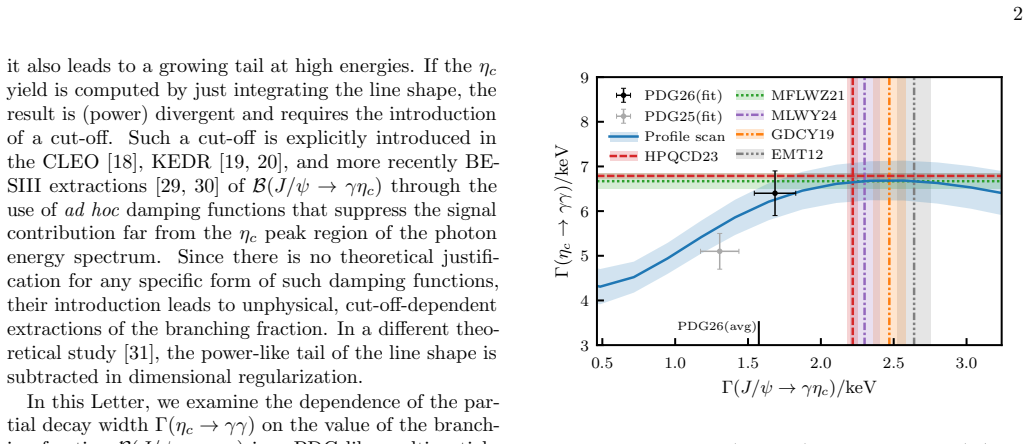
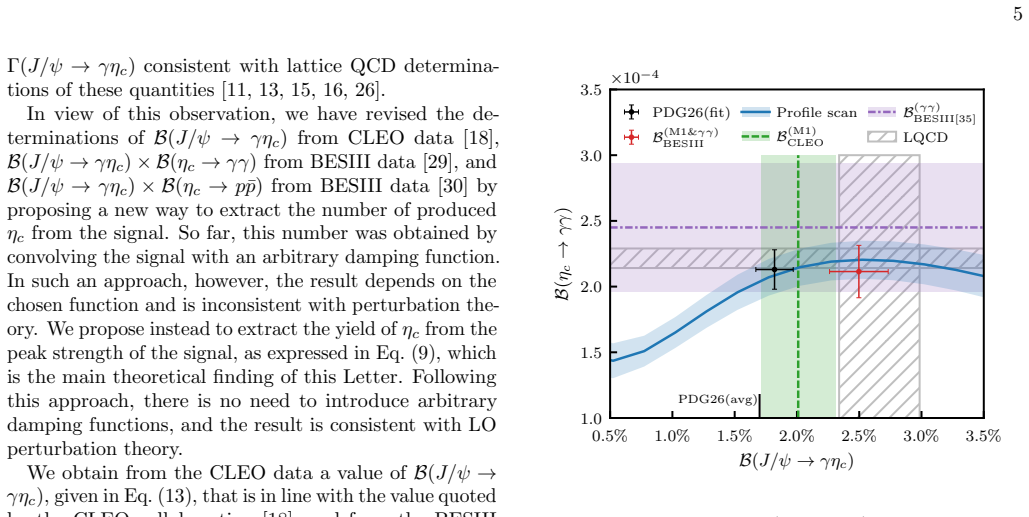
The central claim is that the tension between measured branching fractions and lattice QCD partial widths for J/ψ→γ η_c and η_c→γγ is an artifact of the empirical line-shape modifications used in current extractions; a profile scan over PDG data parameterized by B(J/ψ→γ η_c) demonstrates compatibility with the lattice values, and a first-principles photon spectrum plus extraction prescription for the M1 transition eliminates the ambiguity introduced by damping functions.
What carries the argument
Theoretically derived photon line shape for the M1 radiative transition, used to replace empirical damping in the extraction of branching fractions from the observed spectrum.
If this is right
- Branching fractions and products involving the M1 transition can be extracted without introducing an arbitrary damping parameter.
- The correlation pattern among PDG branching-fraction measurements becomes consistent with independent lattice calculations of the two partial widths.
- Derived quantities such as the eta_c two-photon decay width become directly comparable to lattice results without intermediate empirical corrections.
- Future experimental analyses of similar radiative charmonium transitions can adopt the same line-shape prescription to reduce systematic uncertainty.
Where Pith is reading between the lines
- The method could be tested on other M1 transitions in the charmonium or bottomonium systems where analogous line-shape ambiguities appear.
- Re-analysis of older data sets with the new prescription might shift central values and uncertainties for several charmonium branching fractions.
- If the line shape holds, it supplies a standard template that lattice groups can fold with their width predictions to produce mock data for direct comparison with experiment.
Load-bearing premise
The proposed photon line shape derived from the M1 transition accurately describes the true energy spectrum without any additional empirical adjustments.
What would settle it
A high-statistics measurement of the photon energy spectrum in J/ψ→γ η_c that deviates systematically from the proposed theoretical shape at the level that would require damping functions again.
Figures
read the original abstract
We assess the tension between theoretical predictions and the values quoted by the Particle Data Group (PDG) for the partial decay width and branching fraction associated with the radiative charmonium decay $J/\psi\to\gamma\eta_c$. A profile scan over the most recent PDG data depending on the branching fraction $\mathcal{B}(J/\psi\to\gamma\eta_c)$ suggests that the correlation between measured branching fractions is compatible with lattice QCD determinations of the partial decay widths $\Gamma(J/\psi\to\gamma\eta_c)$ and $\Gamma(\eta_c\to\gamma\gamma)$. We propose a theoretically grounded photon line shape for the radiative decay spectrum and a prescription for the extraction of (product) branching fractions involving the magnetic dipole (M1) transition $J/\psi\to\gamma\eta_c$. This approach obviates the need to modify the photon energy spectrum line shape using empirical damping functions, as done in the most recent experimental extractions of $\mathcal{B}(J/\psi\to\gamma\eta_c)$ from the photon line shape, thereby eliminating an inherent ambiguity in the determination of the derived observables.
Editorial analysis
A structured set of objections, weighed in public.
Referee Report
Summary. The paper assesses tension between lattice QCD predictions and PDG values for the partial width and branching fraction of the radiative decay J/ψ → γ η_c. A profile scan over recent PDG data is used to argue that correlations among measured branching fractions are compatible with lattice determinations of Γ(J/ψ → γ η_c) and Γ(η_c → γγ). The authors propose a theoretically grounded photon line shape for the M1 transition spectrum together with an extraction prescription for (product) branching fractions that avoids empirical damping functions.
Significance. If the line-shape proposal holds, it removes an ad-hoc element from experimental analyses of charmonium M1 transitions and could improve consistency between data and lattice calculations. The profile-scan approach supplies an indirect consistency check that does not require a direct fit to the target observable.
major comments (2)
- The compatibility conclusion rests on the profile scan over PDG inputs; the manuscript must explicitly demonstrate how all published experimental correlations are propagated and whether PDG averages already incorporate extractions that employed the damping functions being criticized (see stress-test concern). Without this, the scan result cannot be shown to be independent of the very modeling choices under discussion.
- The derivation of the proposed photon line shape and the precise prescription for extracting product branching fractions are not supplied with sufficient technical detail (equations, assumptions, or validation against simulated spectra) to confirm that the shape is free of new adjustable parameters or that it reproduces the M1 spectrum without empirical modification.
minor comments (2)
- Add a dedicated section or appendix that tabulates the input PDG measurements, their quoted uncertainties, and the covariance matrix used in the scan.
- Clarify the relation between the new line shape and existing theoretical calculations of the M1 matrix element (e.g., cite the specific lattice or quark-model references used for normalization).
Simulated Author's Rebuttal
We thank the referee for their detailed review and valuable suggestions. We address the major comments point by point below, indicating the revisions we plan to make to strengthen the manuscript.
read point-by-point responses
-
Referee: The compatibility conclusion rests on the profile scan over PDG inputs; the manuscript must explicitly demonstrate how all published experimental correlations are propagated and whether PDG averages already incorporate extractions that employed the damping functions being criticized (see stress-test concern). Without this, the scan result cannot be shown to be independent of the very modeling choices under discussion.
Authors: We agree that a more explicit demonstration of the correlation propagation is required. In the revised version, we will add a dedicated subsection detailing the methodology for incorporating the published experimental correlations from the PDG into the profile scan. This will include the covariance matrix construction and any assumptions made. Concerning the damping functions, while some input measurements may have employed them, the PDG values represent the current consensus; our analysis tests compatibility with these reported values. We will include an additional stress-test to assess sensitivity to potential modeling dependencies, thereby addressing the independence concern. revision: partial
-
Referee: The derivation of the proposed photon line shape and the precise prescription for extracting product branching fractions are not supplied with sufficient technical detail (equations, assumptions, or validation against simulated spectra) to confirm that the shape is free of new adjustable parameters or that it reproduces the M1 spectrum without empirical modification.
Authors: The referee correctly identifies that the technical details in the current manuscript are insufficient. We will revise the manuscript to provide the full derivation of the photon line shape based on the M1 transition matrix element in the non-relativistic limit, including all relevant equations and assumptions (such as the absence of additional parameters). We will also include validation against simulated spectra to demonstrate reproduction of the M1 spectrum without empirical damping. This will clarify that no new adjustable parameters are introduced. revision: yes
Circularity Check
No circularity: profile scan checks external compatibility without self-referential reduction
full rationale
The paper's central step is a profile scan over PDG branching-fraction data (acknowledged to depend on B(J/ψ→γη_c)) to test consistency of measured correlations against independent lattice QCD partial widths Γ(J/ψ→γη_c) and Γ(η_c→γγ). This is framed as an assessment of tension, not a derivation or prediction of the branching fraction itself. The proposed photon line shape is introduced as a new theoretical prescription that removes the need for empirical damping functions; it does not reduce to a fit of the target observable or to any self-citation. No equations or claims in the abstract or described chain equate an output to its inputs by construction, import uniqueness via author prior work, or rename a known result. The derivation therefore rests on external benchmarks and remains non-circular.
Axiom & Free-Parameter Ledger
axioms (1)
- domain assumption Lattice QCD calculations of the partial widths Gamma(J/psi to gamma eta_c) and Gamma(eta_c to gamma gamma) provide reliable external benchmarks.
Reference graph
Works this paper leans on
-
[1]
= (2.1 ± 0.3) × 10−7 [34]. Since our extraction of B(M1,γγ) BESIII is comparable to the BESIII value [29], the net effect of our determination (15) is an increase of B(M1) BESIII and a decrease of B(γγ) BESIII compared to Ref. [30]. DISCUSSION AND CONCLUSIONS Significant discrepancies between the experimental av- erage and fit values provided by the PDG [...
2026
-
[2]
J. J. Aubertet al., Experimental Observation of a Heavy ParticleJ, Phys. Rev. Lett.33, 1404 (1974)
1974
-
[3]
Augustinet al., Discovery of a Narrow Resonance ine +e− Annihilation, Phys
J.-E. Augustinet al., Discovery of a Narrow Resonance ine +e− Annihilation, Phys. Rev. Lett.33, 1406 (1974)
1974
-
[4]
Brambillaet al.,Heavy Quarkonium Physics, CERN Yellow Report (CERN, 2005) arXiv:hep-ph/0412158
N. Brambillaet al.,Heavy Quarkonium Physics, CERN Yellow Report (CERN, 2005) arXiv:hep-ph/0412158
arXiv 2005
-
[5]
Brambillaet al., Heavy quarkonium: progress, puz- zles, and opportunities, Eur
N. Brambillaet al., Heavy quarkonium: progress, puz- zles, and opportunities, Eur. Phys. J. C71, 1534 (2011), arXiv:1010.5827
Pith/arXiv arXiv 2011
-
[6]
N. Brambilla, Y. Jia, and A. Vairo, Model-independent study of magnetic dipole transitions in quarkonium, Phys. Rev. D73, 054005 (2006), arXiv:hep-ph/0512369
Pith/arXiv arXiv 2006
-
[7]
N. Brambilla, P. Roig, and A. Vairo, Precise determination of the ηc mass and width in the radiative J/ψ→η cγ de- cay, AIP Conf. Proc.1343, 418 (2011), arXiv:1012.0773
Pith/arXiv arXiv 2011
-
[8]
A. Pineda and J. Segovia, Improved determination of heavy quarkonium magnetic dipole transitions in potential nonrelativistic QCD, Phys. Rev. D87, 074024 (2013), arXiv:1302.3528
Pith/arXiv arXiv 2013
-
[9]
J. J. Dudek, R. G. Edwards, and D. G. Richards, Radia- tive transitions in charmonium from lattice QCD, Phys. Rev. D73, 074507 (2006), arXiv:hep-ph/0601137
Pith/arXiv arXiv 2006
-
[10]
J. J. Dudek, R. G. Edwards, and C. E. Thomas, Ex- otic and excited-state radiative transitions in charmo- nium from lattice QCD, Phys. Rev. D79, 094504 (2009), arXiv:0902.2241
Pith/arXiv arXiv 2009
-
[11]
Chenet al., Radiative transitions in charmonium from Nf = 2 twisted mass lattice QCD, Phys
Y. Chenet al., Radiative transitions in charmonium from Nf = 2 twisted mass lattice QCD, Phys. Rev. D84, 034503 (2011), arXiv:1104.2655
Pith/arXiv arXiv 2011
-
[12]
D. Beˇ cirevi´ c and F. Sanfilippo, Lattice QCD study of the radiative decays J/ψ→η cγ and hc →η cγ, JHEP01 (2013), 028, arXiv:1206.1445
Pith/arXiv arXiv 2013
-
[13]
G. C. Donald, C. T. H. Davies, R. J. Dowdall, E. Follana, K. Hornbostel, J. Koponen, G. P. Lepage, and C. McNeile, Precision tests of the J/ψ from full lattice QCD: Mass, leptonic width, and radiative decay rate to ηc, Phys. Rev. D86, 094501 (2012), arXiv:1208.2855
Pith/arXiv arXiv 2012
- [14]
-
[15]
J. Delaney, C. E. Thomas, and S. M. Ryan, Radiative transitions in charmonium from lattice QCD, JHEP05 (2024), 230, arXiv:2301.08213
arXiv 2024
-
[16]
B. Colquhoun, L. J. Cooper, C. T. H. Davies, and G. P. Lepage, Precise determination of decay rates for ηc →γγ , J/ψ→γη c, and J/ψ→η ce+e− from lattice QCD, Phys. Rev. D108, 014513 (2023), arXiv:2305.06231
arXiv 2023
-
[17]
Y. Meng, C. Liu, T. Wang, and H. Yan, Lattice study of J/ψ→γη c using a method without momentum extrapola- tion, Phys. Rev. D111, 014508 (2025), arXiv:2411.04415
arXiv 2025
-
[18]
J. E. Gaiseret al., Charmonium spectroscopy from inclu- sive ψ′ and J/ψ radiative decays, Phys. Rev. D34, 711 (1986)
1986
-
[19]
R. E. Mitchellet al., J/ψ and ψ(2S) Radiative Tran- sitions to ηc, Phys. Rev. Lett.102, 011801 (2009), arXiv:0805.0252
Pith/arXiv arXiv 2009
-
[20]
V. V. Anashinet al., Measurement of J/ψ→η cγ at KEDR, Chin. Phys. C34, 831 (2010), arXiv:1002.2071
Pith/arXiv arXiv 2010
-
[21]
V. V. Anashinet al., Measurement of J/ψ→γη c decay rate and ηc parameters at KEDR, Phys. Lett. B738, 391 (2014), arXiv:1406.7644
Pith/arXiv arXiv 2014
-
[22]
Takahashiet al., Review of Particle Physics, Int
F. Takahashiet al., Review of Particle Physics, Int. J. Mod. Phys. A41, 2630011 (2026)
2026
-
[23]
The PDG average and fit only include the measurements reported by Crystal Ball [17] and CLEO [18], but exclude the one reported by KEDR [ 20] owing to the absence of systematic uncertainties
-
[24]
Before 2024, the total and partial decay widths were determined in a single particle constrained fit by the PDG and the B(J/ψ→γη c) measurements entered indirectly via the normalization of B(J/ψ→γη c) × B(ηc →X i) to the average B(av) PDG(J/ψ→γη c) or to BCrystal Ball(J/ψ→ γηc)
2024
-
[25]
Y. Chen, M. Gong, N. Li, C. Liu, Y.-B. Liu, Z. Liu, J.-P. Ma, Y. Meng, C. Xiong, and K.-L. Zhang, Lattice study of two-photon decay widths for scalar and pseudo- scalar charmonium, Chin. Phys. C44, 083108 (2020), arXiv:2003.09817
arXiv 2020
-
[26]
C. Liu, Y. Meng, and K.-L. Zhang, Ward identity of the vector current and the decay rate of ηc →γγ in lattice QCD, Phys. Rev. D102, 034502 (2020), arXiv:2004.03907
arXiv 2020
-
[27]
Y. Meng, X. Feng, C. Liu, T. Wang, and Z. Zou, First- principle calculation of the ηc → 2γ decay width from lattice QCD, Sci. Bull.68, 1880 (2023), arXiv:2109.09381
arXiv 2023
-
[28]
Navaset al., Review of Particle Physics, Phys
S. Navaset al., Review of Particle Physics, Phys. Rev. D 110, 030001 (2024)
2024
-
[29]
A. V. Manohar and P. Ruiz-Femen´ ıa, Orthopositronium decay spectrum using NRQED, Phys. Rev. D69, 053003 (2004), arXiv:hep-ph/0311002
Pith/arXiv arXiv 2004
-
[30]
Ablikimet al., Observation of the Charmonium Decay ηc →γγ in J/ψ→γη c, Phys
M. Ablikimet al., Observation of the Charmonium Decay ηc →γγ in J/ψ→γη c, Phys. Rev. Lett.134, 181901 (2025), arXiv:2412.12998
arXiv 2025
-
[31]
Ablikimet al., Study of the Magnetic Dipole Transition of J/ψ→γη c via ηc →p¯p, Phys
M. Ablikimet al., Study of the Magnetic Dipole Transition of J/ψ→γη c via ηc →p¯p, Phys. Rev. Lett.136, 051901 (2026), arXiv:2510.15247
Pith/arXiv arXiv 2026
-
[32]
J. Segovia and J. Tarr´ us Castell` a, Line shape and the experimental determination of the J/ψ→γη c branching fraction, Phys. Rev. D104, 074032 (2021), arXiv:2106.15203
arXiv 2021
-
[33]
We attribute the small difference between our scan and the PDG value to the independent implementation of the fit procedure, including differences in the minimization algorithm and convergence criteria
-
[34]
M. Ablikimet al., Observation of ηc(1S, 2S) and χcJ decays to 2( π+π−)η via ψ(3686) radiative transitions, Phys. Rev. D111, 052013 (2025), arXiv:2406.08225
arXiv 2025
-
[35]
The average B(γγ,p¯p)
-
[36]
represents an updated value of the current PDG average [21]
-
[37]
M. Ablikimet al.(BESIII), First Measurement of the Ab- solute Branching Fraction of ηc →γγ , arXiv:2601.11236 (2026)
arXiv 2026
-
[38]
Y. Xu, Z. Xing, K. Raya, and L. Chang, Radiative charmo- nium decays in a contact-interaction model with dynami- cal quark anomalous magnetic moment, arXiv:2604.26185 (2026)
Pith/arXiv arXiv 2026
- [39]
-
[40]
Beringer, Programmatic access to PDG data, Nuovo Cim
J. Beringer, Programmatic access to PDG data, Nuovo Cim. C , 206 (2024)
2024
-
[41]
Beringer, New ways to access PDG data, PoS ICHEP2024, 1023 (2025)
J. Beringer, New ways to access PDG data, PoS ICHEP2024, 1023 (2025)
2025
-
[42]
Dembinski, P
H. Dembinski, P. Ongmongkolkul, C. Deil, H. Schreiner, M. Feickert, C. Burr, J. Watson, F. Rost, A. Pearce, 7 L. Geiger, A. Abdelmotteleb, A. Desai, B. M. Wiedemann, C. Gohlke, J. Sanders, J. Drotleff, J. Eschle, L. Neste, M. E. Gorelli, M. Baak, M. Eliachevitch, and O. Zapata, scikit-hep/iminuit (2025)
2025
-
[43]
James and M
F. James and M. Roos, Minuit – a system for function minimization and analysis of the parameter errors and correlations, Comput. Phys. Commun.10, 343 (1975)
1975
-
[44]
D. M. Asneret al., Physics at BES-III: Analysis Tools, Int. J. Mod. Phys. A24, 23 (2009), arXiv:0809.1869
Pith/arXiv arXiv 2009
-
[45]
nonsignal J/ψ→γX i
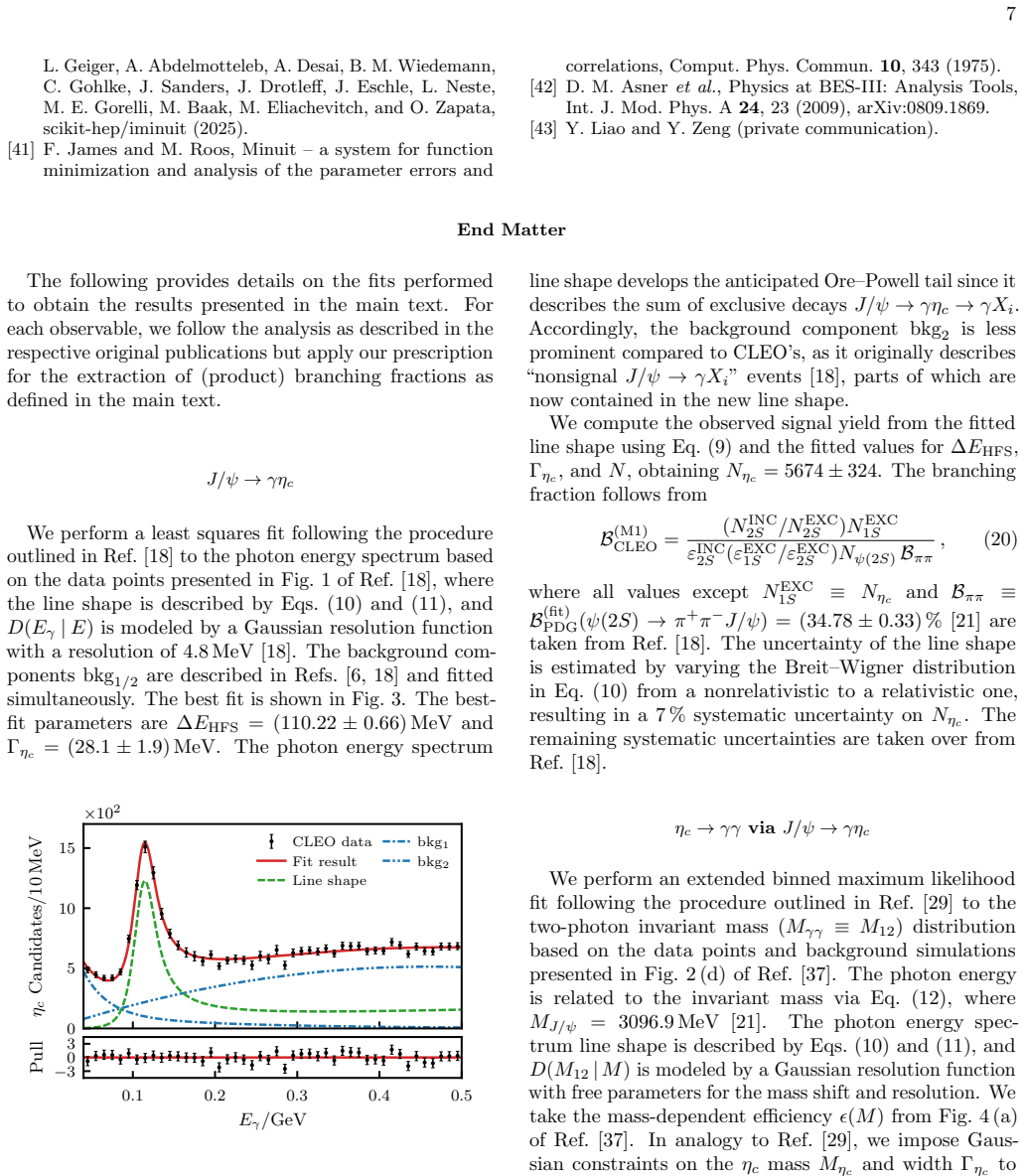
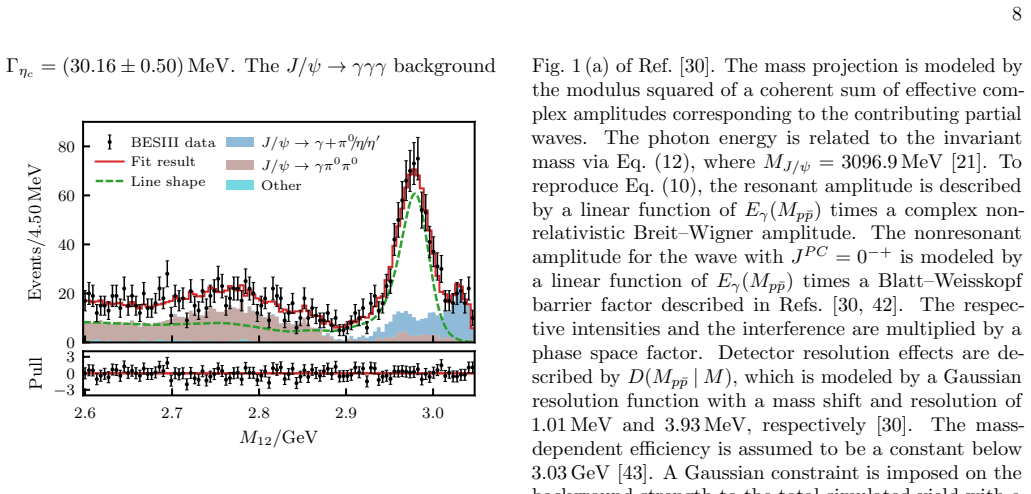
Y. Liao and Y. Zeng (private communication). End Matter The following provides details on the fits performed to obtain the results presented in the main text. For each observable, we follow the analysis as described in the respective original publications but apply our prescription for the extraction of (product) branching fractions as defined in the main...
discussion (0)
Sign in with ORCID, Apple, or X to comment. Anyone can read and Pith papers without signing in.