Beyond Worst-Case Branching: Quantum Tree Search via Amplitude Amplification
Pith reviewed 2026-06-30 01:41 UTC · model grok-4.3
The pith
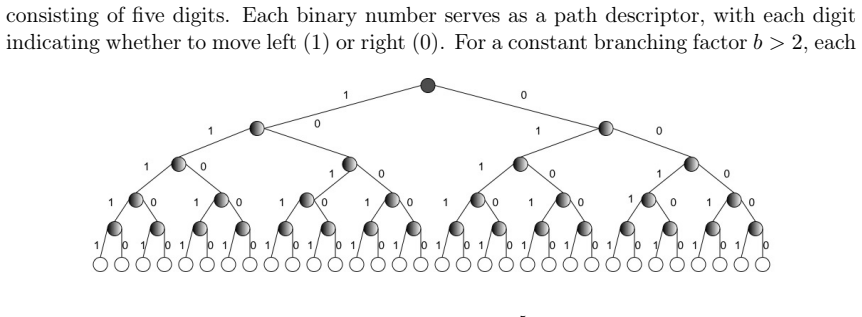
Amplitude amplification constructs a dynamic quantum search tree of depth m whose query complexity scales as the square root of the average branching factor to the m.
A machine-rendered reading of the paper's core claim, the machinery that carries it, and where it could break.
Core claim
Amplitude amplification replaces the uniform Hadamard initialization of Grover's algorithm with an arbitrary unitary A and thereby permits the construction of a dynamic search tree of depth m whose query complexity is sqrt((b_avg)^m) where b_avg is the average branching factor. This bound improves on the commonly used sqrt((b_max)^m). Quantum backtracking is unsuitable for problems that do not admit a natural backtracking structure; in those cases amplitude amplification supplies the better complexity. Because the search tree is constructed dynamically its internal structure is inaccessible, so sampling-based estimation is proposed under the assumption that the tree approximates a normal dis
What carries the argument
Amplitude amplification with arbitrary unitary initialization A, used to build a dynamic search tree whose effective branching is captured by the average b_avg rather than a fixed backtracking structure.
If this is right
- Search problems lacking a natural backtracking structure obtain improved query complexity from amplitude amplification.
- The dynamically constructed tree renders its internal structure inaccessible, so external sampling is needed to recover estimates.
- Sampling-based estimation of the tree relies on the assumption that branching approximates a normal distribution with depth.
- A quantum greedy search procedure can be realized using lookahead heuristics modeled on the Soar architecture.
Where Pith is reading between the lines
- The method may extend to planning or game-tree search domains where local branching varies strongly with position.
- Empirical checks of the normal-distribution assumption on concrete puzzle or optimization trees would test the sampling step.
- The average-branching scaling suggests quantum search can adapt to irregular trees without paying the full worst-case penalty.
Load-bearing premise
That amplitude amplification can be applied to construct a dynamic search tree whose effective branching is captured by the average b_avg rather than requiring a backtracking structure.
What would settle it
A calculation or simulation on an explicit tree with known varying branching factors in which the number of oracle queries required exceeds sqrt((b_avg)^m) and approaches sqrt((b_max)^m).
Figures

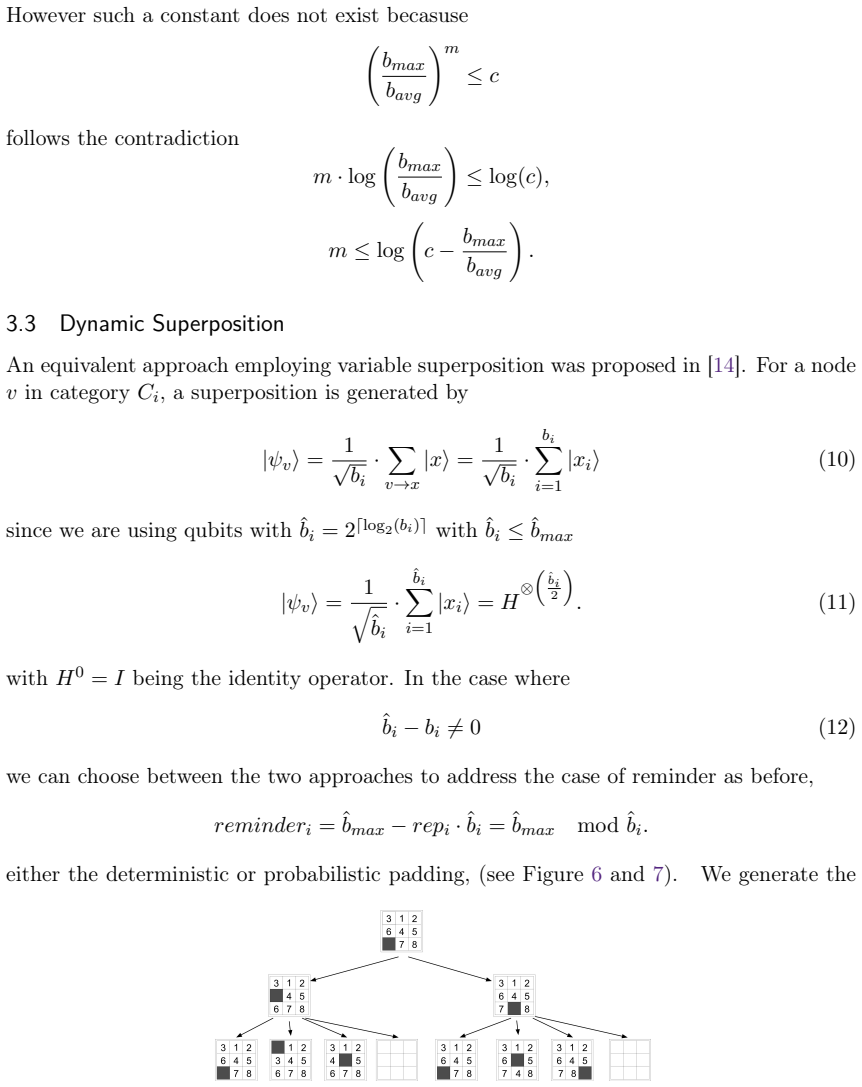
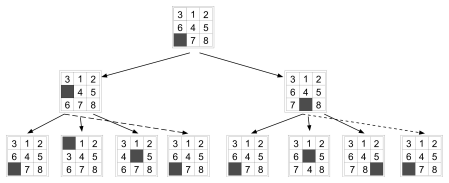
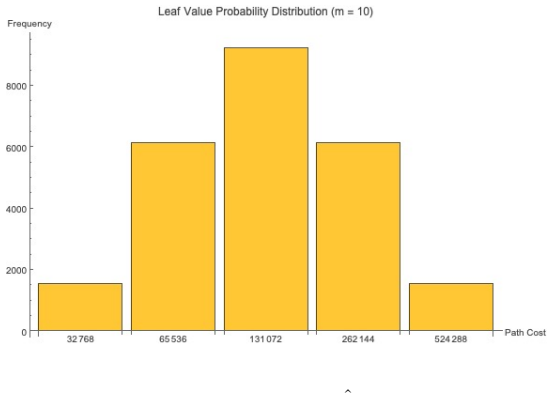
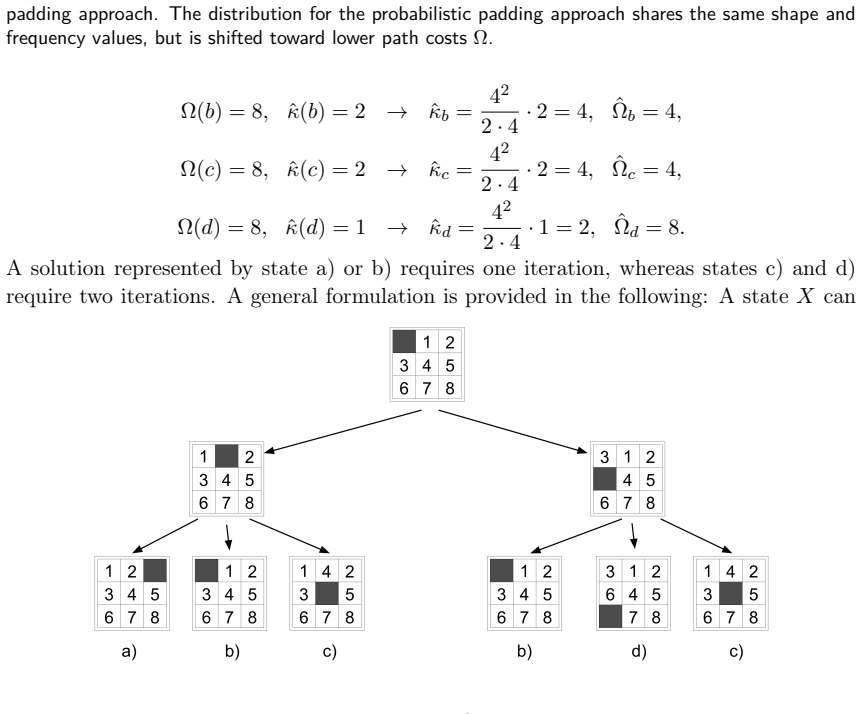
read the original abstract
In this work, we investigate quantum tree search via amplitude amplification. Amplitude amplification generalizes Grover's algorithm by replacing the Hadamard initialization with an arbitrary unitary $A$, with Grover's algorithm recovered as the special case of uniform initialization. We demonstrate the construction of a dynamic search tree of depth $m$ with query complexity $\sqrt{\left(b_{avg}\right)^m}$ where $b_{avg}$ denotes the average branching factor, improving upon the commonly assumed $\sqrt{\left(b_{max}\right)^m}$, where $b_{max}$ is the maximum branching factor. We further challenge the widespread assumption that amplitude amplification is inferior to quantum backtracking. In fact, quantum backtracking is unsuitable for problems that do not naturally admit a backtracking structure; in such cases, amplitude amplification yields improved query complexity. We observe that amplitude amplification constructs the search tree dynamically, rendering its internal structure inaccessible, a constraint that applies equally to quantum backtracking. To address this, we propose sampling-based methods to estimate the tree structure, under the assumption that it approximates a normal distribution with increasing depth. Finally, we introduce a quantum greedy search based on a lookahead heuristic inspired by the classical cognitive architecture Soar, which models human-like problem-solving strategies.
Editorial analysis
A structured set of objections, weighed in public.
Referee Report
Summary. The paper investigates quantum tree search using amplitude amplification on dynamically constructed trees of depth m. It claims a query complexity of √((b_avg)^m) where b_avg is the average branching factor, improving upon the standard √((b_max)^m) bound. The work argues that amplitude amplification is preferable to quantum backtracking for problems lacking a natural backtracking structure, proposes sampling-based methods to estimate tree structure under a normal distribution assumption, and introduces a quantum greedy search heuristic inspired by the Soar cognitive architecture.
Significance. If the central complexity claim is substantiated with a correct derivation, the result would offer a meaningful advance by replacing worst-case branching analysis with an average-branching bound in quantum search, potentially broadening the applicability of amplitude amplification to irregular search trees. The explicit contrast with quantum backtracking and the sampling proposal provide useful context for implementation challenges.
major comments (2)
- [Abstract] Abstract: The central claim that amplitude amplification yields query complexity √((b_avg)^m) is asserted without any derivation, proof sketch, or supporting equations. No analysis shows that the success probability after state preparation satisfies p ≈ 1/(b_avg)^m when the number of leaves equals the sum over paths of the product of per-node branch factors (rather than (b_avg)^m).
- [Abstract] Abstract: The manuscript states that the cost of implementing the initial unitary A and the reflection operators in amplitude amplification is governed by the arithmetic average branching factor rather than b_max, but provides no derivation or cost analysis establishing that the dynamic construction avoids dependence on the maximum local branching factor.
Simulated Author's Rebuttal
We thank the referee for the careful review and constructive feedback on the abstract. We address each major comment below and will revise the manuscript to strengthen the presentation of the central claims.
read point-by-point responses
-
Referee: [Abstract] Abstract: The central claim that amplitude amplification yields query complexity √((b_avg)^m) is asserted without any derivation, proof sketch, or supporting equations. No analysis shows that the success probability after state preparation satisfies p ≈ 1/(b_avg)^m when the number of leaves equals the sum over paths of the product of per-node branch factors (rather than (b_avg)^m).
Authors: We agree that the abstract asserts the √((b_avg)^m) bound without a derivation or proof sketch. The manuscript text provided focuses on the high-level claim and the normal-distribution sampling proposal but does not contain the requested analysis relating success probability to the sum-over-paths leaf count. In revision we will add a concise derivation (or explicit reference to a new subsection) that defines b_avg via the m-th root of the effective leaf count and shows how amplitude amplification then yields the stated query complexity under that definition. revision: yes
-
Referee: [Abstract] Abstract: The manuscript states that the cost of implementing the initial unitary A and the reflection operators in amplitude amplification is governed by the arithmetic average branching factor rather than b_max, but provides no derivation or cost analysis establishing that the dynamic construction avoids dependence on the maximum local branching factor.
Authors: We acknowledge that the manuscript states the cost depends on the arithmetic average without supplying a derivation or explicit cost analysis. The dynamic-construction argument is mentioned conceptually but not formalized with respect to local branching factors. We will revise by adding a short cost analysis (likely in a dedicated subsection) that explains why the unitary A and reflections incur average rather than worst-case cost when nodes are generated on the fly. revision: yes
Circularity Check
No significant circularity detected
full rationale
The paper claims a dynamic tree construction via amplitude amplification yielding query complexity √((b_avg)^m). No equations or sections are provided that define b_avg in terms of the claimed complexity, fit parameters to data then rename the output as a prediction, or reduce the central result to a self-citation chain. The normal-distribution sampling is described only for post-hoc estimation of tree structure, not as input to the query-complexity formula itself. The derivation is presented as a direct construction and remains self-contained against external benchmarks such as standard amplitude amplification analysis.
Axiom & Free-Parameter Ledger
axioms (2)
- standard math Amplitude amplification generalizes Grover's algorithm by replacing the Hadamard initialization with an arbitrary unitary A
- domain assumption A dynamic search tree can be constructed via amplitude amplification with effective complexity governed by average branching factor
Reference graph
Works this paper leans on
-
[1]
Brassard, G., Hoyer, P., Mosca, M., and Tapp, A. (2000). Quantum Amplitude Am- plification and Estimation.eprint arXiv:quant-ph/0005055
work page internal anchor Pith review Pith/arXiv arXiv 2000
-
[2]
(2004).Quantum Computing
Hirvensalo, M. (2004).Quantum Computing. Springer-Verlag, Berlin Heidelberg
2004
-
[3]
Korf, R. E. (1985). Depth-first iterative-deepening : An optimal admissible tree search. Artificial Intelligence, 27(1):97 – 109
1985
-
[4]
F., Newell, A., and Rosenbloom, P
Laird, J. F., Newell, A., and Rosenbloom, P. S. (1987). SOAR: An architecture for general intelligence.Artificial Intelligence, 40
1987
-
[5]
Luger, G. F. and Stubblefield, W. A. (1998).Artificial Intelligence, Structures and Strategies for Complex Problem Solving. Addison-Wesley, third edition
1998
-
[6]
Martiel, S. and Remaud, M. (2019). Practical implementation of a quantum backtrack- ing algorithm.ArXiv Quantum Physics e-prints, abs/1908.11291v1
-
[7]
Montanaro, A. (2018). Quantum-walk speedup of backtracking algorithms.Theory of Computing, 14(15):1–24
2018
-
[8]
Nielsen, M. A. and Chuang, I. L. (2000).Quantum Computation and Quantum Infor- mation. Cambridge University Press, Cambridge, MA, USA
2000
-
[9]
Nilsson, N. J. (1982).Principles of Artificial Intelligence. Springer-Verlag
1982
-
[10]
(1984).Heuristics: Intelligent Strategies for Computer Problem Solving
Pearl, J. (1984).Heuristics: Intelligent Strategies for Computer Problem Solving. Addison-Wesley. 22
1984
-
[11]
Rennela, M., Brand, S., Laarman, A., and Dunjko, V. (2023). Hybrid divide-and- conquer approach for tree search algorithms.Quantum, 7:959
2023
-
[12]
and Norvig, P
Russell, S. and Norvig, P. (2010).Artificial intelligence: a modern approach. Prentice Hall series in artificial intelligence. Prentice Hall
2010
-
[13]
Q., Tcholtchev, N., and Hauswirt, M
Seidel, R., Zander, R., Petric, M., Steinmann1, N., Liu, D. Q., Tcholtchev, N., and Hauswirt, M. (2024). Quantum backtracking in qrisp applied to sudoku problems.ArXiv Quantum Physics e-prints, abs/2402.10060v3
-
[14]
P., and Barbosa, L
Sequeira, A., Santos, L. P., and Barbosa, L. S. (2021). Generalised quantum tree search. InIEEE/ACM 2nd International Workshop on Quantum Software Engineering (Q-SE), pages 39–40
2021
-
[15]
Tarrataca, L. and Wichert, A. (2011). Tree search and quantum computation.Quan- tum Information Processing, 10(4):475–500. 10.1007/s11128-010-0212-z
-
[16]
and Wichert, A
Tarrataca, L. and Wichert, A. (2012). Iterative quantum tree search. CiE 2012 - How the World Computes, 2012
2012
-
[17]
and Wichert, A
Tarrataca, L. and Wichert, A. (2013). Quantum iterative deepening with an applica- tion to the halting problem.PLOS ONE, 8(3)
2013
-
[18]
Wichert, A. (2022). Quantum tree search with qiskit.Mathematics, 10(17):3013
2022
-
[19]
(2024).Quantum Artificial Intelligence with Qiskit
Wichert, A. (2024).Quantum Artificial Intelligence with Qiskit. CRC Press
2024
-
[20]
Winston, P. H. (1992).Artificial Intelligence. Addison-Wesley, third edition. 23
1992
discussion (0)
Sign in with ORCID, Apple, or X to comment. Anyone can read and Pith papers without signing in.