REVIEW 2 minor 2 cited by
Aspherical connected subgraph arrangements are free except possibly when the graph is K4.
Reviewed by Pith at T0; open to challenge. T0 means a machine referee read the full paper against a public rubric. the ladder, T0–T4 →
T0 review · grok-4.3
2026-05-23 02:11 UTC pith:T6432SFL
load-bearing objection Short note that tightens Cuntz-Kühne by showing aspherical connected subgraph arrangements are free except possibly for K4.
On connected subgraph arrangements
The pith
A machine-rendered reading of the paper's core claim, the machinery that carries it, and where it could break.
Core claim
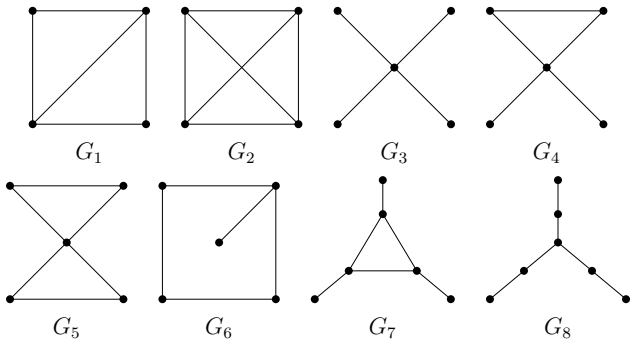
If A_G is an aspherical connected subgraph arrangement, then A_G is free with the unique possible exception when the underlying graph G is the complete graph on 4 nodes.
What carries the argument
The connected subgraph arrangement A_G, which consists of hyperplanes indexed by the connected subgraphs of G and carries the asphericity-to-freeness implication.
Load-bearing premise
That the earlier results of Cuntz and Kühne on connected subgraph arrangements extend without restriction or counterexamples to the aspherical case.
What would settle it
An explicit computation for the complete graph on four vertices that produces an aspherical but non-free arrangement, or a different graph yielding an aspherical non-free A_G.
If this is right
- Aspherical connected subgraph arrangements arise only from a restricted collection of graphs.
- Freeness holds for every aspherical A_G outside the possible K4 exception.
- The class of aspherical members is narrowed to a small list of underlying graphs.
Where Pith is reading between the lines
- The result may simplify the search for free arrangements within graph-derived families.
- Direct verification of the K4 case would complete the classification for this class.
- Similar implications might hold for other combinatorial constructions of arrangements if the same strengthening technique applies.
Editorial analysis
A structured set of objections, weighed in public.
Referee Report
Summary. The paper studies connected subgraph arrangements A_G associated to a graph G, building on the work of Cuntz and Kühne. It strengthens prior results by restricting to the aspherical subclass and proving that such arrangements are free, with the unique possible exception when G is the complete graph K_4 on 4 vertices. The argument proceeds by invoking the existing classification of connected subgraph arrangements and applying freeness criteria to the aspherical members.
Significance. If the result holds, it narrows the possible graphs yielding aspherical connected subgraph arrangements and confirms freeness for this natural subclass, providing a concrete strengthening of the Cuntz-Kühne classification. The note is short and focused, directly leveraging prior work without introducing new ad-hoc parameters or entities.
minor comments (2)
- [Abstract] Abstract: 'withing' is a typo and should read 'within'.
- [Introduction] The manuscript should explicitly state in the introduction or §1 which theorems from Cuntz-Kühne are invoked and how the asphericity restriction is applied to obtain freeness.
Simulated Author's Rebuttal
We thank the referee for the positive assessment of our manuscript, the recognition of its focused strengthening of the Cuntz-Kühne results on aspherical connected subgraph arrangements, and the recommendation of minor revision. No major comments were raised in the report.
Circularity Check
No significant circularity; derivation relies on external prior results
full rationale
The paper strengthens results of Cuntz and Kühne (distinct authors) on connected subgraph arrangements A_G by restricting attention to the aspherical subclass and invoking their existing classification and freeness criteria. The central claim (aspherical A_G is free except possibly for K_4) is obtained by applying those external criteria to the subclass; no equation, definition, or uniqueness statement is shown to reduce to a fitted parameter, self-citation chain, or ansatz internal to the present manuscript. The cited prior work is treated as independent input rather than load-bearing self-reference.
Axiom & Free-Parameter Ledger
read the original abstract
Recently, Cuntz and K\"uhne introduced a particular class of hyperplane arrangements stemming from a given graph $G$, so called connected subgraph arrangements $A_G$. In this note we strengthen some of the result from their work and prove new ones for members of this class. For instance, we show that aspherical members withing this class stem from a rather restricted set of graphs. Specifically, if $A_G$ is an aspherical connected subgraph arrangement, then $A_G$ is free with the unique possible exception when the underlying graph $G$ is the complete graph on $4$ nodes.
Figures


Forward citations
Cited by 2 Pith papers
-
Cremona invariance of filtered Varchenko--Gelfand algebras
Filtered Varchenko–Gelfand algebras are invariant under a Cremona coefficient swap for two-coordinate arrangements, producing a counterexample to the Yagi–Yoshinaga tope-graph conjecture.
-
Orlik--Solomon sheaf homology of geometric lattices
Orlik–Solomon sheaf homology on a geometric lattice concentrates in top degree and decomposes as a sum of local OS algebras tensored with top homology of complementary geometric semilattices.
Reference graph
Works this paper leans on
-
[1]
Abe, Addition-deletion theorem for free hyperplane arrangements and combinatorics
T. Abe, Addition-deletion theorem for free hyperplane arrangements and combinatorics. J. Algebra 610 (2022), 1--17
work page 2022
-
[2]
T. Abe, M. Barakat, M. Cuntz, T. Hoge, and H. Terao, The freeness of ideal subarrangements of Weyl arrangements, JEMS, 18 (2016), no. 6, 1339--1348
work page 2016
-
[3]
T. Abe, T. Horiguchi, M. Masuda, S. Murai, T. Sato, Hessenberg varieties and hyperplane arrangements. J. Reine Angew. Math. 764 (2020), 241--286
work page 2020
-
[4]
N. Amend, T. M\"oller and G. R\"ohrle, Restrictions of aspherical arrangements, Topology Appl. 249 (2018), 67--72
work page 2018
-
[5]
A. Bj\"orner, P. Edelman, and G. Ziegler, Hyperplane arrangements with a lattice of regions. Discrete Comput. Geom. 5 (1990), no. 3, 263--288
work page 1990
-
[6]
K. A. Brandt and H. Terao, Free arrangements and relation spaces. Discrete Comput. Geom. 12 (1994), no. 1, 49--63
work page 1994
-
[7]
Brieskorn, Sur les groupes de tresses [d'apr\`es V
E. Brieskorn, Sur les groupes de tresses [d'apr\`es V . I . A rnold]. In S\'eminaire Bourbaki, 24\`eme ann\'ee (1971/1972), Exp. No. 401 , pages 21--44. Lecture Notes in Math., Vol. 317, Springer, Berlin, 1973
work page 1971
-
[8]
M. Cuntz, A Greedy Algorithm to Compute Arrangements of Lines in the Projective Plane, Discrete Comput.\ Geom.\ 68 (2022), 107--124
work page 2022
-
[9]
M. Cuntz and D. Geis, Combinatorial simpliciality of arrangements of hyperplanes. Beitr. Algebra Geom. 56 (2015), no. 2, 439--458
work page 2015
-
[10]
M. Cuntz and L. Kühne, On arrangements of hyperplanes from connected subgraphs. Ann. Sc. Norm. Super. Pisa Cl. Sci. (5) (to appear) https://journals.sns.it/index.php/annaliscienze/article/ view/6134/1418
-
[11]
M. Cuntz and P. M\"ucksch , MAT-free reflection arrangements, Electronic J. Comb. 27(1) (2020), \#P1.28
work page 2020
- [12]
-
[13]
Deligne, Les immeubles des groupes de tresses g\'en\'eralis\'es, Invent
P. Deligne, Les immeubles des groupes de tresses g\'en\'eralis\'es, Invent. Math. 17 (1972), 273–-302
work page 1972
-
[14]
DiPasquale, A homological characterization for freeness of multi-arrangements, Math
M. DiPasquale, A homological characterization for freeness of multi-arrangements, Math. Ann. 385 (2023), no. 1-2, 745--786
work page 2023
-
[15]
Edelman, A partial order on the regions of ^n dissected by hyperplanes
P.H. Edelman, A partial order on the regions of ^n dissected by hyperplanes. Trans. Amer. Math. Soc. 283 (1984), no. 2, 617--631
work page 1984
-
[16]
Falk, Line-closed matroids, quadratic algebras, and formal arrangements, Adv
M. Falk, Line-closed matroids, quadratic algebras, and formal arrangements, Adv. in Appl. Math., 28 (2002), 250--271
work page 2002
-
[17]
M. Falk and R. Randell, The lower central series of a fiber-type arrangement, Invent. Math. 82 (1985), no. 1, 77--88
work page 1985
-
[18]
, On the homotopy theory of arrangements, Complex analytic singularities, 101--124, Adv. Stud. Pure Math., 8, North-Holland, Amsterdam, 1987
work page 1987
-
[19]
, On the homotopy theory of arrangements. II. Arrangements—Tokyo 1998, 93--125, Adv. Stud. Pure Math., 27, Kinokuniya, Tokyo, 2000
work page 1998
-
[20]
T. Hoge and G. R\"ohrle, Addition–Deletion Theorems for factorizations of Orlik–Solomon algebras and nice arrangements, European Journal of Combinatorics 55 (2016), 20--40
work page 2016
-
[21]
, Some remarks on free arrangements, T\^ohoku Math. J. 73 (2021), no. 2, 277--288
work page 2021
-
[22]
T. Hoge, G. R\"ohrle and A. Schauenburg, Inductive and Recursive Freeness of Localizations of multiarrangements, in: Algorithmic and Experimental Methods in Algebra, Geometry, and Number Theory, Springer Verlag 2017
work page 2017
-
[23]
Hultman, Supersolvability and the Koszul property of root ideal arrangements, Proc
A. Hultman, Supersolvability and the Koszul property of root ideal arrangements, Proc. AMS, 144 (2016), 1401--1413
work page 2016
-
[24]
M. Jambu and L. Paris, Combinatorics of Inductively Factored Arrangements, Europ. J. Combinatorics 16 (1995), 267--292
work page 1995
-
[25]
M. Jambu and H. Terao, Free arrangements of hyperplanes and supersolvable lattices, Adv. in Math. 52 (1984), no. 3, 248--258
work page 1984
-
[26]
T. M\"oller, P. M\"ucksch, and G. R\"ohrle, On Formality and Combinatorial Formality for hyperplane arrangements, Discrete Comput. Geom. 72, (2024), 73--90
work page 2024
-
[27]
T. M\"oller and G. R\"ohrle, Nice Restrictions of Reflection Arrangements, Archiv Math. 112(4), (2019), 347--359
work page 2019
-
[28]
P. M\"ucksch and G. R\"ohrle, Accurate arrangements, Advances in Math. Vol. 383C, 30 pages (2021)
work page 2021
-
[29]
P. M\"ucksch, G. R\"ohrle, and T.N. Tran Flag-accurate arrangements, Innov. Incidence Geom. 21 (2024), no. 1, 57--116
work page 2024
-
[30]
P. M\"ucksch, G. R\"ohrle and S. Wiesner, Free multiderivations of connected subgraph arrangements, preprint (2024)
work page 2024
-
[31]
P. Orlik and L. Solomon, Combinatorics and topology of complements of hyperplanes, Invent. math. 56 (1980), 77--94
work page 1980
- [32]
-
[33]
P. Orlik and H. Terao, Arrangements of hyperplanes, Springer-Verlag, 1992
work page 1992
-
[34]
Paris, The Deligne complex of a real arrangement of hyperplanes, Nagoya Math
L. Paris, The Deligne complex of a real arrangement of hyperplanes, Nagoya Math. J. 131 (1993), 39--65
work page 1993
-
[35]
, Topology of factored arrangements of lines. Proc. Amer. Math. Soc. 123 (1995), no. 1, 7--261
work page 1995
-
[36]
, The counting polynomial of a supersolvable arrangement. Adv. Math. 116 (1995), no. 2, 356--364
work page 1995
-
[37]
R. Randell, Lattice-isotopic Arrangements Are Topologically Isomorphic, Proc.\ Amer.\ Math.\ Soc.\ 107 (1989), no. 2, 555--559
work page 1989
-
[38]
R\"ohrle, Arrangements of ideal type, J
G. R\"ohrle, Arrangements of ideal type, J. Algebra, 484, (2017), 126--167
work page 2017
-
[39]
Solomon, The orders of the finite Chevalley groups
L. Solomon, The orders of the finite Chevalley groups. J. Algebra 3 (1966) 376--393
work page 1966
-
[40]
E. Sommers and J. Tymoczko, Exponents for B -stable ideals. Trans. Amer. Math. Soc. 358 (2006), no. 8, 3493--3509
work page 2006
-
[41]
Terao, Arrangements of hyperplanes and their freeness I, II, J
H. Terao, Arrangements of hyperplanes and their freeness I, II, J. Fac. Sci. Univ. Tokyo 27 (1980), 293--320
work page 1980
-
[42]
, Generalized exponents of a free arrangement of hyperplanes and Shepherd-Todd-Brieskorn formula, Invent. Math. 63 no.\ 1 (1981) 159--179
work page 1981
-
[43]
, Modular elements of lattices and topological fibrations, Adv. in Math. 62 (1986), no. 2, 135--4
work page 1986
-
[44]
, Factorizations of the Orlik-Solomon Algebras, Adv. in Math. 92, (1992), 45--53
work page 1992
-
[45]
Yuzvinsky, The first two obstructions to the freeness of arrangements, Trans
S. Yuzvinsky, The first two obstructions to the freeness of arrangements, Trans. Amer. Math. Soc. 335 (1993), no. 1, 231--244
work page 1993
-
[46]
Ziegler, Matroid representations and free arrangements, Trans. Amer. Math. Soc. 320 (1990), no. 2, 525--541
work page 1990
discussion (0)
Sign in with ORCID, Apple, or X to comment. Anyone can read and Pith papers without signing in.