REVIEW 4 major objections 6 minor 1 cited by
Enhanced continuous-variable quantum key distribution protocol via adaptive signal processing
T0 review · 4 major / 6 minor · reviewed 2026-08-06 · deepseek-v4-flash
Pith's one-line read Digital post-selection filters push continuous-variable QKD key rates past the optimal Gaussian GG02 protocol.
desk verdict A genuinely new software-only post-selection protocol with solid experiments, but the security claim is not established because Eve is restricted to Gaussian attacks and the key experimental comparison is within error bars. read the letter →
The pith
A machine-rendered reading of the paper's core claim, the machinery that carries it, and where it could break.
The reading
What carries the argument
Two digital filters and a density-matrix security calculation carry the argument. Alice's Gaussian filter $F_A(x_a) = e^{-g_x^2 x_a^2}$, applied to her recorded variables, re-normalises the modulation variance to $\tilde{V}_{\mathrm{mod}} = V_{\mathrm{mod}}/(2g^2 V_{\mathrm{mod}}+1)$, substituting for GG02's modulation-variance optimisation without needing channel characterisation. Bob's non-Gaussian notch filter $F_B(x_b)$ (zero for $-c_x < x_b < c_x$, one elsewhere) discards central homodyne outcomes, making the joint distribution highly non-Gaussian and emulating a lower-loss channel. Because Gaussian extremality no longer applies, Eve's information is calculated from her density matrix: her conditional state for each of Bob's outcomes comes from Williamson and Bloch–Messiah decompositions of the conditional covariance matrix, applied to a displaced thermal state, and her average state $\rho_{E_1E_2}$ is the probability-weighted sum over Bob's post-selected distribution $p'_b(x_i)$. The secret-key rate is $K = \beta I_{AB} - I_E$, with the filter success probabilities folded in, and the protocol dynamically optimises $g$ and $c$ for the channel at hand.
What would settle it
Run the authors' density-matrix construction with Eve's average state replaced by an explicit non-Gaussian attack, for instance a photon-subtracted or Fock-truncated state engineered to hide information in the homodyne outcomes Bob discards, and compare Eve's Holevo information with the Gaussian-attack bound; if it exceeds the bound, the quoted key rates are not secure.
Extended reading notes
Core claim
On its own terms, the paper's discovery is that probabilistic filters with no physical-process counterpart can improve CV-QKD security performance. Alice's Gaussian filter $F_A(x_a) = e^{-g_x^2 x_a^2}$ shrinks the effective modulation variance to $\tilde{V}_{\mathrm{mod}} = V_{\mathrm{mod}}/(2g^2 V_{\mathrm{mod}}+1)$, reproducing the variance optimisation that GG02 must perform with prior channel knowledge. Bob's notch filter, which keeps only homodyne outcomes outside the window $-c_x < x_b < c_x$, produces a highly non-Gaussian joint distribution and effectively emulates a channel with less loss; the key rate then depends on the choices of $g$ and $c$ and can exceed the optimal GG02 rate. Because the filter breaks Gaussian extremality, the authors compute Eve's information from her density matrix $\rho_{E_1E_2}$, built through Williamson and Bloch–Messiah decompositions of her conditional covariance matrix and averaged over Bob's post-selected outcomes, giving $I_E = S(\rho_{E_1E_2}) - S(\rho_{E_1E_2|B})$ for a Gaussian collective attack. The consequences the paper draws are that key rates can surpass the optimal GG02 protocol, and that positive keys can be extracted in regions where parameter estimation marks the channel non-secure.
Load-bearing premise
The entire security analysis rests on the assumption that Eve restricts herself to Gaussian attacks; the paper states that the optimal eavesdropping strategy under non-Gaussian post-selection is an open question, so the reported key rates stand or fall on Eve staying Gaussian.
Editorial extensions
If this is right
- Existing GG02 CV-QKD installations can raise key rates through a software or firmware update, since both filters operate on data already recorded after transmission.
- Channels whose parameter estimates fall in the non-secure region can still yield keys: the 29.1 km run starts from a negative raw key rate and ends at the optimal GG02 level.
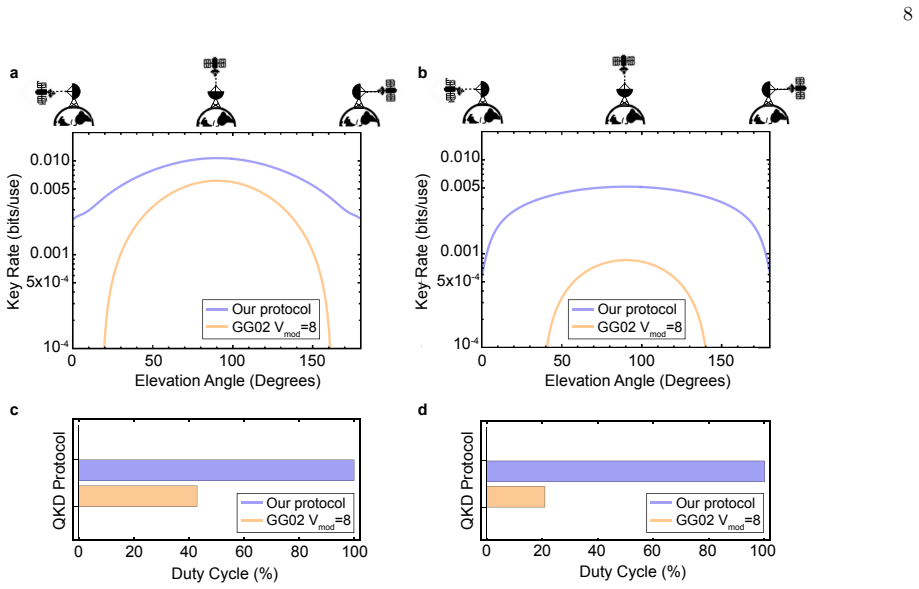
- Rapidly varying channels benefit most because the filter gains are optimised from the data itself, without reliable prior channel estimates; the satellite simulation shows key rates pushed up to 400-fold and the communication window extended to the full roughly three-hour pass.
- Reapplying the protocol to the published parameters of several long-distance experiments yields key-rate improvements from double-digit percentages to more than 400 percent, and extends effective reach by up to 42 km.
Reading between the lines
- If a non-Gaussian Eve attack were found, the claimed supremacy over GG02 could shrink or disappear; the paper's own density-matrix machinery is directly reusable to test that, by replacing Eve's Gaussian average state with a non-Gaussian one and recomputing the Holevo bound.
- The success-probability penalty of post-selection (around 41 percent total in the 29.1 km run) means part of the gain is traded for discarded data; a finite-size analysis that includes the discarded fraction could change the net rate at short block lengths, which the paper leaves for future work.
- Bob's notch filter is a tunable, software-defined member of the same family as discrete-modulation post-selection, so the protocol could plausibly morph a fixed GG02 transmitter into an adaptive-format source, an extension the authors hint at but do not demonstrate.
- The satellite result uses a static link model at each elevation angle; a natural stress test is to run the adaptive optimisation on real scintillation time series, where the channel changes faster than the optimisation cycle.
Editorial analysis
A structured set of objections, weighed in public.
Referee Report
Summary. The paper proposes a continuous-variable QKD protocol that combines Alice-side Gaussian post-selection with Bob-side non-Gaussian notch filtering, claiming to reach key rates above the optimal GG02 protocol and to extract keys in parameter regions that are insecure for standard GG02. The protocol is implemented at the software level and demonstrated on laboratory data at several fibre-equivalent distances, applied retroactively to published experimental datasets, and simulated for a satellite-to-ground link. The reported security analysis computes Eve's Holevo information from her density matrix for a specific two-mode squeezed vacuum attack, deliberately avoiding the Gaussian-extremality argument for the non-Gaussian post-selected state.
Significance. If the security claim were established, a software-only enhancement of CV-QKD with no hardware changes would be practically valuable, and the density-matrix approach to bounding Eve after non-Gaussian post-selection would be a useful technical contribution. The paper also provides a real experimental implementation, which is a strength. However, the central security claim is not currently supported: the analysis restricts Eve to Gaussian attacks without a proof that this restriction is valid after Bob's non-Gaussian filter, and it does not maximize over even the Gaussian attacks. In addition, the headline experimental comparison with optimal GG02 is within statistical uncertainty, and the filter parameters are optimized on the same data used to compute the reported rates. These problems are load-bearing for the paper's main claims, so the significance of the work as a secure protocol is not yet established.
major comments (4)
- [Discussion / Methods] The security analysis restricts Eve to Gaussian attacks, as explicitly acknowledged in the Discussion: "we restrict Eve to Gaussian attacks. However, the optimal eavesdropping strategy in the presence of non-Gaussian post-selection remains an open question." Because Bob's filter FB(xb) in Eq. (2) creates a non-Gaussian post-selected ensemble, the Gaussian extremality results of Refs. [35,36] do not apply, and the paper provides no bound on non-Gaussian attacks. Consequently, the quantity IE computed in Methods Eqs. (15) and (27) is not an upper bound on Eve's information, and the key rate in Eq. (18) is not a proven secure key rate. This is load-bearing because every reported rate, including the headline 0.0038 bits/use at 29.1 km, is conditional on this unproven restriction.
- [Methods, Eq. (14)-(15)] Even within the Gaussian-attack restriction, the analysis does not maximize Eve's information over the parameters of the Gaussian attack. Methods Eq. (15) evaluates IE for a specific TMSV entangling-cloner attack whose squeezing parameters r1 and r2 are derived from the observed Wx and Wp. Standard CV-QKD security proofs instead require a supremum over all attacks consistent with the measured statistics. Without such a maximization, K = beta I_AB - IE is not a lower bound on the secure key rate, and the Abstract's claim that the analysis "accurately bound[s] Eve's information" is not supported.
- [Results, Fig. 2(a) and Table II] The experimental comparison with optimal GG02 is not statistically significant. At T = 0.26 (29.1 km), the key rate after Bob's post-selection is reported as 0.0038 +/- 0.0011 bits/use versus 0.0036 bits/use for optimal GG02; the difference is an order of magnitude smaller than the stated uncertainty. The text's claim that the protocol is "surpassing the optimal GG02 key rate" is therefore not supported by this dataset. The Abstract's "threefold increase in key rates over the optimal GG02 protocol" is also not substantiated by Fig. 2 or Table II; the larger improvements shown in Fig. 4 are relative to each experiment's original (non-optimized) key rate, not to optimal GG02.
- [Methods, Error bars; Fig. 2(b)-(c)] The filter gains (gx, gp) and cut-offs (cx, cp) are optimized on the same dataset that is then used to compute the key rates. The bootstrap error bars described in the Methods resample the data after the parameters have already been fixed, so they do not account for the variance introduced by the parameter selection over the grids in Fig. 2(b) and (c). A train/test split or nested optimization with a separate validation set is needed to rule out the possibility that the reported improvement over GG02 is partly a selection artifact. This is directly relevant to the claim that the protocol "dynamically optimises" key rates in real time.
minor comments (6)
- [Abstract] The phrase "probabilistic filters without known physical representation" is vague; the paper should clarify that the filters are applied to classical data after measurement, which is what makes the scheme implementable at the software level.
- [Fig. 2 caption] The caption states "the key rate achieves the optimal GG02 line," whereas the main text says the rate is "surpassing the optimal GG02 key rate"; these statements are inconsistent and should be reconciled.
- [Methods, Bob's non-Gaussian post-selection] The discretization width (Delta = 0.1 for homodyne, Delta = 0.25 for heterodyne) and the Fock truncation dimension used for the density-matrix calculations are stated, but no convergence checks with respect to these parameters are reported.
- [Table I] The column "Key Rate Improvement (%)" should explicitly state its baseline; it is the original experiment's key rate without post-selection, not the optimal GG02 rate.
- [Fig. 6] The 400-fold improvement in the satellite simulation is a model-based extrapolation using the same filter model and optimized gains; the paper should clearly state that this is a simulation and not an experimentally validated result.
- [Discussion] The Discussion correctly mentions Ref. [43] as a possible route to a rigorous bound; given that the Gaussian-attack restriction is a central limitation, the paper should either incorporate such a bound or explicitly mark all key-rate claims as conditional on the restriction.
Circularity Check
No circular derivation; key-rate improvements are conditional on an acknowledged Gaussian-attack restriction and in-sample filter optimization, which are limitations rather than circular reductions.
full rationale
The central derivation is not circular. The protocol's key rate is computed as K = βIAB − IE (Eq. 18), with IAB obtained from the Alice–Bob covariance matrix (Eqs. 9–12) and IE obtained either from covariance-matrix formulas (Eqs. 14–16) or, after Bob's non-Gaussian filter, from explicitly constructed Eve density matrices (Eqs. 5, 22–27). These are direct evaluations for a specified Gaussian TMSV attack, not re-statements of the desired outcome. The filter gains and cut-offs are optimized on the experimental data (Fig. 2), which introduces in-sample optimism and should be borne in mind when reading the 'surpassing' claim (0.0038 ± 0.001 vs 0.0036 bits/use), but this is an overfitting/statistical concern rather than an equivalence-by-construction: the optimized key rate is not defined as the input parameters. The Discussion explicitly concedes 'we restrict Eve to Gaussian attacks. However, the optimal eavesdropping strategy in the presence of non-Gaussian post-selection remains an open question.' This is a genuine security gap—the reported rates are not proven secure against arbitrary attacks—but it is an unproven assumption/omitted proof, not a circular reduction. Self-citations such as Refs. [27,31] are contextual and not load-bearing. Therefore no circular step is identified.
Assumptions & free parameters
free parameters (3)
- Alice's filter gains gx, gp =
gx = 0.213, gp = 0.259 (29.1 km); gx = 0.178, gp = 0.213 (39.1 km)
- Bob's cut-off parameters cx, cp =
cx = 0, cp = 8.95 (29.1 km)
- Fock truncation dimension =
not stated
assumptions (6)
- ad hoc to paper Eve is restricted to Gaussian attacks
- domain assumption The channel is Gaussian with transmittance T and thermal noise W
- standard math The PM and EB schemes are equivalent
- domain assumption Alice and Bob's joint distribution before post-selection is bivariate Gaussian
- ad hoc to paper The TMSV attack with squeezing parameters derived from Wx and Wp represents the relevant Gaussian attack
- domain assumption Fock-basis truncation converges to the true entropy
Cite this review
Pith. "Pith review of Enhanced continuous-variable quantum key distribution protocol via adaptive signal processing." pith.science (2026). https://pith.science/paper/T6777RRO
@misc{pith2026250718049,
  author       = {Pith},
  title        = {Pith review of: Enhanced continuous-variable quantum key distribution protocol via adaptive signal processing},
  year         = {2026},
  howpublished = {\url{https://pith.science/paper/T6777RRO}},
  note         = {Machine review of arXiv:2507.18049}
}
read the original abstract
Quantum key distribution (QKD) provides a promising approach to secure communications, with continuous-variable QKD (CV-QKD) offering compatibility with existing telecommunication infrastructure. Despite this advantage, CV-QKD is limited by challenges such as losses in terrestrial fibres and atmospheric scintillation in free-space channels. We introduce a QKD protocol that surpasses the optimal Gaussian modulated CV-QKD (GG02) protocol by utilising probabilistic filters without known physical representation. Our approach employs a Gaussian filter at Alice's station and a non-Gaussian notch-like filter at Bob's station. Alice's filter optimises modulation variance to achieve key rates near the optimal GG02 performance, while Bob's filter adapts the effective channel conditions, which can result in higher key rates than the optimal GG02 protocol. Our security analysis avoids Gaussian extremality, accurately bounding Eve's information. The protocol dynamically optimises the secret-key rate for rapidly changing channels, such as terrestrial links and satellite-to-ground communications, and can extract keys in regions deemed non-secure by parameter estimation. Implemented at software level, our protocol requires no hardware modifications and can be integrated into existing QKD systems. Experimental results show a threefold increase in key rates over the optimal GG02 protocol, while simulations for Low Earth Orbit satellite quantum communications indicate a 400-fold increase compared to the non-optimised counterpart.
Figures


Figures from the paper (5 more)




Forward citations
Cited by 1 Pith paper
-
Software-enhanced simultaneous quantum-classical communication protocol with Gaussian post-selection
Gaussian post-selection on Alice's modulation data lets SQCC key rates and reach approach the best fixed-variance choice in fluctuating fibre and satellite channels.
Reference graph
Works this paper leans on
-
[1]
Ekert, A. & Renner, R. The ultimate physical limits of privacy. Nature 507, 443–447 (2014)
work page 2014
-
[2]
Gisin, N., Ribordy, G., Tittel, W. & Zbinden, H. Quan- tum cryptography. Rev. Mod. Phys. 74, 145–195 (2002)
work page 2002
-
[3]
Pirandola, S. et al. Advances in quantum cryptography. Adv. Opt. Photonics 12, 1012–1236 (2020)
work page 2020
-
[4]
Since this variance is close to the optimal value, Alice’s post-selection offered little improvement. How- ever, Bob’s post-selection tripled the original key rate, surpassing the optimal GG02 rate by emulating a better performing channel as shown in Fig. 4(b). This improvement can be explained by considering an entanglement-based experiment where Alice c...
-
[5]
Ralph, T. C. Continuous variable quantum cryptography. Phys. Rev. A 61, 010303 (1999)
work page 1999
-
[6]
Quantum cryptography with squeezed states
Hillery, M. Quantum cryptography with squeezed states. Phys. Rev. A 61, 022309 (2000)
work page 2000
-
[7]
Grosshans, F. & Grangier, P. Continuous variable quan- tum cryptography using coherent states. Phys. Rev. Lett. 88, 057902 (2002)
work page 2002
-
[8]
Grosshans, F. et al. Quantum key distribution using gaussian-modulated coherent states. Nature 421, 238– 241 (2003)
work page 2003
Show all 57 references
-
[9]
Weedbrook, C. et al. Quantum cryptography without switching. Phys. Rev. Lett. 93, 170504 (2004)
2004
-
[10]
Lance, A. M. et al. No-switching quantum key distribu- tion using broadband modulated coherent light. Phys. 13 Rev. Lett. 95, 180503 (2005)
2005
-
[11]
Lodewyck, J. et al. Quantum key distribution over 25 km with an all-fiber continuous-variable system. Phys. Rev. A 76, 042305 (2007)
2007
-
[12]
S., Usenko, V
Madsen, L. S., Usenko, V. C., Lassen, M., Filip, R. & Andersen, U. L. Continuous variable quantum key distri- bution with modulated entangled states. Nat. Commun. 3, 1083 (2012)
2012
-
[13]
& Diamanti, E
Jouguet, P., Kunz-Jacques, S., Leverrier, A., Grangier, P. & Diamanti, E. Experimental demonstration of long- distance continuous-variable quantum key distribution. Nat. Photonics 7, 378–381 (2013)
2013
-
[14]
Wang, C. et al. 25 mhz clock continuous-variable quan- tum key distribution system over 50 km fiber channel. Sci. Rep. 5, 14607 (2015)
2015
-
[15]
Zhang, Y. et al. Long-distance continuous-variable quan- tum key distribution over 202.81 km of fiber. Phys. Rev. Lett. 125, 010502 (2020)
2020
-
[16]
Jain, N. et al. Practical continuous-variable quantum key distribution with composable security. Nat. Commun. 13, 4740 (2022)
2022
-
[17]
Hajomer, A. A. et al. Long-distance continuous-variable quantum key distribution over 100-km fiber with local local oscillator. Sci. Adv. 10, eadi9474 (2024)
2024
-
[18]
Quantum information with optical continuous variables: from bell tests to key dis- tribution (2007)
Garcia-Patron Sanchez, R. Quantum information with optical continuous variables: from bell tests to key dis- tribution (2007)
2007
-
[19]
C., Lund, A
Xiang, G.-Y., Ralph, T. C., Lund, A. P., Walk, N. & Pryde, G. J. Heralded noiseless linear amplification and distillation of entanglement. Nat. Photonics 4, 316–319 (2010)
2010
-
[20]
S., Hosseinidehaj, N
Winnel, M. S., Hosseinidehaj, N. & Ralph, T. C. Gener- alized quantum scissors for noiseless linear amplification. Phys. Rev. A 102, 063715 (2020)
2020
-
[21]
& Levenson, J.- A
Bencheikh, K., Symul, T., Jankovic, A. & Levenson, J.- A. Quantum key distribution with continuous variables. J. Mod. Opt. 48, 1903–1920 (2001)
2001
-
[22]
& Zeng, G
Huang, P., He, G., Fang, J. & Zeng, G. Performance improvement of continuous-variable quantum key distri- bution via photon subtraction. Phys. Rev. A 87, 012317 (2013)
2013
-
[23]
& Zubairy, M
Hu, L., Al-Amri, M., Liao, Z. & Zubairy, M. Continuous- variable quantum key distribution with non-gaussian op- erations. Phys. Rev. A 102, 012608 (2020)
2020
-
[24]
Ye, W. et al. Improvement of self-referenced continuous- variable quantum key distribution with quantum photon catalysis. Opt. Express 27, 17186–17198 (2019)
2019
-
[25]
& Guo, Y
Hu, J., Liao, Q., Mao, Y. & Guo, Y. Performance im- provement of unidimensional continuous-variable quan- tum key distribution using zero-photon quantum cataly- sis. Quantum Inf. Process. 20, 1–20 (2021)
2021
-
[26]
C., Symul, T
Walk, N., Ralph, T. C., Symul, T. & Lam, P. K. Secu- rity of continuous-variable quantum cryptography with gaussian postselection. Phys. Rev. A 87, 020303 (2013)
2013
-
[27]
& Cerf, N
Fiur´ aˇ sek, J. & Cerf, N. J. Gaussian postselection and vir- tual noiseless amplification in continuous-variable quan- tum key distribution. Phys. Rev. A 86, 060302 (2012)
2012
-
[28]
M., Symul, T., Walk, N
Hosseinidehaj, N., Lance, A. M., Symul, T., Walk, N. & Ralph, T. C. Finite-size effects in continuous-variable quantum key distribution with gaussian postselection. Phys. Rev. A 101, 052335 (2020)
2020
-
[29]
Chrzanowski, H. M. et al. Measurement-based noiseless linear amplification for quantum communication. Nat. Photonics 8, 333–338 (2014)
2014
-
[30]
Y., Symul, T., Lam, P
Zhao, J., Haw, J. Y., Symul, T., Lam, P. K. & Assad, S. M. Characterization of a measurement-based noiseless linear amplifier and its applications. Phys. Rev. A 96, 012319 (2017)
2017
-
[31]
Zhao, J. et al. Enhancing quantum teleportation efficacy with noiseless linear amplification. Nat. Commun. 14, 4745 (2023)
2023
-
[32]
Shajilal, B. et al. Improving gaussian channel simula- tion using non-unity gain heralded quantum teleporta- tion. arXiv preprint arXiv:2408.08667 (2024)
2024 arXiv
-
[33]
Li, Z. et al. Non-gaussian postselection and virtual pho- ton subtraction in continuous-variable quantum key dis- tribution. Phys. Rev. A 93, 012310 (2016)
2016
-
[34]
Zhong, H. et al. Enhancing of self-referenced continuous- variable quantum key distribution with virtual photon subtraction. Entropy 20, 578 (2018)
2018
-
[35]
& Huang, D
Zhong, H., Guo, Y., Mao, Y., Ye, W. & Huang, D. Virtual zero-photon catalysis for improving continuous- variable quantum key distribution via gaussian post- selection. Sci. Rep. 10, 17526 (2020)
2020
-
[36]
& Cerf, N
Garc ´ ıa-Patr´ on, R. & Cerf, N. J. Unconditional optimality of gaussian attacks against continuous-variable quantum key distribution. Phys. Rev. Lett. 97, 190503 (2006)
2006
-
[37]
M., Giedke, G
Wolf, M. M., Giedke, G. & Cirac, J. I. Extremality of gaussian quantum states. Phys. Rev. Lett. 96, 080502 (2006)
2006
-
[38]
Holevo, A. S. The capacity of the quantum channel with general signal states. IEEE Trans. Inf. Theory 44, 269– 273 (1998)
1998
-
[39]
Weedbrook, C. et al. Gaussian quantum information. Rev. Mod. Phys. 84, 621–669 (2012)
2012
-
[40]
& Ralph, T
Weedbrook, C., Pirandola, S. & Ralph, T. C. Continuous-variable quantum key distribution using thermal states. Phys. Rev. A 86, 022318 (2012)
2012
-
[41]
Li, L. et al. Continuous-variable quantum key distri- bution with on-chip light sources. Photonics Res. 11, 504–516 (2023)
2023
-
[42]
Sayat, M. et al. Satellite-to-ground continuous variable quantum key distribution: The gaussian and discrete modulated protocols in low earth orbit. IEEE Trans. Commun. (2024)
2024
-
[43]
& Plenio, M
Eisert, J., Scheel, S. & Plenio, M. B. Distilling gaussian states with gaussian operations is impossible. Phys. Rev. Lett. 89, 137903 (2002)
2002
-
[44]
& Leverrier, A
Denys, A., Brown, P. & Leverrier, A. Explicit asymp- totic secret key rate of continuous-variable quantum key distribution with an arbitrary modulation. Quantum 5, 540 (2021)
2021
-
[45]
& Grangier, P
Leverrier, A. & Grangier, P. Unconditional security proof of long-distance continuous-variable quantum key distri- bution with discrete modulation. Phys. Rev. Lett. 102, 180504 (2009)
2009
-
[46]
& Leverrier, A
Ghorai, S., Grangier, P., Diamanti, E. & Leverrier, A. Asymptotic security of continuous-variable quantum key distribution with a discrete modulation. Phys. Rev. X 9, 021059 (2019)
2019
-
[47]
Tian, Y. et al. High-performance long-distance discrete- modulation continuous-variable quantum key distribu- tion. Opt. Lett. 48, 2953–2956 (2023)
2023
-
[48]
& Pacher, C
Kanitschar, F. & Pacher, C. Optimizing continuous- variable quantum key distribution with phase-shift key- ing modulation and postselection. Physical Review Ap- plied 18, 034073 (2022)
2022
-
[49]
J., Wenger, J., Tualle-Brouri, 14 R
Grosshans, F., Cerf, N. J., Wenger, J., Tualle-Brouri, 14 R. & Grangier, P. Virtual entanglement and reconcilia- tion protocols for quantum cryptography with continuous variables. arXiv preprint quant-ph/0306141 (2003)
2003 arXiv
-
[50]
Laudenbach, F. et al. Continuous-variable quantum key distribution with gaussian modulation—the theory of practical implementations. Adv. Quantum Technol. 1, 1800011 (2018)
2018
-
[51]
& Grangier, P
Grosshans, F. & Grangier, P. Reverse reconciliation pro- tocols for quantum cryptography with continuous vari- ables. arXiv preprint quant-ph/0204127 (2002)
2002 arXiv
-
[52]
On the algebraic problem concerning the normal forms of linear dynamical systems
Williamson, J. On the algebraic problem concerning the normal forms of linear dynamical systems. Am. J. Math. 58, 141–163 (1936)
1936
-
[53]
& Pierobon, G
Cariolaro, G. & Pierobon, G. Reexamination of bloch- messiah reduction. Phys. Rev. A 93, 062115 (2016)
2016
-
[54]
& Pan, J.-W
Lu, C.-Y., Cao, Y., Peng, C.-Z. & Pan, J.-W. Mi- cius quantum experiments in space. Reviews of Modern Physics 94, 035001 (2022). 15 SUPPLEMENT AR Y MA TERIAL Appendix A: Detailed Description of the Experimental Parameters In this section, we outline the procedure to implement ...
2022
-
[55]
Therefore, Eqs
Alice’s Post-selection In this case, Alice’s data and her post-selection remains unchanged. Therefore, Eqs. (6) to (8) in the main text still hold. However, Bob’s data, and therefore the calculation of the secret key, are different. Because Bob performs heterodyne detection, t...
-
[56]
Bob’s distribution before the post-selection can be expressed as pb(xb, pb) = 1 π p (Vbx + 1)(Vbp + 1)exp − x2 b (Vbx + 1) − p2 b (Vbp + 1)
Bob’s Post-selection The filter function that Bob uses for heterodyne measurements is given as FB(xb, pb) = ( 0 −c2 < x2 b + p2 b < c2 1 elsewhere , (B8) where c represents the cut-off parameter of the filter which can take the values from 0 to the largest measurement outcome ...
-
[57]
Calculation of the Secret Key Rate When both Alice and Bob perform post-selection, the key rate is computed from K = PBPAx PAp (βIAB − IE), (B27) where PB denotes probability of success of Bob’s post-selection and, PAx and PAp are the probability of success of Alice’s post-sel...
Reviewed August 6, 2026 · model on record in the stance chip above.
Discussion (0). Sign in to comment.