REVIEW 3 major objections 5 minor 3 cited by
Modular programming of interaction and geometric specificity enables assembly of complex DNA origami nanostructures
T0 review · 3 major / 5 minor · reviewed 2026-08-08 · deepseek-v4-flash
Pith's one-line read This paper claims that a conserved triangular-prism DNA origami core, with only its overhangs varied, can encode both interactions and binding angles, enabling self-assembly of a 96-triangle toroid with locally varying curvature.
desk verdict Real modular DNA origami platform with a genuine toroid first, but the headline angle-programming claim runs through an unexplained 7.18°/bp slope that the paper's own oxDNA data undercut. read the letter →
The pith
A machine-rendered reading of the paper's core claim, the machinery that carries it, and where it could break.
The reading
What carries the argument
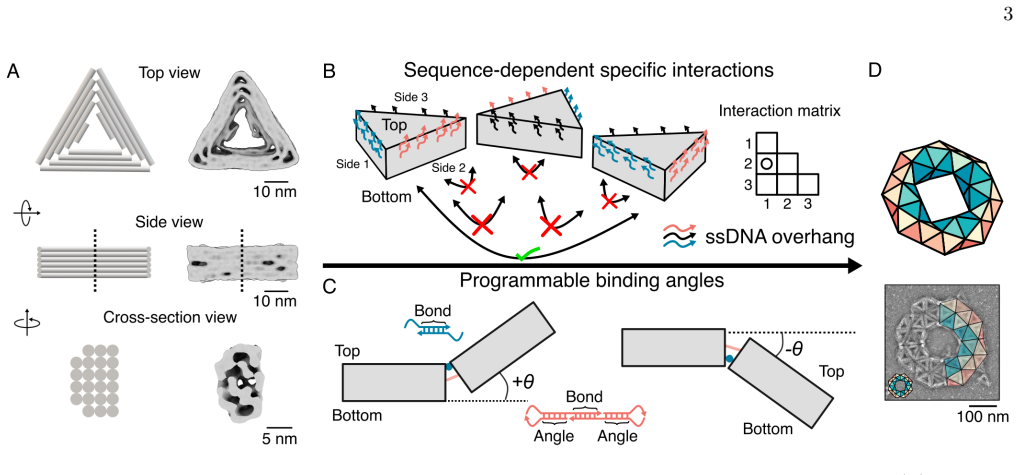
The load-bearing object is the modular triangular prism itself: a hollow right equilateral triangular prism whose 148 core staples and full scaffold routing are frozen across every design, with only the 60 interface staples allowed to vary. Each interface staple carries two independently tunable parts—a five-nucleotide bond domain that encodes interaction specificity (which sides bind) and a hybridized angle domain whose length difference $n\delta$ between two rows of overhangs sets the binding angle $\theta$. The geometric model $\theta = 2\arcsin(0.34\,n\delta/(2d))$ with interhelical spacing $d = 2.6$ nm gives the design intuition, but the paper's actual design rule is the empirical linear calibration measured from self-closing assemblies. This calibration—roughly $6.65^\circ$/bp for positive and $-6.28^\circ$/bp for negative angles—is what makes it possible to prescribe the seven distinct angles needed for the toroid. The symmetry-guided inverse-design step then assigns species and interactions by the 422 symmetry group of the target toroid, reducing the 96 triangles to 12 unique species and 36 unique interactions.
What would settle it
Cryo-electron tomography of assembled toroids measuring the local dihedral angles at the eight junctions would settle the claim: if the measured angles deviate from the designed set (109.5 to -49.1 degrees) by more than the dimer-observed fluctuations, the calibration does not transfer, and toroid closure would be a fortuitous outcome rather than a programmed one.
Extended reading notes
Core claim
The paper's central claim is that interaction specificity and binding angle can be programmed independently on a single conserved DNA-origami block, and that this decoupling is enough to assemble complex, self-limiting two-dimensional manifolds. The block is a hollow right equilateral triangular prism folded from an 8064-nucleotide scaffold; 148 core staples are identical across all designs, while 60 interface staples, 20 per side, carry the program. Each interface staple ends in a five-nucleotide bond domain that sets which sides bind, and adjacent interface strands form a double-stranded angle domain whose length difference $n\delta$ sets the binding angle $\theta$ between neighbors. From dimer cryo-EM, coarse-grained simulations, and gel-electrophoresis measurements of self-closing vertices and rings, the paper derives a linear design rule of roughly $6.65^\circ$ per base pair for positive angles and $-6.28^\circ$ per base pair for negative angles. Using this rule with a symmetry-guided inverse-design algorithm, it assembles non-Platonic shells with substantially improved yields and a toroid of 96 triangles built from 12 unique species, 36 specific interactions, and 7 binding angles spanning $109.5^\circ$ to $-49.1^\circ$, demonstrating a DNA-origami structure whose Gaussian curvature varies globally.
Load-bearing premise
The paper assumes that the angle calibration measured on dimers, vertices, and rings transfers unchanged to the 12-species toroid mixture, where closure depends on the prescribed angles summing correctly.
Editorial extensions
If this is right
- Any triangulated two-dimensional manifold becomes a candidate target with one fixed scaffold routing, since only the overhangs change between designs.
- The cost of a new assembly drops to roughly the synthesis cost of the changed overhangs; the paper quotes about $8,000 for the toroid's 520 unique staples versus about $36,000 for 12 fully bespoke triangle designs.
- A validated library of bond domains and angle domains becomes reusable across shapes, so strands ordered for one structure can be repurposed for another at no added synthesis cost.
- Programming both type specificity and binding angles suppresses off-target polymorphism; yields for the triangular bipyramid, for example, rise from about 12% to 54% when both channels are programmed.
- Self-limiting structures with nonuniform Gaussian curvature, such as the toroid, are assemblable in one pot, although current yields are limited by kinetic deadlock and by misassembled 5-fold toroids.
Reading between the lines
- The conserved-core principle should transfer to other rigid origami polyhedra, such as square- or honeycomb-lattice blocks, since the decoupling of interaction and angle programming does not rely on triangular geometry; the authors gesture at this in their conclusion but do not demonstrate it.
- A systematic map of inner-versus-outer junction bond-length imbalance versus toroid bend angle would convert the paper's observation that the measured bend angle is about $104^\circ$ rather than the designed $109.7^\circ$ into a quantitative design rule for suppressing 5-fold toroid byproducts.
- The roughly four-fold discrepancy between coarse-grained simulations and cryo-EM bending moduli implies the simulation model underestimates single-bond fluctuations; if resolved, simulations could predict angle distributions ahead of experiment rather than merely confirming them.
- The sign-dependent calibration (6.65 vs -6.28 degrees per bp) and the separate 7.18 degrees per bp used for positive angles in the toroid design suggest that a single global calibration may be insufficient at extreme curvatures or helix geometries; a context-dependent calibration table would be a natural testable extension.
Signed reviews
Editorial analysis
A structured set of objections, weighed in public.
Referee Report
Summary. This paper introduces a modular DNA origami building block: a hollow right equilateral triangular prism with a conserved scaffold routing and more than 70% shared core staples. Interaction specificity is programmed through bond-domain sequences in variable interface staples, and binding angles are programmed through the length difference of double-stranded angle domains. The authors characterize binding angles with cryo-EM dimer reconstructions, gel electrophoresis of vertices and rings interpreted with a thermodynamic model, and oxDNA simulations. They then demonstrate self-closing shells, including four non-Platonic shells with improved yields, and a 96-triangle toroid with 12 species, 36 interactions, and 7 programmed angles, which is presented as the key example of a structure with spatially varying Gaussian curvature.
Significance. If the central claim holds, the paper would be a valuable step for DNA origami: an economical, single-scaffold route to complex 2D manifolds with nonuniform curvature, with interaction and angle specification separated into independent overhang domains. The strengths include a parameter-free geometric model (Eq. 1), multiple complementary characterization methods, deposited cryo-EM maps (EMD-48565 to EMD-48569), and an unusually candid reporting of discrepancies, including the four-fold bending-modulus mismatch between oxDNA and cryo-EM and the low toroid yield. However, the toroid demonstration currently rests on an unexplained change in the angle calibration, so the precision of the headline result is not yet established.
major comments (3)
- [SI Section IX (Fig. S20 caption) and main text Section D] The toroid's positive-angle encoding relies on a calibration slope that the main text does not report and the manuscript does not justify. SI Section IX states that all angle-domain lengths for the non-Platonic shells and toroids are derived from the linear fit 'except we use a slope of 7.18 degrees per base-pair for the positive binding angles,' while the main-text calibration (Fig. 2L) reports 6.65 deg/bp for positive angles. This is load-bearing: the toroid requires a positive binding angle of 109.5 deg (main text Section D), which at 6.65 deg/bp would require n_delta of about 16.5 bp, beyond the stated 0-15 bp maximum, whereas at 7.18 deg/bp it falls near the 15 bp maximum. The authors' own oxDNA simulation of a +15-delta dimer gives a mean angle of 99.2 deg (SI Section V), close to the 6.65 deg/bp prediction and about 10 deg below the 109.5 deg target. No measurement, derivation, or error analysis is supplied for the 7.18 deg/bp value. Please either justify this slope with data, show that toroid closure is robust to the choice of slope, or revise the claim that the toroid validates precise angle programming.
- [SI Section VI, Figs. S13E and S14E] The empirical angle calibration is model-dependent, and the manuscript does not propagate the resulting uncertainty into the toroid and shell designs. The inferred positive-angle slopes vary with the assumed bending modulus: from 5.70 to 7.78 deg/bp for vertices and from 6.23 to 7.45 deg/bp for rings, depending on whether B = 10 or 100 kT (Figs. S13E and S14E). The main text fixes B = 25 kT/rad^2 from cryo-EM, but SI Section V reports that oxDNA and cryo-EM disagree on the bending modulus by roughly a factor of four. Since the toroid's largest positive angle sits at the edge of the encodable range, this uncertainty is large enough to shift the required n_delta by several base pairs. Please report confidence intervals for the fitted slopes and show how the uncertainty affects the assigned angle-domain lengths in the toroid design.
- [SI Section VII, Fig. S17] The toroid evidence for 'precise' geometric programming is qualified by the authors' own data: only a small fraction of fully assembled toroids is observed, 21% of closed toroids have the wrong 5-fold symmetry, and the bend angle measured from opened toroids is 104.2 deg rather than the designed 90 deg (Fig. S17G). The thermodynamic model that matches the 4-fold/5-fold selectivity uses this 104 deg bend angle, not the programmed value. Thus the assembled toroid appears to close through bend-angle flexibility and tolerance rather than through faithful reproduction of the programmed local angles. Please provide a quantitative yield, compare designed versus measured local angles in the toroid, or explicitly limit the claim to robust assembly under angular tolerance rather than precise angle encoding.
minor comments (5)
- [SI Eq. (10)] The root-mean-square deviation formula contains a malformed radical expression ('/radicaltp/radicalvertex/radicalvertex√') that should be typeset as a standard square root.
- [Introduction, paragraph 5] The name 'Karfuscher et al.' should be 'Karfusehr et al.' to match reference [35].
- [SI Section II] The text discusses a +20-delta dimer, but Section B of the main text states that angle domains are tunable from 0 to 15 base pairs; please clarify whether +20-delta is a simulation-only probe beyond the design range.
- [SI Section IX caption] The statement that the angle-domain lengths are derived from a linear fit shown in Fig. 2C is inconsistent with the main text, where the linear fit appears in Fig. 2L; the cross-reference should be corrected.
- [Fig. 2L] Error bars are shown on several data points but the caption does not define what they represent (standard deviation, standard error, or fit uncertainty); please define them explicitly.
Circularity Check
The toroid's positive-angle encoding silently replaces the measured 6.65°/bp calibration with an unexplained 7.18°/bp slope, so the flagship 'prediction' of the 109.5° angle is not produced by the paper's own design rule.
-
fitted input called prediction
[SI Section IX, Fig. S20 caption (Overhang design for the interface strands)]
"All the angle-domain lengths for the non-Platonic shells and toroids are derived from a linear fit shown in Fig. 2C, except we use a slope of 7.18 degrees per base-pair for the positive binding angles."
The main-text design rule is the Fig. 2L linear fit with slopes 6.65 and -6.28 deg/bp. For the toroid, the positive slope is silently changed to 7.18 deg/bp. At 6.65, the largest toroid angle 109.5° requires nδ ≈ 16.5 bp, outside the stated 0-15 bp range; at 7.18 it maps to ≈15 bp. The paper's oxDNA +15δ simulation gives 99.2°, consistent with ~6.6 deg/bp. So the toroid's positive-angle prediction is not derived from the calibrated rule; a more favorable slope is substituted to keep the target inside the design space. The toroid thus does not independently validate the reported positive-angle calibration; the programmed angles are adjusted to match the target.
full rationale
Most of the derivation chain is self-contained: Eq. (1) is a parameter-free geometric model; oxDNA simulations and cryo-EM reconstructions are independent measurements; and the vertex/ring gel analysis is a calibration of nδ to θ, not a circular derivation. The modular scaffold/staple conservation claim is supported by the caDNAno design (Fig. S25), not by self-citation. The one load-bearing circular-adjacent step is the toroid encoding in SI Section IX: the paper states that all non-Platonic and toroid angle-domain lengths come from the Fig. 2L fit 'except' for a 7.18 deg/bp positive slope. That slope is not derived or cited anywhere in the manuscript; it differs from the reported 6.65 deg/bp positive slope, from the oxDNA +15δ result (99.2°), and from the ring/vertex fits in SI Section VI. Its practical effect is to move the 109.5° target from an impossible 16.5 bp to an allowed 15 bp. Because this substitution is unexplained, the toroid's positive-angle design is partly constructed from the desired output rather than predicted by the published calibration. The toroid assembly itself remains an experimental fact, and the low yield and 21% 5-fold byproduct count are honestly reported, so the circularity is partial rather than total. The overall claim of modular architecture and independent interaction specificity retains substantial independent content, but the geometric-specificity validation for the flagship toroid is weakened by the unreported slope change. Score 4 reflects one partial reduction-by-construction of the toroid angle prediction without finding the broader derivation circular.
Assumptions & free parameters
free parameters (5)
- Positive angle slope (degrees per bp) =
6.65 deg/bp (main text); 7.18 deg/bp (SI, used for toroids)
- Negative angle slope (degrees per bp) =
-6.28 deg/bp
- Bending modulus B =
25 kT/rad^2 (cryo-EM, used in model); 23.4 kT/rad^2 (toroid bend-angle); oxDNA about 100 kT/rad^2
- Bond free energy delta_E_B =
-17 kT
- Interhelical distance d in geometric model =
2.6 nm
assumptions (5)
- standard math Any 2D manifold can be triangulated, so the triangular prism building block is universally applicable.
- domain assumption Overhang bridges approximate rigid rods because their lengths are much shorter than the dsDNA persistence length.
- domain assumption DNA physical properties are independent of temperature from 298 K to 136 K, so cryo-EM angle distributions can be rescaled by sqrt(T).
- domain assumption The thermodynamic model with bond energy -17 kT and bending modulus B=25 kT/rad^2 captures equilibrium yields of vertices and rings.
- domain assumption oxDNA coarse-grained model faithfully represents the angle distributions of DNA origami dimers.
Cite this review
Pith. "Pith review of Modular programming of interaction and geometric specificity enables assembly of complex DNA origami nanostructures." pith.science (2026). https://pith.science/paper/T67QTUCN
@misc{pith2026250205388,
  author       = {Pith},
  title        = {Pith review of: Modular programming of interaction and geometric specificity enables assembly of complex DNA origami nanostructures},
  year         = {2026},
  howpublished = {\url{https://pith.science/paper/T67QTUCN}},
  note         = {Machine review of arXiv:2502.05388}
}
read the original abstract
We present a modular DNA origami design approach to address the challenges of assembling geometrically complex nanoscale structures, including those with nonuniform Gaussian curvature. This approach features a core structure that completely conserves the scaffold routing across different designs and preserves more than 70% of the DNA staples between designs, dramatically reducing both cost and effort, while enabling precise and independent programming of subunit interactions and binding angles through adjustable overhang lengths and sequences. Using cryogenic electron microscopy, gel electrophoresis, and coarse-grained molecular dynamics simulations, we validate a set of robust design rules. We demonstrate the method's utility by assembling a variety of self-limiting structures, including anisotropic shells with controlled inter-subunit interactions and curvature, and a toroid with globally varying curvature. Our strategy is both cost-effective and versatile, providing a promising and efficient solution for the synthetic fabrication of complex nanostructures.
Figures


Figures from the paper (1 more)

Forward citations
Cited by 3 Pith papers
-
From toroids to helical tubules: Kirigami-inspired programmable assembly of two-periodic curved crystals
A kirigami-based mapping of 2D tilings to 3D curved crystals lets DNA origami triangles self-assemble into programmable toroids, serpentine tubules, and both chiralities of helical tubules.
-
Stochastic size control of self-assembled filaments
Semiaddressable binding, where each species binds itself and the next in sequence, yields a tunable filament length distribution whose mean and width are independently controlled.
-
Inverse Thermodynamics: Designing Interactions for Targeted Phase Behavior
A graph-based design framework positions azeotropes at chosen compositions in binary patchy particle mixtures, confirmed by Gibbs-ensemble simulations.
Reference graph
Works this paper leans on
-
[1]
Hence, they prefer to adopt a buckled conformation to alleviate the strain. FIG. S3. Overhang configuration of +15δ +20δ dimer, simulated in oxDNA. Side view (A), front view (B), and cross-sectional view (C) of a +20δ dimer. (D) Zoomed-in-view of the nicks at the buckled overhangs. 7 III. ANALYZING YIELD FROM GEL INTENSITIES Here, we provide the steps to ...
-
[2]
D. Kimanius, L. Dong, G. Sharov, T. Nakane, and S. H. Scheres, New tools for automated cryo-EM single-particle analysis in RELION-4.0, Biochemical Journal 478, 4169 (2021)
work page 2021
-
[3]
A. Rohou and N. Grigorieff, CTFFIND4: Fast and accurate defocus estimation from electron micrographs, Journal of Structural Biology 192, 216 (2015)
work page 2015
- [4]
-
[5]
T. E. Videbæk, D. Hayakawa, M. F. Hagan, G. M. Grason, S. Fraden, and W. B. Rogers, Measuring multisubunit mechanics of geometrically-programmed colloidal assemblies via cryo-EM multi-body refinement, arXiv preprint arXiv:2501.09230 (2025)
work page Pith review arXiv 2025
-
[6]
T. D. Goddard, C. C. Huang, E. C. Meng, E. F. Pettersen, G. S. Couch, J. H. Morris, and T. E. Ferrin, UCSF ChimeraX: Meeting modern challenges in visualization and analysis, Protein Science 27, 14 (2018)
work page 2018
-
[7]
A. Suma, E. Poppleton, M. Matthies, P. ˇSulc, F. Romano, A. A. Louis, J. P. K. Doye, C. Micheletti, and L. Rovigatti, TacoxDNA: A user-friendly web server for simulations of complex DNA structures, from single strands to origami, Journal of Computational Chemistry 40, 2586 (2019)
work page 2019
- [8]
Show all 34 references
-
[9]
Poppleton, J
E. Poppleton, J. Bohlin, M. Matthies, S. Sharma, F. Zhang, and P. ˇSulc, Design, optimization and analysis of large DNA and RNA nanostructures through interactive visualization, editing and molecular simulation, Nucleic Acids Research 48, e72 (2020)
2020
-
[10]
K. F. Wagenbauer, F. A. S. Engelhardt, E. Stahl, V. K. Hechtl, P. St¨ ommer, F. Seebacher, L. Meregalli, P. Ketterer, T. Gerling, and H. Dietz, How We Make DNA Origami, ChemBioChem 18, 1873 (2017)
2017
-
[11]
Z. Shi, C. E. Castro, and G. Arya, Conformational dynamics of mechanically compliant DNA nanostructures from coarse- grained molecular dynamics simulations, ACS nano 11, 4617 (2017)
2017
-
[12]
S. M. Douglas, A. H. Marblestone, S. Teerapittayanon, A. Vazquez, G. M. Church, and W. M. Shih, Rapid prototyping of 3D DNA-origami shapes with caDNAno, Nucleic Acids Research 37, 5001 (2009)
2009
-
[13]
C. E. Castro, F. Kilchherr, D.-N. Kim, E. L. Shiao, T. Wauer, P. Wortmann, M. Bathe, and H. Dietz, A primer to scaffolded DNA origami, Nature Methods 8, 221 (2011)
2011
-
[14]
J. C. Wang, Helical repeat of DNA in solution, Proceedings of the National Academy of Sciences 76, 200 (1979)
1979
-
[15]
M. Kube, F. Kohler, E. Feigl, B. Nagel-Y¨ uksel, E. M. Willner, J. J. Funke, T. Gerling, P. St¨ ommer, M. N. Honemann, T. G. Martin, et al. , Revealing the structures of megadalton-scale DNA complexes with nucleotide resolution, Nature Communications 11, 1 (2020)
2020
-
[16]
Bednar, P
J. Bednar, P. Furrer, V. Katritch, A. Stasiak, J. Dubochet, and A. Stasiak, Determination of DNA Persistence Length by Cryo-electron Microscopy. Separation of the Static and Dynamic Contributions to the Apparent Persistence Length of DNA, Journal of Molecular Biology 254, 579 (1995)
1995
-
[17]
Dubochet, M
J. Dubochet, M. Adrian, J.-J. Chang, J.-C. Homo, J. Lepault, A. W. McDowall, and P. Schultz, Cryo-electron microscopy of vitrified specimens, Quarterly reviews of biophysics 21, 129 (1988)
1988
-
[18]
Bu and D
Z. Bu and D. J. Callaway, Proteins MOVE! Protein dynamics and long-range allostery in cell signaling, Advances in Protein Chemistry and Structural Biology 83, 163 (2011)
2011
-
[19]
B. E. K. Snodin, F. Randisi, M. Mosayebi, P. ˇSulc, J. S. Schreck, F. Romano, T. E. Ouldridge, R. Tsukanov, E. Nir, A. A. Louis, and J. P. K. Doye, Introducing improved structural properties and salt dependence into a coarse-grained model of DNA, Journal of Chemical Physics 14...
2015
-
[20]
Pazdernik and N
N. Pazdernik and N. Speicher, Oligo synthesis: Why IDT is a leader in the oligo industry (2015),https://www.idtdna.com/ pages/education/decoded/article/oligo-synthesis-why-idt-leads-the-oligo-industry , Last accessed on 2024-12- 28
2015
-
[21]
K. F. Wagenbauer, C. Sigl, and H. Dietz, Gigadalton-scale shape-programmable DNA assemblies, Nature 552, 78 (2017)
2017
-
[22]
Hayakawa, T
D. Hayakawa, T. E. Videbaek, D. M. Hall, H. Fang, C. Sigl, E. Feigl, H. Dietz, S. Fraden, M. F. Hagan, G. M. Grason, and W. B. Rogers, Geometrically programmed self-limited assembly of tubules using DNA origami colloids, Proceedings of the National Academy of Sciences 119, e22...
2022
-
[23]
E. J. Deeds, J. A. Bachman, and W. Fontana, Optimizing ring assembly reveals the strength of weak interactions, Pro- ceedings of the National Academy of Sciences 109, 2348 (2012)
2012
-
[24]
Hayakawa, T
D. Hayakawa, T. E. Videbæk, G. M. Grason, and W. B. Rogers, Symmetry-guided inverse design of self-assembling multiscale DNA origami tilings, ACS Nano 18, 19169 (2024)
2024
-
[25]
Conway, H
J. Conway, H. Burgiel, and C. Goodman-Strauss, The Symmetries of Things , AK Peters/CRC Recreational Mathematics Series (Taylor & Francis, 2008)
2008
-
[26]
T. E. Videbæk, D. Hayakawa, G. M. Grason, M. F. Hagan, S. Fraden, and W. B. Rogers, Economical routes to size-specific assembly of self-closing structures, Science Advances 10, eado5979 (2024)
2024
-
[28]
Bock, L.V., Effects of cryo-em cooling on structural ensembles., Nature Communications 13, 1709 (2022)
G. Bock, L.V., Effects of cryo-em cooling on structural ensembles., Nature Communications 13, 1709 (2022)
2022
-
[40]
Z. Shi, C. E. Castro, and G. Arya, Conformational dynamics of mechanically compliant DNA nanostruc- tures from coarse-grained molecular dynamics simula- tions, ACS nano 11, 4617 (2017)
2017
-
[41]
Nakane, D
T. Nakane, D. Kimanius, E. Lindahl, and S. H. Scheres, Characterisation of molecular motions in cryo-EM single- particle data by multi-body refinement in RELION, Elife 7, e36861 (2018)
2018
-
[43]
J. Lee, K. Baek, M. Kim, G. Yun, Y. H. Ko, N.-S. Lee, I. Hwang, J. Kim, R. Natarajan, C. G. Park, W. Sung, and K. Kim, Hollow nanotubular toroidal polymer mi- crorings, Nature Chemistry 6, 97 (2014)
2014
-
[44]
M. J. Bowick and L. Giomi, Two-dimensional matter: order, curvature and defects, Advances in Physics 58, 449 (2009)
2009
-
[45]
E. J. Deeds, J. A. Bachman, and W. Fontana, Optimizing ring assembly reveals the strength of weak interactions, Proceedings of the National Academy of Sciences 109, 2348 (2012)
2012
-
[46]
Whitelam and R
S. Whitelam and R. L. Jack, The statistical mechanics of dynamic pathways to self-assembly, Annual Review of Physical Chemistry 66, 143 (2015)
2015
-
[47]
Modular programming of interaction and geometric specificity enables assembly of complex DNA origami nanostructures
G. Tikhomirov, P. Petersen, and L. Qian, Fractal assem- bly of micrometre-scale DNA origami arrays with arbi- trary patterns, Nature 552, 67 (2017). Supplemental Information for “Modular programming of interaction and geometric specificity enables assembly of complex DNA origa...
2017 arXiv
Reviewed August 8, 2026 · model on record in the stance chip above.
Discussion (0). Continue with ORCID to comment.