REVIEW 5 major objections 6 minor 1 cited by
Multi-frequency wavefield solutions for variable velocity models using meta-learning enhanced low-rank physics-informed neural network
T0 review · 5 major / 6 minor · reviewed 2026-08-09 · deepseek-v4-flash
Pith's one-line read This paper claims that decomposing a physics-informed neural network's weights by singular value decomposition, with frequency-dependent singular values supplied by a small hypernetwork and a meta-learned initialization, makes…
desk verdict The core multi-frequency speedup is real and well demonstrated at 3–12 Hz, but the abstract's OOD generalization claim outruns the evidence, and the private code/data block verification. read the letter →
The pith
A machine-rendered reading of the paper's core claim, the machinery that carries it, and where it could break.
The reading
What carries the argument
The load-bearing object is the SVD-parameterized low-rank PINN (LRPINN): each hidden-layer weight matrix $W_l$ is written $W_l = U_l \Theta_l V_l^T$, where $U_l$ and $V_l$ are learned, penalized toward orthonormality by an extra loss term, and $\Theta_l = \operatorname{diag}(\sigma_{l,1},\dots,\sigma_{l,k})$ holds frequency-dependent singular values produced by the frequency-embedding hypernetwork (FEH), a small MLP that maps the input frequency to every layer's singular values. This factorization lets one set of singular vectors serve many frequencies while the singular values carry the frequency adaptation. Around it, model-agnostic meta-learning supplies a shared initialization for the LRPINN and FEH, and during meta-testing the FEH is pruned and the retained singular values are fine-tuned; an adaptive rank-reduction step then deletes the smallest singular values and the matching columns of $U_l$ and $V_l$. The orthogonality loss keeps the factorization a genuine SVD so that rank pruning is meaningful.
What would settle it
Run Meta-LRPINN at fixed rank 100 on the 12 Hz overthrust task and compare against the finite-difference reference, then repeat with ranks 200 and 400 while keeping everything else fixed. If increasing the rank does not recover the missing wavefield details, the low-rank SVD representation is not the binding constraint and the paper's account of its own limitation is wrong; if it does recover them, the rank-100 ceiling is confirmed as the stated bottleneck.
Extended reading notes
Core claim
The paper's central claim is that the information carried by frequency in a multi-frequency scattering problem can be parked inside the singular values of a low-rank weight factorization, so that the network's learned geometry (the singular vectors) stays shared across frequencies while only the scaling of each rank-1 component changes. Building on the authors' earlier Meta-PINN, Meta-LRPINN meta-trains both the low-rank PINN and a frequency-embedding hypernetwork so that, at meta-test time, a test frequency is fed through the hypernetwork to initialize the singular values, the hypernetwork is pruned, and only the singular vectors and singular values are fine-tuned for a few hundred epochs. The numerical evidence is that this converges to accurate scattered-wavefield solutions much faster and to lower error than Meta-PINN and vanilla PINN at 3, 6, and 12 Hz on a layered Marmousi model and an overthrust model, and that it retains reasonable accuracy at an out-of-distribution 18 Hz. The authors are explicit that the method's representational ceiling is set by the chosen rank: for the 12 Hz overthrust case, Meta-LRPINN did not capture all details in the reference wavefield, a limitation attributed at least partly to the rank-100 SVD representation.
Load-bearing premise
The method's accuracy depends on the assumption that a rank-100 singular-value representation of each hidden-layer weight matrix can capture the detail of high-frequency scattered wavefields in complex velocity models; the paper itself notes that at 12 Hz on the overthrust model the predicted wavefield misses details in the reference solution and suggests the chosen rank may be the cause.
Editorial extensions
If this is right
- A single meta-trained initialization can be adapted to a new velocity model and frequency with a few hundred gradient updates, rather than training from scratch.
- Adaptive rank reduction during meta-testing cuts the parameter count substantially, with 75–90% reductions improving or matching accuracy at 3 Hz and moderate reductions remaining competitive at 12 Hz.
- Pruning the frequency-embedding hypernetwork after it has supplied the initial singular values accelerates convergence at low and mid frequencies without hurting final accuracy.
- The meta-learned initialization transfers to an out-of-distribution frequency of 18 Hz better than Meta-PINN and vanilla PINN, with an immediate drop in physical loss and rapid early accuracy gains.
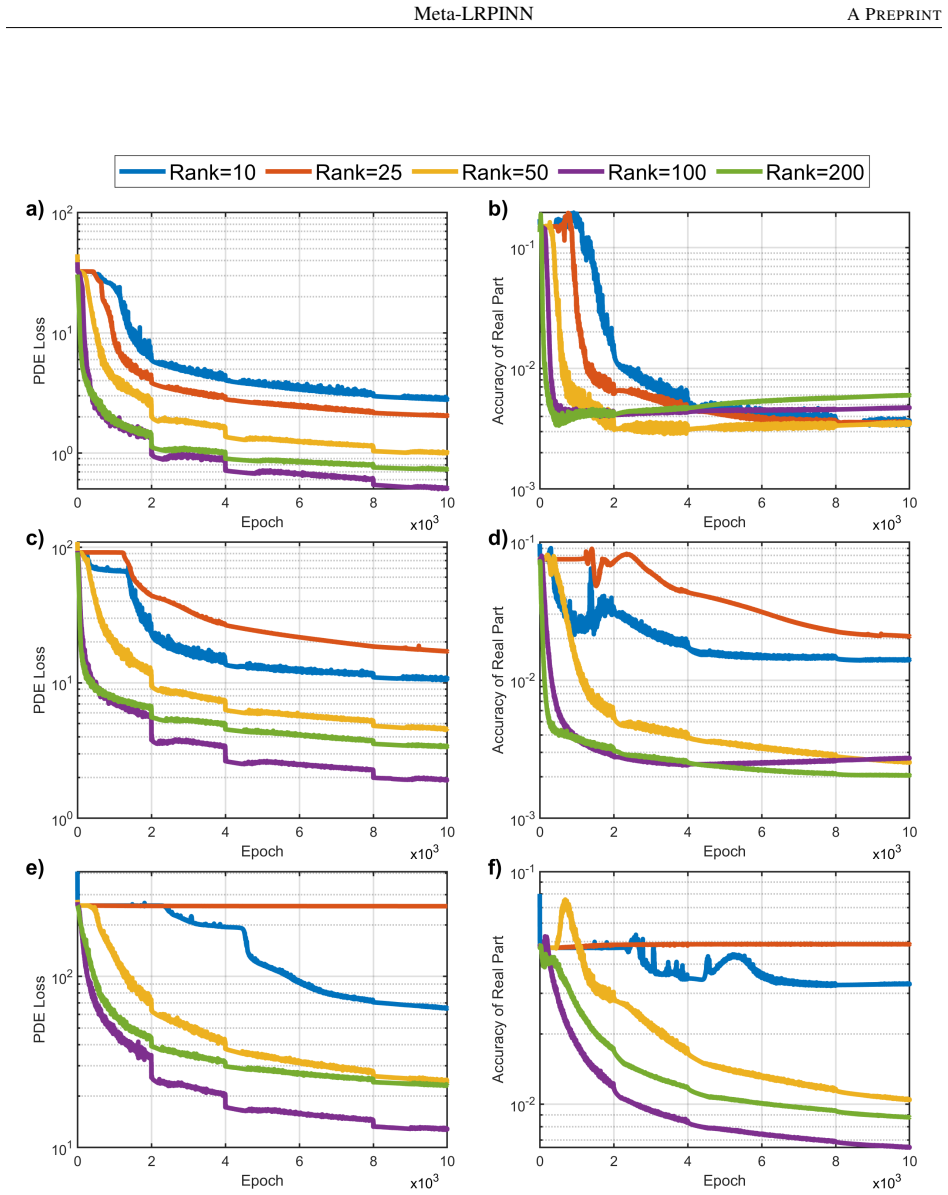
- Higher rank is needed to capture fine details in high-frequency wavefields in large complex models; rank-100 outperforms rank-10 and rank-25 at 12 Hz.
Reading between the lines
- The paper leaves implicit that the same recipe could apply to other parametric PDEs: freeze the network's geometry, condition a scalar parameter through the singular values, and meta-learn the shared part, for example with Reynolds number or dimensionless time as the conditioning parameter.
- The result that rank reduction helps at low frequencies but hurts at high frequencies suggests a frequency-dependent rank schedule, small rank for low frequencies and larger rank for high frequencies, could outperform the fixed rank-100 configuration and would be a cheap test of the claimed link between singular-value magnitude and frequency content.
- The 18 Hz experiment's early accuracy gain followed by decline hints that the meta-learned initialization is a good starting point but not a stable attractor far outside the training distribution; meta-training on a wider or logarithmically spaced frequency range would show whether the decline moves or disappears.
- Because the FEH is pruned after initialization, the paper implies frequency conditioning matters mainly for the starting singular values, not for ongoing adaptation; if so, a cheaper analytical frequency-dependent singular-value scaling might capture part of the benefit.
Editorial analysis
A structured set of objections, weighed in public.
Referee Report
Summary. This paper proposes Meta-LRPINN, a PINN framework for multi-frequency 2D acoustic scattered wavefields in variable velocity models. The method factorizes each hidden-layer weight as U_l Θ_l V_l^T, uses a frequency embedding hypernetwork (FEH) to generate the singular values Θ_l from the input frequency, meta-trains the initialization of the low-rank network and FEH across 40 velocity models and 14 frequencies, and at meta-test time prunes the FEH and optionally reduces rank. Experiments on a Marmousi-extracted layered model and a smoothed overthrust model at 3, 6, and 12 Hz compare against Meta-PINN and vanilla PINN, with additional studies of rank reduction, rank size, FEH pruning, and an out-of-distribution frequency of 18 Hz. The stated central claims are faster convergence, higher accuracy, and strong OOD generalization.
Significance. If the empirical claims held, Meta-LRPINN would be a practically useful step for PINN-based seismic modeling: it combines parameter reduction via SVD with fast adaptation via MAML and introduces a natural frequency-conditioning mechanism. The paper also contributes a clear set of ablations on meta-learning, rank size, FEH pruning, and rank reduction. However, the manuscript currently lacks the quantitative and statistical evidence needed to support its headline claims: there are no final accuracy numbers, no repeated runs or error bars, no public code/data, and the paper's own OOD experiment shows a declining accuracy curve. These gaps are substantial for an empirical methods paper.
major comments (5)
- [Section 5.4, Figure 19] The abstract's claim of 'strong generalization to out-of-distribution frequencies' is contradicted by the paper's own OOD experiment. The text states that at 18 Hz 'Meta-LRPINN initially improves rapidly within just a few epochs, but its accuracy subsequently declines,' and no final converged accuracy, early-stopping rule, or error bars are reported. The evidence supports at most a warm-start benefit on an OOD frequency, not strong generalization. Please either soften the claim or add experiments that demonstrate stable convergence (e.g., best-epoch curves, learning-rate schedules, or further OOD frequencies) and report final accuracy with uncertainty.
- [Sections 4.2–4.3, Figures 3 and 8] The central accuracy claim is not quantitatively supported. All comparisons are presented as loss/accuracy curves, but the text never reports the converged MSE values for Meta-LRPINN, Meta-PINN, or vanilla PINN at any frequency. Without final numbers, repeated runs, and error bars, 'much higher accuracy' cannot be assessed or reproduced. Please report final accuracy metrics, with standard deviations over at least a few random seeds, for each method and frequency.
- [Section 4.3, Figure 11] The overthrust 12 Hz experiment shows a failure mode under the chosen rank: the authors state that 'the Meta-LRPINN overall could not capture the details in the reference wavefield solution' and attribute this to the SVD rank. This directly limits the scope of the claim that Meta-LRPINN achieves high accuracy for high-frequency wavefields in complex models. Please either demonstrate that increasing the rank resolves this failure, or explicitly restrict the accuracy claim to the ranks and frequencies for which the representation is adequate.
- [Sections 3.4–3.5, 4.4, and 5.2] The rank-adaptive pruning relies on an empirical assumption that is never validated: that larger singular values correspond to lower-frequency content and that retaining the top r fraction preserves accuracy. The orthogonality loss in Eq. (22) is also assumed to keep U_l and V_l close to orthonormal, but no orthogonality error is measured. Please report the actual orthogonality error of the learned factors and, if possible, a direct validation of the singular-value-frequency association that motivates pruning.
- [Code and Data Availability] The reproducibility of the experimental section is currently blocked. The stated repository is private, no code or data are provided, and the finite-difference reference solver is not described in terms of grid spacing, discretization order, boundary conditions, or convergence criteria. For an empirical paper whose main contribution is a numerical method, I would request release of the code/data, or a detailed pseudocode plus benchmark outputs, before acceptance.
minor comments (6)
- [Section 2 heading] The heading 'Reivew of frequency-domain scattered wavefield solutions' should be 'Review'.
- [Abstract and throughout] There are several grammar errors, e.g., 'much fast convergence speed and much high accuracy'; these should be corrected throughout.
- [Acknowledgments] 'The authors thank the DeepWave sponsors fort heir support' should be 'for their support'.
- [Section 3.3] The sentence containing 'mathcalT represents all training data set' appears to be a LaTeX rendering error; please fix the notation.
- [Figures 4–6 and 9–11] The figure captions do not list the exact hyperparameters and epoch-to-iteration mapping used for the displayed snapshots; adding this information would help readers interpret the convergence claims.
- [Section 5.2] The phrase 'the rank-10 model performs relatively poor' is ungrammatical, and the qualitative comparison of rank-10 and rank-25 at different frequencies would benefit from the quantitative metrics requested in the major comments.
Circularity Check
No significant circularity: Meta-LRPINN is validated against external finite-difference references, and its PDE-residual training does not encode the target wavefields.
full rationale
This is an empirical methods paper rather than a derivation from first principles, and its central comparisons are self-contained in the relevant sense. The training objective is the physics-informed residual of the scattered Helmholtz equation (Equation 6), not a regression against the reference wavefields; the numerical references used for accuracy evaluation are computed with a finite-difference method, so the accuracy metric is external to the network's optimization. The FEH maps frequency to singular values by construction, but this is the proposed architecture itself rather than a concealed reuse of the target output; the predicted quantity is the LRPINN wavefield produced after meta-testing fine-tuning against the PDE loss. The self-citations to the authors' prior Meta-PINN work are used as a baseline and for a regularization-loss reference, but the novel low-rank and frequency-embedding components are evaluated against that baseline and against vanilla PINN using the same external references, so the self-citation is not load-bearing. There is no uniqueness theorem imported from the authors' prior work, and no ansatz is smuggled in via citation: the SVD low-rank parameterization, FEH, and meta-learning steps are stated directly in the paper. The manuscript does contain internal limitations: Section 4.3 concedes that for the 12 Hz overthrust case 'Meta-LRPINN overall could not capture the details in the reference wavefield solution,' and Section 5.4 reports that at the out-of-distribution 18 Hz frequency 'its accuracy subsequently declines.' These are performance limitations relevant to the strength of the generalization claim, but they are not circularity: they do not show that any claimed result reduces by construction to its inputs. No fitted parameter is renamed as a prediction, and no derived quantity is defined in terms of the quantity it is supposed to predict. The appropriate finding is therefore no significant circularity.
Assumptions & free parameters
free parameters (7)
- SVD rank k =
100 (meta-training); 10-200 in rank experiments
- Retention ratio r for rank pruning =
1.0, 0.5, 0.25, 0.1
- Loss weights lambda_p, lambda_r, lambda_ort, lambda_scale =
1, 1, 1, 0.1
- Learning rates and decay schedule =
inner 2e-3; outer 1e-3 decay 0.8 per 5000 epochs; meta-test 1e-3 decay 0.5 at epochs 2000, 4000, 8000
- FEH architecture =
3 hidden layers, 80 neurons each
- Main LRPINN width and depth =
6 hidden layers; U and V of size 320x100; baselines 320 neurons per layer
- Meta-training task scale =
40 velocity models x 14 frequencies = 560 tasks; 50000 epochs
assumptions (8)
- domain assumption The constant-density acoustic wave equation (Eq. 1) governs the scattered wavefields.
- standard math The scattered-field reformulation (Eq. 2) and analytic Hankel background field (Eq. 3) are valid and remove the source singularity.
- domain assumption The finite-difference numerical references are accurate enough to serve as ground truth for MSE comparisons.
- ad hoc to paper A rank-100 SVD factorization of each hidden layer can represent the multi-frequency scattered wavefield with sufficient accuracy.
- ad hoc to paper The FEH can map any test frequency to singular values that serve as a good starting point for fine-tuning.
- ad hoc to paper The soft orthogonality loss keeps U and V close enough to orthonormal for the factorization to be treated as an SVD.
- ad hoc to paper The 40 training velocity models and the 2-15 Hz frequency range are representative enough for generalization to new models and out-of-distribution frequencies.
- ad hoc to paper Larger singular values correspond to low-frequency content, and smaller singular values to high-frequency details, justifying rank pruning.
invented entities (1)
-
Frequency embedding hypernetwork (FEH)
Cite this review
Pith. "Pith review of Multi-frequency wavefield solutions for variable velocity models using meta-learning enhanced low-rank physics-informed neural network." pith.science (2026). https://pith.science/paper/T6JXCJBW
@misc{pith2026250200897,
  author       = {Pith},
  title        = {Pith review of: Multi-frequency wavefield solutions for variable velocity models using meta-learning enhanced low-rank physics-informed neural network},
  year         = {2026},
  howpublished = {\url{https://pith.science/paper/T6JXCJBW}},
  note         = {Machine review of arXiv:2502.00897}
}
read the original abstract
Physics-informed neural networks (PINNs) face significant challenges in modeling multi-frequency wavefields in complex velocity models due to their slow convergence, difficulty in representing high-frequency details, and lack of generalization to varying frequencies and velocity scenarios. To address these issues, we propose Meta-LRPINN, a novel framework that combines low-rank parameterization using singular value decomposition (SVD) with meta-learning and frequency embedding. Specifically, we decompose the weights of PINN's hidden layers using SVD and introduce an innovative frequency embedding hypernetwork (FEH) that links input frequencies with the singular values, enabling efficient and frequency-adaptive wavefield representation. Meta-learning is employed to provide robust initialization, improving optimization stability and reducing training time. Additionally, we implement adaptive rank reduction and FEH pruning during the meta-testing phase to further enhance efficiency. Numerical experiments, which are presented on multi-frequency scattered wavefields for different velocity models, demonstrate that Meta-LRPINN achieves much fast convergence speed and much high accuracy compared to baseline methods such as Meta-PINN and vanilla PINN. Also, the proposed framework shows strong generalization to out-of-distribution frequencies while maintaining computational efficiency. These results highlight the potential of our Meta-LRPINN for scalable and adaptable seismic wavefield modeling.
Figures


Figures from the paper (16 more)




Forward citations
Cited by 1 Pith paper
-
DiffPINN: Generative diffusion-initialized physics-informed neural networks for accelerating seismic wavefield representation
A conditional latent diffusion model generates physics-informed neural network initializations that speed up seismic wavefield PINN training and improve accuracy.
Reference graph
Works this paper leans on
-
[1]
Seismic modeling
Jose M Carcione, G \'e rard C Herman, and APE Ten Kroode. Seismic modeling. Geophysics, 67 0 (4): 0 1304--1325, 2002
2002
-
[2]
Full seismic waveform modelling and inversion
Andreas Fichtner. Full seismic waveform modelling and inversion. Springer Science & Business Media, 2010
2010
-
[3]
Accuracy of finite-difference and finite-element modeling of the scalar and elastic wave equations
Kurt J Marfurt. Accuracy of finite-difference and finite-element modeling of the scalar and elastic wave equations. Geophysics, 49 0 (5): 0 533--549, 1984
work page 1984
-
[4]
R Gerhard Pratt. Seismic waveform inversion in the frequency domain, part 1: Theory and verification in a physical scale model. Geophysics, 64 0 (3): 0 888--901, 1999
work page 1999
-
[5]
R Gerhard Pratt and Richard M Shipp. Seismic waveform inversion in the frequency domain, part 2: Fault delineation in sediments using crosshole data. Geophysics, 64 0 (3): 0 902--914, 1999
work page 1999
-
[6]
Frequency-domain elastic wave modeling by finite differences: A tool for crosshole seismic imaging
R Gerhard Pratt. Frequency-domain elastic wave modeling by finite differences: A tool for crosshole seismic imaging. Geophysics, 55 0 (5): 0 626--632, 1990
work page 1990
-
[7]
St \'e phane Operto, Jean Virieux, Patrick Amestoy, Jean-Yves L’Excellent, Luc Giraud, and Hafedh Ben Hadj Ali. 3d finite-difference frequency-domain modeling of visco-acoustic wave propagation using a massively parallel direct solver: A feasibility study. Geophysics, 72 0 (5): 0 SM195--SM211, 2007
work page 2007
-
[8]
A new iterative solver for the time-harmonic wave equation
CD Riyanti, YA Erlangga, R-E Plessix, Wim A Mulder, C Vuik, and C Oosterlee. A new iterative solver for the time-harmonic wave equation. Geophysics, 71 0 (5): 0 E57--E63, 2006
work page 2006
Show all 36 references
-
[9]
Three-dimensional frequency-domain full-waveform inversion with an iterative solver
Ren \'e - \'E douard Plessix. Three-dimensional frequency-domain full-waveform inversion with an iterative solver. Geophysics, 74 0 (6): 0 WCC149--WCC157, 2009
2009
-
[10]
3d finite-difference modeling of elastic wave propagation in the laplace-fourier domain
Petr V Petrov and Gregory A Newman. 3d finite-difference modeling of elastic wave propagation in the laplace-fourier domain. Geophysics, 77 0 (4): 0 T137--T155, 2012
2012
-
[11]
An efficient helmholtz solver for acoustic transversely isotropic media
Zedong Wu and Tariq Alkhalifah. An efficient helmholtz solver for acoustic transversely isotropic media. Geophysics, 83 0 (2): 0 C75--C83, 2018
2018
-
[12]
An optimal nearly analytic discrete method for 2d acoustic and elastic wave equations
Dinghui Yang, Ming Lu, Rushan Wu, and Jiming Peng. An optimal nearly analytic discrete method for 2d acoustic and elastic wave equations. Bulletin of the Seismological Society of America, 94 0 (5): 0 1982--1992, 2004
1982
-
[13]
A finite-difference iterative solver of the helmholtz equation for frequency-domain seismic wave modeling and full-waveform inversion
Xingguo Huang and Stewart Greenhalgh. A finite-difference iterative solver of the helmholtz equation for frequency-domain seismic wave modeling and full-waveform inversion. Geophysics, 86 0 (2): 0 T107--T116, 2021
2021
-
[14]
Accelerating the shifted laplace preconditioner for the helmholtz equation by multilevel deflation
Abdul Hanan Sheikh, Domenico Lahaye, L Garcia Ramos, Reinhard Nabben, and Cornelis Vuik. Accelerating the shifted laplace preconditioner for the helmholtz equation by multilevel deflation. Journal of Computational Physics, 322: 0 473--490, 2016
2016
-
[15]
An iterative solver for the 3d helmholtz equation
Mikhail Belonosov, Maxim Dmitriev, Victor Kostin, Dmitry Neklyudov, and Vladimir Tcheverda. An iterative solver for the 3d helmholtz equation. Journal of computational physics, 345: 0 330--344, 2017
2017
-
[16]
Physics-informed neural networks: A deep learning framework for solving forward and inverse problems involving nonlinear partial differential equations
Maziar Raissi, Paris Perdikaris, and George E Karniadakis. Physics-informed neural networks: A deep learning framework for solving forward and inverse problems involving nonlinear partial differential equations. Journal of Computational physics, 378: 0 686--707, 2019
2019
-
[17]
Physics-informed neural networks (pinns) for wave propagation and full waveform inversions
Majid Rasht-Behesht, Christian Huber, Khemraj Shukla, and George Em Karniadakis. Physics-informed neural networks (pinns) for wave propagation and full waveform inversions. Journal of Geophysical Research: Solid Earth, 127 0 (5): 0 e2021JB023120, 2022
2022
-
[18]
Kronecker neural networks overcome spectral bias for pinn-based wavefield computation
Umair Bin Waheed. Kronecker neural networks overcome spectral bias for pinn-based wavefield computation. IEEE Geoscience and Remote Sensing Letters, 19: 0 1--5, 2022
2022
-
[19]
Multi-frequency wavefield modeling of acoustic vti wave equation using physics informed neural networks
Ali Imran Sandhu, Umair bin Waheed, Chao Song, Oliver Dorn, and Pantelis Soupios. Multi-frequency wavefield modeling of acoustic vti wave equation using physics informed neural networks. Frontiers in Earth Science, 11: 0 1227828, 2023
2023
-
[20]
Review of physics-informed machine-learning inversion of geophysical data
Gerard T Schuster, Yuqing Chen, and Shihang Feng. Review of physics-informed machine-learning inversion of geophysical data. Geophysics, 89 0 (6): 0 T337--T356, 2024
2024
-
[21]
Modeling multisource multifrequency acoustic wavefields by a multiscale fourier feature physics-informed neural network with adaptive activation functions
Xintao Chai, Zhiyuan Gu, Hang Long, Shaoyong Liu, Taihui Yang, Lei Wang, Fenglin Zhan, Xiaodong Sun, and Wenjun Cao. Modeling multisource multifrequency acoustic wavefields by a multiscale fourier feature physics-informed neural network with adaptive activation functions. Geop...
2024
-
[22]
Solving the frequency-domain acoustic vti wave equation using physics-informed neural networks
Chao Song, Tariq Alkhalifah, and Umair Bin Waheed. Solving the frequency-domain acoustic vti wave equation using physics-informed neural networks. Geophysical Journal International, 225 0 (2): 0 846--859, 2021
2021
-
[23]
A versatile framework to solve the helmholtz equation using physics-informed neural networks
Chao Song, Tariq Alkhalifah, and Umair Bin Waheed. A versatile framework to solve the helmholtz equation using physics-informed neural networks. Geophysical Journal International, 228 0 (3): 0 1750--1762, 2022
2022
-
[24]
Pinneik: Eikonal solution using physics-informed neural networks
Umair Bin Waheed, Ehsan Haghighat, Tariq Alkhalifah, Chao Song, and Qi Hao. Pinneik: Eikonal solution using physics-informed neural networks. Computers & Geosciences, 155: 0 104833, 2021
2021
-
[25]
A modified physics-informed neural network with positional encoding
Xinquan Huang, Tariq Alkhalifah, and Chao Song. A modified physics-informed neural network with positional encoding. In SEG International Exposition and Annual Meeting, page D011S106R002. SEG, 2021
2021
-
[26]
Helmholtz-equation solution in nonsmooth media by a physics-informed neural network incorporating quadratic terms and a perfectly matching layer condition
Yanqi Wu, Hossein S Aghamiry, Stephane Operto, and Jianwei Ma. Helmholtz-equation solution in nonsmooth media by a physics-informed neural network incorporating quadratic terms and a perfectly matching layer condition. Geophysics, 88 0 (4): 0 T185--T202, 2023
2023
-
[27]
Physics-informed neural wavefields with gabor basis functions
Tariq Alkhalifah and Xinquan Huang. Physics-informed neural wavefields with gabor basis functions. Neural Networks, 175: 0 106286, 2024
2024
-
[28]
Meta-auto-decoder for solving parametric partial differential equations
Xiang Huang, Zhanhong Ye, Hongsheng Liu, Shi Ji, Zidong Wang, Kang Yang, Yang Li, Min Wang, Haotian Chu, Fan Yu, et al. Meta-auto-decoder for solving parametric partial differential equations. Advances in Neural Information Processing Systems, 35: 0 23426--23438, 2022
2022
-
[29]
Single reference frequency loss for multifrequency wavefield representation using physics-informed neural networks
Xinquan Huang and Tariq Alkhalifah. Single reference frequency loss for multifrequency wavefield representation using physics-informed neural networks. IEEE Geoscience and Remote Sensing Letters, 19: 0 1--5, 2022
2022
-
[30]
Simulating seismic multifrequency wavefields with the fourier feature physics-informed neural network
Chao Song and Yanghua Wang. Simulating seismic multifrequency wavefields with the fourier feature physics-informed neural network. Geophysical Journal International, 232 0 (3): 0 1503--1514, 2023
2023
-
[31]
Multiple wavefield solutions in physics-informed neural networks using latent representation
Mohammad H Taufik, Xinquan Huang, and Tariq Alkhalifah. Multiple wavefield solutions in physics-informed neural networks using latent representation. IEEE Geoscience and Remote Sensing Letters, 2024
2024
-
[32]
Meta learning for improved neural network wavefield solutions
Shijun Cheng and Tariq Alkhalifah. Meta learning for improved neural network wavefield solutions. Surveys in Geophysics, pages 1--23, 2025
2025
-
[33]
Model-agnostic meta-learning for fast adaptation of deep networks
Chelsea Finn, Pieter Abbeel, and Sergey Levine. Model-agnostic meta-learning for fast adaptation of deep networks. In International conference on machine learning, pages 1126--1135. PMLR, 2017
2017
-
[34]
Richards
Keiiti Aki and Paul G. Richards. Quantitative seismology: Theory and methods. 1980. URL https://api.semanticscholar.org/CorpusID:58794764
1980
-
[35]
Wavefield solutions from machine learned functions constrained by the helmholtz equation
Tariq Alkhalifah, Chao Song, Umair bin Waheed, and Qi Hao. Wavefield solutions from machine learned functions constrained by the helmholtz equation. Artificial Intelligence in Geosciences, 2: 0 11--19, 2021
2021
-
[36]
Decoupled weight decay regularization
Ilya Loshchilov and Frank Hutter. Decoupled weight decay regularization. arXiv preprint arXiv:1711.05101, 2017
2017 arXiv
Reviewed August 9, 2026 · model on record in the stance chip above.
Discussion (0). Continue with ORCID to comment.