REVIEW 3 major objections 5 minor 52 references
Non-local Recurrent Neural Memory for Supervised Sequence Modeling
T0 review · 3 major / 5 minor · reviewed 2026-08-14 · deepseek-v4-flash
Pith's one-line read The paper argues that full-order interactions inside sliding blocks, passed across blocks by a gated memory, capture long-range dependencies that standard recurrent networks lose.
desk verdict A genuine but incremental LSTM-plus-blockwise-self-attention module with plausible results, whose headline long-range dependency story outruns the evidence because the cross-block path is just a gated recurrence. read the letter →
The pith
A machine-rendered reading of the paper's core claim, the machinery that carries it, and where it could break.
The reading
What carries the argument
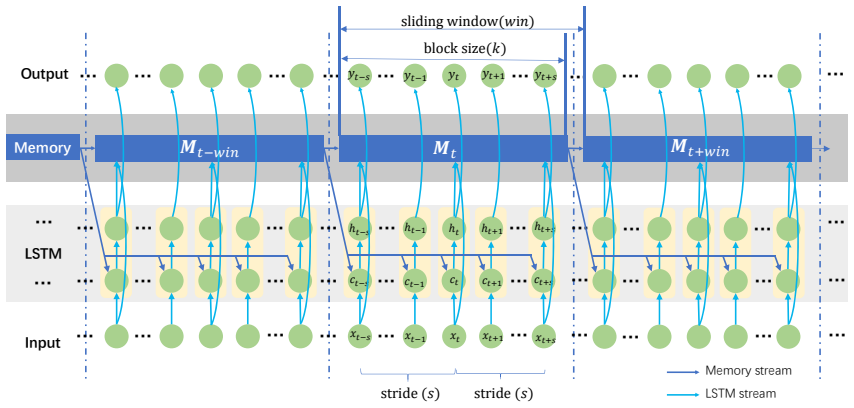
The load-bearing object is the NRNM cell (Equations 1–7). Its core is a scaled dot-product multi-head self-attention over $C = \text{Concat}([h_{t-k+1},...,h_t],[x_{t-k+1},...,x_t])$, which makes every unit in the block attend to every other unit (Eq. 2). The gated recurrence (Eq. 3) then mixes the attended block embedding $\tilde{M}_t$ with the previous memory $M_{t-\text{win}}$ under input and forget gates (Eq. 4), and a memory gate $g_m$ (Eq. 7) flattens $M_{t-\text{win}}$ into the LSTM cell update (Eq. 5). This mechanism is what carries the paper's claim of capturing both local full-order and global block-level dependencies.
What would settle it
Run a synthetic sequence-classification experiment in which the only discriminating signal appears at two time steps separated by more than one block size, with all local windows individually uninformative; if NRNM does not clearly beat LSTM on this task, its claimed long-range memory is not actually doing the work.
Extended reading notes
Core claim
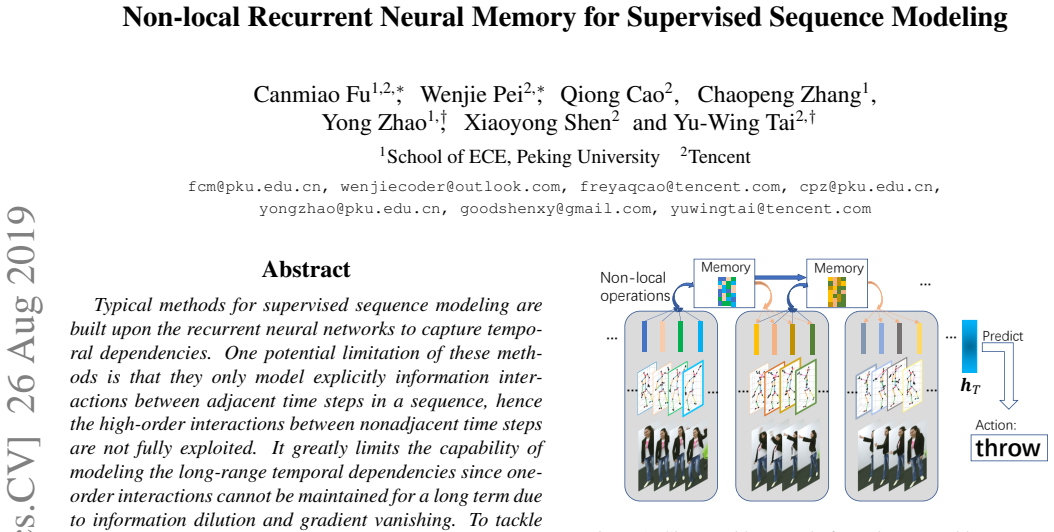
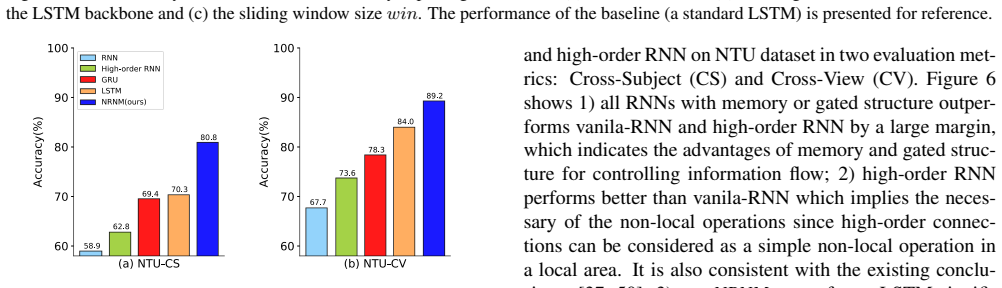
The paper claims that a recurrent sequence model can capture long-range dependencies by combining two interaction scales: inside a sliding block of $k$ time steps, multi-head self-attention over the concatenation of LSTM hidden states and raw inputs models full-order (all-pairs) interactions, producing an attention embedding; across blocks, the memory state is updated by gating the new embedding against the previous memory state, $M_t = G_i \odot \tanh(\tilde{M}_t) + G_f \odot M_{t-\text{win}}$, and this flattened memory is injected into the LSTM cell state through a memory gate. Because the non-local attention shortcut strengthens latent feature propagation, the authors argue, gradients do not have to flow through repeated single-step recurrences. They report 80.8% Cross-Subject and 89.2% Cross-View accuracy on NTU skeleton action recognition and 93.1% accuracy on IMDB sentiment analysis, better than the LSTM/GRU baselines and the listed prior methods.
Load-bearing premise
The long-range claim rests on the assumption that repeated gating across memory blocks (Equation 3) preserves distant information as well as the in-block attention does; the paper does not measure that path directly, so if the gated recurrence still dilutes information over many windows, the reported gains would need a different explanation.
Editorial extensions
If this is right
- Plugging the NRNM cell into a middle LSTM layer improves sequence classification over the same backbone without it.
- The block size $k$ and sliding window size $w_{in}$ have a demonstrated sweet spot: $k=8$ and $w_{in}\in[4,8]$ work best on NTU, with larger blocks tending to overfit.
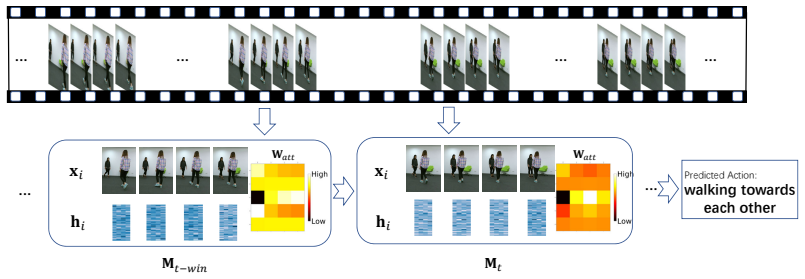
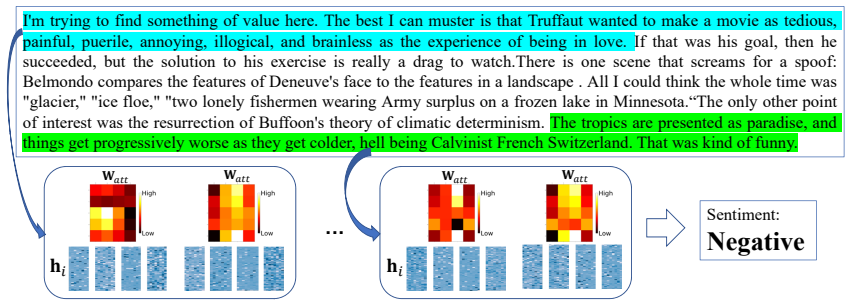
- The learned attention weights inside a block can be visualized to show which past inputs and hidden states form the memory.
- The model reaches its reported accuracy without extra data or pretrained transfer models in the action task, unlike some compared methods.
- On IMDB, the memory helps when the decisive sentiment signal appears early and the final words are misleading, a case where the last hidden state alone fails.
Reading between the lines
- If the paper is right, the cross-block update in Equation 3 is an LSTM-style gated recurrence over memory states, so the 'global interaction' between blocks is still one-order at the block level; testing NRNM with the gated recurrence replaced by an identity skip could quantify how much of the gain is due to this path.
- Because attention inside a block sees all pairs simultaneously, the model may be parallelizable within blocks in a way standard RNNs are not; the paper does not report training speed or parallelism.
- Block boundaries are fixed by hyperparameters; aligning them with semantic units such as sentences or shots is a natural extension that the paper does not explore.
- The classification-only loss means the memory is never trained to reconstruct or predict future content; a future-task objective could sharpen what the memory retains.
Editorial analysis
A structured set of objections, weighed in public.
Referee Report
Summary. The paper introduces the Non-local Recurrent Neural Memory (NRNM), a recurrent memory module built on top of an LSTM backbone. The module slides a temporal block over the sequence, applies multi-head self-attention to the concatenation of LSTM hidden states and input features within the block to form a memory embedding, updates the memory state through a gated recurrent combination with the previous memory state, and injects a flattened earlier memory state into the LSTM cell update. The authors report accuracy gains over LSTM baselines and prior methods on NTU RGB+D skeleton-based action recognition (80.8 CS, 89.2 CV) and IMDB sentiment analysis (93.1), and claim that the model captures long-range dependencies through blockwise non-local interactions and cross-block gated recurrence.
Significance. If the long-range dependency benefit were established, NRNM would be a useful contribution: the blockwise self-attention formulation is clean, the memory gate is easy to insert into LSTM/GRU backbones, and the reported numbers on two standard benchmarks are competitive. The paper gives an explicit forward model, several ablations (block size, integration layer, sliding window size), and qualitative attention visualizations. However, the central mechanism for long-range dependencies is asserted rather than demonstrated, and the empirical claims rest on single accuracy numbers without error bars, seeds, statistical tests, or released code or baseline configurations. The contribution is potentially valuable but requires a major revision to substantiate the load-bearing claims.
major comments (3)
- [Section 3.1, Eq. (3)] The non-local self-attention in Eq. (2) operates only on source units inside a single block [t-k+1, t]. Any dependency spanning more than k steps must propagate through the gated recurrent update M_t = G_i * tanh(~M_t) + G_f * M_{t-win}. This is a gated recurrence over memory states, structurally the same kind of dynamical system as an LSTM cell and, at a coarser time scale, subject to the same information-dilution and gradient-vanishing concerns with which the paper motivates its criticism of recurrent models in Sec. 1. The paper provides no gradient-flow analysis, no diagnostic task with dependency length greater than k, and no ablation separating the contribution of the cross-block recurrent path from that of within-block attention; the visualizations in Figures 7 and 8 show attention weights inside individual blocks only. Consequently, the abstract and conclusion claim that NRNM "is able to capture the long-range dependencies" is not supported by the presented evidence.
- [Section 4.4, Tables 1-2; Section 5.3, Table 3] All reported accuracies are single runs with no error bars, random seed information, or significance tests. The improvements over the next-best methods are often small (e.g., 80.8 versus 79.8 in CS and 89.2 versus 87.1 in CV in Table 1; 93.1 versus 92.6 in Table 3). Table 2 states that all baseline results are from the authors' implementations, but no code or detailed configuration is released, so the comparisons cannot be independently reproduced. The state-of-the-art claim should be supported by multiple seeds with standard deviations and a reproducible baseline setup.
- [Section 3.1, Eq. (2)] The term "full-order interactions" is used to describe what Eq. (2) computes, but the operation is a pairwise dot-product attention Q K^T followed by a softmax. This is an all-pairs, second-order interaction among source units; it does not literally model interactions of order higher than two among time steps. The claim that NRNM "distills high-level features contained in high-order interactions" is therefore an interpretation rather than a demonstrated property. The authors should either replace "full-order" with "all-pairs" or provide a formal characterization of the interaction order captured by the blockwise attention mechanism.
minor comments (5)
- [Throughout] Please correct typographical errors and inconsistent capitalization, including "vanila-RNN" (Sections 1, 4.3, and Figure 6), "Long Shot-Term Memory" (Related work), "stardard" (Section 5.1), and "recoginition" (Section 4.1).
- [Figures 5 and 9] The captions contain local file paths and "Page 1 of 1" placeholders (e.g., "file:///F:/youtu/face/TrainCode/..."); these artifacts must be removed before publication.
- [Section 3.2, Eq. (5)] The text refers to incorporating "the obtained memory state" into the LSTM update, but Eq. (5) uses M_{t-win} rather than M_t. Please clarify whether the injected state is the current block memory or the previous memory and align the description with Figure 4.
- [Section 4.2] The stride parameter s is introduced for selecting source hidden states, but its value in the main experiments is not reported, and no ablation for stride is given. Please report the stride used in Tables 1 and 3 and discuss its effect on the results.
- [Section 4.2] The sentence "The size of memory state is set to be same as the combined size of input hidden states, i.e., the dimensions are [block size (k)/stride (s), dim(h_t)]" is ambiguous, because the source contains 2k units (k hidden states and k input features). Please state the memory dimensions explicitly.
Circularity Check
No circularity: NRNM is an empirical architecture paper whose claims rest on network equations and benchmark experiments, not on fitted inputs or self-citation chains.
full rationale
The paper's central claims—blockwise non-local attention, gated recurrent memory updating, and injection into the LSTM cell—are specified by explicit equations (Eqs. 1–10) and evaluated on held-out test sets (NTU and IMDB). Hyperparameters such as block size, sliding window, and hidden-unit counts are tuned on validation sets, which is standard model selection rather than circular reasoning. The self-citations to the authors' prior work ([26], [27]) appear in the related-work discussion and are not load-bearing for the NRNM derivation; no uniqueness theorem or prior fitted value is imported to force the design. The main weakness noted by a skeptical reader—that the cross-block path in Eq. 3 is a gated recurrence similar to LSTM and lacks explicit gradient or probing analysis—is a substantive empirical limitation and a possible overclaim, but it is not circularity: the long-range dependency claim is not defined in terms of the gated recurrence, nor is any prediction equal by construction to a fitted parameter. No step in the derivation reduces to its own input, so the circularity score is 0.
Assumptions & free parameters
free parameters (7)
- Block size k =
8 (best on NTU validation from {4, 6, 8, 10, 12})
- Sliding window size win =
4 to 8 (best; exact values not listed)
- Stride s =
not reported
- Number of attention heads =
4
- LSTM backbone hidden units =
tuned from {128, 256, 512}; exact best for NRNM not stated (3-layer, 3.6M parameters in Table 2)
- Learning rate =
0.001
- Dropout / zoneout rate =
0.5
assumptions (4)
- standard math Multi-head self-attention as defined by Vaswani et al. is a valid feature pooling operation.
- domain assumption LSTM backbone and NRNM parameters can be trained jointly by backpropagation without instability.
- domain assumption NTU and IMDB labels and evaluation splits are correct and comparable across methods.
- ad hoc to paper Pairwise attention over a block of source units is sufficient to capture 'full-order interactions' and long-range dependencies.
Cite this review
Pith. "Pith review of Non-local Recurrent Neural Memory for Supervised Sequence Modeling." pith.science (2026). https://pith.science/paper/T74B5MYG
@misc{pith2026190809535,
  author       = {Pith},
  title        = {Pith review of: Non-local Recurrent Neural Memory for Supervised Sequence Modeling},
  year         = {2026},
  howpublished = {\url{https://pith.science/paper/T74B5MYG}},
  note         = {Machine review of arXiv:1908.09535}
}
read the original abstract
Typical methods for supervised sequence modeling are built upon the recurrent neural networks to capture temporal dependencies. One potential limitation of these methods is that they only model explicitly information interactions between adjacent time steps in a sequence, hence the high-order interactions between nonadjacent time steps are not fully exploited. It greatly limits the capability of modeling the long-range temporal dependencies since one-order interactions cannot be maintained for a long term due to information dilution and gradient vanishing. To tackle this limitation, we propose the Non-local Recurrent Neural Memory (NRNM) for supervised sequence modeling, which performs non-local operations to learn full-order interactions within a sliding temporal block and models global interactions between blocks in a gated recurrent manner. Consequently, our model is able to capture the long-range dependencies. Besides, the latent high-level features contained in high-order interactions can be distilled by our model. We demonstrate the merits of our NRNM on two different tasks: action recognition and sentiment analysis.
Figures

Figures from the paper (5 more)


Reference graph
Works this paper leans on
-
[1]
D. Bahdanau, K. Cho, and Y . Bengio. Neural machine trans- lation by jointly learning to align and translate. In ICLR, 2015
work page 2015
-
[2]
R. Bertolami, H. Bunke, S. Fernandez, A. Graves, M. Li- wicki, and J. Schmidhuber. A novel connectionist system for improved unconstrained handwriting recognition. IEEE T-PAMI, 31(5), 2009
work page 2009
- [3]
-
[4]
K. Cho, B. Van Merri ¨enboer, C. Gulcehre, D. Bahdanau, F. Bougares, H. Schwenk, and Y . Bengio. Learning phrase representations using rnn encoder-decoder for statistical ma- chine translation. arXiv preprint arXiv:1406.1078, 2014
arXiv 2014
-
[5]
A. M. Dai and Q. V . Le. Semi-supervised sequence learning. In NeurIPS, 2015
work page 2015
-
[6]
A. B. Dieng, C. Wang, J. Gao, and J. Paisley. Topicrnn: A recurrent neural network with long-range semantic depen- dency. In ICLR, 2017
work page 2017
-
[7]
Y . Du, W. Wang, and L. Wang. Hierarchical recurrent neu- ral network for skeleton based action recognition. In CVPR, 2015
work page 2015
- [8]
Show all 52 references
-
[9]
Graves, G
A. Graves, G. Wayne, and I. Danihelka. Neural turing ma- chines. arXiv preprint arXiv:1410.5401, 2014
2014 arXiv
-
[10]
Hochreiter, Y
S. Hochreiter, Y . Bengio, P. Frasconi, J. Schmidhuber, et al. Gradient flow in recurrent nets: the difficulty of learning long-term dependencies, 2001
2001
-
[11]
Hochreiter and J
S. Hochreiter and J. Schmidhuber. Long short-term memory. Neural computation, 9(8):1735–1780, 1997
1997
-
[12]
Huang, Z
G. Huang, Z. Liu, L. Van Der Maaten, and K. Q. Weinberger. Densely connected convolutional networks. In CVPR, 2017
2017
-
[13]
Johnson and T
R. Johnson and T. Zhang. Effective use of word order for text categorization with convolutional neural networks. arXiv preprint arXiv:1412.1058, 2014
2014 arXiv
-
[14]
Johnson and T
R. Johnson and T. Zhang. Supervised and semi-supervised text categorization using lstm for region embeddings. In ICML, 2016
2016
-
[15]
W. Kay, J. Carreira, K. Simonyan, B. Zhang, C. Hillier, S. Vi- jayanarasimhan, F. Viola, T. Green, T. Back, P. Natsev, et al. The kinetics human action video dataset. arXiv preprint arXiv:1705.06950, 2017
2017 arXiv
-
[16]
D. P. Kingma and J. Ba. Adam: A method for stochastic optimization. ICLR, 2015
2015
-
[17]
Krueger, T
D. Krueger, T. Maharaj, J. Kram ´ar, M. Pezeshki, N. Ballas, N. R. Ke, A. Goyal, Y . Bengio, A. Courville, and C. Pal. Zoneout: Regularizing rnns by randomly preserving hidden activations. ICLR, 2017
2017
-
[18]
Kumar, O
A. Kumar, O. Irsoy, P. Ondruska, M. Iyyer, J. Bradbury, I. Gulrajani, V . Zhong, R. Paulus, and R. Socher. Ask me anything: Dynamic memory networks for natural language processing. In ICML, 2016
2016
-
[19]
Lafferty, A
J. Lafferty, A. McCallum, and F. C. Pereira. Conditional ran- dom fields: Probabilistic models for segmenting and labeling sequence data. 2001
2001
-
[20]
I. Lee, D. Kim, S. Kang, and S. Lee. Ensemble deep learning for skeleton-based action recognition using temporal sliding lstm networks. In ICCV, 2017
2017
-
[21]
J. Liu, A. Shahroudy, D. Xu, and G. Wang. Spatio-temporal lstm with trust gates for 3d human action recognition. In ECCV, 2016
2016
-
[22]
A. L. Maas, R. E. Daly, P. T. Pham, D. Huang, A. Y . Ng, and C. Potts. Learning word vectors for sentiment analysis. In Proceedings of the 49th annual meeting of the association for computational linguistics: Human language technologies- volume 1. Association for Computational...
2011
-
[23]
McCann, J
B. McCann, J. Bradbury, C. Xiong, and R. Socher. Learned in translation: Contextualized word vectors. In NeurIPS, 2017
2017
-
[24]
Miyato, A
T. Miyato, A. M. Dai, and I. Goodfellow. Adversarial train- ing methods for semi-supervised text classification. ICLR, 2017
2017
-
[25]
Morency, A
L.-P. Morency, A. Quattoni, and T. Darrell. Latent-dynamic discriminative models for continuous gesture recognition. In CVPR, 2007
2007
-
[26]
W. Pei, T. Baltrusaitis, D. M. Tax, and L.-P. Morency. Tem- poral attention-gated model for robust sequence classifica- tion. In CVPR, 2017
2017
-
[27]
W. Pei, H. Dibeklio ˘glu, D. M. Tax, and L. van der Maaten. Multivariate time-series classification using the hidden-unit logistic model. IEEE transactions on neural networks and learning systems, 29(4):920–931, 2018
2018
-
[28]
J. Peng, L. Bo, and J. Xu. Conditional neural fields. In NIPS, 2009
2009
-
[29]
Qiu and et al
Z. Qiu and et al. Learning spatio-temporal representation with pseudo-3d residual networks. In ICCV, 2017
2017
-
[30]
L. R. Rabiner. A tutorial on hidden markov models and se- lected applications in speech recognition. Proceedings of the IEEE, 77(2):257–286, 1989
1989
-
[31]
Radford, R
A. Radford, R. Jozefowicz, and I. Sutskever. Learning to generate reviews and discovering sentiment. arXiv preprint arXiv:1704.01444, 2017
2017 arXiv
-
[32]
D. E. Rumelhart, G. E. Hinton, R. J. Williams, et al. Learn- ing representations by back-propagating errors. Cognitive modeling, 5(3):1, 1988
1988
-
[33]
H. Sak, A. Senior, and F. Beaufays. Long short-term memory recurrent neural network architectures for large scale acous- tic modeling. In Fifteenth annual conference of the interna- tional speech communication association, 2014
2014
-
[34]
Santoro, R
A. Santoro, R. Faulkner, D. Raposo, J. Rae, M. Chrzanowski, T. Weber, D. Wierstra, O. Vinyals, R. Pascanu, and T. Lill- icrap. Relational recurrent neural networks. In NeurIPS, 2018
2018
-
[35]
Shahroudy, J
A. Shahroudy, J. Liu, T.-T. Ng, and G. Wang. Ntu rgb+ d: A large scale dataset for 3d human activity analysis. In CVPR, 2016
2016
-
[36]
C. Si, Y . Jing, W. Wang, L. Wang, and T. Tan. Skeleton- based action recognition with spatial reasoning and temporal stack learning. In ECCV, 2018
2018
-
[37]
Soltani and H
R. Soltani and H. Jiang. Higher order recurrent neural net- works. arXiv preprint arXiv:1605.00064, 2016. 4329
2016 arXiv
-
[38]
S. Song, C. Lan, J. Xing, W. Zeng, and J. Liu. Spatio- temporal attention-based lstm networks for 3d action recog- nition and detection. IEEE TIP, 27(7):3459–3471, 2018
2018
-
[39]
Sukhbaatar, J
S. Sukhbaatar, J. Weston, R. Fergus, et al. End-to-end mem- ory networks. In NeurIPS, 2015
2015
-
[40]
J. Tu, H. Liu, F. Meng, M. Liu, and R. Ding. Spatial-temporal data augmentation based on lstm autoencoder network for skeleton-based human action recognition. In ICIP, 2018
2018
-
[41]
Van Der Maaten, M
L. Van Der Maaten, M. Welling, and L. Saul. Hidden- unit conditional random fields. In Proceedings of the Four- teenth International Conference on Artificial Intelligence and Statistics, 2011
2011
-
[42]
Vaswani, N
A. Vaswani, N. Shazeer, N. Parmar, J. Uszkoreit, L. Jones, A. N. Gomez, Ł. Kaiser, and I. Polosukhin. Attention is all you need. In NeurIPS, 2017
2017
-
[43]
Wang and L
H. Wang and L. Wang. Modeling temporal dynamics and spatial configurations of actions using two-stream recurrent neural networks. In CVPR, 2017
2017
-
[44]
X. Wang, R. Girshick, A. Gupta, and K. He. Non-local neural networks. In CVPR, 2018
2018
-
[45]
Weston, S
J. Weston, S. Chopra, and A. Bordes. Memory networks. In ICLR, 2015
2015
-
[46]
Y . Xia, X. Tan, F. Tian, T. Qin, N. Yu, and T.-Y . Liu. Model- level dual learning. In ICML, 2018
2018
-
[47]
Xiong, S
C. Xiong, S. Merity, and R. Socher. Dynamic memory net- works for visual and textual question answering. In ICML, 2016
2016
-
[48]
S. Yan, Y . Xiong, and D. Lin. Spatial temporal graph convo- lutional networks for skeleton-based action recognition. In AAAI, 2018
2018
-
[49]
Z. Yang, B. Dhingra, K. He, W. W. Cohen, R. Salakhutdinov, Y . LeCun, et al. Glomo: Unsupervisedly learned relational graphs as transferable representations. In NeurIPS, 2018
2018
-
[50]
Zhang and P
C. Zhang and P. C. Woodland. High order recurrent neural networks for acoustic modelling. In ICASSP, 2018
2018
-
[51]
Zhang, C
P. Zhang, C. Lan, J. Xing, W. Zeng, J. Xue, and N. Zheng. View adaptive recurrent neural networks for high perfor- mance human action recognition from skeleton data. In ICCV, 2017
2017
-
[52]
Zhang, J
P. Zhang, J. Xue, C. Lan, W. Zeng, Z. Gao, and N. Zheng. Adding attentiveness to the neurons in recurrent neural net- works. In ECCV, 2018. 4330
2018
Reviewed August 14, 2026 · model on record in the stance chip above.
Discussion (0). Continue with ORCID to comment.