REVIEW 3 major objections 4 minor 1 cited by
Rapid, Broadband, Optical Spectroscopy of Cold Radicals
T0 review · 3 major / 4 minor · reviewed 2026-08-15 · deepseek-v4-flash
Pith's one-line read Combining a supercontinuum laser with a cryogenic buffer gas cell and a VIPA spectrometer records 15 nm of optical absorption at 0.56 pm resolution, enough to assign hundreds of lines and 15 bands of CaF—including a 2% isotopologue—in a…
desk verdict A genuinely useful broadband high-res absorption method for cold refractory radicals, with a solid CaF demonstration; the calibration reporting and a few minor inconsistencies need fixing. read the letter →
The pith
A machine-rendered reading of the paper's core claim, the machinery that carries it, and where it could break.
The reading
What carries the argument
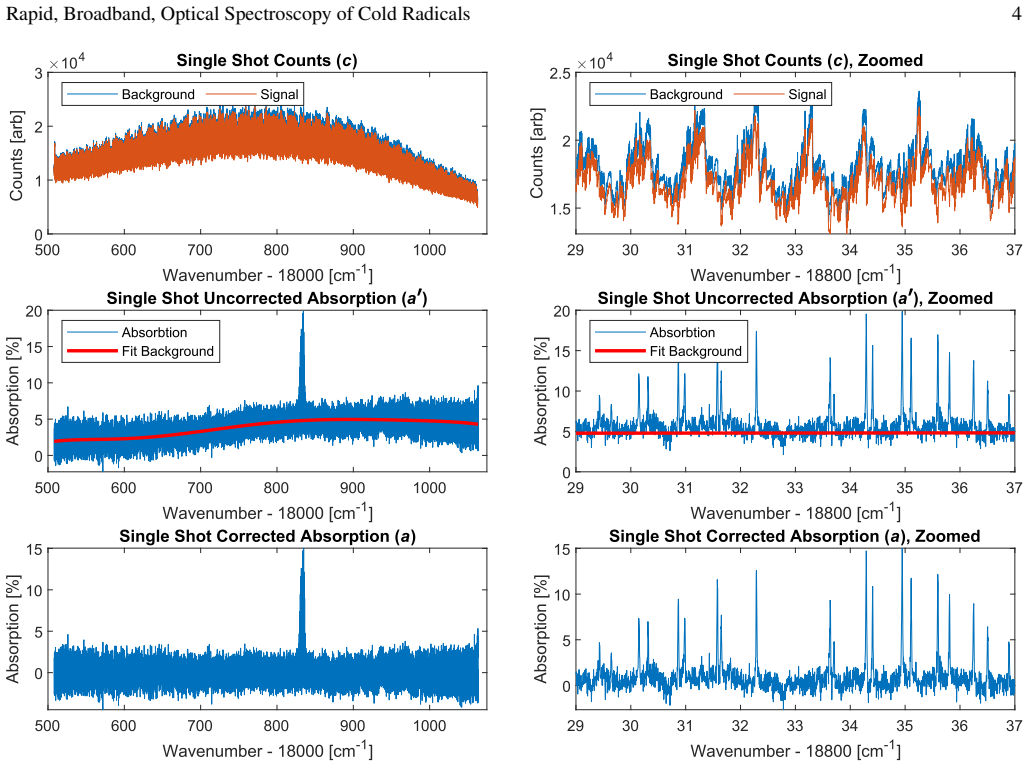
The load-bearing element is the VIPA-based spectrometer: a virtually imaged phased array etalon provides large angular dispersion, an orthogonal diffraction grating separates the degenerate VIPA orders, and a large-area sCMOS camera records the two-dimensional pattern which software unwraps into a one-dimensional spectrum. Around it, three components do the rest: a supercontinuum laser delivers about 0.3 mW/nm of white light through a single-mode fiber; a cryogenic buffer gas cell produces 5 K refractory radicals (here CaF) by laser ablation of a solid CaF$_2$ target; and an iodine-vapor spectrum, compared to a published reference spectrum, supplies an absolute calibration via a linear transformation of the instrument wavenumber axis. Data analysis pairs each molecular pulse with a no-molecule background shot, subtracts slow polynomial and robust-spline backgrounds, and models VIPA-order crosstalk (about 1.5% per order) before averaging, which improves sensitivity as $N^{-1/2}$ down to $7.3\times 10^{-5}$ fractional absorption.
What would settle it
Take a series of molecular transitions whose frequencies are known to better than $0.001$ cm$^{-1}$ from an independent comb or saturated-absorption measurement at both edges and the middle of the 15 nm window, and compare them with the paper's linear calibration; disagreement at the edges beyond the claimed precision would break the linearity assumption. A simpler internal variant: refit the iodine calibration allowing a quadratic term in the wavenumber mapping and check whether the residual improves by more than the noise.
Extended reading notes
Core claim
The central discovery is a spectrometer architecture—supercontinuum source, cryogenic buffer gas cell, and a virtually imaged phased array (VIPA) crossed with a diffraction grating—that simultaneously provides broad spectral coverage, sub-picometer resolution, and near-shot-noise-limited sensitivity on transient, refractory molecules. The paper demonstrates this on the $B^2\Sigma^+$–$X^2\Sigma^+$ system of CaF near 531 nm: a single shot resolves the $(0,0)$ band, and about 13,000 averaged pulses taken over roughly three hours yield 386 assigned features covering the $(0,0)$ through $(14,14)$ bands. From these lines the authors extract rotational ($B$), spin-rotation ($\gamma$), and band-origin ($T$) constants in both electronic states for 15 vibrational levels, with fit standard deviations near $0.001$ cm$^{-1}$ (about 50 MHz), and show them to be consistent with prior high-temperature emission measurements. The spectra also resolve the $^{44}$CaF isotopologue at 2% natural abundance: its origin is shifted by $-0.1176$ cm$^{-1}$ and its $B$ values follow the expected reduced-mass scaling. Measured line intensities across bands give an internal vibrational temperature of roughly 2,240 K for the higher levels.
Load-bearing premise
The load-bearing assumption is that the instrument's wavenumber axis is linear across the entire 15 nm window after a two-parameter calibration anchored to an iodine spectrum and checked against two known CaF lines; if any curvature in the VIPA dispersion remains, every derived rotational, spin-rotation, and isotopologue constant would be systematically biased.
Editorial extensions
If this is right
- Spectroscopy that previously demanded years of scanning narrow-band lasers can be completed in hours, enabling rapid determination of the rovibronic structure needed for laser cooling, trapping, and state control of new molecules.
- Because the full 15 nm window is recorded on every pulse, many vibrational bands and multiple isotopologues are observed simultaneously; the CaF demonstration recovers the $^{44}$CaF spectrum at 2% natural abundance in the same run as the main isotopic species.
- The simultaneous measurement of line intensities across vibrational bands gives direct internal-state thermometry; for CaF the fit yields a vibrational temperature of about 2,240 K for levels above $v = 3$.
- Near-shot-noise single-pulse sensitivity (0.009 fractional absorption) means a single pulse can already reveal spectral structure, and averaging follows $N^{-1/2}$, so features down to about $7\times 10^{-5}$ absorption are reachable with a few hours of integration.
- The same spectrometer used in absorption can be pointed at dispersed laser-induced fluorescence, and with a tunable-range version of the instrument the approach extends across the visible and near-IR where many quantum-science molecules have their transitions.
Reading between the lines
- Averaging many thousands of shots at $N^{-1/2}$ makes the method a candidate for routine isotopic abundance measurements: with several bands in a 15 nm window, the CaF approach could in principle report relative calcium isotope ratios from one night of data, a direction the authors mention but do not develop.
- Because the CBGC source is species-agnostic and the detection is broadband, the architecture should transfer directly to other refractory radicals and to molecules produced by laser ablation of mixed or doped targets, with no change beyond the precursor and wavelength window.
- The single-shot signal could be exploited for source diagnostics and time-resolved chemistry: a single molecular pulse already carries enough information to extract a band spectrum, so shot-to-shot variation of ablation and thermalization could be studied with zero additional averaging.
- If the spectrometer's range is extended across the visible and near-IR, the method pairs naturally with laser-cooled molecules that need a dozen or more vibronic transitions spanning hundreds of nanometers—one broadband sweep would capture them all, whereas the original scanning approach would need many separate campaigns.
Signed reviews
Editorial analysis
A structured set of objections, weighed in public.
Referee Report
Summary. The manuscript reports a broadband, high-resolution absorption spectroscopy method for cold, refractory molecular radicals. The apparatus combines a supercontinuum laser, a cryogenic buffer gas cell (CBGC), and a commercial VIPA-based spectrometer, achieving 15 nm of simultaneous bandwidth, 0.56 pm (≈0.5 GHz) resolution, and single-shot absorption noise of ≈0.009 that averages down to 7.3e-5. As a demonstration, the authors record the Δv=0 bands of the B2Σ+–X2Σ+ system of CaF around 531 nm, assign 386 spectral features across 15 vibrational bands, extract rotational, spin-rotation, and band-origin constants, and identify spectral lines of the low-abundance 44CaF isotopologue, with the identification checked against mass-scaled predictions.
Significance. If the central claims hold, this is a substantial methodological advance: it addresses a real bottleneck in cold-molecule and precision-measurement experiments, where high-resolution spectra of short-lived, refractory species are typically acquired line-by-line over long periods. The paper's strengths include the use of an external iodine calibration, explicit comparison of derived constants with independent previous values, a documented noise-scaling analysis with Gaussian single-shot noise, and a mass-scaling check for the 44CaF assignment. The demonstration of 15 bands and dozens of constants in a few hours is compelling, and the method appears simple and robust enough to be adopted by other groups. The main weakness is the presentation and validation of the frequency calibration, which is the quantitative backbone of every derived constant.
major comments (3)
- [Section II F / Table I] The linear calibration as reported is internally inconsistent. The text defines the calibration as ν̃_cal = m ν̃_inst + b, but the tabulated values are not mutually consistent under this definition. Taking the instrument window as 525–540 nm (≈529 cm−1 wide) and the quoted end shifts Δν̃_red ≈ −0.208 cm−1 and Δν̃_blue ≈ −0.119 cm−1, the implied slope is (Δν̃_blue − Δν̃_red)/(ν̃_blue − ν̃_red) ≈ 1.7×10⁻⁴, i.e. m ≈ 1.00017, not 1.0002, and the implied intercept on the (wavenumber − 18000) axis is approximately −0.295 cm−1, not the tabulated b ≈ −0.1635 cm−1. The tabulated b appears to be the simple average of the two end shifts, i.e. an offset at mid-window, rather than the intercept of the stated transformation. Please clarify the coordinate convention, define b precisely, and give the residual statistics of the iodine fit. Because every absolute line position, band origin, and the 44CaF isotope shift inherit this calibration, the inconsistency must be resolved before the quantitative claims can be assessed.
- [Section II F] No residual analysis is provided for the iodine calibration. The text states that the fit agrees 'well within the instrument resolution across the entire range,' but this is not quantified. Given that a single linear term is assumed to hold over the full 15 nm window, the manuscript should show residuals versus wavenumber across the entire window, the RMS or peak residual, and ideally a test of nonlinearity (for example, whether a quadratic term improves the fit or whether multiple iodine lines spanning the window are reproduced within uncertainties). Without this, the systematic error in the absolute frequency axis—and hence in T_vv and the isotope shift—is unknown.
- [Section II H] The crosstalk model used to identify weak 44CaF features is fitted with several free parameters (FSR and four amplitude ratios) but no uncertainties are reported. Since the 44CaF lines are at the few-percent abundance level and the fitted crosstalk replicas are at the 0.2–2.2% level, the subtraction of fitted crosstalk could in principle create or remove weak features. The manuscript should justify that the observed 44CaF features are not artifacts of the crosstalk subtraction, for example by showing the spectrum before and after crosstalk removal and demonstrating that the 44CaF positions match mass-scaled predictions independently of the fitted amplitudes.
minor comments (4)
- [Table V] There are several obvious digit typos in Table V, including '8766.0039', '8748.2832', and '8581.5830', which should be corrected to '766.0039', '748.2832', and '581.5830' or similar.
- [Section II F / Table I] The table caption and text should state explicitly which wavenumber coordinate is used for the calibration (absolute wavenumber or wavenumber minus 18000 cm−1), and the statement that 'the instrument has an offset of (−0.164±0.001) cm−1' should be reconciled with the definition of b in the calibration equation.
- [Section II F] The claim that 'the linearity m appears to be stable within our ability to measure it over the course of several hours' would be more informative if the scatter of the four fitted m values were reported.
- [Figure 9] The band labels in Figure 9 are crowded and some labels overlap (e.g., '5 4' and '16 15 14' in the inset); labeling every other band or adding a table of band-head positions would improve readability.
Circularity Check
No significant circularity: calibration and derived constants are anchored to external standards and independent comparisons.
full rationale
This is an experimental demonstration with an external calibration chain, not a derivation that reduces to its inputs. The only load-bearing external inputs are (i) the iodine atlas IOSpec5, used to define the linear frequency transformation in Sec. II F, and (ii) previously measured CaF line positions used both for drift correction (Sec. II E) and as a check (Sec. II F). Neither is an output of the paper: the iodine spectrum is an independent reference, and the CaF constants are derived by fitting hundreds of listed transition frequencies (Table V) rather than by imposing the two reference lines as constraints. The resulting B and gamma values agree with an independent combined analysis of hollow-cathode emission and LIF spectra (Ref. 30). The 44CaF band is identified by comparing observed features with mass-scaled predictions of B', B'', and T00, not by fitting the isotopologue constants, and the observed 40Ca/44Ca intensity ratio is compared with natural abundance. The self-citation to a previous CBGC source description [12] is descriptive and not load-bearing for the central claims. The skeptical concern about the internal consistency of the calibration parameters in Table I is a potential systematic error in the absolute frequency scale, not a circularity: an incorrect or miscalibrated standard does not make the derivation self-referential.
Assumptions & free parameters
free parameters (4)
- Crosstalk suppression amplitudes and free spectral range =
2.20%, 0.93%, 0.21%, 0.30%; FSR = 0.997 cm-1
- Background polynomial coefficients =
Sextic and eighth-order polynomial coefficients per spectrum
- Robust spline threshold =
2e-4 fractional absorption
- Frequency calibration m and b =
m = 1.0002, b about -0.163 cm-1
assumptions (5)
- domain assumption The effective Hamiltonian for a 2Sigma molecule (rotational constant B and spin-rotation constant gamma) adequately describes the B2Sigma+-X2Sigma+ spectrum of CaF.
- domain assumption The absorption follows the Beer-Lambert law and the fractional absorption a' = (cb - cs)/cb is proportional to column density in the optically thin limit.
- domain assumption The iodine line positions from IOSpec5 are taken as true for calibration.
- ad hoc to paper The VIPA crosstalk can be modeled as shifted copies of the spectrum with fixed amplitude ratios.
- domain assumption The frequency drift of the instrument is slow and can be corrected by shifting single-shot spectra to known lines.
Cite this review
Pith. "Pith review of Rapid, Broadband, Optical Spectroscopy of Cold Radicals." pith.science (2026). https://pith.science/paper/T7EI7LBZ
@misc{pith2026250503650,
  author       = {Pith},
  title        = {Pith review of: Rapid, Broadband, Optical Spectroscopy of Cold Radicals},
  year         = {2026},
  howpublished = {\url{https://pith.science/paper/T7EI7LBZ}},
  note         = {Machine review of arXiv:2505.03650}
}
abstract
Optical spectroscopy of molecular radicals is an important tool in physical chemistry, and is a prerequisite for many experiments which use molecules for quantum science and precision measurement. However, even the simplest molecules have complex spectra which can be very time consuming to measure. Here we present an approach which offers the ability to measure the optical spectra of cryogenically-cooled molecular radicals with much greater efficiency. By combining a supercontinuum laser with a cryogenic buffer gas molecular source and a commercial optical spectrometer, we realize 15 nm of simultaneous bandwidth with 0.56 pm $(\approx 0.5$ GHz) resolution and high sensitivity. As a demonstration we measure and assign hundreds of lines and dozens of molecular constants from 15 bands in the $B^2\Sigma^+-X^2\Sigma^+$ system of CaF, including a low-abundance isotopologue, in a few hours. The setup is robust, simple, and should enable spectroscopy of molecular radicals with much higher throughput.
Figures


Figures from the paper (5 more)


Forward citations
Cited by 1 Pith paper
-
Production and spectroscopy of cold radioactive molecules
First demonstration of cryogenic cooling and high-resolution laser spectroscopy of neutral radium-containing polyatomic molecules in a tabletop apparatus.
Reference graph
Works this paper leans on
-
[1]
merlin.mbs aapmrev4-1.bst 2010-07-25 4.21a (PWD, AO, DPC) hacked
FUNCTION id.bst "merlin.mbs aapmrev4-1.bst 2010-07-25 4.21a (PWD, AO, DPC) hacked" ENTRY address archive archivePrefix author bookaddress booktitle chapter collaboration doi edition editor eid eprint howpublished institution isbn issn journal key language month note number organization pages primaryClass publisher school SLACcitation series title translat...
2010
-
[2]
merlin.mbs aipauth4-1.bst 2010-07-25 4.21a (PWD, AO, DPC) hacked
FUNCTION id.bst "merlin.mbs aipauth4-1.bst 2010-07-25 4.21a (PWD, AO, DPC) hacked" ENTRY address archive archivePrefix author bookaddress booktitle chapter collaboration doi edition editor eid eprint howpublished institution isbn issn journal key language month note number organization pages primaryClass publisher school SLACcitation series title translat...
2010
-
[3]
merlin.mbs aipnum4-1.bst 2010-07-25 4.21a (PWD, AO, DPC) hacked
FUNCTION id.bst "merlin.mbs aipnum4-1.bst 2010-07-25 4.21a (PWD, AO, DPC) hacked" ENTRY address archive archivePrefix author bookaddress booktitle chapter collaboration doi edition editor eid eprint howpublished institution isbn issn journal key language month note number organization pages primaryClass publisher school SLACcitation series title translati...
2010
-
[4]
merlin.mbs apsrev4-1.bst 2010-07-25 4.21a (PWD, AO, DPC) hacked
FUNCTION id.bst "merlin.mbs apsrev4-1.bst 2010-07-25 4.21a (PWD, AO, DPC) hacked" ENTRY address archive archivePrefix author bookaddress booktitle chapter collaboration doi edition editor eid eprint howpublished institution isbn issn journal key language month note number organization pages primaryClass publisher school SLACcitation series title translati...
2010
-
[5]
merlin.mbs apsrmp4-1.bst 2010-07-25 4.21a (PWD, AO, DPC) hacked
FUNCTION id.bst "merlin.mbs apsrmp4-1.bst 2010-07-25 4.21a (PWD, AO, DPC) hacked" ENTRY address archive archivePrefix author bookaddress booktitle chapter collaboration doi edition editor eid eprint howpublished institution isbn issn journal key language month note number organization pages primaryClass publisher school SLACcitation series title translati...
2010
-
[6]
author author G. Herzberg ,\ @noop title Molecular Spectra and Molecular Structure, Volume 3: Electronic Spectra and Electronic Structure of Polyatomic Molecules \ ( publisher D. Van Nostrand ,\ year 1966 ) NoStop
work page 1966
-
[7]
author author N. R. \ Hutzler ,\ 10.1088/2058-9565/abb9c5 journal journal Quantum Science and Technology \ volume 5 ,\ pages 044011 ( year 2020 ) NoStop
-
[8]
author author M. S. \ Safronova , author D. Budker , author D. DeMille , author D. F. J. \ Kimball , author A. Derevianko , \ and\ author C. W. \ Clark ,\ 10.1103/RevModPhys.90.025008 journal journal Reviews of Modern Physics \ volume 90 ,\ pages 025008 ( year 2018 ) NoStop
Show all 42 references
-
[9]
author author S. L. \ Cornish , author M. R. \ Tarbutt , \ and\ author K. R. A. \ Hazzard ,\ 10.1038/s41567-024-02453-9 journal journal Nature Physics \ volume 20 ,\ pages 730 ( year 2024 ) NoStop
2024 doi
-
[10]
Fitch \ and\ author M
author author N. Fitch \ and\ author M. Tarbutt ,\ 10.1016/bs.aamop.2021.04.003 journal journal Advances in Atomic, Molecular and Optical Physics \ volume 70 ,\ pages 157 ( year 2021 ) NoStop
2021 doi
-
[11]
author author B. L. \ Augenbraun , author L. Anderegg , author C. Hallas , author Z. D. \ Lasner , author N. B. \ Vilas , \ and\ author J. M. \ Doyle ,\ 10.1016/bs.aamop.2023.04.005 journal journal Advances in Atomic, Molecular and Optical Physics \ volume 72 ,\ pages 89 ( yea...
2023 doi
-
[12]
author author N. R. \ Hutzler , author H.-I. \ Lu , \ and\ author J. M. \ Doyle ,\ 10.1021/cr200362u journal journal Chemical Reviews \ volume 112 ,\ pages 4803 ( year 2012 ) NoStop
2012 doi
-
[13]
\ Nguyen , author T
author author D.-T. \ Nguyen , author T. C. \ Steimle , author I. Kozyryev , author M. Huang , \ and\ author A. B. \ McCoy ,\ 10.1016/j.jms.2018.02.007 journal journal Journal of Molecular Spectroscopy \ volume 347 ,\ pages 7 ( year 2018 ) NoStop
2018 doi
-
[14]
Zhang , author B
author author C. Zhang , author B. L. \ Augenbraun , author Z. D. \ Lasner , author N. B. \ Vilas , author J. M. \ Doyle , \ and\ author L. Cheng ,\ 10.1063/5.0063611 journal journal The Journal of Chemical Physics \ volume 155 ,\ pages 091101 ( year 2021 ) NoStop
-
[15]
Adler , author M
author author F. Adler , author M. J. \ Thorpe , author K. C. \ Cossel , \ and\ author J. Ye ,\ 10.1146/annurev-anchem-060908-155248 journal journal Annual Review of Analytical Chemistry \ volume 3 ,\ pages 175 ( year 2010 ) NoStop
2010 doi
-
[16]
Nugent-Glandorf , author T
author author L. Nugent-Glandorf , author T. Neely , author F. Adler , author A. J. \ Fleisher , author K. C. \ Cossel , author B. Bjork , author T. Dinneen , author J. Ye , \ and\ author S. A. \ Diddams ,\ http://www.ncbi.nlm.nih.gov/pubmed/22859160 journal journal Optics let...
2012
-
[17]
Zeng , author A
author author Y. Zeng , author A. Jadbabaie , author A. N. \ Patel , author P. Yu , author T. C. \ Steimle , \ and\ author N. R. \ Hutzler ,\ 10.1103/PhysRevA.108.012813 journal journal Physical Review A \ volume 108 ,\ pages 012813 ( year 2023 ) NoStop
-
[18]
note NKT SuperK EVO ERL-04 NoStop
-
[19]
note NKT SuperK VARIA NoStop
-
[20]
note SRS SR470 NoStop
-
[21]
Devlin , author M
author author J. Devlin , author M. R. \ Tarbutt , author D. L. \ Kokkin , \ and\ author T. C. \ Steimle ,\ 10.1016/j.jms.2015.07.009 journal journal Journal of Molecular Spectroscopy \ volume 317 ,\ pages 1 ( year 2015 ) NoStop
2015 doi
-
[22]
Garcia ,\ 10.1016/j.csda.2009.09.020 journal journal Computational Statistics & Data Analysis \ volume 54 ,\ pages 1167 ( year 2010 ) NoStop
author author D. Garcia ,\ 10.1016/j.csda.2009.09.020 journal journal Computational Statistics & Data Analysis \ volume 54 ,\ pages 1167 ( year 2010 ) NoStop
2009 doi
-
[23]
Garcia ,\ 10.1007/s00348-010-0985-y journal journal Experiments in Fluids \ volume 50 ,\ pages 1247 ( year 2011 ) NoStop
author author D. Garcia ,\ 10.1007/s00348-010-0985-y journal journal Experiments in Fluids \ volume 50 ,\ pages 1247 ( year 2011 ) NoStop
2011 doi
-
[24]
author author E. J. \ Salumbides , author K. S. E. \ Eikema , author W. Ubachs , author U. Hollenstein , author H. Kn \" o ckel , \ and\ author E. Tiemann ,\ 10.1080/00268970600747696 journal journal Molecular Physics \ volume 104 ,\ pages 2641 ( year 2006 ) NoStop
-
[25]
Anderegg , author L
author author L. Anderegg , author L. W. \ Cheuk , author Y. Bao , author S. Burchesky , author W. Ketterle , author K.-K. \ Ni , \ and\ author J. M. \ Doyle ,\ 10.1126/science.aax1265 journal journal Science \ volume 365 ,\ pages 1156 ( year 2019 ) NoStop
-
[26]
Bao , author S
author author Y. Bao , author S. S. \ Yu , author J. You , author L. Anderegg , author E. Chae , author W. Ketterle , author K.-K. \ Ni , \ and\ author J. M. \ Doyle ,\ 10.1103/PhysRevX.14.031002 journal journal Physical Review X \ volume 14 ,\ pages 031002 ( year 2024 ) NoStop
-
[27]
Bao , author S
author author Y. Bao , author S. S. \ Yu , author L. Anderegg , author E. Chae , author W. Ketterle , author K.-K. \ Ni , \ and\ author J. M. \ Doyle ,\ 10.1126/science.adf8999 journal journal Science \ volume 382 ,\ pages 1138 ( year 2023 ) NoStop
-
[28]
author author C. M. \ Holland , author Y. Lu , \ and\ author L. W. \ Cheuk ,\ 10.1126/science.adf4272 journal journal Science \ volume 382 ,\ pages 1143 ( year 2023 ) NoStop
2023 doi
-
[30]
Truppe , author H
author author S. Truppe , author H. J. \ Williams , author N. J. \ Fitch , author M. Hambach , author T. E. \ Wall , author E. A. \ Hinds , author B. E. \ Sauer , \ and\ author M. R. \ Tarbutt ,\ 10.1088/1367-2630/aa5ca2 journal journal New Journal of Physics \ volume 19 ,\ pa...
-
[31]
Costas-Rodríguez , author J
author author M. Costas-Rodríguez , author J. Delanghe , \ and\ author F. Vanhaecke ,\ 10.1016/j.trac.2015.10.008 journal journal TrAC - Trends in Analytical Chemistry \ volume 76 ,\ pages 182 ( year 2016 ) NoStop
2015 doi
-
[32]
author author M. A. \ Antonelli , author J. Kendrick , author C. Yakymchuk , author M. Guitreau , author T. Mittal , \ and\ author F. Moynier ,\ 10.1038/s41467-021-22748-2 journal journal Nature Communications \ volume 12 ( year 2021 ),\ 10.1038/s41467-021-22748-2 NoStop
-
[33]
author author M. B. T. \ Zanatta , author F. V. \ Nakadi , author M. Resano , \ and\ author M. A. M. S. \ da Veiga ,\ @noop journal journal Journal of Analytical Atomic Spectrometry \ volume 34 ,\ pages 2280 ( year 2019 ) NoStop
2019
-
[34]
Lavy , author P
author author L. Lavy , author P. F. \ Bernath , \ and\ author A. Pastorek ,\ 10.3847/1538-4357/ad9c7a journal journal The Astrophysical Journal \ volume 979 ,\ pages 19 ( year 2025 ) NoStop
2025 doi
-
[35]
Bernath ,\ @noop title Spectra of Atoms and Molecules ,\ edition 2nd \ ed.\ ( publisher Oxford University Press ,\ year 2005 ) NoStop
author author P. Bernath ,\ @noop title Spectra of Atoms and Molecules ,\ edition 2nd \ ed.\ ( publisher Oxford University Press ,\ year 2005 ) NoStop
2005
-
[36]
note LightMachinery OP-6721-3371-2, 3.37 mm thick NoStop
-
[37]
author author N. H. \ Pilgram , author A. Jadbabaie , author Y. Zeng , author N. R. \ Hutzler , \ and\ author T. C. \ Steimle ,\ 10.1063/5.0055293 journal journal The Journal of Chemical Physics \ volume 154 ,\ pages 244309 ( year 2021 ) NoStop
-
[38]
author author B. L. \ Augenbraun , author J. M. \ Doyle , author T. Zelevinsky , \ and\ author I. Kozyryev ,\ 10.1103/PhysRevX.10.031022 journal journal Physical Review X \ volume 10 ,\ pages 031022 ( year 2020 ) NoStop
2020 doi
-
[39]
Anderegg , author B
author author L. Anderegg , author B. L. \ Augenbraun , author Y. Bao , author S. Burchesky , author L. W. \ Cheuk , author W. Ketterle , \ and\ author J. M. \ Doyle ,\ 10.1038/s41567-018-0191-z journal journal Nature Physics \ volume 14 ,\ pages 890 ( year 2018 ) NoStop
-
[40]
Anderegg , author B
author author L. Anderegg , author B. L. \ Augenbraun , author E. Chae , author B. Hemmerling , author N. R. \ Hutzler , author A. Ravi , author A. Collopy , author J. Ye , author W. Ketterle , \ and\ author J. M. \ Doyle ,\ 10.1103/PhysRevLett.119.103201 journal journal Physi...
-
[41]
author author M. A. \ Anderson , author M. D. \ Allen , \ and\ author L. M. \ Ziurys ,\ @noop journal journal Astrophysical Journal \ volume 424 ,\ pages 503 ( year 1994 ) NoStop
1994
-
[42]
Caldwell , author J
author author L. Caldwell , author J. A. \ Devlin , author H. J. \ Williams , author N. J. \ Fitch , author E. A. \ Hinds , author B. E. \ Sauer , \ and\ author M. R. \ Tarbutt ,\ @noop journal journal Physical Review Letters \ volume 123 ,\ pages 033202 ( year 2019 ) NoStop
2019
-
[43]
Liu , author W
author author X. Liu , author W. Wang , author S. C. \ Wright , author M. Doppelbauer , author G. Meijer , author S. Truppe , \ and\ author J. Perez-Rios ,\ 10.1063/5.0098378 journal journal Journal of Chemical Physics \ volume 157 ,\ pages 74305 ( year 2022 ) NoStop
Reviewed August 15, 2026 · model on record in the stance chip above.
Discussion (0). Continue with ORCID to comment.