REVIEW 3 major objections 5 minor 35 references
Hydra++: Real-Time Hierarchical 3D Scene Graph Construction With Object-Level Shape Estimation
T0 review · 3 major / 5 minor · reviewed 2026-07-13 · grok-4.5
Pith's one-line read Hydra++ adds instance-specific object meshes to hierarchical 3D scene graphs, improving reconstruction quality indoors and outdoors.
desk verdict Solid systems integration of shape completion into hierarchical scene graphs; indoor numbers are real, outdoor half is still mostly visual. read the letter →
The pith
A machine-rendered reading of the paper's core claim, the machinery that carries it, and where it could break.
The reading
What carries the argument
The reprojection-mask consistency check (RMCC): surface points sampled from the predicted mesh are reprojected into the camera and scored by overlap with the original instance mask; predictions whose overlap falls below a threshold are rejected, preventing partial or mis-segmented observations from polluting the scene graph.
What would settle it
Run the identical pipeline on a held-out outdoor sequence containing novel object instances whose ground-truth meshes are independently scanned; if Chamfer distance, volumetric IoU, and scene-mesh continuity remain no better than pure partial-observation baselines after RMCC filtering, the central claim fails.
Extended reading notes
Core claim
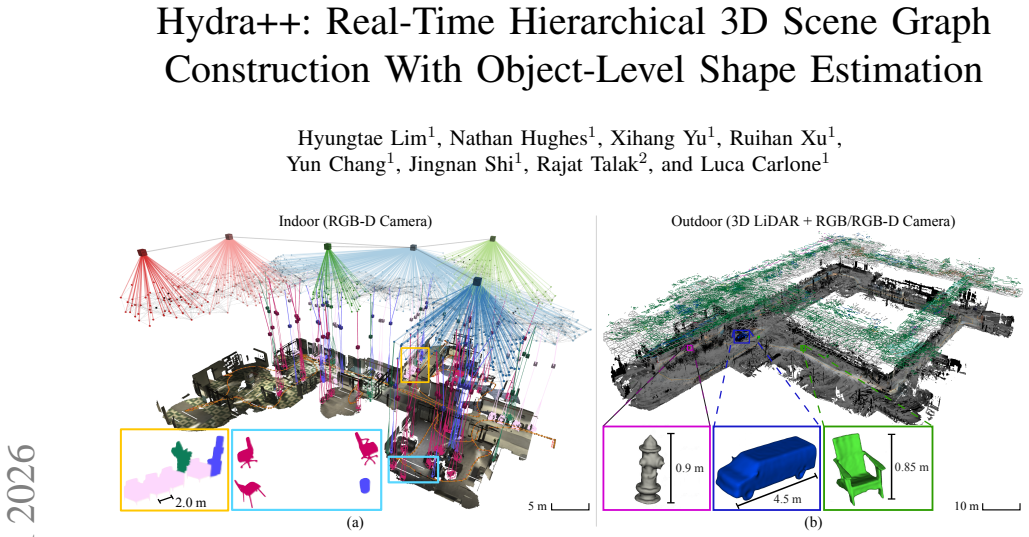
Integrating a category-agnostic learning-based object shape estimator together with a reprojection-mask consistency check into a hierarchical 3D scene-graph pipeline yields measurably better instance-level geometry and, with a hybrid LiDAR-camera front-end plus ground-aware TSDF integration, more continuous outdoor scene meshes, all while remaining modular enough to swap estimators for different speed-versus-generalization trade-offs.
Load-bearing premise
That the single frame with the largest 3D bounding-box volume, plus an off-the-shelf instance mask, is clean and complete enough for the shape network to produce a usable mesh that the simple overlap score can then reliably accept or reject.
Editorial analysis
A structured set of objections, weighed in public.
Referee Report
Summary. Hydra++ is a system-level extension of Hydra/Khronos that integrates category-agnostic learning-based object pose and shape estimators (default CRISP; SAM3D as a modular alternative) into hierarchical 3D scene graph construction. It adds a reprojection-mask consistency check (RMCC) to reject degenerate predictions from partial or imprecise masks, and a hybrid LiDAR-camera mode with ground-aware adaptive TSDF integration for outdoor mesh continuity. The paper claims that this pipeline improves object-level geometric fidelity (instance-specific meshes rather than partial clouds or class CAD templates) and scene-level reconstruction quality in both simulated indoor (uHumans2) and real outdoor campus settings, while preserving online operation under the CRISP configuration.
Significance. If the claims hold, the work is a useful systems contribution for robotics: it shows how to organize learned instance meshes inside layered scene graphs rather than treating shape estimation as an isolated offline module. Indoor quantitative gains (Table I: lower Chamfer, higher B-IoU/V-IoU vs Hydra, Khronos, SlideSLAM; Fig. 12 RMCC ablation raising precision/F1) are concrete and address a real bottleneck for contact-aware or rearrangement tasks. The modular estimator interface and explicit CRISP-vs-SAM3D latency/generalization trade-off (Figs. 7–8) are practical. The hybrid LiDAR-camera ground-aware integration idea is relevant for outdoor metric-semantic mapping. Strengths include clear ablations of RMCC, head-to-head baselines, and an open project page. The result is incremental relative to the authors’ prior stack but fills a documented gap between coarse scene-graph geometry and isolated shape networks.
major comments (3)
- [Abstract; Sec. I; Sec. IV-F] Abstract and Sec. I claim improved object- and scene-level reconstruction quality in both simulation and real-world outdoor campus scenarios. Indoor support is quantitative (Table I, Figs. 5–6, 12). Outdoor support (Sec. IV-F, Figs. 9–10) is purely qualitative visual inspection of a few objects (fire hydrant, car, bench) and scene meshes. No outdoor Chamfer, B-IoU, V-IoU, or multi-object detection statistics appear. Either add comparable quantitative outdoor metrics (even on a small held-out set of scanned objects) or revise the abstract/contributions/conclusion to scope the outdoor claim as qualitative demonstration of hybrid-mode mesh continuity rather than a parallel reconstruction-quality result.
- [Sec. IV-A; Sec. IV-F] Sec. IV-A states outdoor CRISP was trained on approximately 50 SAM-generated keyframes across three categories, with iPad LiDAR meshes manually hole-filled in Blender. This is a thin, hand-curated set for claiming instance-level outdoor shape fidelity. The paper should report at least leave-one-sequence or cross-object hold-out numbers, or explicitly limit the outdoor object-level claim to proof-of-concept under this training regime, so readers can judge generalization risk.
- [Sec. III-C, Eq. (1); Sec. III-D, Eq. (8)] Eq. (1) selects a single max-3D-bbox-volume frame as the sole input to the shape estimator; RMCC (Eq. 8) then accepts/rejects with a simple overlap threshold τ_O. Sec. III-C/D and Fig. 11 show RMCC helps, but there is no systematic study of failure modes when the max-volume view is still truncated/occluded, or of multi-view aggregation alternatives. Because the central object-level claim rests on usable completed meshes from this pipeline, a short sensitivity analysis (or multi-view baseline) would strengthen the load-bearing assumption that one cleaned observation plus RMCC is sufficient.
minor comments (5)
- [Sec. III-B; Fig. 3] Fig. 3 caption and body: d_extra = 3 m is stated as empirical; a one-sentence justification or sensitivity note would help reproducibility.
- [Table I] Table I: report the number of matched object pairs (and total GT objects) per method/threshold so that averaged Chamfer/B-IoU/V-IoU can be interpreted with sample size.
- [Abstract; Sec. IV-E; Fig. 8] Clarify in the main text (not only the abstract) that the real-time claim applies strictly to the CRISP configuration; SAM3D is offline/modular. A short wall-clock breakdown of the full pipeline (active window + tracking + shape + RMCC + backend) would make the online claim more precise.
- [Fig. 5] Fig. 5 color legend (matched/unmatched) is useful; ensure the same τ_d = 0.2 m definition is restated in the caption for standalone readability.
- [Sec. II] Related work could briefly position against recent open-vocabulary or foundation-model scene graphs beyond the cited S-Graphs / hierarchical open-vocab works, given SAM3D is already used as a module.
Circularity Check
Empirical systems paper with modular reuse of authors' prior components; no definitional or fitted-by-construction circularity in the claims.
full rationale
Hydra++ is a systems integration paper whose central claims are empirical improvements in object- and scene-level reconstruction metrics (Table I, Figs. 5–10) obtained by plugging category-agnostic shape estimators (CRISP/SAM3D) plus an RMCC filter and a ground-aware TSDF rule into the existing Hydra/Khronos pipeline. There is no mathematical derivation chain in which a claimed prediction or first-principles result reduces to its own inputs by construction: Eq. (1) is a simple max-volume heuristic for view selection, Eq. (8) is an overlap threshold for rejection, and the outdoor adaptive integration is an engineering clamp on signed-distance updates. Self-citations to Hydra, Khronos and CRISP are load-bearing only as modular building blocks; the paper still reports head-to-head numbers against an external baseline (SlideSLAM) and against ablations of its own additions (w/ vs w/o RMCC). Training CRISP on ~50 keyframes of the outdoor sequence is a thin-data concern for generalization, not a circular reduction of the reported visual results. Consequently the circularity burden is at most minor self-citation of infrastructure, not definitional circularity.
Assumptions & free parameters
free parameters (4)
- d_extra (ground-aware truncation extension) =
3 m
- τ_O (RMCC overlap threshold)
- τ_d (centroid matching distance) =
0.2 m / 0.5 m
- max-volume frame selection heuristic
assumptions (4)
- domain assumption Projective TSDF integration with marching-cubes zero-level extraction yields usable surface meshes when both sides of a surface receive updates.
- domain assumption A category-agnostic shape network (CRISP or SAM3D) can recover metric pose, scale and mesh from a single RGB-D frame + mask when the observation is sufficiently complete.
- domain assumption Off-the-shelf instance segmentation (and SAM for outdoor training masks) produces masks accurate enough that RMCC can filter residual errors.
- ad hoc to paper Inactive tracks can be processed asynchronously without harming the real-time claim of the CRISP configuration.
invented entities (2)
-
Reprojection-Mask Consistency Check (RMCC)
-
Ground-aware adaptive TSDF integration
Cite this review
Pith. "Pith review of Hydra++: Real-Time Hierarchical 3D Scene Graph Construction With Object-Level Shape Estimation." pith.science (2026). https://pith.science/paper/T7W2CP5J
@misc{pith2026260709455,
  author       = {Pith},
  title        = {Pith review of: Hydra++: Real-Time Hierarchical 3D Scene Graph Construction With Object-Level Shape Estimation},
  year         = {2026},
  howpublished = {\url{https://pith.science/paper/T7W2CP5J}},
  note         = {Machine review of arXiv:2607.09455}
}
read the original abstract
3D scene graphs provide a hierarchical abstraction of environments by encoding spatial entities, such as objects and places, and their relationships. However, existing scene graph systems model object geometry coarsely, relying on partial point clouds or class-level CAD templates, which limits instance-specific shape detail. This paper presents Hydra++, a system-level investigation into how learning-based object shape estimators can be integrated into a hierarchical 3D scene graph pipeline. Hydra++ incorporates category-agnostic shape estimation and a reprojection-mask consistency check to reject degenerate predictions from partial observations or imprecise segmentation. In its default CRISP-based configuration, Hydra++ performs online scene graph construction; slower estimators such as SAM3D are evaluated as modular alternatives to demonstrate generalization-latency trade-offs. Furthermore, to address the challenges of sparse and noisy depth measurements in outdoor environments, Hydra++ supports a hybrid LiDAR-camera configuration for large-scale operation, improving scene-level reconstruction quality. Experiments in both simulation and real-world outdoor campus scenarios demonstrate that Hydra++ improves object- and scene-level reconstruction quality. Project page is available at https://hydra-plusplus.github.io/.
Figures


Figures from the paper (5 more)


Reference graph
Works this paper leans on
-
[1]
Kimera: from SLAM to spatial perception with 3D dynamic scene graphs,
A. Rosinol, A. Violette, M. Abate, N. Hughes, Y . Chang, J. Shi, A. Gupta, and L. Carlone, “Kimera: from SLAM to spatial perception with 3D dynamic scene graphs,”Int. J. Robot. Res., vol. 40, no. 12–14, pp. 1510–1546, 2021
2021
-
[2]
Hydra: a real-time spatial perception engine for 3D scene graph construction and optimization,
N. Hughes, Y . Chang, and L. Carlone, “Hydra: a real-time spatial perception engine for 3D scene graph construction and optimization,” inProc. Robot.: Sci. Syst., 2022
2022
-
[3]
SLAM++: Simultaneous localisation and mapping at the level of objects,
R. F. Salas-Moreno, R. A. Newcombe, H. Strasdat, P. H. J. Kelly, and A. J. Davison, “SLAM++: Simultaneous localisation and mapping at the level of objects,” inProc. Conf. Comput. Vis. Pattern Recognit., 2013
2013
-
[4]
QuadricSLAM: Dual quadrics from object detections as landmarks in object-oriented SLAM,
L. Nicholson, M. Milford, and N. Sünderhauf, “QuadricSLAM: Dual quadrics from object detections as landmarks in object-oriented SLAM,”IEEE Robot. Autom. Lett., vol. 4, pp. 1–8, 2018
2018
-
[5]
CubeSLAM: Monocular 3-D object SLAM,
S. Yang and S. Scherer, “CubeSLAM: Monocular 3-D object SLAM,” IEEE Trans. Robot., vol. 35, no. 4, pp. 925–938, 2019
2019
-
[6]
Incremental scene understanding on dense SLAM,
C. Li, H. Xiao, K. Tateno, F. Tombari, N. Navab, and G. D. Hager, “Incremental scene understanding on dense SLAM,” inProc. Int. Conf. Intell. Robots Syst., 2016, pp. 574–581
2016
-
[7]
3D scene graph: A structure for unified semantics, 3D space, and camera,
I. Armeni, Z. He, J. Gwak, A. Zamir, M. Fischer, J. Malik, and S. Savarese, “3D scene graph: A structure for unified semantics, 3D space, and camera,” inProc. Int. Conf. Comput. Vis., 2019, pp. 5664– 5673
2019
-
[8]
Foundations of spatial perception for robotics: Hierarchical representations and real-time systems,
N. Hughes, Y . Chang, S. Hu, R. Talak, R. Abdulhai, J. Strader, and L. Carlone, “Foundations of spatial perception for robotics: Hierarchical representations and real-time systems,”Int. J. Robot. Res., 2024
2024
Show all 35 references
-
[9]
SceneGraphFu- sion: Incremental 3D scene graph prediction from RGB-D sequences,
S. Wu, J. Wald, K. Tateno, N. Navab, and F. Tombari, “SceneGraphFu- sion: Incremental 3D scene graph prediction from RGB-D sequences,” inProc. Conf. Comput. Vis. Pattern Recognit., 2021, pp. 7515–7525
2021
-
[10]
Language-grounded dynamic scene graphs for interactive object search with mobile manipulation,
D. Honerkamp, M. Büchner, F. Despinoy, T. Welschehold, and A. Val- ada, “Language-grounded dynamic scene graphs for interactive object search with mobile manipulation,”IEEE Robot. Autom. Lett., vol. 9, no. 10, pp. 8298–8305, 2024
2024
-
[11]
Khronos: A uni- fied approach for spatio-temporal metric-semantic SLAM in dynamic environments,
L. Schmid, M. Abate, Y . Chang, and L. Carlone, “Khronos: A uni- fied approach for spatio-temporal metric-semantic SLAM in dynamic environments,” inProc. Robot.: Sci. Syst., 2024
2024
-
[12]
CRISP: Object pose and shape estimation with test-time adaptation,
J. Shi, R. Talak, H. Zhang, D. Jin, and L. Carlone, “CRISP: Object pose and shape estimation with test-time adaptation,” inProc. Conf. Comput. Vis. Pattern Recognit., 2025
2025
-
[13]
SAM3D: 3DFY anything in images,
X. Chen, F.-J. Chu, P. Gleize, K. J. Liang, A. Sax, H. Tang, W. Wang, M. Guo, T. Hardin, X. Liet al., “SAM3D: 3DFY anything in images,” inProc. Conf. Comput. Vis. Pattern Recognit., 2026, pp. 7220–7232
2026
-
[14]
Probabilistic data association for semantic SLAM,
S. Bowman, N. Atanasov, K. Daniilidis, and G. Pappas, “Probabilistic data association for semantic SLAM,” inProc. Int. Conf. Robot. Automat., 2017, pp. 1722–1729
2017
-
[15]
A unifying view of geometry, semantics, and data association in SLAM
N. Atanasov, S. L. Bowman, K. Daniilidis, and G. J. Pappas, “A unifying view of geometry, semantics, and data association in SLAM.” inProc. Int. Joint Conf. Artif. Intell., 2018, pp. 5204–5208
2018
-
[16]
ELLIPSDF: joint object pose and shape optimization with a bi-level ellipsoid and signed distance function description,
M. Shan, Q. Feng, Y .-Y . Jau, and N. Atanasov, “ELLIPSDF: joint object pose and shape optimization with a bi-level ellipsoid and signed distance function description,” inProc. Int. Conf. Comput. Vis., 2021, pp. 5946–5955
2021
-
[17]
Box pose and shape estimation and domain adaptation for large-scale warehouse automation,
X. Yu, R. Talak, J. Shi, U. Viereck, I. Gilitschenski, and L. Carlone, “Box pose and shape estimation and domain adaptation for large-scale warehouse automation,”arXiv preprint arXiv:2507.00984, 2025
2025 arXiv
-
[18]
MID-Fusion: Octree-based object-level multi- instance dynamic SLAM,
B. Xu, W. Li, D. Tzoumanikas, M. Bloesch, A. Davison, and S. Leutenegger, “MID-Fusion: Octree-based object-level multi- instance dynamic SLAM,” inProc. Int. Conf. Robot. Automat., 2019, pp. 5231–5237
2019
-
[19]
DeepSDF: Learning continuous signed distance functions for shape representation,
J. Park, P. Florence, J. Straub, R. Newcombe, and S. Lovegrove, “DeepSDF: Learning continuous signed distance functions for shape representation,” inProc. Conf. Comput. Vis. Pattern Recognit., 2019
2019
-
[20]
One- 2-3-45: Any single image to 3D mesh in 45 seconds without per-shape optimization,
M. Liu, C. Xu, H. Jin, L. Chen, M. Varma T, Z. Xu, and H. Su, “One- 2-3-45: Any single image to 3D mesh in 45 seconds without per-shape optimization,”Adv. Neural Inf. Process. Syst., vol. 36, 2024
2024
-
[21]
DSP-SLAM: Object-oriented SLAM with deep shape priors,
J. Wang, M. Rünz, and L. Agapito, “DSP-SLAM: Object-oriented SLAM with deep shape priors,” inProc. Int. Conf. 3D Vis., 2021, pp. 1362–1371
2021
-
[22]
SlideSLAM: Sparse, lightweight, de- centralized metric-semantic SLAM for multi-robot navigation,
X. Liu, J. Lei, A. Prabhu, Y . Tao, I. Spasojevic, P. Chaudhari, N. Atanasov, and V . Kumar, “SlideSLAM: Sparse, lightweight, de- centralized metric-semantic SLAM for multi-robot navigation,”IEEE Trans. Robot., vol. 41, pp. 6529–6548, 2025
2025
-
[23]
3D dynamic scene graphs: Actionable spatial perception with places, objects, and humans,
A. Rosinol, A. Gupta, M. Abate, J. Shi, and L. Carlone, “3D dynamic scene graphs: Actionable spatial perception with places, objects, and humans,” inProc. Robot.: Sci. Syst., 2020
2020
-
[24]
Situational graphs for robot navigation in structured indoor environ- ments,
H. Bavle, J. L. Sanchez-Lopez, M. Shaheer, J. Civera, and H. V oos, “Situational graphs for robot navigation in structured indoor environ- ments,”IEEE Robot. Autom. Lett., vol. 7, no. 4, pp. 9107–9114, 2022
2022
-
[25]
S-Graphs+: Real-time localization and mapping leveraging hierarchical representations,
——, “S-Graphs+: Real-time localization and mapping leveraging hierarchical representations,”arXiv preprint arXiv:2212.11770, 2022
2022 arXiv
-
[26]
Hier- archical Open-V ocabulary 3D Scene Graphs for Language-Grounded Robot Navigation,
A. Werby, C. Huang, M. Büchner, A. Valada, and W. Burgard, “Hier- archical Open-V ocabulary 3D Scene Graphs for Language-Grounded Robot Navigation,” inProc. Robot.: Sci. Syst., 2024
2024
-
[27]
Collaborative dynamic 3D scene graphs for automated driving,
E. Greve, M. Büchner, N. Vödisch, W. Burgard, and A. Valada, “Collaborative dynamic 3D scene graphs for automated driving,” in Proc. Int. Conf. Robot. Automat., 2024, pp. 11 118–11 124
2024
-
[28]
Panoptic Multi-TSDFs: a flexible rep- resentation for online multi-resolution volumetric mapping and long- term dynamic scene consistency,
L. Schmid, J. Delmerico, J. L. Schönberger, J. Nieto, M. Pollefeys, R. Siegwart, and C. Cadena, “Panoptic Multi-TSDFs: a flexible rep- resentation for online multi-resolution volumetric mapping and long- term dynamic scene consistency,” inProc. Int. Conf. Robot. Automat., 2022...
2022
-
[29]
Patchwork: Concentric zone-based region-wise ground segmentation with ground likelihood estimation using a 3D LiDAR sensor,
H. Lim, M. Oh, and H. Myung, “Patchwork: Concentric zone-based region-wise ground segmentation with ground likelihood estimation using a 3D LiDAR sensor,”IEEE Robot. Autom. Lett., vol. 6, no. 4, pp. 6458–6465, 2021
2021
-
[30]
DINOv2: Learning robust visual features without supervision,
M. Oquab, T. Darcet, T. Moutakanni, H. V o, M. Szafraniec, V . Khali- dov, P. Fernandez, D. Haziza, F. Massa, A. El-Noubyet al., “DINOv2: Learning robust visual features without supervision,”arXiv preprint arXiv:2304.07193, 2023
2023 arXiv
-
[31]
VGGT-SLAM: Dense RGB SLAM optimized on the SL(4) manifold,
D. Maggio, H. Lim, and L. Carlone, “VGGT-SLAM: Dense RGB SLAM optimized on the SL(4) manifold,” inAdv. Neural Inf. Process. Syst., 2025
2025
-
[32]
Scene parsing through ADE20K dataset,
B. Zhou, H. Zhao, X. Puig, S. Fidler, A. Barriuso, and A. Torralba, “Scene parsing through ADE20K dataset,” inProc. Conf. Comput. Vis. Pattern Recognit., 2017, pp. 5122–5130
2017
-
[33]
Resilient and distributed multi-robot visual SLAM: Datasets, experiments, and lessons learned,
Y . Tian, Y . Chang, L. Quang, A. Schang, C. Nieto-Granda, J. How, and L. Carlone, “Resilient and distributed multi-robot visual SLAM: Datasets, experiments, and lessons learned,” inProc. Int. Conf. Intell. Robots Syst., 2023
2023
-
[34]
Segment anything,
A. Kirillov, E. Mintun, N. Ravi, H. Mao, C. Rolland, L. Gustafson, T. Xiao, S. Whitehead, A. C. Berg, W.-Y . Loet al., “Segment anything,” inProc. Int. Conf. Comput. Vis., 2023, pp. 4015–4026
2023
-
[35]
B. O. Community,Blender - a 3D modelling and rendering package, Blender Foundation, Stichting Blender Foundation, Amsterdam, 2018. [Online]. Available: http://www.blender.org
2018
Reviewed July 13, 2026 · model on record in the stance chip above.
Discussion (0). Sign in to comment.