REVIEW 3 major objections 6 minor 22 references
History-informed Lagrangian Neural Networks
T0 review · 3 major / 6 minor · reviewed 2026-08-15 · deepseek-v4-flash
Pith's one-line read The paper claims that conditioning a Lagrangian network's mass, potential, and damping on a latent context inferred from position history beats fixed physics-guided and black-box models at long-horizon position-only forecasting.
desk verdict A genuinely new context-conditioned Lagrangian architecture with solid pendulum results, but the paper's 'position-only' framing is undercut by full-state supervision in the training loss. read the letter →
The pith
A machine-rendered reading of the paper's core claim, the machinery that carries it, and where it could break.
The reading
What carries the argument
The load-bearing object is the latent context $z_t$, a 32-dimensional vector produced by a gated recurrent unit (GRU) encoder over the position history $H^q_t = \{q_{t-L+1}, \dots, q_t\}$. It plays two roles: it reconstructs the unobserved initial velocity via $\hat{\dot q}_t = \mathrm{MLP}_v([q_t, z_t])$, and it conditions the structured dynamics—mass matrix $M_\theta(q,z_t)$, potential $V_\phi(q,z_t)$, and optional damping $D_\psi(q,z_t)$—inside a context-conditioned Lagrangian $L_\theta = T - V$ whose accelerations come from the Euler–Lagrange equation with possibly non-conservative forces. The context stays fixed while a differentiable RK4 integrator rolls the state forward, so the encoder, velocity head, and dynamics module are trained end-to-end under rollout loss, initial-velocity loss, and energy-consistency loss.
What would settle it
Run the published training objective on a mechanical benchmark where only position data are available—drop the velocity-supervision and energy terms, or replace them with finite-difference and conservation residuals—and measure 32-step rollout MSE against the fixed LNN baseline; if HiLNN no longer beats LNN or its rollout error grows steeply, the claim that position history alone suffices for long-horizon structured forecasting is refuted.
Extended reading notes
Core claim
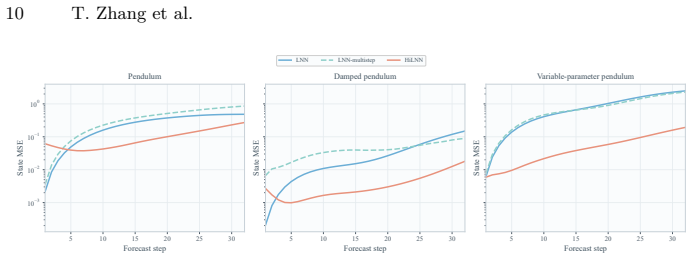
The central discovery is that a latent context extracted from past positions can stand in for the unobserved state and system identity inside a structured Lagrangian model. A recurrent encoder reads a length-8 position history and outputs a context vector; that vector is used to predict the missing initial velocity, to build a positive mass matrix and potential energy, and, for dissipative systems, to set a non-negative damping coefficient. The resulting acceleration comes from the Euler–Lagrange equation, and a differentiable RK4 rollout propagates the state 32 steps ahead with the context held fixed. Trained with multi-step trajectory supervision plus energy-consistency regularization, HiLNN reports the lowest average MSE, final-step MSE, and energy MSE across conservative, damped, and variable-parameter pendulum benchmarks, reducing the variable-parameter final-step error from 2.295 (LNN-multistep) to 0.193.
Load-bearing premise
The load-bearing premise is that ground-truth velocities and energies are available for every rollout step during training, because the proposed loss functions require those labels even though the task is described as position-only.
Editorial extensions
If this is right
- Position-only sensing becomes enough to run structured, physics-constrained forecasting: any system whose coordinates are recorded but whose velocities and parameters are unknown can in principle use the same history-conditioned Lagrangian setup.
- Conditioning mass, potential, and damping on a per-trajectory context removes the fixed-global-model limitation of standard LNNs, so one learned model can serve heterogeneous systems with different physical parameters.
- Differentiable RK4 rollout with full backpropagation is part of the recipe: the ablation shows detached Euler training fails, while full-BPTT RK4 training stabilizes long-horizon errors.
- Energy regularization buys physical consistency without sacrificing accuracy at the right weight, and over-regularizing hurts both, so there is a usable accuracy–energy trade-off.
- The reported reductions (e.g., variable-parameter average MSE from 0.894 to 0.061 and energy MSE from 19.516 to 1.759) imply the method is not just a short-horizon fitter but controls long-horizon error accumulation.
Reading between the lines
- Because the latent context is trained only through dynamics, it may function as a learned parameter-identification vector; a direct test would fix the true mass, length, and damping of test trajectories and check whether the inferred context varies smoothly along those parameter axes.
- The architecture transfers naturally to higher-dimensional or under-actuated systems (double pendulum, cart-pole, soft bodies); if the recurrent encoder can infer multiple hidden parameters from position history there, the paper's mechanism would be a general tool rather than a pendulum result.
- The training objective still requires ground-truth velocity and energy labels; a strictly position-only variant could replace the velocity-supervision term with finite-difference or shooting-based velocity targets and the energy term with a conservation residual, and it would be informative to see how far accuracy falls.
- A competing simpler design—finite-difference velocity estimates plus a context vector from a short window fed into an LNN—might achieve similar gains; comparing against such a baseline would isolate how much of the benefit comes from the learned recurrent encoder rather than from merely having more input features.
Signed reviews
Editorial analysis
A structured set of objections, weighed in public.
Referee Report
Summary. The paper proposes History-informed Lagrangian Neural Networks (HiLNN) for long-horizon forecasting of mechanical systems from position histories. A recurrent encoder (GRU) maps a length-L position history into a latent context z_t; this context is used both to infer the missing initial velocity and to condition the mass matrix, potential energy, and optional damping term of a structured Lagrangian model. The model is trained end-to-end with differentiable RK4 rollout, multi-step trajectory supervision, and energy-consistency regularization. Experiments on a fixed conservative pendulum, a fixed damped pendulum, and a variable-parameter pendulum report that HiLNN outperforms LNN, HNN, Neural ODE, and MLP baselines on trajectory MSE, final-step error, and energy error. The paper claims this demonstrates superior long-horizon prediction from position-only observations under conservative, dissipative, and heterogeneous dynamics.
Significance. If the empirical results hold, HiLNN is a useful step toward physics-guided forecasting under partial observability: it combines a structured Lagrangian prior with trajectory-adapted latent conditioning, and the ablation study supports the value of full rollout backpropagation and high-order integration. The paper ships a public code repository, which is a concrete asset for reproducibility. The main benchmark claim is an honest comparison of trajectory prediction accuracy, and the latent context is inferred from observed past data while the target is future evolution, so there is no obvious circularity in the central evaluation. However, the significance is currently limited by three issues: the training objective uses full-state supervision despite the 'position-only' framing, all quantitative claims rest on single runs without error bars, and the baseline protocol for handling unobserved velocities is unspecified. These issues need to be resolved before the paper's central claim can be accepted at face value.
major comments (3)
- [§3.1, §3.6, Eqs. (20)–(23)] The paper frames the task as 'position-only observations' (Eq. 1), but the training objective is not position-only. L_roll in Eq. (20) includes a velocity MSE term λ_qdot ||qdot_hat − qdot||² at every rollout step; L_v0 in Eq. (21) requires the exact initial velocity; and L_E in Eq. (22) requires ground-truth mechanical energy at every step. Thus velocities and energies are used as supervision throughout training, and only test-time inference is position-only. The ablation in Table 8 removes only λ_v0, not the trajectory velocity or energy terms, so the reported results do not show what happens when velocities are truly unavailable. Please restate the claim as 'position-input with full-state supervision during training' and either add an experiment with λ_qdot = 0 and without L_v0/L_E, or explicitly justify why such supervision is available in the intended applications.
- [Tables 3–7] All quantitative results are reported as single point estimates with no error bars, no seed counts, and no significance tests. Deep-learning training is stochastic, and some headline comparisons are close (for example, Table 4 Step 1 shows HiLNN's one-step MSE of 0.061 is much worse than LNN's 2.17×10⁻³, while the claimed advantage appears at longer horizons). Without multiple random seeds and a measure of variance, the reader cannot assess whether the reported improvements are robust or due to a particular run. Please report mean ± standard deviation over at least five seeds and provide a statistical test for the main MSE and Energy MSE comparisons.
- [§4.1 Evaluation protocol] The evaluation section states that 'all methods follow the same position-only forecasting protocol,' but LNN, HNN, and Neural ODE require the full state (q, qdot) as input. The paper does not specify how these baselines obtain the initial velocity at test time: finite differences, ground-truth velocity, or a learned estimator. This choice directly affects the comparison, because the baselines' accuracy depends on the quality of the velocity input. Please specify the exact baseline input protocol and, if ground-truth or finite-difference velocities are supplied, state this explicitly and discuss how it affects the fairness of the comparison against HiLNN, which must infer velocity from history.
minor comments (6)
- [Eq. (22)] The energy loss contains stray vertical bars in the notation '||E(hat_q, hat_qdot) − E(q, qdot)||²_2'; please use a single consistent norm notation.
- [§4.1 and Table 3] The baselines 'MLP-one-step' and 'LNN-multistep' are named in the tables but not described in the setup section. Please add one or two sentences specifying their architecture, input, and training loss.
- [Table 8] The 'Init. velocity' rows label the default weight as 'λ_v0 = 0.1' but do not mark it as the default configuration, and the row 'λ_v0 = 0.1' duplicates the default setting rather than acting as a distinct ablation. Please relabel to make the default clearly identifiable and clarify that the comparison is between λ_v0 = 0.1 and λ_v0 = 0.
- [§4.4] The paragraph after Table 7 contains two nearly identical concluding sentences ('These results suggest that...' and 'These results indicate that...'); please condense to avoid redundancy.
- [Table 4] HiLNN's Step-1 MSE (0.061) is substantially higher than LNN's (2.17×10⁻³). The text should acknowledge this explicitly and explain why the multi-step roll-out error is the appropriate criterion for the paper's claim.
- [§4.1 and Conclusion] The paper claims 'superior long-term prediction accuracy' and 'state-of-the-art baselines,' but the experiments are limited to three pendulum systems. Please scope the conclusion to these benchmarks or add experiments on higher-dimensional or more complex mechanical systems.
Circularity Check
No circular derivation found: HiLNN's prediction target is an external simulated trajectory, the latent context is inferred rather than fitted to the forecast, and the self-citations are non-load-bearing.
full rationale
The central claim (Section 4.2, Table 3) is an empirical comparison of 32-step open-loop rollouts against simulated pendulum trajectories. The prediction target is the future trajectory, which is not used to construct the model's input: the history encoder consumes only H_q^t = {q_{t-L+1}, ..., q_t} (Eq. 3), and the latent context z_t is fixed during rollout. No parameter is fitted to the test quantity and then reported as a prediction. The latent context is a learned representation supervised on training trajectories and evaluated on held-out test windows from the same simulator; this is standard amortized system identification, not circular reasoning. The energy regularization (Eq. 22) uses ground-truth mechanical energy as supervision, so Energy MSE is partly optimized during training, but it is evaluated on unseen test rollouts and is not the quantity being predicted. The self-citations ([9] and [21]) appear only in a broad motivation list and a related-work sentence ('[14,21]'), and neither is load-bearing for the empirical conclusions. The one substantive weakness is that Eqs. (20)-(22) require ground-truth velocities and energies at every training step and for the initial state, so the method is position-input, full-state-supervised; this narrows the 'position-only observations' claim (Section 3.1) but is an applicability limitation, not a circularity.
Assumptions & free parameters
free parameters (4)
- Energy-regularization weight lambda_E =
0.01
- Initial-velocity loss weight lambda_v0 =
0.1
- History length L =
8
- Latent context dimension d_z =
32
assumptions (4)
- standard math The learned acceleration is defined by the Euler-Lagrange equation with generalized force Q: d/dt(dL/dqdot) - dL/dq = Q (Eq. 12).
- domain assumption The mass matrix is positive and diagonal (scalar in 1D), with kinetic energy quadratic in velocity and potential independent of velocity.
- domain assumption An 8-sample position history contains enough information to infer initial velocity and trajectory-specific parameters such as mass, length, and friction.
- domain assumption Ground-truth velocities and energies are available during training to compute L_roll, L_v0, and L_E.
invented entities (1)
-
Latent context z_t (32-dimensional)
Cite this review
Pith. "Pith review of History-informed Lagrangian Neural Networks." pith.science (2026). https://pith.science/paper/TACA5354
@misc{pith2026260813215,
  author       = {Pith},
  title        = {Pith review of: History-informed Lagrangian Neural Networks},
  year         = {2026},
  howpublished = {\url{https://pith.science/paper/TACA5354}},
  note         = {Machine review of arXiv:2608.13215}
}
read the original abstract
Forecasting the long-horizon evolution of mechanical systems from position-only observations is a pivotal yet difficult task, as hidden velocities and trajectory-specific physical properties must be inferred simultaneously. Although physics-guided neural networks like Lagrangian Neural Networks (LNNs) guarantee physical plausibility, they generally require complete state inputs and lack adaptability to changing system parameters. To break these limitations, we introduce History-informed Lagrangian Neural Networks (HiLNN). Grounded in the insight that temporal position sequences implicitly encode underlying dynamics, HiLNN employs a recurrent encoder to extract a latent context from history. This context not only reconstructs the unobserved initial velocity but also adaptively modulates the mass matrix, potential energy, and damping coefficients of a structured Lagrangian system. By leveraging a differentiable RK4 rollout scheme, the entire pipeline is optimized end-to-end under multi-step trajectory supervision and energy-consistency regularization. Empirical evaluations across conservative, dissipative, and heterogeneous variable-parameter systems show that HiLNN delivers superior long-term prediction accuracy and maintains precise energy profiles compared to state-of-the-art baselines. The source code is publicly available at https://github.com/yingtian22/History-informed-LNN.
Figures

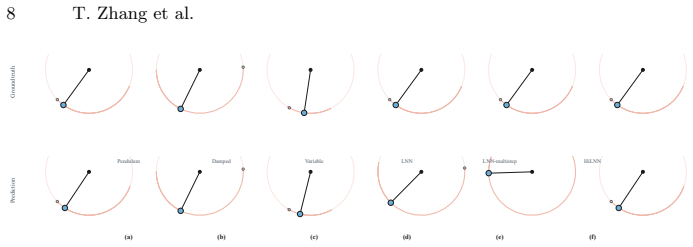
Figures from the paper (2 more)


Reference graph
Works this paper leans on
-
[1]
In: Advances in Neural Information Processing Systems
Battaglia, P.W., Pascanu, R., Lai, M., Rezende, D.J., Kavukcuoglu, K.: Interaction networks for learning about objects, relations and physics. In: Advances in Neural Information Processing Systems. vol. 29, pp. 4502–4510 (2016)
work page 2016
-
[2]
Transactions on Machine Learning Research (2023)
Buisson-Fenet, M., Morgenthaler, V., Trimpe, S., Di Meglio, F.: Recognition mod- els to learn dynamics from partial observations with neural odes. Transactions on Machine Learning Research (2023)
work page 2023
-
[3]
In: Advances in Neural Information Processing Systems
Chen, R.T.Q., Rubanova, Y., Bettencourt, J., Duvenaud, D.K.: Neural ordinary differential equations. In: Advances in Neural Information Processing Systems. vol. 31, pp. 6572–6583 (2018)
work page 2018
-
[4]
In: ICLR 2020 Workshop on Integration of Deep Neural Models and Differential Equations (2020)
Cranmer, M., Greydanus, S., Hoyer, S., Battaglia, P., Spergel, D., Ho, S.: La- grangian neural networks. In: ICLR 2020 Workshop on Integration of Deep Neural Models and Differential Equations (2020)
work page 2020
-
[5]
Physical Review E104(3), 034312 (2021)
Desai, S.A., Mattheakis, M., Sondak, D., Protopapas, P., Roberts, S.J.: Port-hamiltonian neural networks for learning explicit time- dependent dynamical systems. Physical Review E104(3), 034312 (2021). https://doi.org/10.1103/PhysRevE.104.034312
-
[6]
In: Advances in Neural Information Processing Systems
Finzi, M., Wang, K.A., Wilson, A.G.: Simplifying hamiltonian and lagrangian neu- ral networks via explicit constraints. In: Advances in Neural Information Processing Systems. vol. 33, pp. 13880–13889 (2020)
work page 2020
-
[7]
In: Ad- vances in Neural Information Processing Systems
Greydanus, S., Dzamba, M., Yosinski, J.: Hamiltonian neural networks. In: Ad- vances in Neural Information Processing Systems. vol. 32, pp. 15353–15363 (2019)
work page 2019
-
[8]
arXiv preprint arXiv:1511.05121 (2015)
Krishnan, R.G., Shalit, U., Sontag, D.: Deep kalman filters. arXiv preprint arXiv:1511.05121 (2015)
arXiv 2015
Show all 22 references
-
[9]
CAAI Transactions on Intelligent Systems 20(6), 1355–1365 (2025)
Li, M., Xiao, Y., Xing, X.: Trajectory prediction methods based on analytical mechanics and graph neural networks. CAAI Transactions on Intelligent Systems 20(6), 1355–1365 (2025). https://doi.org/10.11992/tis.202501020
2025 doi
-
[10]
In: IEEE International Conference on Acoustics, Speech and Signal Processing (2026)
Li, Y., Ding, K., Yang, C., Chen, S.Y., Tian, Y.: Distilling time series foundation models for efficient forecasting. In: IEEE International Conference on Acoustics, Speech and Signal Processing (2026)
2026
-
[11]
arXiv preprint arXiv:2511.16715 (2025)
Li, Y., Ding, K., Yang, C., Wang, H., Wang, H., Duan, H., Liu, J., Tian, Y.: Ddtime: Dataset distillation with spectral alignment and information bottleneck for time-series forecasting. arXiv preprint arXiv:2511.16715 (2025)
2025
-
[12]
IEEE Transactions on Evolutionary Computa- tion (2026)
Li, Y., Dong, J., Liu, J., Koniusz, P., Zeng, H., Yang, C., Liu, J., Tian, Y., Huang, T., Wu, H.: Evolving multimodal models for physical dynamics: A multi- objective neuroevolution approach. IEEE Transactions on Evolutionary Computa- tion (2026). https://doi.org/10.1109/TEVC....
2026
-
[13]
In: Pro- ceedings of the IEEE/CVF International Conference on Computer Vision
Li, Y., Yang, C., Zeng, H., Dong, Z., An, Z., Xu, Y., Tian, Y., Wu, H.: Frequency- aligned knowledge distillation for lightweight spatiotemporal forecasting. In: Pro- ceedings of the IEEE/CVF International Conference on Computer Vision. pp. 7262–7272 (2025)
2025
-
[14]
In: International Conference on Learning Representations (2019)
Lutter, M., Ritter, C., Peters, J.: Deep lagrangian networks: Using physics as model prior for deep learning. In: International Conference on Learning Representations (2019)
2019
-
[15]
In: 2018 IEEE International Conference on Robotics and Automation
Nagabandi, A., Kahn, G., Fearing, R.S., Levine, S.: Neural network dynam- ics for model-based deep reinforcement learning with model-free fine-tuning. In: 2018 IEEE International Conference on Robotics and Automation. pp. 7559–7566 (2018). https://doi.org/10.1109/ICRA.2018.846...
2018
-
[16]
In: Advances in Neural Information Processing Systems
Rubanova, Y., Chen, R.T.Q., Duvenaud, D.: Latent odes for irregularly-sampled time series. In: Advances in Neural Information Processing Systems. vol. 32 (2019)
2019
-
[17]
In: Proceedings of the 37th International Conference on Machine Learning
Sanchez-Gonzalez, A., Godwin, J., Pfaff, T., Ying, R., Leskovec, J., Battaglia, P.W.: Learning to simulate complex physics with graph networks. In: Proceedings of the 37th International Conference on Machine Learning. vol. 119, pp. 8459–8468 (2020)
2020
-
[18]
arXiv preprint arXiv:2201.10085 (2022)
Sosanya, A., Greydanus, S.: Dissipative hamiltonian neural networks: Learning dissipative and conservative dynamics separately. arXiv preprint arXiv:2201.10085 (2022)
2022 arXiv
-
[19]
In: Dynamical Systems and Turbulence, Warwick 1980, Lecture Notes in Mathematics, vol
Takens, F.: Detecting strange attractors in turbulence. In: Dynamical Systems and Turbulence, Warwick 1980, Lecture Notes in Mathematics, vol. 898, pp. 366–381. Springer, Berlin, Heidelberg (1981). https://doi.org/10.1007/BFb0091924
1981 doi
-
[20]
In: Advances in Neural Information Processing Systems
Yildiz, C., Heinonen, M., Lahdesmaki, H.: Ode2vae: Deep generative second order odes with bayesian neural networks. In: Advances in Neural Information Processing Systems. vol. 32 (2019)
2019
-
[21]
arXiv preprint arXiv:2509.13783 (2025)
Zhang, T., Zhai, W., Yann, R., Gao, J., Cao, H., Xing, X.: Floating-body hydro- dynamic neural networks. arXiv preprint arXiv:2509.13783 (2025)
2025
-
[22]
In: International Conference on Learning Representations (2020)
Zhong, Y.D., Dey, B., Chakraborty, A.: Symplectic ode-net: Learning hamiltonian dynamics with control. In: International Conference on Learning Representations (2020)
2020
Reviewed August 15, 2026 · model on record in the stance chip above.
Discussion (0). Continue with ORCID to comment.