REVIEW 3 major objections 7 minor 45 references
GenPlanX. Generation of Plans and Execution
T0 review · 3 major / 7 minor · reviewed 2026-08-07 · deepseek-v4-flash
Pith's one-line read GenPlanX is an architecture that turns natural-language office requests into cost-optimal, executable plans by giving the LLM the job of writing the problem and a classical planner the job of solving it.
desk verdict A clean integration of known LLM-plus-planner components whose load-bearing translation step is unmeasured and, in one example, demonstrably wrong—worth reviewing, not ready to be believed. read the letter →
The pith
A machine-rendered reading of the paper's core claim, the machinery that carries it, and where it could break.
The reading
What carries the argument
The load-bearing object is the 'assistant' PDDL domain, a curated set of typed objects, predicates, and actions representing office tools and data: types such as data-file, dataframe, graph, slide, presentation, model, and response; predicates such as (in ?c ?c1), (available ?o), (done-query ?q), and (in-graph ?c ?c1 ?g); and actions like read-data, query-data-basic, query-data-optimized, create-graph, add-to-graph, create-slide, generate-presentation, learn-supervised, and predict-using-learned-model. Each action has a Python function of the same name that actually performs the operation on the execution state, so the plan is directly executable. The second load-bearing piece is the LLM-produced dictionary, the only place natural language enters: it specifies the objects, initial state, and goals, and the compiler turns it into PDDL. The separation is what lets the planner's validity guarantee apply to a problem that was authored in English.
What would settle it
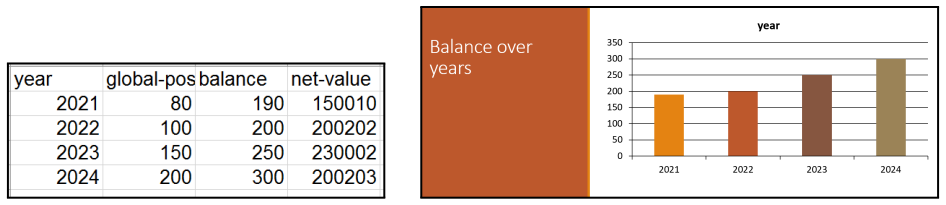
Give GenPlanX a request with a known ground truth—'Read annual-report.csv, make a bar chart of balance by year, and email the result to alice@example.com'—and inspect whether the LLM's dictionary contains the email object and the sent-email goal; a well-formed dictionary that omits a stated goal or misrepresents the initial file would lead to an artifact that misses the request while the system reports success. A broader falsifier is a batch evaluation of such requests where the generated problem specification is compared to gold-standard extractions; any miss that the execution loop does not catch would signal that the classical planner's guarantee does not reach the user.
Extended reading notes
Core claim
The central discovery is the architecture itself and the division of labor inside it. The LLM never proposes a plan; it only proposes the planning problem, in the form of a Python dictionary whose keys are objects, 'init_state', and 'goals', and whose values carry both PDDL types and execution-time values such as file paths and query strings. A compiler converts that dictionary into a PDDL problem, and a classical planner returns a cost-optimal action sequence. The execution module maps each PDDL action to a same-named Python function, checks after each action whether the real-world effect matched, and invokes replanning on failure or when an action (such as reading an email) reveals new goals. The paper's evidence is three worked end-to-end examples plus a small comparison in which two recent LLMs, when asked to plan directly without hints, produced at most 4/5 correct and 0/5 optimal plans, while both reached 5/5 with hints, supporting the claim that the planner is what supplies correctness.
Load-bearing premise
The load-bearing premise is that the LLM will convert the user's request into a complete and accurate dictionary of objects, initial state, and goals; if it misses a goal or misstates the initial configuration, the planner will efficiently solve the wrong problem and the execution loop will carry out that wrong plan with confidence.
Editorial extensions
If this is right
- Plans produced by GenPlanX are provably valid with respect to the problem the LLM generated, so any end-to-end failure can be traced to translation rather than plan search.
- Because costs are encoded in domain actions, the planner can optimize over alternatives that LLM-only planning gets wrong, as in Example 1.2 where the lower-cost database route is chosen.
- The architecture supports adding new tools by defining a PDDL action and a same-named Python function, making it adaptable to new office applications.
- Execution monitoring plus replanning lets the system react to failures and to goals only discovered during execution, such as actions that read email contents and create new intents.
- Any PDDL planner can be substituted, making the system planner-independent.
Reading between the lines
- A fair evaluation would separate translation fidelity from planning: measure how often the LLM-produced dictionary matches a validated extraction of objects, initial state, and goals on a held-out set of office requests, because the planner's guarantee cannot compensate for translation error.
- Using a Python-dictionary intermediate representation, rather than asking the LLM to write PDDL directly, likely makes the translation step easier for the model and also lets execution values such as file paths and email addresses ride along as object values, a design choice worth adopting in similar systems.
- The replanning-on-new-goals behavior invites a goal-driven autonomy extension: the monitoring layer could detect opportunities in the environment and propose new goals, not just wait for an action to fail or explicitly announce them.
Editorial analysis
A structured set of objections, weighed in public.
Referee Report
Summary. The paper presents GenPlanX, a hybrid system for office tasks in which an LLM turns a natural-language request into a Python dictionary containing entities, an initial state, and goals; a compiler converts that dictionary into PDDL; a classical planner (Fast Downward via the Unified Planning library) returns a plan; and an execution module maps PDDL actions to Python functions with monitoring and replanning on failure. The authors describe the architecture, the 'assistant' domain, the full prompt, several worked end-to-end examples (annual-report charts, decision-tree training and prediction, appointments filtering), and a small comparison showing that GPT-4o and o3-mini produce incorrect or suboptimal plans when asked to plan directly. The scientific claims are that this design yields plans that are valid and optimal with respect to the compiled planning problem, and that GenPlanX is effective end-to-end for office-related tasks.
Significance. The architecture is sensible and its division of labor—LLM for translation, classical planner for planning, Python functions for execution—is a credible way to avoid the lack of guarantees in LLM-only planning. The paper is transparent: it provides the full prompt, domain fragments, action implementations, and the raw LLM-planning comparison, which is a strength. If the translation step were shown to be reliable, the system would be a useful contribution in the line of LLM-plus-planner frameworks. However, the central efficacy claim currently rests on a handful of curated examples and no quantitative measurement of the LLM-to-dictionary step. The stress-test concern raised by the reader is real and is borne out by the inconsistencies in Example 1.2. The result is a promising system description rather than a demonstrated end-to-end solution.
major comments (3)
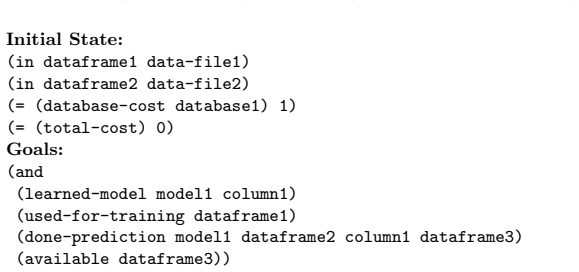
- [§8.1, Example 1.2 / Figure 7 / Table 2] The user request states that db2 has reading cost 3, but the LLM-generated initial state in Figure 7 contains '(= (database-cost database2) 2)' and Table 2 and the surrounding text use cost 2 for read-data(db2). Figure 7 also contains a syntactically malformed literal '(in dataframe1 db1) in dataframe1 db2)' and mixes the object names 'db1'/'db2' with 'database1'/'database2'. Because the initial state is the input to the planner, the planner's 'optimal' plan minimizes cost with respect to a problem that does not match the user's stated request. If this is pipeline output, it is a concrete instance of the failure mode the paper must rule out; if it is a typo, it must be corrected and the example re-verified. As written, this section undermines rather than supports the claim that GenPlanX produces the optimal plan for the user's actual request.
- [§6, §8, §10.1] The paper contains no quantitative evaluation of the LLM's dictionary generation, which is the load-bearing step of the system. There are no reported statistics on translation accuracy, goal completeness, initial-state faithfulness, type correctness, entity-extraction rates, or plan validity of the compiled problems. Section 11 compares LLM-only planning against a classical planner, but that comparison does not test GenPlanX's translation module; if the LLM produces a wrong dictionary, the planner still solves the wrong problem and the error is invisible in that comparison. The single handwritten prompt in Appendix 10.1 and the three curated examples do not establish reliability across the intent list of Section 6.2. A systematic evaluation, for example N requests per intent with human-verified dictionaries and plans, is needed before the end-to-end efficacy claim can be accepted.
- [§7.2] The paper claims that GenPlanX monitors execution and replans on failure, but it reports no experiments in which an action fails or a new goal is generated during execution; all worked examples show successful first-pass execution. The success predicates in Listing 5 are essentially type checks, and the text does not specify how a detected failure is translated back into a PDDL state or what guarantees the replanning procedure provides. As written, the execution-monitoring and replanning claim is architectural rather than demonstrated. At minimum, the paper should define the replanning protocol precisely or present a failure-injection study.
minor comments (7)
- [§2.1 and References] The text cites 'Etizioni et al.', but the reference list entry [8] is '0. Etzioni'; the '0.' appears to be a typo for 'O.', and the author name should be harmonized.
- [References] References [41] and [42] are identical; one of them should be removed or replaced with the intended distinct source.
- [§7.1] The phrase 'problem stated in 2' should read 'problem stated in Listing 2'.
- [§11.2] The text says 'shown in Figure 8' when referring to the results table; the correct reference is Table 8.
- [§11.1] The sentence 'We also tested with providing the action descriptions in PDDL and got simular results' contains a typo: 'simular' should be 'similar'.
- [Appendix 10.1] The instruction 'Do not return Output: in the output' is ambiguous; it should be rephrased to make clear whether it means 'do not prefix your response with Output:'.
- [Abstract and headings] Several instances of 'GenPlanX' are missing the space before the word (e.g., 'introducesGenPlanX' in the abstract and 'handle file and data management tasks' formatting issues); these should be fixed in the final formatting pass.
Circularity Check
No significant circularity: the LLM-to-PDDL-to-planner pipeline is a forward derivation, not a reduction to its inputs.
full rationale
GenPlanX's derivation chain is a forward pipeline: natural-language request to an LLM-produced dictionary, compilation to a PDDL problem, classical planning, and execution. The planner's guarantee that the plan achieves the goals from the initial state is with respect to the PDDL problem actually constructed; the LLM output is an input to that computation and is not itself derived from the plan. No parameter is fitted to output data and then renamed as a prediction, and no uniqueness theorem from prior work by the same authors is invoked to force a choice. The paper's self-citations, such as [21] for entity extraction and [25] for future work on learning action costs, are background or forward-looking and are not load-bearing for the central claim. The Appendix 11 comparison against GPT-4o and o3-mini is an independent empirical comparison, and the optimality contrast in Example 1.2 is computed by the classical planner over the stated planning problem. There is a factual inconsistency in Example 1.2 (the user request says db2 has reading cost 3, while Figure 7 sets database-cost to 2 and Table 2 uses 2+2=4), which is a fidelity/correctness risk but not circularity: the planner still optimizes whatever problem model it is given. Overall, no claimed result reduces by construction to its own inputs, so the circularity score is 0.
Assumptions & free parameters
free parameters (2)
- Cost values in the domain model =
1 for most actions, 5 for query-data-basic, 2 for query-data-optimized
- Prompt structure and few-shot examples =
Handwritten prompt in Appendix 10.1
assumptions (4)
- standard math Classical planners such as Fast Downward are sound and complete for the PDDL fragments used.
- domain assumption The LLM will reliably produce well-formed dictionaries that match the prompt's constraints.
- domain assumption The world is fully described by the PDDL state, and action preconditions and effects accurately capture real-world action outcomes.
- domain assumption Entity extraction correctly identifies the domain-specific entities needed by the LLM.
invented entities (1)
-
The assistant PDDL domain
Cite this review
Pith. "Pith review of GenPlanX. Generation of Plans and Execution." pith.science (2026). https://pith.science/paper/TACTGM2Q
@misc{pith2026250610897,
  author       = {Pith},
  title        = {Pith review of: GenPlanX. Generation of Plans and Execution},
  year         = {2026},
  howpublished = {\url{https://pith.science/paper/TACTGM2Q}},
  note         = {Machine review of arXiv:2506.10897}
}
read the original abstract
Classical AI Planning techniques generate sequences of actions for complex tasks. However, they lack the ability to understand planning tasks when provided using natural language. The advent of Large Language Models (LLMs) has introduced novel capabilities in human-computer interaction. In the context of planning tasks, LLMs have shown to be particularly good in interpreting human intents among other uses. This paper introduces GenPlanX that integrates LLMs for natural language-based description of planning tasks, with a classical AI planning engine, alongside an execution and monitoring framework. We demonstrate the efficacy of GenPlanX in assisting users with office-related tasks, highlighting its potential to streamline workflows and enhance productivity through seamless human-AI collaboration.
Figures


Figures from the paper (16 more)






Reference graph
Works this paper leans on
-
[1]
M. Ai-Chang, J. Bresina, L. Charest, A. Chase, J.C.-J. Hsu, A. Jonsson, B. Kanefsky, P. Morris, K. Rajan, J. Yglesias, B.G. Chafin, W.C. Dias, and P.F. Maldague. MAPGEN: Mixed-initiative planning and scheduling for the Mars Exploration Rover mission.IEEE Intelligent Systems, 19(1):8–12, feb 2004
work page 2004
-
[2]
Learning action models with minimal ob- servability.Artificial Intelligence, 275:104–137, 2019
Diego Aineto, Sergio Jim´ enez Celorrio, and Eva Onaindia. Learning action models with minimal ob- servability.Artificial Intelligence, 275:104–137, 2019
work page 2019
-
[3]
Daniel Borrajo and Manuela M. Veloso. Computing opportunities to augment plans for novel replanning during execution. InProceedings of ICAPS, Guangzhou (China), 2021
work page 2021
-
[4]
Tom B Brown, Benjamin Mann, Nick Ryder, Melanie Subbiah, Jared D Kaplan, Prafulla Dhariwal, Arvind Neelakantan, Pranav Shyam, Girish Sastry, Amanda Askell, et al. Language models are few- shot learners.Advances in neural information processing systems, 33:1877–1901, 2020
work page 1901
-
[5]
A multi-agent architecture for intelligent gathering systems.AI Communications, 18(1):15–32, 2005
David Camacho, Ricardo Aler, Daniel Borrajo, and Jos´ e Manuel Molina. A multi-agent architecture for intelligent gathering systems.AI Communications, 18(1):15–32, 2005
work page 2005
-
[6]
Planning for tourism routes using social networks.Expert Systems with Applications, 69:1–9, 2017
Isabel Cenamor, Sergio N´ u˜ nez, Tom´ as de la Rosa, and Daniel Borrajo. Planning for tourism routes using social networks.Expert Systems with Applications, 69:1–9, 2017
work page 2017
-
[7]
TRIP- PAL: Travel planning with guarantees by combining large language models and automated planners
Tom´ as de la Rosa, Sriram Gopalakrishnan, Alberto Pozanco, Zhen Zeng, and Daniel Borrajo. TRIP- PAL: Travel planning with guarantees by combining large language models and automated planners. arXiv e-prints, abs/2406.10196, 2024
arXiv 2024
-
[8]
0. Etzioni, S. Hanks, D. Weld, D. Draper, N. Lesh, , and M. Williamson. An approach to planning with incomplete information. InProc. 3rd Int. Conf. on Principles of Knowledge Representation and Reasoning, 1992. 17 Initial State: (in dataframe1 data-file1) (in dataframe2 data-file2) (= (database-cost database1) 1) read-data(ai, dataframe1, data-file1, data...
work page 1992
Show all 45 references
-
[9]
Assisting data mining through automated planning
Fernando Fern´ andez, Daniel Borrajo, Susana Fern´ andez, and David Manzano. Assisting data mining through automated planning. In P. Perner, editor,Proceedings of the International Conference on Ma- chine Learning and Data Mining (MLDM 2009), volume 5632 ofLecture Notes in Art...
2009
-
[10]
Anticipation of goals in automated planning
Raquel Fuentetaja, Daniel Borrajo, and Tom´ as de la Rosa. Anticipation of goals in automated planning. AI Communications, 31(2):117–135, March 2018
2018
-
[11]
Florez,´Alvaro Torralba, Daniel Borrajo, Carlos Linares-L´ opez, ´Angel Garc ´ ıa- Olaya, and Juan S´ aenz
Javier Garc ´ ıa, Jos´ e E. Florez,´Alvaro Torralba, Daniel Borrajo, Carlos Linares-L´ opez, ´Angel Garc ´ ıa- Olaya, and Juan S´ aenz. Combining linear programming and automated planning to solve intermodal transportation problems.European Journal of Operations Research, 227(...
2013
-
[12]
Ghallab, A
M. Ghallab, A. Howe, C. Knoblock, D. McDermott, A. Ram, M. Veloso, D. Weld, and D. Wilkins. PDDL - the planning domain definition language. Technical Report CVC TR-98-003/DCS TR-1165, Yale Center for Computational Vision and Control, 1998
1998
-
[13]
Access Online via Elsevier, 2004
Malik Ghallab, Dana Nau, and Paolo Traverso.Automated planning: theory & practice. Access Online via Elsevier, 2004. 18 Figure 13: The input file (top) and the final result, prediction of the ‘WillPurchase’ column using learned model for the (bottom) Example 2
2004
-
[14]
A planning approach to repair domains with incomplete action effects
Alba Gragera, Raquel Fuentetaja, ´Angel Garc ´ ıa-Olaya, and Fernando Fern´ andez. A planning approach to repair domains with incomplete action effects. InProceedings of the International Conference on Automated Planning and Scheduling, volume 33, pages 153–161, 2023
2023
-
[15]
Leveraging pre- trained large language models to construct and utilize world models for model-based task planning
Lin Guan, Karthik Valmeekam, Sarath Sreedharan, and Subbarao Kambhampati. Leveraging pre- trained large language models to construct and utilize world models for model-based task planning. Advances in Neural Information Processing Systems, 36:79081–79094, 2023
2023
-
[16]
Transformers for natural language to structured planning: Integrating domain knowledge
Rajesh Gupta, Suresh Patel, and Ming Lee. Transformers for natural language to structured planning: Integrating domain knowledge. InProceedings of the AAAI Conference on Artificial Intelligence, pages 4567–4574, 2021
2021
-
[17]
Building a domain-independent architecture for planning, learning and execution.pelea
C´ esar Guzm´ an, Vidal Alc´ azar, David Prior, Eva Onaind ´ ıa, Daniel Borrajo, and Juan Fdez-Olivares. Building a domain-independent architecture for planning, learning and execution.pelea. InProceedings of the ICAPS 2011 System Demonstrations, Freiburg (Germany), 2011. AAAI Press
2011
-
[18]
The fast downward planning system.Journal of Artificial Intelligence Research, 26:191– 246, 2006
Malte Helmert. The fast downward planning system.Journal of Artificial Intelligence Research, 26:191– 246, 2006
2006
-
[19]
Language models as zero-shot planners: Extracting actionable knowledge for embodied agents.arXiv preprint arXiv:2201.07207, 2022
Wenlong Huang, Pieter Abbeel, Deepak Pathak, and Roozbeh Mottaghi. Language models as zero-shot planners: Extracting actionable knowledge for embodied agents.arXiv preprint arXiv:2201.07207, 2022
2022 arXiv
-
[20]
Llms can’t plan, but can help planning in llm-modulo frameworks
Subbarao Kambhampati, Karthik Valmeekam, Lin Guan, Kaya Stechly, Mudit Verma, Siddhant Bham- bri, Lucas Saldyt, and Anil Murthy. Llms can’t plan, but can help planning in llm-modulo frameworks. arXiv preprint arXiv:2402.01817, 2024
2024 arXiv
-
[21]
Advanced messaging platform (amp): Pipeline for automated enterprise email processing
Simerjot Kaur, Charese Smiley, Keshav Ramani, Elena Kochkina, Mathieu Sibue, Samuel Mensah, Pietro Totis, Cecilia Tilli, Toyin Aguda, Daniel Borrajo, and Manuela Veloso. Advanced messaging platform (amp): Pipeline for automated enterprise email processing. InProceedings of the...
2025
-
[22]
Elevator control as a planning problem
Jana Koehler and Kilian Schuster. Elevator control as a planning problem. InProceedings of the Fifth International Conference on Artificial Intelligence Planning Systems, pages 331–338, 2000. 19
2000
-
[23]
Llm+ p: Empowering large language models with optimal planning proficiency.arXiv preprint arXiv:2304.11477, 2023
Bo Liu, Yuqian Jiang, Xiaohan Zhang, Qiang Liu, Shiqi Zhang, Joydeep Biswas, and Peter Stone. Llm+ p: Empowering large language models with optimal planning proficiency.arXiv preprint arXiv:2304.11477, 2023
2023 arXiv
-
[24]
Unified planning: Modeling, manipulating and solving ai planning problems in python.SoftwareX, 29:102012, 2025
Andrea Micheli, Arthur Bit-Monnot, Gabriele R¨ oger, Enrico Scala, Alessandro Valentini, Luca Framba, Alberto Rovetta, Alessandro Trapasso, Luigi Bonassi, Alfonso Emilio Gerevini, Luca Iocchi, Felix In- grand, Uwe K¨ ockemann, Fabio Patrizi, Alessandro Saetti, Ivan Serina, and...
2025
-
[25]
On learning action costs from input plans.arXiv preprint arXiv:2408.10889, 2024
Marianela Morales, Alberto Pozanco, Giuseppe Canonaco, Sriram Gopalakrishnan, Daniel Borrajo, and Manuela Veloso. On learning action costs from input plans.arXiv preprint arXiv:2408.10889, 2024
2024 arXiv
-
[26]
Nocturne: A scalable driving benchmark for bringing multi-agent learning one step closer to the real world
Roozbeh Mottaghi, Chuang Gan Wu, and Ali Farhadi. Nocturne: A scalable driving benchmark for bringing multi-agent learning one step closer to the real world. InConference on Robot Learning, pages 647–656. PMLR, 2020
2020
-
[27]
Aha, and Elizabeth Carter
H´ ector Mu˜ noz-Avila, Ulit Jaidee, David W. Aha, and Elizabeth Carter. Goal-driven autonomy with case-based reasoning. InProceedings of Case-Based Reasoning. Research and Development, 18th In- ternational Conference on Case-Based Reasoning (ICCBR) 2010, volume 6176 ofLecture...
2010
-
[28]
Pandurang Nayak, Barney Pell, and Brian C
Nicola Muscettola, P. Pandurang Nayak, Barney Pell, and Brian C. Williams. Remote agent: To boldly go where no AI system has gone before.Artificial Intelligence, 103(1-2):5–47, 1998
1998
-
[29]
Using copilot in microsoft 365
Anand Narayanaswamy. Using copilot in microsoft 365. InMicrosoft Copilot for Windows 11: Under- standing the AI-Powered Features in Windows 11, pages 205–233. Springer, 2024
2024
-
[30]
Large language models as planning domain generators
James Oswald, Kavitha Srinivas, Harsha Kokel, Junkyu Lee, Michael Katz, and Shirin Sohrabi. Large language models as planning domain generators. In34th International Conference on Automated Plan- ning and Scheduling, 2024
2024
-
[31]
On the prospects of incorporating large language models (llms) in automated planning and scheduling (aps).arXiv preprint arXiv:2401.02500, 2024
Vishal Pallagani, Kaushik Roy, Bharath Muppasani, Francesco Fabiano, Andrea Loreggia, Keerthiram Murugesan, Biplav Srivastava, Francesca Rossi, Lior Horesh, and Amit Sheth. On the prospects of incorporating large language models (llms) in automated planning and scheduling (aps...
2024 arXiv
-
[32]
Using online planning and acting to recover from cyberattacks on software-defined networks
Sunandita Patra, Alex Velazquez, Myong Kang, and Dana Nau. Using online planning and acting to recover from cyberattacks on software-defined networks. InProceedings of the AAAI Conference on Artificial Intelligence, volume 35, pages 15377–15384, 2021
2021
-
[33]
Generating replanning goals through multi- objective optimization in response to execution observation
Alberto Pozanco, Daniel Borrajo, and Manuela Veloso. Generating replanning goals through multi- objective optimization in response to execution observation. InProceedings of ECAI, Krak´ ow (Poland), 2023
2023
-
[34]
Learning-driven goal generation.AI Commu- nications, 31(2):137–150, 2018
Alberto Pozanco, Susana Fern´ andez, and Daniel Borrajo. Learning-driven goal generation.AI Commu- nications, 31(2):137–150, 2018. https://content.iospress.com/articles/ai-communications/aic754, DOI: 10.3233/AIC-180754
2018 doi
-
[35]
Computing planning centroids and minimum covering states using symbolic bidirectional search
Alberto Pozanco, ´Alvaro Torralba, and Daniel Borrajo. Computing planning centroids and minimum covering states using symbolic bidirectional search. InProceedings of ICAPS, Banff (Canada), 2024
2024
-
[36]
Adapt: As-needed decomposition and planning with language models, 2024
Archiki Prasad, Alexander Koller, Mareike Hartmann, Peter Clark, Ashish Sabharwal, Mohit Bansal, and Tushar Khot. Adapt: As-needed decomposition and planning with language models, 2024
2024
-
[37]
Integrating plan- ning and scheduling in workflow domains.Expert Systems with Applications, 33(2):389–406, October 2007
Mar ´ ıa Dolores Rodr ´ ıguez-Moreno, Daniel Borrajo, Amedeo Cesta, and Angelo Oddi. Integrating plan- ning and scheduling in workflow domains.Expert Systems with Applications, 33(2):389–406, October 2007. 20
2007
-
[38]
An AI planning- based tool for scheduling satellite nominal operations.AI Magazine, 25(4):9–27, Winter 2004
Mar ´ ıa Dolores Rodr ´ ıguez-Moreno, Daniel Borrajo, and Daniel Meziat. An AI planning- based tool for scheduling satellite nominal operations.AI Magazine, 25(4):9–27, Winter 2004. http://www.aaai.org/ojs/index.php/aimagazine/article/viewArticle/1782
2004
-
[39]
Twostep: Multi-agent task planning using classical planners and large language models, 2024
Ishika Singh, David Traum, and Jesse Thomason. Twostep: Multi-agent task planning using classical planners and large language models, 2024
2024
-
[40]
Automated composition of semantic web services into executable processes
Paolo Traverso and Marco Pistore. Automated composition of semantic web services into executable processes. InInternational Semantic Web Conference, pages 380–394. Springer, 2004
2004
-
[42]
Large language models still can’t plan (a benchmark for llms on planning and reasoning about change).arXiv preprint arXiv:2206.10498, 2022
Karthik Valmeekam, Alberto Olmo, Sarath Sreedharan, and Subbarao Kambhampati. Large language models still can’t plan (a benchmark for llms on planning and reasoning about change).arXiv preprint arXiv:2206.10498, 2022
2022 arXiv
-
[43]
Chain-of-thought prompting elicits reasoning in large language models, 2023
Jason Wei, Xuezhi Wang, Dale Schuurmans, Maarten Bosma, Brian Ichter, Fei Xia, Ed Chi, Quoc Le, and Denny Zhou. Chain-of-thought prompting elicits reasoning in large language models, 2023
2023
-
[44]
Griffiths, Yuan Cao, and Karthik Narasimhan
Shunyu Yao, Dian Yu, Jeffrey Zhao, Izhak Shafran, Thomas L. Griffiths, Yuan Cao, and Karthik Narasimhan. Tree of thoughts: Deliberate problem solving with large language models, 2023
2023
-
[45]
React: Synergizing reasoning and acting in language models, 2023
Shunyu Yao, Jeffrey Zhao, Dian Yu, Nan Du, Izhak Shafran, Karthik Narasimhan, and Yuan Cao. React: Synergizing reasoning and acting in language models, 2023
2023
-
[46]
type": "text
Li Zhang, Mei Wang, and Hui Chen. Structured representations for natural language to planning problem translation.IEEE Transactions on Neural Networks and Learning Systems, 33(5):2003–2015, 2022. 10 Appendix 1 10.1 Complete prompt used to call the LLM We include here an exampl...
2003
Reviewed August 7, 2026 · model on record in the stance chip above.
Discussion (0). Continue with ORCID to comment.