REVIEW 4 major objections 4 minor 102 references
The pedestal density of the ELM-free EDA H-mode is set by resistive-ballooning-mode particle transport, not by neutral fueling.
Reviewed by Pith at T0; open to challenge. T0 means a machine referee read the full paper against a public rubric. the ladder, T0–T4 →
T0 review · deepseek-v4-flash
2026-08-02 18:00 UTC pith:TAHQBQF2
load-bearing objection A careful C-Mod study that plausibly extends pedestal density prediction to EDA H-modes, but the new RBM transport channel rests on a boundary condition that could be absorbing a neutral-source error. the 4 major comments →
Empirical impact of near-separatrix plasma and neutral transport on the pedestal in the transition between EDA and ELMy H-modes on Alcator C-Mod
The pith
A machine-rendered reading of the paper's core claim, the machinery that carries it, and where it could break.
Core claim
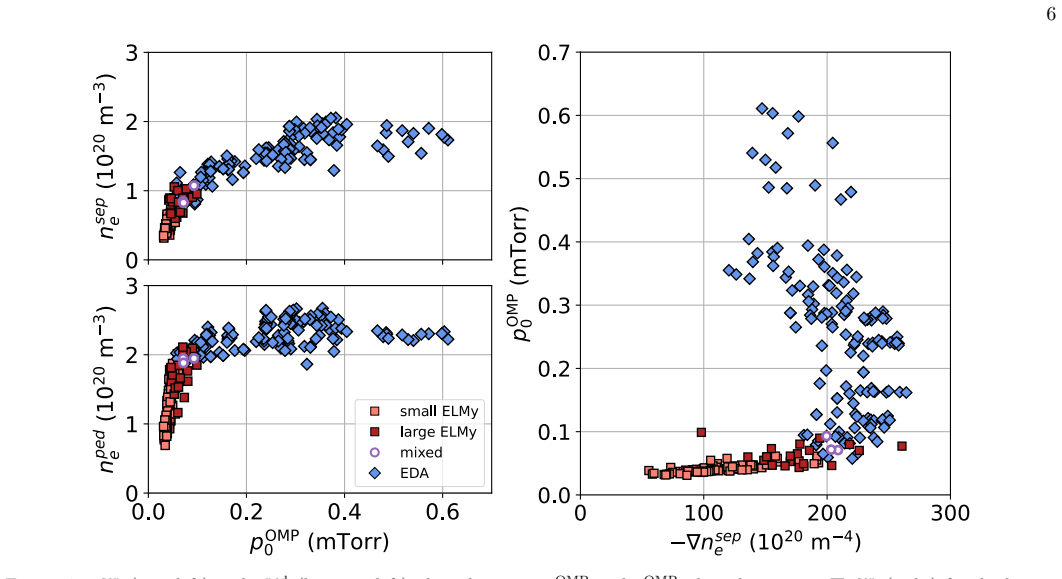
The central claim is that the pedestal density in the high-density EDA H-mode is set by RBM-driven particle transport, not by neutral fueling. Experimentally, n_ped rises with neutral pressure in ELMy H-modes but saturates and becomes insensitive to the neutral source in EDAs, even as n_sep continues to grow. Fluctuation spectra show the quasi-coherent mode (QCM) strengthening across the transition, then saturating and weakening at the highest densities, while broadband fluctuation levels keep rising. The paper adds an RBM diffusivity D_RBM (either C_RBM α_t^a or C_k/(k_RBM^2 qhat_cyl)) to the pedestal transport sum and shows it reproduces EDA pedestals up to 3×10^20 m^-3. EPED scans at n_se
What carries the argument
The load-bearing object is the RBM particle-diffusion coefficient D_RBM added to the pedestal transport sum D_ped = D_neo + D_KBM + D_TG + D_RBM. Two forms are tested: D_RBM = C_RBM α_t^a with a≈1.2, and D_RBM = C_k/(k_RBM^2 qhat_cyl), where α_t is a collisionality-like turbulence drive parameter, k_RBM is the characteristic resistive-ballooning wavenumber from the two-fluid model, and qhat_cyl is the cylindrical safety factor. This term provides the extra outward particle flux that clamps the density gradient at high density; the neutral boundary is supplied by a kinetic neutral simulation mapping the measured wall neutral pressure to the separatrix neutral density.
Load-bearing premise
The need for the extra RBM transport channel rests on the neutral boundary mapping from the kinetic neutral simulation, n_sep0[10^15 m^-3] = 38.5 p_OMP0[mTorr] with the assumption T_e=T_i; if the neutral source is overestimated, D_RBM may be compensating for a boundary-condition error rather than representing a real transport channel.
What would settle it
Measure the actual neutral ionization source in the pedestal (for example, with Ly-alpha emission or a calibrated neutral-density diagnostic) across the ELMy-to-EDA transition and compare it with the model's assumed source. If the separatrix neutral density is lower than the mapped value by enough to remove the overprediction, then D_RBM as added is an artifact; if the neutral source matches, the RBM transport channel is required. A gas-puff modulation experiment that varies neutral pressure while holding the separatrix density fixed could separate source effects from transport effects directl
If this is right
- The density-pedestal model, extended with D_RBM, is validated for ELMy H-modes up to 2×10^20 m^-3 and for EDA H-modes up to 3×10^20 m^-3, extending the model's range to non-ELMing, high-density regimes.
- In EDA H-modes, n_ped is essentially fixed by turbulent transport, so gas fueling cannot be used to raise pedestal density; density must be controlled through edge transport or plasma shape.
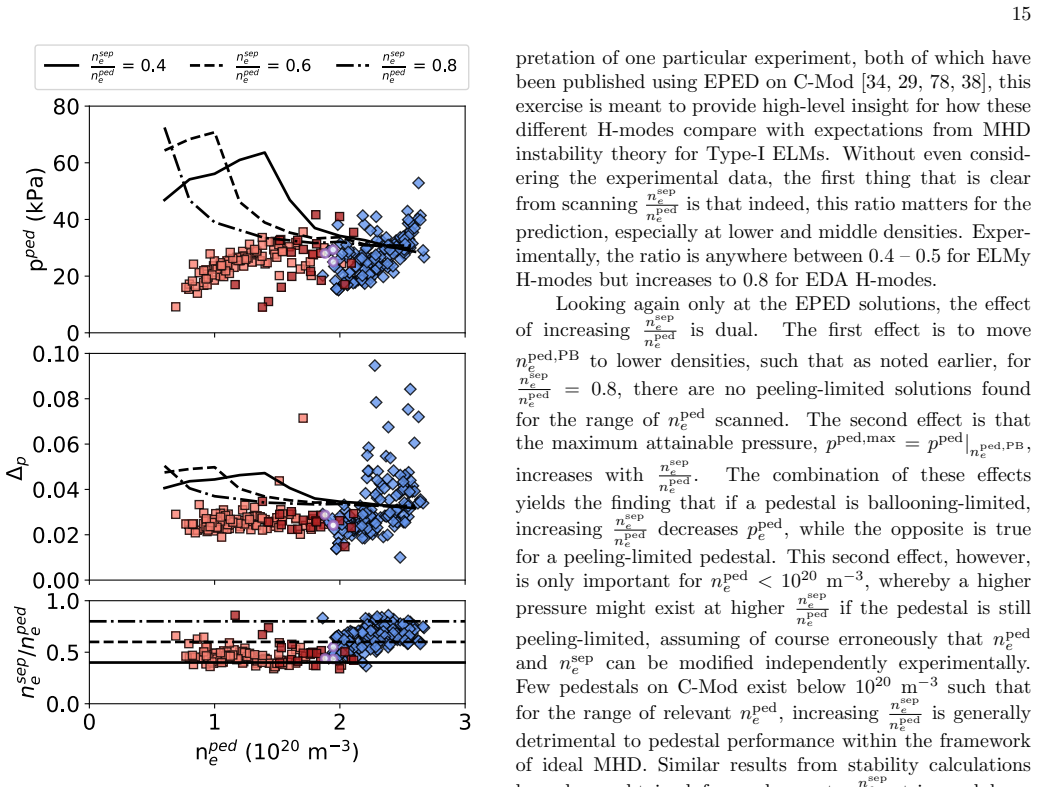
- EPED scans show that rising n_sep/n_ped shifts the peeling-ballooning transition to lower n_ped, so a high separatrix-to-pedestal ratio (typical of EDA) makes pedestal pressure ballooning-limited at lower density.
- For SPARC, including RBM transport lowers n_ped by about 20% and weakens the density gradient near the separatrix in the high-density EDA/QCE-like scenario, changing the expected edge profile for power handling and ELM avoidance.
- The observed saturation of the QCM amplitude at high n_ped, while broadband fluctuations keep rising, points to additional turbulence beyond the QCM contributing to transport near the density limit.
Where Pith is reading between the lines
- If the α_t/k_RBM^2 q scaling for D_RBM is universal, pedestal models for other high-density, ELM-free regimes (for example, the quasi-continuous exhaust regime on other tokamaks) may need the same term; this is testable with existing databases.
- The neutral-boundary uncertainty could be reduced by comparing the kinetic neutral simulation's mapping to direct Ly-alpha measurements of the ionization source; such a test would either strengthen or remove the case for a separate RBM transport channel.
- The prediction that n_ped approaches n_sep at high density in SPARC suggests that pedestal performance and divertor protection become coupled through the same RBM transport; if true, optimizing the separatrix density may be the shared lever for both.
- The weakening of the QCM just before the density limit hints that the RBM channel may replace, rather than merely supplement, the kinetic ballooning mode; a fluid turbulence simulation resolving both instabilities could identify which one is active.
Editorial analysis
A structured set of objections, weighed in public.
Referee Report
Summary. This paper analyzes a set of Alcator C-Mod discharges spanning ELMy and EDA H-modes, using high-resolution Thomson scattering profiles and PCI fluctuation measurements. The authors show that the pedestal density is insensitive to neutral fueling in the EDA regime, while it is fueling-sensitive in the ELMy regime. They validate the Saarelma-Connor pedestal density prediction model on this dataset and find that the model overpredicts the EDA pedestal density at high density. To correct this, they add an ad hoc resistive-ballooning-mode (RBM) particle transport channel, D_RBM, with two alternative forms scaling with α_t and with 1/(k_RBM^2 q_cyl), and report improved agreement up to n_ped = 3×10^20 m^-3. They also perform EPED scans at different n_sep/n_ped ratios, compare to experiment, and make initial SPARC pedestal density predictions for an ELMy and an EDA/QCE-like scenario, finding that D_RBM lowers the predicted SPARC pedestal density by about 20%.
Significance. If the central claim holds, this paper would extend the validated range of a predictive pedestal density model into high-density, ELM-free regimes relevant to ITER and SPARC, and would identify RBM-driven particle transport as the mechanism setting the pedestal density in EDA/QCE H-modes. The manuscript has several concrete strengths: it uses a well-characterized C-Mod dataset with two independent Thomson-scattering fitting approaches; it tracks the QCM amplitude systematically across regimes; it validates the Saarelma-Connor model on a new device and regime; and it is transparent about the model's free parameters and limitations. The EPED scans at fixed n_sep/n_ped are a useful sensitivity study. However, the evidence for the new D_RBM channel is not yet independent of the neutral-boundary model used to infer the separatrix neutral density, and several transport coefficients are hand-tuned. As a result, the main claim is plausible but not fully established.
major comments (4)
- [4.2 / Appendix A / Eqs. (12)-(14)] The conclusion that an RBM-driven transport channel is required in EDA H-modes is load-bearing and rests on the KN1D boundary mapping n_sep0[10^15 m^-3] = 38.5 p_OMP0[mTorr]. The paper itself states 'Two possibilities exist – either the neutral source is overestimated or the plasma transport is underestimated.' The present analysis does not resolve this ambiguity: the mapping is fit to moving-average profiles from the same dataset, assumes T_e=T_i (flagged in Appendix A), uses a linear fit in Fig. A3 despite visible saturation at high p_OMP0, and applies a limiter-shadow density that may overestimate particle content. If n_sep0 is overestimated for EDA points, the standard model may already match the high-density data. Please provide sensitivity tests (e.g., T_i/T_e variation, limiter density variation, alternative neutral model) or independent neutral-density constraints to show D_RBM i
- [4.1, Eq. (9) and Fig. 9] The improved transport settings use C_KBM=0.01 and α_crit=3, whereas α_crit=2 was found suitable for other devices. The motivation for α_crit=3 from an average separatrix α_c=2.6 is suggestive but not a derivation; α_crit is a free parameter for the KBM onset inside the pedestal. Fig. 14 shows that lowering α_crit to 2 changes SPARC n_ped by roughly 15%, so the model is sensitive. Please report a systematic parameter scan (C_KBM, α_crit, (D/χ)_TG) with a quantitative goodness-of-fit metric and uncertainty estimates; otherwise the claimed validation is vulnerable to overfitting.
- [3.1 / Fig. 6 and Fig. 10] The fluctuation data do not currently corroborate the D_RBM term where it matters most. The QCM amplitude B saturates and weakens for n_ped > 2.5×10^20 m^-3 (Fig. 6, right), yet D_RBM is largest at the highest n_ped. The background amplitude A continues to grow, but A is not directly linked to the radial particle transport coefficient D_RBM. Please either connect the fluctuation measurements quantitatively to the proposed transport channel (e.g., through a mixing-length estimate) or temper the claim that the RBM channel is independently supported by the PCI data.
- [6, Fig. 16] The SPARC high-density predictions use very crude inputs—T_EDA = 0.5 T_PRD, n_EDA = 1.5 n_PRD, and ad hoc width adjustments—and the result is highly sensitive to the choice of n_sep0 and whether D_RBM is included (n_ped ranges from 5.1 to 8.8×10^20 m^-3 across the explored settings). The statement that the predictions are 'consistent with assumptions used in previous EPED modeling' should be qualified with these sensitivities; as it stands, the SPARC section is illustrative rather than predictive.
minor comments (4)
- [Fig. A3] The linear fit n_sep0 = 38.5 p_OMP0 appears to be strongly influenced by the highest-pressure point, and the text notes a possible saturation. Show residuals and fit uncertainty, or use a saturating form and justify the linear choice.
- [Eq. (14)] Define all symbols (k_RBM, q_cyl) and give units. Currently C_k_RBM is given only numerically, and the physical dimensions of the expression are not stated.
- [Section 2.2] The transition at p_OMP0 ≈ 0.1 mTorr is central to the regime classification. Provide an uncertainty estimate for the pressure measurement and for how the transition value is determined.
- [Section 4.2] The sentence 'C_RBM = 0.039, taken empirically from the dataset in [33]' is ambiguous—was the coefficient calibrated on the same run day or on an independent dataset? Please clarify to avoid circularity concerns.
Circularity Check
EDA 'prediction' is substantially in-sample: model settings, KN1D boundary, and D_RBM constants all come from the same C-Mod dataset/self-cited analyses.
specific steps
-
fitted input called prediction
[Section 4.1, Eqs. (7)-(10), Fig. 9 (left)]
"Lowering (D/χ)_TG to 0.05, adding weak KBM-driven transport with C_KBM = 0.01, and using a slightly higher value of α_crit = 3 than the value of α_crit = 2 found most suitable for other devices gives the results shown with turquoise squares."
The three parameters altered here are 'user-supplied' free parameters of the Saarelma-Connor model. They are changed until the prediction matches the C-Mod dataset, and the same settings are then called 'validation' and used for the EDA predictions. Thus the agreement in Fig. 9/10 is not an out-of-sample test of the model: the model's transport coefficients were selected on the same n_ped data being predicted.
-
fitted input called prediction
[Section 4.2 / Appendix A (n_sep0 = 38.5 p_OMP0)]
"This is done by running 10 KN1D simulations using characteristic plasma profiles at 10 different logarithmically-spaced values of p OMP 0 that span this dataset. The resulting fit is given by n sep 0 [10^15 m^-3] = 38.5 p OMP 0 [mTorr]."
The characteristic plasma profiles used to build the KN1D boundary are moving averages of the same experimental profiles (including pedestal-top values) that the model is later compared against. The boundary condition is therefore derived from the very data whose n_ped the model claims to predict. Because the paper itself states 'Two possibilities exist – either the neutral source is overestimated or the plasma transport is underestimated', agreement obtained with this boundary cannot uniquely establish the missing transport.
-
self citation load bearing
[Section 4.2, Eqs. (13)-(14), Fig. 10 (right)]
"Solid red squares use the same expression from Equation 13, with C αt RBM = 0.039, taken empirically from the dataset in [33]. Open red squares in the right plot use the expression from Equation 14, with C k RBM = 0.086, taken from the dataset in [8]."
The central EDA result is the addition of D_RBM, but its two forms are not derived here: the constants are empirical fits from the authors' prior C-Mod studies, and [8] is the same run-day/dataset whose classification this paper follows. The 'good agreement' with EDA n_ped then partly re-imports the transport already contained in those fitted constants. Because [65] (the source of the k_RBM/q_cyl scaling) is a submitted self-citation, the loop is not externally checkable.
full rationale
Three in-sample/self-cited inputs support the paper's central EDA claim: (1) user-supplied transport parameters are adjusted on the C-Mod dataset before 'validation'; (2) the KN1D n_sep0 boundary is constructed from moving averages of the same experimental profiles; (3) D_RBM constants are empirical fits from earlier C-Mod papers by the same authors, including [8] on the same run day. The paper explicitly concedes that an overestimated neutral source is an alternative to missing transport, so the RBM channel is underdetermined. This is not a purely definitional circularity — the Saarelma-Connor model was developed on JET and the neutral/plasma integration is nontrivial, and the ELMy validation with fixed n_sep0=1e15 retains independent content. But the 'good agreement' up to 3e20 for EDA is substantially a calibrated reproduction, not a first-principles prediction. EPED comparisons and SPARC projections are not part of this circular loop.
Axiom & Free-Parameter Ledger
free parameters (7)
- (D/χ)_TG =
0.05 or 0.5
- C_KBM =
0.01
- α_crit =
3
- C_RBM (α_t form) =
0.039
- C_k_RBM =
0.086
- n_sep0 mapping coefficient =
38.5 (10^15 m^-3 per mTorr)
- EPED width-height constant C =
0.076
axioms (9)
- domain assumption Reduced two-fluid neutral transport model (Eqs. 4–6) accurately captures neutral penetration in the pedestal.
- domain assumption Pedestal particle transport is the sum of neoclassical, KBM, TG, and RBM channels with the given functional forms.
- domain assumption EPED width-height scaling Δp = C sqrt(β_p^ped) with C=0.076 describes KBM-limited pedestals in these discharges.
- domain assumption Peeling-ballooning stability computed with ELITE determines the pedestal height/width for Type-I ELMy H-modes.
- domain assumption Two-point model with Spitzer-Härm heat transport locates the separatrix and provides T_sep.
- domain assumption T_e = T_i is assumed in KN1D simulations and for total pressure estimates.
- domain assumption The PCI spectral fit function H(f)=P(f)+N(f) (Eqs. 1–3) adequately separates QCM amplitude B from background fluctuations.
- domain assumption p_OMP0 is a valid proxy for volumetric ionization rate S_ion and cross-field particle flux Γ⊥.
- ad hoc to paper For the SPARC high-density scenario, crude profile scalings (T_EDA = ½ T_PRD, n_EDA = 1.5 n_PRD, width adjustments) are adequate inputs.
read the original abstract
The transition between the ELMy H-mode and the EDA H-mode is studied on Alcator C-Mod using an experimental database and predictive pedestal models. High-resolution Thomson scattering measurements are used to compare the pedestal density, $n_{e}^\mathrm{ped}$, and the separatrix density, $n_{e}^\mathrm{sep}$ with main chamber neutral measurements. $n_{e}^\mathrm{ped}$ is sensitive to neutral sources only in the ELMy H-mode regime and not in the EDA H-mode regime. Density fluctuation spectra reveal that quasi-coherent structures become stronger at higher densities and more coherent in the EDA relative to the inter-ELM phases of ELMy H-modes, before weakening again at the highest values of $n_{e}^\mathrm{ped}$. The Saarelma-Connor pedestal density prediction model is validated for ELMy H-modes up to $n_{e}^\mathrm{ped} = 2.0 \times 10^{20}$ m$^{-3}$. An additional transport channel driven by resistive ballooning modes (RBM), $D_\mathrm{RBM}$, scaling directly with $\alpha_{t}$ and inversely with $k_\mathrm{RBM}^{2}\hat{q}_\mathrm{cyl}$ is shown to improve the prediction for EDA H-modes, finding good model agreement up to $n_{e}^\mathrm{ped} = 3.0 \times 10^{20}$ m$^{-3}$. EPED scans in $n_{e}^\mathrm{ped}$ are then performed at three values of $n_{e}^\mathrm{sep}/n_{e}^\mathrm{ped}$. Increasing this ratio moves the peeling-ballooning branch transition to lower $n_{e}^\mathrm{ped}$, increasing $p^\mathrm{ped}$ in the peeling branch and decreasing it in the ballooning branch. Agreement is found for large ELM H-modes. SPARC pedestal density predictions for an ELMy and an EDA/QCE-like H-mode are performed and found consistent with assumptions used in previous EPED modeling. Inclusion of $D_\mathrm{RBM}$ significantly weakens the density gradient near the separatrix, lowering $n_{e}^\mathrm{ped}$ by approximately 20%.
Figures






Reference graph
Works this paper leans on
-
[1]
The H-Mode of ASDEX.Nuclear Fusion, 29(11):1959–2040, November 1989
ASDEX Team. The H-Mode of ASDEX.Nuclear Fusion, 29(11):1959–2040, November 1989
1959
-
[2]
Fenstermacher, L.R
M.E. Fenstermacher, L.R. Baylor, E. De La Luna, M.G. Dunne, G.T.A. Huijsmans, A. Kirk, F.M. Laggner, T.H. Osborne, C. Paz-Soldan, S. Saarelma, P.B. Snyder, E. Viezzer, M. Becoulet, K.H. Burrell, A. Cathey, X. Chen, M. Hoelzl, J.W. Hughes, R. Maingi, A.O. Nelson, H. Urano, E. Wolfrum, X.Q. Xu, A. Diallo, L. Frassinetti, S. Futatani, L. Gil, R. Groebner, T....
-
[3]
A. W. Leonard. Edge-localized-modes in tokamaks.Physics of Plasmas, 21(9):090501
-
[4]
T. Eich, B. Sieglin, A.J. Thornton, M. Faitsch, A. Kirk, A. Herrmann, and W. Suttrop. ELM divertor peak energy fluence scaling to ITER with data from JET, MAST and ASDEX upgrade.Nuclear Materials and Energy, 12:84–90, August 2017
2017
-
[5]
Leonard, A
A.W. Leonard, A. Herrmann, K. Itami, J. Lingertat, A. Loarte, T.H. Osborne, W. Suttrop, The Iter Divertor Modeling Database Expert Group, , and The Iter Divertor Physics Expert Group. The impact of ELMs on the ITER divertor. Journal of Nuclear Materials, 266-269:109–117, March 1999
1999
-
[6]
A. Q. Kuang, S. Ballinger, D. Brunner, J. Canik, A. J. Creely, T. Gray, M. Greenwald, J. W. Hughes, J. Irby, B. LaBombard, B. Lipschultz, J. D. Lore, M. L. Reinke, J. L. Terry, M. Umansky, D. G. Whyte, S. Wukitch, and the SPARC Team. Divertor heat flux challenge and mitigation in SPARC. Journal of Plasma Physics, 86(5):865860505, October 2020
2020
-
[7]
Viezzer, M.E
E. Viezzer, M.E. Austin, M. Bernert, K.H. Burrell, P. Cano- Megias, X. Chen, D.J. Cruz-Zabala, S. Coda, M. Faitsch, O. F´ evrier, L. Gil, C. Giroud, T. Happel, G.F. Harrer, A.E. Hubbard, J.W. Hughes, A. Kallenbach, B. Labit, A. Merle, H. Meyer, C. Paz-Soldan, P. Oyola, O. Sauter, M. Siccinio, D. Silvagni, and E.R. Solano. Prospects of core–edge 25 integra...
-
[8]
Miller, J.W
M.A. Miller, J.W. Hughes, T. Eich, G.R. Tynan, P. Manz, T. Body, D. Silvagni, O. Grover, A.E. Hubbard, A. Cavallaro, M. Wigram, A.Q. Kuang, S. Mordijck, B. LaBombard, J. Dunsmore, and D. Whyte. Determination of confinement regime boundaries via separatrix parameters on Alcator C-Mod based on a model for interchange-drift-Alfv´ en turbulence.Nuclear Fusion...
2025
-
[9]
Characterization of enhanced D high-confinement modes in Alcator C-Mod.Phys
M Greenwald, R Boivin, P Bonoli, R Budny, C Fiore, J Goetz, R Granetz, A Hubbard, I Hutchinson, J Irby, B LaBombard, Y Lin, B Lipschultz, E Marmar, A Mazurenko, D Mossessian, T Sunn Pedersen, C S Pitcher, M Porkolab, J Rice, W Rowan, J Snipes, G Schilling, Y Takase, J Terry, S Wolfe, J Weaver, B Welch, and S Wukitch. Characterization of enhanced D high-co...
1999
-
[10]
Greenwald, A
M. Greenwald, A. Bader, S. Baek, M. Bakhtiari, H. Barnard, W. Beck, W. Bergerson, I. Bespamyatnov, P. Bonoli, D. Brower, D. Brunner, W. Burke, J. Candy, M. Churchill, I. Cziegler, A. Diallo, A. Dominguez, B. Duval, E. Edlund, P. Ennever, D. Ernst, I. Faust, C. Fiore, T. Fredian, O. Garcia, C. Gao, J. Goetz, T. Golfinopoulos, R. Granetz, O. Grulke, Z. Hart...
2014
-
[11]
L. Gil, C. Silva, T. Happel, G. Birkenmeier, G.D. Conway, L. Guimarais, A. Kallenbach, T. P¨ utterich, J. Santos, P.A. Schneider, M. Schubert, E. Seliunin, A. Silva, J. Stober, U. Stroth, E. Trier, E. Wolfrum, ASDEX, and EUROfusion. Stationary ELM-free H-mode in ASDEX Upgrade.Nuclear Fusion, 60(5):054003, May 2020
2020
-
[12]
L. Gil, T. P¨ utterich, C. Silva, D. Hachmeister, G.D. Conway, P. David, M. Faitsch, R. Fischer, T. Happel, A. Kallenbach, J. Santos, A. Silva, J. Stober, U. Stroth, E. Viezzer, E. Wolfrum, the ASDEX Upgrade Team, and the EUROfusion Tokamak Exploitation Team. EDA H-mode in ASDEX Upgrade: scans of heating power, fueling, and plasma current.Nuclear Fusion, ...
2025
-
[13]
Macwan, K
T. Macwan, K. Barada, J. F. Parisi, R. J. Groebner, T. L. Rhodes, S. Banerjee, C. Chrystal, Q. Pratt, Z. Yan, H. Wang, L. Zeng, M. E. Austin, N. A. Crocker, and W. A. Peebles. ELM-free enhanced dαh-mode with near zero NBI torque injection in DIII-d tokamak.Physics of Plasmas, 31(12):122503
-
[14]
Lomas, Carlos Silva, Michael Faitsch, Fulvio Auriemma, Rui Coelho, Mike Dunne, Daniel Hachmeister, David Keeling, Benoit Labit, Olivier Sauter, Emilia R
Luis Gil, Ernesto Lerche, Peter J. Lomas, Carlos Silva, Michael Faitsch, Fulvio Auriemma, Rui Coelho, Mike Dunne, Daniel Hachmeister, David Keeling, Benoit Labit, Olivier Sauter, Emilia R. Solano, and Eleonora Viezzer. A high-confinement, no-ELM regime in JET: the EDA H-mode. InAPS Division of Plasma Physics Meeting Abstracts, volume 2025 ofAPS Meeting Ab...
2025
-
[15]
Faitsch, T
M. Faitsch, T. Eich, G.F. Harrer, E. Wolfrum, D. Brida, P. David, M. Griener, and U. Stroth. Broadening of the power fall-off length in a high density, high confinement H- mode regime in ASDEX Upgrade.Nuclear Materials and Energy, 26:100890, March 2021
2021
-
[16]
Quasi-continuous exhaust operational space.Nuclear Fusion, October 2024
Mike G Dunne, Michael Faitsch, Lidija Radovanovi´ c, and Elisabeth Wolfrum. Quasi-continuous exhaust operational space.Nuclear Fusion, October 2024
2024
-
[17]
A. J. Creely, M. J. Greenwald, S. B. Ballinger, D. Brunner, J. Canik, J. Doody, T. F¨ ul¨ op, D. T. Garnier, R. Granetz, T. K. Gray, C. Holland, N. T. Howard, J. W. Hughes, J. H. Irby, V. A. Izzo, G. J. Kramer, A. Q. Kuang, B. LaBombard, Y. Lin, B. Lipschultz, N. C. Logan, J. D. Lore, E. S. Marmar, K. Montes, R. T. Mumgaard, C. Paz- Soldan, C. Rea, M. L. ...
2020
-
[18]
Faitsch, T
M. Faitsch, T. Eich, G.F. Harrer, E. Wolfrum, D. Brida, P. David, M. Dunne, L. Gil, B. Labit, and U. Stroth. Analysis and expansion of the quasi-continuous exhaust (QCE) regime in ASDEX Upgrade.Nuclear Fusion, 63(7):076013, July 2023
2023
-
[19]
Nami Li, X.Q. Xu, B.S. Victor, Z.Y. Li, and H.Q. Wang. Exploring the transition from continuous turbulence fluctuations to bursting ELMs in high SOL density regimes. Nuclear Fusion, 65(7):076023, July 2025
2025
-
[20]
Saarelma, J.W
S. Saarelma, J.W. Connor, P. Bilkova, P. Bohm, A.R. Field, L. Frassinetti, R. Fridstrom, and A. Kirk. Testing a prediction model for the H-mode density pedestal against JET-IL W pedestals.Nuclear Fusion, 63(5):052002, May 2023
2023
-
[21]
P. B. Snyder, R. J. Groebner, A. W. Leonard, T. H. Osborne, and H. R. Wilson. Development and validation of a predictive model for the pedestal height.Physics of Plasmas, 16(5):056118, May 2009
2009
-
[22]
P. B. Snyder, T. H. Osborne, K. H. Burrell, R. J. Groebner, A. W. Leonard, R. Nazikian, D. M. Orlov, O. Schmitz, M. R. Wade, and H. R. Wilson. The EPED pedestal model and edge localized mode-suppressed regimes: Studies of quiescent H-mode and development of a model for edge localized mode suppression via resonant magnetic perturbations.Physics of Plasmas,...
2012
-
[23]
Saarelma, J.W
S. Saarelma, J.W. Connor, P. B ´ ılkov´ a, P. Bohm, C. Bowman, A.R. Field, L. Frassinetti, R. Friedstr¨ om, S. Henderson, K. Imada, A. Kirk, O.J. Kwon, T. Luda, R. Sarwar, R. Scannell, S.F. Smith, the ASDEX Upgrade Team, MAST- U team, STEP team, JET Contributors, and the Eurofusion Tokamak Exploitation Team. Density pedestal prediction model for tokamak p...
2024
-
[24]
The separatrix operational space of ASDEX Upgrade due to interchange-drift-Alfve´n turbulence.Nucl
T Eich and P Manz. The separatrix operational space of ASDEX Upgrade due to interchange-drift-Alfve´n turbulence.Nucl. Fusion, 2021
2021
-
[25]
Rodriguez-Fernandez, A.J
P. Rodriguez-Fernandez, A.J. Creely, M.J. Greenwald, D. Brun- ner, S.B. Ballinger, C.P. Chrobak, D.T. Garnier, R. Granetz, Z.S. Hartwig, N.T. Howard, J.W. Hughes, J.H. Irby, V.A. Izzo, A.Q. Kuang, Y. Lin, E.S. Marmar, R.T. Mumgaard, C. Rea, M.L. Reinke, V. Riccardo, J.E. Rice, S.D. Scott, B.N. Sorbom, J.A. Stillerman, R. Sweeney, R.A. Tinguely, D.G. Whyte...
2022
-
[26]
The SPARC Primary Reference Discharge defined by cfsPOPCON.arXiv preprint arXiv:2311.05016, 2023
T Body, C Hasse, and A Creely. The SPARC Primary Reference Discharge defined by cfsPOPCON.arXiv preprint arXiv:2311.05016, 2023
Pith/arXiv arXiv 2023
-
[27]
Diallo, J.W
A. Diallo, J.W. Hughes, M. Greenwald, B. LaBombard, E. Davis, S-G. Baek, C. Theiler, P. Snyder, J. Canik, J. Walk, T. Golfinopoulos, J. Terry, M. Churchill, A. Hubbard, M. Porkolab, L. Delgado-Aparicio, M.L. Reinke, A. White, and Alcator C-Mod Team. Observation of Edge Instability Limiting the Pedestal Growth in Tokamak Plasmas.Physical Review Letters, 11...
2014
-
[28]
Diallo, R
A. Diallo, R. J. Groebner, T. L. Rhodes, D. J. Battaglia, D. R. Smith, T. H. Osborne, J. M. Canik, W. Guttenfelder, and P. B. Snyder. Correlations between quasi-coherent fluctuations and the pedestal evolution during the inter-edge localized modes phase on DIII-Da).Physics of Plasmas, 22(5):056111, May 2015
2015
-
[29]
Hughes, P.B
J.W. Hughes, P.B. Snyder, J.R. Walk, E.M. Davis, A. Diallo, 26 B. LaBombard, S.G. Baek, R.M. Churchill, M. Greenwald, R.J. Groebner, A.E. Hubbard, B. Lipschultz, E.S. Marmar, T. Osborne, M.L. Reinke, J.E. Rice, C. Theiler, J. Terry, A.E. White, D.G. Whyte, S. Wolfe, and X.Q. Xu. Pedestal structure and stability in H-mode and I-mode: a comparative study on...
2013
-
[30]
J. W. Hughes, D. A. Mossessian, A. E. Hubbard, B. LaBombard, and E. S. Marmar. Observations and empirical scalings of the high-confinement mode pedestal on Alcator C-Mod.Physics of Plasmas, 9(7):3019–3030, July 2002
2002
-
[31]
J. W. Hughes, D. A. Mossessian, A. E. Hubbard, E. S. Marmar, D. Johnson, and D. Simon. High-resolution edge Thomson scattering measurements on the Alcator C-Mod tokamak. Review of Scientific Instruments, 72(1):1107–1110, January 2001
2001
-
[32]
J. W. Hughes, D. Mossessian, K. Zhurovich, M. DeMaria, K. Jensen, and A. Hubbard. Thomson scattering upgrades on alcator c-mod.Review of Scientific Instruments, 74(3):1667– 1670
-
[33]
Miller, J.W
M.A. Miller, J.W. Hughes, A.M. Rosenthal, S. Mordijck, R. Reksoatmodjo, M. Wigram, J. Dunsmore, F. Sciortino, R.S. Wilcox, and T. Odstrˇ cil. Enhanced pedestal transport driven by edge collisionality on Alcator C-Mod and its role in regulating H-mode pedestal gradients.Nuclear Fusion, 65(2):026029, February 2025. Publisher: IOP Publishing
2025
-
[34]
Walk, P.B
J.R. Walk, P.B. Snyder, J.W. Hughes, J.L. Terry, A.E. Hubbard, and P.E. Phillips. Characterization of the pedestal in Alcator C-Mod ELMing H-modes and comparison with the EPED model.Nuclear Fusion, 52(6):063011, June 2012
2012
-
[35]
Edge profile stiffness and insensitivity of the density pedestal to neutral fuelling in Alcator C-Mod edge transport barriers.Nuclear Fusion, 47(8):1057–1063, August 2007
J.W Hughes, B LaBombard, J Terry, A Hubbard, and B Lipschultz. Edge profile stiffness and insensitivity of the density pedestal to neutral fuelling in Alcator C-Mod edge transport barriers.Nuclear Fusion, 47(8):1057–1063, August 2007
2007
-
[36]
Turbulence driven widening of the near-SOL power width in ASDEX Upgrade H-Mode discharges.Nucl
T Eich, P Manz, R J Goldston, P Hennequin, P David, M Faitsch, B Kurzan, B Sieglin, and E Wolfrum. Turbulence driven widening of the near-SOL power width in ASDEX Upgrade H-Mode discharges.Nucl. Fusion, 2020
2020
-
[37]
Terry, I
J.L. Terry, I. Cziegler, A.E. Hubbard, J.A. Snipes, J.W. Hughes, M.J. Greenwald, B. LaBombard, Y. Lin, P. Phillips, and S. Wukitch. The dynamics and structure of edge-localized- modes in alcator c-mod.Journal of Nuclear Materials, 363- 365:994–999, 2007. Plasma-Surface Interactions-17
2007
-
[38]
Snyder, J.W
P.B. Snyder, J.W. Hughes, T.H. Osborne, C. Paz-Soldan, W.M. Solomon, M. Knolker, D. Eldon, T. Evans, T. Golfinopoulos, B.A. Grierson, R.J. Groebner, A.E. Hubbard, E. Kolemen, B. LaBombard, F.M. Laggner, O. Meneghini, S. Mordijck, T. Petrie, S. Scott, H.Q. Wang, H.R. Wilson, and Y.B. Zhu. High fusion performance in Super H-mode experiments on Alcator C-Mod...
2019
-
[39]
Wang, H.Q
Y.F. Wang, H.Q. Wang, G.S. Xu, G.Z. Jia, F. Turco, C.C. Petty, J.L. Chen, N. Yan, Q.Q. Yang, L. Wang, R. Chen, G.H. Hu, T.H. Osborne, P.B. Snyder, A.M. Garofalo, X.Z. Gong, J.P. Qian, G.Q. Li, H.Y. Guo, and B.N. Wan. Grassy ELM regime at low pedestal collisionality in high-power tokamak plasma. Nuclear Fusion, 61(1):016032
-
[40]
PhD thesis, Massachusetts Institute of Technology, 2025
Miller, M.A.Understanding the Mechanisms that Determine the Edge Electron Density Profile in Tokamaks. PhD thesis, Massachusetts Institute of Technology, 2025
2025
-
[41]
Silvagni, O
D. Silvagni, O. Grover, A. Stagni, J.W. Hughes, M.A. Miller, B. Lomanowski, G. Ciraolo, M. Dunne, T. Eich, L. Frassinetti, C. Giroud, I. Jepu, A. Kallenbach, A. Kirjasuo, A. Kuang, T. Luda, C. Perez von Thun, T. P¨ utterich, H.J. Sun, and H. Zohm. The separatrix electron density in jet, asdex upgrade and alcator c-mod h-mode plasmas: A common evaluation p...
2025
-
[42]
Assessment of ITER divertor performance during early operation phases
Jae-Sun Park, Xavier Bonnin, and Richard Pitts. Assessment of ITER divertor performance during early operation phases. Nuclear Fusion, 61(1):016021, January 2021
2021
-
[43]
The role of the density profile in the ASDEX-Upgrade pedestal structure.Plasma Physics and Controlled Fusion, 59(1):014017, January 2017
M G Dunne, S Potzel, F Reimold, M Wischmeier, E Wolfrum, L Frassinetti, M Beurskens, P Bilkova, M Cavedon, R Fischer, B Kurzan, F M Laggner, R M McDermott, G Tardini, E Trier, E Viezzer, M Willensdorfer, The EUROfusion MST1 Team, and The ASDEX-Upgrade Team. The role of the density profile in the ASDEX-Upgrade pedestal structure.Plasma Physics and Controll...
2017
-
[44]
Y. Lin, J. Irby, P. Stek, I. Hutchinson, J. Snipes, R. Nazikian, and M. McCarthy. Upgrade of reflectometry profile and fluctuation measurements in Alcator C-Mod.Review of Scientific Instruments, 70(1):1078–1081, January 1999
1999
-
[45]
Mazurenko, M
A. Mazurenko, M. Porkolab, D. Mossessian, J. A. Snipes, X. Q. Xu, and W. M. Nevins. Experimental and Theoretical Study of Quasicoherent Fluctuations in Enhanced DαPlasmas in the Alcator C-Mod Tokamak.Physical Review Letters, 89(22):225004, November 2002
2002
-
[46]
Transport phenomena in the edge of Alcator C-Mod plasmas
J.L Terry, N.P Basse, I Cziegler, M Greenwald, O Grulke, B LaBombard, S.J Zweben, E.M Edlund, J.W Hughes, L Lin, Y Lin, M Porkolab, M Sampsell, B Veto, and S.J Wukitch. Transport phenomena in the edge of Alcator C-Mod plasmas. Nuclear Fusion, 45(11):1321–1327, November 2005
2005
-
[47]
A. E. Hubbard, R. L. Boivin, R. S. Granetz, M. Greenwald, J. W. Hughes, I. H. Hutchinson, J. Irby, B. LaBombard, Y. Lin, E. S. Marmar, A. Mazurenko, D. Mossessian, E. Nelson- Melby, M. Porkolab, J. A. Snipes, J. Terry, S. Wolfe, S. Wukitch, B. A. Carreras, V. Klein, and T. Sunn Pedersen. Pedestal profiles and fluctuations in c-mod enhanced d-alpha h-modes...
2033
-
[48]
D. A. Mossessian, R. J. Groebner, R. A. Moyer, T. H. Osborne, J. W. Hughes, M. Greenwald, A. Hubbard, and T. L. Rhodes. Edge dimensionless identity experiment on DIII-D and AlcatorC-Mod.Physics of Plasmas, 10(3):689–698, March 2003
2003
-
[49]
P. J. Sun, Y. D. Li, Y. Ren, X. D. Zhang, G. J. Wu, Y. M. Wang, T. H. Shi, B. Lyu, Y. M. Duan, J. Z. Zhang, F. D. Wang, H. Q. Liu, S. T. Mao, L. Q. Xu, Q. Li, P. Li, J. Bi, L. Q. Hu, and J. G. Li. Experimental study of quasi-coherent mode using EAST tangential CO2 laser collective scattering diagnostic in far-forward mode.Physics of Plasmas, 26(1):012304,...
2019
-
[50]
Kallenbach, M
A. Kallenbach, M. Bernert, P. David, M. G. Dunne, R. Dux, E. Fable, R. Fischer, L. Gil, T. G¨ orler, F. Janky, R. M. McDermott, W. Suttrop, G. Tardini, and M. Wischmeier, Asdex Upgrade Team. Developments towards an ELM-free pedestal radiative cooling scenario using noble gas seeding in ASDEX Upgrade.Nuclear Fusion, 61(1):016002, January 2021
2021
-
[51]
Kalis, G
J. Kalis, G. Birkenmeier, P. Manz, T. Eich, M. Griener, R. Goti, M. Cavedon, L. Gil, M. Faitsch, L. Radovanovic, D. Wendler, E. Wolfrum, U. Stroth, the ASDEX Upgrade Team, and the EUROfusion MST1 Team. Experimental characterization of the quasi-coherent mode in EDA H-Mode and QCE scenarios at ASDEX Upgrade.Nuclear Fusion, 64(1):016038, January 2024
2024
-
[52]
Diallo, J.W
A. Diallo, J.W. Hughes, S-G. Baek, B. LaBombard, J. Terry, I. Cziegler, A. Hubbard, E. Davis, J. Walk, L. Delgado- Aparicio, M.L. Reinke, C. Theiler, R.M. Churchill, E.M. Edlund, J. Canik, P. Snyder, M. Greenwald, A. White, and the Alcator C-Mod Team. Quasi-coherent fluctuations limiting the pedestal growth on Alcator C-Mod: experiment and modelling.Nucle...
2015
-
[53]
Golfinopoulos, B
T. Golfinopoulos, B. LaBombard, R. R. Parker, W. Burke, E. Davis, R. Granetz, M. Greenwald, J. Irby, R. Leccacorvi, E. Marmar, W. Parkin, M. Porkolab, J. Terry, R. Vieira, S. Wolfe, and Alcator C-Mod team. External excitation of a short-wavelength fluctuation in the Alcator C-Mod edge plasma and its relationship to the quasi-coherent mode. Physics of Plas...
2014
-
[54]
LaBombard, T
B. LaBombard, T. Golfinopoulos, J. L. Terry, D. Brunner, E. Davis, M. Greenwald, J. W. Hughes, and Alcator C-Mod Team. New insights on boundary plasma turbulence and the quasi-coherent mode in alcator c-mod using a mirror langmuir probe.Physics of Plasmas, 21(5):056108
-
[55]
Radial localization of edge modes in alcator c- mod pedestals using optical diagnostics.Plasma Physics and Controlled Fusion, 59(2):025016
C Theiler, J L Terry, E Edlund, I Cziegler, R M Churchill, J W Hughes, B LaBombard, T Golfinopoulos, and the Alcator C- 27 Mod Team. Radial localization of edge modes in alcator c- mod pedestals using optical diagnostics.Plasma Physics and Controlled Fusion, 59(2):025016
-
[56]
Golfinopoulos, B
T. Golfinopoulos, B. LaBombard, D. Brunner, J.L. Terry, S.G. Baek, P. Ennever, E. Edlund, W. Han, W.M. Burke, S.M. Wolfe, J.H. Irby, J.W. Hughes, E.W. Fitzgerald, R.S. Granetz, M.J. Greenwald, R. Leccacorvi, E.S. Marmar, S.Z. Pierson, M. Porkolab, R.F. Vieira, S.J. Wukitch, and The Alcator C- Mod Team. Edge transport and mode structure of a QCM- like fluc...
2018
-
[57]
PhD thesis, Massachusetts Institute of Technology, 2012
Dominguez, A.Study of density fluctuations and particle transport at the edge of I-mode plasmas. PhD thesis, Massachusetts Institute of Technology, 2012
2012
-
[58]
J. R. Myra, D. A. D’Ippolito, and X. Q. Xu. Drift wave instability near a magnetic separatrix.Physics of Plasmas, 9(5):1637–1645
-
[59]
Chen, X.Q
B. Chen, X.Q. Xu, T.Y. Xia, M. Porkolab, E. Edlund, B. LaBombard, J. Terry, J.W. Hughes, S.F. Mao, M.Y. Ye, and Y.X. Wan. Edge turbulence and divertor heat flux width simulations of Alcator C-Mod discharges using an electromagnetic two-fluid model.Nuclear Fusion, 57(11):116025, November 2017
2017
-
[60]
B. Chen, X. Q. Xu, T. Y. Xia, N. M. Li, M. Porkolab, E. Edlund, B. LaBombard, J. Terry, J. W. Hughes, M. Y. Ye, and Y. X. Wan. Progress towards modeling tokamak boundary plasma turbulence and understanding its role in setting divertor heat flux widths.Physics of Plasmas, 25(5):055905
-
[61]
Grenfell, L
G. Grenfell, L. Gil, P. Manz, C. Silva, J. Adamek, D. Brida, G.D. Conway, T. Eich, M. Faitsch, T. Happel, M. Spolaore, U. Stroth, B. Tal, B. Vanovac, E. Wolfrum, the ASDEX Upgrade Team, and the EUROfusion Tokamak Exploitation Team. The multi-faced nature of the quasicoherent mode in EDA H-mode.Nuclear Fusion, 64(10):104002, October 2024
2024
-
[62]
The quasi-coherent signature of enhanced D α H-mode in Alcator C-Mod.Plasma Physics and Controlled Fusion, 43(4):L23–L30, April 2001
J A Snipes, B LaBombard, M Greenwald, I H Hutchinson, J Irby, Y Lin, A Mazurenko, and M Porkolab. The quasi-coherent signature of enhanced D α H-mode in Alcator C-Mod.Plasma Physics and Controlled Fusion, 43(4):L23–L30, April 2001
2001
-
[63]
Zholobenko, F
W. Zholobenko, F. Jenko, K. Zhang, P. Ulbl, K. Eder, A. Stegmeir, C. Angioni, and P. Manz. Fast turbulence phase transition in a flux-driven global edge-SOL simulation of a tokamak plasma.Phys. Rev. Lett., pages –
-
[64]
J. T. Tang and N. C. Luhmann. Destabilization of hydromagnetic drift-alfv´ en waves in a finite pressure, collisional plasma.The Physics of Fluids, 19(12):1935–1946
1935
-
[65]
Miller, et al
M.A. Miller, et al. Experimental evidence for increased particle fluxes due to a change in transport at the separatrix near density limits on the Alcator C-Mod tokamak. Submitted, 2025
2025
-
[66]
Study on the turbulence transition in the pedestal of high-density H-mode plasmas in EAST
You Li, Ning Yan, Guosheng Xu, Ziqiang Zhou, Ganjun Zhang, Shaocheng Liu, Jilei Hou, Qingquan Yang, Kedong Li, Wenxiang Shi, Guangle Lin, Lin Yu, Yifeng Wang, Xiang Jian, Genfan Ding, Ran Chen, Yuqi Xu, Rui Ding, Jingsen Geng, Wenxue Fu, Qian Long, Panjun Tang, Yufei Zhang, Ang Ti, Haiqing Liu, Liang Wang, Qing Zang, Jinping Qian, and the EAST Team. Study...
2025
-
[67]
Saarelma, Jerry W
Jamie Dunsmore, S. Saarelma, Jerry W. Hughes, Marco Andres Miller, Julio J. Balbin-Arias, R. Gerr´ u, Laszlo Horvath, and Theresa M. Wilks. Validating a new model for the H-mode density pedestal on DIII-D. InAPS Division of Plasma Physics Meeting Abstracts, volume 2025 ofAPS Meeting Abstracts, October 2025
2025
-
[68]
Saarelma, L
S. Saarelma, L. Frassinetti, P. Bilkova, C. D. Challis, A. Chankin, R. Fridstr¨ om, L. Garzotti, L. Horvath, C. F. Maggi, and JET Contributors. Self-consistent pedestal prediction for JET-IL W in preparation of the DT campaign. Physics of Plasmas, 26(7):072501, July 2019
2019
-
[69]
R. J. Groebner, M. A. Mahdavi, A. W. Leonard, T. H. Osborne, G. D. Porter, R. J. Colchin, and L. W. Owen. The role of neutrals in high-mode (H-mode) pedestal formation.Physics of Plasmas, 9(5):2134–2140, May 2002
2002
-
[70]
M. A. Mahdavi, R. Maingi, R. J. Groebner, A. W. Leonard, T. H. Osborne, and G. Porter. Physics of pedestal density profile formation and its impact on H-mode density limit in burning plasmas.Physics of Plasmas, 10(10):3984–3991, October 2003
2003
-
[71]
M. S. Chu, C. Chu, G. Guest, J. Y. Hsu, and T. Ohkawa. Kinetic analysis of the localized magnetohydrodynamic ballooning mode.Physical Review Letters, 41(4):247–250
-
[72]
Miller, J.W
M.A. Miller, J.W. Hughes, S. Mordijck, M. Wigram, J. Dun- smore, R. Reksoatmodjo, and R.S. Wilcox. Particle control via cryopumping and its impact on the edge plasma profiles of Alcator C-Mod.Nuclear Materials and Energy, 42:101856, March 2025. Publisher: Elsevier BV
2025
-
[73]
KN1D: A 1-D Space, 2-D Velocity, Kinetic Transport Algorithm for Atomic and Molecular Hydrogen in an Ionizing Plasma
B LaBombard. KN1D: A 1-D Space, 2-D Velocity, Kinetic Transport Algorithm for Atomic and Molecular Hydrogen in an Ionizing Plasma
-
[74]
D. R. McCarthy, P. N. Guzdar, J. F. Drake, T. M. Antonsen, and A. B. Hassam. Stability of resistive and ideal ballooning modes in the Texas Experimental Tokamak and DIII-D. Physics of Fluids B: Plasma Physics, 4(7):1846–1854, July 1992
1992
-
[75]
How turbulence sets boundaries for tokamak operation.Reviews of Modern Plasma Physics, 9(1):5, January 2025
Peter Manz, Thomas Eich, and Ondrej Grover. How turbulence sets boundaries for tokamak operation.Reviews of Modern Plasma Physics, 9(1):5, January 2025
2025
-
[76]
B. N. Rogers, J. F. Drake, and A. Zeiler. Phase Space of Tokamak Edge Turbulence, the L - H Transition, and the Formation of the Edge Pedestal.Physical Review Letters, 81(20):4396–4399, November 1998
1998
-
[77]
Wilks, Jerry W
Jiyun Han, Theresa M. Wilks, Jerry W. Hughes, Jamie Dunsmore, Marco Andres Miller, Devon Battaglia, Leo T. Murphy, Cesar F. Clauser, Aaron Ho, J.M. Park, Jeremy A. Fleischhacker, Phil B. Snyder, and Tom H. Osborne. Validating a new model for the H-mode density pedestal on DIII-D. InAPS Division of Plasma Physics Meeting Abstracts, volume 2025 ofAPS Meetin...
2025
-
[78]
Hughes, P.B
J.W. Hughes, P.B. Snyder, M.L. Reinke, B. LaBombard, S. Mordijck, S. Scott, E. Tolman, S.G. Baek, T. Golfinopou- los, R.S. Granetz, M. Greenwald, A.E. Hubbard, E. Marmar, J.E. Rice, A.E. White, D.G. Whyte, T. Wilks, and S. Wolfe. Access to pedestal pressure relevant to burning plasmas on the high magnetic field tokamak Alcator C-Mod.Nuclear Fusion, 58(11)...
2018
-
[79]
Frassinetti, M.G
L. Frassinetti, M.G. Dunne, U. Sheikh, S. Saarelma, C.M. Roach, E. Stefanikova, C. Maggi, L. Horvath, S. Pamela, E. De La Luna, E. Wolfrum, M. Bernert, P. Blanchard, B. Labit, A. Merle, L. Guimarais, S. Coda, H. Meyer, J.C. Hillesheim, the ASDEX Upgrade Team, JET Contributors, the TCV Team, and the EUROfusion MST1 Team. Role of the pedestal position on th...
2019
-
[80]
Evidence for electromagnetic fluid drift turbulence controlling the edge plasma state in the Alcator C-Mod tokamak
B LaBombard, J.W Hughes, D Mossessian, M Greenwald, B Lipschultz, J.L Terry, and The Alcator C-Mod Team. Evidence for electromagnetic fluid drift turbulence controlling the edge plasma state in the Alcator C-Mod tokamak. Nuclear Fusion, 45(12):1658–1675, December 2005
2005
discussion (0)
Sign in with ORCID, Apple, or X to comment. Anyone can read and Pith papers without signing in.