A Semi-Analytical Loss Cone Theory for Tidal Disruption Event Rates Around Kerr Black Holes
Pith reviewed 2026-06-26 23:20 UTC · model grok-4.3
The pith
The global TDE rate around Kerr black holes stays nearly unchanged with spin even though retrograde stars are disrupted more readily.
A machine-rendered reading of the paper's core claim, the machinery that carries it, and where it could break.
Core claim
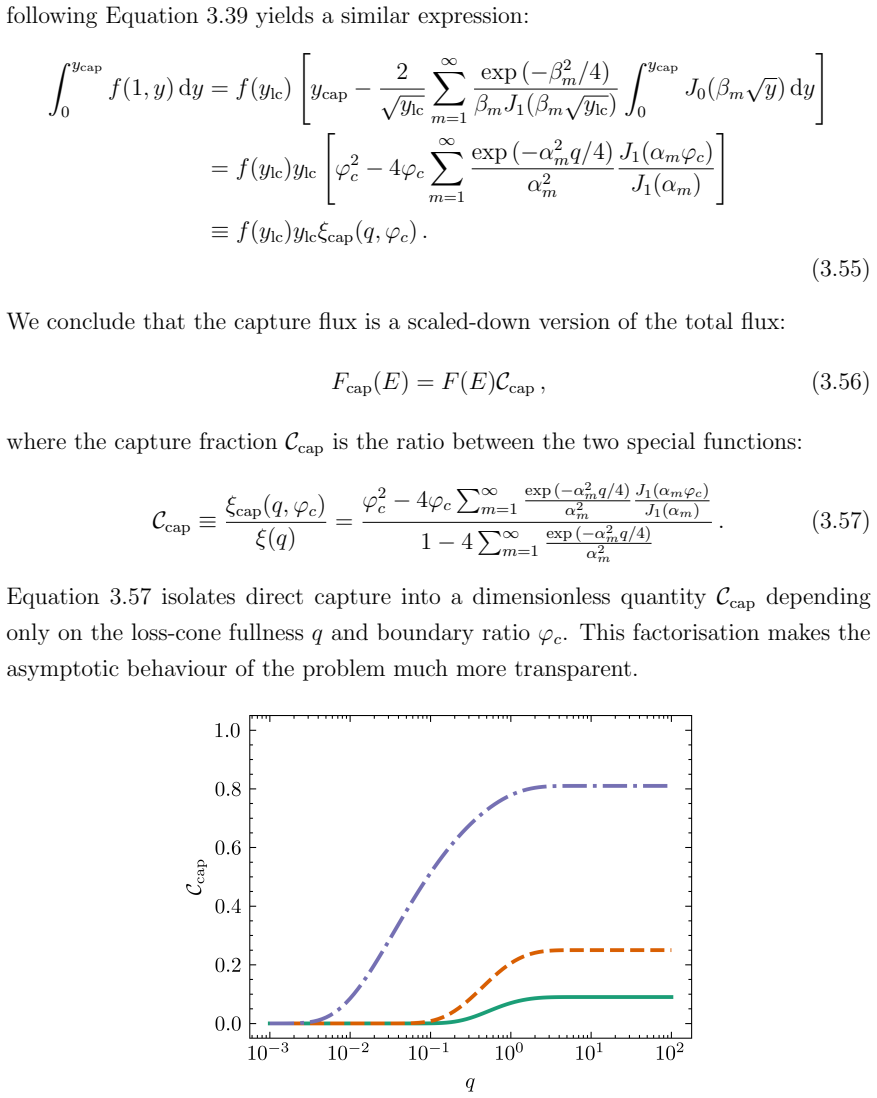
We develop the first semi-analytical framework that incorporates spin-dependent loss-cone boundaries into TDE rate theory. Using a novel tidal tensor formalism, we compute inclination-dependent thresholds for tidal disruption and direct capture by the event horizon. We then revisit the classical one-dimensional loss-cone problem with nested disruption and capture boundaries, deriving a closed-form capture fraction valid across all loss-cone regimes. Finally, we formulate a two-dimensional Fokker-Planck equation describing simultaneous diffusion in angular momentum magnitude and orientation. Through a perturbative treatment, we demonstrate that while the Kerr disruption boundary induces a fir
What carries the argument
The two-dimensional Fokker-Planck equation for diffusion in both angular-momentum magnitude and orientation, solved perturbatively with spin-dependent nested loss-cone boundaries.
If this is right
- TDE rate estimates can continue to use the standard Newtonian loss-cone formalism at leading order even when black-hole spin is present.
- Population-level studies need not treat black-hole spin as a dominant source of uncertainty in the total disruption rate.
- The orientation bias may still appear in the statistics of individual events, such as light-curve shapes or preferred orbital planes.
- The closed-form capture fraction gives an explicit spin- and inclination-dependent correction for stars swallowed whole rather than disrupted.
Where Pith is reading between the lines
- If the global rate is truly spin-insensitive, observed TDE statistics could constrain the stellar cusp properties without requiring knowledge of the underlying black-hole spin distribution.
- The first-order retrograde preference might produce a detectable signature in the average orbital inclinations of TDE hosts, accessible to future astrometric surveys.
- Extending the same perturbative machinery to resonant relaxation or to second-order spin terms would test whether the insensitivity persists at extreme spins or in dense nuclei.
Load-bearing premise
The supply of stars to the disruption zone is governed by Newtonian stellar dynamics while the angular-momentum threshold for disruption is set by general-relativistic tidal dynamics.
What would settle it
A side-by-side comparison of the closed-form capture fraction against the fraction measured in full general-relativistic orbit integrations of stars around a rapidly spinning Kerr black hole.
Figures

read the original abstract
A tidal disruption event (TDE) occurs when a star is scattered onto a near-radial orbit and is torn apart by a black hole (BH)'s tidal field. The angular momentum threshold for disruption is set by general relativistic tidal dynamics, while the supply of stars to the disruption zone is governed by Newtonian stellar dynamics. A spinning BH breaks the spherical symmetry of the disruption boundary, so a star's survival depends on both the magnitude and the orientation of its angular momentum. Existing treatments either assume a non-spinning BH or rely on numerical simulations of spinning BHs. We develop the first semi analytical framework that incorporates spin-dependent loss cone boundaries into TDE rate theory. Using a novel tidal tensor formalism, we compute inclination-dependent thresholds for tidal disruption and direct capture by the event horizon. We then revisit the classical one dimensional loss cone problem with nested disruption and capture boundaries, deriving a closed form capture fraction valid across all loss cone regimes. Finally, we formulate a two dimensional Fokker--Planck equation describing simultaneous diffusion in angular momentum magnitude and orientation. Through a perturbative treatment, we demonstrate that while the Kerr disruption boundary induces a first-order bias favouring the disruption of retrograde stars, the global TDE rate is remarkably insensitive to black hole spin. This approach offers a tractable route to including spin and orbital inclination in population-level TDE studies.
Editorial analysis
A structured set of objections, weighed in public.
Referee Report
Summary. The manuscript develops the first semi-analytical framework for TDE rates around Kerr black holes. It introduces a tidal tensor formalism to compute inclination-dependent thresholds for tidal disruption and direct capture. It derives a closed-form capture fraction for the one-dimensional loss-cone problem with nested boundaries and formulates a two-dimensional Fokker-Planck equation for simultaneous diffusion in angular-momentum magnitude and orientation. A perturbative treatment of this equation is used to show that the Kerr boundary induces a first-order bias favoring retrograde disruptions, yet the global TDE rate remains remarkably insensitive to black hole spin.
Significance. If the derivations hold, the work is significant as the first tractable semi-analytical route to incorporating spin and inclination into population-level TDE calculations, replacing non-spinning approximations or full numerical simulations. The closed-form capture fraction valid across loss-cone regimes and the perturbative treatment of the 2D Fokker-Planck equation are explicit strengths that enable efficient, parameter-free estimates.
major comments (1)
- [Abstract, paragraph 2] Abstract, paragraph 2: The central claim of spin-insensitive global rates rests on separating Newtonian two-body relaxation (supply of stars) from GR tidal thresholds (disruption/capture boundary). For a ≈ 0.9 the relevant angular-momentum thresholds occur at r ∼ few r_g, where frame-dragging and geodesic precession alter diffusion coefficients and couple inclination evolution to radial motion; this directly undermines the 2D Fokker-Planck construction and the perturbative bias calculation.
Simulated Author's Rebuttal
We thank the referee for their careful reading and constructive feedback. We address the single major comment below.
read point-by-point responses
-
Referee: The central claim of spin-insensitive global rates rests on separating Newtonian two-body relaxation (supply of stars) from GR tidal thresholds (disruption/capture boundary). For a ≈ 0.9 the relevant angular-momentum thresholds occur at r ∼ few r_g, where frame-dragging and geodesic precession alter diffusion coefficients and couple inclination evolution to radial motion; this directly undermines the 2D Fokker-Planck construction and the perturbative bias calculation.
Authors: We agree that a fully relativistic treatment of orbital diffusion would be desirable at high spins. However, the framework follows the standard separation in loss-cone theory: two-body relaxation is accumulated through distant encounters at r ≫ r_g where Newtonian coefficients apply, while GR enters only via the inner boundary conditions. The 2D Fokker-Planck equation therefore retains Newtonian diffusion terms, with the Kerr tidal tensor supplying the inclination-dependent thresholds. The perturbative bias calculation isolates the first-order effect of those boundaries. We have added an explicit statement of this regime of validity and a note on the approximation's limitations in the revised text. revision: partial
Circularity Check
Derivation chain is self-contained; no reductions to inputs by construction
full rationale
The paper starts from classical loss-cone theory, introduces a novel tidal-tensor formalism to obtain inclination-dependent GR disruption/capture boundaries, derives a closed-form capture fraction for the 1D nested-boundary problem, and then performs a perturbative analysis on the 2D Fokker-Planck equation in angular-momentum magnitude and orientation. None of these steps are shown to reduce by definition or by self-citation to the final rate; the spin-insensitivity result is obtained from the perturbative expansion rather than being presupposed. No fitted parameters are relabeled as predictions, no uniqueness theorems are imported from the authors' prior work, and no ansatz is smuggled via citation. The separation of Newtonian supply dynamics from GR thresholds is an explicit modeling choice whose validity is external to the derivation chain itself.
Axiom & Free-Parameter Ledger
axioms (2)
- domain assumption Supply of stars to the loss cone is governed by Newtonian stellar dynamics while disruption thresholds are set by general-relativistic tidal dynamics
- ad hoc to paper A perturbative treatment of the two-dimensional Fokker-Planck equation suffices to capture the leading spin-induced bias
Reference graph
Works this paper leans on
-
[1]
M.et al.The process of stellar tidal disruption by supermassive black holes: the first pericenter passage.Space Science Reviews217(2021)
Rossi, E. M.et al.The process of stellar tidal disruption by supermassive black holes: the first pericenter passage.Space Science Reviews217(2021)
2021
-
[2]
Tidal disruption events.Annual Review of Astronomy and Astrophysics59, 21–58 (2021)
Gezari, S. Tidal disruption events.Annual Review of Astronomy and Astrophysics59, 21–58 (2021)
2021
-
[3]
van Velzen, S.et al.Seventeen tidal disruption events from the first half of ztf survey observa- tions: entering a new era of population studies.The Astrophysical Journal908, 4 (2021)
2021
-
[4]
& Gomboc, A
Bricman, K. & Gomboc, A. The prospects of observing tidal disruption events with the large synoptic survey telescope.The Astrophysical Journal890, 73 (2020)
2020
-
[5]
& Gardner, M
Mummery, A., Nathan, E., Ingram, A. & Gardner, M. Fitting transients with discs ( fitted ): a public light curve and spectral fitting package based on evolving relativistic discs.Monthly Notices of the Royal Astronomical Society544, 2225–2240 (2025)
2025
-
[6]
Mummery, A.et al.Fundamental scaling relationships revealed in the optical light curves of tidal disruption events.Monthly Notices of the Royal Astronomical Society527, 2452–2489 (2023)
2023
-
[7]
C.et al.Rates of stellar tidal disruption.Space Science Reviews216(2020)
Stone, N. C.et al.Rates of stellar tidal disruption.Space Science Reviews216(2020)
2020
-
[8]
E., Strader, J
Greene, J. E., Strader, J. & Ho, L. C. Intermediate-mass black holes.Annual Review of Astronomy and Astrophysics58, 257–312 (2020)
2020
-
[9]
Wang, Z.et al.The role of population iii star tidal disruption events in black hole growth at the cosmic dawn.The Astrophysical Journal990, 160 (2025)
2025
-
[10]
W.-S., Onori, F., Hung, T
van Velzen, S., Holoien, T. W.-S., Onori, F., Hung, T. & Arcavi, I. Optical-ultraviolet tidal disruption events.Space Science Reviews216(2020)
2020
-
[11]
Hills, J. G. Possible power source of seyfert galaxies and qsos.Nature254, 295–298 (1975)
1975
-
[12]
Reynolds, C. S. Observational constraints on black hole spin.Annual Review of Astronomy and Astrophysics59, 117–154 (2021)
2021
-
[13]
C., Kesden, M., Cheng, R
Stone, N. C., Kesden, M., Cheng, R. M. & van Velzen, S. Stellar tidal disruption events in general relativity.General Relativity and Gravitation51(2019)
2019
-
[14]
& Loeb, A
Hayasaki, K., Stone, N. & Loeb, A. Circularization of tidally disrupted stars around spinning supermassive black holes.Monthly Notices of the Royal Astronomical Society461, 3760–3780 (2016)
2016
-
[15]
& Rees, M
Frank, J. & Rees, M. J. Effects of massive central black holes on dense stellar systems.Monthly Notices of the Royal Astronomical Society176, 633–647 (1976)
1976
-
[16]
Lightman, A. P. & Shapiro, S. L. The distribution and consumption rate of stars around a massive, collapsed object.The Astrophysical Journal211, 244 (1977)
1977
-
[17]
& Kulsrud, R
Cohn, H. & Kulsrud, R. M. The stellar distribution around a black hole: numerical integration of the fokker-planck equation.The Astrophysical Journal226, 1087–1108 (1978). URLhttps: //ui.adsabs.harvard.edu/abs/1978ApJ...226.1087C. 61
1978
-
[18]
Magorrian, J. & Tremaine, S. Rates of tidal disruption of stars by massive central black holes. Monthly Notices of the Royal Astronomical Society309, 447–460 (1999).astro-ph/9902032
Pith/arXiv arXiv 1999
-
[19]
& Merritt, D
Wang, J. & Merritt, D. Revised rates of stellar disruption in galactic nuclei.The Astrophysical Journal600, 149–161 (2004)
2004
-
[20]
Loss-cone dynamics.Classical and Quantum Gravity30, 244005 (2013)
Merritt, D. Loss-cone dynamics.Classical and Quantum Gravity30, 244005 (2013)
2013
-
[21]
Yao, Y.et al.Tidal disruption event demographics with the zwicky transient facility: volu- metric rates, luminosity function, and implications for the local black hole mass function.The Astrophysical Journal Letters955, L6 (2023)
2023
-
[22]
Chang, J. N. Y., Dai, L., Pfister, H., Kar Chowdhury, R. & Natarajan, P. Rates of stellar tidal disruption events around intermediate-mass black holes.The Astrophysical Journal Letters 980, L22 (2025)
2025
-
[23]
Stone, N. C. & Metzger, B. D. Rates of stellar tidal disruption as probes of the supermassive black hole mass function.Monthly Notices of the Royal Astronomical Society455, 859–883 (2015)
2015
-
[24]
& Merritt, D
Vasiliev, E. & Merritt, D. The loss-cone problem in axisymmetric nuclei.The Astrophysical Journal774, 87 (2013)
2013
-
[25]
Tidal-disruption rate of stars by spinning supermassive black holes.Physical Review D85, 024037 (2012)
Kesden, M. Tidal-disruption rate of stars by spinning supermassive black holes.Physical Review D85, 024037 (2012)
2012
-
[26]
& Mummery, A
Xin, W. & Mummery, A. Relativistic tidal tensor: general solutions for stationary axisymmetric spacetimes and the hills mass of naked singularities.Physical Review D(2025).arXiv:2511. 21499
2025
-
[27]
& Kesden, M
Singh, T. & Kesden, M. Distribution of orbital inclinations for tidal disruption events by kerr black holes.Physical Review D109, 043016 (2024)
2024
-
[28]
Global structure of the kerr family of gravitational fields.Physical Review174, 1559–1571 (1968)
Carter, B. Global structure of the kerr family of gravitational fields.Physical Review174, 1559–1571 (1968)
1968
-
[29]
M., Press, W
Bardeen, J. M., Press, W. H. & Teukolsky, S. A. Rotating black holes: locally nonrotating frames, energy extraction, and scalar synchrotron radiation.The Astrophysical Journal178, 347 (1972)
1972
-
[30]
Wilkins, D. C. Bound geodesics in the kerr metric.Physical Review D5, 814–822 (1972)
1972
-
[31]
Solution to the equations of parallel transport in kerr geometry; tidal tensor
Marck, J.-A. Solution to the equations of parallel transport in kerr geometry; tidal tensor. Proceedings of the Royal Society of London A385, 431–438 (1983)
1983
-
[32]
P., Efstathiou, G
Hobson, M. P., Efstathiou, G. P. & Lasenby, A. N.General relativity: an introduction for physicists(Cambridge University Press, 2006), 1. publ., 6. print. edn
2006
-
[33]
Pirani, F. A. E. Republication of: on the physical significance of the riemann tensor.General Relativity and Gravitation41, 1215–1232 (2009)
2009
-
[34]
Manasse, F. K. & Misner, C. W. Fermi normal coordinates and some basic concepts in differ- ential geometry.Journal of Mathematical Physics4, 735–745 (1963)
1963
-
[35]
& Miller, J
Tejeda, E., Gafton, E., Rosswog, S. & Miller, J. C. Tidal disruptions by rotating black holes: relativistic hydrodynamics with newtonian codes.Monthly Notices of the Royal Astronomical Society469, 4483–4503 (2017)
2017
-
[36]
& Sesana, A
Bortolas, E., Ryu, T., Broggi, L. & Sesana, A. Partial stellar tidal disruption events and their rates.Monthly Notices of the Royal Astronomical Society524, 3026–3038 (2023). 62
2023
-
[37]
& Tremaine, S.Galactic dynamics
Binney, J. & Tremaine, S.Galactic dynamics. No. v.13 in Princeton Series in Astrophysics Series (Princeton University Press, Princeton, 2008), 2nd ed. edn. URLhttps://ui.adsabs. harvard.edu/abs/2008gady.book.....B. Description based on publisher supplied metadata and other sources
2008
-
[38]
& Gebhardt, K
Schulze, A. & Gebhardt, K. Effect of a dark matter halo on the determination of black hole masses.The Astrophysical Journal729, 21 (2011)
2011
-
[39]
Princeton Series in Astrophysics (Princeton University Press, New Jersey, 2013)
Merritt, D.Dynamics and evolution of galactic nuclei. Princeton Series in Astrophysics (Princeton University Press, New Jersey, 2013). URLhttps://ui.adsabs.harvard.edu/abs/ 2013degn.book.....M
2013
-
[40]
& Lacey, C
Binney, J. & Lacey, C. The diffusion of stars through phase space.Monthly Notices of the Royal Astronomical Society230, 597–627 (1988)
1988
-
[41]
& Kesden, M
Servin, J. & Kesden, M. Unified treatment of tidal disruption by schwarzschild black holes. Physical Review D95, 083001 (2017)
2017
-
[42]
Binney, J.The physics of quantum mechanics(Oxford University Press, Oxford, 2015), reprinted with corrections edn
2015
-
[43]
J.Modern quantum mechanics(Cambridge University Press, Cambridge, United Kingdom, 2021), third edition edn
Sakurai, J. J.Modern quantum mechanics(Cambridge University Press, Cambridge, United Kingdom, 2021), third edition edn. Comprend des r´ ef´ erences bibliographiques (pages 541-543) et un index
2021
-
[44]
Rauch, K. P. & Tremaine, S. Resonant relaxation in stellar systems.New Astronomy1, 149–170 (1996)
1996
-
[45]
& Alexander, T
Bar-Or, B. & Alexander, T. Steady-state relativistic stellar dynamics around a massive black hole.The Astrophysical Journal820, 129 (2016)
2016
-
[46]
& Will, C
Merritt, D., Alexander, T., Mikkola, S. & Will, C. M. Stellar dynamics of extreme-mass-ratio inspirals.Physical Review D84, 044024 (2011)
2011
-
[47]
& Tremaine, S
Kocsis, B. & Tremaine, S. Resonant relaxation and the warp of the stellar disc in the galactic centre: Resonant relaxation and warp of the gc disc.Monthly Notices of the Royal Astronomical Society412, 187–207 (2011)
2011
-
[48]
& Poon, M
Merritt, D. & Poon, M. Y. Chaotic loss cones and black hole fueling.The Astrophysical Journal 606, 788–798 (2004)
2004
-
[49]
& Lukes-Gerakopoulos, G
Kerachian, M., Polcar, L., Skoup´ y, V., Efthymiopoulos, C. & Lukes-Gerakopoulos, G. Action- angle formalism for extreme mass ratio inspirals in kerr spacetime.Physical Review D108, 044004 (2023)
2023
-
[50]
Celestial mechanics in kerr spacetime.Classical and Quantum Gravity19, 2743– 2764 (2002)
Schmidt, W. Celestial mechanics in kerr spacetime.Classical and Quantum Gravity19, 2743– 2764 (2002)
2002
-
[51]
& Loeb, A
Stone, N. & Loeb, A. Observing lense-thirring precession in tidal disruption flares.Physical Review Letters108, 061302 (2012)
2012
-
[52]
Collins, N. A. & Hughes, S. A. Towards a formalism for mapping the spacetimes of massive compact objects: bumpy black holes and their orbits.Physical Review D69, 124022 (2004)
2004
-
[53]
& Psaltis, D
Johannsen, T. & Psaltis, D. Metric for rapidly spinning black holes suitable for strong-field tests of the no-hair theorem.Physical Review D83, 124015 (2011)
2011
-
[54]
Rotating traversable wormholes.Physical Review D58, 024014 (1998)
Teo, E. Rotating traversable wormholes.Physical Review D58, 024014 (1998). 63
1998
discussion (0)
Sign in with ORCID, Apple, or X to comment. Anyone can read and Pith papers without signing in.