Predicting intermediate-mass black hole formation in star clusters with machine learning
Pith reviewed 2026-05-22 09:16 UTC · model grok-4.3
The pith
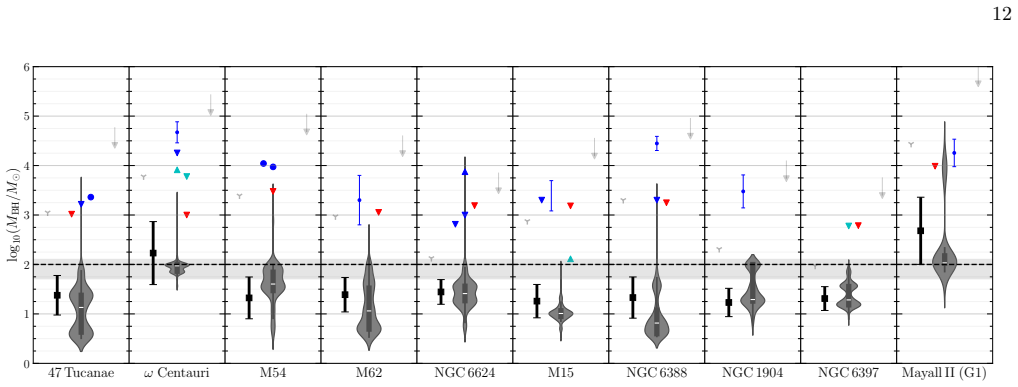
Machine learning on cluster simulations predicts globular clusters rarely host black holes heavier than about 100 solar masses.
A machine-rendered reading of the paper's core claim, the machinery that carries it, and where it could break.
Core claim
By training neural network and random forest regressors on synthetic catalogs generated with the Rapster cluster evolution code, we map observable cluster properties such as total mass and half-mass radius onto the mass of the heaviest black hole built up through repeated mergers. Applying these models to nearby globular and nuclear star clusters forecasts the intermediate-mass black hole population that each system may host, with globular clusters unlikely to contain black holes more massive than ~100 M⊙ and an occupation fraction near 0.02, although they can produce remnants within the upper mass gap with masses approaching 100 M⊙. Among nuclear star clusters, a handful of cases including,
What carries the argument
Neural network and random forest regressors that predict the mass of the heaviest black hole from observable cluster properties, combined with a normalizing flow to quantify the likelihood of initial conditions favoring collisional runaway in the first few million years.
If this is right
- Globular clusters are unlikely to contain black holes more massive than ∼100 M⊙, with an occupation fraction near 0.02.
- Globular clusters can produce black hole remnants in the upper mass gap with masses approaching 100 M⊙.
- A handful of nuclear star clusters including NGC 5102 and NGC 5206 yield predicted central black hole masses above 100 M⊙.
- Where observationally claimed masses exceed the predictions, the assembly history involved processes beyond hierarchical mergers, most plausibly accretion of gas and stars.
- Normalizing flows can quantify for individual globular clusters the likelihood that their initial conditions were favorable to a collisional runaway during the first few million years after formation.
Where Pith is reading between the lines
- The trained models could be applied to larger catalogs from upcoming surveys to identify promising targets for follow-up observations of potential intermediate-mass black holes.
- Systematic differences between model predictions and kinematic mass estimates in nuclear clusters may help isolate the relative importance of accretion versus merger channels.
- Future gravitational-wave observations of black hole mergers could provide an independent test of the mass distributions predicted for clusters with different observable properties.
- Refining the regressors with additional simulation suites that vary stellar evolution or initial mass functions would test how sensitive the occupation fractions are to those inputs.
Load-bearing premise
The synthetic catalogs generated with the Rapster cluster evolution code accurately capture the physics and parameter space of black hole formation through repeated mergers in real star clusters, allowing the trained models to generalize to observed systems.
What would settle it
A kinematic or other direct detection of a central black hole with mass well above 100 solar masses in a typical globular cluster would contradict the low occupation fraction and mass limit forecasts.
Figures




read the original abstract
Whether intermediate-mass black holes reside in nearby star clusters has remained contested for decades. We address this question by training neural network and random forest regressors on synthetic catalogs generated with the {\sc Rapster} cluster evolution code, mapping observable cluster properties such as total mass and half-mass radius onto the mass of the heaviest black hole built up through repeated mergers. Applying these models to nearby globular and nuclear star clusters, we forecast the intermediate-mass black hole population that each system may host. Globular clusters are unlikely to contain black holes more massive than $\sim 100\,M_\odot$, with an occupation fraction near 0.02, although they can produce remnants within the upper mass gap with masses approaching $100\,M_\odot$. Among nuclear star clusters, a handful of cases, including NGC 5102 and NGC 5206, yield predicted central black hole masses above $100\,M_\odot$, which we contrast with kinematically inferred estimates. Where the observationally claimed masses exceed our predictions, the implication is that the assembly history involved processes beyond hierarchical mergers, most plausibly accretion of gas and stars. Finally, we employ a normalizing flow to quantify, for individual globular clusters, the likelihood that their initial conditions were favorable to a collisional runaway during the first few million years after formation.
Editorial analysis
A structured set of objections, weighed in public.
Referee Report
Summary. The paper claims to predict the presence and masses of intermediate-mass black holes (IMBHs) in star clusters using machine learning models trained on synthetic data from the Rapster cluster evolution code. By mapping observable properties such as total cluster mass and half-mass radius to the mass of the heaviest black hole formed via repeated mergers, the authors apply the trained neural network and random forest regressors to observed globular clusters (GCs) and nuclear star clusters (NSCs). They conclude that GCs are unlikely to host black holes more massive than approximately 100 solar masses, with an occupation fraction around 0.02, though they may produce remnants approaching the upper mass gap. For NSCs, a few systems including NGC 5102 and NGC 5206 are predicted to have central black holes exceeding 100 solar masses. The work also uses a normalizing flow to evaluate the probability that initial conditions in GCs favored a collisional runaway process shortly after formation.
Significance. If the results hold, this study provides a practical framework for estimating IMBH masses in observed clusters based on readily available observables, bypassing the need for computationally expensive individual simulations. The predicted low occupation fraction in globular clusters and the identification of potential IMBH hosts in nuclear clusters offer concrete, falsifiable predictions that can guide observational campaigns and help differentiate between hierarchical merger and other formation channels such as gas accretion. The incorporation of a normalizing flow for assessing collisional runaway likelihood adds a probabilistic dimension to the analysis of cluster initial conditions. These elements collectively advance the field by linking simulation-based insights directly to observational data in a scalable manner.
major comments (2)
- [Methods and Results (Rapster catalog generation and model application)] The central predictions, including the occupation fraction near 0.02 for black holes above ~100 M⊙ in globular clusters and the specific mass forecasts for NGC 5102 and NGC 5206, rest on the fidelity of the Rapster synthetic catalogs. The manuscript should provide explicit comparisons of Rapster's treatment of dynamical friction, binary hardening, merger retention, and natal kicks against other codes or observational benchmarks (e.g., in the methods or results section describing the training data generation) to quantify potential systematic biases that could alter the reported occupation fraction and mass predictions.
- [Results (application to observed clusters and discussion of discrepancies)] The application of the trained models to observed clusters and the implication that discrepancies with kinematic mass estimates indicate processes beyond hierarchical mergers (such as gas accretion) requires quantified uncertainties. The paper should report ML prediction uncertainties (e.g., via cross-validation metrics, ensemble variance, or error propagation) and assess sensitivity to Rapster physics parameters, as these are load-bearing for the contrast drawn with observations in the nuclear star cluster cases.
minor comments (2)
- [Methods] Clarify the exact ranges of total mass, half-mass radius, and other initial conditions used to generate the Rapster training catalogs, as this directly affects the applicability of the models to the observed sample of globular and nuclear clusters.
- [Methods (ML model training)] Include performance metrics (such as R² or mean absolute error) for both training and held-out test sets in the description of the neural network and random forest regressors to demonstrate generalization and lack of overfitting.
Simulated Author's Rebuttal
We thank the referee for their constructive comments and positive evaluation of the work's significance. We address each major comment point by point below and indicate the revisions that will be incorporated into the next version of the manuscript.
read point-by-point responses
-
Referee: [Methods and Results (Rapster catalog generation and model application)] The central predictions, including the occupation fraction near 0.02 for black holes above ~100 M⊙ in globular clusters and the specific mass forecasts for NGC 5102 and NGC 5206, rest on the fidelity of the Rapster synthetic catalogs. The manuscript should provide explicit comparisons of Rapster's treatment of dynamical friction, binary hardening, merger retention, and natal kicks against other codes or observational benchmarks (e.g., in the methods or results section describing the training data generation) to quantify potential systematic biases that could alter the reported occupation fraction and mass predictions.
Authors: We agree that additional context on Rapster's physical prescriptions would strengthen the presentation. In the revised manuscript we will insert a concise subsection in the Methods describing Rapster's implementations of dynamical friction, binary hardening, merger retention, and natal kicks, with direct comparisons to the corresponding treatments in CMC and MOCCA together with references to existing benchmark studies. This addition will allow readers to assess the magnitude of any systematic effects on the derived occupation fraction and mass predictions. revision: yes
-
Referee: [Results (application to observed clusters and discussion of discrepancies)] The application of the trained models to observed clusters and the implication that discrepancies with kinematic mass estimates indicate processes beyond hierarchical mergers (such as gas accretion) requires quantified uncertainties. The paper should report ML prediction uncertainties (e.g., via cross-validation metrics, ensemble variance, or error propagation) and assess sensitivity to Rapster physics parameters, as these are load-bearing for the contrast drawn with observations in the nuclear star cluster cases.
Authors: We will expand the Results section to report ensemble variances from both the random-forest and neural-network models as well as additional cross-validation metrics. We will also add a short sensitivity analysis that varies key Rapster parameters (primarily natal-kick dispersion and binary-hardening efficiency) and shows the resulting spread in predicted IMBH masses for the nuclear star clusters. These quantified uncertainties will be used to contextualize the comparison with kinematic estimates for NGC 5102 and NGC 5206. revision: yes
Circularity Check
No significant circularity: ML predictions trained on independent Rapster synthetic catalogs
full rationale
The derivation trains neural network and random forest regressors on synthetic catalogs produced by the external Rapster cluster evolution code, then maps observable properties (total mass, half-mass radius) to heaviest merger-built BH mass and applies the models to real globular and nuclear star clusters. This chain does not reduce any prediction to a fitted parameter defined from the target observations, nor does it rely on self-definitional loops, uniqueness theorems imported from the authors' prior work, or ansatzes smuggled via self-citation. The normalizing-flow step for initial conditions likewise operates on the same independent synthetic data. The central claims therefore remain self-contained against external benchmarks and receive no circularity penalty.
Axiom & Free-Parameter Ledger
axioms (1)
- domain assumption Rapster accurately models repeated black hole mergers and cluster evolution across the relevant mass and density range
Reference graph
Works this paper leans on
-
[1]
Mayall II (G1) Based on kinematic data from the Hubble Space Tele- scope, Ref. [36] suggested that Mayall II (G1), which is the heaviest GC of M31 (the Andromeda galaxy), with a mass of about double that ofωCentauri, hosts an IMBH with mass(1.8±0.5)×104M⊙. In contrast, Ref. [35] conducted N-body simulations and concluded that the existence of an IMBH in t...
-
[2]
Other systems Palomar 5 is a very sparse GC with a mass of1.3× 104M⊙and half-mass radius of27.63 pc. The most likely heaviestBHmasspredictedforthisclusterisabout47 M⊙; however, the RFR gives a model-based probability of 1% that it hosts a∼3800M⊙IMBH. The NN predicts a typical heaviest BH mass of about150M⊙for this cluster. Nevertheless, our models predict...
work page 1904
-
[3]
K.K., D.W. and E.B. are supported by NSF Grants No. AST-2307146, No. PHY-2513337, No. PHY-090003, and No. PHY-20043, by NASA Grant No. 21-ATP21-0010, by John Templeton Foundation Grant No. 62840, by the Simons Foundation [MPS-SIP-00001698, E.B.], by the Si- mons Foundation International [SFI-MPS-BH-00012593- 02], and by Italian Ministry of Foreign Affairs...
-
[4]
Jenny E. Greene, Jay Strader, and Luis C. Ho, “Intermediate-Mass Black Holes,” Annu. Rev. Astron. Astrophys.58, 257–312 (2020), arXiv:1911.09678 [astro- ph.GA]
work page internal anchor Pith review Pith/arXiv arXiv 2020
-
[5]
AnExtension of Hierarchical Star Formation to Galactic Scales,
BruceG.ElmegreenandYuriN.Efremov,“AnExtension of Hierarchical Star Formation to Galactic Scales,” ApJ 466, 802 (1996)
work page 1996
-
[6]
Dominik R. G. Schleicheret al., “Massive star clus- ters detected by JWST as natural birth places to form intermediate-mass black holes,” (2026), arXiv:2603.24550 [astro-ph.GA]
-
[7]
Dieu D. Nguyen, Anil C. Seth, Nadine Neumayer, Se- bastian Kamann, Karina T. Voggel, Michele Cappellari, Arianna Picotti, Phuong M. Nguyen, Torsten Böker, Victor Debattista, Nelson Caldwell, Richard McDer- mid, Nathan Bastian, Christopher C. Ahn, and Renuka Pechetti, “Nearby Early-type Galactic Nuclei at High Resolution: Dynamical Black Hole and Nuclear S...
work page internal anchor Pith review Pith/arXiv arXiv 2018
-
[8]
Amy E. Reines, Jenny E. Greene, and Marla Geha, “Dwarf Galaxies with Optical Signatures of Active Massive Black Holes,” Astrophys. J.775, 116 (2013), arXiv:1308.0328 [astro-ph.CO]
work page internal anchor Pith review Pith/arXiv arXiv 2013
-
[9]
Bradley M. Petersonet al., “Multiwavelength monitor- ing of the dwarf Seyfert 1 galaxy NGC 4395. 1. A Reverberation-based measurement of the black hole mass,” Astrophys. J.632, 799–808 (2005), [Erratum: Astrophys.J. 641, 638 (2006)], arXiv:astro-ph/0506665
work page internal anchor Pith review Pith/arXiv arXiv 2005
-
[10]
Mark den Brok, Anil C. Seth, Aaron J. Barth, Daniel J. Carson, Nadine Neumayer, Michele Cappellari, Vic- tor P. Debattista, Luis C. Ho, Carol E. Hood, and Richard M. McDermid, “Measuring the Mass of the Central Black Hole in the Bulgeless Galaxy NGC 4395 from Gas Dynamical Modeling,” ApJ809, 101 (2015), arXiv:1507.04358 [astro-ph.GA]
work page internal anchor Pith review Pith/arXiv arXiv 2015
-
[11]
A 10,000-solar-mass black hole in the nucleus of a bulgeless dwarf galaxy
Jong-Hak Woo, Hojin Cho, Elena Gallo, Edmund Hodges-Kluck, Huynh Anh N. Le, Jaejin Shin, Donghoon Son, and John C. Horst, “A 10,000-solar-mass black hole in the nucleus of a bulgeless dwarf galaxy,” Na- ture Astronomy3, 755–759 (2019), arXiv:1905.00145 [astro-ph.GA]
work page internal anchor Pith review Pith/arXiv arXiv 2019
-
[13]
A Search for Wandering Black Holes in the Milky Way with Gaia and DECaLS,
Jenny E. Greene, Lachlan Lancaster, Yuan-Sen Ting, Sergey E. Koposov, Shany Danieli, Song Huang, Fangzhou Jiang, Johnny P. Greco, and Jay Strader, “A Search for Wandering Black Holes in the Milky Way with Gaia and DECaLS,” ApJ917, 17 (2021), arXiv:2105.04581 [astro-ph.GA]
-
[14]
Matthew A. Taylor, Behzad Tahmasebzadeh, Solveig Thompson, Eugene Vasiliev, Monica Valluri, Michael J. Drinkwater, Patrick Côté, Laura Ferrarese, Joel Roedi- ger, Holger Baumgardt, Misty C. Bentz, Kristen Dage, Eric W. Peng, Drew Lapeer, Chengze Liu, Zach Sumners, Kaixiang Wang, Vivienne Baldassare, John P. Blakeslee, Youkyung Ko, and Tyrone E. Woods, “A ...
-
[15]
Abbottet al.(LIGO Scientific, Virgo), Phys
R.Abbottet al.(LIGOScientific, Virgo),“GW190521: A Binary Black Hole Merger with a Total Mass of150M⊙,” Phys. Rev. Lett.125, 101102 (2020), arXiv:2009.01075 [gr-qc]
-
[16]
GW231123: a Binary Black Hole Merger with Total Mass 190-265 $M_{\odot}$
A. G. Abacet al.(LIGO Scientific, VIRGO, KAGRA), “GW231123: a Binary Black Hole Merger with Total 24 Mass 190-265 M⊙,” (2025), arXiv:2507.08219 [astro- ph.HE]
work page internal anchor Pith review Pith/arXiv arXiv 2025
-
[17]
Digvijay Wadekar, Javier Roulet, Tejaswi Venumadhav, Ajit Kumar Mehta, Barak Zackay, Jonathan Mushkin, Seth Olsen, and Matias Zaldarriaga, “New black hole mergers in the LIGO-Virgo O3 data from a gravitational wave search including higher-order harmonics,” (2023), arXiv:2312.06631 [gr-qc]
-
[18]
Manuel Arca Sedda, Lavinia Paiella, Cristiano Ugolini, Filippo Santoliquido, Benedetta Mestichelli, Ilaria Usai, Filippo Simonato, and Marica Branchesi, “Isolated or Dynamical? Tracing Black Hole Binary Formation through the Population of Gravitational-Wave Sources,” (2026), arXiv:2603.20430 [astro-ph.GA]
-
[19]
Aidan Mai, Kyle Kremer, and Fulya Kıroğlu, “Shadows of the Colossus: Hierarchical Black Hole Mergers in a 10- million-body Globular Cluster Simulation,” Astrophys. J.998, 138 (2026), arXiv:2510.21916 [astro-ph.GA]
-
[20]
Intermediate- Mass Black Hole Formation from Hierarchical Mergers in Galactic Nuclei,
Amanda Newton, Sanaea C. Rose, Fulya Kıroğlu, Bao- Minh Hoang, and Frederic A. Rasio, “Intermediate- Mass Black Hole Formation from Hierarchical Mergers in Galactic Nuclei,” arXiv e-prints , arXiv:2602.04176 (2026), arXiv:2602.04176 [astro-ph.GA]
-
[21]
Coalescence Forensics: Weighing the Hosts of Hierarchical Binary Black Hole Mergers,
Avinash Tiwari and Shasvath J. Kapadia, “Coalescence Forensics: Weighing the Hosts of Hierarchical Binary Black Hole Mergers,” (2026), arXiv:2602.05645 [astro- ph.HE]
-
[22]
Bi- nary mergers and growth of black holes in dense star clusters,
Ryan M. O’Leary, Frederic A. Rasio, John M. Fregeau, Natalia Ivanova, and Richard W. O’Shaughnessy, “Bi- nary mergers and growth of black holes in dense star clusters,” Astrophys. J.637, 937–951 (2006), arXiv:astro- ph/0508224
-
[24]
Evangelia Tremouet al., “The MAVERIC Survey: Still No Evidence for Accreting Intermediate-mass Black HolesinGlobularClusters,”Astrophys.J.862,16(2018), arXiv:1806.00259 [astro-ph.HE]
work page internal anchor Pith review Pith/arXiv arXiv 2018
-
[25]
Upper limits on the central black hole masses of 47Tuc and NGC6397
Sven De Rijcke, P. Buyle, and H. Dejonghe, “Upper limits on the central black hole masses of 47 tuc and ngc 6397,” Mon. Not. Roy. Astron. Soc.368, L43–L46 (2006), arXiv:astro-ph/0601450
work page internal anchor Pith review Pith/arXiv arXiv 2006
-
[26]
High resolution x-ray imaging of a globular cluster core: compact binaries in 47tuc,
Jonathan E. Grindlay, Craig Heinke, Peter D. Edmonds, and Stephen S. Murray, “High resolution x-ray imaging of a globular cluster core: compact binaries in 47tuc,” Science292, 2290 (2001), arXiv:astro-ph/0105528
-
[28]
VLT Kinematics for omega Centauri: Further Support for a Central Black Hole
Eva Noyola, Karl Gebhardt, Markus Kissler-Patig, Nora Lützgendorf, Behrang Jalali, P. Tim de Zeeuw, and Holger Baumgardt, “Very Large Telescope Kinematics for Omega Centauri: Further Support for a Central Black Hole,” Astrophys. J. Lett.719, L60–L64 (2010), arXiv:1007.4559 [astro-ph.GA]
work page internal anchor Pith review Pith/arXiv arXiv 2010
-
[29]
An intermediate-mass black hole in the centre of the globular cluster 47 Tucanae
Bülent Kızıltan, Holger Baumgardt, and Abraham Loeb, “Anintermediate-massblackholeinthecentreoftheglob- ular cluster 47 Tucanae,” Nature542, 203–205 (2017), arXiv:1702.02149 [astro-ph.GA]
work page internal anchor Pith review Pith/arXiv arXiv 2017
-
[30]
New Limits on an Intermediate Mass Black Hole in Omega Centauri: II. Dynamical Models
Roeland P. van der Marel and Jay Anderson, “New Limits on an Intermediate-Mass Black Hole in Omega Centauri. II. Dynamical Models,” Astrophys. J.710, 1063–1088 (2010), arXiv:0905.0638 [astro-ph.GA]
work page internal anchor Pith review Pith/arXiv arXiv 2010
-
[31]
No evidence for intermediate-mass black holes in the globular clustersω Cen and NGC 6624,
H. Baumgardt, C. He, S. M. Sweet, M. Drinkwater, A. Sollima, J. Hurley, C. Usher, S. Kamann, H. Dal- gleish, S. Dreizler, and T.-O. Husser, “No evidence for intermediate-mass black holes in the globular clustersω Cen and NGC 6624,” MNRAS488, 5340–5351 (2019), arXiv:1907.10845 [astro-ph.GA]
-
[32]
Andrés Bañares-Hernández, Francesca Calore, Jorge Martin Camalich, and Justin I. Read, “New constraints on the central mass contents of Omega Centauri from combined stellar kinematics and pulsar timing,” A&A 693, A104 (2025), arXiv:2408.00939 [astro-ph.GA]
-
[33]
S. Kamann, T.-O. Husser, J. Brinchmann, E. Emsellem, P. M. Weilbacher, L. Wisotzki, M. Wendt, D. Krajnović, M. M. Roth, R. Bacon, and S. Dreizler, “MUSE crowded field 3D spectroscopy of over 12 000 stars in the globular cluster NGC 6397. II. Probing the internal dynamics and the presence of a central black hole,” A&A588, A149 (2016), arXiv:1602.01643 [ast...
work page internal anchor Pith review Pith/arXiv arXiv 2016
-
[34]
Does NGC 6397 contain an intermediate-mass black hole or a more diffuse inner subcluster?
Eduardo Vitral and Gary A. Mamon, “Does NGC 6397 contain an intermediate-mass black hole or a more diffuse inner subcluster?” A&A646, A63 (2021), arXiv:2010.05532 [astro-ph.GA]
-
[35]
Stellar graveyards: clus- tering of compact objects in globular clusters NGC 3201 and NGC 6397,
Eduardo Vitral, Kyle Kremer, Mattia Libralato, Gary A. Mamon, and Andrea Bellini, “Stellar graveyards: clus- tering of compact objects in globular clusters NGC 3201 and NGC 6397,” Mon. Not. Roy. Astron. Soc.514, 806– 825 (2022), arXiv:2202.01599 [astro-ph.GA]
-
[36]
An elusive dark central mass in the globular cluster M4,
Eduardo Vitral, Mattia Libralato, Kyle Kremer, Gary A. Mamon, Andrea Bellini, Luigi R. Bedin, and Jay An- derson, “An elusive dark central mass in the globular cluster M4,” Mon. Not. Roy. Astron. Soc.522, 5740–5757 (2023), arXiv:2305.12702 [astro-ph.GA]
-
[37]
Evidence of Nonluminous Matter in the Center of M62,
Federico Abbate, Andrea Possenti, Monica Colpi, and Mario Spera, “Evidence of Nonluminous Matter in the Center of M62,” ApJ884, L9 (2019), arXiv:1909.11091 [astro-ph.HE]
-
[38]
A Dynamical Model for the Globular Cluster G1
Holger Baumgardt, Junichiro Makino, Piet Hut, Steve McMillan, and Simon F. Portegies Zwart, “A dynamical model for the globular cluster g1,” Astrophys. J. Lett. 589, L25–L28 (2003), arXiv:astro-ph/0301469
work page internal anchor Pith review Pith/arXiv arXiv 2003
-
[39]
Karl Gebhardt, R. Michael Rich, and Luis C. Ho, “An Intermediate-mass black hole in the globular cluster G1: Improved significance from new Keck and Hubble Space Telescope observations,” Astrophys. J.634, 1093–1102 (2005), arXiv:astro-ph/0508251
work page internal anchor Pith review Pith/arXiv arXiv 2005
-
[40]
Renuka Pechetti, Anil Seth, Sebastian Kamann, Nelson Caldwell, Jay Strader, Mark den Brok, Nora Luetzgen- dorf, Nadine Neumayer, and Karina Voggel, “Detection of a 100,000 M⊙ black hole in M31’s Most Massive Glob- ular Cluster: A Tidally Stripped Nucleus,” Astrophys. J.924, 48 (2022), arXiv:2111.08720 [astro-ph.GA]
-
[41]
N-body modeling of globular clusters: Masses, mass-to-light ratios and intermediate-mass black holes
H. Baumgardt, “N -body modelling of globular clusters: masses, mass-to-light ratios and intermediate-mass black holes,” Mon. Not. R. Astron. Soc.464, 2174–2202 (2017), arXiv:1609.08794 [astro-ph.GA]
work page internal anchor Pith review Pith/arXiv arXiv 2017
-
[42]
Fast-moving stars around an intermediate-mass black hole inωCentauri,
Maximilian Häberle, Nadine Neumayer, Anil Seth, Andrea Bellini, Mattia Libralato, Holger Baumgardt, Matthew Whitaker, Antoine Dumont, Mayte Alfaro- Cuello, Jay Anderson, Callie Clontz, Nikolay Kacharov, Sebastian Kamann, Anja Feldmeier-Krause, Antonino 25 Milone, Maria Selina Nitschai, Renuka Pechetti, and Glenn van de Ven, “Fast-moving stars around an in...
-
[43]
A high- velocity star recently ejected by an intermediate-mass black hole in M15,
Yang Huang, Qingzheng Li, Jifeng Liu, Xiaobo Dong, Huawei Zhang, Youjun Lu, and Cuihua Du, “A high- velocity star recently ejected by an intermediate-mass black hole in M15,” Natl. Sci. Rev.12, nwae347 (2025), arXiv:2406.00923 [astro-ph.GA]
-
[44]
Outbursts of the intermediate-mass black hole HLX-1: a wind instability scenario
Roberto Soria, Aina Musaeva, Kinwah Wu, Luca Zampieri, Sara Federle, Ryan Urquhart, Edwin van der Helm, and Sean Farrell, “Outbursts of the intermediate- mass black hole HLX-1: a wind instability scenario,” Mon. Not. Roy. Astron. Soc.469, 886–905 (2017), arXiv:1704.05468 [astro-ph.HE]
work page internal anchor Pith review Pith/arXiv arXiv 2017
-
[45]
A luminous X-ray outburst from an intermediate-mass black hole in an off-centre star cluster
Dacheng Linet al., “A luminous X-ray outburst from an intermediate-mass black hole in an off-centre star clus- ter,” Nature Astron.2, 656–661 (2018), arXiv:1806.05692 [astro-ph.HE]
work page internal anchor Pith review Pith/arXiv arXiv 2018
-
[46]
Dacheng Lin, Jay Strader, Aaron J. Romanowsky, Jimmy A. Irwin, Olivier Godet, Didier Barret, Na- talie A. Webb, Jeroen Homan, and Ronald A. Remil- lard, “Multiwavelength Follow-up of the Hyperlumi- nous Intermediate-mass Black Hole Candidate 3XMM J215022.4−055108,” Astrophys. J. Lett.892, L25 (2020), arXiv:2002.04618 [astro-ph.HE]
-
[47]
Jin et al., An IMBH Lurking in A Galactic Halo Caught Alive during Outburst , 2501.09580
C. C. Jinet al., “An Intermediate-mass Black Hole Lurk- ing in A Galactic Halo Caught Alive during Outburst,” (2025), arXiv:2501.09580 [astro-ph.HE]
-
[48]
The population of tidal dis- ruption events discovered with eROSITA,
Iuliia Grotovaet al., “The population of tidal dis- ruption events discovered with eROSITA,” (2025), arXiv:2504.08424 [astro-ph.HE]
-
[49]
Multiwavelength Study of a Hyperluminous X-Ray Source near NGC 6099: A Strong IMBH Candidate,
Yi-Chi Chang, Roberto Soria, Albert K. H. Kong, Alis- ter W. Graham, Kirill A. Grishin, and Igor V. Chilingar- ian, “Multiwavelength Study of a Hyperluminous X-Ray Source near NGC 6099: A Strong IMBH Candidate,” Astrophys. J.983, 109 (2025), arXiv:2503.00904 [astro- ph.HE]
-
[50]
Richard T. Pomeroy and Mark A. Norris, “A search for intermediate-mass black holes in compact stellar systems through optical emissions from tidal disrup- tion events,” Mon. Not. R. Astron. Soc.530, 3043–3050 (2024), arXiv:2404.09144 [astro-ph.GA]
-
[51]
Formation of massive black holes in dense star clusters,
Frederic A. Rasio, Marc Freitag, and M. Atakan Gurkan, “Formation of massive black holes in dense star clusters,” inCarnegie Observatories Centennial Symposium. 1. Co- evolution of Black Holes and Galaxies(2003) arXiv:astro- ph/0304038
-
[52]
An upper limit to the velocity dispersion of relaxed stellar systems without massive black holes
M. Coleman Miller and Melvyn B. Davies, “An upper limit to the velocity dispersion of relaxed stellar systems without massive black holes,” Astrophys. J.755, 81 (2012), arXiv:1206.6167 [astro-ph.GA]
work page internal anchor Pith review Pith/arXiv arXiv 2012
-
[53]
On the coexistence of stellar-mass and intermediate-mass black holes in globular clusters
Nathan W. C. Leigh, Nora Lützgendorf, Aaron M. Geller, Thomas J. Maccarone, Craig Heinke, and Al- berto Sesana, “On the coexistence of stellar-mass and intermediate-mass black holes in globular clusters,” MN- RAS444, 29–42 (2014), arXiv:1407.4459 [astro-ph.SR]
work page internal anchor Pith review Pith/arXiv arXiv 2014
-
[54]
Binary Black Hole Mergers from Globular Clusters: Implications for Advanced LIGO
Carl L. Rodriguez, Meagan Morscher, Bharath Pattabi- raman, Sourav Chatterjee, Carl-Johan Haster, and Fred- eric A. Rasio, “Binary Black Hole Mergers from Globular Clusters: Implications for Advanced LIGO,” Phys. Rev. Lett.115, 051101 (2015), [Erratum: Phys.Rev.Lett. 116, 029901 (2016)], arXiv:1505.00792 [astro-ph.HE]
work page internal anchor Pith review Pith/arXiv arXiv 2015
-
[55]
Carl L. Rodriguez, Sourav Chatterjee, and Fred- eric A. Rasio, “Binary Black Hole Mergers from Glob- ular Clusters: Masses, Merger Rates, and the Impact of Stellar Evolution,” Phys. Rev. D93, 084029 (2016), arXiv:1602.02444 [astro-ph.HE]
work page internal anchor Pith review Pith/arXiv arXiv 2016
-
[56]
Modeling Dense Star Clus- ters in the Milky Way and beyond with the Cluster Monte Carlo Code,
Carl L. Rodriguezet al., “Modeling Dense Star Clus- ters in the Milky Way and beyond with the Cluster Monte Carlo Code,” Astrophys. J. Supp.258, 22 (2022), arXiv:2106.02643 [astro-ph.GA]
-
[57]
The in-situ growth of stellar-mass “light
Yanlong Shi and Norman Murray, “The in-situ growth of stellar-mass “light” seed black holes in nuclear star clusters,” arXiv e-prints , arXiv:2603.10581 (2026), arXiv:2603.10581 [astro-ph.GA]
-
[58]
Christian Partmann, Thorsten Naab, Natalia Lahén, Antti Rantala, Michaela Hirschmann, Jessica M. Hislop, Jonathan Petersson, and Peter H. Johansson, “The importance of nuclear star clusters for massive black hole growth and nuclear star formation in simulated low- mass galaxies,” (2024), arXiv:2409.18096 [astro-ph.GA]
-
[59]
Survival Analysis of Intermediate- Mass Black Holes in Dense Star Clusters,
Miguel A. S. Martinez, Elena González Prieto, and Frederic A. Rasio, “Survival Analysis of Intermediate- Mass Black Holes in Dense Star Clusters,” (2026), arXiv:2602.23431 [astro-ph.HE]
-
[60]
Kuldeep Sharma and Carl L. Rodriguez, “From Young Massive Clusters to Old Globular Clusters: Density Pro- file Evolution and Intermediate-mass Black Hole Forma- tion,” Astrophys. J.983, 162 (2025), arXiv:2405.05397 [astro-ph.GA]
-
[61]
Growing the Intermediate-mass Black Hole in Omega Centauri,
Elena González Prieto, Carl L. Rodriguez, and Tomás Cabrera, “Growing the Intermediate-mass Black Hole in Omega Centauri,” Astrophys. J. Lett.990, L69 (2025), arXiv:2507.06316 [astro-ph.HE]
-
[62]
The M_BH - sigma relation for intermediate-mass black holes in globular clusters
Nora Lützgendorf, Markus Kissler-Patig, Nadine Neu- mayer, Holger Baumgardt, Eva Noyola, P. Tim de Zeeuw, Karl Gebhardt, Behrang Jalali, and Anja Feldmeier, “The M_BH - sigma relation for intermediate-mass black holes in globular clusters,” Astron. Astrophys.555, A26 (2013), arXiv:1304.7156 [astro-ph.GA]
work page internal anchor Pith review Pith/arXiv arXiv 2013
-
[63]
Discovering Black Hole Mass Scaling Relations with Symbolic Regression,
Zehao Jin and Benjamin L. Davis, “Discovering Black Hole Mass Scaling Relations with Symbolic Regression,” (2023), arXiv:2310.19406 [astro-ph.GA]
-
[64]
Digvijay Wadekar, Leander Thiele, Francisco Villaescusa- Navarro, J. Colin Hill, Miles Cranmer, David N. Spergel, Nicholas Battaglia, Daniel Anglés-Alcázar, Lars Hern- quist, and Shirley Ho, “Augmenting astrophysical scaling relations with machine learning: application to reducing the Sunyaev-Zeldovich flux-mass scatter,” (2022), 10.1073/pnas.2202074120, ...
-
[65]
Interpretable Machine Learning for Finding Intermediate-mass Black Holes,
Mario Pasquato, Piero Trevisan, Abbas Askar, Pablo Lemos, Gaia Carenini, Michela Mapelli, and Yashar Hezaveh, “Interpretable Machine Learning for Finding Intermediate-mass Black Holes,” ApJ965, 89 (2024), arXiv:2310.18560 [astro-ph.GA]
-
[66]
Dynamical evolution of black hole sub-systems in idealised star clusters
Philip G. Breen and Douglas C. Heggie, “Dynamical evolution of black hole sub-systems in idealised star clusters,” Mon. Not. Roy. Astron. Soc.432, 2779 (2013), arXiv:1304.3401 [astro-ph.GA]
work page internal anchor Pith review Pith/arXiv arXiv 2013
-
[67]
Very massive stars, pair-instability supernovae and intermediate-mass black holes with the SEVN code
Mario Spera and Michela Mapelli, “Very massive stars, pair-instability supernovae and intermediate-mass black holes with the SEVN code,” Mon. Not. Roy. Astron. Soc. 470, 4739–4749 (2017), arXiv:1706.06109 [astro-ph.SR]
work page internal anchor Pith review Pith/arXiv arXiv 2017
-
[68]
PRECESSION: Dynamics of spinning black-hole binaries with python
Davide Gerosa and Michael Kesden, “PRECESSION: Dynamics of spinning black-hole binaries with python,” 26 Phys. Rev. D93, 124066 (2016), arXiv:1605.01067 [astro- ph.HE]
work page internal anchor Pith review Pith/arXiv arXiv 2016
-
[69]
Tousif Islam and Digvijay Wadekar, “Accurate models for recoil velocity distribution in black hole mergers with comparable to extreme mass-ratios and their astrophysi- cal implications,” (2025), arXiv:2511.11536 [gr-qc]
-
[70]
Tousif Islam, Digvijay Wadekar, and Konstantinos Kri- tos, “Kick matters: The impact of a new recoil model on the retention of hierarchical black-hole remnants in glob- ular clusters,” (2026), arXiv:2603.10170 [astro-ph.HE]
-
[71]
Dynamical formation of black hole binaries in dense star clusters: Rapid clus- ter evolution code,
Konstantinos Kritos, Vladimir Strokov, Vishal Baib- hav, and Emanuele Berti, “Dynamical formation of black hole binaries in dense star clusters: Rapid clus- ter evolution code,” Phys. Rev. D110, 043023 (2024), arXiv:2210.10055 [astro-ph.HE]
-
[72]
Rates and Characteristics of Intermediate Mass Ratio Inspirals Detectable by Advanced LIGO
Ilya Mandel, Duncan A. Brown, Jonathan R. Gair, and M. Coleman Miller, “Rates and Characteristics of Intermediate-Mass-Ratio Inspirals Detectable by Ad- vanced LIGO,” Astrophys. J.681, 1431–1447 (2008), arXiv:0705.0285 [astro-ph]
work page internal anchor Pith review Pith/arXiv arXiv 2008
-
[73]
H. Baumgardt and M. Hilker, “A catalogue of masses, structural parameters and velocity dispersion profiles of 112 Milky Way globular clusters,” Mon. Not. Roy. Astron. Soc.478, 1520–1557 (2018), arXiv:1804.08359 [astro-ph.GA]
work page internal anchor Pith review Pith/arXiv arXiv 2018
-
[74]
Iskren Y. Georgiev, Torsten Böker, Nathan Leigh, Nora Lützgendorf, andNadineNeumayer,“Massesandscaling relations for nuclear star clusters, and their co-existence with central black holes,” Mon. Not. R. Astron. Soc.457, 2122–2138 (2016), arXiv:1601.02613 [astro-ph.GA]
work page internal anchor Pith review Pith/arXiv arXiv 2016
-
[75]
SciPy 1.0: Fundamental Algorithms for Scientific Com- puting in Python,
Pauli Virtanen, Ralf Gommers, Travis E. Oliphant, Matt Haberland, Tyler Reddy, David Cournapeau, Evgeni Burovski, Pearu Peterson, Warren Weckesser, Jonathan Bright, Stéfan J. van der Walt, Matthew Brett, Joshua Wilson, K. Jarrod Millman, Nikolay Mayorov, Andrew R. J. Nelson, Eric Jones, Robert Kern, Eric Larson, C J Carey, İlhan Polat, Yu Feng, Eric W. Mo...
work page 2020
-
[76]
D. W. Scott,Multivariate Density Estimation: Theory, Practice, and Visualization(John Wiley & Sons, New York, Chicester, 1992)
work page 1992
-
[77]
Supermassive black hole growth in hierarchically merging nuclear star clusters,
Konstantinos Kritos, Ricarda S. Beckmann, Joseph Silk, Emanuele Berti, Sophia Yi, Marta Volonteri, Yohan Dubois, and Julien Devriendt, “Supermassive black hole growth in hierarchically merging nuclear star clusters,” (2024), arXiv:2412.15334 [astro-ph.GA]
- [78]
-
[79]
Pierre Geurts, Damien Ernst, and Louis Wehenkel, “Extremely randomized trees,” Machine Learning63, 3–42 (2006)
work page 2006
-
[80]
Scikit-learn: Machine Learning in Python,
Fabian Pedregosa, Gaël Varoquaux, Alexandre Gramfort, Vincent Michel, Bertrand Thirion, Olivier Grisel, Math- ieu Blondel, Peter Prettenhofer, Ron Weiss, Vincent Dubourg, Jake Vanderplas, Alexandre Passos, David Cournapeau, Matthieu Brucher, Matthieu Perrot, and Édouard Duchesnay, “Scikit-learn: Machine Learning in Python,” Journal of Machine Learning Res...
work page 2011
-
[81]
Distilling free- form natural laws from experimental data,
Michael D. Schmidt and Hod Lipson, “Distilling free- form natural laws from experimental data,” Science324, 81 – 85 (2009)
work page 2009
-
[82]
Toward an AI Physicist for Unsupervised Learning,
Tailin Wu and Max Tegmark, “Toward an AI Physicist for Unsupervised Learning,” arXiv e- prints , arXiv:1810.10525 (2018), arXiv:1810.10525 [physics.comp-ph]
-
[83]
AI Feynman: a Physics-Inspired Method for Symbolic Regression, April 2020
Silviu-Marian Udrescu and Max Tegmark, “AI Feynman: A physics-inspired method for symbolic regression,” Sci- ence Advances6, eaay2631 (2020), arXiv:1905.11481 [physics.comp-ph]
discussion (0)
Sign in with ORCID, Apple, or X to comment. Anyone can read and Pith papers without signing in.