REVIEW 4 minor 2 cited by
Generalized Threshold Factorization with Full Collinear Dynamics
T0 review · 0 major / 4 minor · reviewed 2026-08-14 · deepseek-v4-flash
Pith's one-line read The paper establishes a generalized threshold factorization for color-singlet production that holds when only one momentum fraction tends to 1 and encodes the full singular structure to all orders.
desk verdict A genuinely new factorization theorem for color-singlet production, with strong NLO and NNLO checks; the main soft spot (Glauber/usoft cancellation) is inherited from standard inclusive factorization and does not sink the central claim. read the letter →
The pith
A machine-rendered reading of the paper's core claim, the machinery that carries it, and where it could break.
The reading
What carries the argument
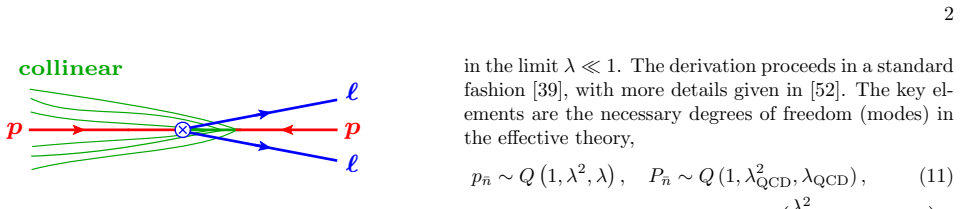
The load-bearing object is the modified beam function $\tilde B_i(\tilde t,x)$, defined as the $\vec{k}_T$-integrated projection of the double-differential beam function $B_i(t,\vec{k}_T,x)$ with $\tilde t=t+|\vec{k}_T|^2/2$. It obeys the same renormalization-group evolution as the ordinary beam function, so its logarithmic structure is fixed, but it has new finite matching coefficients $\tilde I_{ij}(\tilde t,z)$; the paper computes these to $O(\alpha_s^2)$ for quarks and $O(\alpha_s)$ for gluons. The proof works by decomposing the effective theory into collinear, anti-collinear, soft, and threshold-PDF sectors, with the final-state radiation forced to be anti-collinear when $x_a\to1$. The consistency relation Eq. (16) fixes the overlap: when $x_b\to1$, the beam function must collapse to a convolution of the soft function with a threshold PDF, which is precisely the term subtracted in Eq. (17).
What would settle it
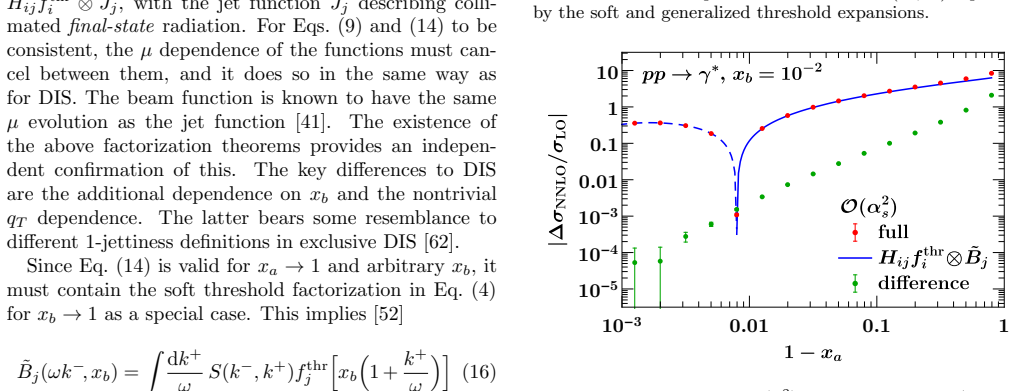
Take the exact $O(\alpha_s^2)$ Drell-Yan cross section at fixed $x_b=10^{-2}$ and subtract the right-hand side of Eq. (14) evaluated with flat test PDFs; the theorem requires the residual to vanish as a power of $1-x_a$ with no logarithmically enhanced residue in any partonic channel. A sharper check is the $O(\alpha_s^3)$ coefficient of $L_5(1-z_a)\,\delta(1-z_b)$, which Eq. (22) fixes in terms of known anomalous dimensions: an independent full $\mathrm{N}^3\mathrm{LO}$ calculation that disagrees with that coefficient would disprove the factorization.
Extended reading notes
Core claim
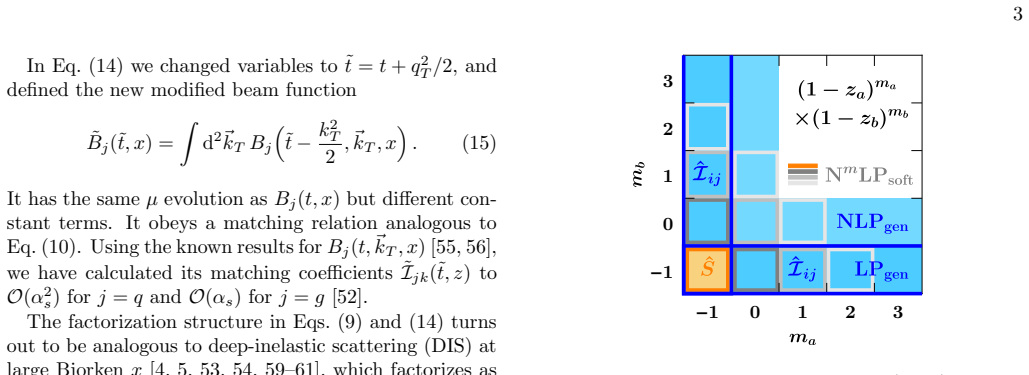
The paper's central claim is the generalized threshold factorization theorem $$\frac{\mathrm{d}\$\sigma$}{\mathrm{d}x_a\,\mathrm{d}x_b}=H_{ij}\left[$f_i^{{\mathrm{thr}}$}\otimes\tilde B_j+\tilde B_i\otimes $f_j^{{\mathrm{thr}}$}-S\otimes $f_i^{{\mathrm{thr}}$}$f_j^{{\mathrm{thr}}$}\right],$$ which holds at leading power in $1-x_a$ for generic $x_b$ (and symmetrically with $x_a\leftrightarrow x_b$). Here $H_{ij}$ is the same hard function that appears in the classic soft-threshold limit, $f_i^{\mathrm{thr}}$ is the threshold parton distribution function, $\tilde B_j$ is a modified beam function obtained by integrating the double-differential $N$-jettiness beam function over transverse momentum, and $S$ is the soft function; the last term subtracts the overlap of the two one-sided limits. All convolutions are with respect to the appropriate momentum fractions and flavor indices are summed. The theorem encodes the complete leading-power singular behavior of the partonic cross section as either $z_a\to1$ or $z_b\to1$, including nondiagonal channels such as $qg\to Lq$, and it reduces to the standard soft-threshold factorization when both $x_a,x_b\to1$. The authors verify it analytically at NLO and numerically at NNLO and use it to predict a set of $\mathrm{N}^3\mathrm{LO}$ threshold logarithms.
Load-bearing premise
The argument would collapse if very soft gluon exchanges connecting the two incoming protons, the ultra-soft and Glauber modes, contribute at leading power; the paper assumes, following standard collinear factorization, that full inclusiveness over perpendicular momenta at the QCD scale makes them cancel.
Editorial extensions
If this is right
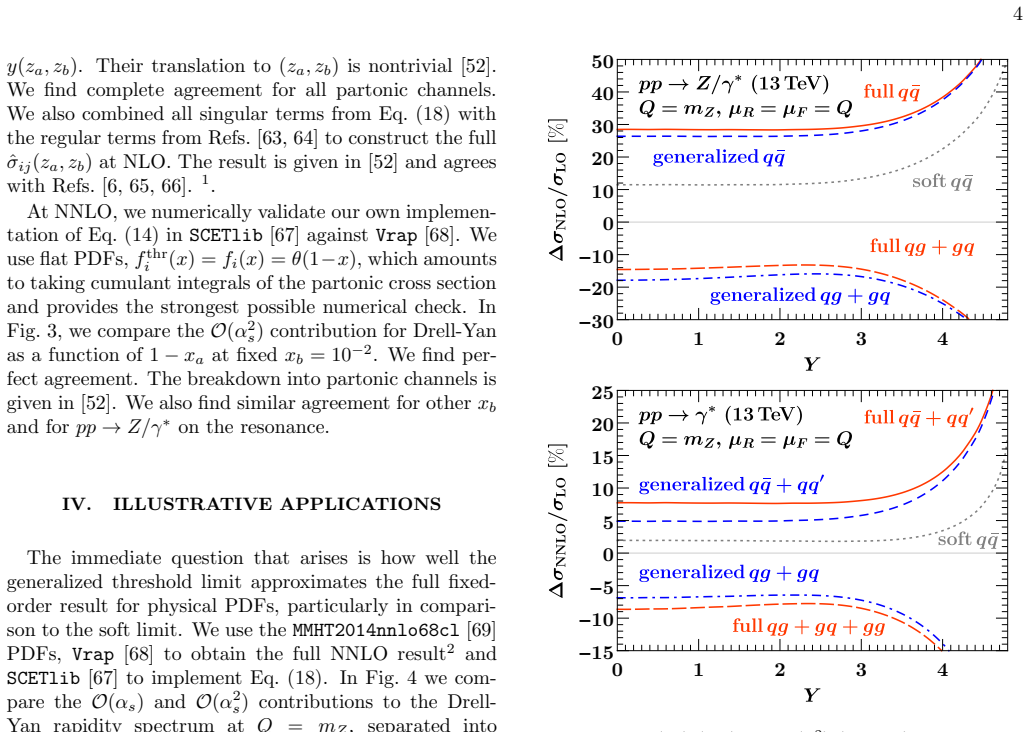
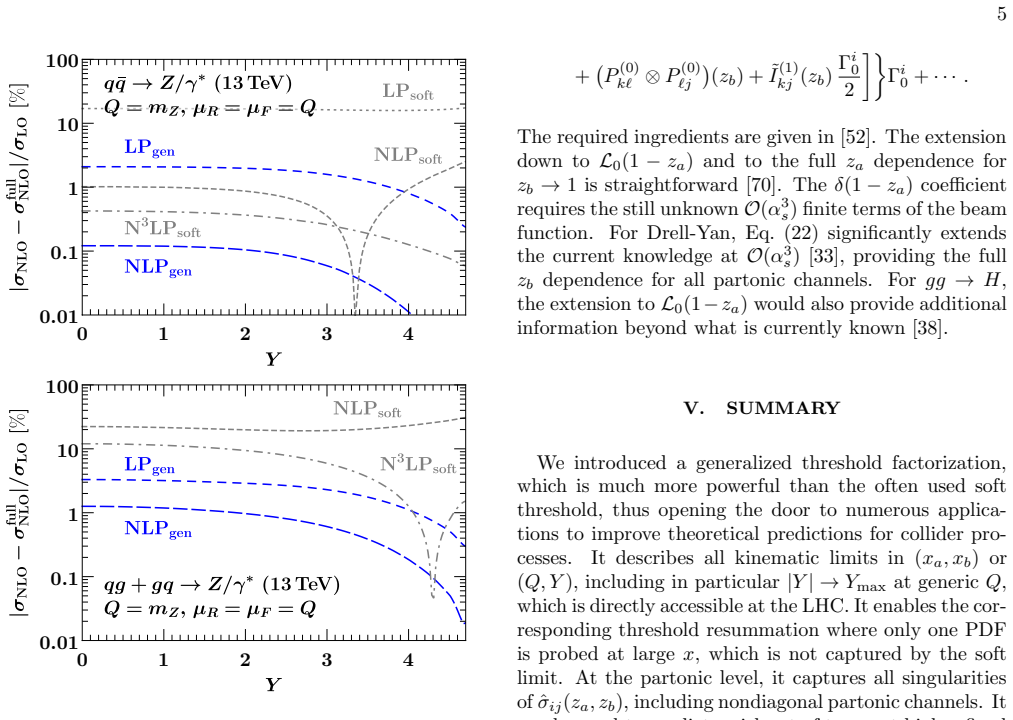
- The generalized threshold approximation reproduces the full Drell-Yan and $gg\to H$ rapidity spectra at $O(\alpha_s)$ and $O(\alpha_s^2)$ in all partonic channels, whereas the standard soft-threshold approximation fails for gluon-initiated channels and gives only a poor approximation for the $q\bar q$ channel.
- At the partonic level, the leading-power generalized expansion contains the entire next-to-leading-power soft expansion, so a single order of the generalized expansion captures two orders of the soft expansion.
- Equation (17) provides the resummation of large-$x$ logarithms in rapidity-dependent observables when only one PDF is probed near $x\to 1$, the situation relevant for resummation-improved PDF fits.
- The theorem predicts a rich set of $\mathrm{N}^3\mathrm{LO}$ threshold logarithms for any color-singlet process, including the full dependence on the non-threshold momentum fraction $z_b$, starting with the $L_5(1-z_a)\delta(1-z_b)$ coefficient given in Eq. (22).
- The two-dimensional convolution structure of Eq. (17) shows that rapidity-sensitive soft-threshold resummation cannot be reduced to a one-dimensional convolution; the paper identifies which published soft-threshold forms for rapidity spectra are incorrect and why.
Reading between the lines
- The same one-sided factorization should carry over to other color-singlet-like final states, such as associated production with a jet or an identified hadron, with the modified beam function replaced by the appropriate generalized jet or fragmentation function.
- The sharpest test of the theorem will be the fully differential $\mathrm{N}^3\mathrm{LO}$ result for Drell-Yan and $gg\to H$: if Eq. (22)'s predicted $L_5$ and $L_4$ coefficients hold, resummation to $\mathrm{N}^3\mathrm{LL}$ in the generalized threshold limit becomes a practical default for rapidity spectra.
- The paper's reliance on full inclusiveness over transverse momenta suggests that a $q_T$-vetoed version of the same observable is the natural place to look for corrections: there the ultra-soft and Glauber cancellation is less protected, and residual power corrections may become numerically visible.
Signed reviews
Editorial analysis
A structured set of objections, weighed in public.
Referee Report
Summary. The paper derives a generalized threshold factorization theorem for color-singlet production, valid in the limit x_a → 1 for generic x_b (and symmetrically x_b → 1 for generic x_a). The central result, Eq. (17), expresses the cross section as a hard function times a sum of a threshold-PDF convolved with a (modified) beam function, with a soft-subtraction term for the overlap. The authors derive the theorem in SCET, introduce a new modified beam function, compute its matching coefficients through O(α_s^2) for quarks and O(α_s) for gluons, perform an analytic NLO check against published results in (z, y) variables for all partonic channels, and an NNLO numerical check against Vrap using flat PDFs. They use the theorem to predict a set of N3LO logarithmic terms and to identify the correct soft-threshold rapidity factorization among competing results in the literature.
Significance. If correct, this is the weakest known kinematic limit in which the process-dependent hard function factorizes, and it materially extends the domain of threshold resummation: it captures the full singular dependence in one momentum fraction while keeping the other exact, including flavor-nondiagonal channels at leading power, and it resolves conflicting soft-threshold results for rapidity spectra. The paper supplies strong evidence: the SCET derivation is standard and detailed in the supplemental material; NLO analytic agreement is shown in all partonic channels; the NNLO numerical validation against Vrap with flat PDFs shows the expected power-law vanishing of the difference; and the N3LO logarithmic predictions follow from RGE evolution rather than fitted constants. The new modified beam function is a useful ingredient in its own right. The only caveat, which I do not regard as blocking, is that the qT-differential factorization in Eq. (12) is not directly validated against an independent calculation; however, the main qT-integrated result in Eq.
minor comments (4)
- [Section II, after Eq. (11)] The assertion that ultra-soft and Glauber modes cancel after Eq. (11) is brief for a theorem that is qT-differential in Eq. (12); please add one or two sentences outlining the scale-separation argument (the measurement is inclusive over perpendicular momenta at the Glauber scale λ_QCD Q) and pointing to the supplemental discussion.
- [Section III, Fig. 3] The NNLO validation is for the qT-integrated factorization Eq. (14), not for the qT-differential theorem in Eq. (12); stating this explicitly would help the reader understand the scope of the numerical check.
- [Equation (22)] The ellipsis in Eq. (22) hides the lower logarithmic powers L0(1−z_a), L1(1−z_a), and L2(1−z_a); consider replacing it with an explicit placeholder or a note in the text that these terms are collected in the supplemental material.
- [Supplement, Sec. E.3] The two-loop modified beam function expressions are described as 'available from the authors upon request'; for a fully reproducible supplement, including them as auxiliary files would be preferable.
Circularity Check
No significant circularity: the generalized threshold factorization is derived from SCET with independent, benchmarked ingredients and validated against fixed-order code.
full rationale
The derivation chain is: Eq. (12) is obtained by SCET sector decomposition, Eq. (14) by integrating over qT, and Eq. (17) by symmetrizing and subtracting the soft overlap; each step uses mode definitions and momentum-conservation arguments rather than assuming the target result. The beam functions and threshold PDFs are external ingredients from the literature, and the new modified beam function in Eq. (15) is defined by projecting the known double-differential beam function, with its matching coefficients computed from the published results in Refs. [55,56]. The N3LO log terms in Eq. (22) are obtained from the RGE with published anomalous dimensions; the undetermined finite terms are explicitly separated and are not presented as predictions. The central factorization is not fitted to the quantities it predicts: the NNLO validation is against Vrap, an independent fixed-order code, using flat PDFs, and the difference is shown to vanish as a power in 1 - x_a. The paper does cite prior work by the same authors (e.g., Refs. [39-44,58]) for beam-function ingredients, but those are published, parameter-free results and are not used to forbid alternatives; they do not make the derivation circular. The unproven usoft/Glauber cancellation after Eq. (11) is a load-bearing physical assumption inherited from inclusive collinear factorization, but it is an external input and correctness risk rather than a step that reduces the conclusion to its own definition, so it is not a circularity under the rubric used here.
Assumptions & free parameters
assumptions (5)
- domain assumption SCET correctly describes QCD in the λ ≪ 1 limit and the mode decomposition of Table S1 captures the relevant degrees of freedom.
- domain assumption Ultra-soft and Glauber modes cancel because the measurement is inclusive at the scale λ_QCD Q.
- domain assumption The threshold PDF f^thr_i factorizes as in Refs. [53,54], splitting the P_n and P_s modes.
- domain assumption Inclusive and double-differential beam functions match onto PDFs for t ≫ Λ_QCD^2 via Eq. (10).
- standard math The cusp and beam-function anomalous dimensions and PDF splitting functions are as known from Refs. [41-44,78].
invented entities (1)
-
Modified beam function \tilde B_j(\tilde t,x)
independent evidence
Cite this review
Pith. "Pith review of Generalized Threshold Factorization with Full Collinear Dynamics." pith.science (2026). https://pith.science/paper/TANS7Y5Z
@misc{pith2026190800985,
  author       = {Pith},
  title        = {Pith review of: Generalized Threshold Factorization with Full Collinear Dynamics},
  year         = {2026},
  howpublished = {\url{https://pith.science/paper/TANS7Y5Z}},
  note         = {Machine review of arXiv:1908.00985}
}
abstract
Soft threshold factorization has been used extensively to study hadronic collisions. It is derived in the limit where the momentum fractions $x_{a,b}$ of both incoming partons approach $x_{a,b}\to 1$. We present a generalized threshold factorization theorem for color-singlet processes, which holds in the weaker limit of only $x_a \to 1$ for generic $x_b$ (or vice versa), corresponding to the limit of large rapidity but generic invariant mass of the produced color singlet. It encodes the complete soft and/or collinear singular structure in the partonic momentum fractions to all orders in perturbation theory, including in particular flavor-nondiagonal partonic channels at leading power. It provides a more powerful approximation than the classic soft threshold limit, capturing a much larger set of contributions. We demonstrate this explicitly for the Z and Higgs rapidity spectrum to NNLO, and we use it to predict a nontrivial set of its N3LO contributions. Our factorization theorem provides the relevant resummation of large-$x$ logarithms in the rapidity spectrum required for resummation-improved PDF fits. One of our factorization ingredients is a new beam function closely related to the N-jettiness beam function. As a byproduct, we identify the correct soft threshold factorization for rapidity spectra among the differing results in the literature.
Figures
Figures from the paper (2 more)
Forward citations
Cited by 2 Pith papers
-
A Toolbox for $q_T$ and $0$-Jettiness Subtractions at N$^3$LO
The paper provides the complete three-loop singular subtraction terms for qT and 0-jettiness and derives the first threshold predictions for the three-loop beam-function coefficients, later confirmed by direct calculation.
-
Beyond Scale Variations: Perturbative Theory Uncertainties from Nuisance Parameters
A framework that turns missing higher-order perturbative coefficients into fit-able theory nuisance parameters, giving correlated and statistically meaningful theory uncertainties.
Reference graph
Works this paper leans on
-
[1]
G. T. Bodwin, Phys. Rev. D31, 2616 (1985), [Erratum: Phys. Rev.D34,3932(1986)]
1985
-
[2]
J. C. Collins, D. E. Soper, and G. F. Sterman, Nucl. Phys. B261, 104 (1985)
1985
-
[3]
J. C. Collins, D. E. Soper, and G. F. Sterman, Nucl. Phys. B308, 833 (1988)
1988
-
[4]
G. F. Sterman, Nucl. Phys. B281, 310 (1987)
1987
- [5]
-
[6]
V. Ravindran, J. Smith, and W. L. van Neerven, Nucl. Phys. B767, 100 (2007), arXiv:hep-ph/0608308
arXiv 2007
-
[7]
D. Westmark and J. F. Owens, Phys. Rev. D95, 056024 (2017), arXiv:1701.06716 [hep-ph]
arXiv 2017
-
[8]
P. Banerjee, G. Das, P. K. Dhani, and V. Ravindran, Phys. Rev. D97, 054024 (2018), arXiv:1708.05706 [hep- ph]
arXiv 2018
Show all 84 references
-
[9]
Banerjee, G
P. Banerjee, G. Das, P. K. Dhani, and V. Ravindran, Phys. Rev. D98, 054018 (2018), arXiv:1805.01186 [hep- ph]
2018 arXiv
-
[10]
Appell, G
D. Appell, G. F. Sterman, and P. B. Mackenzie, Nucl. Phys. B309, 259 (1988)
1988
-
[11]
Magnea, Nucl
L. Magnea, Nucl. Phys. B349, 703 (1991)
1991
-
[12]
G. P. Korchemsky and G. Marchesini, Nucl. Phys. B406, 225 (1993), arXiv:hep-ph/9210281
1993 arXiv
-
[13]
Contopanagos, E
H. Contopanagos, E. Laenen, and G. F. Sterman, Nucl. Phys. B484, 303 (1997), arXiv:hep-ph/9604313
1997 arXiv
-
[14]
Catani, M
S. Catani, M. L. Mangano, P. Nason, and L. Trentadue, Nucl. Phys. B478, 273 (1996), arXiv:hep-ph/9604351
1996 arXiv
-
[15]
A. V. Belitsky, Phys. Lett. B442, 307 (1998), arXiv:hep- ph/9808389
1998
- [16]
- [17]
-
[18]
Idilbi, X.-d
A. Idilbi, X.-d. Ji, and F. Yuan, Nucl. Phys. B753, 42 (2006), arXiv:hep-ph/0605068
2006 arXiv
-
[19]
Mukherjee and W
A. Mukherjee and W. Vogelsang, Phys. Rev. D73, 074005 (2006), arXiv:hep-ph/0601162
2006 arXiv
-
[20]
Bolzoni, Phys
P. Bolzoni, Phys. Lett. B643, 325 (2006), arXiv:hep- ph/0609073
2006
-
[21]
Becher, M
T. Becher, M. Neubert, and G. Xu, JHEP 07, 030 (2008), arXiv:0710.0680 [hep-ph]
2008 arXiv
-
[22]
Bonvini, S
M. Bonvini, S. Forte, and G. Ridolfi, Nucl. Phys. B847, 93 (2011), arXiv:1009.5691 [hep-ph]
2011 arXiv
-
[23]
Bonvini, S
M. Bonvini, S. Marzani, J. Rojo, L. Rottoli, M. Ubiali, R. D. Ball, V. Bertone, S. Carrazza, and N. P. Hartland, JHEP 09, 191 (2015), arXiv:1507.01006 [hep-ph]
2015 arXiv
-
[24]
B. Fuks, M. Klasen, D. R. Lamprea, and M. Rothering, Eur. Phys. J. C73, 2480 (2013), arXiv:1304.0790 [hep- ph]
2013 arXiv
- [25]
-
[26]
Schmidt and M
T. Schmidt and M. Spira, Phys. Rev. D93, 014022 (2016), arXiv:1509.00195 [hep-ph]
2016 arXiv
-
[27]
A. A H, A. Chakraborty, G. Das, P. Mukherjee, and V. Ravindran, (2019), arXiv:1905.03771 [hep-ph]
2019 arXiv
-
[28]
Bonocore, E
D. Bonocore, E. Laenen, L. Magnea, L. Vernazza, and C. D. White, JHEP 12, 121 (2016), arXiv:1610.06842 [hep-ph]
2016 arXiv
-
[29]
Del Duca, E
V. Del Duca, E. Laenen, L. Magnea, L. Vernazza, and C. D. White, JHEP 11, 057 (2017), arXiv:1706.04018 [hep-ph]
2017 arXiv
-
[30]
Beneke, A
M. Beneke, A. Broggio, M. Garny, S. Jaskiewicz, R. Szafron, L. Vernazza, and J. Wang, JHEP 03, 043 (2019), arXiv:1809.10631 [hep-ph]
2019 arXiv
-
[31]
Anastasiou, C
C. Anastasiou, C. Duhr, F. Dulat, E. Furlan, T. Gehrmann, F. Herzog, and B. Mistlberger, Phys. Lett. B737, 325 (2014), arXiv:1403.4616 [hep-ph]
2014 arXiv
-
[32]
Ahmed, M
T. Ahmed, M. Mahakhud, N. Rana, and V. Ravindran, Phys. Rev. Lett. 113, 112002 (2014), arXiv:1404.0366 [hep-ph]
2014 arXiv
-
[33]
Ahmed, M
T. Ahmed, M. K. Mandal, N. Rana, and V. Ravindran, Phys. Rev. Lett. 113, 212003 (2014), arXiv:1404.6504 [hep-ph]
2014 arXiv
-
[34]
de Florian, J
D. de Florian, J. Mazzitelli, S. Moch, and A. Vogt, JHEP 10, 176 (2014), arXiv:1408.6277 [hep-ph]
2014 arXiv
-
[35]
Y. Li, A. von Manteuffel, R. M. Schabinger, and H. X. Zhu, Phys. Rev. D91, 036008 (2015), arXiv:1412.2771 [hep-ph]
2015 arXiv
-
[36]
Anastasiou, C
C. Anastasiou, C. Duhr, F. Dulat, E. Furlan, T. Gehrmann, F. Herzog, A. Lazopoulos, and B. Mistl- berger, JHEP 05, 058 (2016), arXiv:1602.00695 [hep-ph]
2016 arXiv
-
[37]
Dulat, B
F. Dulat, B. Mistlberger, and A. Pelloni, JHEP 01, 145 (2018), arXiv:1710.03016 [hep-ph]
2018 arXiv
-
[38]
Dulat, B
F. Dulat, B. Mistlberger, and A. Pelloni, Phys. Rev. D99, 034004 (2019), arXiv:1810.09462 [hep-ph]
2019 arXiv
-
[39]
I. W. Stewart, F. J. Tackmann, and W. J. Waalewijn, Phys. Rev. D81, 094035 (2010), arXiv:0910.0467 [hep- ph]
2010 arXiv
-
[40]
I. W. Stewart, F. J. Tackmann, and W. J. Waalewijn, Phys. Rev. Lett. 105, 092002 (2010), arXiv:1004.2489 [hep-ph]
2010 arXiv
-
[41]
I. W. Stewart, F. J. Tackmann, and W. J. Waalewijn, JHEP 09, 005 (2010), arXiv:1002.2213 [hep-ph]
2010 arXiv
-
[42]
C. F. Berger, C. Marcantonini, I. W. Stewart, F. J. Tack- mann, and W. J. Waalewijn, JHEP 04, 092 (2011), arXiv:1012.4480 [hep-ph]
2011 arXiv
-
[43]
J. R. Gaunt, M. Stahlhofen, and F. J. Tackmann, JHEP 04, 113 (2014), arXiv:1401.5478 [hep-ph]
2014 arXiv
-
[44]
Gaunt, M
J. Gaunt, M. Stahlhofen, and F. J. Tackmann, JHEP 08, 020 (2014), arXiv:1405.1044 [hep-ph]
2014 arXiv
-
[45]
Melnikov, R
K. Melnikov, R. Rietkerk, L. Tancredi, and C. Wever, JHEP 02, 159 (2019), arXiv:1809.06300 [hep-ph]
2019 arXiv
-
[46]
Melnikov, R
K. Melnikov, R. Rietkerk, L. Tancredi, and C. Wever, JHEP 06, 033 (2019), arXiv:1904.02433 [hep-ph]
2019 arXiv
-
[47]
C. W. Bauer, S. Fleming, and M. E. Luke, Phys. Rev. D63, 014006 (2000), arXiv:hep-ph/0005275
2000 arXiv
-
[48]
C. W. Bauer, S. Fleming, D. Pirjol, and I. W. Stewart, Phys. Rev. D63, 114020 (2001), arXiv:hep-ph/0011336
2001 arXiv
-
[49]
C. W. Bauer and I. W. Stewart, Phys. Lett. B516, 134 (2001), arXiv:hep-ph/0107001
2001 arXiv
-
[50]
C. W. Bauer, D. Pirjol, and I. W. Stewart, Phys. Rev. D65, 054022 (2002), arXiv:hep-ph/0109045
2002 arXiv
-
[51]
C. W. Bauer, S. Fleming, D. Pirjol, I. Z. Rothstein, and I. W. Stewart, Phys. Rev. D66, 014017 (2002), arXiv:hep-ph/0202088
2002 arXiv
-
[52]
See Supplemental Material at the end of this preprint
-
[53]
Fleming and O
S. Fleming and O. Z. Labun, Phys. Rev. D91, 094011 (2015), arXiv:1210.1508 [hep-ph]
2015 arXiv
-
[54]
A. H. Hoang, P. Pietrulewicz, and D. Samitz, Phys. Rev. D93, 034034 (2016), arXiv:1508.04323 [hep-ph]
2016 arXiv
-
[55]
A. Jain, M. Procura, and W. J. Waalewijn, JHEP 04, 132 (2012), arXiv:1110.0839 [hep-ph]
2012 arXiv
-
[56]
J. R. Gaunt and M. Stahlhofen, JHEP 12, 146 (2014), arXiv:1409.8281 [hep-ph]
2014 arXiv
-
[57]
Procura, W
M. Procura, W. J. Waalewijn, and L. Zeune, JHEP 02, 117 (2015), arXiv:1410.6483 [hep-ph]
2015 arXiv
-
[58]
Lustermans, J
G. Lustermans, J. K. L. Michel, F. J. Tackmann, and 7 W. J. Waalewijn, JHEP03, 124 (2019), arXiv:1901.03331 [hep-ph]
2019 arXiv
-
[59]
A. V. Manohar, Phys. Rev. D68, 114019 (2003), arXiv:hep-ph/0309176
2003 arXiv
-
[60]
Becher, M
T. Becher, M. Neubert, and B. D. Pecjak, JHEP 01, 076 (2007), arXiv:hep-ph/0607228
2007 arXiv
- [61]
-
[62]
D. Kang, C. Lee, and I. W. Stewart, Phys. Rev. D88, 054004 (2013), arXiv:1303.6952 [hep-ph]
2013 arXiv
-
[63]
Anastasiou, L
C. Anastasiou, L. J. Dixon, and K. Melnikov, Nucl. Phys. Proc. Suppl. 116, 193 (2003), hep-ph/0211141
2003 arXiv
-
[64]
Anastasiou, L
C. Anastasiou, L. J. Dixon, K. Melnikov, and F. Petriello, Phys. Rev. Lett. 91, 182002 (2003), arXiv:hep-ph/0306192
2003 arXiv
-
[65]
Kubar, M
J. Kubar, M. Le Bellac, J. L. Meunier, and G. Plaut, Nucl. Phys. B175, 251 (1980)
1980
-
[66]
Mathews, V
P. Mathews, V. Ravindran, K. Sridhar, and W. L. van Neerven, Nucl. Phys. B713, 333 (2005), arXiv:hep- ph/0411018
2005
-
[67]
M. A. Ebert, J. K. L. Michel, F. J. Tack- mann, et al. , DESY-17-099 (2018), webpage: http://scetlib.desy.de
2018
-
[68]
Anastasiou, L
C. Anastasiou, L. J. Dixon, K. Melnikov, and F. Petriello, Phys. Rev. D69, 094008 (2004), arXiv:hep- ph/0312266
2004
-
[69]
L. A. Harland-Lang, A. D. Martin, P. Motylinski, and R. S. Thorne, Eur. Phys. J. C75, 204 (2015), arXiv:1412.3989 [hep-ph]
2015 arXiv
-
[70]
Billis, M
G. Billis, M. A. Ebert, J. K. L. Michel, and F. J. Tack- mann, (in preparation)
-
[71]
C. W. Bauer, F. J. Tackmann, J. R. Walsh, and S. Zu- beri, Phys. Rev. D85, 074006 (2012), arXiv:1106.6047 [hep-ph]
2012 arXiv
-
[72]
A. V. Manohar, T. Mehen, D. Pirjol, and I. W. Stewart, Phys. Lett. B539, 59 (2002), arXiv:hep-ph/0204229
2002 arXiv
-
[73]
R. V. Harlander, S. Liebler, and H. Mantler, Comput. Phys. Commun. 184, 1605 (2013), arXiv:1212.3249 [hep- ph]
2013 arXiv
-
[74]
R. V. Harlander, S. Liebler, and H. Mantler, Comput. Phys. Commun. 212, 239 (2017), arXiv:1605.03190 [hep- ph]
2017 arXiv
-
[75]
Laenen and G
E. Laenen and G. F. Sterman, in The Fermilab Meeting DPF 92. Proceedings, 7th Meeting of the American Phys- ical Society, Division of Particles and Fields, Batavia, USA, November 10-14, 1992. Vol. 1, 2 (1992) pp. 987– 989
1992
-
[76]
M. A. Ebert, J. K. L. Michel, and F. J. Tackmann, JHEP 05, 088 (2017), arXiv:1702.00794 [hep-ph]
2017 arXiv
-
[77]
H¨ oschele, J
M. H¨ oschele, J. Hoff, A. Pak, M. Steinhauser, and T. Ueda, Comput. Phys. Commun. 185, 528 (2014), arXiv:1307.6925 [hep-ph]
2014 arXiv
-
[78]
G. P. Korchemsky and A. V. Radyushkin, Nucl. Phys. B283, 342 (1987)
1987
-
[79]
Duhr and F
C. Duhr and F. Dulat, (2019), arXiv:1904.07279 [hep- th]. 8 Mode Lab frame Leptonic ( ˆY = 0) frame (+,−,⊥) (+,−,⊥) p¯n (q+,λ 2q−,λ √ q−q+) Q (1,λ 2,λ ) P¯n ( q+, Λ2 QCD q+ , ΛQCD ) Q (1,λ 2 QCD,λ QCD) Pn (Λ2 QCD q− ,q−, ΛQCD ) Q (λ2 QCD, 1,λ QCD) Ps ( 1 λ2 Λ2 QCD q− ,λ 2q−, Λ...
2019 arXiv
-
[80]
To restrict to q¯q→γ∗→𝓁+𝓁−, only the first term ∝Q2 q is kept
Results for Drell-Yan The Born cross section for Drell-Yan production, q¯q→Z/γ∗→𝓁+𝓁−, is given by σDY B,q = 4πα2 em 3NcQ2 [ Q2 q + (v2 q +a2 q)(v2 𝓁 +a2 𝓁)− 2Qqvqv𝓁(1−m2 Z/Q2) (1−m2 Z/Q2)2 +m2 ZΓ2 Z/Q4 ] , (S14) with Nc the number of colors, Qq the quark charge in units of |e|...
-
[81]
(S19) As in Ref
Results for gluon-fusion Higgs production For gluon-fusion Higgs production, gg→H, we use the effective Lagrangian in the limit m2 H≪ 4m2 t , Leff(mH) =− Ct 12πv αsGa µνGa,µνH, C t = 1 +αs 4π (5CA− 3CF ) +O(α2 s). (S19) As in Ref. [63], the Wilson coefficient Ct is always perturba...
-
[82]
(S14), and CV q¯q is the Wilson coefficient from matching the QCD quark vector current onto SCET
Hard functions The hard function for Drell-Yan production, q¯q→Z/γ∗→𝓁+𝓁−, is given by HDY ij (Q2,µ ) = ∑ q σDY B,q ( δiqδj¯q +δi¯qδjq ) |CV q¯q(Q2,µ )|2, (S36) where the sum runs over q ={u,d,c,s,b }, σDY B,q is the Born cross section given in Eq. (S14), and CV q¯q is the Wils...
-
[83]
Beam functions Fort≫ Λ2 QCD, the modified beam function defined by Eq. (15) can be matched onto PDFs as ˜Bi(t,x,µ ) = ∫ dz z ˜Iij(t,z,µ )fj (x z,µ )[ 1 +O (Λ2 QCD t )] , (S39) which directly follows from the analogous matching relations for the inclusive and double-differential b...
-
[84]
(S43) is exactly the same as for the inclusive beam function Iij(t,z,µ ) [43, 44], except for the different boundary terms I(n) ij (z)⁄= ˜I(n) ij (z)
Calculation of beam function boundary terms The structure of Eq. (S43) is exactly the same as for the inclusive beam function Iij(t,z,µ ) [43, 44], except for the different boundary terms I(n) ij (z)⁄= ˜I(n) ij (z). The definition in Eq. (15) implies for the matching coefficients ...
Reviewed August 14, 2026 · model on record in the stance chip above.
Discussion (0). Continue with ORCID to comment.