REVIEW 3 major objections 9 minor 44 references
It Takes Two to Tribo: Stochastic Charge Evolution in Repeated Binary Collisions of Acoustically Levitated Particles
T0 review · 3 major / 9 minor · reviewed 2026-08-06 · deepseek-v4-flash
Pith's one-line read Repeatedly colliding a levitated pair of identical insulating particles makes their cumulative charge converge to an exponential saturation curve, fitting the condenser model with $R^2>0.99$.
desk verdict A genuinely useful levitation-based single-pair tribocharging assay, but the saturation claim rides on an unquantified cross-talk that can manufacture an exponential plateau. read the letter →
The pith
A machine-rendered reading of the paper's core claim, the machinery that carries it, and where it could break.
The reading
What carries the argument
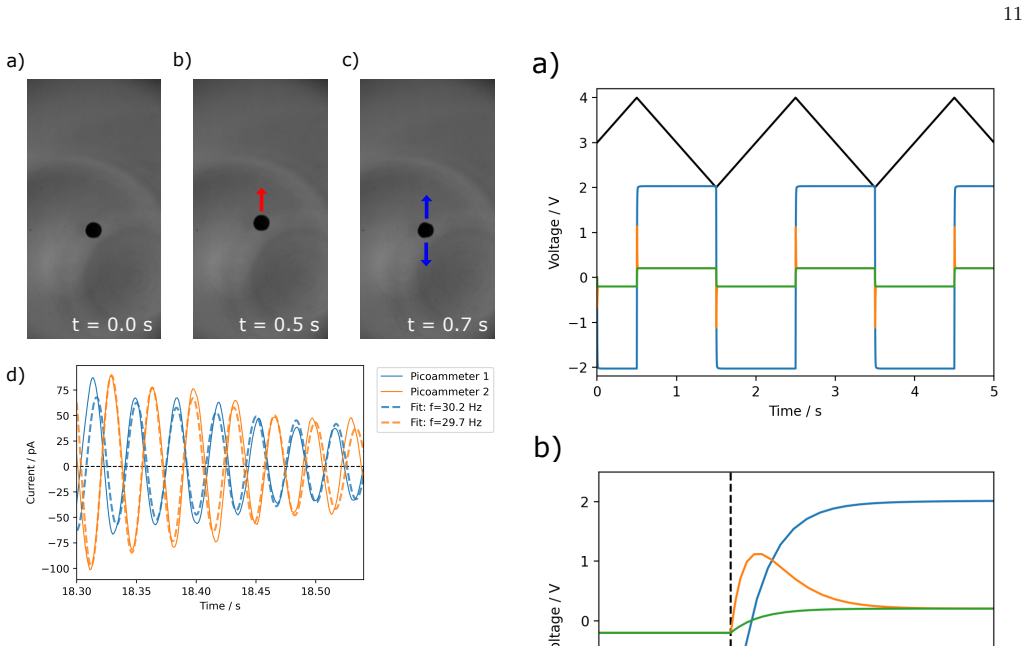
The load-bearing object is the condenser-model saturation curve, the equation $Q(t)=Q_{\mathrm{sat}}(1-e^{-(t-t_0)/\tau})$, which the paper fits to integrated charge measurements. The experimental machinery that makes the fit possible is an acoustic levitator with phased transducer arrays that can switch between a single trap and two separated traps, driving repeated collisions of a particle pair; each Faraday cage is an acoustically transparent mesh cup connected to a picoammeter, and the charge per event is obtained by integrating only the first current peak as a particle enters the cage, with the damped 30 Hz oscillations of the particle about the trap position excluded. The condenser model provides the prediction and the first-peak integration converts the raw current traces into the per-collision charge series that the prediction is tested against.
What would settle it
Repeat the collision sequence with the Faraday cages moved far enough apart that each cage sees only its own particle, and check charge conservation collision-by-collision: if the two measured charges no longer sum to an approximately constant value once cross-talk is removed, or if the $R^2>0.99$ exponential fit degrades, the reported saturation is not a property of the charging process. The paper's own Figure 6d shows the two particles' measured charge gradients disagree by more than 3 $\sigma$, so this conservation check is the natural arbiter.
Extended reading notes
Core claim
The paper's central claim is that repeated contact between two identical insulating particles does not simply accumulate charge linearly; the cumulative charge bends over and saturates according to an exponential approach to a maximum, exactly as a capacitor being charged through a resistor. The authors show this for an individual acoustically levitated pair of polystyrene particles across more than 45 collisions, fitting $Q(t)=Q_{\mathrm{sat}}(1-e^{-(t-t_0)/\tau})$ with $R^2 = 0.996$ and $0.993$ for the two particles. At the same time, the charge transferred in a single collision remains stochastic and is described by a skew-normal distribution whose location parameters for the two particles are opposite in sign and consistent with charge conservation. For graphite-coated conductive particles under identical conditions, charging is suppressed by about an order of magnitude, and the authors attribute the residual events to exposed insulating patches on the discontinuous coating.
Load-bearing premise
The entire saturation trend rests on treating the first integrated current peak in each Faraday cage as that particle's charge and assuming the partner particle's induced signal and the discarded cage oscillations are negligible; if those signals bias the measured charges, the exponential plateau could be an experimental artifact rather than the condenser model.
Editorial extensions
If this is right
- The early-time linear rise seen in earlier single-pair experiments is the low-collision limit of the exponential saturation curve, so short measurements systematically underestimate the eventual charge.
- A pair of identical insulating particles has a well-defined equilibrium charge $Q_{\mathrm{sat}}$; the existence of such a plateau constrains models that propose charge transfer accelerating with existing charge.
- The per-collision charge statistics remain skew-normal even as the cumulative charge follows a deterministic envelope, so any complete model must combine a stochastic transfer step with a saturating mean.
- Conductive surface layers reduce the plateau charge by about an order of magnitude, so surface conductivity—not bulk composition—can be the dominant control parameter in triboelectric evolution.
- The Faraday-cage levitator method resolves per-collision charge over tens of collisions, making single-pair experiments a practical platform for discriminating between charging models.
Reading between the lines
- If the saturation law is universal for same-material insulator pairs, bulk powder charges could be modelled as a superposition of independent pair-level capacitors; the skew-normal single-collision noise would then be the microscopic source of the non-Gaussian tails seen in granular charge distributions.
- The paper excludes the damped oscillation portion of the current trace; an editorially suggested extension is to fit the full oscillatory trace, which might recover the partner particle's induced signal and resolve the cross-talk asymmetry the paper acknowledges between the two measured charge gradients.
- The model implies a memoryless charging rate proportional to remaining capacity; a direct test would be to plot per-collision transferred charge against $(Q_{\mathrm{sat}}-Q)$ and check for a linear dependence, something the current dataset of 55 collisions could already approximately test.
- Varying the transducer drive voltage would change impact velocity; if $\tau$ shortens with impact speed, the condenser picture becomes a contact-area-dependent rate rather than a fixed time constant.
Signed reviews
Editorial analysis
A structured set of objections, weighed in public.
Referee Report
Summary. This paper describes an acoustic levitation platform (MultiLev/TinyLev-type) in which two 2 mm polystyrene beads are repeatedly brought into contact and separated, with each particle entering its own acoustically transparent Faraday cage coupled to a picoammeter. The charge per collision is obtained by integrating only the first current peak of each separation event. The principal result is that over 55 collisions of one particle pair, the cumulative charge of each particle is fit by the condenser-model form Q(t) = Qsat(1 - exp(-(t - t0)/tau)) with R^2 = 0.996 and 0.993, while the per-collision transfers are reported as compatible with skew-normal distributions. A control without separation shows constant net charge, and graphite-coated particles charge substantially less. The paper concludes that this is the first direct evidence for condenser-model saturation in an individual acoustically levitated particle pair.
Significance. This paper addresses a genuinely open question: whether the condenser model of triboelectric charging describes the cumulative charge evolution of an individual pair of identical insulating particles. The acoustically transparent Faraday-cage picoammeters receive careful two-stage calibration (linearity, offset/leakage parameters, and a 1.4% repeatability test), the no-separation control is a sensible negative control showing drift-free net charge in the same apparatus, the experiment extends the linear regime reported by Kline et al. to about 55 collisions, and the conductive-particle contrast experiments show that the same instrument can resolve different charging behavior. The paper also releases its data and processing code with DOIs, which makes the claims independently checkable. If the saturation claim survives the measurement-systematics scrutiny below, this would be the first individual-pair observation of condenser-model saturation in identical insulators and would materially constrain competing models of triboelectric charging.
major comments (3)
- [Section III A, Figs. 5-6, Table I] The central claim depends on the per-collision charge series being free of time-dependent measurement bias, but the paper itself quantifies an uncorrected systematic bias between the two channels. The per-collision gradients in Figure 6d (0.074 +/- 0.002 versus -0.052 +/- 0.003 pC per collision) disagree by roughly 6 sigma in magnitude, and the fitted saturation charges in Table I (8.75 +/- 0.16 versus 6.52 +/- 0.20 pC) disagree by roughly 9 sigma; the text attributes both to cross-talk between the opposing Faraday cages. However, no cross-talk calibration is reported at the 20 mm separation used for the main result, because the Figure 6b control was taken at a smaller separation, and the statement that 'the closer particle will dominate the measured charge' is not a quantitative bound. The Conclusions likewise acknowledge that particle charges 'cannot be fully separated at low cage separations,' but this limitation is stated qualitatively. Because the cross-talk signal scales with the partner particle's growing charge and is uncorrected, it may impose a time-dependent bias on each series; the first-peak integration, adopted precisely because the signal reverses at the displacement maximum, is the part of the trace most sensitive to the simultaneous motion of the two particles. The revision should calibrate the residual cross-talk at the operating separation (for example, by moving one particle alone and recording the apparent signal in the opposing cage), correct or bound it, and redo the fits. The authors should also state explicitly whether Figure 6d and Figure 7 describe the same particle pair and whether the cage separation was changed between them, and they should verify that the first-peak fraction of the total integrated current is constant across the run by computing the full-trace integral (including the oscillations) for each event.
- [Section III A, Figs. 6-7, Table I] The headline claim rests on a single particle pair: one 55-collision run. With n = 1, the statement that the authors 'demonstrate for the first time that the cumulative charge evolution of an individual acoustically levitated particle pair follows the saturation behaviour predicted by the condenser model' is stronger than the evidence supports; a single pair is consistent with the model, but demonstration requires either replicate pairs showing the same saturation (with the scatter of Qsat and tau reported) or a substantially softened claim. The revision should also clarify whether the exponential fit in Figure 7a is the extended version of the same dataset shown as linear fits in Figure 6d, and if so, how the change of cage separation between the two panels is accounted for in the fitted series.
- [Section III A, Eq. (3), Table I] The R^2 > 0.99 agreement is a consistency check rather than a test of the condenser model, because Qsat, tau, and t0 are free parameters fit to the same dataset that is offered as evidence. With 55 points and a saturating functional form, a high R^2 is expected even for a different monotonically saturating process. The authors should (i) report residuals and compare Eq. (3) against alternatives (for example, linear, power-law, or hyperbolic saturation) using an information criterion; (ii) fit the two charge series jointly with a common t0, and possibly a common tau, since the collisions are simultaneous; and (iii) examine the internal consistency of the fitted parameters, for example the relation between the mean per-collision transfer xi = 0.148 pC per collision, the roughly 4 s collision cycle, and the initial slope Qsat/tau of about 0.057 pC/s, which currently differ by a factor of order 1.5 for particle 1.
minor comments (9)
- [Section III A, Eq. (3)] The text below Eq. (3) refers to 'the initial time tau_0', but the equation and Table I use t0; align the notation.
- [Table I] The t0 values (-20.41 and -21.34 s) are reported without uncertainties, and the fitted curves imply an apparent charge of about -1.2 and -0.8 pC at t = 0; the paper should state whether this is an initial charge or an extrapolation artifact.
- [Table I, Fig. 7b] The skew-normal shape parameter alpha is reported with standard errors of order 10^7 (3.65 x 10^7 and 3.79 x 10^6), which indicates that alpha is not identifiable from 55 collisions and that the (xi, omega, alpha) covariance is degenerate; the abstract's statement that individual collisions are 'described by skew-normal distributions' overstates the evidence, and the authors should report the sample mean of the per-collision transfer with its standard error, or a likelihood-ratio test of alpha = 0.
- [Section III A, Fig. 7b paragraph] The statement that the two location parameters 'agree within one standard deviation' is inaccurate: the difference of 0.361 pC has a combined standard error of about 0.19 pC, so the data are consistent with charge conservation only at the roughly 2-sigma level.
- [Section III A, Fig. 6d paragraph] The text says the Figure 6d gradients 'don't quite overlap within 3 confidence intervals', but the two magnitudes differ by about 6 sigma; since this discrepancy is the evidence for cross-talk, it should be stated with its actual significance.
- [Section III A, Appendix] The in-text reference to 'Appendix Figure 5' should be to Appendix Figure 9, and the passage citing the ~30 Hz oscillation frequency should note that the underlying damped-oscillator fits in Figure 9 have reduced chi-squared values of 248 and 205, as acknowledged in the appendix.
- [Section III B and Fig. 8] The caption of Figure 8b and the Conclusions refer to 'graphene-coated' particles, while the text and Figure 8a describe 'graphite-coated' particles; the terminology should be made consistent, and the coating material (commercial graphite spray versus graphene) should be stated precisely.
- [Table I, Section III A] The text claims a 'low parameter uncertainty (<2%)', but Table I lists relative uncertainties of 3.1% for Qsat of particle 2 and 4.5-6.6% for the tau values; the claim should be revised.
- [Data Availability Statement] The data are licensed under 'GPL-4.0'; since the GPL is currently at version 3, the intended license (likely GPL-3.0 or CC-BY-4.0) should be confirmed.
Circularity Check
No significant circularity: the condenser-model fit is a standard model test, and the acknowledged cross-talk limitation is a measurement concern, not a circular argument.
full rationale
After walking the derivation chain, I find no circular step that satisfies the required quoted-reduction test. The central empirical claim is that the cumulative charge of one acoustically levitated pair saturates according to the condenser model; the paper fits Eq. (3), Q(t)=Qsat(1-exp(-(t-t0)/tau)), to the measured charge series and reports R^2>0.99. This is a model-validation fit with Qsat, tau, and t0 as free parameters; no fitted parameter is renamed as an independent prediction, and the functional form is not derived from the data being fitted. The model equation is attributed to external prior work (refs 18,19), not to a self-citation chain, and the per-collision skew-normal description (Eq. 4) is a separate, non-feed-back component. The paper's self-citations (e.g., refs 3, 23, 32, 39) are contextual or instrumental and do not carry the saturation claim. The manuscript itself flags a genuine measurement limitation in Section III A and the Conclusions: at low cage separations 'the charge of one particle cannot be completely separated from an opposing charge in the other,' and Figure 6d shows the two particles' measured charge gradients disagree by more than 3 sigma; the fitted Qsat values in Table I also differ by roughly 10 sigma. This is a serious measurement-validity threat and could make the apparent saturation an artifact, but it is a correctness risk, not a circular derivation, because the charge series are independent inputs rather than outputs of the model being tested. Therefore the circularity score is 0.
Assumptions & free parameters
free parameters (7)
- Condenser model saturation charge Qsat_1 and Qsat_2 =
8.75 ± 0.16 pC and 6.52 ± 0.20 pC
- Condenser model time constant tau_1 and tau_2 =
154 ± 6.9 s and 183 ± 12 s
- Condenser model initial time t0 =
-20.41 s and -21.34 s
- Skew-normal location parameter xi =
0.148 ± 0.157 pC (particle 1), -0.213 ± 0.114 pC (particle 2)
- Skew-normal scale omega =
0.170 ± 0.046 pC and 0.173 ± 0.041 pC
- Skew-normal shape parameter alpha =
-0.40 ± 3.65e7 and 1.21 ± 3.79e6
- Picoammeter feedback resistance and offset =
Rf 6.398 ± 0.0013 GOhm, intercept 30.61 ± 0.09 mV; Rf 6.365 ± 0.0023 GOhm, intercept 31.95 ± 0.15 mV
assumptions (5)
- domain assumption The first current peak from a particle entering the Faraday cage is proportional to its net charge, and the later oscillation currents can be discarded.
- domain assumption After moving the Faraday cages apart, the measured current is dominated by the closer particle, so cross-talk does not distort the saturation trend.
- domain assumption The condenser model exponential form is the correct function to fit to cumulative charge evolution of identical insulating particle pairs.
- domain assumption A sprayed graphite layer makes the particle surface conductive enough to classify the triboelectric behaviour as conductive.
- domain assumption The acoustic trap and Faraday cage measurements do not discharge the particles or add net charge during the experiment.
Cite this review
Pith. "Pith review of It Takes Two to Tribo: Stochastic Charge Evolution in Repeated Binary Collisions of Acoustically Levitated Particles." pith.science (2026). https://pith.science/paper/TB5TH5DK
@misc{pith2026260805083,
  author       = {Pith},
  title        = {Pith review of: It Takes Two to Tribo: Stochastic Charge Evolution in Repeated Binary Collisions of Acoustically Levitated Particles},
  year         = {2026},
  howpublished = {\url{https://pith.science/paper/TB5TH5DK}},
  note         = {Machine review of arXiv:2608.05083}
}
abstract
The mechanisms governing triboelectric charging between insulating particles of the same material remain an open question in nonequilibrium physics, with several competing models proposed to explain observed charging behaviour. Here, we investigate charge evolution in a minimal system consisting of two acoustically levitated particles undergoing repeated binary collisions. To quantify particle charge transfer, purpose-built Faraday cage picoammeters were developed and calibrated. The MultiLev acoustic levitation system was used alongside Ultraino simulations to generate transducer control signals, enabling controlled collision and separation of polystyrene (PS) particles. Although individual collision events exhibit stochastic charge transfer, described by skew-normal distributions, we demonstrate for the first time that the cumulative charge evolution of an individual acoustically levitated particle pair follows the saturation behaviour predicted by the condenser model of triboelectric charging, with fits achieving $R^2 > 0.99$. Under identical conditions, conductive graphite-coated PS particles also undergo charge transfer, but accumulate substantially less charge, consistent with the distinct charging behaviour expected for conductive materials.
Figures


Figures from the paper (7 more)



Reference graph
Works this paper leans on
-
[1]
D. J. Lacks and T. Shinbrot, Long-standing and unre- solved issues in triboelectric charging, Nature Reviews Chemistry3, 465 (2019)
work page 2019
-
[2]
H. Grosshans, W. Xu, S. Jantaˇ c, G. Ozler, and C. Wilms, Unmasking hidden ignition sources: A new approach to finding extreme charge peaks in powder processing, Journal of Loss Prevention in the Process Industries92, 105434 (2024)
work page 2024
- [3]
-
[4]
J. M´ endez Harper, D. Harvey, T. Huang, J. McGrath, D. Meer, and J. C. Burton, The lifetime of charged dust in the atmosphere, PNAS Nexus1, 1 (2022)
work page 2022
-
[5]
I. M. P. Houghton, K. L. Aplin, and K. A. Nicoll, Triboelectric Charging of Volcanic Ash from the 2011 Gr ´ ımsv¨ otn Eruption, Physical Review Letters111, 118501 (2013)
work page 2013
-
[6]
D. P. Reid and K. L. Aplin, Lab-based Martian analogue experiments investigating electric and magnetic fields of dust devils, Journal of Physics: Conference Series2702, 012020 (2024)
work page 2024
-
[7]
B. Hotte and P. Mehrani, Electrostatic Charging–Based Dry Separation of Graphite, Nickel oxide, and Lithium oxide, Minerals Engineering244, 110272 (2026)
work page 2026
- [8]
Show all 44 references
-
[9]
S. D. Cezan, A. A. Nalbant, M. Buyuktemiz, Y. Dede, H. T. Baytekin, and B. Baytekin, Control of triboelec- tric charges on common polymers by photoexcitation of organic dyes, Nature Communications10, 276 (2019)
2019
-
[10]
K. W. Biegaj, M. G. Rowland, T. M. Lukas, and J. Y. Y. Heng, Surface Chemistry and Humidity in Powder Elec- trostatics: A Comparative Study between Tribocharging and Corona Discharge, ACS Omega2, 1576 (2017)
2017
-
[11]
T. F. O’Hara, E. Player, G. Ackroyd, P. J. Caine, and K. L. Aplin, Surface Material Dependence in Powder Tri- boelectric Charging (2025)
2025
-
[12]
A. N. Alagha, E. Galindo, M. Conlon, J. Mu˜ niz, K. Azari, E. Butler-Jones, and M. Brochu, Surface chemistry anal- ysis of aluminum powders through triboelectric charging: Effect of composition, particle size distribution and mois- ture adsorption, Powder Technology468, 121636 (2026)
2026
-
[13]
M. I. Nimvari, A. Sowinski, and P. Mehrani, Investigation of the role of temperature on contact electrification of polyethylene particles, Powder Technology433, 119236 (2024)
2024
-
[14]
Gemine, S
T. Gemine, S. Dehareng, T. Andrianne, and G. Lumay, Influence of turbulence on the triboelectric charging of granular materials carried by an airflow, Phys. Rev. E 10.1103/pyfj-qtgp (2026)
2026 doi
-
[15]
Grosjean, M
G. Grosjean, M. Ostermann, M. Sauer, M. Hahn, C. M. Pichler, F. Fahrnberger, F. Pertl, D. M. Balazs, M. M. Link, S. H. Kim, D. L. Schrader, A. Blanco, F. Gracia, N. Mujica, and S. R. Waitukaitis, Adventitious carbon breaks symmetry in oxide contact electrification, Nature 651,...
2026
-
[16]
Grosjean and S
G. Grosjean and S. Waitukaitis, Asymmetries in tri- boelectric charging: Generalizing mosaic models to different-material samples and sliding contacts, Physical Review Materials7, 065601 (2023)
2023
-
[17]
Matsusaka, M
S. Matsusaka, M. Ghadiri, and H. Masuda, Electrification of an elastic sphere by repeated impacts on a metal plate, Journal of Physics D: Applied Physics33, 2311 (2000)
2000
-
[18]
Matsusaka and H
S. Matsusaka and H. Masuda, Electrostatics of particles, Advanced Powder Technology14, 143 (2003)
2003
-
[19]
Grosshans, G
H. Grosshans, G. Ozler, V. Veeravalli, and S. Jantaˇ c, Unifying Same- and Different-Material Particle Charg- ing through Stochastic Scaling, Physical Review X16, 011023 (2026)
2026
-
[20]
H. T. Baytekin, A. Z. Patashinski, M. Branicki, B. Baytekin, S. Soh, and B. A. Grzybowski, The Mo- saic of Surface Charge in Contact Electrification, Science 333, 308 (2011)
2011
-
[21]
Jantaˇ c and H
S. Jantaˇ c and H. Grosshans, Divergent Impact Charg- ing of Polymer Particles (2026), arXiv:2602.12951 [cond- mat]
2026 arXiv
-
[22]
Matsusaka, H
S. Matsusaka, H. Maruyama, T. Matsuyama, and M. Ghadiri, Triboelectric charging of powders: A review, Chemical Engineering Science65, 5781 (2010)
2010
-
[23]
T. F. O’Hara, D. P. Reid, G. L. Marsden, and K. L. Aplin, Faraday cup measurements of triboelectrically charged granular material: a modular interpretation methodol- ogy, Soft Matter 10.1039/D4SM01124D (2025)
2025 doi
-
[24]
W. Xu, S. Jantaˇ c, T. Matsuyama, and H. Grosshans, Spatially resolved measurement of the electrostatic charge of turbulent powder flows, Experiments in Flu- ids65, 10.1007/s00348-024-03791-3 (2024)
2024 doi
-
[25]
M. Lara, M. Flores, G. Castillo, S. Tassara, S. R. Wait- ukaitis, and N. Mujica, Particle size scaling of non- Gaussian granular charge distributions, Physical Review Materials10, 045604 (2026)
2026
-
[26]
Grosjean and S
G. Grosjean and S. Waitukaitis, Single-Collision Statis- tics Reveal a Global Mechanism Driven by Sample His- tory for Contact Electrification in Granular Media, Phys- ical Review Letters130, 098202 (2023)
2023
-
[27]
Chowdhury, M
F. Chowdhury, M. Ray, A. Passalacqua, P. Mehrani, and A. Sowinski, Electrostatic charging due to individual particle-particle collisions, Powder Technology381, 352 (2021)
2021
-
[28]
Obukohwo, A
O. Obukohwo, A. Sowinski, P. Mehrani, and H. Grosshans, CFD study of particle backflow in pneumatic conveying systems due to triboelectrification, Powder Technology418, 118285 (2023)
2023
-
[29]
A. G. Kline, M. X. Lim, and H. M. Jaeger, Precision measurement of tribocharging in acoustically levitated sub-millimeter grains, Review of Scientific Instruments 91, 023908 (2020)
2020
-
[30]
R. G. Harrison and D. Robert, A Faraday cup for charge measurements in biophysical and environmental field- work, Journal of Electrostatics135, 104062 (2025)
2025
-
[31]
Marzo, A
A. Marzo, A. Barnes, and B. W. Drinkwater, TinyLev: A multi-emitter single-axis acoustic levitator, Review of Scientific Instruments88, 085105 (2017)
2017
-
[32]
A. C. Barnes, T. F. O’Hara, and J. W. E. Drewitt, A simple low cost multi channel signal generator for ultra- sonic applications (2026), manuscript to be submitted to Review of Scientific Instruments. 13
2026
-
[33]
J. F. Davies, A. E. Haddrell, and J. P. Reid, Time- Resolved Measurements of the Evaporation of Volatile Components from Single Aerosol Droplets, Aerosol Sci- ence and Technology46, 666 (2012)
2012
-
[34]
Marzo, T
A. Marzo, T. Corkett, and B. W. Drinkwater, Ultraino: An Open Phased-Array System for Narrowband Air- borne Ultrasound Transmission, IEEE Transactions on Ultrasonics, Ferroelectrics, and Frequency Control65, 102 (2018)
2018
-
[35]
G. T. Silva and H. Bruus, Acoustic interaction forces be- tween small particles in an ideal fluid, Physical Review E90, 063007 (2014)
2014
-
[36]
Jaouen and F.-X
L. Jaouen and F.-X. B´ ecot, Acoustical characterization of perforated facings, The Journal of the Acoustical Society of America129, 1400 (2011)
2011
-
[37]
Bendali, M
A. Bendali, M. Fares, E. Piot, and S. Tordeux, Mathe- matical Justification of the Rayleigh Conductivity Model for Perforated Plates in Acoustics, SIAM Journal on Ap- plied Mathematics73, 438 (2013)
2013
-
[38]
Harrison, R Giles,Meteorological measurements and in- strumentation(John Wiley & Sons, 2015)
2015
-
[39]
R. G. Harrison and Karen L. Aplin, Multimode electrom- eter for atmospheric ion measurements, Review of Scien- tific Instruments71, 4683 (2000)
2000
-
[40]
Azzalini, A Class of Distributions Which Includes the Normal Ones, Scandinavian Journal of Statistics12, 171 (1985)
A. Azzalini, A Class of Distributions Which Includes the Normal Ones, Scandinavian Journal of Statistics12, 171 (1985)
1985
-
[41]
McElligott, A
A. McElligott, A. Guerra, M. J. Wood, A. D. Rey, A.-M. Kietzig, and P. Servio, TinyLev acoustically levitated wa- ter: Direct observation of collective, inter-droplet effects through morphological and thermal analysis of multiple droplets, Journal of Colloid and Interface Scie...
2022
-
[42]
Jantaˇ c, J
S. Jantaˇ c, J. Pelcov´ a, J. Sklen´ aˇ rov´ a, M. Dr´ apela, H. Grosshans, and J. Kosek, Triboelectric charging model for particles with rough surfaces, Advanced Powder Tech- nology36, 104787 (2025)
2025
-
[43]
Obukohwo, S
O. Obukohwo, S. Jantaˇ c, A. Sowinski, P. Mehrani, and H. Grosshans, A novel apparatus for particle-particle single contact triboelectrification experiments, Powder Technology , 122259 (2026)
2026
-
[44]
Morrell and D
M. Morrell and D. G. Grier, Acoustodynamic mass de- termination: Accounting for inertial effects in acoustic levitation of granular materials, Physical Review E108, 064903 (2023)
2023
Reviewed August 6, 2026 · model on record in the stance chip above.
Discussion (0). Continue with ORCID to comment.