REVIEW 3 major objections 5 minor 26 references
Automatic Text Summarization of Legal Cases: A Hybrid Approach
T0 review · 3 major / 5 minor · reviewed 2026-08-14 · deepseek-v4-flash
Pith's one-line read An unsupervised k-means and tf-idf hybrid, tested on one 200-page Australian case, reports higher ROUGE F-measures than three existing legal summarizers.
desk verdict Honest but thin student project; the k-means+tf-idf recipe is unremarkable and the single-case, length-matched evaluation doesn't support the 'favourably well' claim. read the letter →
The pith
A machine-rendered reading of the paper's core claim, the machinery that carries it, and where it could break.
The reading
What carries the argument
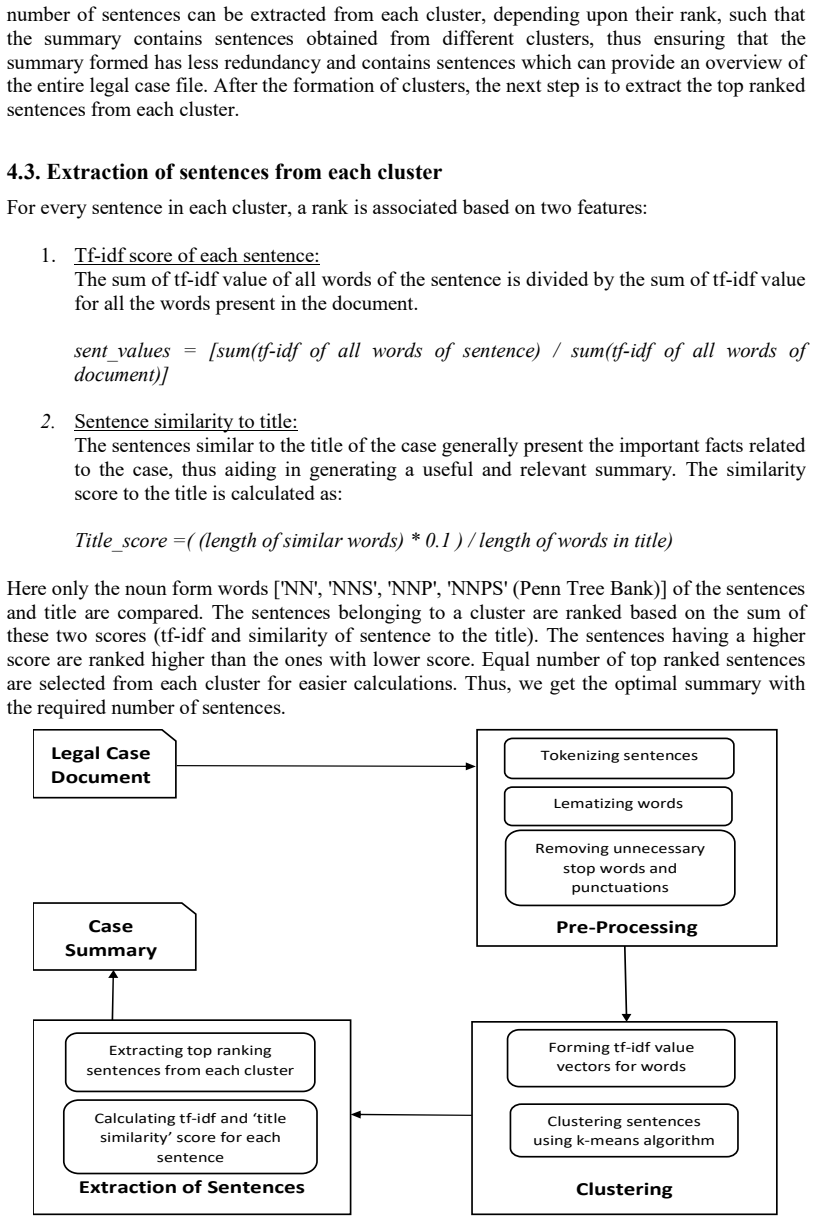
The load-bearing machinery is the cluster-then-rank selection process. Sentences are converted to tf-idf (term frequency-inverse document frequency) vectors, grouped by the k-means clustering algorithm into K similarity-based clusters, and then each sentence is scored as the sum of its normalized tf-idf weight and a title-similarity score that compares only noun forms against the case title. Equal numbers of top-ranked sentences are taken from each cluster, so the summary length is controlled and the final output is intended to represent the whole document with minimal redundancy.
What would settle it
Take a set of, say, twenty legal cases, obtain two or more independent human reference summaries for each, run the hybrid and the three baseline tools with all outputs fixed to a common length, and compare average ROUGE scores; if the hybrid no longer beats the baselines, or if random sentence selection from clusters matches its scores, the reported ranking would be refuted.
Extended reading notes
Core claim
The central claim is that ranking sentences by normalized tf-idf score plus similarity to the case title, and doing that within k-means clusters rather than over the whole document, makes an extractive summarizer competitive for long legal texts. ROUGE is a set of standard n-gram overlap measures for comparing machine summaries with human reference summaries; on the one case reported, the hybrid achieved ROUGE-1, ROUGE-2, ROUGE-L, and ROUGE-W F-measures of 27.88, 5.83, 33.50, and 11.38, each above TextSummarizer, SplitBrain, and ESummarizer. The paper attributes the result to low redundancy: because sentences are drawn from every cluster, the summary covers different parts of the case file instead of concentrating on the most frequent words. It also claims the method is computationally favorable and unsupervised, unlike approaches that need a training corpus.
Load-bearing premise
The load-bearing premise is that ROUGE scores computed against a single lawyer-written summary, with the proposed system's output length manually matched to that summary, provide a fair basis for ranking the methods.
Editorial extensions
If this is right
- According to the paper, legal case files can be summarized without labeled training data, which matters because annotated legal corpora are scarce.
- If the reported speed and stability hold, several-hundred-page cases can be reduced to usable briefs in minutes, while a graph-based method the paper tried on the same input failed with a memory error.
- Because the summary draws equally from every cluster, the method is designed to cover the full case rather than repeat dominant vocabulary, which is the paper's stated reason for its stronger ROUGE results.
- The paper's own next steps are automatic cluster-count selection, additional sentence-ranking features, and rhetorical-role structures for more formal legal briefs.
Reading between the lines
- An implied but untested consequence is that the reported ranking may depend on output length: the proposed system's summary was manually set to the reference length of about 150 sentences, whereas the online baselines likely produced shorter outputs, so a length-matched comparison would be the stronger test.
- Because the evaluation uses one case and one human reference summary, the margins are evidence of feasibility rather than general superiority; running the same pipeline across many cases with multiple independent reference summaries would show whether the advantage persists.
- A random-control experiment would sharpen the claim: if sentences selected at random from the clusters achieved similar ROUGE scores, then the tf-idf and title ranking, not the clustering, would be doing the work.
Signed reviews
Editorial analysis
A structured set of objections, weighed in public.
Referee Report
Summary. The paper proposes an unsupervised extractive text summarization method for legal case documents. The approach consists of pre-processing the input case file, embedding sentences with tf-idf vectors, clustering the sentences using k-means, and then selecting the top-ranked sentences from each cluster using a combination of tf-idf score and similarity to the case title. The authors evaluate the method on a single Australian legal case (Rush v Nationwide News Pty Ltd (No 7)) by comparing the automatically generated summary with the attorney-prepared summary using ROUGE-1, ROUGE-2, ROUGE-L, and ROUGE-W scores against three online summarization tools (TextSummarizer, SplitBrain, ESummarizer). The reported table shows higher ROUGE values for the proposed method, and the authors conclude that it performs favorably and that the generated summary closely resembles the attorney's summary.
Significance. If the reported comparative advantage were valid, the proposed hybrid would be a lightweight, unsupervised baseline for legal-case summarization that avoids the need for training data. The pipeline is clearly described and simple enough to reproduce, and the paper explicitly addresses the large size of legal documents as a motivating challenge. However, the empirical evidence presented is not sufficient to establish the central claim. The comparison is uncontrolled with respect to output length, is based on a single case and a single reference summary, and lacks any significance testing. The low absolute ROUGE scores further undermine the qualitative claim of close resemblance. The idea is reasonable, but the evaluation must be substantially strengthened before the comparative conclusion can be accepted.
major comments (3)
- [Section 5 and Table 1] The proposed system's output length is deliberately matched to the gold summary: Section 5 states that 'approximately 150 sentence summary was generated ... to match its length with the provided summary for better comparison.' The paper reports no output lengths for TextSummarizer, SplitBrain, or ESummarizer. Since ROUGE recall and F-measure are sensitive to candidate length, comparing a length-tuned candidate with length-uncontrolled baselines is not a fair test. The reported advantages in Table 1 could therefore be an artifact of length matching rather than better content selection.
- [Section 6 and Table 1] The evaluation uses exactly one legal case (Rush v Nationwide News Pty Ltd (No 7)) and exactly one human reference summary. No error bars, confidence intervals, or significance tests are provided. The differences among the systems in Table 1 are therefore indistinguishable from random variation. The assertion in Section 6 that the proposed method 'performs favourably well' is not supported by a single-case comparison, and the paper's own statement in Section 8 that real-world tests with attorneys have not been conducted does not mitigate this gap.
- [Section 8 and Table 1] The conclusion that the generated summary 'closely resembles' the attorney's summary is contradicted by the low absolute ROUGE scores in Table 1 (ROUGE-1 F=27.88, ROUGE-2 F=5.83, ROUGE-L F=33.5). A ROUGE-2 F-measure of 5.83 indicates very little bigram overlap, which does not support a qualitative claim of close resemblance. If this claim is intended, it needs to be backed by human evaluation or a more appropriate similarity metric; otherwise the wording should be moderated.
minor comments (5)
- [Throughout] The metric name is ROUGE, not ROGUE; the misspelling appears in the abstract, Sections 5 and 6, and in Table 1.
- [Section 4.3] The formula for title similarity has unbalanced parentheses: 'Title_score =( (length of similar words) * 0.1 ) / length of words in title)' has an extra closing parenthesis.
- [Section 5] The paper mentions algorithms such as the Elbow method for choosing the optimum number of clusters, but the actual value of K used in the experiments is never reported, which hinders reproducibility.
- [Table 1] The table header formatting makes it hard to read, and the name 'ESUMMERIZER' in the table is inconsistent with 'ESummarizer' used in Section 6.
- [References] References [11] through [14] are listed but do not appear to be cited in the body of the paper, and reference [3] appears to combine multiple distinct sources.
Circularity Check
No significant circularity found; the hybrid method's content derivation is self-contained, with only a minor length-matching evaluation concern.
full rationale
I traced the claimed derivation chain: Section 4 defines an unsupervised extractive pipeline (pre-processing, k-means clustering of tf-idf vectors, rank by tf-idf score and title similarity, and extraction of top sentences per cluster); Section 5 applies it to Rush v Nationwide and generates an approximately 150-sentence summary; Section 6 compares ROUGE scores against three online tools. No parameter is fitted to the reference summary's content, no equation defines the predicted ROUGE score in terms of the gold summary, and no load-bearing self-citation or imported uniqueness theorem appears. The author cites only external prior work, and the central scoring is independent of the training data because no training data are used. The only target-dependent element is the explicit length matching in Section 5 ('approximately 150 sentence summary was generated... to match its length with the provided summary for better comparison'), which is an evaluation-fairness risk rather than a circular derivation: it does not force the content selection or the ROUGE advantage by construction. The paper also candidly notes in Section 8 that real-world tests with attorneys have not been conducted, further supporting that the strong comparative claim is under-supported, but under-support is a correctness/evidence concern, not circularity. Therefore the derivation is self-contained and the circularity score is 0.
Assumptions & free parameters
free parameters (3)
- Title similarity weight multiplier =
0.1
- Number of clusters K for k-means
- Summary length =
150 sentences (approximately)
assumptions (4)
- domain assumption Euclidean distances between tf-idf vectors group sentences into meaningful topical clusters.
- ad hoc to paper Sentences similar to the title are more informative for legal briefs.
- ad hoc to paper Extracting equal numbers of sentences from each cluster ensures coverage with least redundancy.
- domain assumption ROUGE metrics validly measure summary quality against a single human-prepared summary.
Cite this review
Pith. "Pith review of Automatic Text Summarization of Legal Cases: A Hybrid Approach." pith.science (2026). https://pith.science/paper/TBR4B4TL
@misc{pith2026190809119,
  author       = {Pith},
  title        = {Pith review of: Automatic Text Summarization of Legal Cases: A Hybrid Approach},
  year         = {2026},
  howpublished = {\url{https://pith.science/paper/TBR4B4TL}},
  note         = {Machine review of arXiv:1908.09119}
}
read the original abstract
Manual Summarization of large bodies of text involves a lot of human effort and time, especially in the legal domain. Lawyers spend a lot of time preparing legal briefs of their clients' case files. Automatic Text summarization is a constantly evolving field of Natural Language Processing(NLP), which is a subdiscipline of the Artificial Intelligence Field. In this paper a hybrid method for automatic text summarization of legal cases using k-means clustering technique and tf-idf(term frequency-inverse document frequency) word vectorizer is proposed. The summary generated by the proposed method is compared using ROGUE evaluation parameters with the case summary as prepared by the lawyer for appeal in court. Further, suggestions for improving the proposed method are also presented.
Figures
Reference graph
Works this paper leans on
-
[1]
INTRODUCTION The amount of information and data has increased tremendously in every field over the years. With the limited human capacity of consuming information, it becomes paramount to extract only useful information out of the vast amount of unstructured data available. Thus, text summarization plays an important role in extracting useful pieces of in...
-
[2]
Automatic text summarization is broadly of two types:
BACKGROUND Summarization is a challenging sub-task of the broader text-to-text generation field of natural language processing (NLP)[3]. Automatic text summarization is broadly of two types:
-
[3]
Extractive Summarization: This method involves selecting the most useful and relevant sentences from the document to provide a summary. Here the sentences originally present in the document are used to form the summary, with no new sentences being formed. Extractive summaries produce a set of the most significant sentences from a document, exactly as they...
-
[4]
Abstractive Summarization: In this type of summarization, new sentences are formed which are relevant to the document. Here the gist of the document is represented using computer generated sentences, having close resemblance to the summary as produced by humans. Abstractive text summarization captures the salient features of the text corpus and summary is...
-
[5]
EXISTING APPROACHES Different kinds of methods have been proposed for text summarization in the legal domain. The earliest of works in this area include the “Fast Legal EXpert CONsultant” (FLEXICON) system developed by Gelbart and Smith (Gelbartand Smith, 1991a). FLEXICON is keyword-based, referencing against a large database of terms to find important re...
work page 1999
-
[6]
Pre-processing Pre-processing of the document is a vital part of any text summarization approach
THE PROPOSED SYSTEM The implementation is carried out in three different steps: pre-processing, clustering of similar sentences, extracting top ranked sentences from each cluster 4.1. Pre-processing Pre-processing of the document is a vital part of any text summarization approach. It is the foremost step of the proposed approach which includes removing of...
-
[7]
sent_values = [sum(tf-idf of all words of sentence) / sum(tf-idf of all words of document)]
Tf-idf score of each sentence: The sum of tf-idf value of all words of the sentence is divided by the sum of tf-idf value for all the words present in the document. sent_values = [sum(tf-idf of all words of sentence) / sum(tf-idf of all words of document)]
-
[8]
Sentence similarity to title: The sentences similar to the title of the case generally present the important facts related to the case, thus aiding in generating a useful and relevant summary. The similarity score to the title is calculated as: Title_score =( (length of similar words) * 0.1 ) / length of words in title) Here only the noun form words ['NN'...
Show all 26 references
-
[9]
The legal cases consist of the headnotes and summary within the case file
IMPLEMENTATION For implementation, Auslii (http://austlii.edu.au) was used which consists of a database of Australian legal cases. The legal cases consist of the headnotes and summary within the case file. The legal cases downloaded in pdf format are given as input and the leg...
2019
-
[10]
The relevance and usefulness of each sentence in the summary changes with the person evaluating them
EVALUATION Summaries are difficult to evaluate because of their subjective nature. The relevance and usefulness of each sentence in the summary changes with the person evaluating them. Hence Lin et al. introduced a set of metrics called the ROUGE package in (Lin, 2004) that pr...
2004
-
[11]
FUTURE WORK The preliminary results of the proposed system serve as a promising means of providing legal summaries of case files. However, the proposed approach can be further improved by making the following addition: For determining the optimal number of clusters for k-mea...
-
[12]
The summary generated closely resembles to the original summary as generated by the attorney of the case and can possibly be used in the court of law after further improvements
CONCLUSIONS The proposed method works favorably well against existing approaches. The summary generated closely resembles to the original summary as generated by the attorney of the case and can possibly be used in the court of law after further improvements. The summary gener...
-
[13]
Text Summarization Extraction System (TSES) Using Extracted Keywords
Al-Hashemi, R.: “Text Summarization Extraction System (TSES) Using Extracted Keywords.” International Arab Journal of e-Technology 1(4) (June 2010)
2010
-
[14]
Summarizing court decisions
Marie-Francine Moens: “Summarizing court decisions” Information Processing and Management: an International Journal Volume 43 Issue 6, November, 2007 Pages:1748-1764
2007
-
[15]
CaseSummarizer: A System for Automated Summarization of Legal Texts
Polsley, Seth, Pooja Jhunjhunwala and Ruihong Huang. “CaseSummarizer: A System for Automated Summarization of Legal Texts.” (COLING (2016))
2016
-
[16]
Assessing sentence scoring techniques for extractive text summarization
RafaelFerreiraa, Lucianode Souza Cabrala, Rafael DueireLins, Gabriel Pereira e Silvaa, Fred Freitas, George D.C. Cavalcantia, Rinaldo Lima, Steven J. Simske, Luciano Favaroc : “Assessing sentence scoring techniques for extractive text summarization” Expert Systems with Applica...
2013
-
[17]
Survey on Abstractive Text Summarization
Nithin Raphal ; Hemanta Duwarah ; Philemon Daniel: “Survey on Abstractive Text Summarization” 2018 International Conference on Communication and Signal Processing (ICCSP)
2018
-
[18]
Multi- document text summarization - a survey
Amol Tandel ; Brijesh Modi ; Priyasha Gupta ; Shreya Wagle ; Sujata Khedkar: “Multi- document text summarization - a survey” (2016 International Conference on Data Mining and Advanced Computing (SAPIENCE))
2016
-
[19]
Casenote Legal Briefs for Torts, Keyed to Prosser, Wade Schwartz Kelly and Partlett
-
[20]
Review on determining number of Cluster in K-Means Clustering
Trupti M. Kodinariya Dr. Prashant R. Makwana: “Review on determining number of Cluster in K-Means Clustering” (2013, IJARCSMS)
2013
-
[21]
ROUGE: a Package for Automatic Evaluation of Summaries
Lin, Chin-Yew. “ROUGE: a Package for Automatic Evaluation of Summaries.” In Proceedings of the Workshop on Text Summarization Branches Out (WAS 2004), Barcelona, Spain, July 25 - 26, 2004
2004
-
[22]
A Review On Automatic Text Summarization Approaches
Yogan, Jaya Kumar and Goh, Ong Sing and Halizah, Basiron and Ngo, Hea Choon and Puspalata, C Suppiah “A Review On Automatic Text Summarization Approaches.” Journal Of Computer Science(2016), 12 (4). pp. 178-190. ISSN 1549-3636
2016
-
[23]
Klopotek and Slawomir T
Mieczyslaw A. Klopotek and Slawomir T. Wierzchon: Modern Algorithms of Cluster Analysis
-
[24]
Steven Bird, Ewan Klein and Edward Loper: Natural Language Processing with Python
-
[25]
Data Algorithms by Mahmoud Parsian
-
[26]
Identification of Rhetorical Roles for Segmentation and Summarization of a Legal Judgment
M. Saravanan • B. Ravindran : “Identification of Rhetorical Roles for Segmentation and Summarization of a Legal Judgment”(B. Artif Intell Law (2010) ) Authors VARUN PANDYA is currently in third year, pursuing B.Tech in Computer Engineering from Pandit Deendayal Petroleum University
2010
Reviewed August 14, 2026 · model on record in the stance chip above.
Discussion (0). Continue with ORCID to comment.