REVIEW 3 major objections 6 minor 103 references
Resolving the $(g-2)_{\mu}$ and $B$ anomalies with leptoquarks and a dark Higgs boson
T0 review · 3 major / 6 minor · reviewed 2026-08-14 · deepseek-v4-flash
Pith's one-line read A two-Higgs-doublet model with leptoquarks and a light dark Higgs can resolve the muon g-2 and B anomalies together.
desk verdict A genuine combined model for the g-2 and B anomalies whose parameter bands rest on an uncomputed W-loop proxy for the vector-leptoquark triangle; worth refereeing, but the quantitative center is conditional until that loop is calculated. read the letter →
The pith
A machine-rendered reading of the paper's core claim, the machinery that carries it, and where it could break.
The reading
What carries the argument
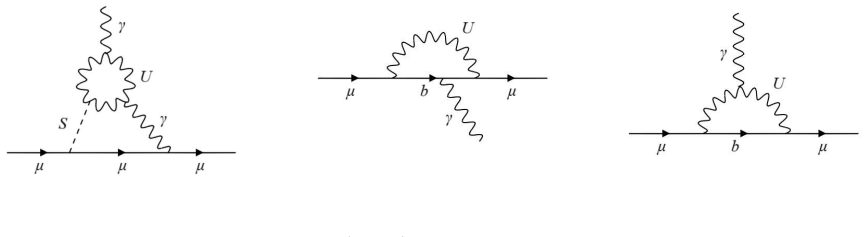
The central object is the effective $S\gamma\gamma$ interaction with coefficient $\kappa$, generated by vector leptoquark loops and written in Eq. (16) as $\kappa = \frac{\alpha_{EM}}{4\pi} \sum_i N_c Q_i^2 \frac{g_{V_i}}{m_{V_i}} F_W$, where $F_W$ is the loop function of a $W$ boson. The paper states explicitly that it models the colored spin-1 leptoquark triangle by the $W$ loop for an order-one estimate. This $\kappa$ enters the log-enhanced two-loop Barr-Zee contribution $\Delta(g-2)_\mu \simeq \frac{1}{4\pi^2} \sin\theta \tan\beta \frac{m_\mu^2}{v} \kappa \ln(\Lambda/m_S)$. The Barr-Zee diagram is a two-loop correction in which a heavy charged particle loop generates the light scalar's coupling to two photons, which then attach to the muon line. The companion object is the $U$ leptoquark with couplings $h^U_{ij}$ to left-handed quarks and leptons, which supplies the Wilson coefficients needed for $R_{K^{(*)}}$ and $R(D^{(*)})$.
What would settle it
A full calculation of the two-loop Barr-Zee amplitude with a spin-1 colored leptoquark in the loop, replacing the $W$-boson loop function $F_W$ in Eq. (16) with the exact amplitude, would settle the central numerical claim: if the resulting $\kappa$ changes sign or drops below roughly one third of the $W$-loop value, the required leptoquark multiplicity grows beyond the TeV-scale region and the claimed solution fails. On the experimental side, a search for $B\to K^{(*)} \gamma\gamma$ with diphoton mass between 10 and 200 MeV that excludes branching fractions above about $10^{-5}$ would also exclude the preferred parameter space.
Extended reading notes
Core claim
The central claim is that the $(g-2)_\mu$ and $B$ anomalies can be resolved together by a Type II two-Higgs-doublet model plus a vector leptoquark $U$, additional vector leptoquarks $V_i$, and a light scalar $S$ with $m_S \sim 10\text{--}200$ MeV. The $V_i$ leptoquarks induce an effective $S\gamma\gamma$ coupling $\kappa \sim (1~\mathrm{TeV})^{-1}$, and this feeds a two-loop Barr-Zee diagram that shifts $(g-2)_\mu$ upward by the required $27 \times 10^{-10}$. The same construction's $U$ leptoquark generates the $b\to s\mu^+\mu^-$ and $b\to c\tau\bar\nu$ coefficients that move $R_K$, $R_{K^*}$, and $R(D^{(*)})$ toward their measured values. The authors identify a viable patch of parameter space—$\sin\theta\simeq 0.005$, $\tan\beta\simeq 40$, $m_S\simeq 100$ MeV, and roughly ten TeV-scale $V$ leptoquarks—and check that current $B$, $K$, $B_s$, and $(g-2)_e$ bounds leave it open.
Load-bearing premise
The crucial assumption is that the unknown loop of the new heavy charged leptoquarks produces the same effect on the light particle's coupling to two photons as a $W$-boson loop; if that estimate is off in sign or size by more than a factor of a few, the number of leptoquarks needed changes by an order of magnitude and the claimed solution may fail.
Editorial extensions
If this is right
- The $(g-2)_\mu$ discrepancy can be removed with new physics at the TeV scale plus a single light state $S$ at 10 to 200 MeV that decays promptly to $e^+e^-$ or $\gamma\gamma$.
- The model predicts $B\to K^{(*)}e^+e^-$ events with $m_{e^+e^-}=m_S$ and $B\to K^{(*)} \gamma\gamma$ events with $m_{\gamma\gamma}=m_S$ at branching fractions near current limits, so existing and upcoming searches can test it.
- It predicts $K^+\to \pi^+\gamma\gamma$ and $K_L\to \pi^0\gamma\gamma$ rates of order $10^{-6}$ with a narrow diphoton peak at $m_S$, above the nonresonant background if $m_S$ is away from the neutral pion mass.
- It predicts that $h\to SS\to \gamma\gamma\gamma\gamma$ contributes to the observed $h\to\gamma\gamma$ signal; current signal strengths allow it, and more precise measurements may reveal a deviation.
- All listed $B$, $K$, $B_s$, and electron $g-2$ constraints are satisfied in the preferred parameter region, so the model is currently viable.
Reading between the lines
- Editorial extension: the numerical bridge between the model and $(g-2)_\mu$ is the $W$-loop approximation in Eq. (16); a complete calculation of the spin-1 colored leptoquark triangle could raise or lower the required leptoquark multiplicity, and a sign flip would break the solution entirely.
- Editorial extension: if $m_S$ sits near the neutral pion mass, the predicted diphoton signals coincide kinematically with $B\to K^{(*)} \pi^0$ and $K\to\pi\pi^0$ backgrounds; measurements with fine diphoton mass resolution are what separate the new-physics peak from the pion.
- Editorial extension: the same template—a light scalar with loop-induced $S\gamma\gamma$ and a Barr-Zee contribution—applies to any model with TeV-scale charged colored states, so the proposed diphoton searches are a generic test of that class of explanations.
- Editorial extension: because the preferred region uses several leptoquark copies with couplings up to $4\pi$, the model as stated is an effective theory; a UV completion would necessarily introduce more states just above the TeV scale, making the leptoquark sector itself a discovery target.
Editorial analysis
A structured set of objections, weighed in public.
Referee Report
Summary. The manuscript constructs a Type II 2HDM extended by a light real scalar S (the dark Higgs), a vector leptoquark U, and an adjustable number N_LQ of vector leptoquarks V_i. The U leptoquark is used to address the B-meson anomalies in R(K), R(K*), and R(D(*)), while the V_i leptoquarks generate an effective Sγγ coupling κ. Through a two-loop Barr-Zee diagram, the Sγγ coupling combined with the S-fermion Yukawa couplings provides a contribution to (g−2)_μ. The paper scans m_S, sinθ, tanβ, κ, and the V-leptoquark parameters to find viable regions, then checks a broad set of hadronic constraints (Table I) and predicts new signals such as B→K(*)e+e−, B→K(*)γγ, K→πγγ, and h→γγγγ. The central quantitative g−2 mechanism is Eq. (16), where the V-leptoquark loop is modeled by the W-boson loop function F_W.
Significance. If the V-leptoquark loop calculation were controlled and the sign of the Sγγ coupling confirmed, the paper would offer a single coherent framework addressing both the muon g−2 and the B anomalies with specific, testable predictions for B, K, and Higgs decays. The manuscript is strong on breadth: it provides explicit Lagrangian definitions, an explicit scalar-potential appendix, and a systematic table of hadronic constraints (Table I) showing that the proposed parameter region is not excluded by the observables considered. The predicted branching fractions lie close to current sensitivities, which is a genuine phenomenological virtue. However, the central quantitative bridge of the (g−2)_μ resolution is an uncomputed O(1) estimate, and the B-sector resolution is a parameterized fit rather than an independent prediction. The paper is therefore best viewed as a proof of principle for a combined dark-Higgs/leptoquark solution, conditional on the completion of the vector-leptoquark two-loop calculation.
major comments (3)
- [Sec. III.B, Eq. (16)] The entire numerical resolution of the (g−2)_μ anomaly rests on Eq. (16), where the V-leptoquark contribution to the Sγγ coupling κ is modeled by the W-boson loop function F_W. The text explicitly states that “leptoquarks are not gauge bosons, there might be ambiguities in the leptoquark two-loop contribution” and that this is only an O(1) estimate. For a colored spin-1 particle, the gauge/Goldstone/ghost structure that makes the W result gauge-independent does not transfer automatically, and the sign and coefficient of the Sγγ amplitude are not guaranteed. Because Eq. (13) requires κ with a particular sign and magnitude, a factor of order unity or a sign change in this loop would move or destroy the allowed region in Fig. 3. This is the load-bearing step for the claimed g−2 solution, and a direct calculation of the V-leptoquark triangle contribution to Sγγ—or a clearly defined effective-theory treatment—is necessary before the central claim can be considered established.
- [Sec. III.B, text after Eq. (16)] The sentence asserting that “the leptoquark contributions to (g−2)_μ are always positive—that is, in the right direction” is not justified by the W-boson analogy. The sign of the Sγγ amplitude depends on the charge and spin structure of the internal particles, and the loop function F_W is specific to the electroweak W boson. If the sign of the effective κ were reversed, the Barr-Zee contribution in Eq. (13) would become negative and the model would not resolve the anomaly through this channel. The paper should either prove the sign statement by an explicit calculation or soften it to a condition on the sign of the loop amplitude and discuss the consequences.
- [Sec. III.C, Eqs. (18)-(19)] There is an internal inconsistency in the charge assignment used for the one-loop U-leptoquark contribution. In the model the U leptoquark is defined with SM quantum numbers (3,1,2/3), which corresponds to electric charge Q_U=+2/3 in the convention used elsewhere in the paper (see Eq. (16), where V has Q=5/3). However, the text below Eq. (18) sets Q_U=−2/3. If Q_U is corrected to +2/3, the sign of the coefficient in Eq. (19) flips and the contribution becomes positive rather than negative. For the allowed range hU_bμ∼0.1–0.6, the corrected magnitude is of order 10^-12–10^-10, so the qualitative conclusion that the U contribution is negligible compared with Δ(g−2)_μ≈27×10^-10 survives, but the formula as printed is incorrect and should be fixed.
minor comments (6)
- [Sec. II, Eq. (9)] The notation sinθ′ is used without a clear definition in the main text; Eq. (10) gives an approximate expression, but the reader has to infer from Appendix A that sinθ′ controls the up-type Yukawa suppression. Please define both mixing angles explicitly in Sec. II.
- [Sec. III.B, Eq. (13)] The cutoff Λ in the logarithmic factor ln(Λ/m_S) is taken to be 2 TeV everywhere, while Fig. 3 allows V-leptoquark masses up to 4 TeV and the text mentions masses up to 4 TeV. The mild logarithmic dependence means this does not affect the conclusions, but the choice should be stated and justified.
- [Sec. IV.B, Table I] The table lists the new scalar contributions to many observables, but for several rows only the new contribution is shown without the total or the SM value. Adding the SM predictions would make the comparison with the quoted measurements more transparent.
- [Sec. V.A, Fig. 6] The purple shaded region in Fig. 6 is described as the region where BR(B→K*e+e−) is within 1σ of its measured value, but the caption does not state how the experimental uncertainty is treated. Please clarify the definition of the band.
- [Sec. V.D] The example parameter set in the h→SS discussion appears to require a tuned cancellation to make m_S as low as 10–200 MeV; the paper acknowledges this in footnote 4. A brief quantitative measure of the fine-tuning would be useful for assessing naturalness.
- [General] There are several typographical issues, including the un-contracted φφ terms in Eq. (8), the notation K(∗) appearing without parentheses in some places, and the statement “N_LQ∼10” in the conclusions while Fig. 3 displays N_LQ up to 60 for some parameter choices. A careful proofreading pass is recommended.
Circularity Check
No significant circularity: the paper explicitly fits parameters, and the cited B-sector results are external data-driven analyses.
full rationale
The derivation chain is self-contained in the required sense. The central g-2 mechanism fixes a required effective coupling κ from Eq. (13) and then shows in Eqs. (16)-(17) that N_LQ vector leptoquarks can generate that κ. This is a parameter construction, not a prediction disguised as a derivation; the paper never claims to predict (g-2)_μ from first principles. The B-anomaly resolution is imported from fits in Refs. [53] and [69], but those are data-driven analyses (including the stated constraint hU_bμ hU_sμ = 8×10^-4 from Ref. [69]); using them is normal literature reliance, and the self-citation is not load-bearing because the U-leptoquark mechanism is widely studied and externally falsifiable. The stated 'O(1) estimate' modeling the V-leptoquark loop by the W loop (Sec. III.B) is a genuine robustness limitation: the sign and normalization of the spin-1 colored loop are not computed, so the required N_LQ and m_LQ could change. But this is a correctness and uncertainty caveat, not an input-output identity. Predicted signals (B→K^(*)γγ, K→πγγ, and h→γγγγ) are computed after fixing parameters and are not used to define those parameters. Hence no step reduces by construction to its own input.
Assumptions & free parameters
free parameters (10)
- mS (dark Higgs mass) =
10-200 MeV (scanned)
- sinθ (dark Higgs mixing) =
~0.005
- tanβ =
~40-60
- κ (effective Sγγ coupling) =
~(1 TeV)^(-1)
- N_LQ (number of V leptoquarks) =
5-50 depending on mass and coupling
- g_V (SVV coupling) =
3 to 4π
- m_LQ (V leptoquark mass) =
1-4 TeV
- hU_bμ hU_sμ product =
8×10^-4
- hU_bτ =
~1
- 2HDM quartic couplings (λ1, λ2, λ345, λd, λu, λud) =
λ1=0.6, λ2=0.3, λ345=2.8, λd=-0.3, λu=0.0005, λud=0.005
assumptions (6)
- domain assumption Type II 2HDM with CP conservation is the underlying Higgs sector, with a scalar portal to the dark Higgs S.
- domain assumption A single U vector leptoquark with left-handed couplings can explain both R(D(*)) and R(K(*)) anomalies.
- ad hoc to paper The vector-leptoquark loop contribution to Sγγ is well approximated by the W-boson loop function FW.
- domain assumption The SM predictions for (g-2)_mu, R(K), R(K*), R(D), and R(D*) quoted in Eqs. (1)-(7) are the correct reference values.
- domain assumption B to K(*) form factors from light-cone sum rules (Refs. [83,84]) are used for the decay rate predictions.
- ad hoc to paper The scalar potential can be tuned so that the physical S mass lies in the 10-200 MeV range.
invented entities (3)
-
Dark Higgs boson S
independent evidence
-
U leptoquark (3,1,2/3)
-
V leptoquarks (3,1,5/3)
Cite this review
Pith. "Pith review of Resolving the $(g-2)_{\mu}$ and $B$ anomalies with leptoquarks and a dark Higgs boson." pith.science (2026). https://pith.science/paper/TCJXXWTC
@misc{pith2026190808625,
  author       = {Pith},
  title        = {Pith review of: Resolving the $(g-2)_\mu$ and $B$ anomalies with leptoquarks and a dark Higgs boson},
  year         = {2026},
  howpublished = {\url{https://pith.science/paper/TCJXXWTC}},
  note         = {Machine review of arXiv:1908.08625}
}
abstract
At present, there are outstanding discrepancies between standard model predictions and measurements of the muon's $g-2$ and several $B$-meson properties. We resolve these anomalies by considering a two-Higgs-doublet model extended to include leptoquarks and a dark Higgs boson $S$. The leptoquarks modify $B$-meson decays and also induce an $S \gamma \gamma$ coupling, which contributes to the muon's $g-2$ through a Barr-Zee diagram. We show that, for TeV-scale leptoquarks and dark Higgs boson masses $m_{S} \sim 10-200~\text{MeV}$, a consistent resolution to all of the anomalies exists. The model predicts interesting new decays, such as $B \to K^{(*)} e^+ e^-$, $B \to K^{(*)} \gamma \gamma$, $K \to \pi \gamma \gamma$, and $h \to \gamma \gamma \gamma \gamma$, with branching fractions not far below current bounds.
Figures


Figures from the paper (4 more)


Reference graph
Works this paper leans on
-
[1]
Calculation of the hadronic vacuum polarization contribution to the muon anomalous magnetic moment,
RBC, UKQCD Collaboration, T. Blum, P. A. Boyle, V. G¨ ulpers, T. Izubuchi, L. Jin, C. Jung, A. J¨ uttner, C. Lehner, A. Portelli, and J. T. Tsang, “Calculation of the hadronic vacuum polarization contribution to the muon anomalous magnetic moment,” Phys. Rev. Lett. 121 no. 2, (2018) 022003, arXiv:1801.07224 [hep-lat]
arXiv 2018
-
[2]
] −gmUSUµUµ
and Lagrangian LU =−1 4FU µνFUµν−m2 UUµUµ− [ hU ij ( ¯QiLγµLjL ) Uµ + H.c. ] −gmUSUµUµ. (11) TheU leptoquark’s couplings to left-handed quarks and leptons resolve theB-meson anoma- lies. The leptoquark’s couplings to right-handed quarks and leptons are constrained to be small [69]. We have also included the leptoquark’s couplings to S. This interaction is...
-
[3]
A clear guide to the combined explanation of the anomalies may be found in Ref
that couples dominantly to left-handed quarks and leptons. A clear guide to the combined explanation of the anomalies may be found in Ref. [62]. For a massmU∼ 1 TeV andO(1) couplings to the third generation, the U leptoquark can explain the R(D(∗)) and R(K(∗)) anomalies, at least for the central q2 data. Weak-scale states do not fully resolve the low-q2 d...
-
[4]
and assume that their couplings to right-handed quarks and leptons are identical. Assuming small couplings hV jk, the leading way in which these Vi leptoquarks contribute to (g− 2)µ is by inducing an Sγγ coupling, which then contributes through a Barr-Zee diagram. The Barr-Zee contribution to ( g− 2)µ with a W boson in the loop has been 6 mS=100 MeV mS=20...
-
[5]
In all panels, we setmS = 100 MeV
induce an effectiveSγγ coupling that resolves the (g−2)µ anomaly. In all panels, we setmS = 100 MeV. In the upper and lower panels, we fix (sinθ, tanβ) = (0.01, 60) and (0.005, 40), respectively. For the left panels, we set gV = 3 and show the bands where the (g− 2)µ discrepancy is reduced to 1 σ. For the right panels, we consider the several values of gV i...
-
[6]
Final Report of the Muon E821 Anomalous Magnetic Moment Measurement at BNL,
Muon g-2 Collaboration, G. W. Bennett et al., “Final Report of the Muon E821 Anomalous Magnetic Moment Measurement at BNL,” Phys. Rev. D73 (2006) 072003, arXiv:hep-ex/0602035 [hep-ex]
arXiv 2006
-
[7]
Muon (g− 2) Technical Design Report,
Muon g-2 Collaboration, J. Grange et al., “Muon (g− 2) Technical Design Report,” arXiv:1501.06858 [physics.ins-det]
-
[8]
Belle-II Collaboration, W. Altmannshofer et al., “The Belle II Physics Book,” arXiv:1808.10567 [hep-ex]
Show all 103 references
-
[9]
Evidence for an excess of ¯B→D(∗)τ−¯ντ decays,
BaBar Collaboration, J. P. Lees et al., “Evidence for an excess of ¯B→D(∗)τ−¯ντ decays,” Phys. Rev. Lett. 109 (2012) 101802, arXiv:1205.5442 [hep-ex]
2012 arXiv
-
[10]
Measurement of an Excess of ¯B→D(∗)τ−¯ντ Decays and Implications for Charged Higgs Bosons,
BaBar Collaboration, J. P. Lees et al., “Measurement of an Excess of ¯B→D(∗)τ−¯ντ Decays and Implications for Charged Higgs Bosons,” Phys. Rev. D88 no. 7, (2013) 072012, arXiv:1303.0571 [hep-ex]
2013 arXiv
-
[11]
Measurement of the branching ratio of ¯B→D(∗)τ−¯ντ relative to ¯B→D(∗)𝓁−¯ν𝓁 decays with hadronic tagging at Belle,
Belle Collaboration, M. Huschle et al., “Measurement of the branching ratio of ¯B→D(∗)τ−¯ντ relative to ¯B→D(∗)𝓁−¯ν𝓁 decays with hadronic tagging at Belle,” Phys. Rev. D92 no. 7, (2015) 072014, arXiv:1507.03233 [hep-ex]
2015 arXiv
-
[12]
Measurement of the branching ratio of ¯B0→D∗+τ−¯ντ relative to ¯B0→D∗+𝓁−¯ν𝓁 decays with a semileptonic tagging method,
Belle Collaboration, A. Abdesselam et al., “Measurement of the branching ratio of ¯B0→D∗+τ−¯ντ relative to ¯B0→D∗+𝓁−¯ν𝓁 decays with a semileptonic tagging method,” in Proceedings, 51st Rencontres de Moriond on Electroweak Interactions and Unified Theories: La Thuile, Italy, Mar...
2016 arXiv
-
[13]
Measurement of the τ lepton polarization and R(D∗) in the decay ¯B→D∗τ−¯ντ,
Belle Collaboration, S. Hirose et al., “Measurement of the τ lepton polarization and R(D∗) in the decay ¯B→D∗τ−¯ντ,” Phys. Rev. Lett. 118 no. 21, (2017) 211801, arXiv:1612.00529 [hep-ex]
2017 arXiv
-
[14]
Measurement of the ratio of branching fractions B( ¯B0→D∗+τ−¯ντ)/B( ¯B0→D∗+µ−¯νµ),
LHCb Collaboration, R. Aaij et al., “Measurement of the ratio of branching fractions B( ¯B0→D∗+τ−¯ντ)/B( ¯B0→D∗+µ−¯νµ),” Phys. Rev. Lett. 115 no. 11, (2015) 111803, arXiv:1506.08614 [hep-ex] . [Erratum: Phys. Rev. Lett.115,no.15,159901(2015)]
2015
-
[15]
Averages of b-hadron, c-hadron, and τ-lepton properties as of summer 2016,
Heavy Flavor Averaging Group Collaboration, Y. Amhis et al., “Averages of b-hadron, c-hadron, and τ-lepton properties as of summer 2016,” Eur. Phys. J. C77 (2017) 895, arXiv:1612.07233 [hep-ex] . Updated results and plots available at https://hflav.web.cern.ch
2017 arXiv
-
[16]
Revisiting B→D𝓁ν,
D. Bigi and P. Gambino, “Revisiting B→D𝓁ν,” Phys. Rev. D94 no. 9, (2016) 094008, arXiv:1606.08030 [hep-ph] . 21
2016 arXiv
-
[17]
Extraction of |Vcb| from B→D(∗)𝓁ν𝓁 and the Standard Model predictions of R(D(∗)),
S. Jaiswal, S. Nandi, and S. K. Patra, “Extraction of |Vcb| from B→D(∗)𝓁ν𝓁 and the Standard Model predictions of R(D(∗)),” JHEP 12 (2017) 060, arXiv:1707.09977 [hep-ph]
2017 arXiv
-
[18]
Measurement ofR(D) andR(D∗) with a semileptonic tagging method,
Belle Collaboration, A. Abdesselam et al., “Measurement ofR(D) andR(D∗) with a semileptonic tagging method,” arXiv:1904.08794 [hep-ex]
1904 arXiv
-
[19]
More model-independent analysis of b→s processes,
G. Hiller and F. Kruger, “More model-independent analysis of b→s processes,” Phys. Rev. D69 (2004) 074020, arXiv:hep-ph/0310219 [hep-ph]
2004 arXiv
-
[20]
RK and future b→s𝓁𝓁 physics beyond the standard model opportunities,
G. Hiller and M. Schmaltz, “ RK and future b→s𝓁𝓁 physics beyond the standard model opportunities,” Phys. Rev. D90 (2014) 054014, arXiv:1408.1627 [hep-ph]
2014 arXiv
-
[21]
Search for lepton-universality violation in B+→K+𝓁+𝓁− decays,
LHCb Collaboration, R. Aaij et al., “Search for lepton-universality violation in B+→K+𝓁+𝓁− decays,” Phys. Rev. Lett. 122 no. 19, (2019) 191801, arXiv:1903.09252 [hep-ex]
2019 arXiv
-
[22]
On the Standard Model predictions for RK and RK∗,
M. Bordone, G. Isidori, and A. Pattori, “On the Standard Model predictions for RK and RK∗,” Eur. Phys. J. C76 no. 8, (2016) 440, arXiv:1605.07633 [hep-ph]
2016 arXiv
-
[23]
Test of lepton universality with B0→K∗0𝓁+𝓁− decays,
LHCb Collaboration, R. Aaij et al., “Test of lepton universality with B0→K∗0𝓁+𝓁− decays,” JHEP 08 (2017) 055, arXiv:1705.05802 [hep-ex]
2017 arXiv
-
[24]
Test of lepton flavor universality in B→K∗𝓁+𝓁− decays at Belle,
Belle Collaboration, A. Abdesselam et al., “Test of lepton flavor universality in B→K∗𝓁+𝓁− decays at Belle,” arXiv:1904.02440 [hep-ex]
1904 arXiv
-
[25]
Test of lepton flavor universality in B→K𝓁+𝓁− decays,
A. Abdesselam et al., “Test of lepton flavor universality in B→K𝓁+𝓁− decays,” arXiv:1908.01848 [hep-ex]
1908 arXiv
-
[26]
On the impact of power corrections in the prediction of B→K∗µ+µ− observables,
S. Descotes-Genon, L. Hofer, J. Matias, and J. Virto, “On the impact of power corrections in the prediction of B→K∗µ+µ− observables,” JHEP 12 (2014) 125, arXiv:1407.8526 [hep-ph]
2014 arXiv
-
[27]
Resonances gone topsy turvy - the charm of QCD or new physics in b→s𝓁+𝓁−?,
J. Lyon and R. Zwicky, “Resonances gone topsy turvy - the charm of QCD or new physics in b→s𝓁+𝓁−?,” arXiv:1406.0566 [hep-ph]
-
[28]
Reassessing the discovery potential of the B→K∗𝓁+𝓁− decays in the large-recoil region: SM challenges and BSM opportunities,
S. J¨ ager and J. Martin Camalich, “Reassessing the discovery potential of the B→K∗𝓁+𝓁− decays in the large-recoil region: SM challenges and BSM opportunities,” Phys. Rev. D93 no. 1, (2016) 014028, arXiv:1412.3183 [hep-ph]
2016 arXiv
-
[29]
Simultaneous Explanation of the RK and R(D(∗)) Puzzles,
B. Bhattacharya, A. Datta, D. London, and S. Shivashankara, “Simultaneous Explanation of the RK and R(D(∗)) Puzzles,” Phys. Lett. B742 (2015) 370–374, arXiv:1412.7164 [hep-ph]
2015 arXiv
-
[30]
Lepton universality violation and lepton flavor conservation inB-meson decays,
R. Alonso, B. Grinstein, and J. Martin Camalich, “Lepton universality violation and lepton flavor conservation inB-meson decays,” JHEP 10 (2015) 184, arXiv:1505.05164 [hep-ph]
2015 arXiv
-
[31]
On the breaking of Lepton Flavor Universality in B decays,
A. Greljo, G. Isidori, and D. Marzocca, “On the breaking of Lepton Flavor Universality in B decays,” JHEP 07 (2015) 142, arXiv:1506.01705 [hep-ph]
2015 arXiv
-
[32]
Effective Field Theory Approach to b→s𝓁𝓁′, B→K(∗)νν and B→D(∗)τν with Third Generation Couplings,
L. Calibbi, A. Crivellin, and T. Ota, “Effective Field Theory Approach to b→s𝓁𝓁′, B→K(∗)νν and B→D(∗)τν with Third Generation Couplings,” Phys. Rev. Lett. 115 (2015) 181801, arXiv:1506.02661 [hep-ph]
2015 arXiv
-
[33]
RD(∗) anomaly: A possible hint for natural supersymmetry with R-parity violation,
W. Altmannshofer, P. S. Bhupal Dev, and A. Soni, “ RD(∗) anomaly: A possible hint for natural supersymmetry with R-parity violation,” Phys. Rev. D96 no. 9, (2017) 095010, arXiv:1704.06659 [hep-ph]
2017 arXiv
-
[34]
Patterns of New Physics in b→s𝓁+𝓁− transitions in the light of recent data,
B. Capdevila, A. Crivellin, S. Descotes-Genon, J. Matias, and J. Virto, “Patterns of New Physics in b→s𝓁+𝓁− transitions in the light of recent data,” JHEP 01 (2018) 093, arXiv:1704.05340 [hep-ph]
2018 arXiv
-
[35]
Interpreting Hints for Lepton Flavor Universality Violation,
W. Altmannshofer, P. Stangl, and D. M. Straub, “Interpreting Hints for Lepton Flavor Universality Violation,” Phys. Rev. D96 no. 5, (2017) 055008, arXiv:1704.05435 22 [hep-ph]
2017 arXiv
-
[36]
Flavour anomalies after the RK∗ measurement,
G. D’Amico, M. Nardecchia, P. Panci, F. Sannino, A. Strumia, R. Torre, and A. Urbano, “Flavour anomalies after the RK∗ measurement,” JHEP 09 (2017) 010, arXiv:1704.05438 [hep-ph]
2017 arXiv
-
[37]
RK and RK∗ beyond the standard model,
G. Hiller and I. Nisandzic, “ RK and RK∗ beyond the standard model,” Phys. Rev. D96 no. 3, (2017) 035003, arXiv:1704.05444 [hep-ph]
2017 arXiv
-
[38]
Towards the discovery of new physics with lepton-universality ratios of b→s𝓁𝓁 decays,
L.-S. Geng, B. Grinstein, S. J¨ ager, J. Martin Camalich, X.-L. Ren, and R.-X. Shi, “Towards the discovery of new physics with lepton-universality ratios of b→s𝓁𝓁 decays,” Phys. Rev. D96 no. 9, (2017) 093006, arXiv:1704.05446 [hep-ph]
2017 arXiv
-
[39]
On Flavourful Easter Eggs for New Physics Hunger and Lepton Flavour Universality Violation,
M. Ciuchini, A. M. Coutinho, M. Fedele, E. Franco, A. Paul, L. Silvestrini, and M. Valli, “On Flavourful Easter Eggs for New Physics Hunger and Lepton Flavour Universality Violation,” Eur. Phys. J. C77 no. 10, (2017) 688, arXiv:1704.05447 [hep-ph]
2017 arXiv
-
[40]
Gauge-invariant implications of the LHCb measurements on lepton-flavor nonuniversality,
A. Celis, J. Fuentes-Martin, A. Vicente, and J. Virto, “Gauge-invariant implications of the LHCb measurements on lepton-flavor nonuniversality,” Phys. Rev. D96 no. 3, (2017) 035026, arXiv:1704.05672 [hep-ph]
2017 arXiv
-
[41]
A leptoquark model to accommodateRexp K <R SM K and Rexp K∗ <R SM K∗ ,
D. Beˇ cirevi´ c and O. Sumensari, “A leptoquark model to accommodateRexp K <R SM K and Rexp K∗ <R SM K∗ ,” JHEP 08 (2017) 104, arXiv:1704.05835 [hep-ph]
2017 arXiv
-
[42]
Minimal flavor-changingZ′ models and muon g− 2 after the RK∗ measurement,
S. Di Chiara, A. Fowlie, S. Fraser, C. Marzo, L. Marzola, M. Raidal, and C. Spethmann, “Minimal flavor-changingZ′ models and muon g− 2 after the RK∗ measurement,” Nucl. Phys. B923 (2017) 245–257, arXiv:1704.06200 [hep-ph]
2017 arXiv
-
[43]
A New Light Particle in B Decays?,
F. Sala and D. M. Straub, “A New Light Particle in B Decays?,” Phys. Lett. B774 (2017) 205–209, arXiv:1704.06188 [hep-ph]
2017 arXiv
-
[44]
Explaining the RK and RK∗ anomalies,
D. Ghosh, “Explaining the RK and RK∗ anomalies,” Eur. Phys. J. C77 no. 10, (2017) 694, arXiv:1704.06240 [hep-ph]
2017 arXiv
-
[45]
New Physics in b→sµ+µ− after the Measurement of RK∗,
A. K. Alok, B. Bhattacharya, A. Datta, D. Kumar, J. Kumar, and D. London, “New Physics in b→sµ+µ− after the Measurement of RK∗,” Phys. Rev. D96 no. 9, (2017) 095009, arXiv:1704.07397 [hep-ph]
2017 arXiv
-
[46]
Lepton flavor non-universality in the B-sector: a global analyses of various new physics models,
A. K. Alok, D. Kumar, J. Kumar, and R. Sharma, “Lepton flavor non-universality in the B-sector: a global analyses of various new physics models,” arXiv:1704.07347 [hep-ph]
-
[47]
Implications of the RK and RK∗ anomalies,
W. Wang and S. Zhao, “Implications of the RK and RK∗ anomalies,” Chin. Phys. C42 no. 1, (2018) 013105, arXiv:1704.08168 [hep-ph]
2018 arXiv
-
[48]
U(1)B3−3Lµ gauge symmetry as a simple description of b→s anomalies,
C. Bonilla, T. Modak, R. Srivastava, and J. W. F. Valle, “ U(1)B3−3Lµ gauge symmetry as a simple description of b→s anomalies,” Phys. Rev. D98 no. 9, (2018) 095002, arXiv:1705.00915 [hep-ph]
2018 arXiv
-
[49]
Role of Tensor operators in RK and RK∗,
D. Bardhan, P. Byakti, and D. Ghosh, “Role of Tensor operators in RK and RK∗,” Phys. Lett. B773 (2017) 505–512, arXiv:1705.09305 [hep-ph]
2017 arXiv
-
[50]
Simultaneous explanation ofR(D(∗)) and b→sµ+µ−: the last scalar leptoquarks standing,
A. Crivellin, D. M¨ uller, and T. Ota, “Simultaneous explanation ofR(D(∗)) and b→sµ+µ−: the last scalar leptoquarks standing,” JHEP 09 (2017) 040, arXiv:1703.09226 [hep-ph]
2017 arXiv
-
[51]
Vector leptoquark resolution ofRK and RD(∗) puzzles,
S. Fajfer and N. Koˇ snik, “Vector leptoquark resolution ofRK and RD(∗) puzzles,” Phys. Lett. B755 (2016) 270–274, arXiv:1511.06024 [hep-ph]
2016 arXiv
-
[52]
Minimal Leptoquark Explanation for the RD(∗) , RK , and (g− 2)µ Anomalies,
M. Bauer and M. Neubert, “Minimal Leptoquark Explanation for the RD(∗) , RK , and (g− 2)µ Anomalies,” Phys. Rev. Lett. 116 no. 14, (2016) 141802, arXiv:1511.01900 [hep-ph]
2016 arXiv
-
[53]
Anomalies in B-decays and U(2) flavour symmetry,
R. Barbieri, G. Isidori, A. Pattori, and F. Senia, “Anomalies in B-decays and U(2) flavour symmetry,” Eur. Phys. J. C76 no. 2, (2016) 67, arXiv:1512.01560 [hep-ph]
2016 arXiv
-
[54]
Towards a unified explanation of RD(∗), RK 23 and (g− 2)µ anomalies in a left-right model with leptoquarks,
D. Das, C. Hati, G. Kumar, and N. Mahajan, “Towards a unified explanation of RD(∗), RK 23 and (g− 2)µ anomalies in a left-right model with leptoquarks,” Phys. Rev. D94 (2016) 055034, arXiv:1605.06313 [hep-ph]
2016 arXiv
-
[55]
Phenomenology of anSU (2)×SU (2)×U(1) model with lepton-flavour non-universality,
S. M. Boucenna, A. Celis, J. Fuentes-Martin, A. Vicente, and J. Virto, “Phenomenology of anSU (2)×SU (2)×U(1) model with lepton-flavour non-universality,” JHEP 12 (2016) 059, arXiv:1608.01349 [hep-ph]
2016 arXiv
-
[56]
Leptoquark model to explain the B-physics anomalies, RK and RD,
D. Beˇ cirevi´ c, S. Fajfer, N. Koˇ snik, and O. Sumensari, “Leptoquark model to explain the B-physics anomalies, RK and RD,” Phys. Rev. D94 no. 11, (2016) 115021, arXiv:1608.08501 [hep-ph]
2016 arXiv
-
[57]
Simultaneous Explanation of the RK and RD(∗) Puzzles: a Model Analysis,
B. Bhattacharya, A. Datta, J.-P. Gu´ evin, D. London, and R. Watanabe, “Simultaneous Explanation of the RK and RD(∗) Puzzles: a Model Analysis,” JHEP 01 (2017) 015, arXiv:1609.09078 [hep-ph]
2017 arXiv
-
[58]
Excesses of muon g− 2, RD(∗), and RK in a leptoquark model,
C.-H. Chen, T. Nomura, and H. Okada, “Excesses of muon g− 2, RD(∗), and RK in a leptoquark model,” Phys. Lett. B774 (2017) 456–464, arXiv:1703.03251 [hep-ph]
2017 arXiv
-
[59]
Combined Explanations of the b→sµ+µ− and b→cτ−¯ν Anomalies: a General Model Analysis,
J. Kumar, D. London, and R. Watanabe, “Combined Explanations of the b→sµ+µ− and b→cτ−¯ν Anomalies: a General Model Analysis,” Phys. Rev. D99 no. 1, (2019) 015007, arXiv:1806.07403 [hep-ph]
2019 arXiv
-
[60]
B Meson Anomalies in a Pati-Salam Model within the Randall-Sundrum Background,
M. Blanke and A. Crivellin, “ B Meson Anomalies in a Pati-Salam Model within the Randall-Sundrum Background,” Phys. Rev. Lett. 121 no. 1, (2018) 011801, arXiv:1801.07256 [hep-ph]
2018 arXiv
-
[61]
Importance of Loop Effects in Explaining the Accumulated Evidence for New Physics in B Decays with a Vector Leptoquark,
A. Crivellin, C. Greub, D. M¨ uller, and F. Saturnino, “Importance of Loop Effects in Explaining the Accumulated Evidence for New Physics in B Decays with a Vector Leptoquark,” Phys. Rev. Lett. 122 no. 1, (2019) 011805, arXiv:1807.02068 [hep-ph]
2019 arXiv
-
[62]
Explaining the Flavor Anomalies with a Vector Leptoquark (Moriond 2019 update),
A. Crivellin and F. Saturnino, “Explaining the Flavor Anomalies with a Vector Leptoquark (Moriond 2019 update),” PoS DIS2019 (2019) 163, arXiv:1906.01222 [hep-ph]
2019 arXiv
-
[63]
Probing New Physics Signals with Symmetry-Restored Yukawa Textures,
S.-P. Li and X.-Q. Li, “Probing New Physics Signals with Symmetry-Restored Yukawa Textures,” arXiv:1907.13555 [hep-ph]
1907 arXiv
-
[64]
RD(∗),RK(∗) and neutrino mass in the 2HDM-III with right-handed neutrinos,
S.-P. Li, X.-Q. Li, Y.-D. Yang, and X. Zhang, “ RD(∗),RK(∗) and neutrino mass in the 2HDM-III with right-handed neutrinos,” JHEP 09 (2018) 149, arXiv:1807.08530 [hep-ph]
2018 arXiv
-
[65]
R2 as a single leptoquark solution to RD(∗) and RK(∗),
O. Popov, M. A. Schmidt, and G. White, “ R2 as a single leptoquark solution to RD(∗) and RK(∗),” Phys. Rev. D100 no. 3, (2019) 035028, arXiv:1905.06339 [hep-ph]
2019 arXiv
-
[66]
B-physics anomalies: a guide to combined explanations,
D. Buttazzo, A. Greljo, G. Isidori, and D. Marzocca, “ B-physics anomalies: a guide to combined explanations,” JHEP 11 (2017) 044, arXiv:1706.07808 [hep-ph]
2017 arXiv
-
[67]
Supersymmetry and the anomalous magnetic moment of the muon,
J. L. Feng and K. T. Matchev, “Supersymmetry and the anomalous magnetic moment of the muon,” Phys. Rev. Lett. 86 (2001) 3480–3483, arXiv:hep-ph/0102146 [hep-ph]
2001 arXiv
-
[68]
Scalar dark matter candidates,
C. Boehm and P. Fayet, “Scalar dark matter candidates,” Nucl. Phys. B683 (2004) 219–263, arXiv:hep-ph/0305261 [hep-ph]
2004 arXiv
-
[69]
Secluded U(1) below the weak scale,
M. Pospelov, “Secluded U(1) below the weak scale,” Phys. Rev. D80 (2009) 095002, arXiv:0811.1030 [hep-ph]
2009 arXiv
-
[70]
US Cosmic Visions: New Ideas in Dark Matter 2017: Community Report,
M. Battaglieri et al., “US Cosmic Visions: New Ideas in Dark Matter 2017: Community Report,” in U.S. Cosmic Visions: New Ideas in Dark Matter College Park, MD, USA, March 23-25, 2017 . 2017. arXiv:1707.04591 [hep-ph] . http://lss.fnal.gov/archive/2017/conf/fermilab-conf-17-282...
2017 arXiv
-
[71]
Muon anomalous magnetic moment through the leptonic Higgs portal,
B. Batell, N. Lange, D. McKeen, M. Pospelov, and A. Ritz, “Muon anomalous magnetic moment through the leptonic Higgs portal,” Phys. Rev. D95 no. 7, (2017) 075003, arXiv:1606.04943 [hep-ph] . 24
2017 arXiv
-
[72]
Light resonances and the low-q2 bin of RK∗,
W. Altmannshofer, M. J. Baker, S. Gori, R. Harnik, M. Pospelov, E. Stamou, and A. Thamm, “Light resonances and the low-q2 bin of RK∗,” JHEP 03 (2018) 188, arXiv:1711.07494 [hep-ph]
2018 arXiv
-
[73]
The B Anomalies and New Physics in b→se+e−,
A. Datta, J. Kumar, and D. London, “The B Anomalies and New Physics in b→se+e−,” Phys. Lett. B797 (2019) 134858, arXiv:1903.10086 [hep-ph]
2019 arXiv
-
[74]
B-decay discrepancies after Moriond 2019,
J. Aebischer, W. Altmannshofer, D. Guadagnoli, M. Reboud, P. Stangl, and D. M. Straub, “B-decay discrepancies after Moriond 2019,” arXiv:1903.10434 [hep-ph]
2019 arXiv
-
[75]
Tale of two anomalies,
H. Davoudiasl and W. J. Marciano, “Tale of two anomalies,” Phys. Rev. D98 no. 7, (2018) 075011, arXiv:1806.10252 [hep-ph]
2018 arXiv
-
[76]
Implications of a light “dark Higgs
C.-Y. Chen, H. Davoudiasl, W. J. Marciano, and C. Zhang, “Implications of a light “dark Higgs” solution to the gµ− 2 discrepancy,” Phys. Rev. D93 no. 3, (2016) 035006, arXiv:1511.04715 [hep-ph]
2016 arXiv
-
[77]
New Barr-Zee contributions to ( g− 2)µ in two-Higgs-doublet models,
V. Ilisie, “New Barr-Zee contributions to ( g− 2)µ in two-Higgs-doublet models,” JHEP 04 (2015) 077, arXiv:1502.04199 [hep-ph]
2015 arXiv
-
[78]
Higgs Decay to Two Photons,
W. J. Marciano, C. Zhang, and S. Willenbrock, “Higgs Decay to Two Photons,” Phys. Rev. D85 (2012) 013002, arXiv:1109.5304 [hep-ph]
2012 arXiv
-
[79]
New Physics Contributions to the Muon Anomalous Magnetic Moment: A Numerical Code,
F. S. Queiroz and W. Shepherd, “New Physics Contributions to the Muon Anomalous Magnetic Moment: A Numerical Code,” Phys. Rev. D89 no. 9, (2014) 095024, arXiv:1403.2309 [hep-ph]
2014 arXiv
-
[80]
Continuing search for new physics in b→sµµ decays: two operators at a time,
A. K. Alok, A. Dighe, S. Gangal, and D. Kumar, “Continuing search for new physics in b→sµµ decays: two operators at a time,” JHEP 06 (2019) 089, arXiv:1903.09617 [hep-ph]
2019 arXiv
-
[81]
New Physics in b→s𝓁+𝓁− confronts new data on Lepton Universality,
M. Ciuchini, A. M. Coutinho, M. Fedele, E. Franco, A. Paul, L. Silvestrini, and M. Valli, “New Physics in b→s𝓁+𝓁− confronts new data on Lepton Universality,” arXiv:1903.09632 [hep-ph]
1903 arXiv
-
[82]
What RK and Q5 can tell us about New Physics in b→s𝓁𝓁 transitions?,
M. Alguero, B. Capdevila, S. Descotes-Genon, P. Masjuan, and J. Matias, “What RK and Q5 can tell us about New Physics in b→s𝓁𝓁 transitions?,” JHEP 07 (2019) 096, arXiv:1902.04900 [hep-ph]
2019 arXiv
-
[83]
Implications for New Physics in b→sµµ transitions after recent measurements by Belle and LHCb,
K. Kowalska, D. Kumar, and E. M. Sessolo, “Implications for New Physics in b→sµµ transitions after recent measurements by Belle and LHCb,” arXiv:1903.10932 [hep-ph]
1903 arXiv
-
[84]
Multi-lepton Signatures of a Hidden Sector in Rare B Decays,
B. Batell, M. Pospelov, and A. Ritz, “Multi-lepton Signatures of a Hidden Sector in Rare B Decays,” Phys. Rev. D83 (2011) 054005, arXiv:0911.4938 [hep-ph]
2011 arXiv
-
[85]
A light Z′ for the RK puzzle and nonstandard neutrino interactions,
A. Datta, J. Liao, and D. Marfatia, “A light Z′ for the RK puzzle and nonstandard neutrino interactions,” Phys. Lett. B768 (2017) 265–269, arXiv:1702.01099 [hep-ph]
2017 arXiv
-
[86]
New light mediators for the RK and RK∗ puzzles,
A. Datta, J. Kumar, J. Liao, and D. Marfatia, “New light mediators for the RK and RK∗ puzzles,” Phys. Rev. D97 no. 11, (2018) 115038, arXiv:1705.08423 [hep-ph]
2018 arXiv
-
[87]
B→V𝓁 +𝓁− in the Standard Model from light-cone sum rules,
A. Bharucha, D. M. Straub, and R. Zwicky, “ B→V𝓁 +𝓁− in the Standard Model from light-cone sum rules,” JHEP 08 (2016) 098, arXiv:1503.05534 [hep-ph]
2016 arXiv
-
[88]
New results on B→π,K,η decay formfactors from light-cone sum rules,
P. Ball and R. Zwicky, “New results on B→π,K,η decay formfactors from light-cone sum rules,” Phys. Rev. D71 (2005) 014015, arXiv:hep-ph/0406232 [hep-ph]
2005 arXiv
-
[89]
Lifetimes and heavy quark expansion,
A. Lenz, “Lifetimes and heavy quark expansion,” Int. J. Mod. Phys. A30 no. 10, (2015) 1543005, arXiv:1405.3601 [hep-ph] . [,63(2014)]
2015 arXiv
-
[90]
flavio: a Python package for flavour and precision phenomenology in the Standard Model and beyond,
D. M. Straub, “flavio: a Python package for flavour and precision phenomenology in the Standard Model and beyond,” arXiv:1810.08132 [hep-ph]
-
[91]
Review of Particle Physics,
Particle Data Group Collaboration, M. Tanabashi et al., “Review of Particle Physics,” Phys. Rev. D98 no. 3, (2018) 030001. 25
2018
-
[92]
QCD corrections to b→sγγ induced decays: B→Xsγγ and Bs→γγ,
L. Reina, G. Ricciardi, and A. Soni, “QCD corrections to b→sγγ induced decays: B→Xsγγ and Bs→γγ,” Phys. Rev. D56 (1997) 5805–5815, arXiv:hep-ph/9706253 [hep-ph]
1997 arXiv
-
[93]
Phenomenology of two Higgs doublet models with flavor changing neutral currents,
D. Atwood, L. Reina, and A. Soni, “Phenomenology of two Higgs doublet models with flavor changing neutral currents,” Phys. Rev. D55 (1997) 3156–3176, arXiv:hep-ph/9609279 [hep-ph]
1997 arXiv
-
[94]
Measurement of BR(K±→µ±νµe+e−) with NA48/2 at CERN,
G. Khoriauli, “Measurement of BR(K±→µ±νµe+e−) with NA48/2 at CERN,” Journal of Physics: Conference Series 800 no. 1, (2017) 012035. http://stacks.iop.org/1742-6596/800/i=1/a=012035
2017
-
[95]
New Physics and the Proton Radius Problem,
C. E. Carlson and B. C. Rislow, “New Physics and the Proton Radius Problem,” Phys. Rev. D86 (2012) 035013, arXiv:1206.3587 [hep-ph]
2012 arXiv
-
[96]
Precise measurement of the K±→π±e+e− decay,
NA48/2 Collaboration, J. R. Batley et al., “Precise measurement of the K±→π±e+e− decay,” Phys. Lett. B677 (2009) 246–254, arXiv:0903.3130 [hep-ex]
2009 arXiv
-
[97]
Measurement of the B0→K∗0e+e− branching fraction at low dilepton mass,
LHCb Collaboration, R. Aaij et al., “Measurement of the B0→K∗0e+e− branching fraction at low dilepton mass,” JHEP 05 (2013) 159, arXiv:1304.3035 [hep-ex]
2013 arXiv
-
[98]
Measurement of the B→Xsl+l− branching fraction and search for direct CP violation from a sum of exclusive final states,
BaBar Collaboration, J. P. Lees et al., “Measurement of the B→Xsl+l− branching fraction and search for direct CP violation from a sum of exclusive final states,” Phys. Rev. Lett. 112 (2014) 211802, arXiv:1312.5364 [hep-ex]
2014 arXiv
-
[99]
Predictions for B→Kγγ decays,
G. Hiller and A. S. Safir, “Predictions for B→Kγγ decays,” JHEP 02 (2005) 011, arXiv:hep-ph/0411344 [hep-ph]
2005 arXiv
-
[100]
Higgs boson decays to CP odd scalars at the Tevatron and beyond,
B. A. Dobrescu, G. L. Landsberg, and K. T. Matchev, “Higgs boson decays to CP odd scalars at the Tevatron and beyond,” Phys. Rev. D63 (2001) 075003, arXiv:hep-ph/0005308 [hep-ph]
2001 arXiv
-
[101]
Measurements of Higgs boson properties in the diphoton decay channel in proton-proton collisions at √s = 13 TeV,
CMS Collaboration, A. M. Sirunyan et al., “Measurements of Higgs boson properties in the diphoton decay channel in proton-proton collisions at √s = 13 TeV,” JHEP 11 (2018) 185, arXiv:1804.02716 [hep-ex]
2018 arXiv
-
[102]
Measurements of Higgs boson properties in the diphoton decay channel using 80 fb−1 of pp collision data at√s = 13 TeV with the ATLAS detector,
ATLAS Collaboration, “Measurements of Higgs boson properties in the diphoton decay channel using 80 fb−1 of pp collision data at√s = 13 TeV with the ATLAS detector,” Tech. Rep. ATLAS-CONF-2018-028, CERN, Geneva, Jul, 2018. http://cds.cern.ch/record/2628771
2018
-
[103]
Implications of a Modified Higgs to Diphoton Decay Width,
M. Carena, I. Low, and C. E. M. Wagner, “Implications of a Modified Higgs to Diphoton Decay Width,” JHEP 08 (2012) 060, arXiv:1206.1082 [hep-ph] . 26
2012 arXiv
Reviewed August 14, 2026 · model on record in the stance chip above.
Discussion (0). Continue with ORCID to comment.