REVIEW 3 major objections 4 minor 5 cited by
DIME:Diffusion-Based Maximum Entropy Reinforcement Learning
T0 review · 3 major / 4 minor · reviewed 2026-08-09 · deepseek-v4-flash
Pith's one-line read The paper claims diffusion policies can be trained in maximum entropy RL by maximizing a variational lower bound on the intractable entropy, so each policy improvement step becomes a path-space KL fit to the energy policy $\exp(Q)/Z$.
desk verdict A genuinely new diffusion MaxEnt RL method with strong empirical work, but the advertised convergence theorem has a real proof gap that the authors need to fix or retract. read the letter →
The pith
A machine-rendered reading of the paper's core claim, the machinery that carries it, and where it could break.
The reading
What carries the argument
The load-bearing object is the path-space KL divergence between the forward noising process $\bar{\pi}_{0:N}(a_{0:N}|s)$ and the backward denoising process $\pi_{0:N}(a_{0:N}|s)$ over the discretized Ornstein-Uhlenbeck diffusion chain. Minimizing this KL aligns the two joint distributions, so the denoising chain ends in the target energy policy $\exp(Q_{\bar{\pi}}(s,a_0))/Z_{\bar{\pi}}(s)$; expanding it gives the tractable objective in Eq. 27, in which the partition function drops out and gradients flow to the score network through reparameterization. The same KL acts as the policy improvement operator in the iteration, which is why the lower-bound derivation in Eq. 15, not score matching, is the mechanism that makes entropy-based training of diffusion policies possible.
What would settle it
Take a small exactly solvable MDP (or a finely discretized finite MDP) in which the optimal diffusion policy and its Q-function can be computed to high precision directly from the path-space KL objective. Run DIME's policy iteration exactly, without neural approximation; if the Q-values do not increase monotonically or the iterates do not approach the computed optimal policy, the convergence claim is false. A sharper check targets a specific proof step: Proposition 4.2's derivation writes the target density as $\exp(Q(s,a_0))/Z$ but the displayed algebra replaces the action by $a_N$; testing whether $Q_{\pi_{\mathrm{new}}}\ge Q_{\pi_{\mathrm{old}}}$ survives in a two-action case where that replacement changes the inequality would settle the proof's validity.
Extended reading notes
Core claim
At the heart of the paper is the observation that the MaxEnt objective for a diffusion policy can be maximized indirectly. The marginal entropy $H(\bar{\pi}_0(a_0|s))$ of the denoising process is intractable, but it is bounded below by $\ell_{\bar{\pi}}(a_0,s)=E_{\bar{\pi}_{0:N}}\!\left[\log\big(\bar{\pi}_{1:N|0}(a_{1:N}|a_0,s)/\pi_{0:N}(a_{0:N}|s)\big)\right]$, where $\bar{\pi}_{0:N}$ is the discretized noising process and $\pi_{0:N}$ the denoising process. Substituting this lower bound into the maximum entropy objective turns the policy improvement step into the path-space KL problem $\arg\min_{\pi\in\bar{\Pi}} D_{\mathrm{KL}}(\pi_{0:N}(a_{0:N}|s)\,\|\,\bar{\pi}_{0:N}(a_{0:N}|s))$, with target marginal $\bar{\pi}_0(a_0|s)=\exp(Q_{\bar{\pi}}(s,a_0))/Z_{\bar{\pi}}(s)$. Unlike score matching, this objective can be optimized from evaluations of the Q-function alone, using reparameterized samples from the diffusion policy, so no samples from the energy policy are required. The paper states this gives a policy iteration scheme that converges monotonically to the optimal diffusion policy (Propositions 4.1-4.3), and the practical variant uses distributional Q-learning with batch renormalization while learning the temperature and the diffusion coefficient.
Load-bearing premise
The load-bearing assumption is that at every policy improvement step the parameterized diffusion policy can represent the target density $\exp(Q_{\bar{\pi}})/Z_{\bar{\pi}}$ closely enough that the KL minimization is effectively solved, and that the policy iteration guarantee, which the paper proves only for finite action spaces, still holds in the continuous action spaces used in the experiments.
Editorial extensions
If this is right
- Diffusion policies become usable in online maximum entropy RL without score matching or samples from the energy policy, so the exploration distribution comes from the policy itself rather than from injected Gaussian noise.
- The exploration-exploitation trade-off is controlled by the learned temperature and diffusion coefficient, so the method requires less manual tuning than diffusion-based baselines that must add noise for exploration.
- The policy improvement step is a path-space inference problem, so any diffusion sampler that defines forward and backward joint distributions can be substituted into the same objective, as the paper's general-bridge extension suggests.
- The convergence result, if valid, upgrades diffusion-based RL from a heuristic policy class to one with a monotone policy-iteration guarantee within the diffusion family.
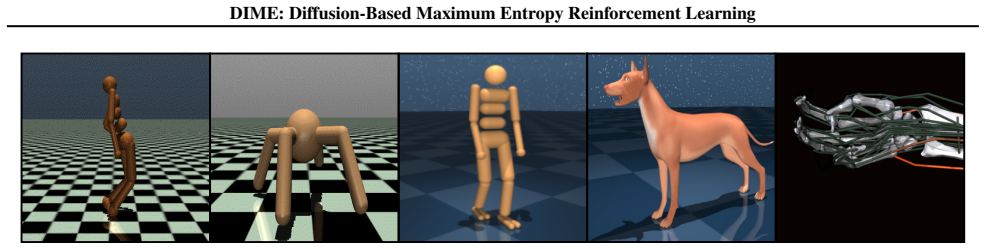
- On the paper's benchmarks, DIME outperforms all diffusion-based baselines on all 13 tasks and is competitive with the best Gaussian-policy methods at a much smaller update-to-data ratio and roughly half the training time.
Reading between the lines
- Editorial inference: The same lower-bound trick should transfer to offline RL and imitation learning, where the Q-function is fixed or estimated from a static dataset, giving a variational objective that needs no online rollouts.
- Editorial inference: The exploration claim predicts a measurable signature: over training, DIME's action distribution should remain visibly non-Gaussian on tasks that reward multi-modal behavior, while a fair Gaussian-policy comparison cannot produce the same diversity; logging action statistics would test this directly.
- Editorial inference: The convergence guarantee as stated is open at its joints: the proofs are written for finite action spaces and one displayed step appears to replace the action $a_0$ in the target with $a_N$; computing the exact Q-iteration on a small solvable MDP would settle whether the monotone improvement claim survives in continuous action spaces.
- Editorial inference: Because the objective is fully differentiable in the diffusion coefficient and the prior, end-to-end learning of these quantities could be pushed further into learned forward processes, potentially replacing the fixed Ornstein-Uhlenbeck prior with an adaptive one.
Editorial analysis
A structured set of objections, weighed in public.
Referee Report
Summary. The paper proposes DIME, a method for maximum-entropy reinforcement learning with diffusion-model policies. Because the marginal entropy of a diffusion policy is intractable, the authors derive a variational lower bound on the entropy (Section 4.1, Eq. 15) and cast the MaxEnt objective as a path-space KL minimization between the denoising process and an energy-based target policy exp(Q)/Z. They then state a policy-iteration scheme with monotone improvement (Propositions 4.1-4.3) and a practical actor-critic algorithm using a score network, distributional Q-learning, and automatic temperature tuning. Experiments on 13 continuous-control tasks report that DIME outperforms diffusion-based baselines on all environments and is competitive with state-of-the-art Gaussian-policy methods such as CrossQ and BRO.
Significance. If the theoretical claims hold, DIME would be a principled way to train expressive diffusion policies in online MaxEnt RL without adding Gaussian exploration noise, which is a genuine gap in the current literature. The variational lower-bound derivation in Section 4.1 is clean and standard, and the paper is commendably thorough in its empirical validation: 10 seeds, IQM with bootstrap confidence intervals, ablations on the temperature, diffusion steps, distributional Q, and the learned diffusion coefficient, plus runtime comparisons. The connection to approximate-inference samplers (Berner et al.; Richter & Berner) is clearly laid out and the method is well positioned relative to prior diffusion-RL baselines. The main body of the paper is readable and the practical recipe is concrete and reproducible from the appendices. The load-bearing theoretical claims, as written, are not fully supported, which limits what can be concluded from the convergence propositions.
major comments (3)
- [Appendix B, Eq. 45 and Section 4.2] The proof of Proposition 4.2 defines the candidate policy as pi^(i+1)(a^{0:N}|s) = exp(Q^{pi^i}(s,a^N))/Z * pi^i(a^{0:N-1}|a^N,s), putting the energy factor at the noised action a^N. In the main text, however, the MDP action is a^0: the policy improvement target in Eqs. 22-23, the rewards in Eq. 16, the Q-function in Eq. 17, and the actor loss in Eq. 27 all evaluate Q at a^0. The inequalities (47)-(57) and the recursive definition of Q in Eq. 52 all track a^N, so the chain establishes at most an improvement statement for the noised action argument, not for the action a^0 that enters the environment. No step in the proof connects the a^N-marginal of exp(Q)/Z to the required a^0-marginal. As a result, Proposition 4.2 and the convergence claim in Proposition 4.3 are not supported by the presented proof.
- [Section 4.2 and Section 4.3] Section 4.2 states 'Throughout this section, we assume finite action spaces to enable theoretical analysis, but relax this assumption in Section 4.3.' Section 4.3 then introduces the practical algorithm without any additional regularity conditions, convergence argument, or density-assumption check for continuous action spaces. Since the proof of Proposition 4.2 relies on KL divergences between densities and on exact minimization over the policy class (Eq. 22), the formal guarantees do not transfer to the continuous setting in which DIME is defined and evaluated. The paper should either supply conditions under which the finite-action proofs extend, or explicitly scope the convergence theorems to the finite-action case and state what is only heuristic for the continuous case.
- [Appendix B, proof of Proposition 4.3] The proof of Proposition 4.3 is conditional on existence of the limit: it reads 'If for lim_{k->infty} pi^k = pi*, then it must hold that Q^{pi*}(s,a) >= Q^{pi}(s,a)'. The proof does not show that the sequence pi^i converges, nor that the fixed point is unique and optimal within the restricted class \bar{Pi}. Additionally, the idealized policy-iteration step in Eq. 22 assumes an exact argmin over \bar{pi}, whereas the practical algorithm minimizes the amortized loss in Eq. 27 by stochastic gradients, so the connection between the formal policy-iteration theorem and the empirical procedure is not established. These gaps leave the statement 'provably converges to the optimal diffusion policy' unsupported as written.
minor comments (4)
- [Appendix A, Eqs. (29)-(32)] The lower-bound derivation has inconsistent notation between \vec pi and \bar pi in the displayed equations; for instance, Eq. (29) uses \vec pi for the denoising joint, while Eq. (32) returns a bound involving \bar pi, and Eq. (33) states the factorisation π0 = \vecπ0:N / \vecπ1:N|0 without aligning the superscripts with the preceding lines. The argument is standard, but the notation should be made uniform.
- [Proposition 4.3 statement] The statement uses (s,a) without a superscript on the action, whereas the policy and Q-function elsewhere in Section 4.2 are defined in terms of a^0. The statement should read Q^{pi*}(s,a^0) for consistency with Eq. 17.
- [Figure 2 caption] The caption for 'Diffusion Policy Benefit' refers to 'on the (a) humanoid-run and (b) dog-run tasks', but the corresponding panels are (c) and (d); this makes the caption confusing when read alongside the temperature panels (a)-(b).
- [Appendix D, Eq. (59)] The tanh change-of-variables log-likelihood correction uses u^N_i in the final term, but the correction is applied at the last diffusion step n = 0, so the term should involve u^0_i; the superscript N appears to be a typo.
Circularity Check
No significant circularity; the derivation is self-contained, though the convergence proof contains a correctness gap.
full rationale
The paper's central derivation chain is not circular. The lower bound in Eq. 15 is a standard auxiliary-variable bound derived from the data processing inequality and the non-negativity of KL divergence (Appendix A); it does not presuppose the maximum-entropy objective it is used to maximize. The policy improvement target exp(Q)/Z in Eqs. 18-23 is the standard MaxEnt control-as-inference target, with Q defined through Eq. 17 including the entropy lower bound, and the parameterized diffusion policy is trained by minimizing the resulting KL divergence against a learned critic. This is normal actor-critic feedback rather than a fitted input being renamed as a prediction. Self-citations to the authors' approximate-inference work (Richter & Berner, Blessing et al.) are used as optional samplers and ablations; the objective itself is derived by elementary identities in Appendix A, so these citations are not load-bearing for the central claim. The main theoretical weakness is a correctness gap, not circularity: the proof of Proposition 4.2 in Appendix B, Eq. 45, places the energy exp(Q)/Z at the noised action a^N rather than the MDP action a^0 used in Eqs. 17, 22-23 and 27, and Proposition 4.3 assumes convergence of the policy sequence rather than establishing it. That gap undermines the 'provably converges' claim as written, but it does not make any prediction reduce to its inputs by construction. The empirical comparison is against external baselines, so the paper is self-contained against outside benchmarks. Honest non-finding is therefore appropriate.
Assumptions & free parameters
free parameters (5)
- Temperature alpha / target entropy Htarget =
Auto-tuned via Eq. 28; Htarget = 4*dim(A) for DIME
- Number of diffusion steps N =
16 (2 to 32 tested in Fig. 3)
- Prior distribution variance eta^2 =
N(0, 2.5)
- Per-dimension diffusion coefficient scaling beta =
Learned end-to-end (Appendix G, Fig. 7)
- Distributional Q bin bounds vmin/vmax =
-1600/1600 Gym, -200/200 DMC, -3600/3600 MyoSuite
assumptions (6)
- domain assumption The OU noising process converges to a Gaussian prior at T: pi_T approx N(0, eta^2 I).
- standard math Time-reversal of the OU diffusion (Anderson/Nelson) gives the reverse process in Eq. 8.
- standard math The variational lower bound in Eq. 15 is valid for any joint distributions placed in the log-ratio.
- standard math Standard policy evaluation convergence (Sutton and Barto) applies to the entropy-augmented reward r + ell.
- ad hoc to paper The restricted diffusion policy class Pi_bar contains, or can approximate, the optimal solution of the KL minimization in Eq. 22.
- ad hoc to paper The sequence of policies generated by the practical actor-critic updates converges to the fixed point of the idealized policy iteration.
Cite this review
Pith. "Pith review of DIME:Diffusion-Based Maximum Entropy Reinforcement Learning." pith.science (2026). https://pith.science/paper/TCMMLHA7
@misc{pith2026250202316,
  author       = {Pith},
  title        = {Pith review of: DIME:Diffusion-Based Maximum Entropy Reinforcement Learning},
  year         = {2026},
  howpublished = {\url{https://pith.science/paper/TCMMLHA7}},
  note         = {Machine review of arXiv:2502.02316}
}
read the original abstract
Maximum entropy reinforcement learning (MaxEnt-RL) has become the standard approach to RL due to its beneficial exploration properties. Traditionally, policies are parameterized using Gaussian distributions, which significantly limits their representational capacity. Diffusion-based policies offer a more expressive alternative, yet integrating them into MaxEnt-RL poses challenges-primarily due to the intractability of computing their marginal entropy. To overcome this, we propose Diffusion-Based Maximum Entropy RL (DIME). \emph{DIME} leverages recent advances in approximate inference with diffusion models to derive a lower bound on the maximum entropy objective. Additionally, we propose a policy iteration scheme that provably converges to the optimal diffusion policy. Our method enables the use of expressive diffusion-based policies while retaining the principled exploration benefits of MaxEnt-RL, significantly outperforming other diffusion-based methods on challenging high-dimensional control benchmarks. It is also competitive with state-of-the-art non-diffusion based RL methods while requiring fewer algorithmic design choices and smaller update-to-data ratios, reducing computational complexity.
Figures


Figures from the paper (6 more)



Forward citations
Cited by 5 Pith papers
-
GeMPO: Generalized Measure Matching for Online Diffusion Reinforcement Learning
GeMPO unifies diffusion RL reweighting as measure matching to a regularized target, enabling flexible and negative weights that improve exploration and performance.
-
Efficient Online Reinforcement Learning for Diffusion Policy
Diffusion policies can be trained online with reweighted score matching using only Q-functions, and the resulting DPMD and SDAC algorithms beat SAC and prior diffusion-policy RL on most MuJoCo tasks.
-
Diffusion-Augmented Markov Decision Processes for Maximum Entropy Reinforcement Learning
Diffusion policies can be inserted into maximum-entropy RL by minimizing an upper bound on reverse KL, yielding DiffPPO, DiffSAC, and DiffWPO.
-
Towards Adaptive External Communication in Autonomous Vehicles: A Conceptual Design Framework
A three-layer framework (input, processing, output) for adaptive external human-machine interfaces in autonomous vehicles is introduced to systematize design and analysis.
-
Exploratory Diffusion Model for Unsupervised Reinforcement Learning
A diffusion-model denoising loss serves as an intrinsic reward to guide unsupervised RL exploration, plus an alternating fine-tuning scheme for diffusion policies.
Reference graph
Works this paper leans on
-
[1]
write newline
" write newline "" before.all 'output.state := FUNCTION n.dashify 't := "" t empty not t #1 #1 substring "-" = t #1 #2 substring "--" = not "--" * t #2 global.max substring 't := t #1 #1 substring "-" = "-" * t #2 global.max substring 't := while if t #1 #1 substring * t #2 global.max substring 't := if while FUNCTION format.date year duplicate empty "emp...
-
[2]
Agakov, F. V. and Barber, D. An auxiliary variational method. In Neural Information Processing: 11th International Conference, ICONIP 2004, Calcutta, India, November 22-25, 2004. Proceedings 11, pp.\ 561--566. Springer, 2004
work page 2004
-
[3]
S., Courville, A
Agarwal, R., Schwarzer, M., Castro, P. S., Courville, A. C., and Bellemare, M. Deep reinforcement learning at the edge of the statistical precipice. Advances in neural information processing systems, 34: 0 29304--29320, 2021
2021
-
[4]
J., Mittal, S., Lemos, P., Liu, C.-H., Sendera, M., Ravanbakhsh, S., Gidel, G., Bengio, Y., et al
Akhound-Sadegh, T., Rector-Brooks, J., Bose, A. J., Mittal, S., Lemos, P., Liu, C.-H., Sendera, M., Ravanbakhsh, S., Gidel, G., Bengio, Y., et al. Iterated denoising energy matching for sampling from boltzmann densities. arXiv preprint arXiv:2402.06121, 2024
arXiv 2024
-
[5]
Anderson, B. D. Reverse-time diffusion equation models. Stochastic Processes and their Applications, 12 0 (3): 0 313--326, 1982
1982
-
[6]
Efficient gradient-free variational inference using policy search
Arenz, O., Neumann, G., and Zhong, M. Efficient gradient-free variational inference using policy search. In International conference on machine learning, pp.\ 234--243. PMLR, 2018
work page 2018
-
[7]
G., Dabney, W., and Munos, R
Bellemare, M. G., Dabney, W., and Munos, R. A distributional perspective on reinforcement learning. In International conference on machine learning, pp.\ 449--458. PMLR, 2017
2017
-
[8]
An optimal control perspective on diffusion-based generative modeling
Berner, J., Richter, L., and Ullrich, K. An optimal control perspective on diffusion-based generative modeling. Transactions on Machine Learning Research
Show all 79 references
-
[9]
Crossq: Batch normalization in deep reinforcement learning for greater sample efficiency and simplicity
Bhatt, A., Palenicek, D., Belousov, B., Argus, M., Amiranashvili, A., Brox, T., and Peters, J. Crossq: Batch normalization in deep reinforcement learning for greater sample efficiency and simplicity. In The Twelfth International Conference on Learning Representations, 2024
2024
-
[10]
Underdamped diffusion bridges with applications to sampling
Blessing, D., Berner, J., Richter, L., and Neumann, G. Underdamped diffusion bridges with applications to sampling. In The Thirteenth International Conference on Learning Representations, 2025 a
2025
-
[11]
End-to-end learning of gaussian mixture priors for diffusion sampler
Blessing, D., Jia, X., and Neumann, G. End-to-end learning of gaussian mixture priors for diffusion sampler. In The Thirteenth International Conference on Learning Representations, 2025 b . URL https://openreview.net/forum?id=iXbUquaWbl
2025
-
[12]
Openai gym, 2016
Brockman, G., Cheung, V., Pettersson, L., Schneider, J., Schulman, J., Tang, J., and Zaremba, W. Openai gym, 2016
2016
-
[13]
Myosuite -- a contact-rich simulation suite for musculoskeletal motor control, 2022
Caggiano, V., Wang, H., Durandau, G., Sartori, M., and Kumar, V. Myosuite -- a contact-rich simulation suite for musculoskeletal motor control, 2022. arXiv preprint arXiv:2205.00588
2022 arXiv
-
[14]
Offline reinforcement learning via high-fidelity generative behavior modeling
Chen, H., Lu, C., Ying, C., Su, H., and Zhu, J. Offline reinforcement learning via high-fidelity generative behavior modeling. In The Eleventh International Conference on Learning Representations, 2023
2023
-
[15]
Sequential controlled langevin diffusions
Chen, J., Richter, L., Berner, J., Blessing, D., Neumann, G., and Anandkumar, A. Sequential controlled langevin diffusions. arXiv preprint arXiv:2412.07081, 2024
2024 arXiv
-
[16]
Sequential controlled langevin diffusions
Chen, J., Richter, L., Berner, J., Blessing, D., Neumann, G., and Anandkumar, A. Sequential controlled langevin diffusions. In The Thirteenth International Conference on Learning Representations, 2025. URL https://openreview.net/forum?id=dImD2sgy86
2025
-
[17]
Diffusion policy: Visuomotor policy learning via action diffusion
Chi, C., Feng, S., Du, Y., Xu, Z., Cousineau, E., Burchfiel, B., and Song, S. Diffusion policy: Visuomotor policy learning via action diffusion. In Proceedings of Robotics: Science and Systems (RSS), 2023
2023
-
[18]
Cover, T. M. Elements of information theory. John Wiley & Sons, 1999
1999
-
[19]
A stochastic control approach to reciprocal diffusion processes
Dai Pra, P. A stochastic control approach to reciprocal diffusion processes. Applied mathematics and Optimization, 23 0 (1): 0 313--329, 1991
1991
-
[20]
Sequential monte carlo samplers
Del Moral, P., Doucet, A., and Jasra, A. Sequential monte carlo samplers. Journal of the Royal Statistical Society Series B: Statistical Methodology, 68 0 (3): 0 411--436, 2006
2006
-
[21]
Diffusion-based reinforcement learning via q-weighted variational policy optimization
Ding, S., Hu, K., Zhang, Z., Ren, K., Zhang, W., Yu, J., Wang, J., and Shi, Y. Diffusion-based reinforcement learning via q-weighted variational policy optimization. In The Thirty-eighth Annual Conference on Neural Information Processing Systems, 2024
2024
-
[22]
and Jin, C
Ding, Z. and Jin, C. Consistency models as a rich and efficient policy class for reinforcement learning. In The Twelfth International Conference on Learning Representations, 2024
2024
-
[23]
G., and Strathmann, H
Doucet, A., Grathwohl, W., Matthews, A. G., and Strathmann, H. Score-based diffusion meets annealed importance sampling. Advances in Neural Information Processing Systems, 35: 0 21482--21494, 2022
2022
-
[24]
Diffusion actor-critic: Formulating constrained policy iteration as diffusion noise regression for offline reinforcement learning
Fang, L., Liu, R., Zhang, J., Wang, W., and Jing, B. Diffusion actor-critic: Formulating constrained policy iteration as diffusion noise regression for offline reinforcement learning. In The Thirteenth International Conference on Learning Representations, 2025
2025
-
[25]
and Domke, J
Geffner, T. and Domke, J. Langevin diffusion variational inference. In International Conference on Artificial Intelligence and Statistics, pp.\ 576--593. PMLR, 2023
2023
-
[26]
Reinforcement learning with deep energy-based policies
Haarnoja, T., Tang, H., Abbeel, P., and Levine, S. Reinforcement learning with deep energy-based policies. In International conference on machine learning, pp.\ 1352--1361. PMLR, 2017
2017
-
[27]
Latent space policies for hierarchical reinforcement learning
Haarnoja, T., Hartikainen, K., Abbeel, P., and Levine, S. Latent space policies for hierarchical reinforcement learning. In International Conference on Machine Learning, pp.\ 1851--1860. PMLR, 2018 a
2018
-
[28]
Soft actor-critic: Off-policy maximum entropy deep reinforcement learning with a stochastic actor
Haarnoja, T., Zhou, A., Abbeel, P., and Levine, S. Soft actor-critic: Off-policy maximum entropy deep reinforcement learning with a stochastic actor. In International conference on machine learning, pp.\ 1861--1870. PMLR, 2018 b
2018
-
[29]
Soft actor-critic algorithms and applications
Haarnoja, T., Zhou, A., Hartikainen, K., Tucker, G., Ha, S., Tan, J., Kumar, V., Zhu, H., Gupta, A., Abbeel, P., et al. Soft actor-critic algorithms and applications. arXiv preprint arXiv:1812.05905, 2018 c
2018 arXiv
-
[30]
G., and Levine, S
Hansen-Estruch, P., Kostrikov, I., Janner, M., Kuba, J. G., and Levine, S. Idql: Implicit q-learning as an actor-critic method with diffusion policies. arXiv preprint arXiv:2304.10573, 2023
2023 arXiv
-
[31]
Haussmann, U. G. and Pardoux, E. Time reversal of diffusions. The Annals of Probability, pp.\ 1188--1205, 1986
1986
-
[32]
Denoising diffusion probabilistic models
Ho, J., Jain, A., and Abbeel, P. Denoising diffusion probabilistic models. Advances in neural information processing systems, 33: 0 6840--6851, 2020
2020
-
[33]
o dinger-f \
Huang, J., Jiao, Y., Kang, L., Liao, X., Liu, J., and Liu, Y. Schr \"o dinger-f \"o llmer sampler: sampling without ergodicity. arXiv preprint arXiv:2106.10880, 1, 2021
2021 arXiv
-
[34]
and Dayan, P
Hyv \"a rinen, A. and Dayan, P. Estimation of non-normalized statistical models by score matching. Journal of Machine Learning Research, 6 0 (4), 2005
2005
-
[35]
N., and Precup, D
Ishfaq, H., Wang, G., Islam, S. N., and Precup, D. Langevin soft actor-critic: Efficient exploration through uncertainty-driven critic learning. In The Thirteenth International Conference on Learning Representations, 2025. URL https://openreview.net/forum?id=FvQsk3la17
2025
-
[36]
Planning with diffusion for flexible behavior synthesis
Janner, M., Du, Y., Tenenbaum, J., and Levine, S. Planning with diffusion for flexible behavior synthesis. In International Conference on Machine Learning, pp.\ 9902--9915. PMLR, 2022
2022
-
[37]
Efficient diffusion policies for offline reinforcement learning
Kang, B., Ma, X., Du, C., Pang, T., and Yan, S. Efficient diffusion policies for offline reinforcement learning. Advances in Neural Information Processing Systems, 36, 2023
2023
-
[38]
Elucidating the design space of diffusion-based generative models
Karras, T., Aittala, M., Aila, T., and Laine, S. Elucidating the design space of diffusion-based generative models. Advances in neural information processing systems, 35: 0 26565--26577, 2022
2022
-
[39]
Kingma, D. P. Auto-encoding variational bayes. arXiv preprint arXiv:1312.6114, 2013
2013 arXiv
-
[40]
Batch reinforcement learning
Lange, S., Gabel, T., and Riedmiller, M. Batch reinforcement learning. In Reinforcement learning: State-of-the-art, pp.\ 45--73. Springer, 2012
2012
-
[41]
Offline reinforcement learning: Tutorial, review, and perspectives on open problems
Levine, S., Kumar, A., Tucker, G., and Fu, J. Offline reinforcement learning: Tutorial, review, and perspectives on open problems. arXiv preprint arXiv:2005.01643, 2020
2005 arXiv
-
[42]
TOP - ERL : Transformer-based off-policy episodic reinforcement learning
Li, G., Tian, D., Zhou, H., Jiang, X., Lioutikov, R., and Neumann, G. TOP - ERL : Transformer-based off-policy episodic reinforcement learning. In The Thirteenth International Conference on Learning Representations, 2025
2025
-
[43]
Learning multimodal behaviors from scratch with diffusion policy gradient
Li, Z., Krohn, R., Chen, T., Ajay, A., Agrawal, P., and Chalvatzaki, G. Learning multimodal behaviors from scratch with diffusion policy gradient. arXiv preprint arXiv:2406.00681, 2024
2024 arXiv
-
[44]
Contrastive energy prediction for exact energy-guided diffusion sampling in offline reinforcement learning
Lu, C., Chen, H., Chen, J., Su, H., Li, C., and Zhu, J. Contrastive energy prediction for exact energy-guided diffusion sampling in offline reinforcement learning. In International Conference on Machine Learning, pp.\ 22825--22855. PMLR, 2023
2023
-
[45]
K., S nderby, S
Maal e, L., S nderby, C. K., S nderby, S. K., and Winther, O. Auxiliary deep generative models. In International conference on machine learning, pp.\ 1445--1453. PMLR, 2016
2016
-
[46]
Diffusion-dice: In-sample diffusion guidance for offline reinforcement learning
Mao, L., Xu, H., Zhan, X., Zhang, W., and Zhang, A. Diffusion-dice: In-sample diffusion guidance for offline reinforcement learning. In The Thirty-eighth Annual Conference on Neural Information Processing Systems, 2024
2024
-
[47]
S 2 ac: Energy-based reinforcement learning with stein soft actor critic
Messaoud, S., Mokeddem, B., Xue, Z., Pang, L., An, B., Chen, H., and Chawla, S. S 2 ac: Energy-based reinforcement learning with stein soft actor critic. In The Twelfth International Conference on Learning Representations
-
[48]
and Cygan, M
Nauman, M. and Cygan, M. On the theory of risk-aware agents: Bridging actor-critic and economics. In ICML 2024 Workshop: Aligning Reinforcement Learning Experimentalists and Theorists, 2023
2024
-
[49]
Bigger, regularized, optimistic: scaling for compute and sample efficient continuous control
Nauman, M., Ostaszewski, M., Jankowski, K., Mi o \'s , P., and Cygan, M. Bigger, regularized, optimistic: scaling for compute and sample efficient continuous control. In The Thirty-eighth Annual Conference on Neural Information Processing Systems, 2024
2024
-
[50]
Dynamical theories of Brownian motion, volume 101
Nelson, E. Dynamical theories of Brownian motion, volume 101. Princeton university press, 2020
2020
-
[51]
A unified view of entropy-regularized markov decision processes
Neu, G., Jonsson, A., and G \'o mez, V. A unified view of entropy-regularized markov decision processes. arXiv preprint arXiv:1705.07798, 2017
2017 arXiv
-
[52]
The primacy bias in deep reinforcement learning
Nikishin, E., Schwarzer, M., D’Oro, P., Bacon, P.-L., and Courville, A. The primacy bias in deep reinforcement learning. In International conference on machine learning, pp.\ 16828--16847. PMLR, 2022
2022
-
[53]
Noble, M., Grenioux, L., Gabri \'e , M., and Durmus, A. O. Learned reference-based diffusion sampling for multi-modal distributions. arXiv preprint arXiv:2410.19449, 2024
2024 arXiv
-
[54]
Transport meets variational inference: Controlled monte carlo diffusions
Nusken, N., Vargas, F., Padhy, S., and Blessing, D. Transport meets variational inference: Controlled monte carlo diffusions. In The Twelfth International Conference on Learning Representations: ICLR 2024, 2024
2024
-
[55]
Learning a diffusion model policy from rewards via q-score matching
Psenka, M., Escontrela, A., Abbeel, P., and Ma, Y. Learning a diffusion model policy from rewards via q-score matching. In Forty-first International Conference on Machine Learning, 2024
2024
-
[56]
Hierarchical variational models
Ranganath, R., Tran, D., and Blei, D. Hierarchical variational models. In International conference on machine learning, pp.\ 324--333. PMLR, 2016
2016
-
[57]
Goal conditioned imitation learning using score-based diffusion policies
Reuss, M., Li, M., Jia, X., and Lioutikov, R. Goal conditioned imitation learning using score-based diffusion policies. In Robotics: Science and Systems, 2023
2023
-
[58]
and Berner, J
Richter, L. and Berner, J. Improved sampling via learned diffusions. In The Twelfth International Conference on Learning Representations
-
[59]
and Solin, A
S \"a rkk \"a , S. and Solin, A. Applied stochastic differential equations, volume 10. Cambridge University Press, 2019
2019
-
[60]
Deep unsupervised learning using nonequilibrium thermodynamics
Sohl-Dickstein, J., Weiss, E., Maheswaranathan, N., and Ganguli, S. Deep unsupervised learning using nonequilibrium thermodynamics. In International conference on machine learning, pp.\ 2256--2265. PMLR, 2015
2015
-
[61]
P., Kumar, A., Ermon, S., and Poole, B
Song, Y., Sohl-Dickstein, J., Kingma, D. P., Kumar, A., Ermon, S., and Poole, B. Score-based generative modeling through stochastic differential equations. In International Conference on Learning Representations, 2021
2021
-
[62]
Sutton, R. S. and Barto, A. G. Reinforcement learning: An introduction. Robotica, 17 0 (2): 0 229--235, 1999
1999
-
[63]
Robot trajectory optimization using approximate inference
Toussaint, M. Robot trajectory optimization using approximate inference. In Proceedings of the 26th annual international conference on machine learning, pp.\ 1049--1056, 2009
2009
-
[64]
Tran, D., Ranganath, R., and Blei, D. M. The variational gaussian process. arXiv preprint arXiv:1511.06499, 2015
2015 arXiv
-
[65]
dm\_control: Software and tasks for continuous control
Tunyasuvunakool, S., Muldal, A., Doron, Y., Liu, S., Bohez, S., Merel, J., Erez, T., Lillicrap, T., Heess, N., and Tassa, Y. dm\_control: Software and tasks for continuous control. Software Impacts, 6: 0 100022, 2020. ISSN 2665-9638
2020
-
[66]
and Raginsky, M
Tzen, B. and Raginsky, M. Theoretical guarantees for sampling and inference in generative models with latent diffusions. In Conference on Learning Theory, pp.\ 3084--3114. PMLR, 2019
2019
-
[67]
S., and Doucet, A
Vargas, F., Grathwohl, W. S., and Doucet, A. Denoising diffusion samplers. In The Eleventh International Conference on Learning Representations
-
[68]
u sken, N. Bayesian learning via neural schr \
Vargas, F., Ovsianas, A., Fernandes, D., Girolami, M., Lawrence, N. D., and N \"u sken, N. Bayesian learning via neural schr \"o dinger--f \"o llmer flows. Statistics and Computing, 33 0 (1): 0 3, 2023
2023
-
[69]
A connection between score matching and denoising autoencoders
Vincent, P. A connection between score matching and denoising autoencoders. Neural computation, 23 0 (7): 0 1661--1674, 2011
2011
-
[70]
and Liu, Q
Wang, D. and Liu, Q. Learning to draw samples: With application to amortized mle for generative adversarial learning. arXiv preprint arXiv:1611.01722, 2016
2016 arXiv
-
[71]
Wang, Y., Wang, L., Jiang, Y., Zou, W., Liu, T., Song, X., Wang, W., Xiao, L., WU, J., Duan, J., and Li, S. E. Diffusion actor-critic with entropy regulator. In The Thirty-eighth Annual Conference on Neural Information Processing Systems, 2024. URL https://openreview.net/forum...
2024
-
[72]
J., and Zhou, M
Wang, Z., Hunt, J. J., and Zhou, M. Diffusion policies as an expressive policy class for offline reinforcement learning. International Conference on Learning Representations, 2023
2023
-
[73]
and Teh, Y
Welling, M. and Teh, Y. W. Bayesian learning via stochastic gradient langevin dynamics. In Proceedings of the 28th international conference on machine learning (ICML-11), pp.\ 681--688. Citeseer, 2011
2011
-
[74]
h., Zhong, Y., Yang, Y., Fang, C., Wen, S., Zhou, B., and Lin, Z
Yang, L., Huang, Z., Lei, F. h., Zhong, Y., Yang, Y., Fang, C., Wen, S., Zhou, B., and Lin, Z. Policy representation via diffusion probability model for reinforcement learning. arXiv preprint arXiv:2305.13122, 2023
2023 arXiv
-
[75]
T., Liu, C.-H., Courville, A., and Bengio, Y
Zhang, D., Chen, R. T., Liu, C.-H., Courville, A., and Bengio, Y. Diffusion generative flow samplers: Improving learning signals through partial trajectory optimization. arXiv preprint arXiv:2310.02679, 2023
2023 arXiv
-
[76]
and Chen, Y
Zhang, Q. and Chen, Y. Path integral sampler: a stochastic control approach for sampling. arXiv preprint arXiv:2111.15141, 2021
2021 arXiv
-
[77]
Variational distillation of diffusion policies into mixture of experts
Zhou, H., Blessing, D., Li, G., Celik, O., Jia, X., Neumann, G., and Lioutikov, R. Variational distillation of diffusion policies into mixture of experts. In The Thirty-eighth Annual Conference on Neural Information Processing Systems, 2024. URL https://openreview.net/forum?id...
2024
-
[78]
Ziebart, B. D. Modeling purposeful adaptive behavior with the principle of maximum causal entropy. Carnegie Mellon University, 2010
2010
-
[79]
D., Maas, A
Ziebart, B. D., Maas, A. L., Bagnell, J. A., Dey, A. K., et al. Maximum entropy inverse reinforcement learning. In Aaai, volume 8, pp.\ 1433--1438. Chicago, IL, USA, 2008
2008
Reviewed August 9, 2026 · model on record in the stance chip above.
Discussion (0). Continue with ORCID to comment.