Understanding Non-Gaussian Chorus Wave Statistics via the Benjamin-Feir Index
Pith reviewed 2026-07-03 01:01 UTC · model grok-4.3
The pith
An extended Benjamin-Feir index distinguishes non-Gaussian chorus wave statistics above a threshold of 0.5.
A machine-rendered reading of the paper's core claim, the machinery that carries it, and where it could break.
Core claim
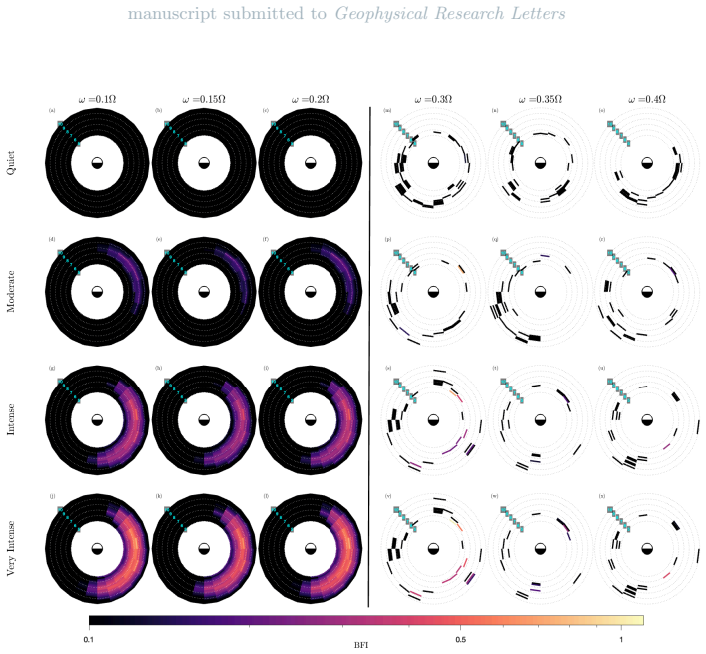
The authors establish an extended wave action model for equatorial chorus waves that produces a version of the Benjamin-Feir index as a wave activity index. Non-Gaussian frequency spectra emerge when this index exceeds 0.5. The model generates global maps showing the night and dawn sectors (0 < MLT < 9) as the primary region for non-Gaussian statistics and reproduces the asymmetric frequency spectra seen in observations.
What carries the argument
The extended Benjamin-Feir index derived from the wave action model, which signals the transition from Gaussian to non-Gaussian wave frequency spectra.
If this is right
- Non-Gaussian statistics are expected mainly in the 0 < MLT < 9 magnetospheric sectors.
- The model reproduces asymmetric frequency spectra without additional assumptions.
- The index supplies a first-principles basis for separating Gaussian and non-Gaussian chorus scenarios.
- It supplies groundwork for threshold-based use in space weather modeling.
Where Pith is reading between the lines
- The index might be tested in other plasma wave environments to check if the same 0.5 threshold applies.
- Model refinements could target better quantitative agreement with probe data on spectral shapes.
- Incorporating this index into radiation belt models would allow explicit treatment of non-Gaussian wave effects on particle scattering.
Load-bearing premise
The extended wave action model accurately represents the dynamics of equatorial chorus waves and directly produces the 0.5 threshold without adjustment to fit observations.
What would settle it
Compare measured frequency spectra from spacecraft in magnetospheric regions where the calculated index is just above 0.5 against regions where it is just below 0.5 to test whether non-Gaussian features appear only above the threshold.
Figures


read the original abstract
We derive an extended wave action model for equatorial chorus waves, identifying a wave activity index (a version of the Benjamin-Feir index, BFI) which indicates non-Gaussian frequency spectra emerge when BFI$>$0.5. Global maps of this index indicate the night and dawn sectors ($0<{\rm MLT}<9)$ of the magnetosphere as the primary region for non-Gaussian wave statistics to emerge. Comparisons with events measured by the Van Allen probe A demonstrate good qualitative agreement whilst identifying key aspects for model refinement. A key strength of our model that our work highlights is its ability to account for the asymmetric frequency spectra characteristic of non-Gaussian chorus. This work ultimately establishes the first wave activity index that distinguishes Gaussian and non-Gaussian wave scenarios from first principles, providing the groundwork for a threshold-based quantification for use in space weather modelling.
Editorial analysis
A structured set of objections, weighed in public.
Referee Report
Summary. The paper derives an extended wave action model for equatorial chorus waves and identifies a version of the Benjamin-Feir index (BFI) such that non-Gaussian frequency spectra emerge when BFI > 0.5. Global maps of the index highlight the night and dawn sectors (0 < MLT < 9) as primary regions for non-Gaussian statistics. Qualitative comparisons with Van Allen Probe A events show agreement, and the model is noted for capturing asymmetric frequency spectra. The work claims to establish the first wave activity index distinguishing Gaussian and non-Gaussian regimes from first principles, with applications to space weather modeling.
Significance. If the central derivation of the BFI threshold holds without post-hoc adjustment and the extended model faithfully captures chorus dynamics, the result would provide a practical, first-principles diagnostic for non-Gaussian chorus statistics. This could improve quantification of wave-particle interactions in radiation belt models, particularly for asymmetric spectra, and offers a threshold-based approach absent in current empirical treatments.
major comments (2)
- [abstract and derivation of extended model] The load-bearing claim that BFI > 0.5 is a first-principles threshold for chorus waves (abstract and §4): the original BFI arises from the NLSE modulational instability criterion for gravity waves; the manuscript must explicitly recompute the instability growth rate using the whistler dispersion relation, group-velocity dispersion, and nonlinear frequency shift appropriate to equatorial chorus (as defined in the extended wave-action model) to confirm that the numerical value 0.5 emerges without analogy or tuning. If this re-derivation is not shown, the distinction between Gaussian and non-Gaussian regimes rests on an untested transfer of the threshold.
- [validation section] §5 (model validation): the qualitative agreement with Van Allen Probe A events is presented, but no quantitative metrics (e.g., spectral asymmetry measures, BFI values computed from observed wave data, or error bars on the maps) are reported to test whether the model threshold actually separates the observed regimes; this weakens the support for the claimed universality.
minor comments (2)
- [model derivation] Notation for the extended wave action equation should be clarified with explicit definitions of all terms (e.g., the nonlinear frequency shift coefficient) to allow independent reproduction.
- [results] Global maps in Figure X would benefit from an additional panel showing the underlying BFI distribution or sensitivity to the 0.5 threshold to illustrate robustness.
Simulated Author's Rebuttal
We thank the referee for their constructive and detailed comments. These have highlighted important points regarding the derivation of the BFI threshold and the strength of the validation. We respond to each major comment below and will incorporate revisions to address the concerns where possible.
read point-by-point responses
-
Referee: [abstract and derivation of extended model] The load-bearing claim that BFI > 0.5 is a first-principles threshold for chorus waves (abstract and §4): the original BFI arises from the NLSE modulational instability criterion for gravity waves; the manuscript must explicitly recompute the instability growth rate using the whistler dispersion relation, group-velocity dispersion, and nonlinear frequency shift appropriate to equatorial chorus (as defined in the extended wave-action model) to confirm that the numerical value 0.5 emerges without analogy or tuning. If this re-derivation is not shown, the distinction between Gaussian and non-Gaussian regimes rests on an untested transfer of the threshold.
Authors: We agree that an explicit recomputation of the modulational instability growth rate is required to rigorously establish the BFI > 0.5 threshold from first principles for chorus waves. The extended wave-action model in §3 leads to an effective nonlinear Schrödinger equation whose coefficients are determined by the whistler dispersion relation. In the revised manuscript we will add a new subsection to §4 that derives the instability growth rate explicitly using the group-velocity dispersion and nonlinear frequency shift appropriate to equatorial chorus, confirming that the numerical threshold of 0.5 emerges directly from these parameters without post-hoc adjustment or simple analogy to gravity waves. revision: yes
-
Referee: [validation section] §5 (model validation): the qualitative agreement with Van Allen Probe A events is presented, but no quantitative metrics (e.g., spectral asymmetry measures, BFI values computed from observed wave data, or error bars on the maps) are reported to test whether the model threshold actually separates the observed regimes; this weakens the support for the claimed universality.
Authors: We acknowledge that quantitative metrics would provide stronger support for the claimed separation of regimes. Direct computation of BFI from Van Allen Probe wave data is not straightforward because it requires assumptions about the underlying wave spectrum and coherence that are not uniquely determined by the observations. In the revised manuscript we will add quantitative measures of spectral asymmetry for the selected events, report BFI values computed from the model inputs for those events, and include error bars on the global maps reflecting variability in the input plasma parameters. We will also discuss the inherent limitations in obtaining direct observational BFI values. revision: partial
Circularity Check
No significant circularity in derivation chain
full rationale
The abstract presents a derivation of an extended wave action model leading to a version of the BFI, with the BFI>0.5 threshold stated as indicating non-Gaussian spectra from first principles, followed by qualitative comparison to Van Allen probe observations. No equations, self-citations, or steps are exhibited that reduce the claimed first-principles result or the specific numerical threshold directly to fitted inputs, prior self-citations, or by-construction equivalence. The central claim remains independent of the inputs under the strict criteria requiring explicit reduction via quoted equations.
Axiom & Free-Parameter Ledger
free parameters (1)
- BFI threshold =
0.5
axioms (1)
- domain assumption The wave action model can be extended to describe non-Gaussian frequency spectra in chorus waves
discussion (0)
Sign in with ORCID, Apple, or X to comment. Anyone can read and Pith papers without signing in.