Level rearrangement in K- p system
Pith reviewed 2026-06-26 12:56 UTC · model grok-4.3
The pith
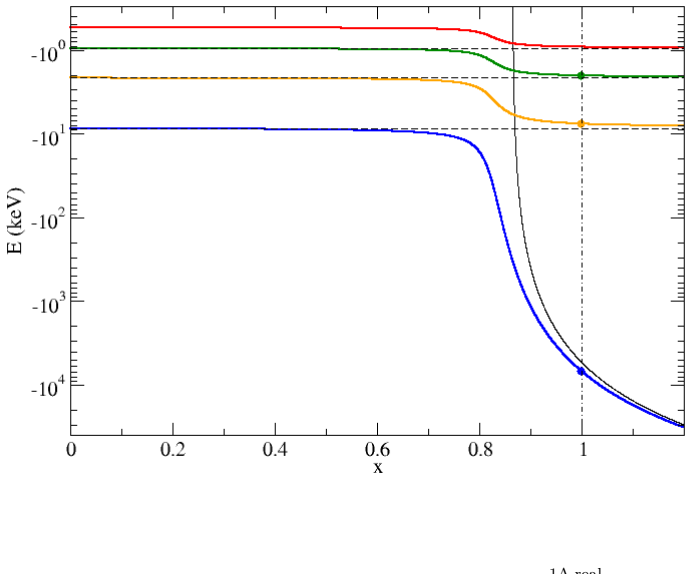
The interplay of strong and Coulomb potentials causes level rearrangement in the K- p system, making the 1s shift of kaonic hydrogen attractive.
A machine-rendered reading of the paper's core claim, the machinery that carries it, and where it could break.
Core claim
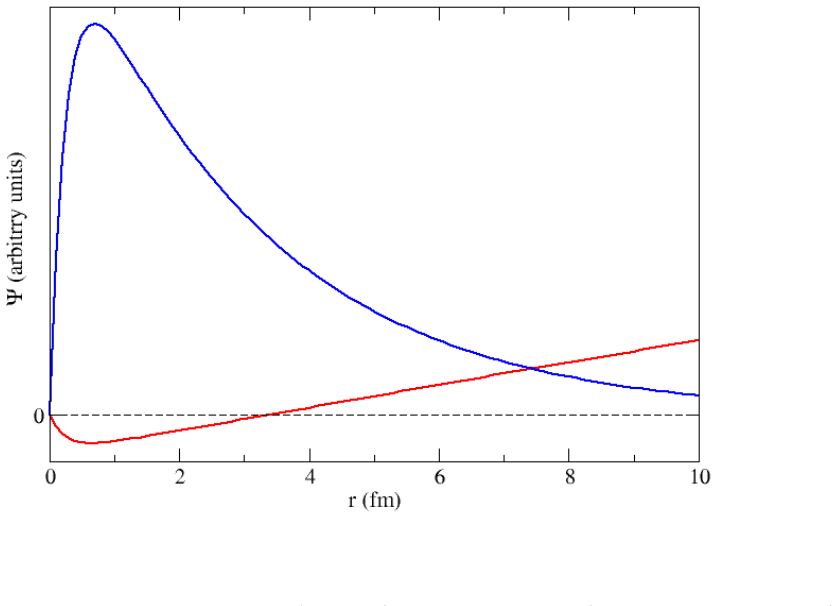
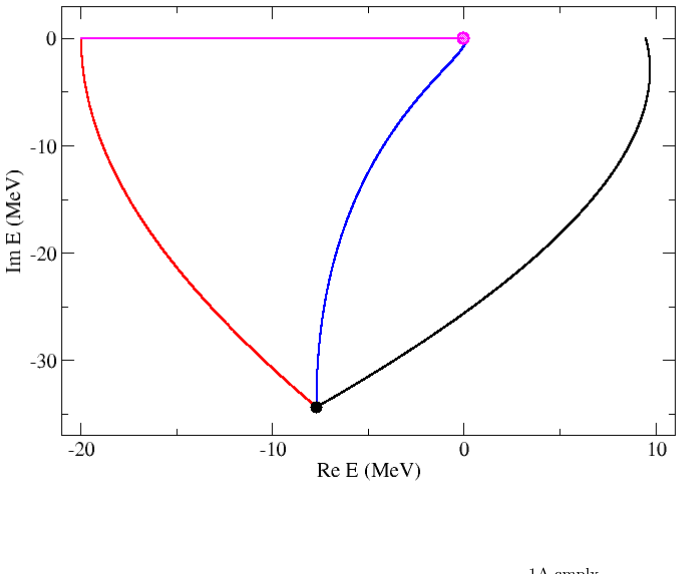
We observed a level rearrangement in the K- p system caused by the interplay of strong nuclear and long range Coulomb potentials. The 1s shift of kaonic hydrogen is in fact attractive. Absorption in the strong antikaon-nucleon interaction does not destroy the level rearrangement.
What carries the argument
Level rearrangement arising from the combined strong and Coulomb potentials in the K- p atom.
Load-bearing premise
The strong antikaon-nucleon potential has a particular form and strength such that its combination with the Coulomb potential produces the level rearrangement.
What would settle it
A measurement of the 1s energy shift in kaonic hydrogen that is repulsive rather than attractive would falsify the claim of rearrangement.
Figures
read the original abstract
We studied the level shifts in the $K^- p$ system caused by the interplay of strong nuclear and long range Coulomb potentials. We observed a level rearrangement in the system and found that the $1s$ shift of kaonic hydrogen is in fact ``attractive''. In addition, we demonstrated that absorption in the strong antikaon-nucleon interaction does not destroy the level rearrangement.
Editorial analysis
A structured set of objections, weighed in public.
Referee Report
Summary. The paper examines level shifts in the K^- p system arising from the interplay between a strong antikaon-nucleon potential and the long-range Coulomb potential. It reports the observation of level rearrangement and concludes that the 1s shift of kaonic hydrogen is attractive. The work further demonstrates that inclusion of absorption in the strong interaction does not eliminate the rearrangement effect.
Significance. If the central result is robust, the finding of an attractive 1s shift would be noteworthy for the interpretation of kaonic-atom data and the low-energy KN interaction. The explicit check that absorption preserves the rearrangement adds value. However, the significance is conditional on the specific potential chosen; the manuscript provides no evidence that the sign of the shift survives reasonable variations in range, strength, or imaginary part consistent with scattering data.
major comments (1)
- [Potential model and numerical results (likely §2–4)] The headline claim that the 1s shift is attractive and that level rearrangement occurs rests entirely on one particular parametrization of the strong potential. No scan or sensitivity study over plausible alternative forms (range, depth, or absorptive strength) consistent with KN data is presented; a different but still viable potential could move the system out of the rearrangement regime and reverse the sign of the shift. This is load-bearing for the central result.
minor comments (1)
- [Abstract] The abstract is concise but could usefully state the specific potential employed and the range of parameters explored.
Simulated Author's Rebuttal
We thank the referee for the detailed review and for highlighting the importance of robustness with respect to the strong-interaction potential. We address the single major comment below and indicate the revisions we will make.
read point-by-point responses
-
Referee: [Potential model and numerical results (likely §2–4)] The headline claim that the 1s shift is attractive and that level rearrangement occurs rests entirely on one particular parametrization of the strong potential. No scan or sensitivity study over plausible alternative forms (range, depth, or absorptive strength) consistent with KN data is presented; a different but still viable potential could move the system out of the rearrangement regime and reverse the sign of the shift. This is load-bearing for the central result.
Authors: We agree that the central results are obtained with one specific parametrization of the strong potential. The manuscript demonstrates level rearrangement and an attractive 1s shift (including the persistence of the effect when absorption is added) for that choice, which is constrained by low-energy KN data. However, we acknowledge that no explicit variation of range, depth or imaginary strength within the experimentally allowed window is shown. In the revised manuscript we will add a sensitivity study: we will repeat the calculation for a small set of alternative potentials (different ranges and depths, with imaginary parts adjusted to remain consistent with KN scattering lengths and cross sections) and report whether the rearrangement and the sign of the 1s shift survive. If any of the variants move the system out of the rearrangement regime we will state this explicitly and qualify the conclusions accordingly. revision: yes
Circularity Check
No circularity; derivation follows from numerical solution of Schrödinger equation with given potentials
full rationale
The paper computes level shifts and rearrangement in the K-p system by solving the two-body problem with a specific strong antikaon-nucleon potential plus Coulomb interaction. The reported attractive 1s shift and persistence under absorption are direct numerical outputs for the chosen interaction; no equation or result is shown to be identical to its inputs by construction, no fitted parameter is relabeled as a prediction, and no load-bearing premise reduces to a self-citation chain. The model dependence is explicit but does not meet any of the enumerated circularity criteria.
Axiom & Free-Parameter Ledger
Reference graph
Works this paper leans on
-
[1]
Bajzer, Zeitschrift f¨ ur Physik A Atoms and Nuclei278, 97 (1976)
Z. Bajzer, Zeitschrift f¨ ur Physik A Atoms and Nuclei278, 97 (1976)
1976
-
[2]
Papp, Journal of Physics A: Mathematical and General20, 153 (1987)
Z. Papp, Journal of Physics A: Mathematical and General20, 153 (1987)
1987
-
[3]
N. V. Shevchenko, Physical Review C112, 064007 (2025)
2025
-
[4]
C. J. Batty and A. Gal, Il Nuovo Cimento A (1965-1970)102, 255 (1989)
1965
-
[5]
Bazzi, G
M. Bazzi, G. Beer, L. Bombelli, A. M. Bragadireanu, M. Cargnelli, G. Corradi, and C. Curceanu, Phys. Lett. B704, 113 (2011)
2011
-
[6]
Y. B. Zel’dovich, Soviet Phys.-Solid State1(1960)
1960
-
[7]
A. M. Badalyan, L. P. Kok, M. I. Polikarpov, and Y. A. Simonov, Physics Reports82, 31 (1982)
1982
-
[8]
A. Gal, E. Friedman, and C. J. Batty, Nuclear Physics A606, 283 (1996). 11
1996
discussion (0)
Sign in with ORCID, Apple, or X to comment. Anyone can read and Pith papers without signing in.