REVIEW 3 major objections 4 minor 37 references
A single unfinished demonstration can teach a robot a manipulation skill and its reverse.
Reviewed by Pith at T0; open to challenge. T0 means a machine referee read the full paper against a public rubric. the ladder, T0–T4 →
T0 review · deepseek-v4-flash
2026-08-02 03:24 UTC pith:TDMIATV3
load-bearing objection Solid one-shot contact-rich LfD framework with a genuinely new twist-direction segmentation, but the headline extrapolation claim is not yet backed by data that varies how much of the contact phase is missing. the 3 major comments →
Learning Forward & Reverse Skills from a Single Unfinished Demonstration for Constrained Manipulation Tasks
The pith
A machine-rendered reading of the paper's core claim, the machinery that carries it, and where it could break.
Core claim
The paper's core claim is that a contact-rich manipulation task can be decomposed into a sequence of constant screw motions, and that this decomposition lets a single, possibly unfinished human demonstration support both forward and reverse execution. The decomposition is learned by a geometry-driven segmentation that groups trajectory samples by direction-only twist features—rotation axis and translation direction—rather than by timing or speed. Each resulting segment is fitted with a constant-twist screw primitive, parameterized by axis, point, pitch, and progress, through a Lie-algebra residual optimization. During execution, these primitives are run under a 6D admittance pose correction
What carries the argument
The screw primitive: a constant twist ξ=(ω,v) that parameterizes a rigid-body motion as rotation about and translation along a fixed axis, with finite displacement exp(ξ̂θ) for progress θ. The framework's central operation is a twist-direction segmentation algorithm that partitions the demonstrated contact trajectory into blocks with consistent rotation-axis and translation directions, then refines boundaries by cosine-similarity thresholds and merges spurious segments. Each segment is fit to a screw primitive by weighted least squares in se(3), and execution is governed by admittance dynamics that convert measured wrench into pose corrections and progress-speed adjustments.
Load-bearing premise
The central premise is that every task-critical contact phase can be represented as a constant screw motion, and that the partial observation of each phase in the demonstration is enough to fit that screw; if the motion is not screw-like, or a phase is entirely missing, the framework cannot fill the gap.
What would settle it
Take a task with a contact phase that is deliberately non-constant-screw (e.g., a variable-pitch thread or a jamming insertion), learn from a demonstration that covers only the beginning of the phase, and measure whether the constant-twist extrapolation either diverges from the true constraint (large wrench spikes) or fails to complete the task. A second decisive test is to truncate the demonstration before a distinct contact phase begins, so that phase has zero observed samples; the paper's own admission that it 'does not infer absent phases' predicts failure.
If this is right
- If the constant-screw representation holds, a robot can complete a task whose demonstration stopped early—e.g., continue turning a lock after the demonstrated rotation ends—because progress is controlled by contact load rather than by trajectory length.
- Reverse skills such as unscrewing, extracting, and unlocking can be generated from the same primitives without new demonstrations, by reversing the primitive order and negating the twist.
- Because each contact phase is a geometric object rather than a raw trajectory, the learned primitives transfer to objects with the same contact topology but different dimensions, as the paper's generalization experiments suggest.
- The twist-direction segmentation itself may provide a more stable decomposition of short, noisy contact motions than methods relying on speed or reconstruction error, which could benefit other LfD pipelines.
Where Pith is reading between the lines
- Editorial extension: The paper stops at constant screws, but the same encoding could be composed: a library of screw primitives learned across different tasks could be sequenced to perform novel constrained tasks without new demonstrations.
- Editorial extension: The successful reversal by negating the twist implies a symmetry that only holds when the contact topology is the same in reverse; tasks involving irreversible contacts (snap fits, deformations) would need a modified primitive model.
- Editorial extension: If the constant-screw assumption is accurate, it suggests a testable prediction that the demonstrated contact phase can be compressed to a few parameters (axis, point, pitch) with almost no loss of information; measuring reconstruction error across many tasks could verify this.
- Editorial extension: The method's reliance on 'at least partial observation' of each phase means that the framework is not truly zero-shot for missing phases; an autonomous data-collection scheme that decides when a phase has been sufficiently observed would be a natural follow-up.
Editorial analysis
A structured set of objections, weighed in public.
Referee Report
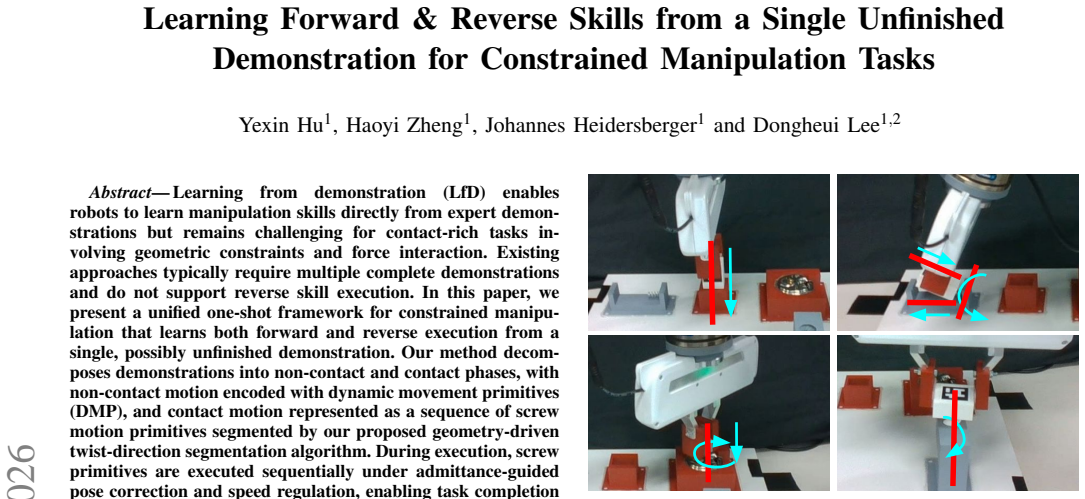
Summary. The paper presents a one-shot learning-from-demonstration framework for constrained, contact-rich manipulation tasks. A single kinesthetic demonstration is decomposed into a free-space phase, encoded by a DMP, and a contact phase, segmented into a sequence of screw motion primitives using a geometry-driven twist-direction segmentation algorithm. Execution of the screw primitives is modulated by 6D admittance pose correction and 1D admittance speed regulation, allowing the contact motion to extend beyond the demonstrated trajectory length. Reverse execution is obtained by sign-flipping the learned twists and running the primitives in reverse order. Experiments on peg insertion, battery insertion, lock opening, and screw driving report 20/20 success on complete demonstrations and 18/20 success on unfinished demonstrations for the proposed method, outperforming three one-shot trajectory baselines.
Significance. If the reported results hold, this is a practically valuable contribution: it addresses a real gap in one-shot LfD for contact-rich tasks, introduces a clean geometric representation of contact phases, and demonstrates that reverse skills can be obtained without additional demonstrations. The screw-fitting formulation in Eq. (8) is principled, and the twist-direction segmentation is described in enough detail to be reproducible. The paper is also honest about the method's key limitation—it cannot infer entirely unobserved contact phases—and about the screw-driving failures caused by stitching errors. However, the experimental evidence is currently too thin and under-quantified to fully support the central extrapolation claim.
major comments (3)
- [§V-B; Fig. 5; Table II] The central claim that the method completes tasks 'beyond the demonstrated trajectory length' is not actually stress-tested. Unfinished demonstrations are said to be generated by 'directly truncating the contact phase,' but no truncation fraction, remaining phase fraction, or per-phase retention is reported anywhere. The dotted trajectories in Fig. 5 appear to retain a substantial portion of the contact phase. If the retained portion is, say, 80–90% of each phase, the extrapolation is nearly trivial and the strong claim in the abstract is not validated. Please report the actual truncation point for each task and, ideally, perform a systematic sweep over truncation fractions (e.g., 25%, 50%, 75% of each contact phase). This is load-bearing because §IV-A explicitly states that the method 'does not infer absent phases.'
- [§V-A; Tables I and II] All success rates are counts over 5 trials per condition, with no confidence intervals or statistical tests. The only failure of the proposed method (screw driving: 3/5 forward and 3/5 reverse in Table II) is within sampling noise of a perfect 5/5 score, and the paper attributes it to 'pitch deviations from trajectory stitching' without reporting the number of regrasp cycles or the stitching errors. The claim of 'improved success rates' would be much stronger if accompanied by binomial confidence intervals, more trials per condition, or a statistical comparison. At minimum, report the stitching error and the number of regrasps in the screw-driving trials, since this is the only task where the method's extrapolation fails.
- [Abstract; §IV-A] The abstract and introduction claim that the method learns from 'a single, possibly unfinished demonstration' and 'enable[s] task completion beyond the demonstrated trajectory length,' but §IV-A states a critical restriction: 'each task-critical contact phase must be at least partially observed; the method extrapolates observed primitives but does not infer absent phases.' This restriction is not reflected in the abstract, the title, or the framing of the contributions. A reader would reasonably conclude that the method can handle a demonstration that stops before a phase begins. Please state the partial-observation requirement in the abstract and intro, and include an experiment that clearly shows the boundary of what the method can and cannot extrapolate.
minor comments (4)
- [Eq. (4)] The refinement index k is described as a split within the transition block, but the notation is ambiguous about whether k refers to local sample indices within the block or global trajectory indices. Please clarify.
- [§V-G] The generalization to novel objects is asserted without any trial counts, quantitative success criteria, or comparison; Fig. 6 is illustrative only. Either add the same evaluation protocol or explicitly label this as a qualitative demonstration.
- [§V-B] The screw-driving demonstration is stitched from regrasp segments. The paper should report the stitching error (e.g., pose gap at stitching points) to support the claim that the stitched trajectory is a valid continuous SE(3) motion.
- [§V-D] Table I reports 'DMP+Twist+Adm' with 15/20 forward but 10/20 reverse. The text explains the reverse failures but does not give per-task details; a sentence or small table would help the reader see which tasks fail and why.
Circularity Check
No load-bearing circularity: extrapolation beyond the demonstrated length uses fitted screw priors plus wrench feedback, not a re-labeling of the fitted inputs.
full rationale
The derivation chain is: recorded demonstration -> DMP for free-space motion and twist-direction segmentation of contact -> per-segment constant-screw fitting (Eqs. 6-8) -> sequential execution under 6D admittance pose correction and 1D admittance speed regulation (Eqs. 10-13). The 'beyond demonstrated trajectory length' property comes from not using the terminal progress value as a termination condition and from load-triggered speed reduction, not from re-inserting the fitted parameters as the outcome; hence there is no fitted-input-called-prediction step. The method is explicitly scoped in Sec. IV-A: "For an unfinished demonstration, each task-critical contact phase must be at least partially observed; the method extrapolates observed primitives but does not infer absent phases." That is an inductive assumption, not a circular reduction. The self-citations [17] and [34] are background and evaluation-metric citations, respectively, and are not load-bearing; no uniqueness theorem or prior-work ansatz is invoked to force the screw representation. The screw-driving success criterion "stop by method's own mechanism" is self-referential in evaluation, but it still requires reaching the tightening point, and the derivation does not depend on this criterion. No specific circular step can be exhibited; the central claims are tested against external baselines on real-robot trials. The score of 2 reflects only the presence of minor, non-load-bearing self-citations, not a circular derivation.
Axiom & Free-Parameter Ledger
free parameters (10)
- Segmentation block length B
- Direction similarity thresholds τ_ω, τ_v
- Per-sample cost weights w_ω, w_v
- Dwell cleanup magnitude thresholds
- 6D admittance parameters M, B, K
- Scalar load weights k^∥_F, k^∥_T, k^⊥_F, k^⊥_T
- 1D admittance parameters M_θ, B_θ and nominal speed θ̇_0
- Primitive completion threshold and sustained duration
- Screw primitive parameters per segment (axis, point, pitch, progress scale) =
fitted per segment, not individually reported
- Spiral search parameters
axioms (7)
- standard math Mozzi–Chasles theorem: any instantaneous rigid-body motion is a screw motion
- domain assumption Contact-rich manipulation tasks can be decomposed into sequences of constant-screw-motion segments
- domain assumption A partially observed screw segment can be extrapolated reliably by continuing the progress variable θ beyond the demonstrated range
- domain assumption Pure translation segments are adequately modeled by a PCA direction with ω=0
- domain assumption Wrench measurements reliably indicate contact state and resistance along the screw axis
- domain assumption Regrasp intervals in screw driving can be stitched by chaining relative motions into a continuous trajectory
- domain assumption Reversing twist parameters (ω,v)→(−ω,−v) and segment order produces a valid reverse geometric constraint
read the original abstract
Learning from demonstration (LfD) enables robots to learn manipulation skills directly from expert demonstrations but remains challenging for contact-rich tasks involving geometric constraints and force interaction. Existing approaches typically require multiple complete demonstrations and do not support reverse skill execution. In this paper, we present a unified one-shot framework for constrained manipulation that learns both forward and reverse execution from a single, possibly unfinished demonstration. Our method decomposes demonstrations into non-contact and contact phases, with non-contact motion encoded with dynamic movement primitives (DMP), and contact motion represented as a sequence of screw motion primitives segmented by our proposed geometry-driven twist-direction segmentation algorithm. During execution, screw primitives are executed sequentially under admittance-guided pose correction and speed regulation, enabling task completion beyond the demonstrated trajectory length as well as reverse skill execution without additional learning data. Experiments on peg insertion, battery insertion, lock opening, and screw driving tasks demonstrate improved success rates and robustness over segmentation and one-shot trajectory learning baselines. Details are available on the project website: https://tuwien-asl.github.io/LfD-Screw/.
Figures


Reference graph
Works this paper leans on
-
[1]
Recent advances in robot learning from demonstration,
H. Ravichandar, A. S. Polydoros, S. Chernova, and A. Billard, “Recent advances in robot learning from demonstration,”Annual review of control, robotics, and autonomous systems, vol. 3, no. 1, pp. 297– 330, 2020
2020
-
[2]
A survey of demonstration learning,
A. Correia and L. A. Alexandre, “A survey of demonstration learning,” Robotics and Autonomous Systems, vol. 182, p. 104812, 2024
2024
-
[3]
movement primitives: Imitation learning of cartesian motion with movement primitives,
A. Fabisch, “movement primitives: Imitation learning of cartesian motion with movement primitives,”Journal of Open Source Software, vol. 9, no. 97, p. 6695, 2024. [Online]. Available: https://doi.org/10.21105/joss.06695
-
[4]
Dynamic movement primitives in robotics: A tutorial survey,
M. Saveriano, F. J. Abu-Dakka, A. Kramberger, and L. Peternel, “Dynamic movement primitives in robotics: A tutorial survey,”The International Journal of Robotics Research, vol. 42, no. 13, pp. 1133– 1184, 2023
2023
-
[5]
Impedance control: An approach to manipulation,
N. Hogan, “Impedance control: An approach to manipulation,” in1984 American control conference. IEEE, 1984, pp. 304–313
1984
-
[6]
Cartesian impedance control of redundant robots: Recent results with the dlr- light-weight-arms,
A. Albu-Schaffer, C. Ott, U. Frese, and G. Hirzinger, “Cartesian impedance control of redundant robots: Recent results with the dlr- light-weight-arms,” inIEEE International conference on robotics and automation, vol. 3, 2003, pp. 3704–3709
2003
-
[7]
Compliance and force control for computer controlled manipulators,
M. T. Mason, “Compliance and force control for computer controlled manipulators,”IEEE Transactions on Systems, Man, and Cybernetics, vol. 11, no. 6, pp. 418–432, 2007
2007
-
[8]
Robots and screw theory: applications of kinematics and statics to robotics,
J. K. Davidson, K. H. Hunt, and G. R. Pennock, “Robots and screw theory: applications of kinematics and statics to robotics,”J. Mech. Des., vol. 126, no. 4, pp. 763–764, 2004
2004
-
[9]
Screwmimic: Bimanual imitation from human videos with screw space projection,
A. Bahety, P. Mandikal, B. Abbatematteo, and R. Mart ´ın-Mart´ın, “Screwmimic: Bimanual imitation from human videos with screw space projection,”arXiv preprint arXiv:2405.03666, 2024
Pith/arXiv arXiv 2024
-
[10]
Human-guided planning for complex manipulation tasks using the screw geometry of motion,
D. Mahalingam and N. Chakraborty, “Human-guided planning for complex manipulation tasks using the screw geometry of motion,” arXiv preprint arXiv:2209.05672, 2022
Pith/arXiv arXiv 2022
-
[11]
Diffusion policy: Visuomotor policy learning via action diffusion,
C. Chi, Z. Xu, S. Feng, E. Cousineau, Y . Du, B. Burchfiel, R. Tedrake, and S. Song, “Diffusion policy: Visuomotor policy learning via action diffusion,”The International Journal of Robotics Research, vol. 44, no. 10-11, pp. 1684–1704, 2025
2025
-
[12]
Transporter networks: Rearranging the visual world for robotic manipulation,
A. Zeng, P. Florence, J. Tompson, S. Welker, J. Chien, M. Attarian, T. Armstrong, I. Krasin, D. Duong, V . Sindhwani,et al., “Transporter networks: Rearranging the visual world for robotic manipulation,” in Conference on Robot Learning. PMLR, 2021, pp. 726–747
2021
-
[13]
Rt-2: Vision-language-action models transfer web knowledge to robotic control,
B. Zitkovich, T. Yu, S. Xu, P. Xu, T. Xiao, F. Xia, J. Wu, P. Wohlhart, S. Welker, A. Wahid,et al., “Rt-2: Vision-language-action models transfer web knowledge to robotic control,” inConference on Robot Learning. PMLR, 2023, pp. 2165–2183
2023
-
[14]
Dynamical movement primitives: learning attractor models for motor behaviors,
A. J. Ijspeert, J. Nakanishi, H. Hoffmann, P. Pastor, and S. Schaal, “Dynamical movement primitives: learning attractor models for motor behaviors,”Neural computation, vol. 25, no. 2, pp. 328–373, 2013
2013
-
[15]
Learning and reproduction of gestures by imitation,
S. Calinon, F. D’halluin, E. L. Sauser, D. G. Caldwell, and A. G. Billard, “Learning and reproduction of gestures by imitation,”IEEE Robotics & Automation Magazine, vol. 17, no. 2, pp. 44–54, 2010
2010
-
[16]
A tutorial on task-parameterized movement learning and retrieval,
S. Calinon, “A tutorial on task-parameterized movement learning and retrieval,”Intelligent service robotics, vol. 9, no. 1, pp. 1–29, 2016
2016
-
[17]
Learning task-parameterized dynamic move- ment primitives using mixture of gmms,
A. Pervez and D. Lee, “Learning task-parameterized dynamic move- ment primitives using mixture of gmms,”Intelligent Service Robotics, vol. 11, no. 1, pp. 61–78, 2018
2018
-
[18]
Modelling reversible execution of robotic assembly,
J. S. Laursen, L.-P. Ellekilde, and U. P. Schultz, “Modelling reversible execution of robotic assembly,”Robotica, vol. 36, no. 5, pp. 625–654, 2018
2018
-
[19]
Asap: Automated sequence planning for complex robotic assembly with physical feasibility,
Y . Tian, K. D. Willis, B. Al Omari, J. Luo, P. Ma, Y . Li, F. Javid, E. Gu, J. Jacob, S. Sueda,et al., “Asap: Automated sequence planning for complex robotic assembly with physical feasibility,” in2024 IEEE International Conference on Robotics and Automation (ICRA). IEEE, 2024, pp. 4380–4386
2024
-
[20]
Guidance algorithm for complex-shape peg-in-hole strategy based on geometrical information and force control,
H.-C. Song, Y .-L. Kim, and J.-B. Song, “Guidance algorithm for complex-shape peg-in-hole strategy based on geometrical information and force control,”Advanced Robotics, vol. 30, no. 8, pp. 552–563, 2016
2016
-
[21]
Force control for a rigid dual peg-in-hole assembly,
K. Zhang, M. Shi, J. Xu, F. Liu, and K. Chen, “Force control for a rigid dual peg-in-hole assembly,”Assembly Automation, vol. 37, no. 2, pp. 200–207, 2017
2017
-
[22]
Comparative peg- in-hole testing of a force-based manipulation controlled robotic hand,
K. Van Wyk, M. Culleton, J. Falco, and K. Kelly, “Comparative peg- in-hole testing of a force-based manipulation controlled robotic hand,” IEEE Transactions on Robotics, vol. 34, no. 2, pp. 542–549, 2018
2018
-
[23]
Adaptive robust control and admittance control for contact-driven robotic surface conditioning,
J. E. Solanes, L. Gracia, P. Munoz-Benavent, A. Esparza, J. V . Miro, and J. Tornero, “Adaptive robust control and admittance control for contact-driven robotic surface conditioning,”Robotics and Computer- Integrated Manufacturing, vol. 54, pp. 115–132, 2018
2018
-
[24]
Path planning under force control in robotic polishing of the complex curved surfaces,
I. Mohsin, K. He, Z. Li, and R. Du, “Path planning under force control in robotic polishing of the complex curved surfaces,”Applied Sciences, vol. 9, no. 24, p. 5489, 2019
2019
-
[25]
R. S. Ball,A Treatise on the Theory of Screws. Cambridge university press, 1998
1998
-
[26]
Geometry and screw theory for robotics,
S. Stramigioli and H. Bruyninckx, “Geometry and screw theory for robotics,” 2001
2001
-
[27]
Enhancing motion trajectory segmentation of rigid bodies using a novel screw-based trajectory-shape representation,
A. Verduyn, M. V ochten, and J. De Schutter, “Enhancing motion trajectory segmentation of rigid bodies using a novel screw-based trajectory-shape representation,” inIEEE International Conference on Robotics and Automation (ICRA), 2024, pp. 7179–7185
2024
-
[28]
D. Das, A. Patankar, N. Chakraborty, C. Ramakrishnan, and I. Ra- makrishnan, “Screw geometry meets bandits: Incremental acquisition of demonstrations to generate manipulation plans,”arXiv preprint arXiv:2410.18275, 2024
Pith/arXiv arXiv 2024
-
[29]
A versatile affordance modeling framework using screw primitives to increase autonomy during manipulation contact tasks,
A. Pettinger, F. Alambeigi, and M. Pryor, “A versatile affordance modeling framework using screw primitives to increase autonomy during manipulation contact tasks,”IEEE Robotics and Automation Letters, vol. 7, no. 3, pp. 7224–7231, 2022
2022
-
[30]
Transition state clustering: Unsupervised surgical tra- jectory segmentation for robot learning,
S. Krishnan, A. Garg, S. Patil, C. Lea, G. Hager, P. Abbeel, and K. Goldberg, “Transition state clustering: Unsupervised surgical tra- jectory segmentation for robot learning,”The International journal of robotics research, vol. 36, no. 13-14, pp. 1595–1618, 2017
2017
-
[31]
Waypoint-based imitation learning for robotic manipulation,
L. X. Shi, A. Sharma, T. Z. Zhao, and C. Finn, “Waypoint-based imitation learning for robotic manipulation,” inConference on Robot Learning. PMLR, 2023, pp. 2195–2209
2023
-
[32]
Universal visual decomposer: Long-horizon manipulation made easy,
Z. Zhang, Y . Li, O. Bastani, A. Gupta, D. Jayaraman, Y . J. Ma, and L. Weihs, “Universal visual decomposer: Long-horizon manipulation made easy,” inIEEE International Conference on Robotics and Automation (ICRA), 2024, pp. 6973–6980
2024
-
[33]
Category- specific video summarization,
D. Potapov, M. Douze, Z. Harchaoui, and C. Schmid, “Category- specific video summarization,” inEuropean conference on computer vision. Springer, 2014, pp. 540–555
2014
-
[34]
M2r2: Multimodal robotic representation for temporal action segmentation,
D. Sliwowski and D. Lee, “M2r2: Multimodal robotic representation for temporal action segmentation,”arXiv preprint arXiv:2504.18662, 2025
Pith/arXiv arXiv 2025
-
[35]
K. M. Lynch and F. C. Park,Modern robotics. Cambridge University Press, 2017
2017
-
[36]
Apriltag: A robust and flexible visual fiducial system,
E. Olson, “Apriltag: A robust and flexible visual fiducial system,” in IEEE international conference on robotics and automation, 2011, pp. 3400–3407
2011
-
[37]
Comparing clusterings by the variation of information,
M. Meil ˘a, “Comparing clusterings by the variation of information,” in Learning Theory and Kernel Machines: 16th Annual Conference on Learning Theory and 7th Kernel Workshop, COLT/Kernel, Washington, DC, USA, August 24-27. Proceedings. Springer, 2003, pp. 173–187
2003
discussion (0)
Sign in with ORCID, Apple, or X to comment. Anyone can read and Pith papers without signing in.