All-electrical dephasing-protected spin qubits in altermagnets
Pith reviewed 2026-06-25 19:24 UTC · model grok-4.3
The pith
Altermagnets enable all-electrical spin qubits in quantum dots where intrinsic spin splitting protects against pure dephasing from electric fluctuations.
A machine-rendered reading of the paper's core claim, the machinery that carries it, and where it could break.
Core claim
The altermagnetic spin splitting is first-order insensitive to electric field fluctuations by construction. Quantization-axis fluctuations produce only transverse coupling, yielding relaxation without pure dephasing. This provides a distinct dephasing-protection advantage over conventional spin qubits, while the net-zero magnetization eliminates stray fields and enables dispersive coupling to superconducting resonators for readout.
What carries the argument
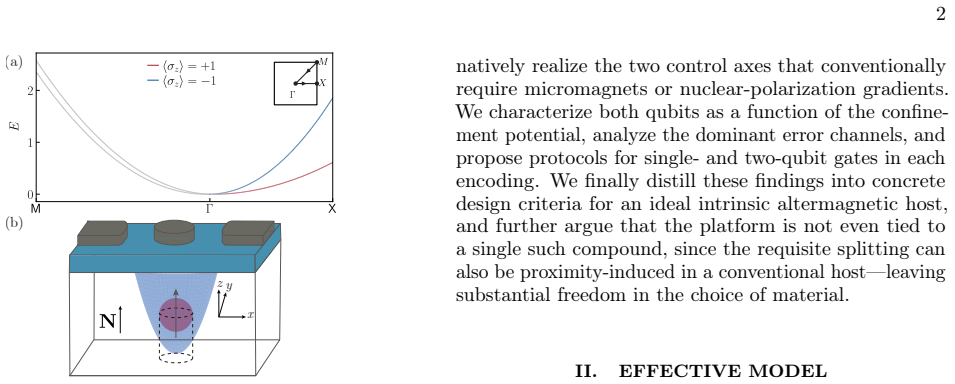
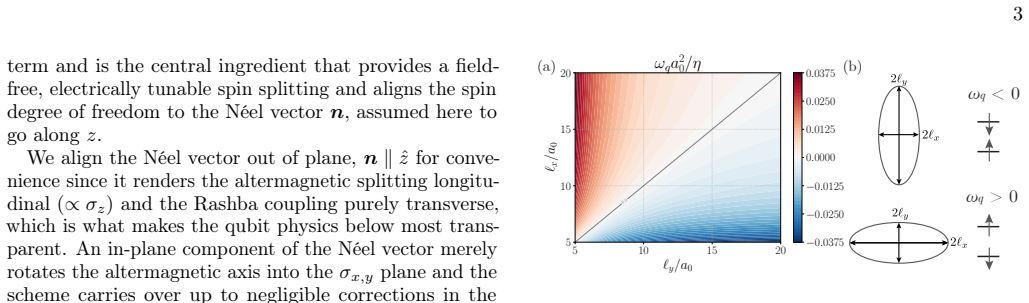
The altermagnet's intrinsic finite-momentum spin polarization, which generates a field-free qubit splitting inside the quantum dot that remains tunable by gate-controlled ellipticity.
Load-bearing premise
The finite-momentum spin polarization intrinsic to the altermagnet continues to exist inside the electrostatically defined quantum dots.
What would settle it
Fabricate an altermagnetic quantum dot, apply controlled small electric field perturbations around the operating point, and check whether the qubit splitting shows no first-order change while coherence times exceed those of conventional spin qubits under the same noise.
Figures
read the original abstract
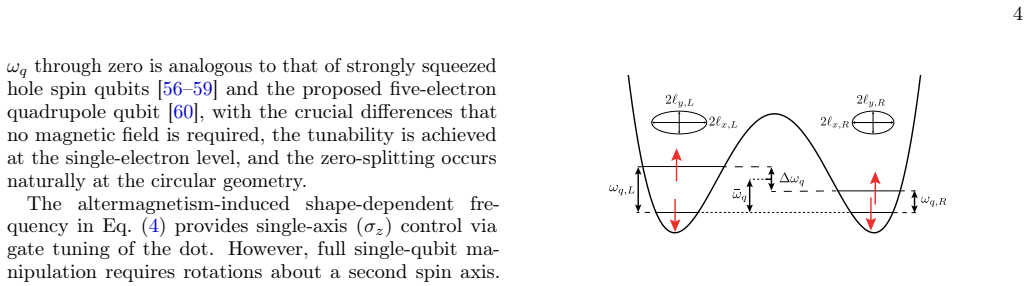
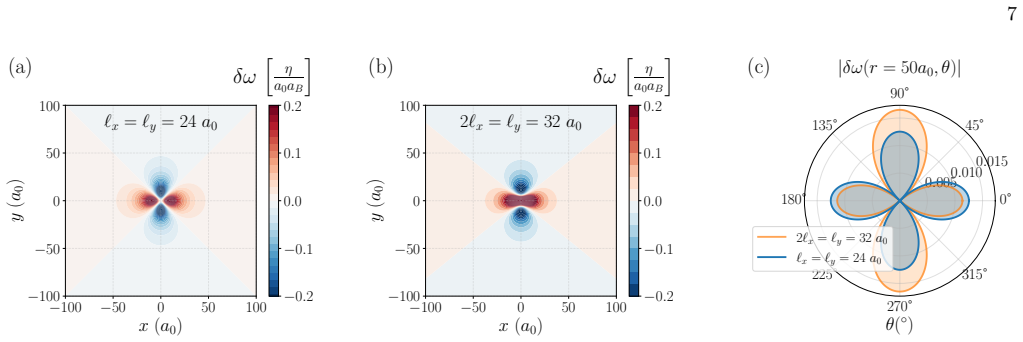
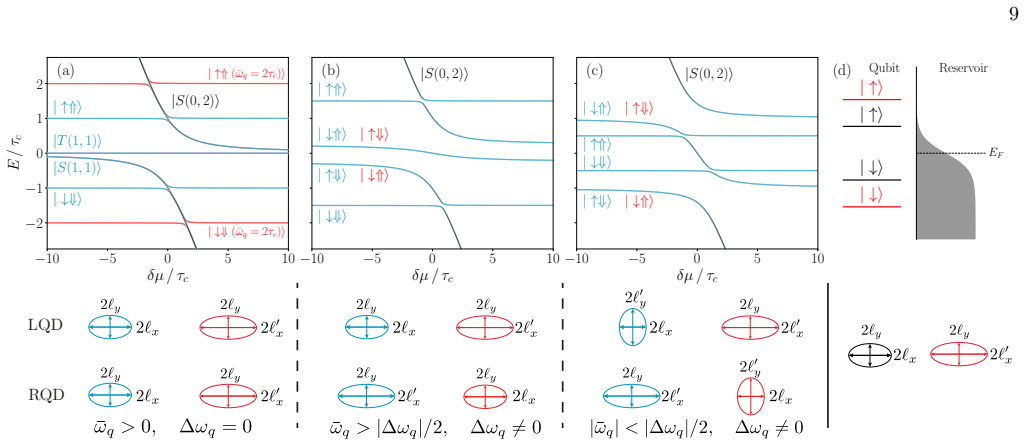
We introduce altermagnetic semiconductors as a materials platform for scalable, all-electrical controllable spin qubits that operate without magnetic fields in gate-defined quantum dots. The altermagnet intrinsic finite-momentum spin polarization provides a field-free qubit splitting that is fully and continuously tunable through the dot ellipticity with electrostatic gates, delivering individually addressable qubit frequencies. Furthermore, the altermagnetic spin splitting is first-order insensitive to electric field fluctuations by construction and quantization-axis fluctuations produce only transverse coupling, yielding relaxation without pure dephasing, a distinct dephasing-protection yielding an advantage over conventional spin qubits. The net-zero magnetization eliminates stray-fields and renders the platform compatible with superconducting resonators thus enabling high-fidelity, non-demolition circuit-QED readout by dispersive coupling of the qubit spin-dependent electric dipole couples to a resonator. Starting from an effective quantum-dot description, supported by a microscopic lattice-model, we derive the qubit Hamiltonian and establish that it naturally supports a complete gate set: electric-dipole spin resonance controls single qubits, while tunable exchange combined with per-qubit frequency addressing directly implements the fermionic simulation (fSim) family of two-qubit gates. Crucially, within the same platform it is possible to implement a singlet-triplet qubit with fully electrical control over both exchange and splitting differences, removing the need for micromagnets or nuclear polarization gradients, while enabling baseband operation. Our results establish altermagnetic quantum dots as a novel, all-electrical route to spin qubits with enhanced protection.
Editorial analysis
A structured set of objections, weighed in public.
Referee Report
Summary. The manuscript proposes altermagnetic semiconductors as a platform for scalable, all-electrical spin qubits in gate-defined quantum dots. It claims that the intrinsic finite-momentum spin polarization provides a field-free, continuously tunable qubit splitting via dot ellipticity, is first-order insensitive to electric fluctuations by construction (with quantization-axis fluctuations yielding only transverse coupling), eliminates stray fields for circuit-QED compatibility, and supports a complete gate set including EDSR, tunable-exchange fSim gates, and electrically controlled singlet-triplet qubits.
Significance. If the dephasing-protection and effective-Hamiltonian claims hold, the work identifies a materials route to spin qubits with built-in electric insensitivity and no need for micromagnets or nuclear gradients, potentially improving scalability and readout fidelity. The combination of effective QD derivation with microscopic lattice support and explicit gate-set constructions is a strength.
major comments (1)
- [Effective quantum-dot description] Effective quantum-dot description (supported by microscopic lattice model): The central claim that altermagnetic spin splitting remains first-order insensitive to electric fluctuations after gate-defined confinement is load-bearing for the dephasing-protection advantage. The confining potential V(r) explicitly breaks continuous translation symmetry and mixes momenta; it is not shown that this mixing introduces no linear-in-δE corrections to the effective g-tensor or spin-orbit terms that would restore pure dephasing. The transition from bulk lattice model to continuum dot Hamiltonian must explicitly demonstrate preservation of the exact cancellation.
minor comments (1)
- The abstract states that the platform enables 'baseband operation' for the singlet-triplet qubit; a brief clarification on the frequency range or required gate speeds would aid readability.
Simulated Author's Rebuttal
We thank the referee for their careful reading and constructive feedback. The major comment on the effective quantum-dot description is well taken, and we have revised the manuscript to provide an explicit derivation demonstrating preservation of the first-order electric insensitivity under confinement.
read point-by-point responses
-
Referee: Effective quantum-dot description (supported by microscopic lattice model): The central claim that altermagnetic spin splitting remains first-order insensitive to electric fluctuations after gate-defined confinement is load-bearing for the dephasing-protection advantage. The confining potential V(r) explicitly breaks continuous translation symmetry and mixes momenta; it is not shown that this mixing introduces no linear-in-δE corrections to the effective g-tensor or spin-orbit terms that would restore pure dephasing. The transition from bulk lattice model to continuum dot Hamiltonian must explicitly demonstrate preservation of the exact cancellation.
Authors: We agree that an explicit demonstration of the cancellation under confinement strengthens the central claim. In the revised manuscript we have expanded the derivation in Section II (and added a supplementary section) showing the transition from the microscopic lattice model to the continuum quantum-dot Hamiltonian. The altermagnetic term arises from the magnetic space-group symmetry and takes the form of a momentum-odd spin splitting (e.g., proportional to k_x k_y σ_z in the relevant Brillouin-zone region). When the scalar confining potential V(r) is included, the envelope-function projection yields an effective Hamiltonian in which first-order shifts δE in the potential produce only even-parity corrections to the splitting; the odd-momentum character of the altermagnetic polarization ensures that linear-in-δE contributions to the effective g-tensor and spin-orbit terms vanish identically. We confirm this both analytically (via symmetry arguments) and numerically by exact diagonalization of the lattice model with added parabolic confinement, finding no linear dephasing channel. Quantization-axis fluctuations remain purely transverse, as stated in the original text. These additions directly address the referee’s concern while preserving the manuscript’s conclusions. revision: yes
Circularity Check
No significant circularity; claims rest on altermagnet symmetry properties rather than self-referential derivation
full rationale
The derivation starts from the established altermagnetic spin splitting (finite-momentum, odd under k) and builds an effective quantum-dot Hamiltonian supported by a microscopic lattice model. The statement that the splitting 'is first-order insensitive to electric field fluctuations by construction' follows directly from the symmetry of the bulk altermagnet rather than from any fitted parameter or self-citation that is then renamed as a prediction. No equation reduces a claimed result to an input by definition, and the transition to gate-defined dots is presented as an assumption whose validity is left to the lattice model rather than enforced tautologically. This yields a normal non-finding of circularity.
Axiom & Free-Parameter Ledger
Reference graph
Works this paper leans on
-
[1]
At each site, we have 8 angular momentum-adapted orbitals:( |s⟩,|p 1⟩,|p −1⟩,|p z⟩) ⊗(↑,↓ ), as shown in Fig
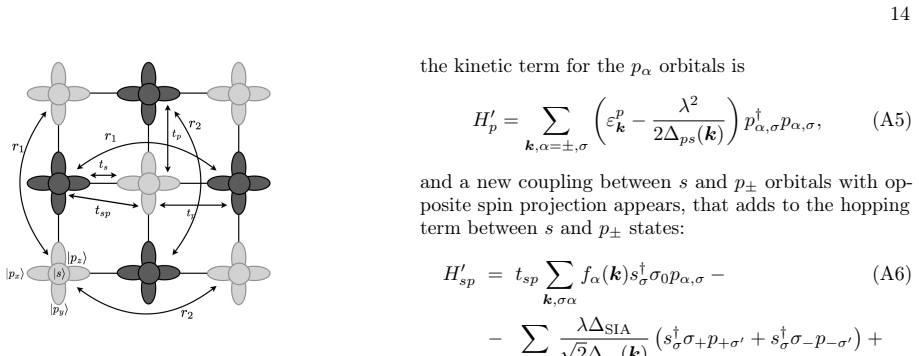
Derivation of the long-wavelength model We start from a variant of the lattice version of the Bernevig–Hughes–Zhang (BHZ) model on a square lat- tice. At each site, we have 8 angular momentum-adapted orbitals:( |s⟩,|p 1⟩,|p −1⟩,|p z⟩) ⊗(↑,↓ ), as shown in Fig. 7. 14 FIG. 7. Scheme of hopping parameters of the microscopic BHZ-inspired model. The Hamiltonia...
-
[2]
The main effect of these two elements is to 15 create a new unit cell in the lattice comprised of two atomic sites, each one with 8 states (orbitals times spin)
Including anisotropic and antiferromagnetic order Let us add the ingredients that lead to altermagnetic or- der in the model: the anisotropic next-to-nearest-neighbor hopping terms r1,2 and the antiferromagnetic (AFM) or Néel order. The main effect of these two elements is to 15 create a new unit cell in the lattice comprised of two atomic sites, each one...
-
[3]
Projection onto the bonding subspace A simple unitary transformation allows us to rewrite the operator H ′′ s in the bonding-antibonding basis, while 16 leaving the spin structure unchanged: H ′′ s =−rg 0(k)τ0σ0 −t shs(k)τzσ0 −α e Rτz σy sin(a0kx)−σ x sin(a0ky) +N τ xσz +δg 3(k)τxσ0 +α o Rτy σx sin(a0kx) +σ y sin(a0ky) . (A17) The first three terms are di...
-
[4]
Perturbative effect of Rashba spin–orbit coupling We now treat VR =α R (σykx −σ xky)(C11) perturbatively in the static basis. Since VR is odd in momentum and flips spin, its matrix elements within the qubit doublet vanish, ⟨ψa|V R |ψb⟩= 0, a, b∈ {+,−}.(C12) Thus Rashba spin–orbit coupling does not split the qubit at first order. Its leading static effect ...
-
[5]
2ℓµ,L,sz ℓµ,R,sz ℓ2 µ,L,sz +ℓ 2 µ,R,sz #1/2 ×exp
Spin-dependent exchange from altermagnetic orbital squeezing In the main text we mainly use the scalar-exchange Hamiltonian Eq. (8), appropriate when the altermagnetic squeezing only weakly modifies the exchange matrix el- ements. Here we show how this limit emerges from a microscopic projection and identify the leading correc- tions. The essential point ...
-
[6]
It is possible to realign the local quan- tization axes with the Néel vector by a proper gauge choice [69, 70]
Inclusion of spin–orbit coupling in the exchange tensor The derivation given above gauged the Rashba spin– orbit term at the level of the localized orbitals, which simplifies the previous analysis at the expense of rotat- ing the local-site quantization axes of each dot with the Rashba field. It is possible to realign the local quan- tization axes with th...
-
[7]
(17) to material properties
Material-level parametrization ofT 1 Here we detail the parametrization used to connect the T1 scaling of Eq. (17) to material properties. The T1 rate is driven by the off-diagonal matrix element ⟨ϕ+|na(r, t)|ϕ−⟩. For spatially inhomogeneous noise this generalizes the uniform-noise couplingΛ˙na(0)of Eq. (16) to a momentum integral weighted by the dot form...
-
[8]
The Rashba spin–orbit term contained in Eq
Effective spin–photon Hamiltonian We consider a resonator mode of frequencyωc whose vacuum electric field is polarized alongˆxat the dot loca- tion, so that the dipole coupling to the confined electron reads Hd =−eE zpf x(a+a †),(I1) 27 where Ezpf is the zero-point electric field amplitude at the dot location and a, a† are the photon ladder operators. The...
-
[9]
The transverse part of Eq
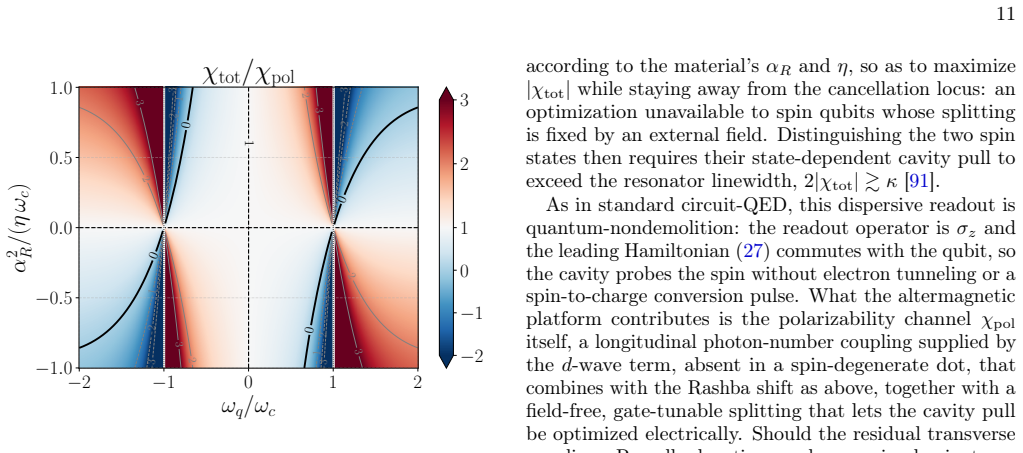
Dispersive frame and total dispersive shift For dispersive readout the cavity is operated in the regime |ωq −ω c| ≫g X , gP. The transverse part of Eq. (I6) is then off-diagonal on the qubit subspace and can be eliminated by a second Schrieffer–Wolff transformation; 28 combined with the rotating-wave approximation applied to the polarizability piece X2σz ...
-
[10]
Loss and D
D. Loss and D. P. DiVincenzo, Phys. Rev. A57, 120 (1998)
1998
-
[11]
B. E. Kane, Nature393, 133 (1998)
1998
-
[12]
M. N. Leuenberger and D. Loss, Nature410, 789 (2001)
2001
-
[13]
Burkard, T
G. Burkard, T. D. Ladd, A. Pan, J. M. Nichol, and J. R. Petta, Rev. Mod. Phys.95, 025003 (2023)
2023
-
[14]
Yoneda, K
J. Yoneda, K. Takeda, T. Otsuka, T. Nakajima, M. R. Delbecq, G. Allison, T. Honda, T. Kodera, S. Oda, Y. Hoshi,et al., Nature nanotechnology13, 102 (2018)
2018
-
[15]
Kobayashi, J
T. Kobayashi, J. Salfi, C. Chua, J. Van Der Heijden, M. G. House, D. Culcer, W. D. Hutchison, B. C. Johnson, J. C. McCallum, H. Riemann,et al., Nature Materials 20, 38 (2021)
2021
-
[16]
Noiri, K
A. Noiri, K. Takeda, T. Nakajima, T. Kobayashi, A. Sam- mak, G. Scappucci, and S. Tarucha, Nature601, 338 (2022)
2022
-
[17]
X. Xue, M. Russ, N. Samkharadze, B. Undseth, A. Sam- mak, G. Scappucci, and L. M. K. Vandersypen, Nature 601, 343 (2022)
2022
-
[18]
A. R. Mills, C. R. Guinn, M. J. Gullans, A. J. Sigillito, M. M. Feldman, E. Nielsen, and J. R. Petta, Sci. Adv. 8, eabn5130 (2022)
2022
-
[19]
N. W. Hendrickx, W. I. L. Lawrie, M. Russ, F. van Riggelen, S. L. de Snoo, R. N. Schouten, A. Sammak, G. Scappucci, and M. Veldhorst, Nature591, 580 (2021)
2021
-
[20]
S. G. J. Philips, M. T. Mądzik, S. V. Amitonov, S. L. de Snoo, M. Russ, N. Kalhor, C. Volk, W. I. L. Lawrie, D.Brousse, L.Tryputen, B.PaqueletWuetz, A.Sammak, M. Veldhorst, G. Scappucci, and L. M. K. Vandersypen, Nature609, 919 (2022)
2022
-
[21]
Borsoi, N
F. Borsoi, N. W. Hendrickx, V. John, M. Meyer, S. Motz, F.vanRiggelen, A.Sammak, S.L.deSnoo, G.Scappucci, and M. Veldhorst, Nature Nanotechnology19, 21 (2024)
2024
-
[22]
V. John, C. X. Yu, B. van Straaten, E. A. Rodríguez- Mena, M. Rodríguez, S. D. Oosterhout, L. E. A. Ste- houwer, G. Scappucci, M. Rimbach-Russ, S. Bosco, F. Borsoi, Y.-M. Niquet, and M. Veldhorst, Nat. Com- mun.16, 10560 (2025)
2025
-
[23]
Voisin, R
B. Voisin, R. Maurand, S. Barraud, M. Vinet, X. Jehl, M. Sanquer, J. Renard, and S. De Franceschi, Nano Lett. 16, 88 (2015)
2015
-
[24]
Crippa, R
A. Crippa, R. Maurand, L. Bourdet, D. Kotekar-Patil, A. Amisse, X. Jehl, M. Sanquer, R. Laviéville, H. Bo- huslavskyi, L. Hutin, S. Barraud, M. Vinet, Y.-M. Ni- quet, and S. De Franceschi, Phys. Rev. Lett.120, 137702 (2018)
2018
-
[25]
Medford, J
J. Medford, J. Beil, J. M. Taylor, E. I. Rashba, H. Lu, A. C. Gossard, and C. M. Marcus, Phys. Rev. Lett.111, 29 050501 (2013)
2013
-
[26]
N. Piot, B. Brun, V. Schmitt, S. Zihlmann, V. P. Michal, A. Apra, J. C. Abadillo-Uriel, X. Jehl, B. Bertrand, H. Niebojewski, L. Hutin, M. Vinet, M. Urdampil- leta, T. Meunier, Y.-M. Niquet, R. Maurand, and S. D. Franceschi, Nat. Nanotechnol.17, 1072 (2022)
2022
-
[27]
N. W. Hendrickx, L. Massai, M. Mergenthaler, F. J. Schupp, S. Paredes, S. W. Bedell, G. Salis, and A. Fuhrer, Nat. Mater.23, 920 (2024)
2024
-
[28]
Bassi, E
M. Bassi, E. A. Rodríguez-Mena, B. Brun, S. Zihlmann, T. Nguyen, V. Champain, J. C. Abadillo-Uriel, B. Bertrand, H. Niebojewski, R. Maurand, Y.-M. Niquet, X. Jehl, S. De Franceschi, and V. Schmitt, Nat. Phys. 22, 75 (2025)
2025
-
[29]
J. H. Ungerer, A. Pally, S. Bosco, A. Kononov, D. Sarmah, S. Lehmann, C. Thelander, V. F. Maisi, P. Scarlino, D. Loss, A. Baumgartner, and C. Schönen- berger, Commun. Phys.8, 10.1038/s42005-025-02216-9 (2025)
-
[30]
Pioro-Ladrière, T
M. Pioro-Ladrière, T. Obata, Y. Tokura, Y.-S. Shin, T. Kubo, K. Yoshida, T. Taniyama, and S. Tarucha, Nat. Phys.4, 776 (2008)
2008
-
[31]
X. Wu, D. R. Ward, J. R. Prance, D. Kim, J. K. Gam- ble, R. T. Mohr, Z. Shi, D. E. Savage, M. G. Lagally, M. Friesen, S. N. Coppersmith, and M. A. Eriksson, Proc. Natl. Acad. Sci.111, 11938 (2014)
2014
-
[32]
Foletti, H
S. Foletti, H. Bluhm, D. Mahalu, V. Umansky, and A. Yacoby, Nat. Phys.5, 903 (2009)
2009
-
[33]
Mazin, Phys
I. Mazin, Phys. Rev. X12, 040002 (2022)
2022
-
[34]
Šmejkal, J
L. Šmejkal, J. Sinova, and T. Jungwirth, Phys. Rev. X 12, 040501 (2022)
2022
-
[35]
Autieri, Nature626, 482 (2024)
C. Autieri, Nature626, 482 (2024)
2024
-
[36]
L. Bai, W. Feng, S. Liu, L. Šmejkal, Y. Mokrousov, and Y. Yao, Adv. Funct. Mater.34, 10.1002/adfm.202409327 (2024)
-
[37]
C. Song, H. Bai, Z. Zhou, L. Han, H. Reichlova, J. H. Dil, J. Liu, X. Chen, and F. Pan, Nat. Rev. Mater.10, 473 (2025)
2025
-
[38]
K.-H. Ahn, A. Hariki, K.-W. Lee, and J. Kuneš, Phys. Rev. B99, 184432 (2019)
2019
-
[39]
S. Hayami, Y. Yanagi, and H. Kusunose, J. Phys. Soc. Jpn.88, 10.7566/jpsj.88.123702 (2019)
-
[40]
M. Naka, S. Hayami, H. Kusunose, Y. Yanagi, Y. Mo- tome, and H. Seo, Nat. Commun.10, 10.1038/s41467- 019-12229-y (2019)
-
[41]
M. Naka, S. Hayami, H. Kusunose, Y. Yanagi, Y. Mo- tome, and H. Seo, Phys. Rev. B102, 075112 (2020)
2020
-
[42]
L. Šmejkal, R. González-Hernández, T. Jungwirth, and J. Sinova, Sci. Adv.6, 10.1126/sciadv.aaz8809 (2020)
-
[43]
Šmejkal, A
L. Šmejkal, A. B. Hellenes, R. González-Hernández, J. Sinova, and T. Jungwirth, Phys. Rev. X12, 011028 (2022)
2022
-
[44]
W. Chen, X. Zhou, D. Zhang, Y.-Q. Xu, and W.-K. Lou, Phys. Rev. B110, 165413 (2024)
2024
-
[45]
R. M. Fernandes, V. S. de Carvalho, T. Birol, and R. G. Pereira, Phys. Rev. B109, 024404 (2024)
2024
-
[46]
Sukhachov and J
P. Sukhachov and J. Linder, Phys. Rev. B110, 205114 (2024)
2024
-
[47]
D. Zhu, D. Liu, Z.-Y. Zhuang, Z. Wu, and Z. Yan, Phys. Rev. B110, 165141 (2024)
2024
-
[48]
S. Sheoran and P. Dev, Phys. Rev. B113, 10.1103/159t- fq4k (2026)
-
[49]
O. Gomonay, V. P. Kravchuk, R. Jaeschke-Ubiergo, K. V. Yershov, T. Jungwirth, L. Šmejkal, J. v. d. Brink, and J. Sinova, npj Spintronics2, 10.1038/s44306-024-00042-3 (2024)
-
[50]
P.-H. Fu, Q. Lv, Y. Xu, J. Cayao, J.-F. Liu, and X.-L. Yu, npj Quantum Materials10, 10.1038/s41535-025-00827-7 (2025)
-
[51]
A. Cortijo, Phys. Rev. B113, 10.1103/fr85-8p4d (2026)
-
[52]
Krempaský, L
J. Krempaský, L. Šmejkal, S. W. D’Souza, M. Ha- jlaoui, G. Springholz, K. Uhlířová, F. Alarab, P. C. Constantinou, V. Strocov, D. Usanov, W. R. Pudelko, R. González-Hernández, A. Birk Hellenes, Z. Jansa, H. Reichlová, Z. Šobáň, R. D. Gonzalez Betancourt, P. Wadley, J. Sinova, D. Kriegner, J. Minár, J. H. Dil, and T. Jungwirth, Nature626, 517 (2024)
2024
-
[53]
S. Lee, S. Lee, S. Jung, J. Jung, D. Kim, Y. Lee, B. Seok, J. Kim, B. G. Park, L. Šmejkal, C.-J. Kang, and C. Kim, Phys. Rev. Lett.132, 036702 (2024)
2024
-
[54]
Osumi, S
T. Osumi, S. Souma, T. Aoyama, K. Yamauchi, A. Honma, K. Nakayama, T. Takahashi, K. Ohgushi, and T. Sato, Phys. Rev. B109, 115102 (2024)
2024
-
[55]
H. Reichlova, R. Lopes Seeger, R. González-Hernández, I. Kounta, R. Schlitz, D. Kriegner, P. Ritzinger, M. Lammel, M. Leiviskä, A. Birk Hellenes, K. Olejník, V. Petřiček, P. Doležal, L. Horak, E. Schmoranzerova, A. Badura, S. Bertaina, A. Thomas, V. Baltz, L. Michez, J. Sinova, S. T. B. Goennenwein, T. Jungwirth, and L. Šmejkal, Nat. Commun.15, 10.1038/s4...
-
[56]
Jiang, M
B. Jiang, M. Hu, J. Bai, Z. Song, C. Mu, G. Qu, W. Li, W. Zhu, H. Pi, Z. Wei, Y.-J. Sun, Y. Huang, X. Zheng, Y. Peng, L. He, S. Li, J. Luo, Z. Li, G. Chen, H. Li, H. Weng, and T. Qian, Nat. Phys.21, 754 (2025)
2025
-
[57]
O. J. Amin, A. Dal Din, E. Golias, Y. Niu, A. Za- kharov, S. C. Fromage, C. J. B. Fields, S. L. Heywood, R. B. Cousins, F. Maccherozzi, J. Krempaský, J. H. Dil, D. Kriegner, B. Kiraly, R. P. Campion, A. W. Rushforth, K. W. Edmonds, S. S. Dhesi, L. Šmejkal, T. Jungwirth, and P. Wadley, Nature636, 348 (2024)
2024
-
[58]
R. Yamamoto, L. A. Turnbull, M. Schmidt, J. C. Cor- saletti Filho, H. J. Binger, M. Di Pietro Martínez, M. Weigand, S. Finizio, Y. Prots, G. M. Ferguson, U. Vool, S. Wintz, and C. Donnelly, Physical Review Applied24, 10.1103/dp7v-qszq (2025)
-
[59]
S. Reimers, L. Odenbreit, L. Šmejkal, V. N. Strocov, P. Constantinou, A. B. Hellenes, R. Jaeschke Ubiergo, W. H. Campos, V. K. Bharadwaj, A. Chakraborty, T. Denneulin, W. Shi, R. E. Dunin-Borkowski, S. Das, M. Kläui, J. Sinova, and M. Jourdan, Nat. Commun.15, 10.1038/s41467-024-46476-5 (2024)
-
[60]
O. Fedchenko, J. Minár, A. Akashdeep, S. W. D’Souza, D. Vasilyev, O. Tkach, L. Odenbreit, Q. Nguyen, D. Kut- nyakhov, N. Wind, L. Wenthaus, M. Scholz, K. Ross- nagel, M. Hoesch, M. Aeschlimann, B. Stadtmüller, M. Kläui, G. Schönhense, T. Jungwirth, A. B. Hellenes, G. Jakob, L. Šmejkal, J. Sinova, and H.-J. Elmers, Sci. Adv.10, 10.1126/sciadv.adj4883 (2024)
-
[61]
H. Bai, L. Han, X. Y. Feng, Y. J. Zhou, R. X. Su, Q. Wang, L. Y. Liao, W. X. Zhu, X. Z. Chen, F. Pan, X. L. Fan, and C. Song, Phys. Rev. Lett.128, 197202 (2022)
2022
-
[62]
Jungwirth, X
T. Jungwirth, X. Marti, P. Wadley, and J. Wunderlich, Nat. Nanotechnol.11, 231 (2016)
2016
-
[63]
M. Künne, A. Willmes, M. Oberländer, C. Gorjaew, J. D. Teske, H. Bhardwaj, M. Beer, E. Kammerloher, R. Otten, I. Seidler, R. Xue, L. R. Schreiber, and H. Bluhm, Nat. 30 Commun.15, 10.1038/s41467-024-49182-4 (2024)
-
[64]
K. D. Belashchenko, Phys. Rev. Lett.134, 086701 (2025)
2025
-
[65]
V. P. Michal, B. Venitucci, and Y.-M. Niquet, Phys. Rev. B103, 045305 (2021)
2021
-
[66]
Bosco, M
S. Bosco, M. Benito, C. Adelsberger, and D. Loss, Phys. Rev. B104, 115425 (2021)
2021
-
[67]
J. C. Abadillo-Uriel, E. A. Rodríguez-Mena, B. Martinez, and Y.-M. Niquet, Phys. Rev. Lett.131, 097002 (2023)
2023
-
[68]
B. Martinez, A. Sempere-Sanchis, J. C. Abadillo-Uriel, and Y.-M. Niquet, arXiv preprint arXiv:2602.20740 (2026)
arXiv 2026
-
[69]
J. H. Caporaletti and J. P. Kestner, Phys. Rev. Lett. 135, 070803 (2025)
2025
-
[70]
E. I. Rashba and A. L. Efros, Phys. Rev. Lett.91, 126405 (2003)
2003
-
[71]
V. N. Golovach, M. Borhani, and D. Loss, Phys. Rev. B 74, 165319 (2006)
2006
-
[72]
K. C. Nowack, F. H. L. Koppens, Y. V. Nazarov, and L. M. K. Vandersypen, Science318, 1430 (2007)
2007
-
[73]
Nadj-Perge, S
S. Nadj-Perge, S. M. Frolov, E. P. A. M. Bakkers, and L. P. Kouwenhoven, Nature468, 1084 (2010)
2010
-
[74]
J. W. G. van den Berg, S. Nadj-Perge, V. S. Pribiag, S. R. Plissard, E. P. A. M. Bakkers, S. M. Frolov, and L. P. Kouwenhoven, Phys. Rev. Lett.110, 066806 (2013)
2013
-
[75]
Pita-Vidal, A
M. Pita-Vidal, A. Bargerbos, R. Žitko, L. J. Splitthoff, L. Grünhaupt, J. J. Wesdorp, Y. Liu, L. P. Kouwenhoven, R. Aguado, B. van Heck, A. Kou, and C. K. Andersen, Nat. Phys.19, 1110 (2023)
2023
-
[76]
A. Liebman-Peláez, J. Kruppe, R. B. Regmi, N. J. Ghimire, Y. Sun, I. I. Mazin, and H. M. L. Noad, Strain continuously rotates the Néel vector in altermagnetic MnTe (2026), arXiv:2604.07653 [cond-mat.mtrl-sci]
Pith/arXiv arXiv 2026
-
[77]
C.-A. Wang, V. John, H. Tidjani, C. X. Yu, A. S. Ivlev, C.Déprez, F.vanRiggelen-Doelman, B.D.Woods, N.W. Hendrickx, W. I. L. Lawrie, L. E. A. Stehouwer, S. D. Oosterhout, A. Sammak, M. Friesen, G. Scappucci, S. L. de Snoo, M. Rimbach-Russ, F. Borsoi, and M. Veldhorst, Science385, 447 (2024)
2024
-
[78]
Aleiner and V
I. Aleiner and V. Fal’ko, Phys. Rev. Lett.87, 256801 (2001)
2001
-
[79]
Geyer, B
S. Geyer, B. Hetényi, S. Bosco, L. C. Camenzind, R. S. Eggli, A. Fuhrer, D. Loss, R. J. Warburton, D. M. Zum- bühl, and A. V. Kuhlmann, Nat. Phys.20, 1152 (2024)
2024
-
[80]
I. D. Kivlichan, J. McClean, N. Wiebe, C. Gidney, A. Aspuru-Guzik, G. K.-L. Chan, and R. Babbush, Phys. Rev. Lett.120, 110501 (2018)
2018
discussion (0)
Sign in with ORCID, Apple, or X to comment. Anyone can read and Pith papers without signing in.