REVIEW 3 major objections 5 minor 57 references
Nonperturbative Stabilization of D-Instantons in the Bosonic IIB Matrix Model
T0 review · 3 major / 5 minor · reviewed 2026-08-11 · deepseek-v4-flash
Pith's one-line read In the bosonic IKKT matrix model, the exact two-body interaction keeps D-instantons from collapsing, making the one-loop collapse an artifact.
desk verdict Solid exact N=2 computation, but the non-collapse claim rests on a gauge-choice assumption the authors themselves flag as interpretive. read the letter →
The pith
A machine-rendered reading of the paper's core claim, the machinery that carries it, and where it could break.
The reading
What carries the argument
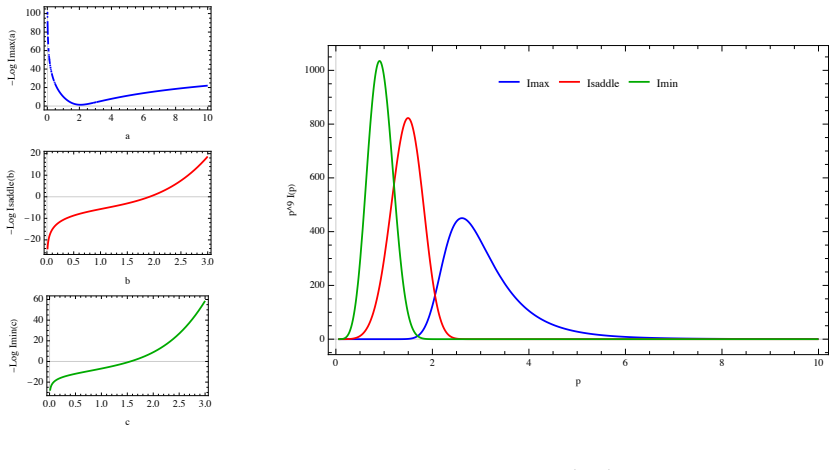
The load-bearing object is the maximal diagonal gauge: the Gribov copy of the $\mathrm{U}(N)$ gauge group that maximizes the height function $f_A=\mathrm{tr}\,P_\mu P_\mu$, meaning it packs the largest possible share of the matrix inertia into the diagonal block. In this gauge the off-diagonal fluctuation of every pair is bounded by that pair's separation, so the short-distance integration domain is compact and the Boltzmann weight becomes nearly constant, producing a finite repulsive force instead of the divergent collapse seen in the naive Lorenz gauge. The computation also relies on the exact $\mathrm{U}(2)$ partition function, obtained after a BRST gauge fixing that introduces a new four-leg ghost vertex and organizes the Faddeev-Popov determinant into a many-body expansion whose two-body sector factorizes into copies of the $N=2$ model. At $N=2$ the Gribov-copy structure is exhibited explicitly through the singular-value decomposition of the $3\times d$ matrix $A^a_\mu$, where the three ordered singular values correspond to the maximal, saddle, and minimal copies.
What would settle it
Run a direct numerical evaluation of the bosonic $\mathrm{U}(2)$ model with the maximal diagonal gauge imposed and measure the distribution of the eigenvalue separation $p$. If the effective potential $-\log I_{\mathrm{max}}(p)$ is monotonically decreasing as $p\to 0$, or if the separation distribution peaks at $p=0$, the non-collapse claim fails; the paper predicts a distribution suppressed at $p=0$ with a peak at $p$ of order one, and at $d=10$ the explicit closed form of $I_{\mathrm{max}}(p)$ can be compared against the numerics.
Extended reading notes
Core claim
The central claim is that the apparent collapse of the D-instanton positions in the bosonic IIB matrix model is a one-loop artifact. The one-loop logarithmic potential is only the leading large-distance term of the exact Faddeev-Popov determinant expansion, and the full two-body interaction, computed exactly in the $\mathrm{U}(2)$ model because the $N\times N$ two-body sector factorizes into independent pairs, is finite and repulsive at short distance in the maximal diagonal gauge. In that gauge the two-body effective potential $V(\Delta)=-\log Z(\Delta)$ rises both as $\Delta\to\infty$, reproducing the attractive one-loop logarithm, and as $\Delta\to 0$, from a logarithmic repulsion generated by the finite volume inside the Gribov horizon, so it has a stable minimum at a separation of order one. The paper therefore claims that two D-instantons do not collapse onto each other, and that the negative region of the naive Lorenz-gauge $\mathrm{U}(2)$ partition function is a Gribov artifact coming from summing over copies with negative Faddeev-Popov determinant.
Load-bearing premise
The load-bearing premise is that the maximal diagonal gauge, the choice that packs the largest possible amount of the matrix weight into the diagonal entries, is the physically correct frame for reading off D-instanton positions; the non-collapse conclusion is derived inside that gauge and would not follow from the gauge-invariant path integral alone.
Editorial extensions
If this is right
- The one-loop collapse potential used to motivate supersymmetry in the IKKT model is only the leading term of a large-separation expansion, so the exact two-body force must be used to decide the fate of the D-instanton positions.
- In the maximal diagonal gauge the two-body potential has a stable minimum at finite separation, so the bosonic model alone can support non-collapsed configurations of two D-instantons.
- Because the two-body sector of the $N\times N$ model factorizes into independent $\mathrm{U}(2)$ pairs, the non-collapse mechanism extends pairwise to any $N$, although the detailed distribution still requires the higher-body potentials.
- The negativity of the naive Lorenz-gauge $N=2$ partition function is a Gribov artifact rather than a physical instability; at $d=10$ the identity $I_{\mathrm{max}}-I_{\mathrm{saddle}}+I_{\mathrm{min}}=Z_{\mathrm{Lorenz}}$ holds in closed form.
- The maximal diagonal gauge agrees with the perturbative one-loop result at large separation, so ordinary perturbation theory is safe there; only the short-distance regime requires the Gribov-corrected frame.
Reading between the lines
- Editorial inference: the same Gribov-horizon mechanism could protect the eigenvalue distribution of other bosonic matrix models, such as the BFSS-type models, from collapse even without supersymmetry.
- Editorial inference: a direct Monte Carlo simulation of the bosonic $\mathrm{U}(2)$ model in the maximal diagonal gauge should find a separation distribution peaked at $p\sim O(1)$ and suppressed at $p=0$, a concrete testable prediction of the paper.
- Editorial inference: if the conjectured general-$N$ scaling $Z\sim\prod_{i<j}(p^{(i)}-p^{(j)})^{2d}$ holds, the effective repulsion among D-instantons resembles a Vandermonde factor with doubled exponent, suggesting a new effective matrix model for the diagonal positions alone.
- Editorial inference: the Lorentzian-signature model is left open, but the same maximal-diagonal-gauge construction formally applies with $e^{iS}$, so the non-collapse mechanism could be probed there with sign-problem-free numerical methods; the paper makes no claim about this case.
Editorial analysis
A structured set of objections, weighed in public.
Referee Report
Summary. The paper studies the bosonic IIB (IKKT) matrix model and the effective potential for the diagonal components p^{(i)}_μ, interpreted as D-instanton positions. The authors argue that the well-known one-loop collapse of these positions is an artifact of the leading perturbative truncation, and that the exact all-loop two-body interaction prevents collapse. The technical core is a U(2) (N=2) computation: the authors gauge-fix U(N) in a Lorenz-type condition while separating diagonal and off-diagonal sectors, handle the residual U(1)^N symmetry with an auxiliary-ghost BRST construction that generates a new four-leg ghost vertex, and then integrate out off-diagonal modes and ghosts exactly at N=2. The resulting partition function Z(p) is finite at finite separation but develops a negative region at p~O(1); this is attributed to the Gribov ambiguity of the Lorenz gauge. The paper resolves the ambiguity by selecting the maximal diagonal gauge, i.e. the Gribov copy maximizing f_A=tr(P_μP_μ), in which the short-distance behavior is Z~p^{2d} and repulsive, while the large-distance behavior reproduces the one-loop attractive logarithm. The conclusion is that two D-instantons do not collapse and the two-body potential has a stable minimum at finite separation. Full N-body stabilization and the detailed eigenvalue distribution are explicitly left to future work and framed as conjectural in Sec. 6.
Significance. If the central claim survives scrutiny, the paper provides a nonperturbative mechanism that stabilizes D-instanton positions in the purely bosonic IKKT model, potentially reopening a question usually settled by adding supersymmetry. The N=2 computation is a genuine strength: it is performed without fitted parameters, the closed form (4.12) is cross-checked numerically, the Gribov decomposition identity (5.16) is verified in closed form at d=10, and the paper is unusually honest in labeling the general-N extensions as conjectures. The main weakness is that the physical conclusion is tied to a specific gauge choice: the D-instanton positions are not gauge-invariant, and the maximal diagonal gauge is selected by the 'classical frame' principle of Sec. 5.4 rather than derived from the gauge-invariant path integral. The result is therefore best read as a well-defined and suggestive statement about one particular frame, not yet as a gauge-invariant proof of non-collapse. This distinction is load-bearing for the paper's central claim.
major comments (3)
- [Sec. 5.4 and Eq. (5.8)] The non-collapse conclusion is conditional on the choice of the maximal Gribov copy. Equation (5.8) decomposes the Lorenz-gauge partition function as Z_Lorenz = I_max - I_saddle + I_min, and the short-distance hierarchy in Sec. 5.5 shows that I_saddle and I_min diverge as p^{-4}, while only I_max ~ p^{2d} is finite and repulsive. Since the p^{(i)}_μ are not gauge-invariant, the statement 'the two D-instantons do not collapse' is not an invariant observable statement: if one of the other Gribov copies were used to define the diagonal positions, the short-distance force would be attractive and divergent. The 'classical frame' justification in Sec. 5.4 is a physical modeling assumption, not a theorem derived from the gauge-invariant path integral. The paper should either provide an independent, gauge-invariant diagnostic of non-collapse (for example an expectation value or spectral quantity that does not require a choice of frame) or explicitly restate the abstract and conclusions so that non-collapse is presented as a property of the maximal diagonal gauge, i.e. as a proposal rather than an established result.
- [Sec. 4.1, Eq. (4.3), and Sec. 5.3] The normalization of the separation variable relative to the singular values needs clarification and checking. In Eq. (4.3) the diagonal part of A_μ is written as (1/2)Δ_μ σ_3, so the singular value associated with the diagonal block in the SVD of the coefficient matrix A^a_μ is |Δ|/2, whereas Sec. 5.3 identifies the diagonal singular value with p ≡ sqrt(Δ^2). This factor of two rescales the action S(a,b,c) in Eq. (5.12), the closed forms in Appendix C, and the location of the minimum Δ*. Please state the precise relation between p and the SVD variables and verify that Eq. (5.16) and the asymptotics of Appendix C are consistent with the action normalization in Eq. (2.1).
- [Sec. 6, Eq. (6.2)] The conjectured general-N scaling Z ~ ∏_{i<j} |p^{(i)}-p^{(j)}|^{2d} is presented as the natural extrapolation of the N=2 result, but the paper itself notes that the exact Gribov horizon and the copy structure are unknown for N≥3 because the SU(2)≃SO(3) shortcut is unavailable. This conjecture is not used in the two-body proof, so it does not undermine the N=2 calculation, but the concluding sentence that the results 'are consistent with a stable, non-collapsed distribution' should be more carefully separated from what has actually been established. The distinction between the derived pairwise bound (6.3) and the conjectured measure factor is already drawn in Sec. 6; the conclusion should carry the same caution.
minor comments (5)
- [Eq. (4.12)] The prefactor of the closed form is rendered as 'π2 1−2d'; this should be a single well-defined expression such as π^{3-2d} or the equivalent, and the normalization of Z(p) relative to Eq. (4.9) should be stated explicitly.
- [Fig. 3] The caption refers to coordinates (u,v,x) and a horizon equation, but these variables are not defined in the main text before the figure; please define them or refer to the appendix equation from which the horizon condition is taken.
- [Sec. 2.2, Eq. (2.31)] The claim that ∂(δ_BRST c^c)/∂c^c = 0 is only sketched; since c is Grassmann, the derivative evaluation should be shown explicitly, as the sign of this term is important for the supertrace argument.
- [Sec. 3.1, Eqs. (A.22)-(A.28)] The notation {i,j,k,...}_Diff. and the symbol (↔) are introduced informally; a short definition before Eq. (A.22) in the main text would make the many-body decomposition substantially easier to verify.
- [References] Several references are dated 2025 or 2026 and appear to be unpublished preprints; if the journal requires published or arXiv-available sources, these should be updated or supplemented.
Circularity Check
No significant circularity: the U(2) two-body computation is self-contained, and the non-collapse conclusion is a derived consequence of the maximal-diagonal-gauge calculation, not an input.
full rationale
The central derivation is self-contained. The two-body sector is isolated by the large-distance expansion of the Faddeev–Popov determinant (Sec. 3), the N=2 partition function is evaluated exactly from the gauge-fixed action (Eq. 4.12), and the short-distance behavior of the maximal Gribov copy is computed in closed form from the singular-value decomposition (Eqs. 5.17 and C.1–C.3), with the decomposition Z_Lorenz = I_max − I_saddle + I_min verified explicitly at d=10 (Eq. 5.16). The non-collapse conclusion is not obtained by fitting or by renaming an input: it follows from the p^{2d} vanishing of I_max(p) combined with the p^{-2d+4} one-loop tail, which gives V(Δ) a minimum at finite Δ. The paper's only hand-selected element is the physical identification of D-instanton positions with the maximal diagonal gauge; this is an interpretive assumption and a correctness risk, since the saddle and minimal copies would give divergent, attractive short-distance forces, but it is not a fitted parameter, the paper does not hide the conditionality, and the exact computation does not presuppose the non-collapse it derives. Author self-citations appear only in motivation, historical context, and future directions, and none is load-bearing for the two-body computation. No step in the claimed derivation reduces to its own input by construction.
Assumptions & free parameters
assumptions (4)
- domain assumption The bosonic IIB (IKKT) matrix model action S = -1/4 tr[A_mu, A_nu]^2 is the correct starting point for studying D-instanton dynamics.
- domain assumption The diagonal components p^{(i)}_mu of the matrices represent D-instanton positions.
- domain assumption The BRST quantization with auxiliary ghost zero modes correctly handles the residual U(1)^N gauge symmetry and yields the gauge-fixed partition function (2.53).
- ad hoc to paper The maximal diagonal gauge, selecting the global maximum of f_A = tr P_mu P_mu, is the physically correct frame for the D-instantons.
Cite this review
Pith. "Pith review of Nonperturbative Stabilization of D-Instantons in the Bosonic IIB Matrix Model." pith.science (2026). https://pith.science/paper/TDXSMZFL
@misc{pith2026260809598,
  author       = {Pith},
  title        = {Pith review of: Nonperturbative Stabilization of D-Instantons in the Bosonic IIB Matrix Model},
  year         = {2026},
  howpublished = {\url{https://pith.science/paper/TDXSMZFL}},
  note         = {Machine review of arXiv:2608.09598}
}
abstract
We study the bosonic type IIB (IKKT) matrix model and the fate of the D-instanton positions $p^{(i)}_\mu$, the diagonal components of the $d$ Hermitian matrices, whose one-loop effective potential infamously drives them to a single point. We argue that this collapse is an artifact of the leading (one-loop) truncation, while the actual non-collapse of the $p^{(i)}_\mu$ is a nonperturbative effect: it is invisible at one loop but already present in the exact (all-loop) two-body interaction. Since the two-body sector of the $N\times N$ model factorizes into copies of $N=2$, this interaction is captured exactly by the $\mathrm{U}(2)$ model, and we find that the two D-instantons do not collapse onto each other. To set up the computation, we gauge-fix the $\text{U}(N)$ symmetry in a way that keeps the diagonal and off-diagonal sectors distinct, and we handle the residual $\mathrm{U}(1)^N$ symmetry with an auxiliary-ghost BRST construction. This construction generates a new ghost four-leg vertex; the resulting Faddeev-Popov determinant admits a systematic large-separation expansion that organizes the effective potential into a many-body decomposition, separating the interaction into two-body, three-body, and higher-body contributions. The exact $N=2$ partition function is finite at finite separation; its naive Lorenz-gauge form develops a negative region at separations of order one, which we trace to a Gribov ambiguity of the Lorenz gauge and resolve with the maximal diagonal gauge--the classical frame containing the perturbative vacuum--where the short-distance force is finite and repulsive, so that the two-body potential develops a stable minimum at finite separation. These results are consistent with a stable, non-collapsed distribution of the $p^{(i)}_\mu$; establishing the detailed distribution and full $N$-body non-collapse requires the higher-body potentials and is left to future work.
Figures


Figures from the paper (1 more)
Reference graph
Works this paper leans on
-
[1]
N. Ishibashi, H. Kawai, Y. Kitazawa, and A. Tsuchiya. A Large N reduced model as superstring.Nucl. Phys. B, 498:467–491, 1997
work page 1997
-
[2]
Dynamical aspects of large N re- duced models.Nucl
Tomohiro Hotta, Jun Nishimura, and Asato Tsuchiya. Dynamical aspects of large N re- duced models.Nucl. Phys. B, 545:543–575, 1999
work page 1999
-
[3]
Sang-Woo Kim, Jun Nishimura, and Asato Tsuchiya. Expanding (3+1)-dimensional uni- verse from a Lorentzian matrix model for superstring theory in (9+1)-dimensions.Phys. Rev. Lett., 108:011601, 2012
work page 2012
-
[4]
Konstantinos N. Anagnostopoulos, Takehiro Azuma, Yuta Ito, Jun Nishimura, Toshiyuki Okubo, and Stratos Kovalkov Papadoudis. Complex Langevin analysis of the spontaneous breaking of 10D rotational symmetry in the Euclidean IKKT matrix model.JHEP, 06:069, 2020
work page 2020
-
[5]
Kohta Hatakeyama, Akira Matsumoto, Jun Nishimura, Asato Tsuchiya, and Atis Yosprakob. The emergence of expanding space-time and intersecting D-branes from clas- sical solutions in the Lorentzian type IIB matrix model.PTEP, 2020(4):043B10, 2020
work page 2020
-
[6]
Eigenvalue distributions in Yang-Mills integrals
Werner Krauth and Matthias Staudacher. Eigenvalue distributions in Yang-Mills integrals. Phys. Lett. B, 453:253–257, 1999
work page 1999
-
[7]
H. Aoki, S. Iso, H. Kawai, Y. Kitazawa, and T. Tada. Space-Time Structures from IIB Matrix Model.Prog. Theor. Phys., 99:713–746, 1998
work page 1998
-
[8]
PhD thesis, Massachusetts Institute of Technology, 1982
Jens Hoppe.Quantum Theory of a Massless Relativistic Surface and a Two-Dimensional Bound State Problem. PhD thesis, Massachusetts Institute of Technology, 1982
work page 1982
Show all 57 references
-
[9]
On the quantum mechanics of super- membranes.Nucl
Bernard de Wit, Jens Hoppe, and Hermann Nicolai. On the quantum mechanics of super- membranes.Nucl. Phys. B, 305:545–581, 1988
1988
-
[10]
Monte Carlo approach to M theory.Phys
Werner Krauth, Hermann Nicolai, and Matthias Staudacher. Monte Carlo approach to M theory.Phys. Lett. B, 431:31–41, 1998
1998
-
[11]
Finite Yang-Mills integrals.Phys
Werner Krauth and Matthias Staudacher. Finite Yang-Mills integrals.Phys. Lett. B, 435:350–355, 1998
1998
-
[12]
Spontaneous breakdown of Lorentz invariance in IIB matrix model.JHEP, 04:015, 2000
Jun Nishimura and Graziano Vernizzi. Spontaneous breakdown of Lorentz invariance in IIB matrix model.JHEP, 04:015, 2000
2000
-
[13]
Peter Austing and John F. Wheater. The Convergence of Yang-Mills Integrals.JHEP, 02:028, 2001
2001
-
[14]
Peter Austing and John F. Wheater. Convergent Yang-Mills Matrix Theories.JHEP, 04:019, 2001
2001
-
[15]
A New Type of Saddle in the Euclidean IKKT Matrix Model and Its Emergent Geometry
Henry Liao and Reishi Maeta. A New Type of Saddle in the Euclidean IKKT Matrix Model and Its Emergent Geometry. 2025
2025
-
[16]
Steinacker
Pei-Ming Ho, Hikaru Kawai, and Harold C. Steinacker. General Relativity in IIB matrix model.JHEP, 02:070, 2026
2026
-
[17]
Makeenko.Methods of contemporary gauge theory
Yu. Makeenko.Methods of contemporary gauge theory. Cambridge Monographs on Math- ematical Physics. Cambridge University Press, 11 2005. 38
2005
-
[18]
Reduction of Dynamical Degrees of Freedom in the Large N Gauge Theory.Phys
Tohru Eguchi and Hikaru Kawai. Reduction of Dynamical Degrees of Freedom in the Large N Gauge Theory.Phys. Rev. Lett., 48:1063, 1982
1982
-
[19]
A Simple Expression for Planar Field Theories.Phys
Giorgio Parisi. A Simple Expression for Planar Field Theories.Phys. Lett. B, 112:463–464, 1982
1982
-
[20]
Gross and Yoshihisa Kitazawa
David J. Gross and Yoshihisa Kitazawa. A Quenched Momentum Prescription for Large N Theories.Nucl. Phys. B, 206:440–472, 1982
1982
-
[21]
On the Ground State Wave Function of Matrix Theory
Ying-Hsuan Lin and Xi Yin. On the Ground State Wave Function of Matrix Theory. JHEP, 11:027, 2015
2015
-
[22]
Princeton Uni- versity Press, Princeton, NJ, 1992
Marc Henneaux and Claudio Teitelboim.Quantization of Gauge Systems. Princeton Uni- versity Press, Princeton, NJ, 1992
1992
-
[23]
I. A. Batalin and G. A. Vilkovisky. Gauge Algebra and Quantization.Phys. Lett. B, 102:27–31, 1981
1981
-
[24]
I. A. Batalin and G. A. Vilkovisky. Quantization of Gauge Theories with Linearly De- pendent Generators.Phys. Rev. D, 28:2567–2582, 1983. [Erratum: Phys.Rev.D 30, 508 (1984)]
1984
-
[25]
Localization of gauge theory on a four-sphere and supersymmetric Wilson loops.Commun
Vasily Pestun. Localization of gauge theory on a four-sphere and supersymmetric Wilson loops.Commun. Math. Phys., 313:71–129, 2012
2012
-
[26]
V. N. Gribov. Quantization of Nonabelian Gauge Theories.Nucl. Phys. B, 139:1, 1978
1978
-
[27]
Vandersickel and Daniel Zwanziger
N. Vandersickel and Daniel Zwanziger. The Gribov problem and QCD dynamics.Phys. Rept., 520:175–251, 2012
2012
-
[28]
I. M. Singer. Some Remarks on the Gribov Ambiguity.Commun. Math. Phys., 60:7–12, 1978
1978
-
[29]
Steinacker.Quantum Geometry, Matrix Theory, and Gravity
Harold C. Steinacker.Quantum Geometry, Matrix Theory, and Gravity. Cambridge Uni- versity Press, 4 2024
2024
-
[30]
Nonperturbative BRS Invariance and the Gribov Problem.Phys
Herbert Neuberger. Nonperturbative BRS Invariance and the Gribov Problem.Phys. Lett. B, 183:337–340, 1987
1987
-
[31]
Nonperturbative BRS Invariance.Phys
Herbert Neuberger. Nonperturbative BRS Invariance.Phys. Lett. B, 175:69–72, 1986
1986
-
[32]
Andrei V. Smilga. Witten index calculation in supersymmetric gauge theory.Nucl. Phys. B, 266:45–57, 1986. Russian original: Yad. Fiz. 42 (1985) 728–731
1985
-
[33]
Kronfeld, M
Andreas S. Kronfeld, M. L. Laursen, G. Schierholz, and U. J. Wiese. Monopole Conden- sation and Color Confinement.Phys. Lett. B, 198:516–520, 1987
1987
-
[34]
Absil, R
P.-A. Absil, R. Mahony, and R. Sepulchre.Optimization Algorithms on Matrix Manifolds. Princeton University Press, 2008
2008
-
[35]
Describing curved spaces by ma- trices.Prog
Masanori Hanada, Hikaru Kawai, and Yusuke Kimura. Describing curved spaces by ma- trices.Prog. Theor. Phys., 114:1295–1316, 2006
2006
-
[36]
Regularization of Matrices in the Covariant Derivative Interpretation of Matrix Models.PTEP, 2024(12):123B06, 2024
Keiichiro Hattori, Yuki Mizuno, and Asato Tsuchiya. Regularization of Matrices in the Covariant Derivative Interpretation of Matrix Models.PTEP, 2024(12):123B06, 2024
2024
-
[37]
Description of curved spacetimes by finite-size matrices in the type IIB matrix model
Keiichiro Hattori, Tatsuya Seko, and Asato Tsuchiya. Description of curved spacetimes by finite-size matrices in the type IIB matrix model. 6 2026. 39
2026
-
[38]
Green and Michael Gutperle
Michael B. Green and Michael Gutperle. Configurations of two D instantons.Phys. Lett. B, 398:69–78, 1997
1997
-
[39]
Green and Michael Gutperle
Michael B. Green and Michael Gutperle. Effects of D instantons.Nucl. Phys. B, 498:195– 227, 1997
1997
-
[40]
Itoyama, Hikaru Kawai, and Shoichi Kawamoto
H. Itoyama, Hikaru Kawai, and Shoichi Kawamoto. Fermionic modes of D-instanton worm- holes from broken local supersymmetry. 4 2026
2026
-
[41]
Hartnoll and Jun Liu
Sean A. Hartnoll and Jun Liu. The polarised IKKT matrix model.JHEP, 03:060, 2025
2025
-
[42]
Einstein gravity from a matrix integral
Shota Komatsu, Adrien Martina, Jo˜ ao Penedones, Antoine Vuignier, and Xiang Zhao. Einstein gravity from a matrix integral. Part I.JHEP, 12:029, 2025
2025
-
[43]
Einstein gravity from a matrix integral
Shota Komatsu, Adrien Martina, Jo˜ ao Penedones, Antoine Vuignier, and Xiang Zhao. Einstein gravity from a matrix integral. Part II.JHEP, 12:030, 2025
2025
-
[44]
Monte Carlo Studies of the Emergent Spacetime in the Polarized Type IIB Matrix Model.Phys
Chien-Yu Chou, Jun Nishimura, and Cheng-Tsung Wang. Monte Carlo Studies of the Emergent Spacetime in the Polarized Type IIB Matrix Model.Phys. Rev. Lett., 135(22):221601, 2025
2025
-
[45]
Anagnostopoulos, Takehiro Azuma, Kohta Hatakeyama, Jun Nishimura, Stratos Papadoudis, and Asato Tsuchiya
Mitsuaki Hirasawa, Konstantinos N. Anagnostopoulos, Takehiro Azuma, Kohta Hatakeyama, Jun Nishimura, Stratos Papadoudis, and Asato Tsuchiya. The effects of SUSY on the emergent spacetime in the Lorentzian type IIB matrix model.PoS, CORFU2023:257, 2024
2024
-
[46]
Path integral for the closed superstring and the matrix model
Yuhma Asano. Path integral for the closed superstring and the matrix model. In25th Hellenic School and Workshops on Elementary Particle Physics and Gravity, 4 2026
2026
-
[47]
Defining the Type IIB Matrix Model without Breaking Lorentz Symmetry.Phys
Yuhma Asano, Jun Nishimura, Worapat Piensuk, and Naoyuki Yamamori. Defining the Type IIB Matrix Model without Breaking Lorentz Symmetry.Phys. Rev. Lett., 134(4):041603, 2025
2025
-
[48]
Inequivalence between the Eu- clidean and Lorentzian Versions of the Type IIB Matrix Model from Lefschetz Thimble Calculations.Phys
Chien-Yu Chou, Jun Nishimura, and Ashutosh Tripathi. Inequivalence between the Eu- clidean and Lorentzian Versions of the Type IIB Matrix Model from Lefschetz Thimble Calculations.Phys. Rev. Lett., 134(21):211601, 2025
2025
-
[49]
Anagnostopoulos, Takehiro Azuma, Mitsuaki Hirasawa, Jun Nishimura, Stratos Papadoudis, and Asato Tsuchiya
Konstantinos N. Anagnostopoulos, Takehiro Azuma, Mitsuaki Hirasawa, Jun Nishimura, Stratos Papadoudis, and Asato Tsuchiya. The emergence of (3+1)-dimensional expanding spacetime from complex Langevin simulations of the Lorentzian type IIB matrix model with deformations. 4 2026
2026
-
[50]
Anagnostopoulos, Takehiro Azuma, Mitsuaki Hirasawa, Jun Nishimura, Asato Tsuchiya, and Naoyuki Yamamori
Konstantinos N. Anagnostopoulos, Takehiro Azuma, Mitsuaki Hirasawa, Jun Nishimura, Asato Tsuchiya, and Naoyuki Yamamori. Impact of supersymmetry on the dynamical emergence of the spacetime in the type IIB matrix model with the Lorentz symmetry ”gauge fixed”. In42th Internation...
2026
-
[51]
Regularized Master-Field Approximation for Large-NReduced Matrix Mod- els
Reishi Maeta. Regularized Master-Field Approximation for Large-NReduced Matrix Mod- els. 5 2026
2026
-
[52]
Matrix bootstrap approximation without positivity constraint.JHEP, 05:283, 2026
Reishi Maeta. Matrix bootstrap approximation without positivity constraint.JHEP, 05:283, 2026
2026
-
[53]
Anderson and Martin Kruczenski
Peter D. Anderson and Martin Kruczenski. Loop Equations and bootstrap methods in the lattice.Nucl. Phys. B, 921:702–726, 2017
2017
-
[54]
Henry W. Lin. Bootstraps to strings: solving random matrix models with positivity.JHEP, 06:090, 2020. 40
2020
-
[55]
unsolvable
Vladimir Kazakov and Zechuan Zheng. Analytic and numerical bootstrap for one-matrix model and “unsolvable” two-matrix model.JHEP, 06:030, 2022
2022
-
[56]
Release 1.2.4 of 2025-03-15; F
NIST Digital Library of Mathematical Functions.https://dlmf.nist.gov/. Release 1.2.4 of 2025-03-15; F. W. J. Olver et al., eds
2025
-
[57]
I. S. Gradshteyn and I. M. Ryzhik.Table of Integrals, Series, and Products. Academic Press, 8th edition, 2014. 41
2014
Reviewed August 11, 2026 · model on record in the stance chip above.
Discussion (0). Continue with ORCID to comment.