REVIEW 4 major objections 5 minor 60 references
Pulsar Rockets and Gaia Neutron Star Binaries
T0 review · 4 major / 5 minor · reviewed 2026-08-06 · deepseek-v4-flash
Pith's one-line read This paper proves that a pulsar's electromagnetic rocket force vanishes exactly in a force-free magnetosphere filled with pair plasma, overturning the vacuum-based recoil estimates behind the Gaia eccentricity debate.
desk verdict A genuinely new zero-force theorem for FFE pulsars, but it is conditional on an unproven topology assumption and directly contradicts the published simulation of Pétri 2021; the Gaia population synthesis is solid and worth reading. read the letter →
The pith
A machine-rendered reading of the paper's core claim, the machinery that carries it, and where it could break.
The reading
What carries the argument
The identity that carries the argument is $E + V\times B = \nabla\chi$, valid for a magnetosphere stationary in the rotating frame, with $V = \Omega\times r$. In FFE, $E\cdot B = 0$ converts this into $B\cdot\nabla\chi = 0$, meaning $\chi$ is constant along every field line; the boundary value $\chi = 0$ on the star, together with the premise that every field line is anchored to the star at at least one point, forces $\chi = 0$ everywhere, so the electric field is exactly $E = -V\times B$. At the light cylinder $\rho = 1/\Omega$ this makes the $z\rho$ component of the Maxwell stress, $\sigma_{z\rho} = E_z E_\rho + B_z B_\rho$, vanish identically, removing the $z$-momentum flux and with it the time-averaged spin-aligned force. The same identity, with the right-hand side replaced by $B\cdot\nabla\chi = E\cdot B$, generates the dissipative estimate: a nonzero parallel electric field near the light cylinder, characterized by the radiative efficiency $\epsilon$, yields $F \sim c^{-5}\,\epsilon\,\Omega^5\mu q$, with $q$ the magnetic quadrupole pseudo-tensor.
What would settle it
A numerical force-free experiment that drives a dipole-plus-quadrupole rotator to a stationary state and measures the time-averaged $z\rho$ Maxwell stress directly at the light cylinder would settle the theorem: the proof predicts exactly zero, while the contested numerical study of Pétri (2021) predicts a nonzero value. A complementary test searches for persistent detached field-line pockets in stationary force-free solutions, since finding one would break the anchoring premise that the zero-force conclusion depends on.
Extended reading notes
Core claim
The paper's central claim, stated on its own terms, is that the spin-aligned electromagnetic recoil force on a pulsar vanishes identically in Force-Free Electrodynamics (FFE). For a magnetosphere stationary in the rotating frame, the advection condition combined with Faraday's law gives $E + V\times B = \nabla\chi$ with $V = \Omega\times r$. The FFE condition $E\cdot B = 0$ makes $\chi$ constant along magnetic field lines; $\chi = 0$ at the stellar surface; and with every field line anchored to the star at least once, $\chi = 0$ everywhere outside the star. Then $E = -V\times B$ exactly, and at the light cylinder the $z\rho$ Maxwell stress $\sigma_{z\rho} = E_z E_\rho + B_z B_\rho$ vanishes, so there is no $z$-momentum flux and the time-averaged force along the spin axis is zero. The paper is explicit that the anchoring premise is asserted on physical grounds rather than proven, and that the result contradicts the numerical FFE study of Pétri (2021), where it suspects an error in using a Poynting-flux integral over a light-cylinder sphere as a force proxy. In a dissipative magnetosphere with $E\cdot B \neq 0$, the force is instead proportional to the radiative efficiency; the paper's order-of-magnitude estimate is $v_r \sim 30\,\epsilon\,\epsilon_q\,\nu_{0,716}^3$ km/s, which is substantial only for old, initially fast-spinning, weakly magnetized neutron stars with a strong quadrupole field.
Load-bearing premise
The proof rests on the premise that every magnetic field line in a stationary force-free magnetosphere is anchored to the star at at least one point; the paper states this is likely on physical grounds and supported by simulations, but if detached closed field lines or persistent plasmoids exist, the zero-force conclusion can fail.
Editorial extensions
If this is right
- Strong pulsars, whose magnetospheres are pair-filled and approximately force-free, cannot accelerate by the electromagnetic rocket at all; the vacuum-derived terminal velocities of hundreds of km/s are ruled out.
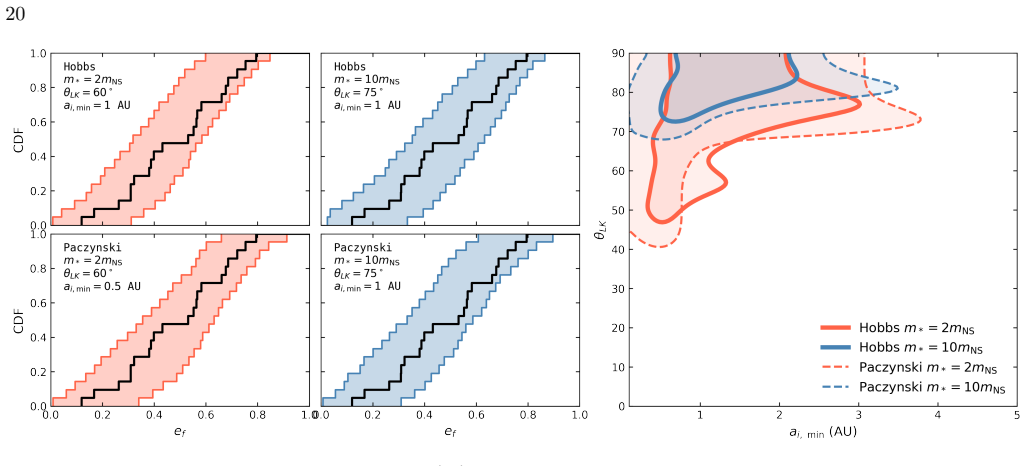
- For a broad range of pre-supernova initial conditions and natal kick distributions, the Gaia eccentricities still favor rocket velocities of order $v_r \gtrsim 30$ km/s, so the rocket survives only in weak-pulsar form.
- If rockets are eventually shown to be required, the Gaia neutron stars must be older than about a megayear, born spinning at several hundred hertz, with dipole fields $\lesssim 10^{10}$ G and a relatively strong quadrupole component.
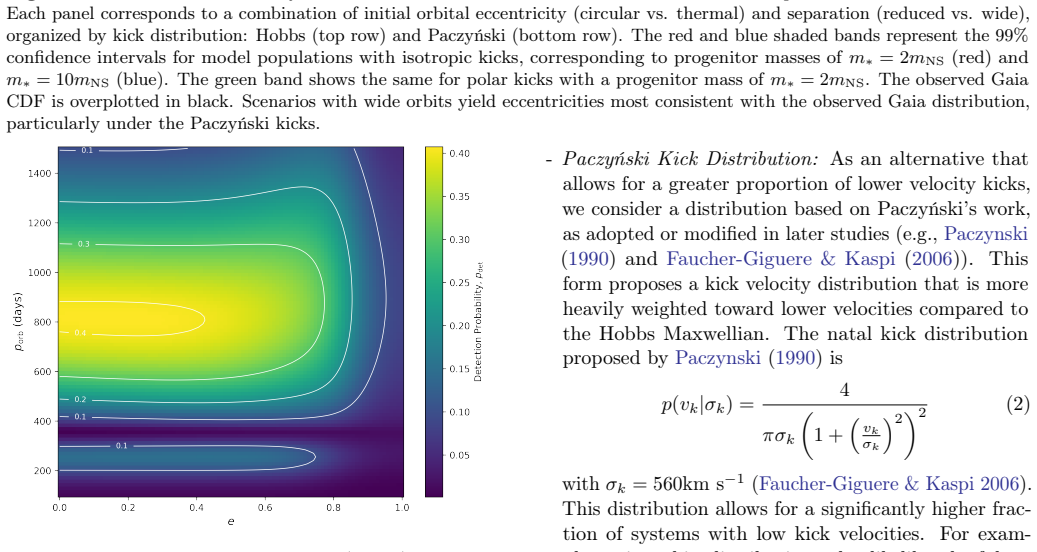
- Without rockets, the observed eccentricity distribution can be matched only if the pre-supernova orbits stayed wide (no strong common-envelope shrinkage) and the kicks have substantial low-velocity support, as in the Paczyński distribution, or are misaligned from the polar direction with a wide opening angle.
- The Monte Carlo analysis, folded through the Gaia selection function, also shows that polar kicks with initially circular orbits require extremely small supernova mass loss; reproducing the lowest-eccentricity system would need a progenitor of only about $2.2\,M_\odot$.
Reading between the lines
- The fault line of the proof is the anchoring premise: if a stationary force-free magnetosphere can contain a detached closed field-line pocket or a persistent plasmoid, $\chi$ need not vanish there and the light-cylinder stress could be nonzero; a targeted numerical search for such persistent structures would determine whether the theorem survives contact with time-dependent force-free solutions.
- The estimate $v_r \sim 30\,\epsilon\,\epsilon_q\,\nu_{0,716}^3$ km/s is an order-of-magnitude scaling rather than a prediction; a natural next step is a dissipative or particle-in-cell simulation of a weak pulsar that measures the $E\cdot B$ structure near the light cylinder and converts the scaling into a quantitative force.
- Because the rocket speed scales with gamma-ray radiative efficiency, the most promising observational candidates would be old, radio-quiet but gamma-ray-bright neutron stars in wide binaries, a selection that future Gaia and gamma-ray catalogs could test.
- The paper notes that Gaia white-dwarf binaries also appear anomalously wide, which suggests that common-envelope orbital shrinkage may be weaker than current prescriptions assume; if so, the no-rocket scenario for the Gaia eccentricities becomes the default and the weak-pulsar rocket would only be needed if future data forces it.
Editorial analysis
A structured set of objections, weighed in public.
Referee Report
Summary. The paper addresses the role of the electromagnetic rocket effect in explaining the Gaia sample of 21 neutron star binaries. In the first part, the authors build Monte-Carlo populations over two pre-supernova separation ranges, two initial-eccentricity prescriptions, two natal-kick distributions, and two kick geometries, and fold in a fit to the Gaia DR3 selection function. They find that some no-rocket models (wide initial orbits with low-velocity Paczynski kicks, or sufficiently misaligned kicks) match the observed eccentricity CDF, while reduced-orbit/Hobbs scenarios require a rocket velocity dispersion σr ≳ 30 km/s. In the second part, they argue from stationarity in the rotating frame and E·B=0 that a force-free pulsar magnetosphere with all field lines anchored to the star has χ=0, so the zρ Maxwell stress at the light cylinder vanishes and the spin-aligned rocket force is identically zero. They then give an order-of-magnitude dissipative estimate F ~ ε f Lγ/c, yielding terminal velocities vr ~ 30 ε εq ν0,716^3 km/s, and derive conditions under which weak pulsars can be effective rockets.
Significance. If the zero-force theorem is accepted, the paper overturns a long-standing estimate and redirects the Gaia eccentricity interpretation toward weak, old, weakly magnetized neutron stars. The proof is elegant and unusually transparent, and the assumptions behind each step are mostly stated. The Monte-Carlo infrastructure, the Gaia selection-function fit, and the per-source inference are useful and reproducible in spirit. The main caveat is that the theorem's global step rests on an unproven topological premise, and the contradiction with Pétri (2021) is not diagnosed; as written, the abstract overstates the result as unconditional. These issues are fixable within the manuscript's scope by presenting the theorem as conditional and testing the assumptions numerically.
major comments (4)
- [§3.2, paragraph after Eq. (18)] The conclusion that χ=0 everywhere uses the premise that every magnetic field line intersects the stellar surface. The manuscript justifies this as 'seems likely on physical grounds' plus a citation to FFE simulations; it is not a theorem. If a stationary FFE solution contains a detached closed flux tube or a persistent plasmoid, then B·∇χ=0 on that flux surface only makes χ constant, not zero, and the light-cylinder cancellation σ_zρ=0 in Eq. (21) need not hold. Because this is the only step separating the proof from the numerical counterexample of Pétri (2021), the abstract's claim to have 'proved' an identically zero rocket force is too strong. Please either prove the anchored-field property from the FFE equations plus boundary/regularity conditions, or state the theorem as conditional on it throughout (abstract, Section 3.2, Section 4).
- [§3.2, Eq. (10)] Stationarity in the rotating frame is assumed at the outset. Real pair-filled pulsar magnetospheres are time dependent (plasmoid ejections, reconnection events), and if ∂tB is not equal to ∇×(V×B), Eq. (14) fails and the χ-based argument collapses. The later remark in Section 3.3 that magnetospheres are only 'at least statistically' stationary shows that this is not a harmless idealization for real pulsars. The theorem should explicitly name stationary rotating-frame solutions as part of its hypotheses, and the discussion should state how far real pulsars are expected to depart from this condition.
- [§3.2, final paragraph] The manuscript asserts that the numerical result of Pétri (2021) is in error, but admits 'it is hard for us to say exactly where the error is' and offers only a 'potential weak point' about the Poynting-flux proxy. For a headline theorem that directly contradicts a published simulation, this leaves the central claim vulnerable: the discrepancy could instead arise from the unproven anchored-field premise or from non-stationarity in Pétri's solution. Please diagnose the contradiction concretely, for example by checking field-line topology and time dependence in the rotating frame in that simulation, or by explicitly restricting the theorem and leaving the numerical counterexample unresolved as a limitation.
- [§2.2.1 and Fig. 5] The statement that Bayes factors 'decisively favor' the rocket model in all scenarios is not backed by reported marginal-likelihood values, and the prior p(σr) ∝ f_surv,det(σr) is constructed from the same simulated populations whose orbits depend on σr. This prior choice can strongly affect the σr=0 comparison, especially for reduced orbits where survivability changes with rocket strength. Please report actual Bayes factors and demonstrate that the 'vr ≳ 30 km/s required' conclusion is robust to alternative priors (e.g., flat in σr or flat in log σr).
minor comments (5)
- [§3.2, first paragraph] There are duplicated words in 'As we will shall see' and 'this this equation'; please proofread the passage.
- [§2.2] 'in turm' should be 'in turn'.
- [§3.3, after Eq. (42)] ϵq is used in Eq. (42) before its definition; define it before the equation. Also, 'teble 14' should be 'Table 14', and in Eq. (30) 'I amd M' should be 'I and M'.
- [App. B] In the description of the selection-function fit, 'pdet(Porb,e, e)' has a doubled e, and the reference 'El-Badry et al. (2024a) (2023)' is redundant; the parametric fit does not fully reproduce the multiple local maxima at P_orb > 365 d for e=0, which should be noted as a limitation in the main text where p_det is used.
- [App. D] Several typographical errors ('In Fig. 9 shows', 'eccentrcities', 'minimium', 'witin') appear in Appendix D; these do not affect the analysis but should be corrected.
Circularity Check
No significant circularity: the zero-force theorem is a self-contained FFE derivation, and the Gaia rocket constraints are explicitly presented as fitted/conditional inferences rather than predictions.
full rationale
The central zero-force result in Section 3.2 is derived from Maxwell's equations, stationarity in the rotating frame (Eq. 10), the FFE condition E·B=0 (Eq. 16), and the surface boundary condition χ|_rs=0 (Eq. 18). Equations (15)-(21) then imply χ=0 and the vanishing of the zρ Maxwell stress at the light cylinder, so the conclusion is not taken as an input. The only soft point is the explicit assumption that all field lines are anchored to the star 'at least at one point'; the paper labels this as physically plausible rather than proved, and it is an unproven premise rather than a circular step. The Gaia analysis fits σr to the observed eccentricities and does not disguise this as a prediction; indeed Section 2 states that for some plausible initial-condition and kick choices 'currently the data does not require rockets', while the '30 km/s required' statement is a conditional inference from the fitted models. The weak-pulsar rocket estimate in Section 3.3 is explicitly 'a very rough estimate' and is not presented as an independent first-principles prediction. Self-citations (e.g., Gruzinov 2006, 2013a, 2023) support parts of the discussion, but the main proof is reproduced in the paper and does not reduce to those citations. No circularity pattern is present.
Assumptions & free parameters
free parameters (5)
- σr (rocket velocity dispersion) =
Posterior favors σr ≥ 30 km/s for reduced orbits; σr = 50 km/s used in Figure 4
- ai,min (minimum pre-supernova separation) =
Posterior peaks near 1 AU, 90% credible interval [0.5, 3] AU
- Detection probability fit parameters A1, σ1, A2, σ2, α, c =
Given in Eqs. (B9)-(B14)
- ε (radiative efficiency) =
~0.2 from gamma-ray pulsar data (Smith et al. 2023)
- εq (quadrupole-to-dipole field ratio) =
Order several, from NICER observations of PSR J0030+0451
assumptions (6)
- domain assumption The pulsar magnetosphere is well described by Force-Free Electrodynamics with E·B=0 for strong pulsars
- ad hoc to paper All magnetic field lines are anchored to the star at at least one point
- domain assumption The magnetosphere is stationary in the rotating frame
- ad hoc to paper Pre-supernova separation distributions are log-uniform in the chosen ranges, with either circular or thermal eccentricities
- domain assumption Hobbs and Paczynski kick distributions bracket the true natal kick distribution
- domain assumption Gruzinov (2023) weak-pulsar condition and Spitkovsky (2006) spin-down luminosity apply
Cite this review
Pith. "Pith review of Pulsar Rockets and Gaia Neutron Star Binaries." pith.science (2026). https://pith.science/paper/TDY56MBN
@misc{pith2026250705602,
  author       = {Pith},
  title        = {Pith review of: Pulsar Rockets and Gaia Neutron Star Binaries},
  year         = {2026},
  howpublished = {\url{https://pith.science/paper/TDY56MBN}},
  note         = {Machine review of arXiv:2507.05602}
}
abstract
We prove that the spin-aligned electromagnetic recoil force acting on a pulsar vanishes identically in Force-Free Electrodynamics. This contrasts with Hirai et al.'s recent argument that the rocket effect was important for explaining the eccentricity distribution of wide neutron star binaries found by Gaia. Our detailed analysis confirms that for a broad range of initial conditions and natal kick distributions, the rocket velocities of $v_r \gtrsim 30\, \mathrm{km/s}$ are required to account for the observed eccentricities. However, we find that in scenarios where the common envelope phase does not significantly shrink the initial orbit, and the natal kicks are drawn from Paczynski-type distribution, these eccentricities may arise without the influence of an EM rocket. If the natal kicks are perpendicular to the initial orbits, then explaining the Gaia neutron star eccentricities without invoking rockets additionally requires that the pre-supernova binaries avoid significant circularization, and that the mass loss during the supernova is minimal. The rocket effect can only be substantial in "weak" pulsars, where pair production near the light cylinder is suppressed and ${\bf E}\cdot{\bf B} \neq 0$ in the outer magnetosphere. We derive a rough estimate for a rocket force in a weak pulsar and relate it to the pulsar's radiative efficiency; simulations are needed to obtain numerically reliable expressions. If future observations prove that rockets are required to explain the data, this would imply that Gaia neutron stars are $\gtrsim $ Myr old, were previously rapidly spinning and are weakly magnetized, with a dipole field $\lesssim 10^{10}$ G and a relatively strong quadrupole component.
Figures


Figures from the paper (7 more)



Reference graph
Works this paper leans on
-
[1]
Baibhav, V., & Kalogera, V. 2024. 2412.03461
arXiv 2024
-
[2]
1961, , 15, 265
Blaauw , A. 1961, , 15, 265
1961
-
[3]
Bransgrove , A., Beloborodov , A. M., & Levin , Y. 2023, , 958, L9, 10.3847/2041-8213/ad0556
-
[4]
Brisken, W. F., Benson, J. M., Goss, W. M., & Thorsett, S. E. 2002, Astrophys. J., 571, 906, 10.1086/340098
doi:10.1086/340098 2002
-
[5]
Chatterjee, S., Brisken, W. F., Vlemmings, W. H. T., et al. 2009, Astrophys. J., 698, 250, 10.1088/0004-637X/698/1/250
-
[6]
Chen , A. Y., & Beloborodov , A. M. 2014, , 795, L22, 10.1088/2041-8205/795/1/L22
-
[7]
Y., Cruz , F., & Spitkovsky , A
Chen , A. Y., Cruz , F., & Spitkovsky , A. 2020, , 889, 69, 10.3847/1538-4357/ab5c20
-
[8]
1993, , 402, 264, 10.1086/172129
Chen , K., & Ruderman , M. 1993, , 402, 264, 10.1086/172129
doi:10.1086/172129 1993
Show all 60 references
-
[9]
Chevalier , R. A. 1989, , 346, 847, 10.1086/168066
1989 doi
-
[10]
1999, , 511, 351, 10.1086/306652
Contopoulos , I., Kazanas , D., & Fendt , C. 1999, , 511, 351, 10.1086/306652
1999 doi
-
[11]
2024, , 690, A229, 10.1051/0004-6361/202347926
Cruz , F., Grismayer , T., Torres , R., et al. 2024, , 690, A229, 10.1051/0004-6361/202347926
2024 doi
-
[12]
2017, in Journal of Physics Conference Series, Vol
De Luca , A. 2017, in Journal of Physics Conference Series, Vol. 932, Journal of Physics Conference Series (IOP), 012006, 10.1088/1742-6596/932/1/012006
2017 doi
-
[13]
Disberg, P., & Mandel, I. 2025. 2505.22102
2025 arXiv
-
[14]
2024 a , The Open Journal of Astrophysics, 7, 100, 10.33232/001c.125461
El-Badry , K., Lam , C., Holl , B., et al. 2024 a , The Open Journal of Astrophysics, 7, 100, 10.33232/001c.125461
2024 doi
-
[15]
W., et al
El-Badry , K., Rix , H.-W., Latham , D. W., et al. 2024 b , The Open Journal of Astrophysics, 7, 58, 10.33232/001c.121261
2024 doi
-
[16]
Faucher-Giguere, C.-A., & Kaspi, V. M. 2006, Astrophys. J., 643, 332, 10.1086/501516
2006 doi
-
[17]
1999, , 345, 847
Geppert , U., Page , D., & Zannias , T. 1999, , 345, 847
1999
-
[18]
Goldreich , P., & Julian , W. H. 1969, , 157, 869, 10.1086/150119
1969 doi
-
[19]
V., & Halpern , J
Gotthelf , E. V., & Halpern , J. P. 2009, , 695, L35, 10.1088/0004-637X/695/1/L35
2009 doi
- [20]
-
[21]
2005, , 94, 021101, 10.1103/PhysRevLett.94.021101
---. 2005, , 94, 021101, 10.1103/PhysRevLett.94.021101
2005 doi
- [22]
- [23]
- [24]
- [25]
- [26]
-
[27]
2023, , 943, 105, 10.3847/1538-4357/acab05
Hakobyan , H., Philippov , A., & Spitkovsky , A. 2023, , 943, 105, 10.3847/1538-4357/acab05
2023 doi
- [28]
-
[29]
Hessels , J. W. T., Ransom , S. M., Stairs , I. H., et al. 2006, Science, 311, 1901, 10.1126/science.1123430
2006 doi
-
[30]
2024, Astrophys
Hirai, R., Podsiadlowski, P., Heger, A., & Nagakura, H. 2024, Astrophys. J. Lett., 972, L18, 10.3847/2041-8213/ad6e77
2024 doi
-
[33]
Hu , R., & Beloborodov , A. M. 2022, , 939, 42, 10.3847/1538-4357/ac961d
2022 doi
-
[34]
Igoshev, A. P. 2020, Mon. Not. Roy. Astron. Soc., 494, 3663, 10.1093/mnras/staa958
2020 doi
-
[35]
P., Hollerbach, R., & Wood, T
Igoshev, A. P., Hollerbach, R., & Wood, T. 2023, Mon. Not. Roy. Astron. Soc., 525, 3354, 10.1093/mnras/stad2404
2023 doi
-
[36]
2005, Mon
Johnston, S., Hobbs, G., Vigeland, S., et al. 2005, Mon. Not. Roy. Astron. Soc., 364, 1397, 10.1111/j.1365-2966.2005.09669.x
2005
-
[37]
2007, Mon
Johnston, S., Kramer, M., Karastergiou, A., et al. 2007, Mon. Not. Roy. Astron. Soc., 381, 1625, 10.1111/j.1365-2966.2007.12352.x
2007
-
[38]
2023, Mon
Kapil, V., Mandel, I., Berti, E., & M\"uller, B. 2023, Mon. Not. Roy. Astron. Soc., 519, 5893, 10.1093/mnras/stad019
2023 doi
-
[39]
Kojima, Y., & Kato, Y. E. 2011, Astrophys. J., 728, 75, 10.1088/0004-637X/728/2/75
2011 doi
-
[40]
G., Hobbs, G., et al
Kramer, M., Lyne, A. G., Hobbs, G., et al. 2003, Astrophys. J. Lett., 593, L31, 10.1086/378082
2003 doi
-
[41]
F., & Cordes, J
Lai, D., Chernoff, D. F., & Cordes, J. M. 2001, Astrophys. J., 549, 1111, 10.1086/319455
2001 doi
-
[42]
D., & Lifshitz , E
Landau , L. D., & Lifshitz , E. M. 1975, The classical theory of fields
1975
-
[43]
Mandel, I., & Igoshev, A. P. 2023, Astrophys. J., 944, 153, 10.3847/1538-4357/acb3c3
2023 doi
-
[44]
C., et al
Miller, M. C., et al. 2019, Astrophys. J. Lett., 887, L24, 10.3847/2041-8213/ab50c5
2019 doi
-
[45]
1995, , 440, L77, 10.1086/187765
Muslimov , A., & Page , D. 1995, , 440, L77, 10.1086/187765
1995 doi
-
[46]
W., Brisken, W
Ng, C.-Y., Romani, R. W., Brisken, W. F., Chatterjee, S., & Kramer, M. 2006, Astrophys. J., 654, 487, 10.1086/510576
2006 doi
-
[47]
2012, Mon
Noutsos, A., Kramer, M., Carr, P., & Johnston, S. 2012, Mon. Not. Roy. Astron. Soc., 423, 2736, 10.1111/j.1365-2966.2012.21083.x
2012
-
[48]
Noutsos , A., Schnitzeler , D. H. F. M., Keane , E. F., Kramer , M., & Johnston , S. 2013, , 430, 2281, 10.1093/mnras/stt047
2013 doi
- [49]
- [50]
- [51]
-
[52]
2021, , 501, 4479, 10.1093/mnras/staa3909
P \'e tri , J. 2021, , 501, 4479, 10.1093/mnras/staa3909
2021 doi
-
[53]
2022, , 60, 495, 10.1146/annurev-astro-052920-112338
Philippov , A., & Kramer , M. 2022, , 60, 495, 10.1146/annurev-astro-052920-112338
2022 doi
-
[54]
A., Spitkovsky , A., & Cerutti , B
Philippov , A. A., Spitkovsky , A., & Cerutti , B. 2015, , 801, L19, 10.1088/2041-8205/801/1/L19
2015 doi
-
[55]
E., et al
Riley, T. E., et al. 2019, Astrophys. J. Lett., 887, L21, 10.3847/2041-8213/ab481c
2019 doi
-
[56]
A., & Sutherland , P
Ruderman , M. A., & Sutherland , P. G. 1975, , 196, 51, 10.1086/153393
1975 doi
-
[57]
A., Abdollahi , S., Ajello , M., et al
Smith , D. A., Abdollahi , S., Ajello , M., et al. 2023, , 958, 191, 10.3847/1538-4357/acee67
2023 doi
- [58]
- [59]
-
[60]
2017, Astron
Verbunt, F., Igoshev, A., & Cator, E. 2017, Astron. Astrophys., 608, A57, 10.1051/0004-6361/201731518
2017 doi
-
[61]
2006, Astrophys
Wang, C., Lai, D., & Han, J. 2006, Astrophys. J., 639, 1007, 10.1086/499397
2006 doi
-
[62]
2021, Astrophys
Willcox, R., Mandel, I., Thrane, E., et al. 2021, Astrophys. J. Lett., 920, L37, 10.3847/2041-8213/ac2cc8
2021 doi
Reviewed August 6, 2026 · model on record in the stance chip above.
Discussion (0). Sign in to comment.