ArrythML: An Autoencoder-Based TinyML Approach for On-Device Arrhythmia Detection on Resource-Constrained Embedded Systems
Pith reviewed 2026-06-28 15:24 UTC · model grok-4.3
The pith
TinyML autoencoders detect arrhythmias on embedded devices with 84% recall and 9 ms latency after excluding ambiguous cases.
A machine-rendered reading of the paper's core claim, the machinery that carries it, and where it could break.
Core claim
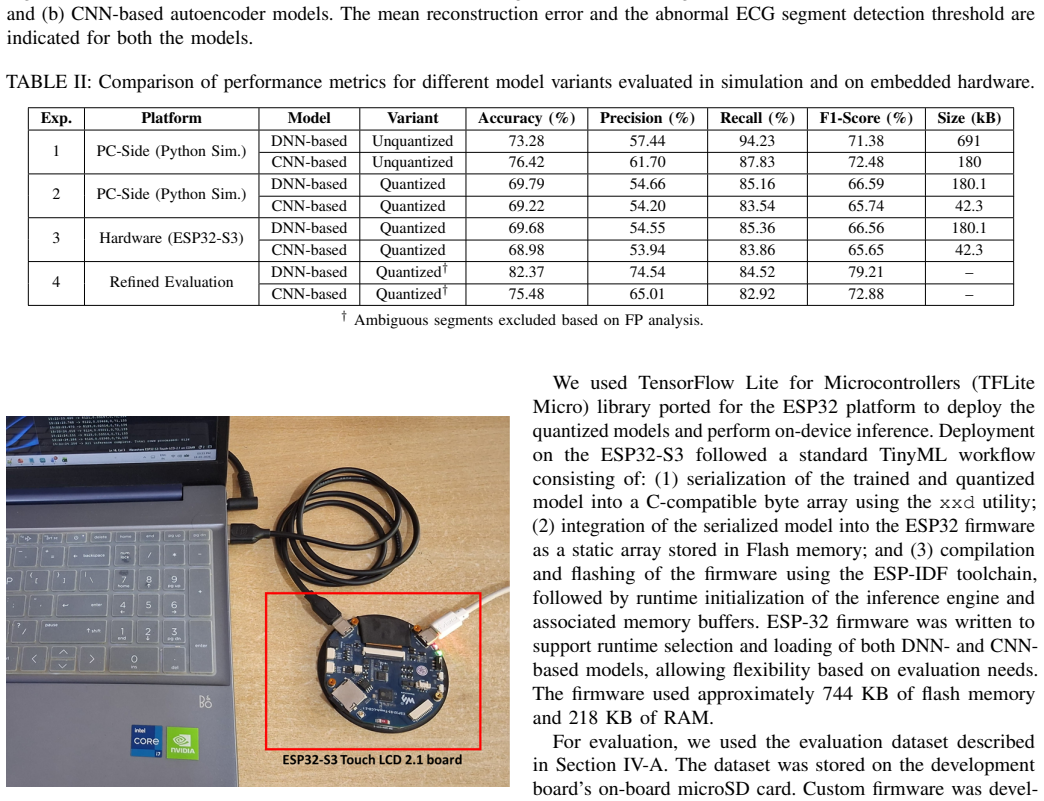
Refined evaluation by filtering out ambiguous cases in the dataset shows that the best-performing DNN-based autoencoder achieves a recall of 84%, an F1-score of 79%, a model size of approximately 180 KB, and an inference latency of 9 ms on-device.
What carries the argument
INT8 quantized autoencoder with minimal layers that flags arrhythmias by reconstruction error on ECG segments.
If this is right
- Real-time arrhythmia detection becomes feasible inside battery-powered wearables without sending data off-device.
- The 180 KB model and 9 ms latency allow continuous monitoring on microcontrollers such as the ESP32-S3.
- Failure patterns indicate the model can surface early or subtle anomalies that standard annotations label normal.
- Quantized autoencoders with few parameters suffice for accurate on-device ECG analysis.
- Privacy-preserving embedded systems can perform the full detection pipeline locally.
Where Pith is reading between the lines
- Integrating these models into consumer fitness bands could enable always-on screening that alerts users to potential issues without cloud involvement.
- The filtering step would need prospective clinical validation to confirm it does not systematically hide dangerous rhythms.
- The same lightweight autoencoder structure could be tested on other single-lead biosignals such as photoplethysmography for pulse irregularity detection.
- Extending the approach to multi-class rhythm typing rather than binary anomaly detection would require only modest additional output heads.
Load-bearing premise
Removing ambiguous or borderline ECG segments produces an unbiased performance estimate rather than inflating metrics by excluding hard cases.
What would settle it
Running the same model on the original unfiltered MIT-BIH segments and measuring whether recall falls below 80% or specific verified arrhythmia beats are missed.
Figures
read the original abstract
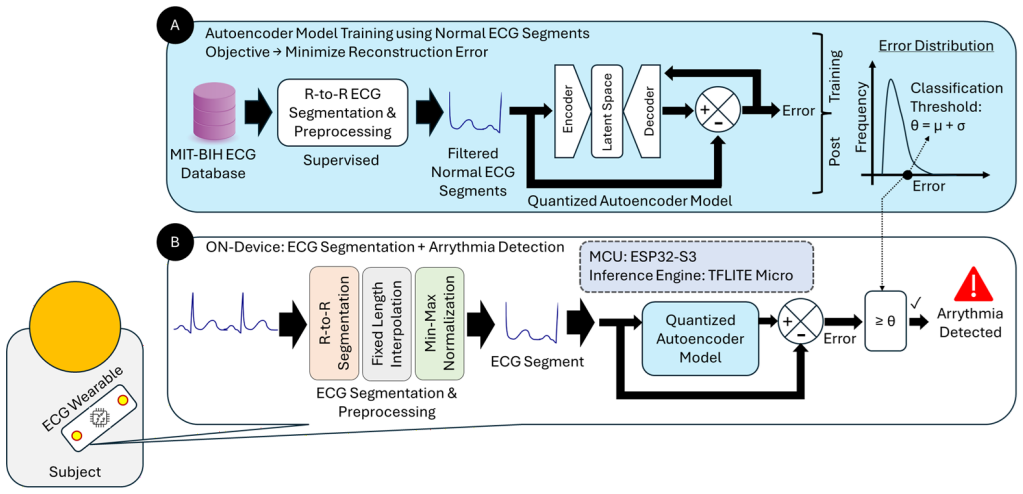
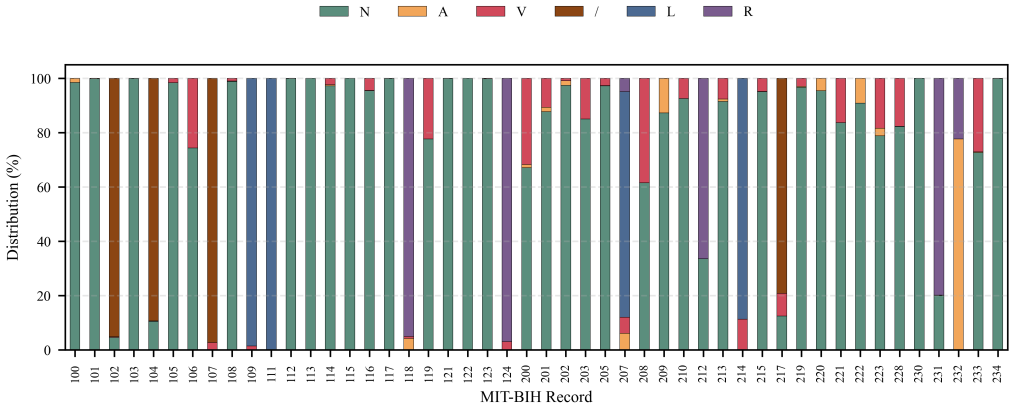
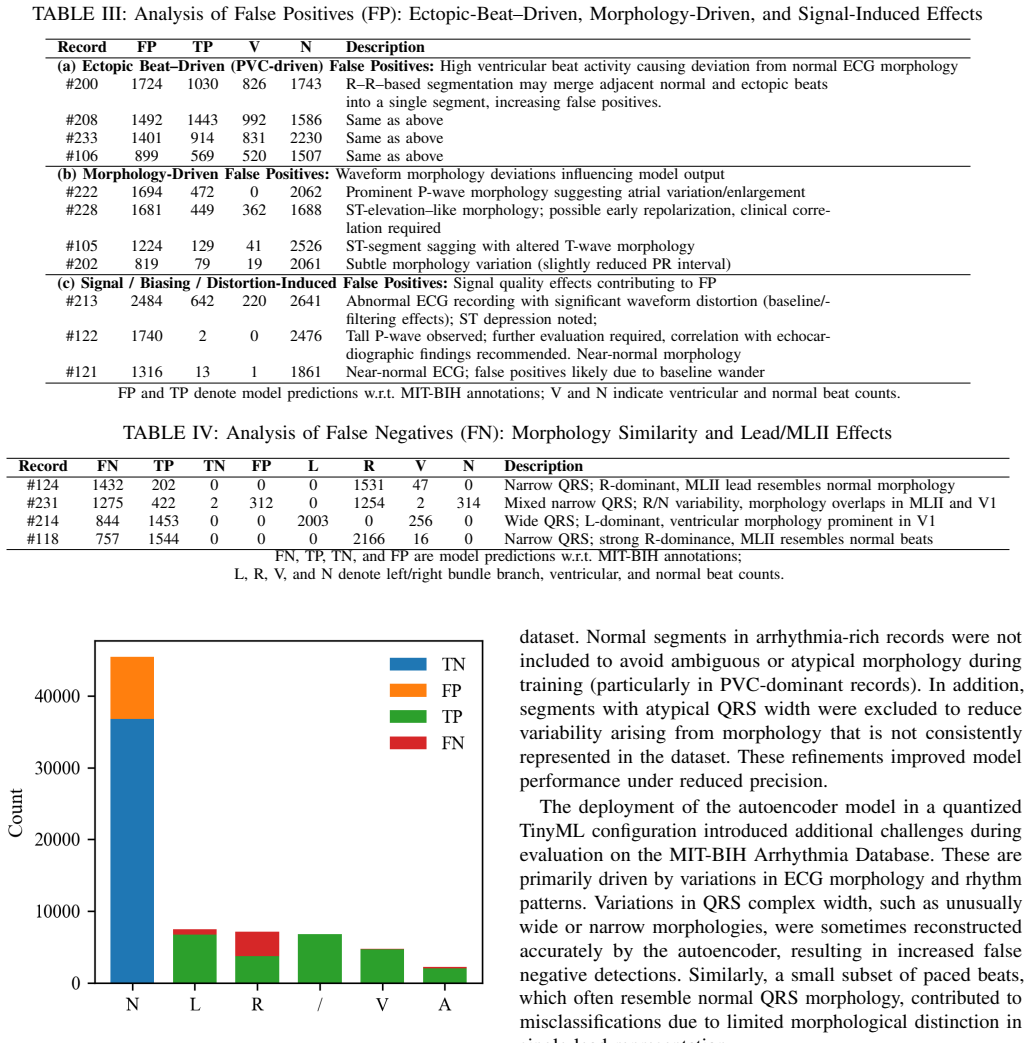
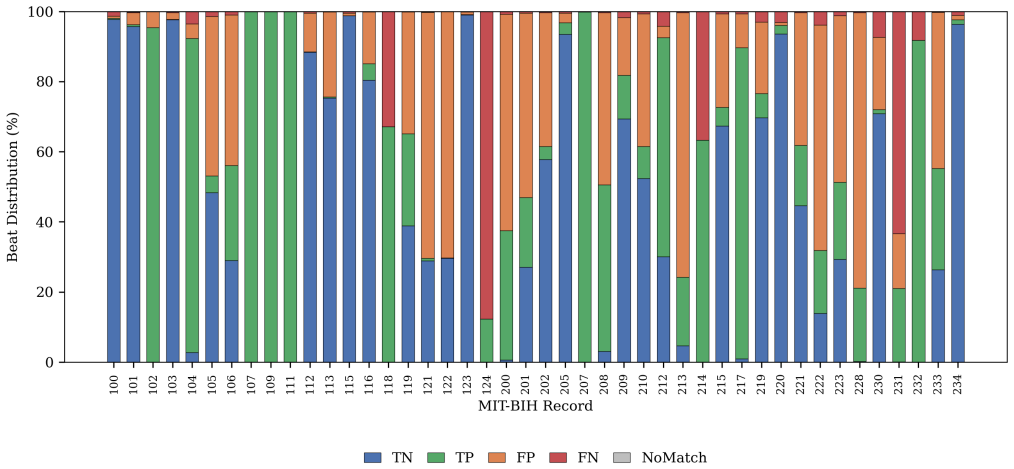
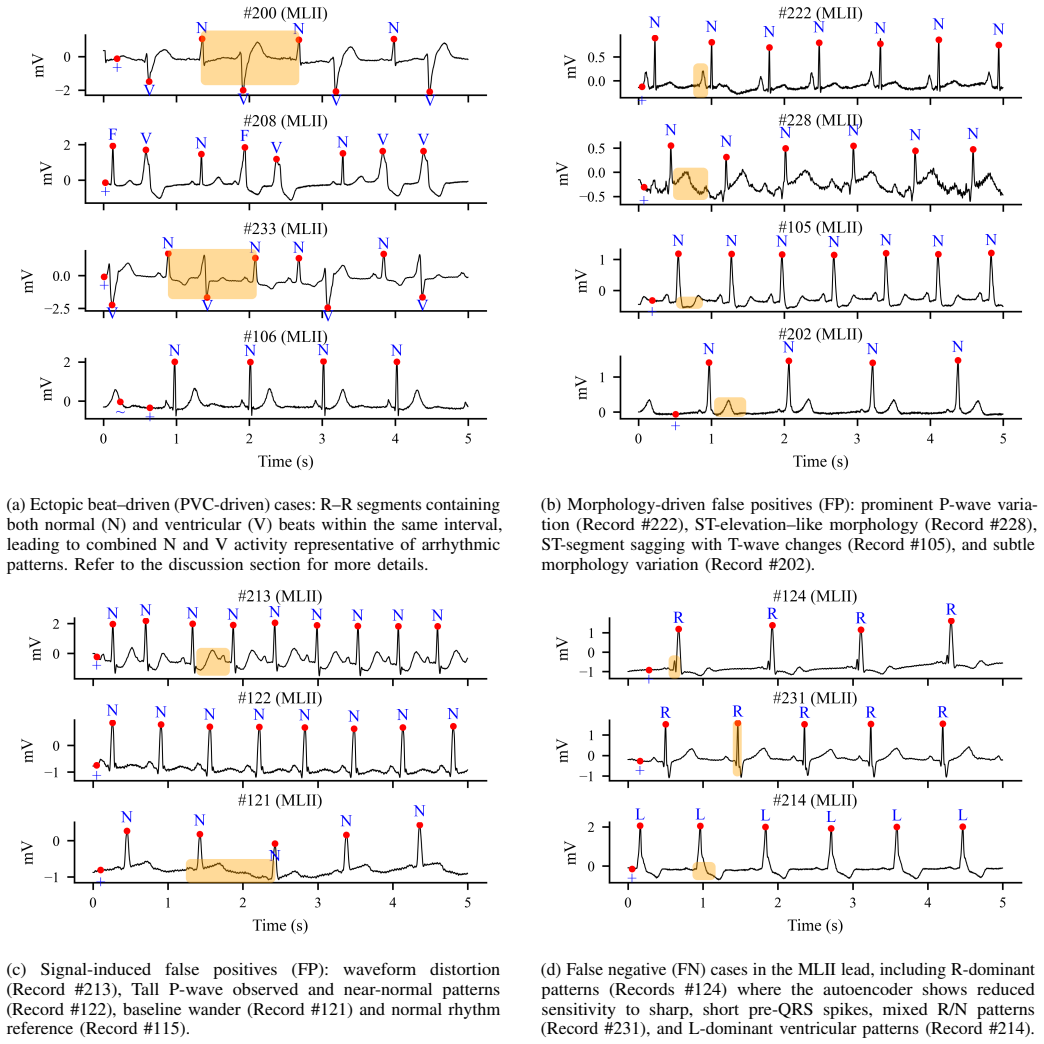
Our work presents a method for ECG segmentation and arrhythmia detection using Tiny Machine Learning (TinyML) models for real-time, on-device inference on resource-constrained embedded systems. We develop INT8 quantized autoencoder-based TinyML models with minimal layers and parameters for embedded deployment. These models are evaluated using a custom dataset derived from the MIT-BIH Arrhythmia Database and validated in both PC-based simulations and on-device environments. For the evaluations, over 95,000 ECG segments are processed on an ESP32-S3 microcontroller running the TensorFlow Lite Micro runtime. Post-evaluation, detailed analysis, including annotation-wise and record-wise failure analysis, is conducted to characterize model behavior across diverse ECG morphologies and rhythm patterns and to explain missed detections. In several cases, apparent misclassifications may correspond to early or subtle anomaly patterns labeled as normal in the reference annotations, highlighting the model's sensitivity. A refined evaluation by filtering out ambiguous cases in the dataset shows that the best-performing DNN-based autoencoder achieves a recall of 84%, an F1-score of 79%, a model size of approximately 180 KB, and an inference latency of 9 ms on-device. These results demonstrate the feasibility of low-power, privacy-preserving embedded wearable systems capable of performing accurate arrhythmia detection entirely on-device.
Editorial analysis
A structured set of objections, weighed in public.
Referee Report
Summary. The manuscript proposes ArrythML, an autoencoder-based TinyML model for on-device ECG arrhythmia detection on embedded systems. It uses INT8 quantized autoencoders with minimal layers, evaluates on a custom MIT-BIH derived dataset with over 95,000 segments on ESP32-S3 using TensorFlow Lite Micro, conducts failure analysis, and reports refined performance after filtering ambiguous cases: 84% recall, 79% F1, ~180 KB size, 9 ms latency.
Significance. If the reported metrics hold under a reproducible and unbiased evaluation protocol, the work is significant for demonstrating practical on-device arrhythmia detection with low power and privacy benefits for wearable devices. The explicit on-device validation and annotation-wise failure analysis provide concrete evidence of feasibility in resource-constrained environments.
major comments (2)
- [Abstract] Abstract: the refined evaluation by filtering out ambiguous cases lacks a pre-specified definition of ambiguity, the number of excluded segments, any inter-rater protocol, and performance results on the unfiltered dataset. This is load-bearing for the central claim (recall 84%, F1 79%), as post-hoc removal of cases that 'may represent early or subtle anomaly patterns labeled as normal' risks upward bias without justification.
- [Evaluation] Evaluation section: no training details, data-split protocol, baseline comparisons, or full error analysis are supplied beyond the abstract's mention of post-evaluation filtering and failure analysis. These omissions prevent verification of the empirical claims and assessment of whether the autoencoder approach is competitive.
minor comments (1)
- [Abstract] Abstract: the model-size figure is given as 'approximately 180 KB' without an exact value or table reference; provide a precise number and link to the corresponding table or section.
Simulated Author's Rebuttal
We thank the referee for the constructive feedback. We address the major comments point-by-point below and will revise the manuscript to enhance transparency and completeness of the evaluation protocol.
read point-by-point responses
-
Referee: [Abstract] Abstract: the refined evaluation by filtering out ambiguous cases lacks a pre-specified definition of ambiguity, the number of excluded segments, any inter-rater protocol, and performance results on the unfiltered dataset. This is load-bearing for the central claim (recall 84%, F1 79%), as post-hoc removal of cases that 'may represent early or subtle anomaly patterns labeled as normal' risks upward bias without justification.
Authors: We acknowledge the concern regarding potential bias in the post-hoc filtering. In the revised manuscript, we will add a clear, pre-specified definition of ambiguous cases (based on the annotation-wise failure analysis identifying segments with possible subtle anomalies), report the exact number of excluded segments from the >95,000 total, clarify that the process relied on the original MIT-BIH annotations without an additional inter-rater protocol, and include the performance metrics (recall, F1, etc.) on the unfiltered dataset alongside the refined results for direct comparison. revision: yes
-
Referee: [Evaluation] Evaluation section: no training details, data-split protocol, baseline comparisons, or full error analysis are supplied beyond the abstract's mention of post-evaluation filtering and failure analysis. These omissions prevent verification of the empirical claims and assessment of whether the autoencoder approach is competitive.
Authors: We will expand the Evaluation section to include: (1) full training details such as hyperparameters, loss function, optimizer, and epochs for the INT8 quantized autoencoders; (2) the data-split protocol used to create the custom dataset of over 95,000 segments from MIT-BIH; (3) baseline comparisons with other lightweight models suitable for TinyML (e.g., simpler classifiers or alternative autoencoder architectures); and (4) a more comprehensive error analysis incorporating quantitative metrics in addition to the existing annotation-wise and record-wise failure analysis. These changes will support verification and competitiveness assessment. revision: yes
Circularity Check
No circularity; purely empirical evaluation with no derivations or self-referential reductions
full rationale
The paper describes development and on-device evaluation of quantized autoencoder models for ECG arrhythmia detection using a MIT-BIH-derived dataset. All reported results (recall, F1, model size, latency) are direct empirical measurements on processed segments, including a post-evaluation refinement step that filters ambiguous cases. No equations, parameter-fitting derivations, predictions from fitted inputs, or load-bearing self-citations appear in the provided text. The central claims reduce to measured performance numbers on held-out data rather than any construction that equates outputs to inputs by definition. This is the expected non-finding for an applied ML systems paper without theoretical derivations.
Axiom & Free-Parameter Ledger
free parameters (2)
- autoencoder depth and width
- INT8 quantization scale factors
axioms (1)
- domain assumption Reconstruction error of an autoencoder trained on normal ECG reliably flags arrhythmias.
Reference graph
Works this paper leans on
-
[1]
An autoencoder-based tinyml model for on-device arrhythmia detection,
S. Nagarajan and K. Polachan, “An autoencoder-based tinyml model for on-device arrhythmia detection,” in2025 International Conference on Smart Applications, Communications and Networking (SmartNets). IEEE, 2025, pp. 1–6
2025
-
[2]
The impact of the mit-bih arrhythmia database,
G. B. Moody and R. G. Mark, “The impact of the mit-bih arrhythmia database,”IEEE Engineering in Medicine and Biology Magazine, vol. 20, no. 3, pp. 45–50, May-Jun 2001
2001
-
[3]
A real-time health moni- toring system for remote cardiac patients using smartphone and wearable sensors,
P. Kakria, N. K. Tripathi, and P. Kitipawang, “A real-time health moni- toring system for remote cardiac patients using smartphone and wearable sensors,”International Journal of Telemedicine and Applications, vol. 2015, p. 373474, 2015, epub 2015 Dec 15. PMID: 26788055; PMCID: PMC4692989
2015
-
[4]
R. M. Rangayyan,Biomedical Signal Analysis: A Case-Study Approach. Wiley-IEEE Press, 2002
2002
-
[5]
Vlc-le: Energy- efficient and secure visible light communication for the internet of bodies,
K. Agarwal, R. Lalwani, U. Abeena, and K. Polachan, “Vlc-le: Energy- efficient and secure visible light communication for the internet of bodies,” in2024 International Conference on Smart Applications, Communications and Networking (SmartNets). IEEE, 2024, pp. 1–6
2024
-
[6]
hbclock: Encrypted rf communication utilizing body-coupled keys for the internet of bodies,
S. Majumdar, A. Madurwar, A. Shetty, and K. Polachan, “hbclock: Encrypted rf communication utilizing body-coupled keys for the internet of bodies,” in2025 38th International Conference on VLSI Design and 2024 23rd International Conference on Embedded Systems (VLSID). IEEE, 2025, pp. 55–60
2024
-
[7]
Murmur: A secure and low- energy audio communication for the internet of bodies,
P. Jagan, K. Polachan, M. Raoet al., “Murmur: A secure and low- energy audio communication for the internet of bodies,” in2025 17th International Conference on COMmunication Systems and NETworks (COMSNETS). IEEE, 2025, pp. 217–224
2025
-
[8]
Gpio puf for iot devices,
G. Vaidya, T. Prabhakar, and L. Manjunath, “Gpio puf for iot devices,” inGLOBECOM 2020-2020 IEEE Global Communications Conference. IEEE, 2020, pp. 1–6
2020
-
[9]
iopuf: A puf-based iot node identification utilizing pull-up/down resistors on io pins,
P. Chakrabarty, A. L. Ravi, and K. Polachan, “iopuf: A puf-based iot node identification utilizing pull-up/down resistors on io pins,” in2024 IEEE 22nd Mediterranean Electrotechnical Conference (MELECON). IEEE, 2024, pp. 45–50
2024
-
[10]
Led- puf: Physical unclonable led signatures for unique identification of iot nodes,
S. Naz, A. D. Mulla, H. Sumayya, R. S. Sarang, and K. Polachan, “Led- puf: Physical unclonable led signatures for unique identification of iot nodes,” in2024 IEEE 22nd Mediterranean Electrotechnical Conference (MELECON). IEEE, 2024, pp. 862–867
2024
-
[11]
Autoen- coders and their applications in machine learning: a survey,
K. Berahmand, F. Daneshfar, E. S. Salehi, Y . Li, and Y . Xu, “Autoen- coders and their applications in machine learning: a survey,”Artificial Intelligence Review, vol. 57, no. 2, p. 28, 2024
2024
-
[12]
The mit-bih arrhythmia database,
G. B. Moody and R. G. Mark, “The mit-bih arrhythmia database,” PhysioNet, 1992, available at PhysioNet. [Online]. Available: https://physionet.org/content/mitdb/1.0.0/
1992
-
[13]
A real-time qrs detection algorithm,
J. Pan and W. J. Tompkins, “A real-time qrs detection algorithm,”IEEE Transactions on Biomedical Engineering, vol. BME-32, no. 3, pp. 230– 236, 1985
1985
-
[14]
Quantitative investigation of qrs detection rules using the mit-bih arrhythmia database,
P. S. Hamilton and W. J. Tompkins, “Quantitative investigation of qrs detection rules using the mit-bih arrhythmia database,”IEEE Transactions on Biomedical Engineering, vol. 33, no. 12, pp. 1157–1165,
-
[15]
Available: https://ieeexplore.ieee.org/document/4122227
[Online]. Available: https://ieeexplore.ieee.org/document/4122227
-
[16]
A database for evaluation of algorithms for measurement of qt and other waveform intervals in the ecg,
P. Laguna, R. G. Mark, A. Goldberg, and G. B. Moody, “A database for evaluation of algorithms for measurement of qt and other waveform intervals in the ecg,”Computers in Cardiology, vol. 21, pp. 673–676, 1994
1994
-
[17]
Advanced methods and tools for ecg data analysis,
G. D. Clifford, F. Azuaje, and P. McSharry, “Advanced methods and tools for ecg data analysis,” inAdvanced Methods and Tools for ECG Data Analysis. Artech House, 2006
2006
-
[18]
A deep convolutional neural network model to classify heartbeats,
U. R. Acharya, H. Fujita, S. L. Oh, Y . Hagiwara, J. H. Tan, and M. Adam, “A deep convolutional neural network model to classify heartbeats,” Computers in Biology and Medicine, vol. 89, pp. 389–396, 2017
2017
-
[19]
Cardiologist-level arrhythmia detection with convolutional neural networks,
P. Rajpurkar, A. Y . Hannunet al., “Cardiologist-level arrhythmia detection with convolutional neural networks,”arXiv preprint arXiv:1707.01836, 2017
Pith/arXiv arXiv 2017
-
[20]
Ecg arrhythmia classification using a 2-d convolutional neural network,
T. J. Jun, H. M. Nguyen, D. Kang, D. Kim, D. Kim, and Y .-H. Kim, “Ecg arrhythmia classification using a 2-d convolutional neural network,”arXiv preprint arXiv:1804.06812, 2018. [Online]. Available: https://arxiv.org/abs/1804.06812
Pith/arXiv arXiv 2018
-
[21]
Cardiologist-level arrhythmia detection and classification in ambulatory electrocardiograms using a deep neural network,
A. Y . Hannun, P. Rajpurkar, M. Haghpanahi, G. H. Tison, C. Bourn, M. P. Turakhia, and A. Y . Ng, “Cardiologist-level arrhythmia detection and classification in ambulatory electrocardiograms using a deep neural network,”Nature Medicine, vol. 25, no. 1, pp. 65–69, 2019. [Online]. Available: https://www.nature.com/articles/s41591-018-0268-3
2019
-
[22]
Real-time patient-specific ecg classification by 1-d convolutional neural networks,
S. Kiranyaz, T. Ince, and M. Gabbouj, “Real-time patient-specific ecg classification by 1-d convolutional neural networks,”IEEE Transactions on Biomedical Engineering, vol. 63, no. 3, pp. 664–675, 2016
2016
-
[23]
Heartbeat classification based on single lead-ii ecg using deep learning,
M. F. Issa, A. Yousry, G. Tuboly, Z. Juhasz, A. H. AbuEl-Atta, and M. M. Selim, “Heartbeat classification based on single lead-ii ecg using deep learning,”Heliyon, vol. 9, no. 7, p. e17974, 2023. [Online]. Available: https://www.sciencedirect.com/science/article/pii/S2405844023051824
2023
-
[24]
Benchmarking tinyml systems: Challenges and direction,
C. Banbury, V . J. Reddiet al., “Benchmarking tinyml systems: Challenges and direction,”arXiv, vol. arXiv:2003.04821, 2021
arXiv 2003
-
[25]
A method for detection of atrial fibrillation using rr intervals,
K. Tateno and L. Glass, “A method for detection of atrial fibrillation using rr intervals,”IEEE Transactions on Biomedical Engineering, vol. 48, no. 7, pp. 731–737, 2001
2001
-
[26]
A simple method to detect atrial fibrillation using rr intervals,
J. Lian, L. Wang, and D. Muessig, “A simple method to detect atrial fibrillation using rr intervals,”Physiological Measurement, vol. 32, no. 6, pp. 683–695, 2011
2011
-
[27]
Goodfellow, Y
I. Goodfellow, Y . Bengio, and A. Courville,Deep Learning. Cambridge, MA: MIT Press, 2016. [Online]. Available: https://www.deeplearningbook.org/
2016
-
[28]
Ecg basics: Normal p wave, qrs complex, st segment, t wave, and j point,
E. Waves, “Ecg basics: Normal p wave, qrs complex, st segment, t wave, and j point,” n.d., accessed: 2025-03-13. [Online]. Available: https://ecgwaves.com/topic/ecg-normal-p-wave-qrs-complex-st- segment-t-wave-j-point/
2025
-
[29]
Support-vector networks,
C. Cortes and V . Vapnik, “Support-vector networks,”Machine Learning, vol. 20, no. 3, pp. 273–297, 1995
1995
-
[30]
Random forests,
L. Breiman, “Random forests,”Machine Learning, vol. 45, no. 1, pp. 5–32, 2001
2001
-
[31]
Reducing the dimensionality of data with neural networks,
G. E. Hinton and R. R. Salakhutdinov, “Reducing the dimensionality of data with neural networks,”Science, vol. 313, no. 5786, pp. 504–507, 2006
2006
-
[32]
Anomaly detection using autoencoders with nonlinear dimensionality reduction,
M. Sakurada and T. Yairi, “Anomaly detection using autoencoders with nonlinear dimensionality reduction,” inProceedings of the MLSDA 2014 Workshop on Machine Learning for Sensory Data Analysis, 2014, pp. 4–11
2014
-
[33]
Long short-term memory,
S. Hochreiter and J. Schmidhuber, “Long short-term memory,”Neural Computation, vol. 9, no. 8, pp. 1735–1780, 1997
1997
-
[34]
Can deep learning revolutionize mobile sensing?
N. D. Lane, P. Georgiev, and L. Qendro, “Can deep learning revolutionize mobile sensing?” inProceedings of the 16th International Workshop on Mobile Computing Systems and Applications, 2015, pp. 117–122
2015
-
[35]
A comprehensive survey of regression- based loss functions for time series forecasting,
A. Jadon, A. Patil, and S. Jadon, “A comprehensive survey of regression- based loss functions for time series forecasting,” inInternational Conference on Data Management, Analytics & Innovation. Springer, 2024, pp. 117–147
2024
-
[36]
A. L. Goldberger, Z. D. Goldberger, and A. Shvilkin,Goldberger’s Clinical Electrocardiography: A Simplified Approach. Elsevier, 2017
2017
-
[37]
Waveform database software package (wfdb) for python (version 4.1.0),
C. Xie, L. McCullum, A. Johnson, T. Pollard, B. Gow, and B. Moody, “Waveform database software package (wfdb) for python (version 4.1.0),”
-
[38]
Available: https://doi.org/10.13026/9njx-6322
[Online]. Available: https://doi.org/10.13026/9njx-6322
-
[39]
Tensorflow model optimization toolkit,
TensorFlow, “Tensorflow model optimization toolkit,” 2023
2023
-
[40]
Quantization and training of neural networks for efficient integer-arithmetic-only inference,
B. Jacob, S. Kligys, B. Chen, M. Zhu, M. Tang, A. Howard, H. Adam, and D. Kalenichenko, “Quantization and training of neural networks for efficient integer-arithmetic-only inference,” inProceedings of the IEEE Conference on Computer Vision and Pattern Recognition (CVPR), 2018, pp. 2704–2713
2018
-
[41]
Micronets: Neural network architectures for deploying tinyml applications on commodity microcontrollers,
C. Banbury, V . J. Reddi, M. Lam, W. Fu, A. Fazel, J. Holleman, X. Huang, R. Hurtado, D. Kanter, A. Lokhmotovet al., “Micronets: Neural network architectures for deploying tinyml applications on commodity microcontrollers,”Proceedings of Machine Learning and Systems, vol. 3, pp. 517–532, 2021
2021
-
[42]
Tensorflow lite for microcontrollers,
TensorFlow, “Tensorflow lite for microcontrollers,” 2020, tinyML infer- ence framework documentation
2020
-
[43]
ESP32-S3 Series Datasheet,
E. Systems, “ESP32-S3 Series Datasheet,” 2022, espressif Systems Technical Documentation. [Online]. Available: https://www.espressif.com
2022
-
[44]
ESP32-S3 Touch LCD 2.1 Development Board User Manual,
W. Electronics, “ESP32-S3 Touch LCD 2.1 Development Board User Manual,” 2023, waveshare Product Documentation. [Online]. Available: https://www.waveshare.com
2023
-
[45]
Aha/accf/hrs recommendations for the standardization and interpretation of the electrocardiogram,
B. Surawicz, R. Childers, B. J. Deal, L. S. Getteset al., “Aha/accf/hrs recommendations for the standardization and interpretation of the electrocardiogram,”Journal of the American College of Cardiology, vol. 53, no. 11, pp. 976–981, 2009
2009
-
[46]
G. S. Wagner,Marriott’s Practical Electrocardiography, 12th ed. Lippincott Williams & Wilkins, 2013. Nagarajan Sreceived the M.Tech degree in Em- bedded Systems and has over 20 years of industry experience in embedded systems and firmware de- velopment. He is currently a doctoral researcher at the International Institute of Information Technology Bangalor...
2013
discussion (0)
Sign in with ORCID, Apple, or X to comment. Anyone can read and Pith papers without signing in.