On the self-similarity of rational power series with matrix coefficients
Pith reviewed 2026-05-22 04:09 UTC · model grok-4.3
The pith
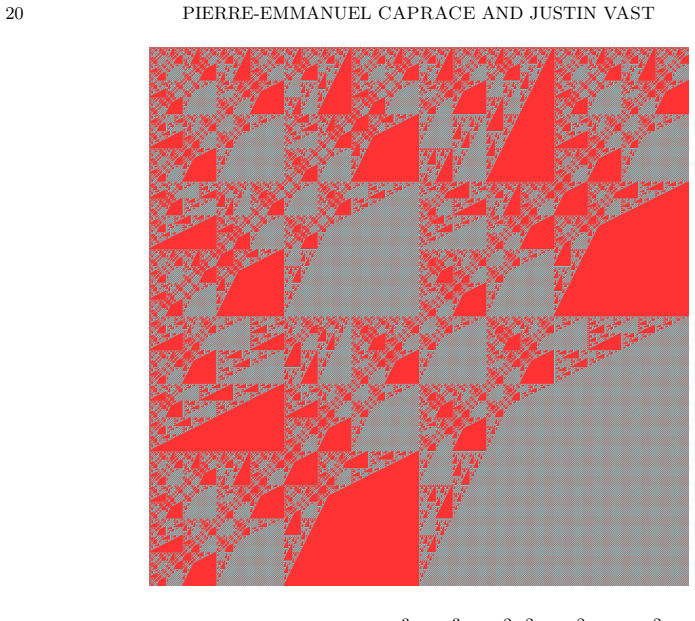
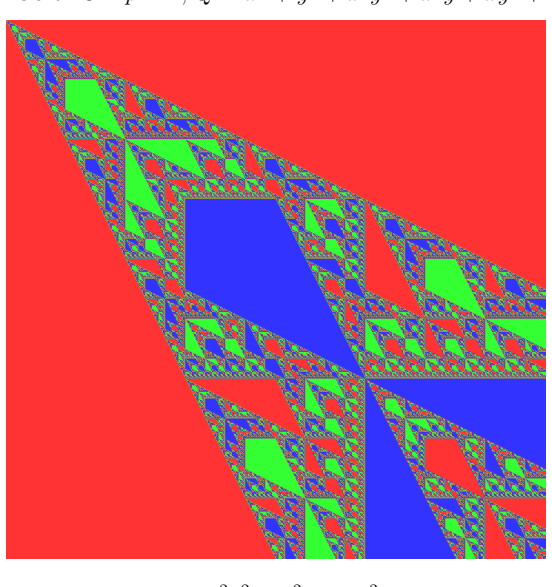
Rational power series with matrix coefficients over finite fields generate self-similar colored tilings of n-dimensional space.
A machine-rendered reading of the paper's core claim, the machinery that carries it, and where it could break.
Core claim
The map M that sends each multi-index to the corresponding coefficient in the power series expansion of the rational fraction P Q inverse in the ring of matrix formal power series is self-similar when interpreted as a tiling of R^n by unit cubes colored by matrices; self-similarity takes the form of invariance under substitutions.
What carries the argument
Invariance under substitutions of the colored tiling whose colors are the matrix coefficients of the power series expansion of P Q inverse.
If this is right
- The classical self-similarity of binomial coefficients modulo a prime is recovered exactly by setting d=1, n=2, P=1 and Q=1-x1-x2.
- The same substitution invariance holds for any dimension n and any matrix size d.
- Rational functions with non-commuting matrix coefficients supply an explicit algebraic recipe for producing self-similar colorings.
Where Pith is reading between the lines
- The substitution rules furnished by the matrix construction could be used to generate infinite families of higher-dimensional substitution tilings by direct computation.
- Similar coefficient extractions from other algebraic series might be checked for the same invariance property, extending the method beyond the rational case.
- The colored tilings provide concrete examples of multi-dimensional automatic structures whose fractal geometry can be studied via linear algebra over finite fields.
Load-bearing premise
Q must be invertible in the ring of formal power series with matrix coefficients so that the rational fraction possesses a well-defined power-series expansion whose coefficients define the map M.
What would settle it
Choose small concrete values of p, d, n, P and Q satisfying the invertibility condition, compute the matrix coefficients of P Q inverse up to a fixed multi-degree, assemble the corresponding finite colored tiling, and verify whether it satisfies the substitution-invariance relation claimed for the infinite tiling.
Figures




read the original abstract
Let $p$ be a prime, let $d \geq 1$ be an integer and $A$ be the algebra of square matrices of size $d$ over the field of order $p$. Let $P, Q \in A[x_1, \dots x_n]$ be polynomials in $n$ indeterminates with coefficients in $A$, such that $Q$ is invertible in $ A[\![x_1, \dots, x_n]\!]$. Let also $\mathcal M \colon \mathbf Z^n \to A$ be the map associating to the $n$-tuple of integers $(\alpha_1, \dots, \alpha_n)$ the coefficient of the monomial $x_1^{\alpha_1} \dots x_n^{\alpha_n}$ in the development of the rational fraction $PQ^{-1}$ as a power series (the support of $\mathcal M$ is contained in $\mathbf N^n$). Our main result ensures that the map $\mathcal M$, viewed as a tiling of $\mathbf R^n$ by unit cubes with color set $A$, is self-similar. The self-similarity is expressed in terms of invariance under substitutions. By specializing to $d=1$, $n=2$, $P=1$ and $Q =1-x_1-x_2$, we recover the well-known self-similarity feature of the binomial coefficients modulo $p$.
Editorial analysis
A structured set of objections, weighed in public.
Circularity Check
No significant circularity; derivation is algebraic and self-contained
full rationale
The central result establishes self-similarity of the coefficient map M of the rational series PQ^{-1} by deriving a recurrence on coefficients from the invertibility of Q in the power-series ring, then verifying that this recurrence is preserved under the base-p digit substitution operators. The argument proceeds by direct verification that the substitution operators commute with the matrix multiplication implicit in the recurrence relation, reducing to the classical binomial case when d=1. No step equates a derived quantity to a fitted parameter, renames a known pattern as a new result, or relies on a load-bearing self-citation whose content is itself unverified. The special-case recovery of binomial self-similarity is presented as an instance of the general construction rather than its justification. The derivation therefore rests on explicit algebraic identities rather than circular re-labeling or imported uniqueness.
Axiom & Free-Parameter Ledger
axioms (1)
- domain assumption Q is invertible in the formal power series ring A[[x1, …, xn]]
Reference graph
Works this paper leans on
-
[1]
Jean-Paul Allouche and Jeffrey Shallit, Automatic sequences, Cambridge University Press, Cambridge, 2003, Theory, applications, generalizations. 1997038
work page 2003
-
[2]
A. Barb\'e and F. von Haeseler, Limit sets of automatic sequences, Adv. Math. 175 (2003), no. 2, 169--196. 1972631
work page 2003
-
[3]
A. C ern \'y and J. Gruska, Modular trellises, pp. 45--61, Springer Berlin Heidelberg, Berlin, Heidelberg, 1986
work page 1986
-
[4]
Systems Theory 6 (1972), 164--192
Alan Cobham, Uniform tag sequences, Math. Systems Theory 6 (1972), 164--192. 457011
work page 1972
-
[5]
M. I. Cortez and B. Solomyak, Invariant measures for non-primitive tiling substitutions, J. Anal. Math. 115 (2011), 293--342. 2855041
work page 2011
-
[6]
N. J. Fine, Binomial coefficients modulo a prime, Amer. Math. Monthly 54 (1947), 589--592. 23257
work page 1947
-
[7]
Natalie Priebe Frank, A primer of substitution tilings of the E uclidean plane , Expo. Math. 26 (2008), no. 4, 295--326. 2462439
work page 2008
-
[8]
W. H. Gottschalk, Substitution minimal sets, Trans. Amer. Math. Soc. 109 (1963), 467--491. 190915
work page 1963
-
[9]
Florian Greinecker, Spatial equidistribution of combinatorial number schemes, J. Fractal Geom. 4 (2017), no. 2, 105--126. 3667703
work page 2017
-
[10]
Steven M. Kautz and James I. Lathrop, Self-assembly of the discrete S ierpinski carpet and related fractals , DNA Computing and Molecular Programming, Lecture Notes in Comput. Sci., vol. 5877, Springer, Heidelberg, 2009, 15th International Conference, DNA 15 Fayetteville, AR, USA, pp. 78--87
work page 2009
-
[11]
E. Lucas, Sur les congruences des nombres eul\'eriens et les coefficients diff\'erentiels des functions trigonom\'etriques suivant un module premier, Bull. Soc. Math. France 6 (1878), 49--54. 1503769
-
[12]
Lucas' theorem: its generalizations, extensions and applications (1878--2014)
R. Me s trovi \' c , Lucas' theorem: its generalizations, extensions and applications (1878--2014), Preprint, arXiv:1409.3820, 2014
work page internal anchor Pith review Pith/arXiv arXiv 2014
-
[13]
Harold Marston Morse, Recurrent geodesics on a surface of negative curvature, Trans. Amer. Math. Soc. 22 (1921), no. 1, 84--100. 1501161
work page 1921
-
[14]
Shahar Mozes, Tilings, substitution systems and dynamical systems generated by them, J. Analyse Math. 53 (1989), 139--186. 1014984
work page 1989
-
[15]
Hao Pan, A congruence of L ucas' type , Discrete Math. 288 (2004), no. 1-3, 173--175. 2101126
work page 2004
-
[16]
Marko Razpet, The L ucas property of a number array , Discrete Math. 248 (2002), no. 1-3, 157--168. 1892693
work page 2002
-
[17]
Olivier Salon, Suites automatiques \`a multi-indices , Séminaire de Théorie des Nombres de Bordeaux (1986), 1--36A
work page 1986
-
[18]
, Suites automatiques \`a multi-indices et alg\'ebricit\'e , C. R. Acad. Sci. Paris S\'er. I Math. 305 (1987), no. 12, 501--504. 916320
work page 1987
-
[19]
J. Shallit and J. Stolfi, Two methods for generating fractals, Comp. Graphics 13 (1989), 185--191
work page 1989
-
[20]
Marta Sved, Divisibility---with visibility, Math. Intelligencer 10 (1988), no. 2, 56--64. 932163
work page 1988
discussion (0)
Sign in with ORCID, Apple, or X to comment. Anyone can read and Pith papers without signing in.