REVIEW 2 major objections 5 minor 1 cited by
Ref-GS: Directional Factorization for 2D Gaussian Splatting
T0 review · 2 major / 5 minor · reviewed 2026-08-12 · deepseek-v4-flash
Pith's one-line read Ref-GS defers shading until after Gaussian attributes are blended, then queries a roughness-aware spherical Mip-grid with the reflected direction and uses an outer product of spatial and directional features to render view-dependent…
desk verdict Solid incremental contribution to 2D Gaussian splatting with deferred shading; the geometry claim is plausible but needs code and error bars before I'd trust the small margins. read the letter →
The pith
A machine-rendered reading of the paper's core claim, the machinery that carries it, and where it could break.
The reading
What carries the argument
The load-bearing mechanism has three parts. (1) Deferred Gaussian rendering: per-Gaussian attributes are $\alpha$-blended first, producing a G-buffer with diffuse color, feature $K$, roughness $M$, and normal $N$; shading happens afterward on this screen-space surface. (2) Sph-Mip grid: a learnable multi-level spherical feature grid whose two angular axes index the reflection direction $\omega_r$ and whose third axis indexes roughness, so the same grid serves both sharp and rough surfaces with trilinear interpolation. (3) Directional factorization: the per-pixel outer product $K \otimes S$ of the spatial feature and the directional feature feeds a shallow MLP, letting a single shared lighting representation combine with local material and geometry information to reproduce spatially varying inter-reflections.
What would settle it
Take a synthetic scene with a thin translucent object or two overlapping transparent surfaces where front and back surfaces both land in one pixel, render it with a ground-truth path tracer, and compare Ref-GS's predicted normal and specular highlight against the true reflection. If the blended normal lies between the two surfaces, the highlight will appear at the wrong location or blur; that would show the deferred normal is not a single consistent surface orientation.
Extended reading notes
Core claim
On its own terms, the paper's discovery is that directional encoding belongs on the rendered surface, not on each Gaussian. Ref-GS first renders a G-buffer by blending the per-Gaussian diffuse color, feature vector, roughness, and normal along each ray; it then computes a reflection direction from the blended normal and viewing direction, encodes that direction with a learnable multi-level spherical feature grid (Sph-Mip grid) that is also indexed by roughness, and predicts specular color from the directional feature plus the per-pixel outer product of the spatial and directional features through a lightweight MLP. The paper argues that this pipeline resolves the ambiguity in which per-primitive SH coefficients and orientations could otherwise undo the reflection transform, and that the factorization keeps per-primitive features small (four channels) and the renderer fast while supporting spatially varying near-field effects.
Load-bearing premise
The whole method assumes that when several Gaussian splats overlap in a pixel, blending their normals gives the true surface direction at that pixel; where that fails, the reflected ray is pointed the wrong way and the specular result is ungrounded.
Editorial extensions
If this is right
- Reflective and refractive surfaces, including windshields, spheres, and glass objects, can be reconstructed with cleaner normals and meshes than prior Gaussian baselines, not just rendered more convincingly.
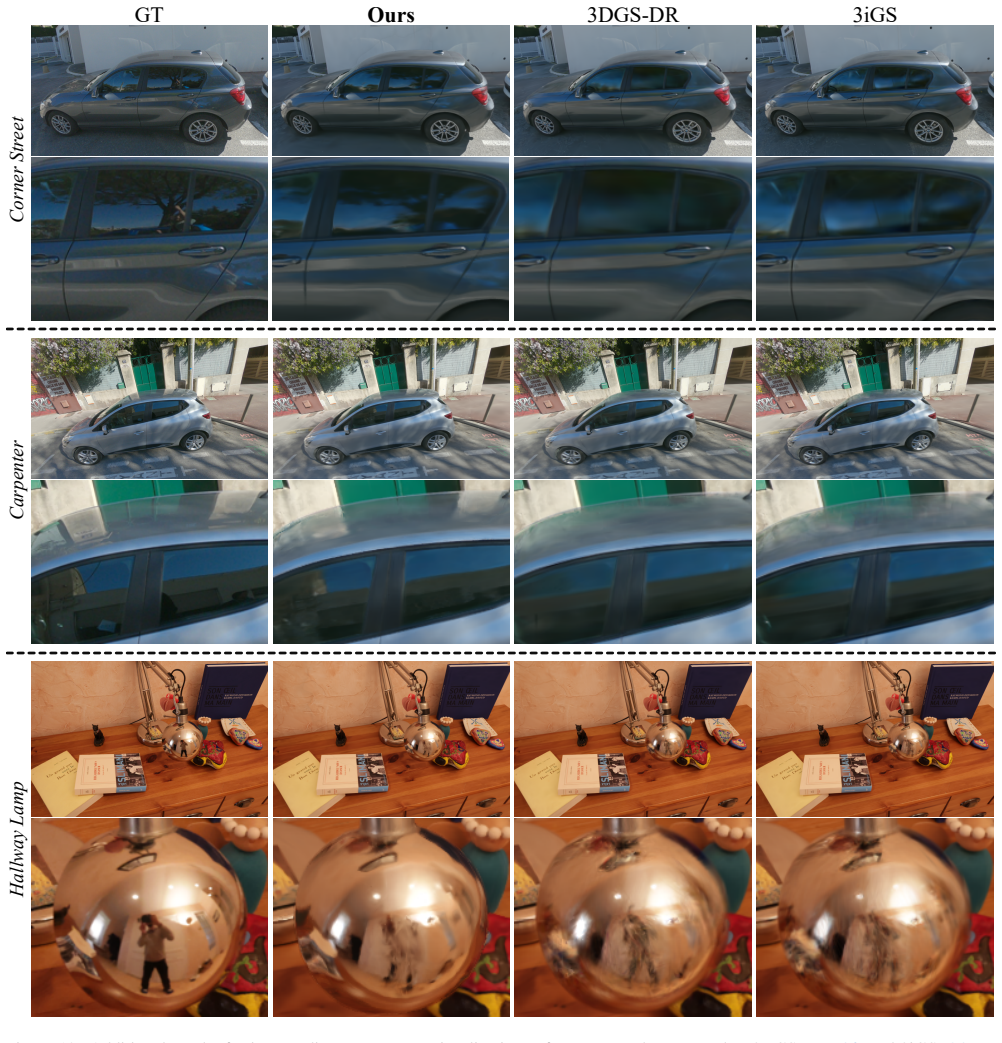
- Specular highlights stay sharp in novel views because the reflection direction is computed from a blended surface rather than from individual splats.
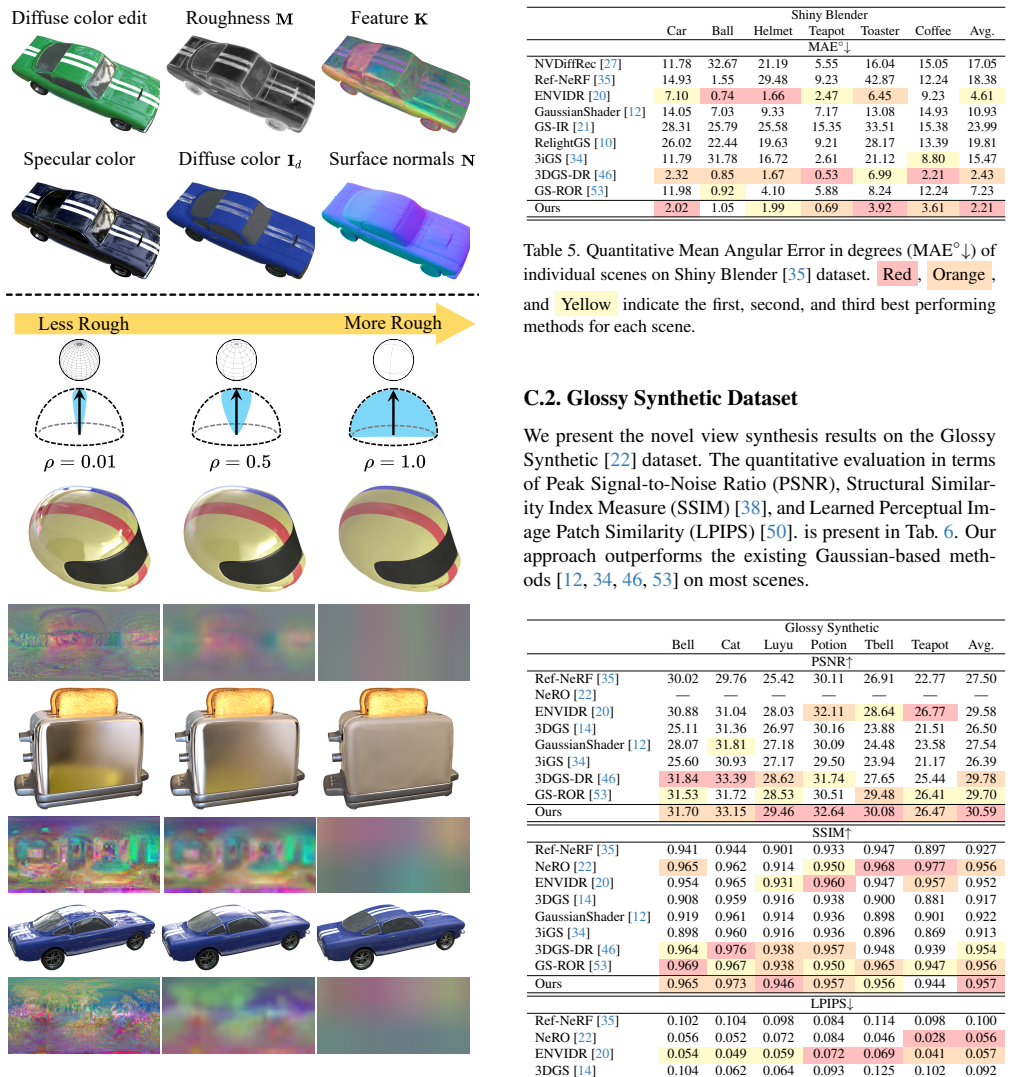
- Rough and smooth materials are handled by one representation: interpolation along the roughness axis of the Sph-Mip grid adjusts the directional feature without adding extra networks.
- The outer-product factorization keeps per-Gaussian features to four dimensions, making the rendering pipeline fast enough for real-time novel view synthesis at more than 45 FPS at 800x800 resolution.
- The separated diffuse, specular, and roughness maps support material editing, such as changing roughness or diffuse color, without retraining.
Reading between the lines
- If the alpha-blended normal assumption fails at edges of transparent or overlapping surfaces, a natural extension is to keep a small set of candidate normals per pixel and select the one with the highest transmittance-weighted confidence before computing the reflection direction.
- Because the Sph-Mip grid encodes lighting separately from the spatial features, swapping the grid for a different environment should give relighting of the same scene without retraining the geometry; the paper does not demonstrate this but the factorization invites it.
- The outer-product factorization is a rank-one tensor decomposition; adding more rank terms could trade a little speed for better handling of multi-bounce reflections, a testable extension the paper leaves implicit.
Editorial analysis
A structured set of objections, weighed in public.
Referee Report
Summary. The paper presents Ref-GS, a 2D Gaussian splatting method for jointly recovering view-dependent appearance and geometry. It introduces deferred shading to Gaussian splatting: primitive attributes (diffuse color, feature, roughness, normal) are alpha-blended into a G-buffer and then shaded in a second pass using a spherical Mip-grid (Sph-Mip) that encodes far-field lighting conditioned on reflection direction and roughness. A directional factorization via the per-pixel outer product of a spatial feature and a directional feature is used to model spatially varying inter-reflections. The method is evaluated on synthetic and real datasets (NeRF Synthetic, Shiny Blender, Glossy Synthetic, Shiny Real, Mip-NeRF360, Tanks and Temples, Glass & Ball) against NeRF- and Gaussian-based baselines, with PSNR/SSIM/LPIPS and normal MAE metrics, plus ablations and a speed comparison.
Significance. If the results hold, Ref-GS would be a valuable contribution to reflective and refractive scene reconstruction with 2D Gaussian splatting, achieving real-time rendering with improved view-dependent effects and competitive geometry accuracy. The paper's ablations are internally consistent: removing Sph-Mip, the mipmap, deferred shading, or the directional factorization each degrades metrics. The supplementary material provides per-scene breakdowns, additional datasets, and material-editing visualizations, which strengthen the empirical contribution. However, the central deferred-shading mechanism relies on alpha-blended G-buffer normals for reflection queries, and the paper provides no formal or experimental validation of that premise in challenging regions. The lack of error bars also makes the claimed superiority over close baselines difficult to assess. These issues temper but do not eliminate the significance.
major comments (2)
- [Section 5.1 (Eqs. 4-6)] The G-buffer normal N is produced by alpha-blending per-Gaussian normals via Eq. (4), and this blended normal is then used to compute the reflection direction ω_r in Eq. (6) for the Sph-Mip query. The paper gives no argument that alpha-blending preserves surface orientation at depth discontinuities or for transparent/refractive objects, and it does not normalize the blended normal; with partial opacity the vector need not be unit length. The normal-consistency loss in supplementary Eq. (10) supervises per-splat normals against the depth-gradient normal, but the depth map itself is alpha-composited, so it cannot correct the G-buffer normal at occlusion boundaries. Because the specular term depends on ω_r, this is a load-bearing unverified premise. Please provide a theoretical justification, a normalization step, or an experiment quantifying the error of the blended normal at edges and on transparent scenes (e.g., using the available ground-truth normals of Shiny Blender).
- [Section 6.4 and Table 5 (supplementary)] The claim of accurate geometry recovery is based on an average MAE of 2.21° on Shiny Blender, but the per-scene results in supplementary Table 5 show that Ref-GS is worse than 3DGS-DR on Ball (1.05 vs 0.85), Helmet (1.99 vs 1.67), Teapot (0.69 vs 0.53), and Coffee (3.61 vs 2.21). No variance or multiple-seed results are reported anywhere in the paper, and the rendering margins over 3DGS-DR are small (e.g., Shiny Blender PSNR 34.80 vs 33.94 in Table 1). Without error bars or a significance test, the statement that Ref-GS achieves 'superior photorealistic rendering ... while also accurately recovering geometry' (abstract) is not robustly supported. Please report standard deviations over at least three runs, or at least a paired per-scene analysis.
minor comments (5)
- [Supplementary B] The limitations paragraph in the appendix appropriately acknowledges that the method is slower than 2DGS and is hard to integrate into standard CG engines; this honesty is appreciated, but the abstract's phrase 'superior photorealistic rendering' should be nuanced by the fact that on NeRF Synthetic the PSNR (33.20) is below 3DGS (33.30) and 3iGS (33.60) in Table 2.
- [Section 1] The sentence 'Our Ref-GS achieves effective reconstruction of high-frequency reflection and fraction' appears to contain a typo; 'fraction' should likely be 'refraction'.
- [Supplementary A.1] There is a typo in the sentence 'The goal of the shallow MLP fΘ is is to non-linearly map...' (duplicate 'is').
- [Section 6.3] The implementation details give the Sph-Mip grid size and MLP width but do not specify the learning rate or the number of training views per scene; specifying these would improve reproducibility.
- [Section 5.1] The phrase 'we treat M, N, K as a G-buffer and pass it a standard rasterization render for shading' is unclear; the G-buffer should be passed to the shader rather than to a render.
Circularity Check
No significant circularity: Ref-GS is evaluated on held-out views against external baselines, and its self-citations to 2DGS and TensoRF are independently validated building blocks, not unverified premises.
full rationale
Ref-GS is a learning-based deferred-shading method evaluated on held-out novel views against external baselines, so its central claims do not reduce to its own inputs. The only self-citations are to 2DGS [11] as the base representation and loss, and to TensoRF [7] as inspiration for the outer-product factorization; both are externally published, independently validated, and used as openly stated building blocks rather than as unverified premises that force the result. The directional-encoding pipeline (Eqs. 5-7) is a screen-space shading computation on learned G-buffer attributes, not a definitional identity: the specular term is a learned function of Sph-Mip features queried by reflection directions, and rendering quality and normal accuracy are measured against ground-truth images and normals from held-out views. The normal-consistency loss (Eq. 10) is a regularizer in the optimization, not a term that makes the reported geometry equal to an input by construction. The alpha-blended G-buffer normal assumption at occlusion boundaries and the lack of normalization are legitimate correctness/robustness concerns, but they are not circularity under the rules: no quoted step exhibits a prediction that is equivalent to a fitted input or a load-bearing claim justified only by an unverified self-citation. Therefore no circular step meets the evidentiary bar.
Assumptions & free parameters
free parameters (5)
- Sph-Mip base grid resolution =
512 x 1024 x 16
- Sph-Mip number of levels N =
9
- MLP hidden size =
256
- Per-Gaussian feature dimension D =
4
- Loss weights lambda_d and lambda_n =
lambda_d=100, lambda_n=0.05
assumptions (3)
- domain assumption Alpha-blended G-buffer attributes represent a coherent surface for shading.
- domain assumption Specular appearance is dominated by first-bounce reflection of far-field lighting, queried by a single reflection direction.
- domain assumption The spherical mip-grid with sparse (theta, phi, roughness) coordinates can represent the relevant lighting for all test scenes.
invented entities (1)
-
Sph-Mip grid
Cite this review
Pith. "Pith review of Ref-GS: Directional Factorization for 2D Gaussian Splatting." pith.science (2026). https://pith.science/paper/TEE6UYXT
@misc{pith2026241200905,
  author       = {Pith},
  title        = {Pith review of: Ref-GS: Directional Factorization for 2D Gaussian Splatting},
  year         = {2026},
  howpublished = {\url{https://pith.science/paper/TEE6UYXT}},
  note         = {Machine review of arXiv:2412.00905}
}
read the original abstract
In this paper, we introduce Ref-GS, a novel approach for directional light factorization in 2D Gaussian splatting, which enables photorealistic view-dependent appearance rendering and precise geometry recovery. Ref-GS builds upon the deferred rendering of Gaussian splatting and applies directional encoding to the deferred-rendered surface, effectively reducing the ambiguity between orientation and viewing angle. Next, we introduce a spherical Mip-grid to capture varying levels of surface roughness, enabling roughness-aware Gaussian shading. Additionally, we propose a simple yet efficient geometry-lighting factorization that connects geometry and lighting via the vector outer product, significantly reducing renderer overhead when integrating volumetric attributes. Our method achieves superior photorealistic rendering for a range of open-world scenes while also accurately recovering geometry.
Figures


Figures from the paper (7 more)



Forward citations
Cited by 1 Pith paper
-
EnvGS: Modeling View-Dependent Appearance with Environment Gaussian
EnvGS represents scene reflections as a set of 3D Gaussian primitives that are ray-traced from the reflected view direction, enabling sharper near-field and high-frequency reflections than environment-map methods at r...
Reference graph
Works this paper leans on
-
[1]
Deep learning using rectified linear units (relu)
Abien Fred Agarap. Deep learning using rectified linear units (relu). arXiv preprint arXiv:1803.08375, 2018. 1
arXiv 2018
-
[2]
Proposal for a standard de- fault color space for the internet—srgb
Matthew Anderson, Ricardo Motta, Srinivasan Chan- drasekar, and Michael Stokes. Proposal for a standard de- fault color space for the internet—srgb. In Color and imag- ing conference, pages 238–245. Society of Imaging Science and Technology, 1996. 1
work page 1996
-
[3]
Mip-nerf: A multiscale representation for anti-aliasing neu- ral radiance fields
Jonathan T Barron, Ben Mildenhall, Matthew Tancik, Peter Hedman, Ricardo Martin-Brualla, and Pratul P Srinivasan. Mip-nerf: A multiscale representation for anti-aliasing neu- ral radiance fields. In Proceedings of the IEEE/CVF inter- national conference on computer vision , pages 5855–5864,
-
[4]
Mip-nerf 360: Unbounded anti-aliased neural radiance fields
Jonathan T Barron, Ben Mildenhall, Dor Verbin, Pratul P Srinivasan, and Peter Hedman. Mip-nerf 360: Unbounded anti-aliased neural radiance fields. In Proceedings of the IEEE/CVF conference on computer vision and pattern recognition, pages 5470–5479, 2022. 1, 2, 6
work page 2022
-
[5]
Eikonal fields for refractive novel-view synthesis
Mojtaba Bemana, Karol Myszkowski, Jeppe Revall Frisvad, Hans-Peter Seidel, and Tobias Ritschel. Eikonal fields for refractive novel-view synthesis. In ACM SIGGRAPH 2022 Conference Proceedings, pages 1–9, 2022. 6, 7
work page 2022
-
[6]
Anpei Chen, Minye Wu, Yingliang Zhang, Nianyi Li, Jie Lu, Shenghua Gao, and Jingyi Yu. Deep surface light fields.Pro- ceedings of the ACM on Computer Graphics and Interactive Techniques, 1(1):1–17, 2018. 2
work page 2018
-
[7]
Tensorf: Tensorial radiance fields
Anpei Chen, Zexiang Xu, Andreas Geiger, Jingyi Yu, and Hao Su. Tensorf: Tensorial radiance fields. InEuropean con- ference on computer vision, pages 333–350. Springer, 2022. 2, 3, 5
work page 2022
-
[8]
The triangle processor and normal vector shader: a vlsi system for high performance graphics
Michael Deering, Stephanie Winner, Bic Schediwy, Chris Duffy, and Neil Hunt. The triangle processor and normal vector shader: a vlsi system for high performance graphics. Acm siggraph computer graphics, 22(4):21–30, 1988. 4
work page 1988
Show all 54 references
-
[9]
Plenoxels: Radiance fields without neural networks
Sara Fridovich-Keil, Alex Yu, Matthew Tancik, Qinhong Chen, Benjamin Recht, and Angjoo Kanazawa. Plenoxels: Radiance fields without neural networks. In Proceedings of the IEEE/CVF conference on computer vision and pattern recognition, pages 5501–5510, 2022. 2
2022
-
[10]
Relightable 3d gaussians: Re- alistic point cloud relighting with brdf decomposition and ray tracing
Jian Gao, Chun Gu, Youtian Lin, Zhihao Li, Hao Zhu, Xun Cao, Li Zhang, and Yao Yao. Relightable 3d gaussians: Re- alistic point cloud relighting with brdf decomposition and ray tracing. In European Conference on Computer Vision , pages 73–89. Springer, 2024. 2
2024
-
[11]
2d gaussian splatting for geometrically accu- rate radiance fields
Binbin Huang, Zehao Yu, Anpei Chen, Andreas Geiger, and Shenghua Gao. 2d gaussian splatting for geometrically accu- rate radiance fields. In SIGGRAPH 2024 Conference Papers. Association for Computing Machinery, 2024. 1, 2, 3, 4, 7
2024
-
[12]
Gaussian- shader: 3d gaussian splatting with shading functions for re- flective surfaces
Yingwenqi Jiang, Jiadong Tu, Yuan Liu, Xifeng Gao, Xi- aoxiao Long, Wenping Wang, and Yuexin Ma. Gaussian- shader: 3d gaussian splatting with shading functions for re- flective surfaces. In Proceedings of the IEEE/CVF Confer- ence on Computer Vision and Pattern Recognition , p...
2024
-
[13]
Tensoir: Tensorial inverse rendering
Haian Jin, Isabella Liu, Peijia Xu, Xiaoshuai Zhang, Song- fang Han, Sai Bi, Xiaowei Zhou, Zexiang Xu, and Hao Su. Tensoir: Tensorial inverse rendering. In Proceedings of the IEEE/CVF Conference on Computer Vision and Pattern Recognition, pages 165–174, 2023. 3
2023
-
[14]
3d gaussian splatting for real-time radiance field rendering
Bernhard Kerbl, Georgios Kopanas, Thomas Leimk ¨uhler, and George Drettakis. 3d gaussian splatting for real-time radiance field rendering. ACM Transactions on Graphics, 42 (4), 2023. 2, 3, 4, 7, 8
2023
-
[15]
Adam: A method for stochastic opti- mization
Diederik P Kingma. Adam: A method for stochastic opti- mization. arXiv preprint arXiv:1412.6980, 2014. 7, 1
2014 arXiv
-
[16]
Tanks and temples: Benchmarking large-scale scene reconstruction
Arno Knapitsch, Jaesik Park, Qian-Yi Zhou, and Vladlen Koltun. Tanks and temples: Benchmarking large-scale scene reconstruction. ACM Transactions on Graphics (ToG) , 36 (4):1–13, 2017. 1, 6
2017
-
[17]
Neural point cata- caustics for novel-view synthesis of reflections
Georgios Kopanas, Thomas Leimk ¨uhler, Gilles Rainer, Cl´ement Jambon, and George Drettakis. Neural point cata- caustics for novel-view synthesis of reflections. ACM Trans- actions on Graphics, 41(6):Article–201, 2022. 3, 4
2022
-
[18]
Modular primitives for high-performance differentiable rendering
Samuli Laine, Janne Hellsten, Tero Karras, Yeongho Seol, Jaakko Lehtinen, and Timo Aila. Modular primitives for high-performance differentiable rendering. ACM Transac- tions on Graphics (ToG), 39(6):1–14, 2020. 7
2020
-
[19]
Tensosdf: Roughness-aware tensorial representation for robust geom- etry and material reconstruction
Jia Li, Lu Wang, Lei Zhang, and Beibei Wang. Tensosdf: Roughness-aware tensorial representation for robust geom- etry and material reconstruction. ACM Transactions on Graphics (TOG), 43(4):1–13, 2024. 3
2024
-
[20]
Envidr: Implicit differentiable renderer with neural environment lighting
Ruofan Liang, Huiting Chen, Chunlin Li, Fan Chen, Sel- vakumar Panneer, and Nandita Vijaykumar. Envidr: Implicit differentiable renderer with neural environment lighting. In Proceedings of the IEEE/CVF International Conference on Computer Vision, pages 79–89, 2023. 3, 4, 7, 2
2023
-
[21]
Gs-ir: 3d gaussian splatting for inverse rendering
Zhihao Liang, Qi Zhang, Ying Feng, Ying Shan, and Kui Jia. Gs-ir: 3d gaussian splatting for inverse rendering. In Pro- ceedings of the IEEE/CVF Conference on Computer Vision and Pattern Recognition, pages 21644–21653, 2024. 2
2024
-
[22]
Nero: Neural geometry and brdf reconstruction of reflective objects from multiview images
Yuan Liu, Peng Wang, Cheng Lin, Xiaoxiao Long, Jiepeng Wang, Lingjie Liu, Taku Komura, and Wenping Wang. Nero: Neural geometry and brdf reconstruction of reflective objects from multiview images. 2023. 3, 4, 5, 6, 7, 2
2023
-
[23]
Specnerf: Gaussian directional encoding for spec- ular reflections
Li Ma, Vasu Agrawal, Haithem Turki, Changil Kim, Chen Gao, Pedro Sander, Michael Zollh ¨ofer, and Christian Richardt. Specnerf: Gaussian directional encoding for spec- ular reflections. In Proceedings of the IEEE/CVF Conference on Computer Vision and Pattern Recognition, pages...
2024
-
[24]
Nerf in the wild: Neural radiance fields for uncon- strained photo collections
Ricardo Martin-Brualla, Noha Radwan, Mehdi SM Sajjadi, Jonathan T Barron, Alexey Dosovitskiy, and Daniel Duck- worth. Nerf in the wild: Neural radiance fields for uncon- strained photo collections. In Proceedings of the IEEE/CVF 9 conference on computer vision and pattern reco...
2021
-
[25]
Nerf: Representing scenes as neural radiance fields for view syn- thesis
Ben Mildenhall, Pratul P Srinivasan, Matthew Tancik, Jonathan T Barron, Ravi Ramamoorthi, and Ren Ng. Nerf: Representing scenes as neural radiance fields for view syn- thesis. In European Conference on Computer Vision, pages 405–421. Springer, 2020. 2, 6, 7, 3
2020
-
[26]
Instant neural graphics primitives with a mul- tiresolution hash encoding
Thomas M ¨uller, Alex Evans, Christoph Schied, and Alexan- der Keller. Instant neural graphics primitives with a mul- tiresolution hash encoding. ACM transactions on graphics (TOG), 41(4):1–15, 2022. 2
2022
-
[27]
Extracting Triangular 3D Models, Materials, and Light- ing From Images
Jacob Munkberg, Jon Hasselgren, Tianchang Shen, Jun Gao, Wenzheng Chen, Alex Evans, Thomas M¨uller, and Sanja Fi- dler. Extracting Triangular 3D Models, Materials, and Light- ing From Images. In Proceedings of the IEEE/CVF Confer- ence on Computer Vision and Pattern Recognitio...
2022
-
[28]
Pytorch: An imperative style, high- performance deep learning library
Adam Paszke, Sam Gross, Francisco Massa, Adam Lerer, and Soumith Chintala. Pytorch: An imperative style, high- performance deep learning library. 2019. 7, 1
2019
-
[29]
Surfels: Surface elements as rendering primi- tives
Hanspeter Pfister, Matthias Zwicker, Jeroen Van Baar, and Markus Gross. Surfels: Surface elements as rendering primi- tives. In Proceedings of the 27th annual conference on Com- puter graphics and interactive techniques , pages 335–342,
-
[30]
Image-based rendering of cars using se- mantic labels and approximate reflection flow
Simon Rodriguez, Siddhant Prakash, Peter Hedman, and George Drettakis. Image-based rendering of cars using se- mantic labels and approximate reflection flow. Proceedings of the ACM on Computer Graphics and Interactive Tech- niques, 3(1), 2020. 3, 4
2020
-
[31]
Direct voxel grid optimization: Super-fast convergence for radiance fields reconstruction
Cheng Sun, Min Sun, and Hwann-Tzong Chen. Direct voxel grid optimization: Super-fast convergence for radiance fields reconstruction. In Proceedings of the IEEE/CVF conference on computer vision and pattern recognition , pages 5459– 5469, 2022. 2
2022
-
[32]
Nu-nerf: Neural reconstruction of nested transparent objects with un- controlled capture environment
Jia-Mu Sun, Tong Wu, Ling qI Yan, and Lin Gao. Nu-nerf: Neural reconstruction of nested transparent objects with un- controlled capture environment. In ACM Transactions on Graphics(ACM SIGGRAPH Asia 2024), 2024. 3
2024
-
[33]
Block-nerf: Scalable large scene neural view synthesis
Matthew Tancik, Vincent Casser, Xinchen Yan, Sabeek Prad- han, Ben Mildenhall, Pratul P Srinivasan, Jonathan T Barron, and Henrik Kretzschmar. Block-nerf: Scalable large scene neural view synthesis. InProceedings of the IEEE/CVF Con- ference on Computer Vision and Pattern Reco...
2022
-
[34]
3igs: Factorised tensorial illumination for 3d gaussian splatting
Zhe Jun Tang and Tat-Jen Cham. 3igs: Factorised tensorial illumination for 3d gaussian splatting. In European Confer- ence on Computer Vision, pages 143–159. Springer, 2024. 3, 5, 7, 8, 1, 2, 4
2024
-
[35]
Ref-nerf: Struc- tured view-dependent appearance for neural radiance fields
Dor Verbin, Peter Hedman, Ben Mildenhall, Todd Zickler, Jonathan T Barron, and Pratul P Srinivasan. Ref-nerf: Struc- tured view-dependent appearance for neural radiance fields. In 2022 IEEE/CVF Conference on Computer Vision and Pat- tern Recognition (CVPR), pages 5481–5490. IE...
2022
-
[36]
Microfacet models for refraction through rough surfaces
Bruce Walter, Stephen R Marschner, Hongsong Li, and Ken- neth E Torrance. Microfacet models for refraction through rough surfaces. Rendering techniques, 2007:18th, 2007. 2
2007
-
[37]
Neus: Learning neural im- plicit surfaces by volume rendering for multi-view recon- struction
Peng Wang, Lingjie Liu, Yuan Liu, Christian Theobalt, Taku Komura, and Wenping Wang. Neus: Learning neural im- plicit surfaces by volume rendering for multi-view recon- struction. Advances in Neural Information Processing Sys- tems, 34:27171–27183, 2021. 2
2021
-
[38]
Image quality assessment: from error visibility to structural similarity
Zhou Wang, Alan C Bovik, Hamid R Sheikh, and Eero P Si- moncelli. Image quality assessment: from error visibility to structural similarity. IEEE transactions on image processing, 13(4):600–612, 2004. 7, 1, 2
2004
-
[39]
Specgaussian with latent features: A high-quality modeling of the view-dependent appearance for 3d gaussian splatting
Zhiru Wang, Shiyun Xie, Chengwei Pan, and Guoping Wang. Specgaussian with latent features: A high-quality modeling of the view-dependent appearance for 3d gaussian splatting. In Proceedings of the 32nd ACM International Conference on Multimedia, pages 6270–6278, 2024. 2
2024
-
[40]
Wood, Daniel I
Daniel N. Wood, Daniel I. Azuma, Ken Aldinger, Brian Cur- less, Tom Duchamp, David Salesin, and Werner Stuetzle. Surface light fields for 3d photography. InComputer Graph- ics and Interactive Techniques, 2000. 2
2000
-
[41]
Neural directional encoding for efficient and accurate view-dependent appearance modeling
Liwen Wu, Sai Bi, Zexiang Xu, Fujun Luan, Kai Zhang, Iliyan Georgiev, Kalyan Sunkavalli, and Ravi Ramamoor- thi. Neural directional encoding for efficient and accurate view-dependent appearance modeling. In Proceedings of the IEEE/CVF Conference on Computer Vision and Pattern ...
2024
-
[42]
Deferredgs: Decoupled and editable gaussian splatting with deferred shading
Tong Wu, Jia-Mu Sun, Yu-Kun Lai, Yuewen Ma, Leif Kobbelt, and Lin Gao. Deferredgs: Decoupled and editable gaussian splatting with deferred shading. arXiv preprint arXiv:2404.09412, 2024. 3
2024 arXiv
-
[43]
Spec-gaussian: Anisotropic view-dependent ap- pearance for 3d gaussian splatting
Ziyi Yang, Xinyu Gao, Yang-Tian Sun, Yihua Huang, Xi- aoyang Lyu, Wen Zhou, Shaohui Jiao, Xiaojuan Qi, and Xi- aogang Jin. Spec-gaussian: Anisotropic view-dependent ap- pearance for 3d gaussian splatting. Advances in Neural In- formation Processing Systems, 37:61192–61216, 2024. 2
2024
-
[44]
Neilf: Neural incident light field for physically-based ma- terial estimation
Yao Yao, Jingyang Zhang, Jingbo Liu, Yihang Qu, Tian Fang, David McKinnon, Yanghai Tsin, and Long Quan. Neilf: Neural incident light field for physically-based ma- terial estimation. In European Conference on Computer Vi- sion, pages 700–716. Springer, 2022. 2, 3
2022
-
[45]
V ol- ume rendering of neural implicit surfaces
Lior Yariv, Jiatao Gu, Yoni Kasten, and Yaron Lipman. V ol- ume rendering of neural implicit surfaces. Advances in Neu- ral Information Processing Systems, 34:4805–4815, 2021. 2, 3
2021
-
[46]
3d gaussian splat- ting with deferred reflection
Keyang Ye, Qiming Hou, and Kun Zhou. 3d gaussian splat- ting with deferred reflection. InACM SIGGRAPH 2024 Con- ference Papers, pages 1–10, 2024. 2, 3, 5, 7, 8, 1, 4
2024
-
[47]
Differentiable surface splatting for point-based geometry processing
Wang Yifan, Felice Serena, Shihao Wu, Cengiz ¨Oztireli, and Olga Sorkine-Hornung. Differentiable surface splatting for point-based geometry processing. ACM Transactions on Graphics (TOG), 38(6):1–14, 2019. 3
2019
-
[48]
Neilf++: Inter-reflectable light fields for geometry and material esti- mation
Jingyang Zhang, Yao Yao, Shiwei Li, Jingbo Liu, Tian Fang, David McKinnon, Yanghai Tsin, and Long Quan. Neilf++: Inter-reflectable light fields for geometry and material esti- mation. In Proceedings of the IEEE/CVF International Con- ference on Computer Vision, pages 3601–3610...
2023
-
[49]
Nerf++: Analyzing and improving neural radiance fields
Kai Zhang, Gernot Riegler, Noah Snavely, and Vladlen Koltun. Nerf++: Analyzing and improving neural radiance fields. arXiv:2010.07492, 2020. 2 10
2010 arXiv
-
[50]
The unreasonable effectiveness of deep features as a perceptual metric
Richard Zhang, Phillip Isola, Alexei A Efros, Eli Shecht- man, and Oliver Wang. The unreasonable effectiveness of deep features as a perceptual metric. In Proceedings of the IEEE conference on computer vision and pattern recogni- tion, pages 586–595, 2018. 7, 2
2018
-
[51]
Ner- factor: Neural factorization of shape and reflectance under an unknown illumination
Xiuming Zhang, Pratul P Srinivasan, Boyang Deng, Paul De- bevec, William T Freeman, and Jonathan T Barron. Ner- factor: Neural factorization of shape and reflectance under an unknown illumination. ACM Transactions on Graphics (ToG), 40(6):1–18, 2021. 2
2021
-
[52]
Nemf: Inverse volume rendering with neural microflake field
Youjia Zhang, Teng Xu, Junqing Yu, Yuteng Ye, Yanqing Jing, Junle Wang, Jingyi Yu, and Wei Yang. Nemf: Inverse volume rendering with neural microflake field. In Proceed- ings of the IEEE/CVF International Conference on Com- puter Vision (ICCV), pages 22919–22929, 2023. 2
2023
-
[53]
Gs-ror: 3d gaussian splatting for reflective object relighting via sdf pri- ors
Zuo-Liang Zhu, Beibei Wang, and Jian Yang. Gs-ror: 3d gaussian splatting for reflective object relighting via sdf pri- ors. arXiv preprint arXiv:2406.18544, 2024. 3, 7, 2
2024 arXiv
-
[54]
w/o K⊗S” demonstrates that theSph-Mip encoding can further enhance rendering quality. Additionally, the results of “w/o DS
Matthias Zwicker, Hanspeter Pfister, Jeroen Van Baar, and Markus Gross. Ewa volume splatting. In Proceedings Visu- alization, 2001. VIS’01., pages 29–538. IEEE, 2001. 3 11 Ref-GS: Directional Factorization for 2D Gaussian Splatting Supplementary Material This supplementary mat...
2001
Reviewed August 12, 2026 · model on record in the stance chip above.
Discussion (0). Continue with ORCID to comment.