REVIEW 4 major objections 4 minor 1 cited by
DAViD: Data-efficient and Accurate Vision Models from Synthetic Data
T0 review · 4 major / 4 minor · reviewed 2026-08-06 · deepseek-v4-flash
Pith's one-line read A single high-fidelity synthetic dataset of 300K human images trains depth, surface-normal, and matting models that match or beat 2B-parameter foundation models on real benchmarks.
desk verdict Powerful synthetic-data result, but hidden pretrained weights and overclaimed normals stop it short of the abstract's promise. read the letter →
The pith
A machine-rendered reading of the paper's core claim, the machinery that carries it, and where it could break.
The reading
What carries the argument
The engine is the SynthHuman data-generation pipeline and its perfect labels: procedural sampling of bodies, expressions, poses, textures, hair, accessories, clothing, and environments, with two technical choices that make the ground truth trainable. Hair normals are re-defined by voxelizing the strand geometry and running marching cubes to build a coarse proxy mesh, so ground-truth normals follow hair volume and clumps instead of aliasing from individual strands; translucent surfaces such as glasses lenses are rendered so the depth and normals behind them can be included or ignored for different applications. On the model side, a DPT-style ViT encoder runs at a fixed 384×384 resolution while a light fully convolutional "Resizer" carries full-resolution features into the decoder, so fine detail is predicted without the quadratic self-attention cost of high-resolution tokens; the same architecture serves all three tasks, with only the output channels and losses changing.
What would settle it
Measure the depth and normal models on a real test set whose ground truth is captured at finer fidelity than Goliath and Hi4D (for example, light-stage scans that resolve hair strands and wrinkles). If the models' fine-detail advantage over Sapiens-2B does not appear there, then the paper's attribution of accuracy to high-fidelity synthetic ground truth is refuted; if blurring the predictions still helps on that finer benchmark, the benchmark itself is the bottleneck, not the model.
Extended reading notes
Core claim
The central discovery is that the fidelity of the ground truth, not the size of the model or dataset, is what limits accuracy for dense human-centric prediction. Scans used by earlier synthetic pipelines (THuman, RenderPeople) represent hair as a coarse mesh and miss fine structure, and their ground truth carries scanning artifacts; the paper's SynthHuman pipeline instead renders strand-level hair, expressive faces with dynamic wrinkle maps, artist-created clothing and accessories, and varied HDRI and 3D environments, producing depth, normal, and alpha ground truth that resolves details real benchmarks cannot even record. A model trained only on these 300K images achieves depth root-mean-square error of 0.072 on Hi4D versus 0.095 for the 2.16B-parameter Sapiens model, on-par surface-normal accuracy with a fraction of the parameters, and matting SAD of 5.85 on PhotoMatte85 versus 13.94 for MODNet, using a single architecture and no task-specific add-ons.
Load-bearing premise
The load-bearing premise is that the rendered synthetic humans in SynthHuman are realistic enough that a model trained only on them transfers to real photographs; if the synthetic-to-real gap were large, the accuracy gains over data-hungry baselines would not materialize.
Editorial extensions
If this is right
- A 0.3B-parameter model trained only on synthetic data matches the depth accuracy of a 2.16B-parameter foundation model on Goliath and Hi4D, so parameter scale is not the binding constraint for these tasks.
- Training cost drops by orders of magnitude: the paper estimates that the compute used to train one Sapiens-2B model could train roughly 800 of its own models.
- Because the training data is procedurally generated, downstream models inherit guarantees on consent, licensing, and data provenance that large real-image collections cannot provide.
- Diversity in pose, body shape, and environment is an explicit sampling dial, giving a direct mechanism to probe and correct unfairness across demographic groups.
- The same dataset and architecture handle three dense prediction tasks at once, and a single multi-task model with three heads performs close to three task-specific models.
Reading between the lines
- The same recipe may transfer to other domains where dense ground truth is physically hard to capture, such as hands, animals, or transparent and reflective objects: strand-level or artist-authored geometry with physically motivated rendering could supply the fine-detail labels that real sensors and scans miss.
- The paper's Appendix B.1 shows that blurring its normal predictions improves scores on Goliath, a sign that the real normals benchmark is too coarse to measure fine detail; if so, the published normal-error gaps probably understate the synthetic-data advantage, and a finer real benchmark is needed to settle it.
- If synthetic fidelity continues to rise, the economic case for collecting and pseudo-labelling hundreds of millions of real images for dense prediction weakens; these results put a concrete data point on that trade-off, with 300K images standing in for 62M.
- The paper restricts its claim to human-centric relative depth and does not show synthetic-only training for metric depth or general scenes; testing whether the same pipeline survives open-world geometry would define the boundary of the paradigm.
Editorial analysis
A structured set of objections, weighed in public.
Referee Report
Summary. The paper introduces DAViD, a family of DPT-style vision models trained on SynthHuman, a procedurally generated dataset of 300K high-fidelity synthetic human images with dense ground truth for relative depth, surface normals, and soft foreground segmentation. Using a single architecture and a single synthetic dataset, the authors report accuracy competitive with or better than much larger foundation models such as Sapiens-2B on real benchmarks (Goliath, Hi4D, PhotoMatte85, PPM-100), while requiring far fewer FLOPs and parameters. The paper also provides ablations on data source, dataset size, model size, and multi-task training, and it releases the dataset and trained models.
Significance. If the central claim holds, the paper demonstrates a qualitatively different scaling story for human-centric dense prediction: a relatively small, carefully designed synthetic dataset can replace massive real-data pretraining and produce state-of-the-art results on multiple tasks. The contribution is potentially significant for privacy, provenance, and compute efficiency. The paper's strengths include cross-dataset evaluation on real benchmarks with no training-to-test circularity, careful ablations isolating data source and model size, transparent reporting of benchmark construction details (Appendix B.7), and an honest discussion of failure cases and of noise in the surface-normal ground truth (Appendix B.1). The main risk is that the paper's strongest claims are stated more broadly than the evidence supports, and one load-bearing implementation detail—the initialization of the encoder—is not disclosed.
major comments (4)
- [Sec. 3.2 and Sec. 4.1] The manuscript never states whether the DPT/ViT encoder is initialized from pretrained weights (e.g., ImageNet, MiDaS, or DPT checkpoints) or trained from random initialization. This is load-bearing for the abstract's claim of training 'entirely on synthetic data' and for the compute comparison in Sec. 7, because if the encoder starts from a real-data-pretrained backbone, the models are not trained solely on synthetic data and the pretraining compute is omitted. Please disclose the initialization and, ideally, provide an ablation training from random initialization; without this, the attribution of the results to SynthHuman is not established.
- [Abstract and Table 2] The abstract's 'no loss in accuracy' is contradicted by the surface-normal results in Table 2: on Hi4D, Ours-Large has mean angular error 15.37° versus 12.14° for Sapiens-2B, and on Goliath UpperBody and FullBody the gaps are 13.96° vs. 10.65° and 14.60° vs. 11.49°, respectively. The depth numbers in Table 1 also show a small aggregate gap on the averaged-over-all row (Ours-Large RMSE 0.191 vs. Sapiens-2B 0.170), although Ours-Large is better on several Goliath subsets. The accuracy claim should be qualified to reflect which tasks, subsets, and metrics are actually on par or better.
- [Table 2 caption and Sec. 4.2] Table 2's caption states 'All results on the Hi4D dataset are taken from [17],' yet the table includes rows for Ours-Base and Ours-Large, which cannot come from [17]. Please clarify which Hi4D numbers were computed by the authors, which were copied from Sapiens, and whether the same preprocessing and foreground masks were used for all entries. The current wording makes the comparison protocol ambiguous and affects the validity of the surface-normal claims.
- [Sec. 7] The claimed efficiency advantage—'we can train ~800 models with the compute used to train a single Sapiens-2B'—is not substantiated with a concrete compute accounting. No total GPU-hours are reported for DAViD training, and the Sapiens reference includes only the 18-day/1,024-A100 pretraining cost, explicitly excluding fine-tuning. If the DAViD backbone is itself pretrained (see the first major comment), that pretraining cost must be included. Please provide an apples-to-apples training-cost table.
minor comments (4)
- [Appendix B.1 and Sec. 4.3] The observation that blurring the predicted normals improves all Goliath metrics (Table 5) is an important caveat for the surface-normal comparisons and should be stated in the main text near the normals results, not only in the supplementary material.
- [Sec. 4.3] The text cites 'Depth-Pro [46]' when discussing the depth comparison, but reference [46] in the bibliography is Depth Anything v2; the intended citation appears to be [2]. Please correct the citation.
- [References] References [33] and [34] are the same paper (Ranftl et al., 'Towards robust monocular depth estimation'); please merge or differentiate them appropriately.
- [Sec. 4.1] The implementation details report a batch size of 24 'on each GPU of a A100 ×4 compute node'; please state the total batch size and whether all four GPUs were used for each task, and report the number of training runs or seeds for the main results.
Circularity Check
No significant circularity: DAViD trains on SynthHuman synthetic renders and evaluates on independent real benchmarks; no prediction is defined by its training input.
full rationale
The paper's derivation chain is empirical rather than analytic. Section 3.1 describes SynthHuman as 300K procedurally rendered images (using the pipeline of Hewitt et al. and the face model of Petikam et al.) with pixel-perfect depth, normals, and alpha labels. Section 3.2 defines a DPT-style architecture, and Section 3.3 defines losses (L_alpha, L_eta, L_d) that supervise predictions against these synthetic labels. Section 4.3 then measures the trained models on independent real benchmarks: Goliath and Hi4D for depth and normals, PhotoMatte85 and PPM-100 for soft foreground segmentation. None of the reported metrics (AbsRel, RMSE, angular error, SAD, MSE, Conn) is equal by construction to a training loss or to a fitted parameter; the shift-and-scale s,t in Eq. 4 and the weighting omega_lap are standard loss/hyperparameter choices, not quantities presented as predictions. The Goliath evaluation subset (Table 8) is a disclosed protocol decision, and the normals ground-truth ceiling effect (Appendix B.1) is reported as a caveat rather than used to define the method. Self-citations to Hewitt et al. and Petikam et al. supply the renderer and face model; these are prior published components, and the paper's transfer claim is tested on external real data, so the citations are supporting evidence rather than a self-referential derivation. The undisclosed ViT initialization is a reproducibility and fairness-of-comparison concern, but it is not circular: no result in the paper is defined in terms of that initialization. Accordingly, no circular step can be exhibited.
Assumptions & free parameters
free parameters (2)
- omega_lap =
unspecified (stated to be < 1)
- omega_grad =
unspecified
assumptions (4)
- domain assumption The Hewitt et al. procedural pipeline with the updated face model of Petikam et al. produces synthetic images and dense ground truth with a domain gap small enough to transfer to real photographs.
- domain assumption Goliath and Hi4D real-world ground-truth annotations are accurate enough to measure relative model quality for depth and surface normals.
- domain assumption The sampled 3,572 scans, 548 hairstyles, 36 glasses, 57 headwear, and 50 clothing tops represent sufficient human diversity to support the generalization and fairness claims.
- standard math Standard training procedures (AdamW, cosine schedule, data augmentation, DPT/ViT architecture) are appropriate and do not introduce hidden biases.
Cite this review
Pith. "Pith review of DAViD: Data-efficient and Accurate Vision Models from Synthetic Data." pith.science (2026). https://pith.science/paper/TGD6IUDN
@misc{pith2026250715365,
  author       = {Pith},
  title        = {Pith review of: DAViD: Data-efficient and Accurate Vision Models from Synthetic Data},
  year         = {2026},
  howpublished = {\url{https://pith.science/paper/TGD6IUDN}},
  note         = {Machine review of arXiv:2507.15365}
}
read the original abstract
The state of the art in human-centric computer vision achieves high accuracy and robustness across a diverse range of tasks. The most effective models in this domain have billions of parameters, thus requiring extremely large datasets, expensive training regimes, and compute-intensive inference. In this paper, we demonstrate that it is possible to train models on much smaller but high-fidelity synthetic datasets, with no loss in accuracy and higher efficiency. Using synthetic training data provides us with excellent levels of detail and perfect labels, while providing strong guarantees for data provenance, usage rights, and user consent. Procedural data synthesis also provides us with explicit control on data diversity, that we can use to address unfairness in the models we train. Extensive quantitative assessment on real input images demonstrates accuracy of our models on three dense prediction tasks: depth estimation, surface normal estimation, and soft foreground segmentation. Our models require only a fraction of the cost of training and inference when compared with foundational models of similar accuracy. Our human-centric synthetic dataset and trained models are available at https://aka.ms/DAViD.
Figures
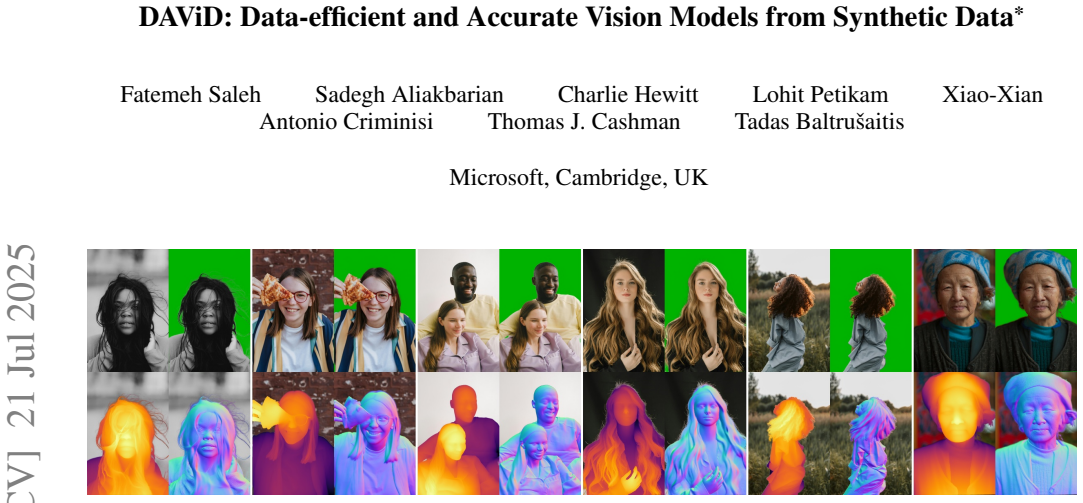


Figures from the paper (12 more)


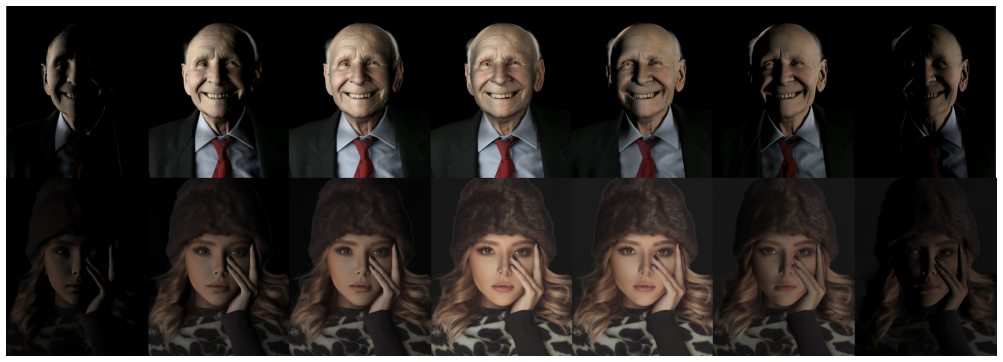


Forward citations
Cited by 1 Pith paper
-
Video Generation Models are General-Purpose Vision Learners
A video-diffusion backbone fine-tuned as a single-step multi-task perceiver matches or beats specialists on depth, normals, pose and segmentation, with high data efficiency and sim-to-real transfer.
Reference graph
Works this paper leans on
-
[17]
Sapiens: Foundation for human vision mod- els
Rawal Khirodkar, Timur Bagautdinov, Julieta Martinez, Su Zhaoen, Austin James, Peter Selednik, Stuart Anderson, and Shunsuke Saito. Sapiens: Foundation for human vision mod- els. In European Conference on Computer Vision , pages 206–228. Springer, 2024. 2, 3, 4, 5, 6, 7, 8, 9, 10, 11, 14
work page 2024
-
[1]
Black, Priyanka Patel, Joachim Tesch, and Jinlong Yang
Michael J. Black, Priyanka Patel, Joachim Tesch, and Jinlong Yang. BEDLAM: A synthetic dataset of bodies exhibiting detailed lifelike animated motion. In Proceedings IEEE/CVF Conf. on Computer Vision and Pattern Recognition (CVPR), pages 8726–8737, 2023. 2, 3, 6
work page 2023
-
[2]
Aleksei Bochkovskii, Ama¨el Delaunoy, Hugo Germain, Mar- cel Santos, Yichao Zhou, Stephan R. Richter, and Vladlen Koltun. Depth pro: Sharp monocular metric depth in less than a second. In International Conference on Learning Represen- tations, 2025. 2, 3, 4, 7
work page 2025
-
[3]
Find: An unsupervised implicit 3d model of articulated human feet
Oliver Boyne, James Charles, and Roberto Cipolla. Find: An unsupervised implicit 3d model of articulated human feet. In British Machine Vision Conference (BMVC), 2022. 2
work page 2022
-
[4]
G. J. Brostow, C. Hern´andez, G. V ogiatzis, B. Stenger, and R. Cipolla. Video normals from colored lights. TPAMI, 33(10): 2104–2114, 2011. 2
work page 2011
-
[5]
The cityscapes dataset for semantic urban scene understanding
Marius Cordts, Mohamed Omran, Sebastian Ramos, Timo Rehfeld, Markus Enzweiler, Rodrigo Benenson, Uwe Franke, Stefan Roth, and Bernt Schiele. The cityscapes dataset for semantic urban scene understanding. In Proceedings of the IEEE conference on computer vision and pattern recognition, pages 3213–3223, 2016. 2
work page 2016
-
[6]
Imagenet: A large-scale hierarchical image database
Jia Deng, Wei Dong, Richard Socher, Li-Jia Li, Kai Li, and Li Fei-Fei. Imagenet: A large-scale hierarchical image database. In Computer Vision and Pattern Recognition, 2009. CVPR
work page 2009
-
[7]
An image is worth 16x16 words: Transformers for image recognition at scale
Alexey Dosovitskiy, Lucas Beyer, Alexander Kolesnikov, Dirk Weissenborn, Xiaohua Zhai, Thomas Unterthiner, Mostafa Dehghani, Matthias Minderer, G Heigold, S Gelly, et al. An image is worth 16x16 words: Transformers for image recognition at scale. In International Conference on Learning Representations, 2020. 4
work page 2020
Show all 53 references
-
[8]
Omnidata: A scalable pipeline for making multi-task mid-level vision datasets from 3d scans
Ainaz Eftekhar, Alexander Sax, Jitendra Malik, and Amir Zamir. Omnidata: A scalable pipeline for making multi-task mid-level vision datasets from 3d scans. In Proceedings of the IEEE/CVF International Conference on Computer Vision, pages 10786–10796, 2021. 5
2021
-
[9]
Renderpeople
Renderpeople GmbH. Renderpeople. 3, 9
-
[10]
High-fidelity 3d human digitization from single 2k resolution images
Sang-Hun Han, Min-Gyu Park, Ju Hong Yoon, Ju-Mi Kang, Young-Jae Park, and Hae-Gon Jeon. High-fidelity 3d human digitization from single 2k resolution images. In Proceedings of the IEEE/CVF Conference on Computer Vision and Pattern Recognition (CVPR), 2023. 2
2023
-
[11]
Look ma, no markers: holistic perfor- mance capture without the hassle
Charlie Hewitt, Fatemeh Saleh, Sadegh Aliakbarian, Lohit Petikam, Shideh Rezaeifar, Louis Florentin, Zafiirah Hose- nie, Thomas J Cashman, Julien Valentin, Darren Cosker, and Tadas Baltruˇsaitis. Look ma, no markers: holistic perfor- mance capture without the hassle. ACM Trans...
2024
-
[12]
Context-aware image matting for simultaneous foreground and alpha estimation
Qiqi Hou and Feng Liu. Context-aware image matting for simultaneous foreground and alpha estimation. In Proceed- ings of the IEEE/CVF International Conference on Computer Vision, pages 4130–4139, 2019. 4
2019
-
[13]
Learning high fidelity depths of dressed humans by watching social media dance videos
Yasamin Jafarian and Hyun Soo Park. Learning high fidelity depths of dressed humans by watching social media dance videos. In Proceedings of the IEEE/CVF Conference on Com- puter Vision and Pattern Recognition, pages 12753–12762,
-
[14]
Whole-body human pose estimation in the wild
Sheng Jin, Lumin Xu, Jin Xu, Can Wang, Wentao Liu, Chen Qian, Wanli Ouyang, and Ping Luo. Whole-body human pose estimation in the wild. In Proceedings of the European Conference on Computer Vision (ECCV), 2020. 2
2020
-
[15]
Fairface: Face at- tribute dataset for balanced race, gender, and age for bias mea- surement and mitigation
Kimmo Karkkainen and Jungseock Joo. Fairface: Face at- tribute dataset for balanced race, gender, and age for bias mea- surement and mitigation. In Proceedings of the IEEE/CVF Winter Conference on Applications of Computer Vision, pages 1548–1558, 2021. 2
2021
-
[16]
Modnet: Real-time trimap-free portrait matting via objective decomposition
Zhanghan Ke, Jiayu Sun, Kaican Li, Qiong Yan, and Ryn- son WH Lau. Modnet: Real-time trimap-free portrait matting via objective decomposition. In Proceedings of the AAAI Conference on Artificial Intelligence, pages 1140–1147, 2022. 2, 5, 7, 11
2022
-
[18]
Privacy- preserving portrait matting
Jizhizi Li, Sihan Ma, Jing Zhang, and Dacheng Tao. Privacy- preserving portrait matting. In Proceedings of the 29th ACM international conference on multimedia, pages 3501–3509,
-
[19]
Real-time high-resolution background matting
Shanchuan Lin, Andrey Ryabtsev, Soumyadip Sengupta, Brian L Curless, Steven M Seitz, and Ira Kemelmacher- Shlizerman. Real-time high-resolution background matting. In Proceedings of the IEEE/CVF Conference on Computer Vision and Pattern Recognition, pages 8762–8771, 2021. 5, 7, 11
2021
-
[20]
Microsoft coco: Common objects in context
Tsung-Yi Lin, Michael Maire, Serge Belongie, James Hays, Pietro Perona, Deva Ramanan, Piotr Doll´ar, and C Lawrence Zitnick. Microsoft coco: Common objects in context. Euro- pean conference on computer vision, pages 740–755, 2014. 2
2014
-
[21]
A new dataset and boundary-attention semantic segmentation for face parsing
Yinglu Liu, Hailin Shi, Hao Shen, Yue Si, Xiaobo Wang, and Tao Mei. A new dataset and boundary-attention semantic segmentation for face parsing. In AAAI, pages 11637–11644,
-
[22]
Sgdr: Stochastic gradient descent with warm restarts
Ilya Loshchilov and Frank Hutter. Sgdr: Stochastic gradient descent with warm restarts. arXiv preprint arXiv:1608.03983,
-
[23]
Decoupled weight decay regularization
Ilya Loshchilov and Frank Hutter. Decoupled weight decay regularization. arXiv preprint arXiv:1711.05101, 2017. 5
2017 arXiv
-
[24]
Rapid acquisi- tion of specular and diffuse normal maps from polarized spherical gradient illumination
Wan-Chun Ma, Tim Hawkins, Pieter Peers, Charles-Felix Chabert, Malte Weiss, and Paul Debevec. Rapid acquisi- tion of specular and diffuse normal maps from polarized spherical gradient illumination. In Proceedings of the 18th Eurographics Conference on Rendering Techniques , pa...
2007
-
[25]
Amass: Archive of motion capture as surface shapes
Naureen Mahmood, Nima Ghorbani, Nikolaus F Troje, Ger- ard Pons-Moll, and Michael J Black. Amass: Archive of motion capture as surface shapes. In Proceedings of the IEEE/CVF international conference on computer vision, pages 5442–5451, 2019. 9
2019
-
[26]
Jewett, Simon Venshtain, Christopher Heilman, Yueh-Tung Chen, Sidi Fu, Mohamed Ezzeldin A
Julieta Martinez, Emily Kim, Javier Romero, Timur Bagautdi- nov, Shunsuke Saito, Shoou-I Yu, Stuart Anderson, Michael Zollh¨ofer, Te-Li Wang, Shaojie Bai, Chenghui Li, Shih- En Wei, Rohan Joshi, Wyatt Borsos, Tomas Simon, Jason Saragih, Paul Theodosis, Alexander Greene, Anjani...
2024
-
[27]
Kinect- facedb: A kinect database for face recognition
Rui Min, Neslihan Kose, and Jean-Luc Dugelay. Kinect- facedb: A kinect database for face recognition. IEEE Trans- actions on Systems, Man, and Cybernetics: Systems, 44(11): 1534–1548, 2014. 2
2014
-
[28]
Maxime Oquab, Timoth´ee Darcet, Th´eo Moutakanni, Huy V . V o, Marc Szafraniec, Vasil Khalidov, Pierre Fernandez, Daniel HAZIZA, Francisco Massa, Alaaeldin El-Nouby, Mido Assran, Nicolas Ballas, Wojciech Galuba, Russell Howes, Po-Yao Huang, Shang-Wen Li, Ishan Misra, Michael R...
-
[29]
Huang, Joachim Tesch, David T
Priyanka Patel, Chun-Hao P. Huang, Joachim Tesch, David T. Hoffmann, Shashank Tripathi, and Michael J. Black. AGORA: Avatars in geography optimized for regression anal- ysis. In Proceedings IEEE/CVF Conf. on Computer Vision and Pattern Recognition (CVPR), 2021. 2
2021
-
[30]
Georgios Pavlakos, Vasileios Choutas, Nima Ghorbani, Timo Bolkart, Ahmed A. A. Osman, Dimitrios Tzionas, and Michael J. Black. Expressive body capture: 3d hands, face, and body from a single image. In Proceedings IEEE Conf. on Computer Vision and Pattern Recognition (CVPR), 2019. 2
2019
-
[31]
Eyelid fold consistency in facial modeling
Lohit Petikam, Charlie Hewitt, Fatemeh Saleh, and Tadas Baltruˇsaitis. Eyelid fold consistency in facial modeling. In SIGGRAPH Asia 2024 Technical Communications, pages 1–4. Association for Computing Machinery, 2024. 3, 9
2024
-
[32]
Learning transferable visual models from natural language supervi- sion
Alec Radford, Jong Wook Kim, Chris Hallacy, Aditya Ramesh, Gabriel Goh, Sandhini Agarwal, Girish Sastry, Amanda Askell, Pamela Mishkin, Jack Clark, et al. Learning transferable visual models from natural language supervi- sion. In International conference on machine learning, ...
2021
-
[33]
Towards robust monocular depth estimation: Mixing datasets for zero-shot cross-dataset transfer
Ren´e Ranftl, Katrin Lasinger, David Hafner, Konrad Schindler, and Vladlen Koltun. Towards robust monocular depth estimation: Mixing datasets for zero-shot cross-dataset transfer. IEEE transactions on pattern analysis and machine intelligence, 44(3):1623–1637, 2020. 4, 5 16
2020
-
[34]
Towards robust monocular depth estimation: Mixing datasets for zero-shot cross-dataset transfer
Ren´e Ranftl, Katrin Lasinger, David Hafner, Konrad Schindler, and Vladlen Koltun. Towards robust monocular depth estimation: Mixing datasets for zero-shot cross-dataset transfer. IEEE transactions on pattern analysis and machine intelligence, 44(3):1623–1637, 2020. 5, 7, 11
2020
-
[35]
Vi- sion transformers for dense prediction
Ren´e Ranftl, Alexey Bochkovskiy, and Vladlen Koltun. Vi- sion transformers for dense prediction. In Proceedings of the IEEE/CVF international conference on computer vision, pages 12179–12188, 2021. 3, 4
2021
-
[36]
Em- bodied hands: modeling and capturing hands and bodies together
Javier Romero, Dimitrios Tzionas, and Michael J Black. Em- bodied hands: modeling and capturing hands and bodies together. ACM Transactions on Graphics (TOG), 36(6):1–17,
-
[37]
300 faces in-the-wild challenge: database and results
Christos Sagonas, Epameinondas Antonakos, Georgios Tz- imiropoulos, Stefanos Zafeiriou, and Maja Pantic. 300 faces in-the-wild challenge: database and results. Image and Vi- sion Computing, 47:3–18, 2016. 300-W, the First Automatic Facial Landmark Detection in-the-Wild Challenge. 2
2016
-
[38]
300 faces in-the-wild challenge: Database and results
Christos Sagonas, Epameinondas Antonakos, Georgios Tz- imiropoulos, Stefanos Zafeiriou, and Maja Pantic. 300 faces in-the-wild challenge: Database and results. Image and vision computing, 47:3–18, 2016. 2
2016
-
[39]
Pifuhd: Multi-level pixel-aligned implicit function for high-resolution 3d human digitization
Shunsuke Saito, Tomas Simon, Jason Saragih, and Hanbyul Joo. Pifuhd: Multi-level pixel-aligned implicit function for high-resolution 3d human digitization. In Proceedings of the IEEE/CVF conference on computer vision and pattern recognition, pages 84–93, 2020. 7
2020
-
[40]
Learning to regress 3D face shape and expression from an image without 3D supervision
Soubhik Sanyal, Timo Bolkart, Haiwen Feng, and Michael Black. Learning to regress 3D face shape and expression from an image without 3D supervision. In Proceedings IEEE Conf. on Computer Vision and Pattern Recognition (CVPR), pages 7763–7772, 2019. 2
2019
-
[41]
Generalised dice overlap as a deep learning loss function for highly unbalanced segmen- tations
Carole H Sudre, Wenqi Li, Tom Vercauteren, Sebastien Ourselin, and M Jorge Cardoso. Generalised dice overlap as a deep learning loss function for highly unbalanced segmen- tations. In Deep Learning in Medical Image Analysis and Multimodal Learning for Clinical Decision Support...
2017
-
[42]
Face mask extraction in video sequence
Yujiang Wang, Bingnan Luo, Jie Shen, and Maja Pantic. Face mask extraction in video sequence. International Journal of Computer Vision, 127(6):625–641, 2019. 2
2019
-
[43]
Cashman, and Jamie Shotton
Erroll Wood, Tadas Baltruˇsaitis, Charlie Hewitt, Sebastian Dziadzio, Thomas J. Cashman, and Jamie Shotton. Fake it till you make it: face analysis in the wild using synthetic data alone. In Proceedings of the IEEE/CVF international conference on computer vision, pages 3681–36...
2021
-
[44]
Icon: Implicit clothed humans obtained from normals
Yuliang Xiu, Jinlong Yang, Dimitrios Tzionas, and Michael J Black. Icon: Implicit clothed humans obtained from normals. In 2022 IEEE/CVF Conference on Computer Vision and Pat- tern Recognition (CVPR), pages 13286–13296. IEEE, 2022. 7
2022
-
[45]
Econ: Explicit clothed humans optimized via normal integration
Yuliang Xiu, Jinlong Yang, Xu Cao, Dimitrios Tzionas, and Michael J Black. Econ: Explicit clothed humans optimized via normal integration. In Proceedings of the IEEE/CVF conference on computer vision and pattern recognition, pages 512–523, 2023. 7
2023
-
[46]
Depth anything v2
Lihe Yang, Bingyi Kang, Zilong Huang, Zhen Zhao, Xiao- gang Xu, Jiashi Feng, and Hengshuang Zhao. Depth anything v2. Advances in Neural Information Processing Systems, 37: 21875–21911, 2025. 2, 3, 5, 6, 7, 11
2025
-
[47]
Wider face: A face detection benchmark
Shuo Yang, Ping Luo, Chen Change Loy, and Xiaoou Tang. Wider face: A face detection benchmark. 2016 IEEE Confer- ence on Computer Vision and Pattern Recognition (CVPR), pages 5525–5533, 2015. 2
2016
-
[48]
Synbody: Synthetic dataset with layered human models for 3d human perception and modeling
Zhitao Yang, Zhongang Cai, Haiyi Mei, Shuai Liu, Zhaoxi Chen, Weiye Xiao, Yukun Wei, Zhongfei Qing, Chen Wei, Bo Dai, Wayne Wu, Chen Qian, Dahua Lin, Ziwei Liu, and Lei Yang. Synbody: Synthetic dataset with layered human models for 3d human perception and modeling. In Proceedi...
2023
-
[49]
Hi4d: 4d instance segmentation of close human interaction
Yifei Yin, Chen Guo, Manuel Kaufmann, Juan Zarate, Jie Song, and Otmar Hilliges. Hi4d: 4d instance segmentation of close human interaction. In Computer Vision and Pattern Recognition (CVPR), 2023. 1, 2, 5
2023
-
[50]
Function4d: Real-time human volu- metric capture from very sparse consumer rgbd sensors
Tao Yu, Zerong Zheng, Kaiwen Guo, Pengpeng Liu, Qiong- hai Dai, and Yebin Liu. Function4d: Real-time human volu- metric capture from very sparse consumer rgbd sensors. In IEEE Conference on Computer Vision and Pattern Recogni- tion (CVPR2021), 2021. 2, 3, 5, 9, 10
2021
-
[51]
Lightweight portrait matting via regional attention and refinement
Yatao Zhong and Ilya Zharkov. Lightweight portrait matting via regional attention and refinement. In Proceedings of the IEEE/CVF Winter Conference on Applications of Computer Vision, pages 4158–4167, 2024. 6, 7, 11 17
2024
-
[2009]
IEEE, 2009
IEEE Conference on, pages 248–255. IEEE, 2009. 2
2009
-
[2024]
Featured Certification. 2
Reviewed August 6, 2026 · model on record in the stance chip above.
Discussion (0). Continue with ORCID to comment.