REVIEW 3 major objections 6 minor 44 references
Influence of the residual magnetic field on the azimuthal distribution of final-state particles in photon-nuclear processes
T0 review · 3 major / 6 minor · reviewed 2026-08-16 · deepseek-v4-flash
Pith's one-line read This paper claims that in peripheral heavy-ion collisions the residual magnetic field imprints a $2\langle\cos 2\phi\rangle$ modulation on photoproduced $\rho^0 \to \pi^+\pi^-$ decays that exceeds the photon-polarization signal.
desk verdict A useful forward-model estimate of a magnetic-field background for rho0 azimuthal measurements in peripheral collisions; the headline 0.2 effect is plausible but the model dependence is unquantified. read the letter →
The pith
A machine-rendered reading of the paper's core claim, the machinery that carries it, and where it could break.
The reading
What carries the argument
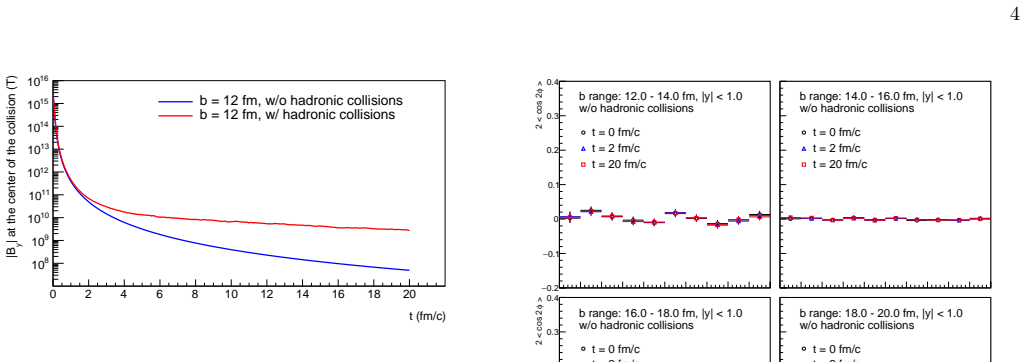
The load-bearing object is the residual magnetic field $\vec{B}(t,\vec{x})$ obtained from the Liénard-Wiechert potential sum over all charged hadrons produced by the transport model (Eq. 10), with the ultra-peripheral case approximated by point-like nuclei (Eq. 11). That field is applied to the $\pi^+\pi^-$ pairs from isotropic $\rho^0$ decays sampled from the production amplitude, and the observable is the second-order azimuthal modulation $2\langle\cos 2\phi\rangle$ of the pair distribution. The mechanism that carries the argument is that in peripheral collisions the produced hadrons stay in the overlap region and sustain a slowly decaying field, which deflects the low-$p_T$ pions and imprints a nonzero modulation that grows with time, whereas in the ultra-peripheral case the field is short-lived and localized away from the production region.
What would settle it
Measure the $p_T$-dependent $2\langle\cos 2\phi\rangle$ of photoproduced $\rho^0 \to \pi^+\pi^-$ in 40–60% central Au+Au collisions at $\sqrt{s_{NN}}=200$ GeV with enough statistics to resolve a 0.2 modulation: if the excess over the UPC polarization baseline does not appear near $p_T\approx 0.1$ GeV/c and grow with centrality, the claim fails. Alternatively, repeat the field calculation with a finite-conductivity medium; if the late-time $|B_y|$ at the production region is suppressed by more than a factor of two relative to the vacuum sum, the predicted 0.2 modulation would not survive.
Extended reading notes
Core claim
The central claim is that the residual magnetic field left after a peripheral heavy-ion collision materially changes the azimuthal anisotropy of final-state pions from photoproduced vector mesons, an effect previously treated as negligible. The authors simulate $\rho^0$ photoproduction with the equivalent-photon approximation and vector-meson-dominance model, let the $\rho^0$ decay isotropically into $\pi^+\pi^-$ pairs, and evolve those pairs in the magnetic field computed as a Liénard-Wiechert sum over all charged hadrons from the UrQMD model. In ultra-peripheral collisions the field decays quickly and stays near the origin where few $\rho^0$ are produced, so the $2\langle\cos 2\phi\rangle$ from photon polarization is unaffected. In peripheral collisions, hadrons produced in the overlap region slow the field's decay and reshape it; the resulting $2\langle\cos 2\phi\rangle$ reaches about 0.2 at $p_T \approx 0.1$ GeV/c, larger than the roughly 0.1 modulation attributed to photon polarization in UPC measurements. The field also broadens the pair $p_T$ distribution.
Load-bearing premise
The calculation assumes that the residual magnetic field felt by the pions is accurately given by the vacuum Liénard-Wiechert sum over charged hadrons from the transport model, without modeling the electrical conductivity of the produced medium, and it checks this field against another model at only a single space-time point.
Editorial extensions
If this is right
- In peripheral Au+Au collisions at $\sqrt{s_{NN}}=200$ GeV, the magnetic-field-induced $2\langle\cos 2\phi\rangle$ at $p_T\approx 0.1$ GeV/c is roughly twice the UPC polarization signal, so nuclear-shape extractions from peripheral photoproduction need a field-background subtraction.
- The effect grows with centrality; at 40–60% centrality the pair $p_T$ distribution broadens from about 0.1 to 0.14 GeV/c, which can shift the diffractive peaks and valleys used to constrain nuclear shapes.
- In ultra-peripheral collisions the field effect is negligible, so existing UPC measurements of $2\langle\cos 2\phi\rangle$ remain clean probes of photon polarization and nuclear geometry.
- The same residual-field distortion is expected in photon-photon production processes and in other collision systems such as Pb–Pb at 5.02 TeV, and should be included in those analyses.
Reading between the lines
- A direct corollary the authors leave implicit is that the excess $2\langle\cos 2\phi\rangle$ should scale with charged-particle multiplicity within a centrality class, so a multiplicity-differential measurement could separate the field contribution from the polarization baseline.
- The vacuum Liénard-Wiechert treatment omits the electrical conductivity of the produced medium; if the quark-gluon plasma sustains the late-time field longer than the vacuum sum, the effect would exceed 0.2, while strong screening would shrink it, making the quoted value a model-dependent estimate.
- The same mechanism should distort the azimuthal anisotropy of dilepton and photon-photon final states in peripheral events; because their production-point distributions differ from the $\rho^0$ case, those channels could serve as independent cross-checks of the field geometry.
Signed reviews
Editorial analysis
A structured set of objections, weighed in public.
Referee Report
Summary. This manuscript examines whether the residual magnetic field generated after peripheral Au+Au collisions at sqrt(s_NN)=200 GeV distorts the azimuthal distribution of pi+pi- pairs from photoproduced rho0 mesons, thereby contaminating the 2<cos2phi> observable used for nuclear-structure studies. The authors combine the EPA+VMD/Glauber framework to sample rho0 production positions and momenta, the UrQMD transport model to generate the charged hadrons of the collision, and the vacuum Lienard-Wiechert formula (Eq. 10) to evaluate the time-dependent magnetic field. They propagate the decay pions in this field and compute 2<cos2phi> as a function of pair pT. They find that in UPCs the field has negligible effect, whereas in peripheral collisions (20-40% and 40-60% centralities) the field produces a modulation reaching about 0.2 near pT ~ 0.1 GeV/c, which is claimed to exceed the UPC polarized-photon modulation of about 0.1. They also report a small broadening of the pair pT spectrum.
Significance. Should the quantitative result hold, it is significant for the experimental program that uses photoproduced vector-meson azimuthal anisotropies to extract nuclear shape and size; a magnetic-field background of order 0.2 at pT~0.1 GeV/c would have to be subtracted before structure information can be read off in peripheral collisions, and the effect would also apply to gamma-gamma processes and heavier systems such as Pb+Pb at 5.02 TeV. The paper has notable strengths: the magnetic field is taken from an independent transport model with no parameters fitted to 2<cos2phi>, the observable starts at zero by construction (no circularity), and the electric-field contribution is explicitly checked and found to cancel. The qualitative conclusion that a nontrivial field-induced modulation exists is plausible and likely robust. However, the headline magnitude (0.2) is not yet quantitatively supported because the late-time magnetic field is computed in vacuum and the validation against HSD is limited to one early-time point and is never propagated to the final observable.
major comments (3)
- [II.B and III (Eq. (10), Figs. 4 and 6)] The central claim depends on Eq. (10), a vacuum retarded-field sum over UrQMD point charges, with no treatment of the electrical conductivity of the quark-gluon/hadronic medium. The effect is accumulated by propagating pions out to t=20 fm/c (red squares vs black circles in Fig. 6), so it is precisely the late-time field that sets the claimed 0.2 value. The only cross-check, Fig. 4, compares |By| between UrQMD and HSD at one position (x=3 fm, y=0, b=10 fm) for t<0.3 fm/c, and the text never states that the final observable was recomputed with HSD fields. Since a conducting medium can either sustain or screen late-time fields, the separation between 0.2 and the UPC value of about 0.1 is not yet quantified. I ask the authors to propagate at least one alternative field model or a conductivity-corrected field through the full pion-propagation calculation, or to provide a quantitative bound on the late-time field uncertainty.
- [III (Figs. 6 and 7)] The decay pions are evolved only under the Lorentz force; hadronic rescattering in the peripheral hadronic environment is neglected. In 20-60% centralities the rho0 decays in or near the same overlap region whose UrQMD particles generate the field, and those particles would also scatter the pions. Such strong final-state interactions can alter the azimuthal distribution and the pT broadening of Fig. 7 in either direction, so the computed distortion is an isolated electromagnetic effect rather than a complete background estimate. Please state this limitation explicitly and estimate the pion mean free path or rescattering probability for the centralities considered.
- [II.A and III] The production distribution of rho0 is presented and sampled explicitly for b=10 fm (Fig. 1), while the PC results are quoted for 20-40% and 40-60% centralities. It is not stated whether the rho0 coordinate and momentum distributions were recomputed for each centrality/impact-parameter class or whether a single b=10 fm distribution was reused. Because the overlap between the rho0 production region and the UrQMD magnetic field determines the magnitude of the effect, this choice needs to be documented; if a single distribution was used, the calculation should be repeated for each centrality bin.
minor comments (6)
- [Figures 5-7] Typos in axis labels: 'TP' should be 'pT', and several tick labels contain stray minus signs (e.g., '-0').
- [II.A] The decay time distribution is written as '1/τ e^{-τ/t}'; this should presumably be 'e^{-t/τ}/τ'.
- [Eq. (1)] The symbol y is used both for the vector-meson rapidity and in the coordinate context; please disambiguate the notation.
- [III] The plots show no statistical error bars or event counts; adding them would help confirm that the 0.2 peak is not a statistical fluctuation.
- [III] The comparison with the STAR UPC value of about 0.1 would benefit from a direct citation and the experimental uncertainty.
- [II.B and III] Clarify the mapping between the impact parameter b=12 fm in Fig. 3 and the centrality classes used in Fig. 6.
Circularity Check
No significant circularity: the residual-field azimuthal modulation is computed as a forward electromagnetic deflection of photoproduced rho0 decay pions, with no parameter fitted to the target observable.
full rationale
The paper's central claim is that a residual magnetic field from hadronic collisions deflects pi+ pi- pairs from photoproduced rho0 mesons and induces a 2<cos2phi> modulation that can exceed the photon-polarization baseline in peripheral Au+Au collisions. This is a forward calculation: the rho0 phase-space distribution comes from the EPA+VMD model (Eqs. 1-7), the magnetic field comes from the Liénard-Wiechert sum over UrQMD-generated charged hadrons (Eq. 10), and the pions are propagated through that field to obtain the final azimuthal distribution. No parameter is fitted to the 2<cos2phi> observable; the initial azimuthal modulation is zero by construction and the reported signal arises from the simulated deflection. The paper does cite prior work by the same authors for the photoproduction formalism and for the polarized-photon baseline (Refs. [14], [18], [34]), but those citations provide the background framework rather than the new magnetic-field effect, and the comparison value of ~0.1 for the UPC polarization modulation is taken from STAR data, not from a self-referential derivation. The HSD/model comparison in Fig. 4 checks the magnetic field at one early space-time point and is not propagated to the final 2<cos2phi>, but this is a limitation in model validation (a correctness risk), not circular reasoning. The derivation chain therefore does not reduce to its own inputs; the claimed effect is an independent, externally grounded prediction.
Assumptions & free parameters
assumptions (5)
- domain assumption Woods-Saxon charge density for Au with R_WS=6.38 fm and d=0.535 fm (Eq. 2)
- standard math Equivalent Photon Approximation flux (Eq. 1) and VMD-Glauber production amplitude (Eqs. 3-7)
- domain assumption Lienard-Wiechert point-charge superposition (Eq. 10) accurately gives the residual magnetic field from UrQMD particles
- domain assumption UrQMD provides a realistic space-time distribution of charged particles in peripheral Au+Au collisions
- domain assumption rho0 decays isotropically in its rest frame with lifetime 1/tau exp(-t/tau) (Section II.A)
Cite this review
Pith. "Pith review of Influence of the residual magnetic field on the azimuthal distribution of final-state particles in photon-nuclear processes." pith.science (2026). https://pith.science/paper/TGDNCKO2
@misc{pith2026250500999,
  author       = {Pith},
  title        = {Pith review of: Influence of the residual magnetic field on the azimuthal distribution of final-state particles in photon-nuclear processes},
  year         = {2026},
  howpublished = {\url{https://pith.science/paper/TGDNCKO2}},
  note         = {Machine review of arXiv:2505.00999}
}
read the original abstract
In relativistic heavy-ion collisions, charged particles are accelerated to nearly the speed of light, and their external electromagnetic fields can be effectively approximated as quasi-real photons. These photons interact with another nucleus via photon-nuclear interactions, producing vector mesons. These vector mesons possess extremely low transverse momentum (pT ~ 0.1 GeV/c), distinguishing them from particles produced via hadronic interactions. STAR and ALICE have observed J/psi, rho0 and other vector mesons with very low pT, which are well described by photoproduction models. This unique characteristic of having extremely low transverse momentum allows them to serve as a novel experimental probe. Recent STAR results show that the equivalent photons in photoproduction processes are fully linearly polarized, affecting the azimuthal distribution of final-state particles like rho0 -> pi+ pi-. Since the polarization links to the initial collision geometry, the rho0 azimuthal modulation can probe nuclear structure. However, the post-collision magnetic field may deflect these particles, distorting the azimuthal distribution and complicating structure measurements. We simulated the distribution of residual magnetic fields over time under different collision conditions using UrQMD for Au+Au collisions at sqrt(sNN)=200 GeV and calculated their effects on the azimuthal modulation (<cos 2phi>) of photoproduced rho0. Our results show that in peripheral collisions, the field significantly alters the for photoproduced rho0 with pT ~ 0.1 GeV/c. This provides key insights for future nuclear structure studies via photoproduction in peripheral collisions.
Figures


Figures from the paper (4 more)


Reference graph
Works this paper leans on
- [1]
-
[2]
M. S. Abdallah, B. Aboona, J. Adam, L. Adamczyk, J. Adams, J. K. Adkins, G. Agakishiev, I. Aggarwal, 6 M. M. Aggarwal, Z. Ahammed, et al. , Physical review letters 129, 092501 (2022)
work page 2022
-
[3]
H.-J. Xu, X. Wang, H. Li, J. Zhao, Z.-W. Lin, C. Shen, and F. Wang, Physical Review Letters 121, 022301 (2018)
work page 2018
-
[4]
S. Lin, J. Hu, H. Xu, S. Pu, and Q. Wang, Phys. Rev. D 111, 074020 (2025)
work page 2025
- [5]
- [6]
-
[7]
C. A. Bertulani and G. Baur, Physics Reports 163, 299 (1988)
work page 1988
-
[8]
L. Criegee, M. H. Garrell, C. Gottfried, A. Krolzig, G. Lo- effler, A. Saulys, K. P. Sch¨ uler, U. Timm, W. Zimmer- mann, H. Werner, et al. , Phys. Lett. B 28, 282 (1968)
work page 1968
Show all 44 references
-
[9]
Ballam, G
J. Ballam, G. B. Chadwick, R. Gearhart, Z. G. T. Guiragossi´ an, M. Menke, J. J. Murray, P. Seyboth, A. Shapira, C. K. Sinclair, I. O. Skillicorn, G. Wolf, R. H. Milburn, H. H. Bingham, W. B. Fretter, K. C. Moffeit, W. J. Podolsky, M. S. Rabin, A. H. Rosenfeld, and R. Windmold...
1970
-
[10]
Eisenberg, B
Y. Eisenberg, B. Haber, E. Kogan, U. Karshon, E. E. Ronat, A. Shapira, and G. Yekutieli, Nucl. Phys. B 104, 61 (1976)
1976
-
[11]
Derrick et al
M. Derrick et al. (ZEUS), Phys. Lett. B 377, 259 (1996), arXiv:hep-ex/9601009
1996 arXiv
-
[12]
B. I. Abelev et al. (STAR), Phys. Rev. C 77, 034910 (2008), arXiv:0712.3320 [nucl-ex]
2008 arXiv
-
[13]
Hiraiwa et al
T. Hiraiwa et al. (LEPS), Phys. Rev. C 97, 035208 (2018), arXiv:1711.01095 [nucl-ex]
2018 arXiv
-
[14]
W. Zha, J. D. Brandenburg, L. Ruan, and Z. Tang, Phys. Rev. D 103, 033007 (2021)
2021
-
[15]
H. Xing, C. Zhang, J. Zhou, and Y.-J. Zhou, JHEP 10, 064, arXiv:2006.06206 [hep-ph]
2006 arXiv
-
[16]
H. Xing, C. Zhang, J. Zhou, and Y. Zhou, J. High Energy Phys. 64 (10), 1
-
[17]
Collaboration et al., Phys
A. Collaboration et al., Phys. Lett. B858, 139017 (2024)
2024
-
[18]
X. Wu, X. Li, Z. Tang, P. Wang, and W. Zha, Phys. Rev. Res. 4, L042048 (2022)
2022
-
[19]
D. E. Kharzeev, L. D. McLerran, and H. J. Warringa, Nuclear Physics A 803, 227 (2008)
2008
-
[20]
Deng and X.-G
W.-T. Deng and X.-G. Huang, Physical Review C—Nuclear Physics 85, 044907 (2012)
2012
-
[21]
V. D. Toneev, V. P. Konchakovski, V. Voronyuk, E. L. Bratkovskaya, and W. Cassing, Phys. Rev. C 86, 064907 (2012), arXiv:1208.2519 [nucl-th]
2012 arXiv
- [22]
-
[23]
S. A. Bass, M. Belkacem, M. Bleicher, M. Brandstetter, L. Bravina, C. Ernst, L. Gerland, M. Hofmann, S. Hof- mann, J. Konopka, et al. , Prog. Part. Nucl. Phys. 41, 255 (1998)
1998
-
[24]
Bleicher, E
M. Bleicher, E. Zabrodin, C. Spieles, S. A. Bass, C. Ernst, S. Soff, L. Bravina, M. Belkacem, H. Weber, H. St¨ ocker, et al., Journal of Physics G: Nuclear and Particle Physics 25, 1859 (1999)
1999
-
[25]
C. Li, J. Zhou, and Y.-J. Zhou, Phys. Rev. D101, 034015 (2020), arXiv:1911.00237 [hep-ph]
2020 arXiv
-
[26]
Klein, A
S. Klein, A. H. Mueller, B.-W. Xiao, and F. Yuan, Phys. Rev. Lett. 122, 132301 (2019), arXiv:1811.05519 [hep- ph]
2019 arXiv
-
[27]
Von Weizsacker, Z
C. Von Weizsacker, Z. Phys 88, 95 (1934)
1934
-
[28]
Williams, Physical Review 45, 729 (1934)
E. Williams, Physical Review 45, 729 (1934)
1934
-
[29]
R. C. Barrett and D. F. Jackson,Nuclear Sizes and Struc- ture (Clarendon Press, Oxford, 1977)
1977
-
[30]
M. L. Miller, K. Reygers, S. J. Sanders, and P. Steinberg, Annu. Rev. Nucl. Part. Sci. 57, 205 (2007)
2007
-
[31]
T. H. Bauer, R. D. Spital, D. R. Yennie, and F. M. Pip- kin, Rev. Mod. Phys. 50, 261 (1978)
1978
-
[32]
Klein and J
S. Klein and J. Nystrand, Phys. Rev. C 60, 014903 (1999), arXiv:hep-ph/9902259
1999 arXiv
-
[33]
Hufner and B
J. Hufner and B. Z. Kopeliovich, Phys. Lett. B 426, 154 (1998), arXiv:hep-ph/9712297
1998 arXiv
-
[34]
W. Zha, S. R. Klein, R. Ma, L. Ruan, T. Todoroki, Z. Tang, Z. Xu, C. Yang, Q. Yang, and S. Yang, Phys. Rev. C 97, 044910 (2018)
2018
-
[35]
Veyssiere, H
A. Veyssiere, H. Beil, R. Berg` ere, P. Carlos, and A. Lep- retre, Nucl. Phys. A 159, 561 (1970)
1970
-
[36]
Lepretre, H
A. Lepretre, H. Beil, R. Berg` ere, P. Carlos, J. Fagot, A. D. Miniac, and A. Veyssiere, Nucl. Phys. A 367, 237 (1981)
1981
-
[37]
Carlos, H
P. Carlos, H. Beil, R. Berg` ere, J. Fagot, A. Lepretre, and A. Veyssi` ere, Nucl. Phys. A431, 573 (1984)
1984
-
[38]
T. A. Armstrong, W. R. Hogg, G. M. Lewis, A. W. Robertson, G. R. Brookes, A. S. Clough, J. H. Freeland, W. Galbraith, A. F. King, and W. R. Rawlinson, Phys. Rev. D 5, 1640 (1972)
1972
-
[39]
D. O. Caldwell, V. B. Elings, W. P. Hesse, R. J. Morrison, F. V. Murphy, and D. E. Yount, Phys. Rev. D 7, 1362 (1973)
1973
-
[40]
Michalowski, D
S. Michalowski, D. Andrews, J. Eickmeyer, T. Gentile, N. Mistry, R. Talman, and K. Ueno, Phys. Rev. Lett. 39, 737 (1977)
1977
-
[41]
T. A. Armstrong, W. R. Hogg, G. M. Lewis, A. W. Robertson, G. R. Brookes, A. S. Clough, J. H. Freeland, W. Galbraith, A. F. King, and W. R. Rawlinson, Nucl. Phys. B 41, 445 (1972)
1972
-
[42]
Skokov, A
V. Skokov, A. Y. Illarionov, and V. Toneev, Int. J. Mod. Phys. A 24, 5925 (2009), arXiv:0907.1396 [nucl-th]
2009 arXiv
-
[43]
Bleicher and E
M. Bleicher and E. Bratkovskaya, Prog. Part. Nucl. Phys. 122, 103920 (2022)
2022
-
[44]
Voronyuk, V
V. Voronyuk, V. D. Toneev, W. Cassing, E. L. Bratkovskaya, V. P. Konchakovski, and S. A. Voloshin, Phys. Rev. C 83, 054911 (2011), arXiv:1103.4239 [nucl- th]
2011 arXiv
Reviewed August 16, 2026 · model on record in the stance chip above.
Discussion (0). Continue with ORCID to comment.