LED-based multibeam photoacoustics combined with electrical circuit-based modeling for the analysis of multispecies mass transport through thin membranes
Pith reviewed 2026-05-25 06:49 UTC · model grok-4.3
The pith
The combined photoacoustic measurements and electrical-circuit model enable quantitative analysis of multispecies transport through thin membranes.
A machine-rendered reading of the paper's core claim, the machinery that carries it, and where it could break.
Core claim
The paper develops LED-based multibeam photoacoustic setups operating in front-side detection and diffuse-reflection geometries, calibrated via steady-state transmission-mode experiments, and applies them to a model photoinduced decay system. It introduces a lumped electrical-circuit model in tableau form that connects species population dynamics to an interaction matrix for mass-transport couplings consistent with the underlying diffusion-reaction framework, along with a validated simplified approximation. The combined approach characterizes bulk transport kinetics and interfacial equilibration through changes in interfacial reflectivity.
What carries the argument
The lumped electrical-circuit model formulated in tableau form, which links species population dynamics to an interaction matrix that encodes the mass-transport couplings.
If this is right
- Bulk transport kinetics in thin-membrane systems can be characterized separately from interfacial processes.
- Time-dependent changes in interfacial reflectivity directly monitor equilibration at membrane boundaries.
- The tableau-form interaction matrix provides a direct link between observed signals and the underlying diffusion-reaction framework.
- A simplified approximation of the electrical-circuit model reproduces the experimental transport data.
Where Pith is reading between the lines
- The tableau structure could accommodate additional reaction terms by expanding the interaction matrix for more complex chemical systems.
- The method offers a route to study transport in other thin-layer geometries where spatial resolution is limited.
Load-bearing premise
The lumped electrical-circuit model in tableau form accurately captures the diffusion-reaction couplings without requiring post-hoc adjustments to the interaction matrix when applied to the experimental data.
What would settle it
A clear mismatch between the model predictions and the measured time-dependent photoacoustic signals from the photoinduced decay system, without any adjustments to the interaction matrix, would falsify the claim that the model accurately represents the couplings.
Figures
read the original abstract
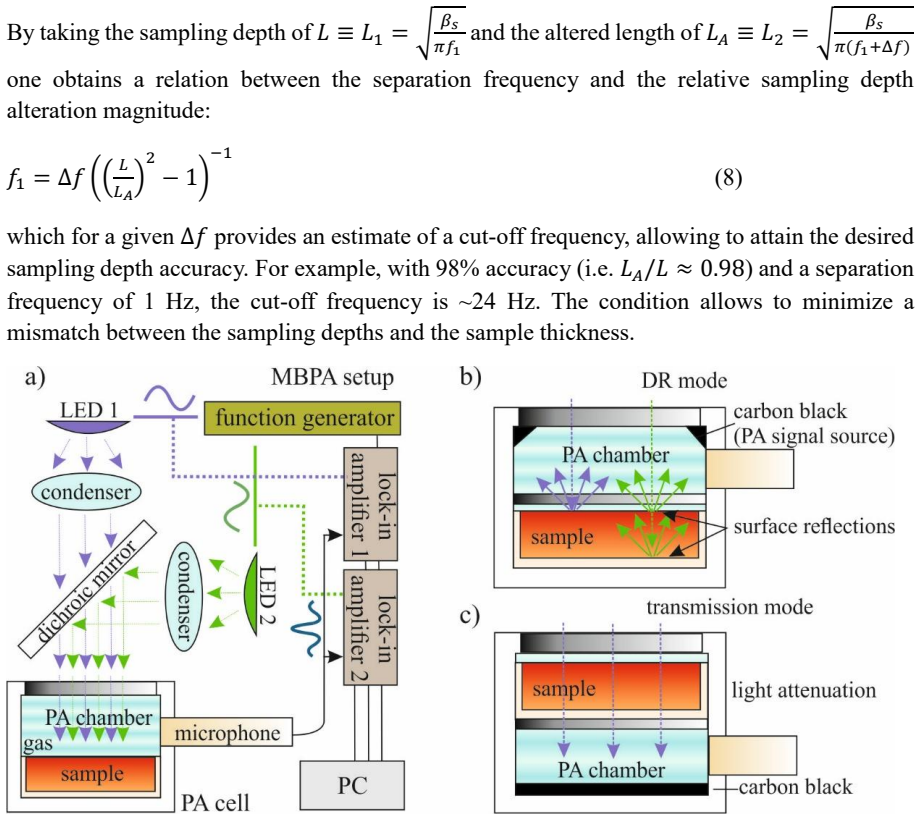
This work develops photoacoustic-based experimental methods for comprehensive characterization of multispecies mass transport from donor compartments to thin-membrane acceptor systems in perfect contact, supported by a dedicated mass transfer modeling framework. Multibeam configurations are implemented in photoacoustic setups operating in front-side detection and diffuse-reflection geometries. The setups are calibrated and adjusted prior to measurements by means of transmission-mode photoacoustic experiments conducted under steady-state conditions. Finally, the methodologies were applied to a model system undergoing photoinduced decay, enabling characterization of bulk transport kinetics as well as interfacial equilibration monitored through time-dependent changes in interfacial reflectivity. For the analysis of bulk transport data, a lumped electrical-circuit (EC) model is introduced. The model is formulated in tableau form, linking species population dynamics to an interaction matrix representing mass-transport couplings consistent with the underlying diffusion-reaction framework. A simplified approximation of the model is further proposed and validated against experimental results. The combined experimental-modeling framework provides an effective approach for quantitative analysis of coupled diffusion, reaction, and interfacial processes in thin-membrane systems.
Editorial analysis
A structured set of objections, weighed in public.
Referee Report
Summary. The manuscript develops LED-based multibeam photoacoustic setups in front-side detection and diffuse-reflection geometries for characterizing multispecies mass transport through thin membranes in contact with donor compartments. Setups are calibrated via transmission-mode steady-state experiments. A lumped electrical-circuit (EC) model is formulated in tableau form, with species dynamics linked by an interaction matrix consistent with the diffusion-reaction framework; a simplified approximation is proposed and validated against time-dependent data from a photoinduced decay system. The central claim is that the combined experimental-modeling approach enables quantitative analysis of coupled diffusion, reaction, and interfacial processes.
Significance. If the EC model validation demonstrates independent predictive power with quantitative agreement to experiment (e.g., via reported error metrics on transport rates or interfacial equilibration times), the framework could provide a practical, lumped-parameter tool for membrane transport studies. The explicit tableau formulation and consistency with the underlying PDE framework are strengths that could support reproducibility if the interaction matrix and validation data are fully specified.
major comments (2)
- [Abstract] Abstract: The statement that 'a simplified approximation of the model is further proposed and validated against experimental results' is load-bearing for the central claim, yet no quantitative validation metrics (error bars, goodness-of-fit values, number of replicates, or comparison to an independent observable) are supplied. This prevents assessment of whether the validation supports the 'effective approach for quantitative analysis' assertion.
- [Abstract] Abstract: The EC model is defined via an interaction matrix 'consistent with the underlying diffusion-reaction framework.' The manuscript must clarify whether this consistency is enforced by construction (rendering the validation non-falsifiable) or whether the matrix is independently determined from first principles or auxiliary measurements; without the explicit matrix form or fitting procedure, the risk of circularity cannot be evaluated.
minor comments (1)
- [Abstract] The abstract would benefit from naming the specific chemical species or membrane material used in the photoinduced decay experiment to allow readers to judge transferability.
Simulated Author's Rebuttal
We thank the referee for the constructive feedback. We address each of the major comments below.
read point-by-point responses
-
Referee: [Abstract] Abstract: The statement that 'a simplified approximation of the model is further proposed and validated against experimental results' is load-bearing for the central claim, yet no quantitative validation metrics (error bars, goodness-of-fit values, number of replicates, or comparison to an independent observable) are supplied. This prevents assessment of whether the validation supports the 'effective approach for quantitative analysis' assertion.
Authors: The full manuscript presents the validation through direct comparison of the simplified EC model predictions with the time-dependent photoacoustic data in the results section. However, we agree that explicit quantitative metrics are not detailed in the abstract. In the revised manuscript, we will include specific validation metrics such as goodness-of-fit values, error bars from replicates, and any comparison to independent observables in both the abstract and the main text to better support the central claim. revision: yes
-
Referee: [Abstract] Abstract: The EC model is defined via an interaction matrix 'consistent with the underlying diffusion-reaction framework.' The manuscript must clarify whether this consistency is enforced by construction (rendering the validation non-falsifiable) or whether the matrix is independently determined from first principles or auxiliary measurements; without the explicit matrix form or fitting procedure, the risk of circularity cannot be evaluated.
Authors: The interaction matrix is formulated by construction to be consistent with the diffusion-reaction framework, incorporating the appropriate coupling terms from the underlying PDE model to ensure physical consistency (e.g., conservation laws). It is not determined by fitting to the validation dataset. The validation is performed by comparing the model output to independent experimental measurements from the photoinduced decay system. To address the concern, we will provide the explicit form of the interaction matrix and its derivation in the revised manuscript. revision: yes
Circularity Check
No significant circularity
full rationale
The paper formulates its lumped EC model in tableau form explicitly to ensure consistency with the underlying diffusion-reaction framework via an interaction matrix, and proposes a simplified approximation that is validated directly against experimental data from the photoinduced decay system. This definitional consistency is by construction for the model setup itself, but does not extend to any claimed predictions or first-principles results reducing to inputs. No self-citations, fitted parameters presented as predictions, uniqueness theorems, or ansatzes smuggled via citation are present. The central claim rests on the experimental validation step, making the derivation self-contained against external benchmarks.
Axiom & Free-Parameter Ledger
axioms (1)
- domain assumption The interaction matrix in the tableau-form EC model represents mass-transport couplings consistent with the underlying diffusion-reaction framework.
invented entities (1)
-
lumped electrical-circuit (EC) model in tableau form
no independent evidence
Forward citations
Cited by 1 Pith paper
-
Determination of the mass transport parameters in thin membranes by phase-sensitive photoacoustics in the optically transparent and mixed regimes
Phase-sensitive photoacoustics determines mass transport parameters in thin membranes in transparent and mixed regimes by assuming heat distributions follow Fickian diffusion concentration profiles.
Reference graph
Works this paper leans on
-
[1]
F. Bouwer, M. Brits, J.M. Viljoen, Cracking the Skin Barrier: Models and Methods Driving Dermal Drug Delivery, Pharmaceutics. 17 (2025) 1586. doi:10.3390/pharmaceutics17121586
-
[2]
Y . Shi, S. Yang, E. Wu, L. Wang, W. Chen, W. Xiong, Y . Zhang, A. Zhang, B. Lian, Advection–Dispersion Behavior for Simulation of H-3 and Pu-238 Transport in Undisturbed Argillaceous Shale of a Near-Surface Repository, Toxics. 11 (2023) 124. doi:10.3390/toxics11020124
-
[3]
J. Yang, B. Wang, X. Feng, Mass Transport Based on Covalent Organic Frameworks, Acc. Chem. Res. 58 (2025) 1447–1460. doi:10.1021/acs.accounts.5c00086
-
[4]
M.P. Rosseto, R.S. Zola, E.K. Lenzi, L.R. Evangelista, Anomalous relaxation and electrical impedance: A diffusion approach with adsorption–desorption at the interfaces, Chaos An Interdiscip. J. Nonlinear Sci. 35 (2025). doi:10.1063/5.0239836
- [5]
-
[6]
J. Chen, F. Rosenberger, Calculation of Lag Time for Convective-Reactive Diffusion, J. Phys. Chem. 95 (1991) 10164–10168. doi:10.1021/j100177a097
-
[7]
K. Huang, N. Toride, M.T. Van Genuchten, Experimental investigation of solute transport in large, homogeneous and heterogeneous, saturated soil columns, Transp. Porous Media. 18 (1995) 283–302. doi:10.1007/BF00616936
-
[8]
B. Godin, E. Touitou, Transdermal skin delivery: Predictions for humans from in vivo, ex vivo and animal models, Adv. Drug Deliv. Rev. 59 (2007) 1152–1161. doi:10.1016/j.addr.2007.07.004
-
[9]
A. Stricker, S. Hilpmann, A. Mansel, K. Franke, S. Schymura, Radiolabeling of Micro- /Nanoplastics via In-Diffusion, Nanomaterials. 13 (2023) 2687. doi:10.3390/nano13192687
-
[10]
A.E. Delhumeau, A. Obliger, T. Tassaing, Infrared microspectroscopy with Bayesian inference for revealing spatiotemporal evolution of supercritical CO2 sorption in low- 22 density polyethylene, J. Supercrit. Fluids. 229 (2026) 106823. doi:10.1016/j.supflu.2025.106823
-
[11]
Rochowski, On the equivocal nature of the mass absorption curves, Int
P. Rochowski, On the equivocal nature of the mass absorption curves, Int. J. Pharm. 646 (2023) 123452. doi:10.1016/j.ijpharm.2023.123452
-
[12]
A. Chatterjee, M.N.S. Swapna, A. Mikaeeli, M. Khalid, D. Korte, A.D. Wieck, M. Pawlak, Photothermal Infrared Radiometry and Thermoreflectance—Unique Strategy for Thermal Transport Characterization of Nanolayers, Nanomaterials. 14 (2024) 1711. doi:10.3390/nano14211711
-
[13]
K. Misztal, J. Kopaczek, R. Kudrawiec, Photoacoustic spectroscopy of layered crystals: An enhancement of the photoacoustic signal and its analysis from the perspective of heat generation, Photoacoustics. 41 (2025) 100668. doi:10.1016/j.pacs.2024.100668
-
[14]
J. Opsal, A. Rosencwaig, Thermal-wave depth profiling: Theory, J. Appl. Phys. 53 (1982) 4240–4246. doi:10.1063/1.331250
-
[15]
J. Ravi, Y . Lu, S. Longuemart, S. Paoloni, H. Pfeiffer, J. Thoen, C. Glorieux, Optothermal depth profiling by neural network infrared radiometry signal recognition, J. Appl. Phys. 97 (2005). doi:10.1063/1.1821635
-
[16]
P. Rochowski, S.J. Pogorzelski, M. Grzegorczyk, S. Kulesza, The strategies for the modelling of the passive mass transport through porous membranes: applicability to transdermal delivery systems, Int. J. Pharm. 591 (2020) 120017. doi:10.1016/j.ijpharm.2020.120017
-
[17]
G. Puccetti, R.M. Leblanc, Titanium Dioxide Particles and Dihydroxyacetone on Human Epiderm, Photochem. Photobiol. 71 (2000) 426–430
work page 2000
-
[18]
F. Lahjomri, G. Puccetti, R.M. Leblanc, V . Alard, A. Denis, J. ‐F. Trenchant, Pulsed Photoacoustic Study of the Diffusion of Chromophores in Human Skin, Photochem. Photobiol. 65 (1997) 292–302. doi:10.1111/j.1751-1097.1997.tb08561.x
-
[19]
N. Benamar, A.F. Laplante, F. Lahjomri, R.M. Leblanc, Modulated photoacoustic spectroscopy study of an artificial tanning on human skin induced by dihydroxyacetone, Physiol. Meas. 25 (2004) 1199–1210. doi:10.1088/0967- 3334/25/5/010
-
[20]
Rochowski, A prelude to the multibeam photoacoustics of condensed systems, Measurement
P. Rochowski, A prelude to the multibeam photoacoustics of condensed systems, Measurement. 253 (2025) 117575. doi:10.1016/j.measurement.2025.117575
-
[21]
P. Rochowski, G. Pontrelli, Mass diffusion in multi-layer systems: an electrical analogue modelling approach, Comput. Biol. Med. 148 (2022) 105774. doi:10.1016/j.compbiomed.2022.105774
-
[22]
M. Grzegorczyk, S. Pogorzelski, P. Rochowski, Towards a novel class of photoacoustics-based water contamination sensors, J. Environ. Chem. Eng. 10 (2022) 107983. doi:10.1016/j.jece.2022.107983
-
[23]
P. Rochowski, P. Niedziałkowski, S.J. Pogorzelski, The benefits of photoacoustics for the monitoring of drug stability and penetration through tissue-mimicking membranes, Int. J. Pharm. 580 (2020) 119233. doi:10.1016/j.ijpharm.2020.119233
-
[24]
A. Schendzielorz, B.D. Hanh, R.H.H. Neubert, S. Wartewig, Penetration Studies of Clotrimazole from Semisolid Formulation Using Step-Scan FT-IR Photoacoustic 23 Spectroscopy, Pharm. Res. 16 (1999) 42–45
work page 1999
-
[25]
P. Rochowski, J. Szurkowski, Physical signatures of drug transport through an artificial skin barrier—A proposed model and its validation, Colloids Surfaces B Biointerfaces. 117 (2014) 107–113. doi:10.1016/j.colsurfb.2014.02.002
-
[26]
Crank, The Mathematics of Diffusion, Second Edi, Clarendon Press, Oxford, 1975
J. Crank, The Mathematics of Diffusion, Second Edi, Clarendon Press, Oxford, 1975
work page 1975
-
[27]
S. Pogorzelski, D. Watrobska-Swietlikowska, M. Sznitowska, Surface tensometry studies on formulations of surfactants with preservatives as a tool for antimicrobial drug protection characterization, J. Biophys. Chem. 03 (2012) 324–333. doi:10.4236/jbpc.2012.34040
-
[28]
V .B. Fainerman, E. V . Aksenenko, A. V . Makievski, M. V . Nikolenko, A. Javadi, E. Schneck, R. Miller, Particular Behavior of Surface Tension at the Interface between Aqueous Solution of Surfactant and Alkane, Langmuir. 35 (2019) 15214–15220. doi:10.1021/acs.langmuir.9b02579
-
[29]
P. Rochowski, M. Grzegorczyk, S. Pogorzelski, A wettability-based approach for the monitoring of drug transport through biological membranes, J. Colloid Interface Sci. 555 (2019) 352–360. doi:10.1016/j.jcis.2019.07.111
discussion (0)
Sign in with ORCID, Apple, or X to comment. Anyone can read and Pith papers without signing in.