REVIEW 3 major objections 5 minor 6 references
From Sublinear to Linear: Local Convergence in Finite-Width Networks via Locally Polyak-Lojasiewicz Regions
T0 review · 3 major / 5 minor · reviewed 2026-08-06 · deepseek-v4-flash
Pith's one-line read Local NTK conditioning makes finite-width GD converge linearly on a local region
desk verdict Correct and admirably honest, but the headline claim is a conditional statement whose key hypothesis (fixed-step containment) is assumed, not proven, so the advertised sublinear-to-linear transition is not actually demonstrated. read the letter →
The pith
A machine-rendered reading of the paper's core claim, the machinery that carries it, and where it could break.
The reading
What carries the argument
The carrying object is the empirical neural tangent kernel matrix $\Theta_\theta = \frac{1}{n} J_\theta J_\theta^\top$ on the training inputs. Its smallest eigenvalue at initialization, $\lambda_0$, is the spectral budget; its Lipschitz constant $L_\Theta$ over the LQCR sets the erosion rate; the LQCR radius $r(R)$ is the maximum distance over which the budget must hold; and the compatibility condition $L_\Theta r(R) < \lambda_0$ keeps the budget positive. The squared-loss identity relating gradient norm to the kernel-weighted residual turns that spectral lower bound into the local PL inequality.
What would settle it
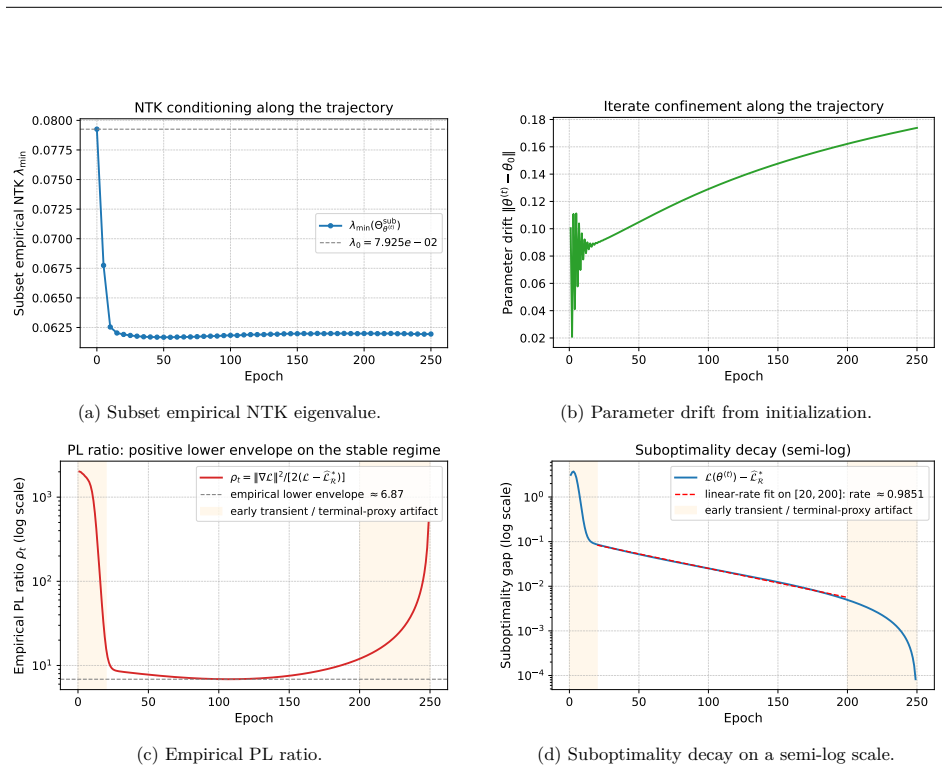
Run full-batch GD on a smooth finite-width network with $\lambda_{\min}(\Theta_{\theta_0})>0$ and $L_\Theta r(R)<\lambda_0$ verified, and measure the empirical PL ratio $\|\nabla L(\theta)\|^2 / [2(L(\theta)-L_R^*)]$ at iterates inside $R$; a single interior iterate where the ratio falls to zero would contradict Lemma 5.3. Alternatively, a trajectory that starts inside the region, keeps a positive NTK gap, and shows non-geometric loss decay under $\eta \le 1/L$ would falsify Theorem 5.7.
Extended reading notes
Core claim
The central claim is that local NTK conditioning yields a local PL inequality on the LQCR: pointwise positivity at the initialization point, Lipschitz stability of the empirical kernel over the region, and compatibility $L_\Theta r(R) < \lambda_0$ together imply that $R$ is a $(\mu,R)$-Locally Polyak-Łojasiewicz Region with $\mu = \lambda_0 - L_\Theta r(R)$ for the squared empirical loss. The proof runs through the identity $\|\nabla L(\theta)\|^2 = \frac{1}{n}(f_\theta-y)^\top \Theta_\theta (f_\theta-y)$ and Weyl's inequality, which propagates the initial spectral gap across the region. With $L$-smoothness, step size $\eta \le 1/L$, and the hypothesis that fixed-step iterates stay in $R$, the loss approaches the region minimum $L_R^*$ at the linear rate $(1-\eta\lambda_R)^t$. The paper is explicit that this is a sufficient-condition result, scoped to squared loss and to the local regime where iterates remain inside the region.
Load-bearing premise
The load-bearing premise is that fixed-step gradient descent iterates stay inside the local region $R$ for every step — the paper assumes this containment rather than proving it — and the region's radius and width condition are imported from prior work without being re-derived.
Editorial extensions
If this is right
- On any LQCR satisfying the NTK conditioning assumption, fixed-step GD with $\eta \le 1/L$ converges linearly to $L_R^*$ at rate $(1-\eta\lambda_R)^t$ while iterates remain in the region.
- The PL constant is explicit and measurable: $\lambda_0$ and $L_\Theta$ can be estimated, and $r(R)$ is given by the LQCR construction.
- The result transfers the classical NTK linear-convergence mechanism from overparameterized or infinite-width settings to a finite-width region with explicit radius.
- When iterates leave the region, the linear-rate guarantee lapses; the width ablation shows this empirically at width 1024 with $\eta=10^{-3}$.
Reading between the lines
- Because fixed-step containment is assumed rather than derived, the paper does not yet close the gap to the original LQCR setting, whose provable containment uses a decaying step size; a direct linear-rate proof under that decaying schedule would complete the sublinear-to-linear transition in the same provable setting.
- The empirical PL-ratio lower envelope could serve as a practical monitor: tracking whether the ratio stays bounded away from zero, along with parameter drift and NTK eigenvalue, tells a practitioner whether a run is inside a locally PL regime.
- The squared-loss bridge suggests a direct extension target: any loss whose gradient admits a similar Jacobian-residual factorization, for example losses with a linear output layer, may inherit a local PL inequality from the same spectral argument.
- The width-1024 boundary case hints that step size, not width alone, controls whether the local regime is entered; a testable prediction is that adaptive schedules chosen to keep NTK drift below the initial gap should preserve linear-rate decay at larger widths.
Editorial analysis
A structured set of objections, weighed in public.
Referee Report
Summary. The paper studies local linear convergence of full-batch gradient descent for finite-width feedforward networks under squared loss. Its main theoretical result is that if the empirical NTK is positive at initialization, Lipschitz stable on a Locally Quasi-Convex Region of radius r(R), and the compatibility condition L_Theta r(R) < lambda_0 holds, then the squared loss satisfies a local Polyak-Lojasiewicz inequality on that region with constant mu = lambda_0 - L_Theta r(R). A second theorem states that if fixed-step gradient descent iterates remain inside the region and the step size satisfies eta <= 1/L, the loss decreases linearly to the regional minimum. The paper then probes the theory empirically on binary MNIST with an MLP, a width ablation, and a CNN robustness check, measuring the subset NTK eigenvalue, parameter drift, empirical PL ratio, and suboptimality decay. The authors are explicit that the fixed-step containment is an assumption rather than a derived property.
Significance. The conditional mathematics is sound and clearly presented: Lemma 5.3 correctly propagates pointwise NTK positivity via Weyl's inequality, Theorem 5.4 correctly converts the spectral lower bound into a PL inequality using the squared-loss gradient identity, and Theorem 5.7 is the standard PL descent argument. The paper also deserves credit for explicitly separating the roles of the LQCR, the NTK stability assumption, and the containment hypothesis, and for designing diagnostics that probe the latent variables of the theory rather than only final loss curves. If the containment hypothesis could be derived or certified in a concrete setting, the result would be a clean finite-width local linear-convergence guarantee. As it stands, however, the main advertised transition from a sublinear LQCR guarantee to a linear rate is not established in any provable setting because the fixed-step containment is assumed, and the experiments do not verify the full assumptions of the theorem. The significance is therefore conditional and the central claim is narrower than the title suggests.
major comments (3)
- [Section 5.3, Theorem 5.7, and Abstract] The advertised transition from sublinear to linear convergence is not realized in any proven setting. Theorem 5.7 assumes the iterates remain in R for every t, but the only containment result imported from Aich et al. (2025) uses the decaying step-size schedule eta_t = eta0/(1+t)^(1/3), not fixed-step gradient descent. The paper therefore does not show that the prior sublinear-guarantee setting becomes linear under the same provable containment mechanism. This gap is load-bearing because the title and Contribution 1 frame the result as 'from sublinear to linear.' Please either prove a fixed-step containment theorem under explicit conditions, or explicitly reframe the contribution as a conditional local-PL theorem with the sublinear-to-linear transition as an open problem.
- [Sections 6.1 and 6.2, Table 1] The empirical spectral quantity reported as lambda_0 is not the quantity used in Assumption 5.1. The theorem concerns lambda_min(Theta_theta0) for the full empirical NTK Theta_theta = (1/n) J_theta J_theta^T over all n training points, while the experiments report lambda_min on a fixed subset of n_sub = 100 inputs. Positivity of the subset eigenvalue does not certify positivity of the full NTK eigenvalue, and L_Theta and r(R) are never computed, so the compatibility condition L_Theta r(R) < lambda_0 is never verified. The empirical section should either compute the full NTK eigenvalue, provide a rigorous argument that the subset eigenvalue bounds the full one, or be presented as evidence of plausibility rather than confirmation of Assumption 5.1.
- [Section 6.1 and Section 6.2] The parameter-drift measurements do not establish the containment used in Theorem 5.7. A final drift of about 0.17 in a space of roughly 10^6 parameters is not informative without a value for r(R), and Theorem 5.7 requires theta(t) in R for every t, not merely a small final drift. The width-1024, eta = 10^-3 run is an explicit violation of the containment hypothesis (drift 1.870), so its use as a 'failure mode' is honest but should be described as an assumption violation rather than as an empirical test of the theorem. I recommend either measuring or estimating r(R) and L_Theta along the trajectory, or weakening the empirical claims to say that the diagnostics are consistent with the assumptions on the runs where the assumptions appear to hold.
minor comments (5)
- [Section 3 and Related Work] The symbol L is used both for the number of layers in the width condition m = Omega(L^3) in Section 2.3 and for the smoothness constant in Theorem 5.7, while D denotes depth in Section 3. Please disambiguate these uses.
- [Remark 4.3] Remark 4.3 refers to 'the submitted corrigendum' to Aich et al. (2025) without a citation or bibliographic entry; please either provide the reference or remove the pointer.
- [Assumption 5.1 and Lemma 5.3] The Lipschitz condition on Theta_theta uses a matrix norm, but the norm is not specified. Since the proof of Lemma 5.3 uses Weyl's inequality for the spectral norm, please state explicitly that the operator/spectral norm is used throughout.
- [Figure 1d] The 'linear-rate fit' reports a contraction factor of 0.9851 on [20, 200], which is very close to 1 and therefore represents a shallow exponential rate. Please report the fit uncertainty and show how sensitive the rate is to the choice of the window endpoints.
- [Theorem 5.7] The step-size condition eta <= 1/L is never related to the LQCR curvature constant alpha or to the LQCR step-size restriction eta0 <= 1/alpha, so it is unclear whether the fixed-step and decaying-step regimes can overlap for the same region. A short remark connecting these constants would help the reader assess the practical plausibility of the fixed-step containment hypothesis.
Circularity Check
No significant circularity: the PL and linear-rate theorems are conditional derivations, with fixed-step iterate containment explicitly hypothesized rather than disguised as a derived consequence.
full rationale
The derivation chain is self-contained conditional mathematics. Lemma 5.3 propagates pointwise NTK positivity across the LQCR using Lipschitz stability and the radius r(R) via Weyl's inequality; Theorem 5.4 obtains the local PL inequality from the squared-loss gradient identity combined with Lemma 5.3; Theorem 5.7 derives the linear rate from the PL inequality and L-smoothness, explicitly conditioning on fixed-step iterate containment (Section 5.3: 'Assume that the resulting iterates remain in R, i.e., theta(t) in R for every t >= 0'). No conclusion is identified with an input: the PL inequality is a consequence of a strictly stronger spectral condition, and the linear rate is conditional on containment rather than defined by it. The LQCR radius r(R) is imported from the same authors' prior work (Aich et al., 2025), but that citation is independent support: its assumptions (smooth feedforward networks, width m = Omega(L^3)) do not include the present PL or linear-rate conclusions, and the paper repeatedly disclaims deriving fixed-step containment from that decaying-step result. The empirical sections measure latent variables (subset NTK eigenvalues, parameter drift, empirical PL ratio) rather than fitting parameters that are then relabeled as predictions, so the fitted-input pattern does not apply. The paper's explicit limitation statements (Section 5.4 and Section 7, item 4) that fixed-step containment is assumed rather than derived are honest scope boundaries: they identify a missing proof in the stronger 'sublinear-to-linear transition' narrative, but not a circular reduction of the theorem to its hypotheses. The central claim is therefore a correct conditional sufficiency result with no significant circularity.
Assumptions & free parameters
free parameters (4)
- Stable regime endpoints [20,200] and [20,180] =
20 to 200 epochs (MLP); 20 to 180 epochs (CNN)
- Reduced step size for width-1024 recovery run =
eta = 5e-4
- NTK probe subset size =
nsub = 100
- Terminal-loss proxy for the regional minimum =
hat L*_R = L(theta(T))
assumptions (9)
- domain assumption LQCR existence and radius r(R) from Aich et al. (2025) under hidden width m = Omega(L^3)
- domain assumption Pointwise NTK positivity lambda_min(Theta_theta0) >= lambda0 > 0
- domain assumption Empirical NTK is L_Theta-Lipschitz on the region R
- domain assumption Compatibility condition L_Theta r(R) < lambda0
- domain assumption The loss L is L-smooth on R
- domain assumption Fixed-step GD iterates remain in R for every t
- standard math Weyl's eigenvalue perturbation inequality
- ad hoc to paper Subset NTK eigenvalue tracks the full NTK eigenvalue
- ad hoc to paper Terminal training loss proxies the regional minimum L*_R
invented entities (1)
-
Locally Polyak-Lojasiewicz Region (LPLR)
Cite this review
Pith. "Pith review of From Sublinear to Linear: Local Convergence in Finite-Width Networks via Locally Polyak-Lojasiewicz Regions." pith.science (2026). https://pith.science/paper/TGZGZKQN
@misc{pith2026250721429,
  author       = {Pith},
  title        = {Pith review of: From Sublinear to Linear: Local Convergence in Finite-Width Networks via Locally Polyak-Lojasiewicz Regions},
  year         = {2026},
  howpublished = {\url{https://pith.science/paper/TGZGZKQN}},
  note         = {Machine review of arXiv:2507.21429}
}
abstract
We study local linear convergence of gradient descent for finite-width feedforward networks under the squared empirical loss. Prior work shows that GD can remain confined to a Locally Quasi-Convex Region (LQCR) around initialization, but only gives a sublinear rate. We show that if the empirical Neural Tangent Kernel is positive at initialization, Lipschitz stable on the LQCR, and compatible with the LQCR radius, then the squared loss satisfies a local Polyak-{\L}ojasiewicz inequality with constant $\mu = \lambda_0 - L_\Theta r(\Rcal) > 0$. Combined with fixed-step iterate containment in the LQCR, imposed as a hypothesis in the linear-rate theorem, this yields linear convergence on the region. The LQCR supplies localization; fixed-step containment is imposed as a hypothesis in the linear-rate theorem; and the PL inequality comes from NTK conditioning under squared loss. The result is therefore a sufficient local condition, not a claim that this mechanism is necessary or unique for fast convergence. Empirically, we probe the theory through NTK spectral gap, parameter drift, empirical PL ratio, and suboptimality decay. On binary MNIST, the NTK remains positive, the PL ratio has a positive lower envelope, and the loss shows geometric decay on the stable regime. In a width ablation, the fixed-step width-$1024$ run leaves the local regime; reducing the step size lowers final drift from $1.870$ to $0.158$, restores the observed local-regime diagnostics, and yields the largest empirical PL-ratio lower envelope observed in the study. A CNN robustness check on a CIFAR-10 subset shows the PL-ratio envelope remains positive across three seeds, with a positive lower envelope across all three seeds on the stable regime.
Figures

Reference graph
Works this paper leans on
-
[2]
doi: 10.4208/jml.240724. Originally arXiv:2304.09221,
-
[2015]
Samuel Daudin and François Delarue. Genericity of polyak-lojasiewicz inequalities for entropic mean-field neural odes.arXiv preprint arXiv:2507.08486,
-
[2019]
The loss surfaces of multilayer networks
Anna Choromanska, Mikael Henaff, Michael Mathieu, Gérard Ben Arous, and Yann LeCun. The loss surfaces of multilayer networks. InProceedings of the 18th International Conference on Artificial Intelligence and Statistics (AISTATS 2015), pp. 192–204, San Diego, CA,
work page 2015
-
[2020]
Henning Petzka and Cristian Sminchisescu
doi: 10.1109/JSAIT.2020.2991332. Henning Petzka and Cristian Sminchisescu. Non-attracting regions of local minima in deep and wide neural networks.Journal of Machine Learning Research, 22(143):1–34,
-
[2022]
Originally arXiv:2003.00307,
arXiv 2003
-
[2025]
Zeyuan Allen-Zhu, Yuanzhi Li, and Zhao Song
doi: 10.1080/00207160.2025.2522349. Zeyuan Allen-Zhu, Yuanzhi Li, and Zhao Song. A convergence theory for deep learning via over- parameterization. InProceedings of the 36th International Conference on Machine Learning (ICML), volume 97 ofProceedings of Machine Learning Research, pp. 242–252. PMLR,
arXiv 2025
Reviewed August 6, 2026 · model on record in the stance chip above.
Discussion (0). Continue with ORCID to comment.