REVIEW 4 major objections 4 minor 57 references
Predicting Network Controllability Robustness: A Convolutional Neural Network Approach
T0 review · 4 major / 4 minor · reviewed 2026-08-14 · deepseek-v4-flash
Pith's one-line read A convolutional neural network can predict network controllability robustness curves directly from adjacency matrices, matching simulations at a fraction of the cost.
desk verdict New task, weak evaluation: the accuracy claim is unsupported without a trivial baseline, but the application is worth a careful revision. read the letter →
The pith
A machine-rendered reading of the paper's core claim, the machinery that carries it, and where it could break.
The reading
What carries the argument
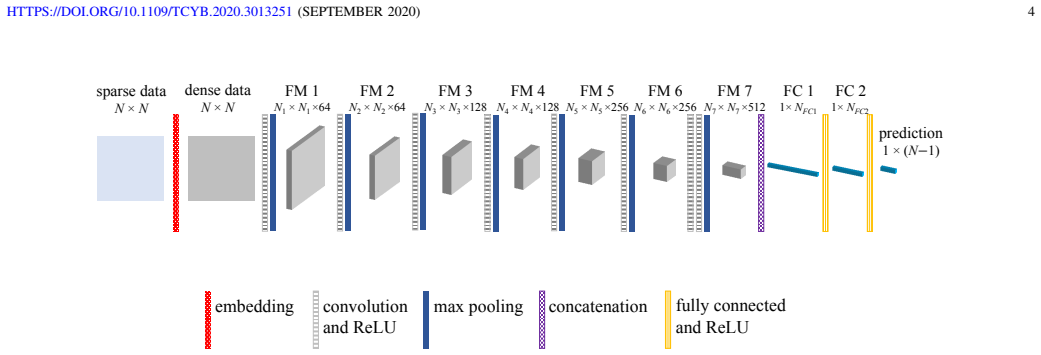
The central object is the controllability robustness curve, a vector of driver-node densities $n_D = N_D/N$ recorded after each successive node removal, where $N_D$ comes from maximum matching for structural controllability or from $N - \mathrm{rank}(A)$ for state controllability. The mechanism carrying the argument is a deep convolutional architecture with seven convolutional groups, ReLU activations, max pooling, an embedding layer that densifies the sparse 0-1 adjacency matrix, two fully connected layers, and the mean-squared-error loss of Eq. (5). The CNN's job is to accept the adjacency matrix as a gray-scale image and output the whole curve, replacing the iterative attack-and-match simulation.
What would settle it
Train the same CNN on the same adjacency matrices but with each training label replaced by the mean controllability curve of its class; if the mean prediction error on the test set stays at the same level as the reported error, the accuracy result is a baseline artifact. A second check: shuffle the rows and columns of each adjacency matrix before training, destroying network-specific structure while preserving the degree sequence; a network-specific predictor should lose accuracy, while a curve-average predictor would not.
Extended reading notes
Core claim
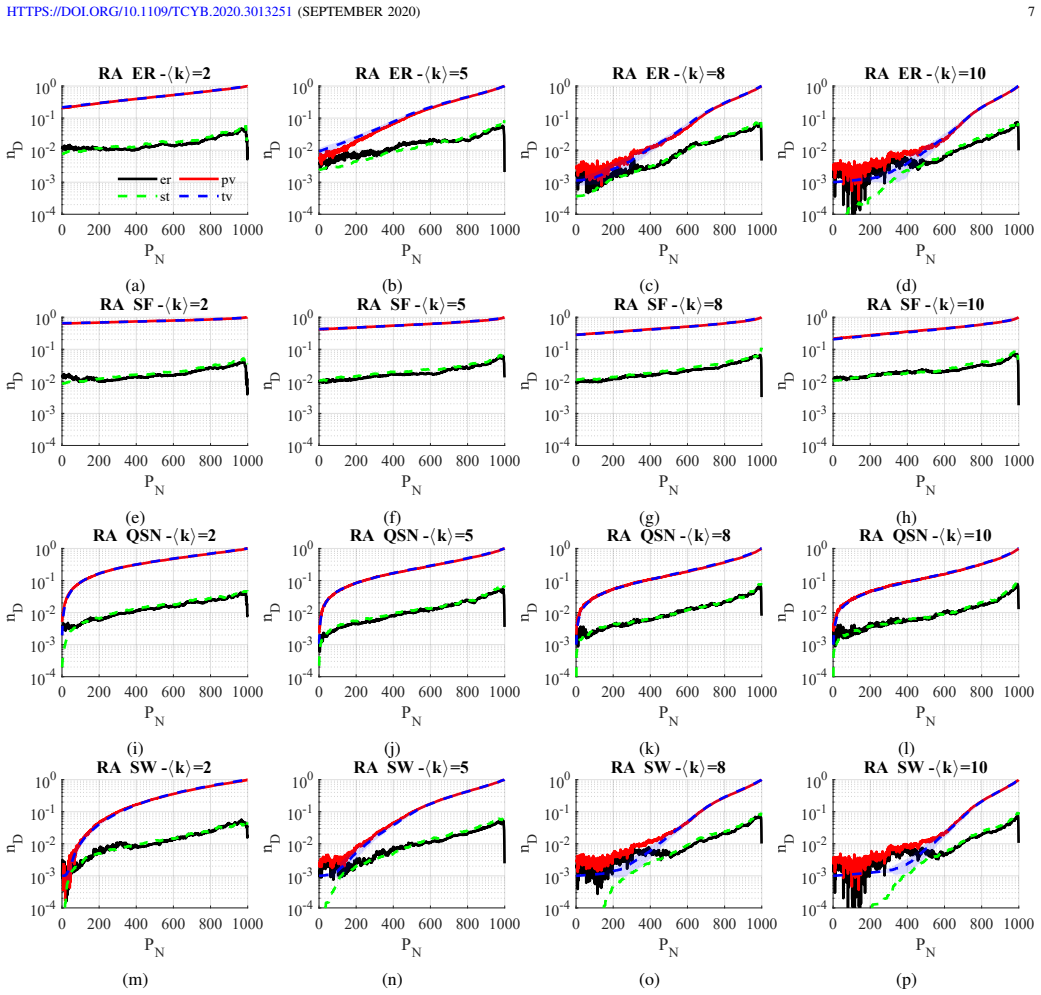
The paper's central claim is that a deep convolutional network can learn the mapping from the raw adjacency matrix, rendered as an image, to the full controllability robustness curve. For node-removal attacks under random, betweenness-based, and degree-based orders, the predicted density of driver nodes after each removed node closely matches the simulated curve for random, scale-free, q-snapback, and small-world networks, in both unweighted structural-controllability and weighted state-controllability settings, for network sizes 800, 1000, and 1200. The paper quantifies accuracy by comparing the mean prediction error with the sample standard deviation of the testing data, and reports that training takes under five hours while a single prediction takes less than 0.2 seconds.
Load-bearing premise
The load-bearing premise is that matching the standard deviation of the test data is enough to prove the CNN predicts each network's own curve, rather than merely reproducing the average behavior of the network family.
Editorial extensions
If this is right
- Controllability robustness can be estimated in under 0.2 seconds per network rather than about 90 seconds, making large-scale robustness screening practical.
- No hand-crafted topological feature set is needed: the raw adjacency structure, encoded as pixels, carries enough information for the CNN to learn the mapping.
- The same trained network extends to weighted networks and to sizes from 800 to 1200 with low error, and retraining for a new attack method is reported to take under five hours.
- When the test networks come from a different average-degree distribution than the training set, predictions degrade for random, snapback, and small-world networks but remain accurate for scale-free networks, pointing to transfer learning as the next step.
Reading between the lines
- An extension the paper leaves implicit is the need for a trivial baseline: a predictor that always outputs the mean curve of the training class would produce errors of the same order as the reported values, so the er-versus-st comparison alone does not prove network-specific predictive skill.
- Because the CNN receives only the adjacency matrix, the learned representation may encode controllability-relevant structure such as matching backbones; probing the network with single-edge perturbations could reveal whether the CNN relies on matching structure or on coarse degree statistics.
- The fixed input size requirement suggests a practical route to much larger networks: train on coarsened or sampled adjacency matrices after verifying that the coarsening preserves the controllability robustness curve, since resizing pixels would alter the topology itself.
Signed reviews
Editorial analysis
A structured set of objections, weighed in public.
Referee Report
Summary. The paper proposes a convolutional neural network (CNN) approach to predict the controllability robustness curve of a network directly from its adjacency matrix, thereby avoiding costly attack simulations. The authors train a VGG-style CNN on adjacency matrices of four directed network models (ER, SF, QSN, SW) with varying average degrees and attack methods (RA, TBA, TDA), and evaluate it on held-out networks of the same configurations, as well as on networks with different average degrees and different sizes. The central claim is that the CNN predicts controllability robustness curves accurately and reliably with very low inference overhead (under 0.2 seconds versus about 90 seconds for simulation). The paper includes unweighted structural controllability experiments, weighted state controllability experiments, a training-data-size sensitivity study, and computational cost measurements.
Significance. If the claims are substantiated, the approach would be a practically valuable surrogate for expensive controllability-robustness simulations, and the paper is clearly written with a reproducible architecture and publicly available source code. The strength of the paper is its clean problem formulation and extensive experimental coverage across topologies, degrees, attack methods, weights, and sizes. However, the significance hinges entirely on whether the reported errors demonstrate genuine network-specific predictive skill rather than mere configuration-level averaging. The current evaluation does not establish this, and the out-of-distribution results in the paper itself show that the method degrades substantially for several topologies. With a proper baseline comparison and a more careful framing of the generalization scope, the core idea could be a useful contribution; in its present form, the accuracy claim is not supported by the evidence.
major comments (4)
- [Section IV-A, Tables II and III, Fig. 3] The central evaluation compares the mean prediction error er to the standard deviation st of the test data and treats er ≈ st as evidence of accuracy. This comparison is not sufficient to establish predictive skill. For each table entry, the 100 test networks are random realizations of the same topology and average degree, so a trivial configuration-mean predictor that ignores the adjacency matrix and outputs the average controllability curve for each (topology, degree, attack method) cell would have an expected absolute error of about 0.8·st for roughly Gaussian scatter. Many of the reported er values are at or below st, which is exactly the signature of such a baseline. The authors must compare against a configuration-mean predictor, or an input-shuffled CNN, to show that the CNN actually uses the individual adjacency matrix rather than recognizing only broad configuration cues such as topology and edge density. Without this baseline, the abstract and Section V claims that predictions are 'accurate and reliable' are not supported.
- [Section III, NFC2 hyperparameter] The text states that the fully-connected layer size NFC2 is a hyperparameter with NFC2 ∈ (NFC1, N−1), and then sets NFC2 = 4096 for N = 800, 1000, and 1200. For N = 1000, with seven max-pooling stages of stride 2, N7 = ceil(1000/128) = 8, so NFC1 = 8×8×512 = 32768, while N−1 = 999. Thus 4096 is neither greater than NFC1 nor less than N−1. This is an internal inconsistency in the architecture description and needs to be corrected or clarified; as written, the stated relationship among the layer sizes is impossible.
- [Section IV-B, Table IV and Fig. 5] The out-of-distribution experiments, where the CNN is trained on networks with average degrees 2, 5, 8, 10 and tested on degrees 3 and 7, show that the mean prediction error is about 2 to 4 times the test standard deviation for ER, QSN, and SW, which the paper itself describes as 'clearly worse.' This is expected if the model relies heavily on configuration-level cues and has limited network-specific predictive ability. The paper should explicitly address whether the method is intended for in-distribution use only, and should temper the introduction's claim that the method applies to 'any size and any type' of network. At minimum, the limitations of the transfer scenario should be moved into the main conclusions rather than presented as an aside.
- [Section IV, QSN generation parameters] The q-snapback network model depends on the snapback probability q and the layer parameter rq, but the paper does not report the values of q and rq used in the experiments. This omission prevents replication of the QSN experiments and should be fixed; the reported results for QSN cannot be independently reproduced without these parameters.
minor comments (4)
- [Section II, after Eq. (4)] There is a typo: 'diver nodes' should be 'driver nodes.'
- [Section III, Eq. (5)] The loss function uses the Euclidean norm notation in a sum over scalar differences; since pvi and tvi are scalars, ||pvi − tvi|| is just the absolute value. The notation is misleading and should be simplified.
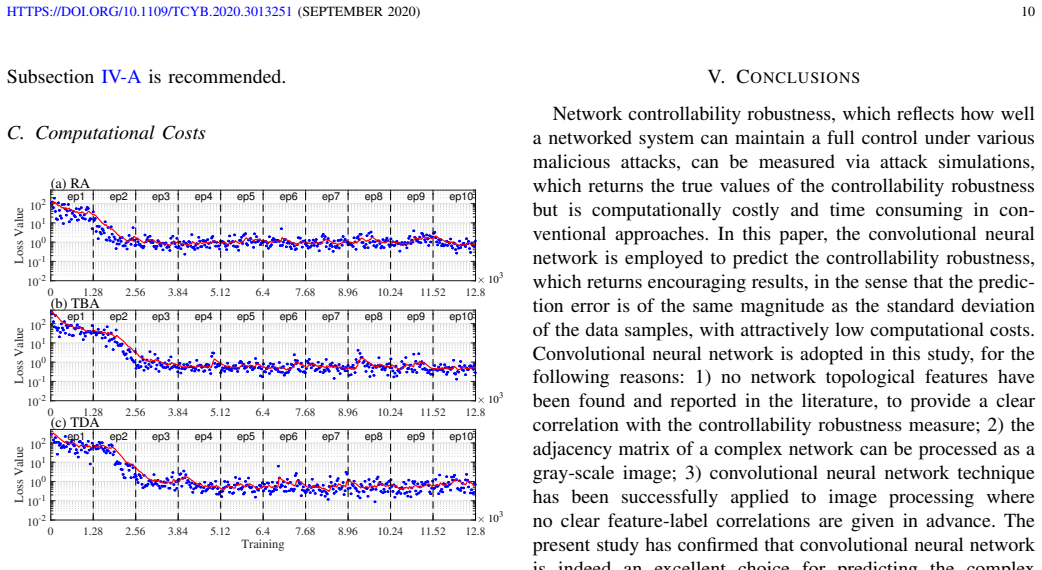
- [Section IV-C] The paper reports a training time of less than 5 hours as 'low overheads,' but the claim of low overhead is primarily about the inference time of 0.2 seconds. Please distinguish training cost from prediction cost more clearly in the conclusions.
- [Section IV-B] When varying the network size, a separate CNN is trained for each size, so the method is not size-agnostic; the phrase 'of any size' in the introduction should be qualified to reflect that a new model is required for each input dimension.
Circularity Check
No significant circularity: the CNN is a fitted regressor evaluated on held-out simulation data, and the paper's self-citations are not load-bearing.
full rationale
The paper's derivation chain is: (1) generate adjacency matrices from four random graph models; (2) compute controllability curves via the structural or state controllability formulas in Eqs. (3)-(4); (3) train a CNN to minimize the MSE loss in Eq. (5) on 800 samples per configuration; (4) evaluate on 100 held-out samples per configuration. The target controllability curves enter only through the supervised loss; they are not reused as inputs or as parts of the predicted output by construction. The reported er-versus-st comparison is a weak validation benchmark, because a trivial configuration-mean predictor would have absolute error of the same order as st, so the paper overstates the evidence for network-specific predictive skill. However, that is a statistical validation and baselining concern, not circularity. No equation in the paper reduces to its own input by definition, and no fitted parameter is renamed as a prediction. The self-citations [27], [30], [31] by the authors are used to define the QSN model and to motivate the claim that no simple topological feature predicts controllability robustness; they are not load-bearing for the CNN architecture, the training procedure, or the evaluation, so they do not constitute circular reliance. The paper is self-contained in the sense that all predictions are checked against independently simulated ground-truth curves on held-out samples.
Assumptions & free parameters
free parameters (4)
- SF degree exponent sigma =
0.999
- QSN snapback probability q =
not reported
- CNN fully-connected size NFC2 =
4096
- Training instances per configuration =
800
assumptions (3)
- standard math Minimum inputs theorem: ND = N - |E*| for structural controllability (Liu et al. 2011)
- standard math Exact controllability condition for weighted networks: ND = max(1, N - rank(A)) (Yuan et al. 2013)
- domain assumption The adjacency matrix image contains sufficient information for the CNN to learn the controllability curve
Cite this review
Pith. "Pith review of Predicting Network Controllability Robustness: A Convolutional Neural Network Approach." pith.science (2026). https://pith.science/paper/THKNCK6I
@misc{pith2026190809471,
  author       = {Pith},
  title        = {Pith review of: Predicting Network Controllability Robustness: A Convolutional Neural Network Approach},
  year         = {2026},
  howpublished = {\url{https://pith.science/paper/THKNCK6I}},
  note         = {Machine review of arXiv:1908.09471}
}
read the original abstract
Network controllability measures how well a networked system can be controlled to a target state, and its robustness reflects how well the system can maintain the controllability against malicious attacks by means of node-removals or edge-removals. The measure of network controllability is quantified by the number of external control inputs needed to recover or to retain the controllability after the occurrence of an unexpected attack. The measure of the network controllability robustness, on the other hand, is quantified by a sequence of values that record the remaining controllability of the network after a sequence of attacks. Traditionally, the controllability robustness is determined by attack simulations, which is computationally time consuming. In this paper, a method to predict the controllability robustness based on machine learning using a convolutional neural network is proposed, motivated by the observations that 1) there is no clear correlation between the topological features and the controllability robustness of a general network, 2) the adjacency matrix of a network can be regarded as a gray-scale image, and 3) the convolutional neural network technique has proved successful in image processing without human intervention. Under the new framework, a fairly large number of training data generated by simulations are used to train a convolutional neural network for predicting the controllability robustness according to the input network-adjacency matrices, without performing conventional attack simulations. Extensive experimental studies were carried out, which demonstrate that the proposed framework for predicting controllability robustness of different network configurations is accurate and reliable with very low overheads.
Figures

Figures from the paper (4 more)


Reference graph
Works this paper leans on
-
[1]
A.-L. Barab ´asi, Network Science. Cambridge University Press, 2016
work page 2016
-
[2]
M. E. Newman, Networks: An Introduction . Oxford University Press, 2010
work page 2010
-
[3]
G. Chen, X. Wang, and X. Li, Fundamentals of Complex Networks: Models, Structures and Dynamics , 2nd ed. John Wiley & Sons, 2014
work page 2014
-
[4]
Controllability of complex networks,
Y .-Y . Liu, J.-J. Slotine, and A.-L. Barab´asi, “Controllability of complex networks,” Nature, vol. 473, no. 7346, pp. 167–173, 2011
work page 2011
-
[5]
Exact controllability of complex networks,
Z. Z. Yuan, C. Zhao, Z. R. Di, W.-X. Wang, and Y .-C. Lai, “Exact controllability of complex networks,” Nature Communications , vol. 4, p. 2447, 2013
work page 2013
-
[6]
Effect of correlations on network controllability,
M. P ´osfai, Y .-Y . Liu, J.-J. Slotine, and A.-L. Barab ´asi, “Effect of correlations on network controllability,” Scientific Reports , vol. 3, p. 1067, 2013
work page 2013
-
[7]
Network controllability is determined by the density of low in-degree and out-degree nodes,
G. Menichetti, L. Dall’Asta, and G. Bianconi, “Network controllability is determined by the density of low in-degree and out-degree nodes,” Physical Review Letters , vol. 113, no. 7, p. 078701, 2014
work page 2014
-
[8]
A. E. Motter, “Networkcontrology,” Chaos: An Interdisciplinary Journal of Nonlinear Science , vol. 25, no. 9, p. 097621, 2015
work page 2015
Show all 57 references
-
[9]
Controllability of networked mimo systems,
L. Wang, X. Wang, G. Chen, and W. K. S. Tang, “Controllability of networked mimo systems,” Automatica, vol. 69, pp. 405–409, 2016
2016
-
[10]
Control principles of complex systems,
Y .-Y . Liu and A.-L. Barab´asi, “Control principles of complex systems,” Review of Modern Physics , vol. 88, no. 3, p. 035006, 2016
2016
-
[11]
Controllability of networked higher- dimensional systems with one-dimensional communication channels,
L. Wang, X. Wang, and G. Chen, “Controllability of networked higher- dimensional systems with one-dimensional communication channels,” Royal Society Philosophical Transactions A , vol. 375, no. 2088, p. 20160215, 2017
2017
-
[12]
Physical con- trollability of complex networks,
L.-Z. Wang, Y .-Z. Chen, W.-X. Wang, and Y .-C. Lai, “Physical con- trollability of complex networks,” Scientific Reports , vol. 7, p. 40198, 2017. HTTPS://DOI.ORG/10.1109/TCYB.2020.3013251 (SEPTEMBER 2020) 11
2017
-
[13]
Controllability analysis for a networked dynamic system with autonomous subsystems,
Y . Zhang and T. Zhou, “Controllability analysis for a networked dynamic system with autonomous subsystems,” IEEE Transactions on Automatic Control, vol. 62, no. 7, pp. 3408–3415, 2016
2016
-
[14]
Benchmarking measures of network controllability on canonical graph models,
E. Wu-Yan, R. F. Betzel, E. Tang, S. Gu, F. Pasqualetti, and D. S. Bassett, “Benchmarking measures of network controllability on canonical graph models,” Journal of Nonlinear Science , pp. 1–39, 2018
2018
-
[15]
Further on the controllability of networked MIMO LTI systems,
Y . Hao, Z. Duan, and G. Chen, “Further on the controllability of networked MIMO LTI systems,” International Journal of Robust and Nonlinear Control, vol. 28, no. 5, pp. 1778–1788, 2018
2018
-
[16]
Advances in network controllability,
L. Xiang, F. Chen, W. Ren, and G. Chen, “Advances in network controllability,” IEEE Circuits and Systems Magazine , vol. 19, no. 2, pp. 8–32, 2019
2019
-
[17]
Coordination and control of complex network systems with switching topologies: A survey,
G. Wen, X. Yu, W. Yu, and J. L ¨u, “Coordination and control of complex network systems with switching topologies: A survey,” IEEE Transactions on Systems, Man, and Cybernetics: Systems , 2020, doi:10.1109/TSMC.2019.2961753
2020
-
[18]
Attack vulnerability of complex networks,
P. Holme, B. J. Kim, C. N. Yoon, and S. K. Han, “Attack vulnerability of complex networks,” Physical Review E , vol. 65, no. 5, p. 056109, 2002
2002
-
[19]
Optimization of robustness and connectivity in complex networks,
B. Shargel, H. Sayama, I. R. Epstein, and Y . Bar-Yam, “Optimization of robustness and connectivity in complex networks,” Physical Review Letters, vol. 90, no. 6, p. 068701, 2003
2003
-
[20]
Mitigation of malicious attacks on networks,
C. M. Schneider, A. A. Moreira, J. S. Andrade, S. Havlin, and H. J. Herrmann, “Mitigation of malicious attacks on networks,” Proceedings of the National Academy of Sciences , vol. 108, no. 10, pp. 3838–3841, 2011
2011
-
[21]
Control centrality and hierarchical structure in complex networks,
Y .-Y . Liu, J.-J. Slotine, and A.-L. Barab ´asi, “Control centrality and hierarchical structure in complex networks,” PLOS ONE, vol. 7, no. 9, p. e44459, 2012
2012
-
[22]
The extreme vulnerability of interdependent spatially embedded networks,
A. Bashan, Y . Berezin, S. Buldyrev, and S. Havlin, “The extreme vulnerability of interdependent spatially embedded networks,” Nature Physics, vol. 9, pp. 667–672, 2013
2013
-
[23]
Optimization of ro- bustness of network controllability against malicious attacks,
Y .-D. Xiao, S.-Y . Lao, L.-L. Hou, and L. Bai, “Optimization of ro- bustness of network controllability against malicious attacks,” Chinese Physics B, vol. 23, no. 11, p. 118902, 2014
2014
-
[24]
Robustness analysis of network controllability,
C.-L. Pu, W.-J. Pei, and A. Michaelson, “Robustness analysis of network controllability,” Physica A: Statistical Mechanics and its Applications , vol. 391, no. 18, pp. 4420–4425, 2012
2012
-
[25]
Robustness of controllability for networks based on edge-attack,
S. Nie, X. Wang, H. Zhang, Q. Li, and B. Wang, “Robustness of controllability for networks based on edge-attack,” PLoS One , vol. 9, no. 2, p. e89066, 2014
2014
-
[26]
Catas- trophic cascade of failures in interdependent networks,
S. Buldyrev, R. Parshani, G. Paul, H. Stanley, and S. Havlin, “Catas- trophic cascade of failures in interdependent networks,”Nature, vol. 464, p. 1025, 2010
2010
-
[27]
Toward stronger robustness of network controllability: A snapback network model,
Y . Lou, L. Wang, and G. Chen, “Toward stronger robustness of network controllability: A snapback network model,” IEEE Transactions on Circuits and Systems I: Regular Papers , vol. 65, no. 9, pp. 2983–2991, 2018
2018
-
[28]
Improving controllability of complex networks by rewiring links regularly,
J. Xu, J. Wang, H. Zhao, and S. Jia, “Improving controllability of complex networks by rewiring links regularly,” in Chinese Control and Decision Conference (CCDC) , 2014, pp. 642–645
2014
-
[29]
Enhancing complex network con- trollability by rewiring links,
L. Hou, S. Lao, B. Jiang, and L. Bai, “Enhancing complex network con- trollability by rewiring links,” in International Conference on Intelligent System Design and Engineering Applications (ISDEA) . IEEE, 2013, pp. 709–711
2013
-
[30]
A comparative study on controllability robustness of complex networks,
G. Chen, Y . Lou, and L. Wang, “A comparative study on controllability robustness of complex networks,” IEEE Transactions on Circuits and Systems II: Express Briefs , vol. 66, no. 5, pp. 828–832, 2019
2019
-
[31]
Enhancing controllability robustness of q-snapback networks through redirecting edges,
Y . Lou, L. Wang, and G. Chen, “Enhancing controllability robustness of q-snapback networks through redirecting edges,” Research, vol. 2019, no. 7857534, 2019
2019
-
[32]
Deep learning in neural networks: An overview,
J. Schmidhuber, “Deep learning in neural networks: An overview,” Neural Networks, vol. 61, pp. 85–117, 2015
2015
-
[33]
End-to-end text recog- nition with convolutional neural networks,
T. Wang, D. J. Wu, A. Coates, and A. Y . Ng, “End-to-end text recog- nition with convolutional neural networks,” in International Conference on Pattern Recognition (ICPR 2012) . IEEE, 2012, pp. 3304–3308
2012
-
[34]
Recurrent convolutional neural networks for text classification,
S. Lai, L. Xu, K. Liu, and J. Zhao, “Recurrent convolutional neural networks for text classification,” in AAAI Conference on Artificial Intelligence, 2015, pp. 2267–2273
2015
-
[35]
Character-level convolutional networks for text classification,
X. Zhang, J. Zhao, and Y . LeCun, “Character-level convolutional networks for text classification,” in Advances in Neural Information Processing Systems (NIPS 2015) , 2015, pp. 649–657
2015
-
[36]
Applying convolutional neural networks concepts to hybrid NN-HMM model for speech recognition,
O. Abdel-Hamid, A.-r. Mohamed, H. Jiang, and G. Penn, “Applying convolutional neural networks concepts to hybrid NN-HMM model for speech recognition,” in International Conference on Acoustics, Speech and Signal Processing (ICASSP) . IEEE, 2012, pp. 4277–4280
2012
-
[37]
Convolutional neural networks for speech recognition,
O. Abdel-Hamid, A.-R. Mohamed, H. Jiang, L. Deng, G. Penn, and D. Yu, “Convolutional neural networks for speech recognition,” IEEE/ACM Transactions on Audio, Speech, and Language Processing , vol. 22, no. 10, pp. 1533–1545, 2014
2014
-
[38]
ABCNN: Attention-based convolutional neural network for modeling sentence pairs,
W. Yin, H. Sch ¨utze, B. Xiang, and B. Zhou, “ABCNN: Attention-based convolutional neural network for modeling sentence pairs,” Transactions of the Association for Computational Linguistics , vol. 4, pp. 259–272, 2016
2016
-
[39]
Convolutional neural tensor network architec- ture for community-based question answering,
X. Qiu and X. Huang, “Convolutional neural tensor network architec- ture for community-based question answering,” in International Joint Conference on Artificial Intelligence , 2015, pp. 1305–1311
2015
-
[40]
Imagenet classification with deep convolutional neural networks,
A. Krizhevsky, I. Sutskever, and G. E. Hinton, “Imagenet classification with deep convolutional neural networks,” in Advances in Neural Infor- mation Processing Systems (NIPS 2012) , 2012, pp. 1097–1105
2012
-
[41]
Large-scale video classification with convolutional neural networks,
A. Karpathy, G. Toderici, S. Shetty, T. Leung, R. Sukthankar, and L. Fei-Fei, “Large-scale video classification with convolutional neural networks,” in IEEE Conference on Computer Vision and Pattern Recog- nition (CVPR), 2014, pp. 1725–1732
2014
-
[42]
A convolutional neural network cascade for face detection,
H. Li, Z. Lin, X. Shen, J. Brandt, and G. Hua, “A convolutional neural network cascade for face detection,” in IEEE Conference on Computer Vision and Pattern Recognition (CVPR) , 2015, pp. 5325–5334
2015
-
[43]
An improved deep learning architecture for person re-identification,
E. Ahmed, M. Jones, and T. K. Marks, “An improved deep learning architecture for person re-identification,” in IEEE Conference on Com- puter Vision and Pattern Recognition (CVPR) , 2015, pp. 3908–3916
2015
-
[44]
Point to set similarity based deep feature learning for person re-identification,
S. Zhou, J. Wang, J. Wang, Y . Gong, and N. Zheng, “Point to set similarity based deep feature learning for person re-identification,” in IEEE Conference on Computer Vision and Pattern Recognition (CVPR) , 2017, pp. 3741–3750
2017
-
[45]
U-Net: Convolutional net- works for biomedical image segmentation,
O. Ronneberger, P. Fischer, and T. Brox, “U-Net: Convolutional net- works for biomedical image segmentation,” in International Conference on Medical Image Computing and Computer-Assisted Intervention . Springer, 2015, pp. 234–241
2015
-
[46]
Real-time patient-specific ecg classification by 1-d convolutional neural networks,
S. Kiranyaz, T. Ince, and M. Gabbouj, “Real-time patient-specific ecg classification by 1-d convolutional neural networks,” IEEE Transactions on Biomedical Engineering , vol. 63, no. 3, pp. 664–675, 2015
2015
-
[47]
Very deep convolutional networks for large-scale image recognition,
K. Simonyan and A. Zisserman, “Very deep convolutional networks for large-scale image recognition,” arXiv Preprint: 1409.1556 , 2014
2014 arXiv
-
[48]
Efficient estimation of word representations in vector space,
T. Mikolov, K. Chen, G. Corrado, and J. Dean, “Efficient estimation of word representations in vector space,” arXiv preprint: 1301.3781, 2013
2013 arXiv
-
[49]
Network control principles predict neuron function in the caenorhabditis elegans connectome,
G. Yan, P. E. V ´ertes, E. K. Towlson, Y . L. Chew, D. S. Walker, W. R. Schafer, and A.-L. Barab ´asi, “Network control principles predict neuron function in the caenorhabditis elegans connectome,” Nature, vol. 550, no. 7677, p. 519, 2017
2017
-
[50]
Deep sparse rectifier neural networks,
X. Glorot, A. Bordes, and Y . Bengio, “Deep sparse rectifier neural networks,” in International Conference on Artificial Intelligence and Statistics, 2011, pp. 315–323
2011
-
[51]
On the strength of connectedness of a random graph,
P. Erd ¨os and A. R ´enyi, “On the strength of connectedness of a random graph,” Acta Mathematica Hungarica , vol. 12, no. 1-2, pp. 261–267, 1964
1964
-
[52]
Universal behavior of load distri- bution in scale-free networks,
K.-I. Goh, B. Kahng, and D. Kim, “Universal behavior of load distri- bution in scale-free networks,” Physical Review Letters, vol. 87, no. 27, p. 278701, 2001
2001
-
[53]
Effects of the network structural properties on its con- trollability,
F. Sorrentino, “Effects of the network structural properties on its con- trollability,” Chaos: An Interdisciplinary Journal of Nonlinear Science , vol. 17, no. 3, p. 033101, 2007
2007
-
[54]
Renormalization group analysis of the small-world network model,
M. E. Newman and D. J. Watts, “Renormalization group analysis of the small-world network model,” Physics Letters A , vol. 263, no. 4-6, pp. 341–346, 1999
1999
-
[55]
Learning convolutional neural networks for graphs,
M. Niepert, M. Ahmed, and K. Kutzkov, “Learning convolutional neural networks for graphs,” in International Conference on Machine Learning (ICML), 2016, pp. 2014–2023
2016
-
[56]
Adam: A method for stochastic optimization,
D. P. Kingma and J. Ba, “Adam: A method for stochastic optimization,” arXiv Preprint: 1412.6980 , 2014
2014 arXiv
-
[57]
A survey on transfer learning,
S. J. Pan and Q. Yang, “A survey on transfer learning,” IEEE Transac- tions on Knowledge and Data Engineering , vol. 22, no. 10, pp. 1345– 1359, 2009
2009
Reviewed August 14, 2026 · model on record in the stance chip above.
Discussion (0). Continue with ORCID to comment.