REVIEW 4 major objections 5 minor 57 references
Scout: Leveraging Large Language Models for Rapid Digital Evidence Discovery
T0 review · 4 major / 5 minor · reviewed 2026-08-06 · deepseek-v4-flash
Pith's one-line read Scout presents a prototype framework in which large language models pre-screen seized digital evidence and rank potentially relevant files before manual analysis.
desk verdict Scout is a sensible prototype idea with an honest limitations section, but its central claim is never tested: no accuracy metrics, no baseline, no code, and the Results section is screenshots plus an unfinished sentence. read the letter →
The pith
A machine-rendered reading of the paper's core claim, the machinery that carries it, and where it could break.
The reading
What carries the argument
The carrying mechanism is Scout's evidence-type routing pipeline. Each seized file is first normalized into a model-friendly form: network packet captures are fed packet by packet, office documents are converted to structured content by Docling, and audio files are transcribed by Whisper before the text goes to a language model. The prepared content is then passed to a foundation model along with a prompt that can carry investigation context, and the model returns observations, summaries, and red flags that the investigator can use to prioritize manual review. Scout runs read-only and can be deployed offline, and its per-file-type design means new evidence formats can be added as plugins.
What would settle it
Take a corpus of seized files with known ground-truth relevant artifacts, run Scout with the same prompts used in the paper, and check whether the known-relevant files appear at the top of the suggested processing order; if the ranking is no better than random, the central prioritization claim fails.
Extended reading notes
Core claim
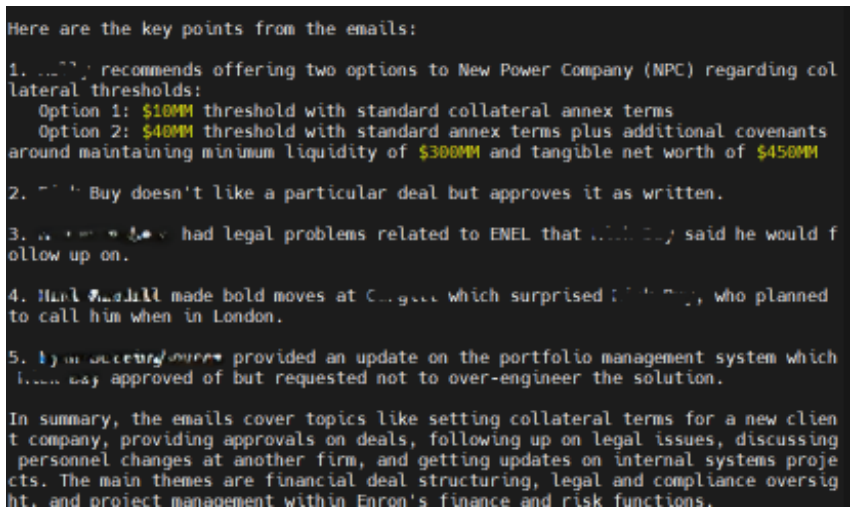
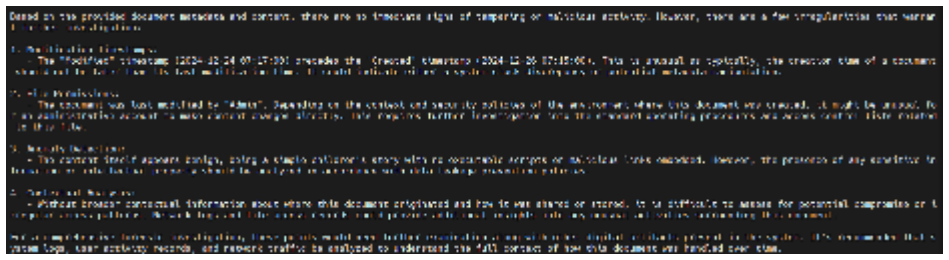
In the paper's own terms, the discovery is that a prompt-driven pipeline built around foundation models can identify, summarize, and contextualize forensic artifacts well enough to recommend a processing order for evidence files. On a sample network packet capture, the framework noticed repeated DNS requests and ICMP errors; on Enron emails it summarized conversations and flagged meetings and purchases; on an office document it spotted that the creation date had been set in the future; and on images and videos it described scenes and raised case-related observations. The authors state that Scout was able to identify the evidence files that were of potential interest to the investigator, and that it does so by choosing text models for textual evidence and multimodal models for multimedia evidence, with the investigator able to rerun the evidence through different models or prompts.
Load-bearing premise
Scout's usefulness rests on the assumption that the files the models flag are genuinely the ones an investigator would find most relevant, and the paper provides no accuracy measurement that would test that match.
Editorial extensions
If this is right
- Investigators can begin a case by reviewing a model-generated shortlist, which may reduce the time spent sifting large disk images, packet captures, and media collections.
- Evidence stays admissible in principle because Scout only points at files; extraction and examination remain with the investigator using approved methods.
- Because models can be swapped and rerun, the same evidence can be examined from multiple interpretive angles without altering the underlying files.
- A fully offline deployment lets agencies process sensitive seized material without sending it to external services.
- Extending Scout to new file types becomes a plugin-writing exercise, so the approach can keep pace with new devices and formats.
Reading between the lines
- If model-driven triage proves reliable, the practical bottleneck in digital forensics shifts from discovery to verification: resources concentrate on confirming flagged artifacts rather than on finding them.
- The author's own warning about false negatives implies that the framework should be measured by ranking quality, not by whether it ever misses, and that any deployment should pair model flags with exhaustive enumeration.
- A testable extension would be to run Scout on a standardized corpus with known relevant artifacts and compare the position of true positives against random ordering.
- The approach could be combined with keyword and hash-based tools, since language models and signature tools catch different kinds of leads: contextual anomalies versus exact matches.
Editorial analysis
A structured set of objections, weighed in public.
Referee Report
Summary. The paper presents Scout, a prototype framework that uses large language models and multimodal models to pre-analyze and prioritize digital evidence files (network packet captures, emails, office documents, audio, images, videos) for forensic investigators. The claimed contribution is that Scout suggests an order for processing files so that relevant evidence is found faster. The paper describes the architecture, model choices (e.g., Llama 3.3, Hermes 3, Qwen2-VL, Whisper), and shows qualitative screenshots of model outputs on a small set of example files. The authors explicitly state that they withhold accuracy metrics due to the probabilistic nature of foundation models, and they acknowledge a large possibility of false negatives. No baseline comparison, quantitative evaluation, or ground-truth validation is provided.
Significance. If validated, a tool that reliably prioritizes digital evidence for forensic triage would be a practically useful contribution, and the proposed design has plausible strengths: it operates offline, in read-only mode to preserve evidence integrity, and is plugin-extensible across file types. However, the manuscript's central claim—that Scout enables rapid evidence discovery—is entirely unsupported by the reported results. The paper ships no machine-checked proofs, no reproducible evaluation pipeline, and no falsifiable quantitative predictions; it instead withholds accuracy data and presents only successful examples. The significance of the work therefore remains speculative, and in its current form the paper is a prototype description rather than a validated research contribution.
major comments (4)
- [Section 4, opening paragraph] The central claim of the paper is that Scout helps investigators find relevant evidence faster, but Section 4 explicitly states: "We decided to hold the release of Scout's accuracy on complete datasets due to the probabilistic nature of foundation models." This is a load-bearing omission: no precision, recall, F1, time-to-evidence, or comparison against random ordering, keyword search, or existing triage tools is reported. The screenshots in Figures 3–14 are anecdotal and do not substantiate the prioritization quality that the contribution promises.
- [Section 5] The discussion concedes "a large possibility of false negatives" and states that "All the remaining files are must also be analyzed by the forensic investigator." Together with the withheld accuracy metrics, this means a missed file leaves the full workload intact, so the proposed benefit of reduced analysis time is never demonstrated. The paper provides no measurement of how often Scout's ranking improves over the original file order, which is the core requirement for the stated use case.
- [Section 4.4] The audio analysis subsection ends with the incomplete sentence "This XXX". This is not a minor typo; it indicates that the audio analysis result is unfinished. Given that audio is one of the six evidence modalities claimed as supported, the incompleteness undermines the completeness of the presented evaluation.
- [Figures 11–14] Figures 11 and 13 are labeled "Sample video" but the corresponding output captions (Figures 12 and 14) say "Information gathered from the previous image." This mislabeling, along with the fact that only successful outputs are shown with no failure cases or error analysis, suggests the reported examples may be post-hoc selections. The paper does not describe the sampling of test files or the selection criteria for the displayed outputs, making it impossible to assess representativeness.
minor comments (5)
- [Section 4.2] The sentence "Scout was able was to summarize the emails" contains a duplicated verb and should be corrected.
- [Section 3.5] The phrase "since the larger and clearer the image is, the more accurate the analysis is" is informal; consider rephrasing for clarity, and specify the resolution/downscaling trade-off with quantitative details if available.
- [Section 2.2] The term "foundational models" is used inconsistently with "foundation models" in the abstract; unify the terminology.
- [References] Several references are incomplete or informal (e.g., [28], [42], [44], [54]), lacking page numbers, publisher information, or access dates; the reference list should be formatted to the journal's standards.
- [Throughout] The paper contains numerous typographical and grammatical errors (e.g., "o iff ce"), inconsistent capitalization, and informal phrasings that require thorough proofreading.
Circularity Check
No circular derivation: Scout reports raw LLM outputs with no fitted parameters or self-referential equations; withheld accuracy is a validation gap, not circularity.
full rationale
The paper's central claim is that Scout, a prototype framework, uses pretrained foundation models to flag potentially interesting evidence files. There are no equations, no fitted parameters, and no quantity is predicted from a separately fitted input. The outputs are direct responses from external models (e.g., Llama 3.3, Hermes 3, Qwen2-VL, Whisper, Docling), so no step reduces to its own inputs by construction. The only self-citation, [14], appears in a general list of digital forensics process references and is not load-bearing for the framework's behavior. Section 4 explicitly withholds accuracy metrics due to the probabilistic nature of foundation models, and Section 5 acknowledges false negatives; these are empirical soundness and validation concerns, not circularity. Because the reported results are demonstrations rather than derived predictions, the derivation chain, such as it is, is self-contained and does not invert inputs into outputs.
Assumptions & free parameters
assumptions (3)
- domain assumption Foundation model outputs are reliable enough to prioritize evidence without systematic validation
- domain assumption Processing each packet or file independently preserves the information needed for relevance judgment
- domain assumption The models operate in a read-only manner that does not contaminate evidence
Cite this review
Pith. "Pith review of Scout: Leveraging Large Language Models for Rapid Digital Evidence Discovery." pith.science (2026). https://pith.science/paper/THPV5LTH
@misc{pith2026250718478,
  author       = {Pith},
  title        = {Pith review of: Scout: Leveraging Large Language Models for Rapid Digital Evidence Discovery},
  year         = {2026},
  howpublished = {\url{https://pith.science/paper/THPV5LTH}},
  note         = {Machine review of arXiv:2507.18478}
}
read the original abstract
Recent technological advancements and the prevalence of technology in day to day activities have caused a major increase in the likelihood of the involvement of digital evidence in more and more legal investigations. Consumer-grade hardware is growing more powerful, with expanding memory and storage sizes and enhanced processor capabilities. Forensics investigators often have to sift through gigabytes of data during an ongoing investigation making the process tedious. Memory forensics, disk analysis all are well supported by state of the art tools that significantly lower the effort required to be put in by a forensic investigator by providing string searches, analyzing images file etc. During the course of the investigation a lot of false positives are identified that need to be lowered. This work presents Scout, a digital forensics framework that performs preliminary evidence processing and prioritizing using large language models. Scout deploys foundational language models to identify relevant artifacts from a large number of potential evidence files (disk images, captured network packets, memory dumps etc.) which would have taken longer to get identified. Scout employs text based large language models can easily process files with textual information. For the forensic analysis of multimedia files like audio, image, video, office documents etc. multimodal models are employed by Scout. Scout was able to identify and realize the evidence file that were of potential interest for the investigator.
Figures


Figures from the paper (7 more)



Reference graph
Works this paper leans on
-
[1]
Gogolin, G., 2010. The digital crime tsunami. Digital investigation, 7(1-2), pp.3-8
work page 2010
-
[2]
Quick, D. and Choo, K.K.R., 2014. Impacts of increasing volume of digital forensic data: A survey and future research challenges. Digital Investigation, 11(4), pp.273-294
work page 2014
-
[3]
Roussev, V., Quates, C. and Martell, R., 2013. Real-time digital forensics and triage. Digital Investigation, 10(2), pp.158-167
work page 2013
-
[4]
Shaw, A. and Browne, A., 2013. A practical and robust approach to coping with large volumes of data submitted for digital forensic examination. Digital Investigation, 10(2), pp.116-128. 19
work page 2013
-
[5]
Naveed, H., Khan, A.U., Qiu, S., Saqib, M., Anwar, S., Usman, M., Akhtar, N., Barnes, N. and Mian, A., 2023. A comprehensive overview of large language models. arXiv preprint arXiv:2307.06435
arXiv 2023
-
[6]
Common Crawl: Data Collection and Use Cases for NLP
Nagel, S., 2023. Common Crawl: Data Collection and Use Cases for NLP. HPLT & NLPL Winter School on Large-Scale Language Modeling and Neural Machine Transla- tion with Web Data, February, 6
work page 2023
-
[7]
Awais, M., Naseer, M., Khan, S., Anwer, R.M., Cholakkal, H., Shah, M., Yang, M.H. and Khan, F.S., 2023. Foundational models de fining a new era in vision: A survey and outlook. arXiv preprint arXiv:2307.13721
arXiv 2023
-
[8]
Chacko, N. and Chacko, V., 2023. Paradigm shift presented by large language models (llm) in deep learning. ADV ANCES IN EMERGING COMPUTING TECHNOLOGIES, 40
work page 2023
Show all 57 references
-
[9]
and Polosukhin, I., 2017
Vaswani, A., Shazeer, N., Parmar, N., Uszkoreit, J., Jones, L., Gomez, A.N., Kaiser, L. and Polosukhin, I., 2017. Attention Is All You Need.(Nips), 2017. arXiv preprint arXiv:1706.03762, 10, p.S0140525X16001837
2017 arXiv
-
[10]
BERT: a review of applications in natural language processing and understanding
Koroteev, M.V., 2021. BERT: a review of applications in natural language processing and understanding. arXiv preprint arXiv:2103.11943
2021 arXiv
-
[11]
and Agarwal, S., 2020
Brown, T., Mann, B., Ryder, N., Subbiah, M., Kaplan, J.D., Dhariwal, P., Neelakantan, A., Shyam, P., Sastry, G., Askell, A. and Agarwal, S., 2020. Language models are few- shot learners. Advances in neural information processing systems, 33, pp.1877-1901
2020
-
[12]
Pollitt, Mark. ”A history of digital forensics.” Advances in Digital Forensics VI: Sixth IFIP WG 11.9 International Conference on Digital Forensics, Hong Kong, China, Jan- uary 4-6, 2010, Revised Selected Papers 6. Springer Berlin Heidelberg, 2010. 20
2010
-
[13]
”Digital forensics research: The next 10 years.” digital investigation 7 (2010): S64-S73
Gar finkel, Simson L. ”Digital forensics research: The next 10 years.” digital investigation 7 (2010): S64-S73
2010
-
[14]
”A tool for extracting static and volatile forensic artifacts of windows 8
Murtuza, Shariq, Robin Verma, Jayaprakash Govindaraj, and Gaurav Gupta. ”A tool for extracting static and volatile forensic artifacts of windows 8. x apps.” In IFIP In- ternational Conference on Digital Forensics, pp. 305-320. Cham: Springer International Publishing, 2015
2015
-
[15]
Ruan, Keyun, et al. ”Cloud forensics.” Advances in Digital Forensics VII: 7th IFIP WG 11.9 International Conference on Digital Forensics, Orlando, FL, USA, January 31–February 2, 2011, Revised Selected Papers 7. Springer Berlin Heidelberg, 2011
2011
-
[16]
”Cloud forensics: Technical chal- lenges, solutions and comparative analysis.” Digital investigation 13 (2015): 38-57
Pichan, Ameer, Mihai Lazarescu, and Sie Teng Soh. ”Cloud forensics: Technical chal- lenges, solutions and comparative analysis.” Digital investigation 13 (2015): 38-57
2015
-
[17]
”Mobile forensics: advances, challenges, and research oppor- tunities.” IEEE Security & Privacy 15.6 (2017): 42-51
Chernyshev, Maxim, et al. ”Mobile forensics: advances, challenges, and research oppor- tunities.” IEEE Security & Privacy 15.6 (2017): 42-51
2017
-
[18]
”Current and future trends in mobile device forensics: A survey.” ACM Computing Surveys (CSUR) 51.3 (2018): 1-31
Barmpatsalou, Konstantia, et al. ”Current and future trends in mobile device forensics: A survey.” ACM Computing Surveys (CSUR) 51.3 (2018): 1-31
2018
-
[19]
”A survey on the internet of things (IoT) forensics: challenges, approaches, and open issues.” IEEE Communications Surveys & Tutorials 22.2 (2020): 1191-1221
Stoyanova, Maria, et al. ”A survey on the internet of things (IoT) forensics: challenges, approaches, and open issues.” IEEE Communications Surveys & Tutorials 22.2 (2020): 1191-1221
2020
-
[20]
”Internet of things forensics: A review.” Internet of Things 11 (2020): 100220
Atlam, Hany F., et al. ”Internet of things forensics: A review.” Internet of Things 11 (2020): 100220
2020
-
[21]
”Internet of things forensics: Recent advances, taxonomy, require- ments, and open challenges.” Future Generation Computer Systems 92 (2019): 265-275
Yaqoob, Ibrar, et al. ”Internet of things forensics: Recent advances, taxonomy, require- ments, and open challenges.” Future Generation Computer Systems 92 (2019): 265-275. 21
2019
-
[22]
”The impact of automation and arti fi- cial intelligence on digital forensics.” Wiley Interdisciplinary Reviews: Forensic Science 3.6 (2021): e1418
Jarrett, Aaron, and Kim-Kwang Raymond Choo. ”The impact of automation and arti fi- cial intelligence on digital forensics.” Wiley Interdisciplinary Reviews: Forensic Science 3.6 (2021): e1418
2021
-
[23]
”Explainable arti ficial intelligence for digital forensics.” Wiley Interdisciplinary Reviews: Forensic Science 4.2 (2022): e1434
Hall, Stuart W., Amin Sakzad, and Kim-Kwang Raymond Choo. ”Explainable arti ficial intelligence for digital forensics.” Wiley Interdisciplinary Reviews: Forensic Science 4.2 (2022): e1434
2022
-
[24]
Al-Dhaqm, S
A. Al-Dhaqm, S. A. Razak, R. A. Ikuesan, V. R. Kebande, K. Siddique, A Review of Mobile Forensic Investigation Process Models, IEEE Access 8 (2020) 173359–173375. doi:10.1109/ACCESS.2020.3014615
2020
-
[25]
and Alsewari, A.A., 2021
Al-Dhaqm, A., Ikuesan, R.A., Kebande, V.R., Abd Razak, S., Grispos, G., Choo, K.K.R., Al-Rimy, B.A.S. and Alsewari, A.A., 2021. Digital forensics subdomains: the state of the art and future directions. IEEE Access, 9, pp.152476-152502
2021
-
[26]
and Gadekallu, T.R., 2022
Javed, A.R., Ahmed, W., Alazab, M., Jalil, Z., Kifayat, K. and Gadekallu, T.R., 2022. A comprehensive survey on computer forensics: State-of-the-art, tools, techniques, chal- lenges, and future directions. IEEE Access, 10, pp.11065-11089
2022
-
[27]
Handbook of digital forensics and investigation
Casey, E., 2009. Handbook of digital forensics and investigation. Academic Press
2009
-
[28]
and Nisbet, A., 2016
Lennox-Steele, A. and Nisbet, A., 2016. A forensic examination of several mobile device Faraday bags & materials to test their e ffectiveness
2016
-
[29]
and Khan, I.U., Arti ficial General Intelligence (AGI) Secu- rity
El Hajjami, S., Kaushik, K. and Khan, I.U., Arti ficial General Intelligence (AGI) Secu- rity
-
[30]
and Kim, A., 2023
Chew, R., Bollenbacher, J., Wenger, M., Speer, J. and Kim, A., 2023. LLM-assisted con- tent analysis: Using large language models to support deductive coding. arXiv preprint arXiv:2306.14924. 22
2023 arXiv
-
[31]
and Ku, L.W., 2023
Dai, S.C., Xiong, A. and Ku, L.W., 2023. LLM-in-the-loop: Leveraging large language model for thematic analysis. arXiv preprint arXiv:2310.15100
2023 arXiv
-
[32]
and Zhang, J., 2023
Liu, S.C., Wang, S., Lin, W., Hsiung, C.W., Hsieh, Y.C., Cheng, Y.P., Luo, S.H., Chang, T. and Zhang, J., 2023. Jarvix: A llm no code platform for tabular data analysis and optimization. arXiv preprint arXiv:2312.02213
2023 arXiv
-
[33]
and Avila, R., 2023
Achiam, J., Adler, S., Agarwal, S., Ahmad, L., Akkaya, I., Aleman, F.L., Almeida, D., Altenschmidt, J., Altman, S., Anadkat, S. and Avila, R., 2023. Gpt-4 technical report. arXiv preprint arXiv:2303.08774
2023 arXiv
-
[34]
and Rodriguez, A., 2023
Touvron, H., Lavril, T., Izacard, G., Martinet, X., Lachaux, M.A., Lacroix, T., Rozi` ere, B., Goyal, N., Hambro, E., Azhar, F. and Rodriguez, A., 2023. Llama: Open and effi cient foundation language models. arXiv preprint arXiv:2302.13971
2023 arXiv
-
[35]
and Silver, D., 2023
Team, G., Anil, R., Borgeaud, S., Alayrac, J.B., Yu, J., Soricut, R., Schalkwyk, J., Dai, A.M., Hauth, A., Millican, K. and Silver, D., 2023. Gemini: a family of highly capable multimodal models. arXiv preprint arXiv:2312.11805
2023 arXiv
-
[36]
and Hui, B., 2023
Bai, J., Bai, S., Chu, Y., Cui, Z., Dang, K., Deng, X., Fan, Y., Ge, W., Han, Y., Huang, F. and Hui, B., 2023. Qwen technical report. arXiv preprint arXiv:2309.16609
2023 arXiv
-
[37]
and Zhou, J., 2023
Bai, J., Bai, S., Yang, S., Wang, S., Tan, S., Wang, P., Lin, J., Zhou, C. and Zhou, J., 2023. Qwen-vl: A frontier large vision-language model with versatile abilities. arXiv preprint arXiv:2308.12966
2023 arXiv
-
[38]
OpenAI. (2024). ChatGPT [Large language model]. https://chat.openai.com
2024
-
[39]
and Chiriatti, M., 2020
Floridi, L. and Chiriatti, M., 2020. GPT-3: Its nature, scope, limits, and consequences. Minds and Machines, 30, pp.681-694
2020
-
[40]
and Peng, H., 2024
Zhou, C., Li, Q., Li, C., Yu, J., Liu, Y., Wang, G., Zhang, K., Ji, C., Yan, Q., He, L. and Peng, H., 2024. A comprehensive survey on pretrained foundation models: A history 23 from bert to chatgpt. International Journal of Machine Learning and Cybernetics, pp.1- 65
2024
-
[41]
and Batool, L., 2024
Shahriar, S., Lund, B.D., Mannuru, N.R., Arshad, M.A., Hayawi, K., Bevara, R.V.K., Mannuru, A. and Batool, L., 2024. Putting gpt-4o to the sword: A comprehensive evaluation of language, vision, speech, and multimodal pro ficiency. Applied Sciences, 14(17), p.7782
2024
-
[42]
and Tselikas, N.D., 2023
Roumeliotis, K.I. and Tselikas, N.D., 2023. Chatgpt and open-ai models: A preliminary review. Future Internet, 15(6), p.192
2023
-
[43]
and Goyal, A., 2024
Dubey, A., Jauhri, A., Pandey, A., Kadian, A., Al-Dahle, A., Letman, A., Mathur, A., Schelten, A., Yang, A., Fan, A. and Goyal, A., 2024. The llama 3 herd of models. arXiv preprint arXiv:2407.21783
2024 arXiv
-
[44]
Roque, L., The Evolution of Llama: From Llama 1 to Llama 3.1 A Comprehensive Guide to the Advancements and Innovations in the Family of Llama Models from Meta AI
-
[45]
and Mishra, L., 2024
Auer, C., Lysak, M., Nassar, A., Dol fi, M., Livathinos, N., Vagenas, P., Ramis, C.B., Omenetti, M., Lindlbauer, F., Dinkla, K. and Mishra, L., 2024. Docling Technical Report. arXiv preprint arXiv:2408.09869
2024 arXiv
-
[46]
and Staar, P., 2022, August
P fitzmann, B., Auer, C., Dol fi, M., Nassar, A.S. and Staar, P., 2022, August. Doclaynet: A large human-annotated dataset for document-layout segmentation. In Proceedings of the 28th ACM SIGKDD conference on knowledge discovery and data mining (pp. 3743- 3751)
2022
-
[47]
and Staar, P., 2022
Nassar, A., Livathinos, N., Lysak, M. and Staar, P., 2022. Tableformer: Table struc- ture understanding with transformers. In Proceedings of the IEEE/CVF Conference on Computer Vision and Pattern Recognition (pp. 4614-4623). 24
2022
-
[48]
and Scanlon, M., 2024
Wickramasekara, A., Breitinger, F. and Scanlon, M., 2024. Exploring the Potential of Large Language Models for Improving Digital Forensic Investigation E ffi ciency. arXiv preprint arXiv:2402.19366
2024 arXiv
-
[49]
and Sheppard, J., 2023
Scanlon, M., Breitinger, F., Hargreaves, C., Hilgert, J.N. and Sheppard, J., 2023. Chat- GPT for digital forensic investigation: The good, the bad, and the unknown. Forensic Science International: Digital Investigation, 46, p.301609
2023
-
[50]
and Liu, T., 2023
Huang, L., Yu, W., Ma, W., Zhong, W., Feng, Z., Wang, H., Chen, Q., Peng, W., Feng, X., Qin, B. and Liu, T., 2023. A survey on hallucination in large language models: Principles, taxonomy, challenges, and open questions. ACM Transactions on Information Systems
2023
-
[51]
and Guang, C., 2024
Teknium, R., Quesnelle, J. and Guang, C., 2024. Hermes 3 technical report. arXiv preprint arXiv:2408.11857
2024 arXiv
-
[52]
and Sutskever, I., 2023, July
Radford, A., Kim, J.W., Xu, T., Brockman, G., McLeavey, C. and Sutskever, I., 2023, July. Robust speech recognition via large-scale weak supervision. In International con- ference on machine learning (pp. 28492-28518). PMLR
2023
-
[53]
and Lee, Y.J., 2024
Liu, H., Li, C., Li, Y. and Lee, Y.J., 2024. Improved baselines with visual instruction tuning. In Proceedings of the IEEE/CVF Conference on Computer Vision and Pattern Recognition (pp. 26296-26306)
2024
-
[54]
huggingface.co/Intel/llava-llama-3-8b
Intel/llava-llama-3-8b · Hugging Face. huggingface.co/Intel/llava-llama-3-8b
-
[55]
and Fan, Y., 2024
Wang, P., Bai, S., Tan, S., Wang, S., Fan, Z., Bai, J., Chen, K., Liu, X., Wang, J., Ge, W. and Fan, Y., 2024. Qwen2-vl: Enhancing vision-language model’s perception of the world at any resolution. arXiv preprint arXiv:2409.12191
2024 arXiv
-
[56]
Gar finkel, Farrell, Roussev and Dinolt, Bringing Science to Digital Forensics with Stan- dardized Forensic Corpora, DFR WS 2009, Montreal, Canada 25
2009
-
[57]
LibriVox — free public domain audiobooks. (n.d.). https://librivox.org/ 26 Figure 4: Sample email Analysis from Enron Dataset (Names blurred). Figure 5: Sample email Analysis from Enron Dataset (Names blurred). 27 Figure 6: Analysis of a Tampered o ffi ce document with creation ...
Reviewed August 6, 2026 · model on record in the stance chip above.
Discussion (0). Sign in to comment.