REVIEW 4 major objections 5 minor 83 references
Generation as Auxiliary Supervision: Enhancing Visual Understanding at Zero Inference Overhead via Decoupled Embedding Prediction
T0 review · 4 major / 5 minor · reviewed 2026-08-16 · deepseek-v4-flash
Pith's one-line read Training a multimodal model to predict projected image embeddings, through a decoupled generation branch, improves perception and spatial understanding, and discarding the branch at inference makes the gains cost-free.
desk verdict A carefully controlled empirical study whose headline 'improves aggregate understanding' claim rests on an undefined Overall score; the per-benchmark and ablation evidence is solid enough to deserve revision, not rejection. read the letter →
The pith
A machine-rendered reading of the paper's core claim, the machinery that carries it, and where it could break.
The reading
What carries the argument
The load-bearing mechanism is the pair NEP plus MoT decoupling. NEP replaces pixel or discrete-token targets with the continuous embedding of the target image, $\hat{z}^{\mathrm{tgt}}_i = f^{\mathrm{gen}}(x_{\mathrm{ctx}}, \hat{z}^{\mathrm{tgt}}_{<i}; \Theta_{\mathrm{gen}})$, optimized by the cosine loss $L_{\mathrm{gen}} = \frac{1}{N}\sum_i \left(1 - \frac{\hat{z}^{\mathrm{tgt}}_i \cdot z^{\mathrm{tgt}}_i}{\|\hat{z}^{\mathrm{tgt}}_i\|\|z^{\mathrm{tgt}}_i\|}\right)$. To prevent the moving target projector from destabilizing training, the target embeddings come from an exponential moving average of the active projector. The MoT branch copies upper-layer weights from the understanding backbone, splits at $l_{\mathrm{split}}\approx L/2$, and lets generation gradients flow into the shared lower trunk while the upper understanding layers see only the text cross-entropy loss. That asymmetric gradient flow lets the generation loss inject fine-grained spatial pressure into representations that the understanding branch must consume, while keeping the understanding side's own optimization intact.
What would settle it
Take the GAS training recipe and replace each target image's embedding with a spatially shuffled version of itself, keeping the global statistics intact; if counting and spatial scores still rise, the spatial content of the NEP target is not what carries the effect. Or probe the slowly-updated target projector with linear classifiers on small-object crops; if those target embeddings do not separate fine-grained spatial categories, the claimed injection of region-level detail is impossible.
Extended reading notes
Core claim
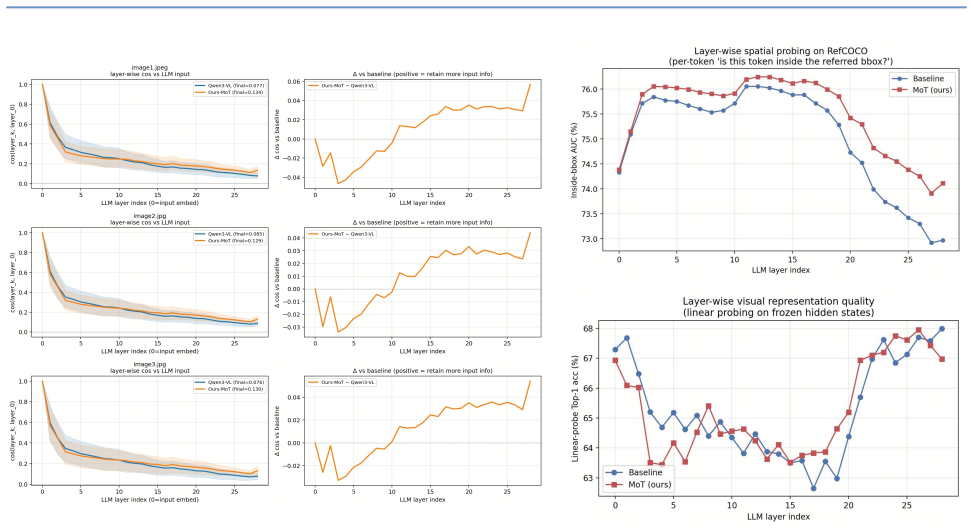
At its center, the paper claims that autoregressive prediction of continuous visual embeddings—Next Embedding Prediction (NEP)—works as auxiliary supervision for visual understanding, provided it is routed through a Mixture-of-Transformers (MoT) decoupling. The target is the projected embedding of a target image, $z_{\mathrm{tgt}} = \mathrm{Projector}(\mathrm{ViT}(I_{\mathrm{tgt}}))$, computed by a frozen vision encoder and an EMA-stabilized projector, so it lives in the same continuous space as the LLM's inputs. A generation branch consisting of independently initialized transformer layers reads hidden states at an intermediate layer (around $L/2$) and predicts that embedding sequence; only the shared lower layers and the projection receive generation gradients, while the upper understanding layers are supervised solely by the text objective. At inference the generation branch and its vision head are removed, so the understanding model is structurally identical to a standard baseline. The paper's evidence for the claim is a set of paired runs at two scales showing aggregate gains, representation diagnostics (better visual-information retention in deep layers, sharper attention on relevant regions, linear-probing gains on a region-level task but not on global classification), and ablations showing that the gains scale with the correlation between the generation task and the target capability.
Load-bearing premise
The load-bearing premise is that the projected embedding of the target image—the thing the generation branch is trained to predict—still contains the fine-grained spatial detail (object boundaries, small-object structure, location) that the paper says this supervision injects; if a frozen vision encoder and a slowly-updated copy of the projector have already squeezed that detail out, the loss can only reinforce a coarse or noisy target.
Editorial extensions
If this is right
- A GAS-trained model is deployed with exactly the same inference-time architecture as its baseline twin, so the understanding gains cost nothing at serving time despite roughly 11.6% more training GPU-hours.
- Because the gains appear when GAS is applied from scratch, after large-scale pretraining, and after instruction fine-tuning, it can be inserted into existing training pipelines as a stage-agnostic augmentation.
- The task mix determines the transfer profile: grounding and segmentation improve counting and spatial benchmarks, Visual-CoT improves reasoning benchmarks, and combining all five task categories beats the best single category on counting and spatial scores, indicating complementary supervision.
- Within a fixed task and data volume, rewriting text-to-image prompts to carry compositional and world-knowledge structure makes the same samples transfer substantially better, showing that task correlation to the target capability, not sample count, drives the gain.
- Representation diagnostics tie the gains to three mechanisms: deeper layers retain more visual information, attention stays concentrated on question-relevant image regions, and region-level linear probing improves while global classification stays flat; pure-text reasoning scores are not degraded and increase slightly in the reported settings.
Reading between the lines
- An implication left implicit in the paper: the NEP target's information ceiling is set by the frozen vision encoder and the EMA-stabilized projector, so swapping in a higher-resolution or denser-feature encoder should amplify GAS's spatial gains; that is a direct testable prediction of the paper's own mechanism.
- Because the method needs only projected embeddings as targets and discards the generation branch at inference, the same recipe could be applied to video, audio, or 3D data by treating temporal or spatial chunks as prediction targets; the paper lists video as future work, so the zero-overhead property is a natural extension, not an observed result.
- The 'task correlation' principle implies an automatic data-selection heuristic: score a candidate generation sample by how strongly its target embedding overlaps the representations probed by the target benchmark, and prioritize those samples; the paper's Rewrite-versus-Easy experiment is evidence for the principle but stops short of a full curriculum.
- The zero-inference-overhead claim should not be read as 'free training': the paper reports roughly 11.6% more GPU-hours, so GAS is a one-time training-budget tradeoff against a permanently cheaper serving model.
Signed reviews
Editorial analysis
A structured set of objections, weighed in public.
Referee Report
Summary. The paper presents GAS, a generation-guided training framework for multimodal large language models. A decoupled Mixture-of-Transformers (MoT) generation branch is trained to predict, via a Next Embedding Prediction (NEP) loss, the projected ViT embeddings of target images conditioned on instruction and source image; at inference this branch is discarded. The authors claim that this auxiliary supervision improves aggregate multimodal understanding on 2B and 4B backbones, with the most reliable gains on perception and counting/spatial benchmarks, at zero inference overhead, and they support the claim with matched-budget controls, per-task ablations, repeated-run statistics, and representation-level diagnostics.
Significance. If the central claim holds, the paper is practically valuable: it demonstrates a training-only mechanism for transferring generation-style supervision into understanding at no inference-time cost, with a modest training overhead (approximately 11.6% additional GPU-hours). The paper is unusually thorough in its controlled comparisons: Table 3 disentangles data, architecture, and objective; Table 4 ablates generation task categories; Table 9 reports repeated-run statistics; and Table 10 compares against reconstructed objectives on the same backbone and data. These are genuine strengths. The main weakness is evaluative rather than mechanistic: the headline 'Overall' aggregate is never defined, and the NEP target representation is not validated to carry the fine-grained spatial information on which the mechanism depends. Both issues are fixable with additional reporting and analysis, so the core idea remains plausible conditional on those fixes.
major comments (4)
- [Sections 3.2–3.3, Tables 2–6, 9, 10] The headline 'Overall' score, and the Perception/Reasoning/Count&Spatial/Video capability aggregates, are never defined. No normalization formula, weighting scheme, or explicit list of which of the 16 benchmarks enter each aggregate is provided. This is not merely a presentation issue: Table 1 shows mixed per-benchmark deltas (e.g., at 4B, GAS is below baseline on BLINK, DynaMath, VisuLogic, Video-MME, and MVBench), so the claimed aggregate gain depends on an unspecified weighting. Since the matched-control tables use the same undefined Overall as their primary evidence, the central claim 'improves aggregate multimodal understanding' is not falsifiable from the manuscript as written. Please define the aggregation explicitly, state which benchmarks enter each capability aggregate, and report robustness of the headline numbers to plausible alternative weighting schemes.
- [Section 2.1, Eqs. (1)–(2); Section 4.5] The NEP target is z_tgt = Projector(ViT(I_tgt)) with an EMA-stabilized projector, and the paper's mechanism story is that this objective injects fine-grained spatial precision into shared representations. However, the paper never verifies that the projected target embeddings actually retain region-level spatial detail. If the frozen ViT plus EMA projector compress away small-object or boundary information, the generation loss would reinforce a coarse or noisy target, and the reported spatial-perception gains would not follow from the stated mechanism. Please add a direct check, for example linear probing of the target embeddings on RefCOCO and ImageNet compared with raw ViT features, or a localization/retrieval probe on z_tgt.
- [Table 3 vs. Table 9] The matched controls used to attribute the gain to NEP+MoT (understanding-only baseline, +11% data, same generation data with no target loss, MoT-only, and no-shift visual prediction) are all single runs, while only GAS is repeated: the 2.5B GAS mean is 48.46 ± 0.37 across three runs. The difference between GAS and the MoT-only control is 0.62 pp, which is less than two standard deviations of the repeated GAS runs, and no variance is reported for any control. The conclusion that GAS beats the matched controls therefore needs repeated baselines for at least the key controls, or a variance estimate, before the attribution claim is supported.
- [Tables 3 and 4] The per-task ablation in Table 4 uses an 'Understanding only' baseline of 47.63, which is not the 47.25 understanding-only baseline of Table 3 but instead coincides with the 'MoT, no generation supervision' row. If the per-task rows were added to the MoT-only architecture rather than the standard baseline, the text should say so; otherwise the per-task deltas are computed against an inconsistent reference, and the 'complementary effect' claim (Count&Spatial 75.72 in the All row vs. 73.15 from the best single task) is not comparable to the main results.
minor comments (5)
- [Section 3.3] The text says VisuLogic is the 'lone exception' at 4B, but Table 1 also shows 4B regressions on BLINK (-0.9), DynaMath (-2.4), Video-MME (-0.6), and MVBench (-1.8); the sentence should be corrected to reflect the full set of per-benchmark regressions.
- [Table 1] In the LLaVA-v1.5 row, the entry '16.68.52' appears malformed and should be split into separate benchmark scores.
- [Section 4.5] The linear probing protocol is under-specified: please report the feature extraction layers, probe training data, optimizer, and whether the reported accuracies are on a held-out split.
- [Figure 4] The description of the left panel says 'cosine similarity between per-layer visual tokens and input visual features' but does not state how the input features are defined or how per-token similarities are aggregated; please clarify.
- [Section 3.2] The label 'General Perception (Multi-Image)' is misleading because MME and MMMU are not multi-image benchmarks; consider renaming the group.
Circularity Check
No circularity: the NEP objective and benchmark evaluations are independent; the undefined Overall metric is a reporting gap, not a construction-level circularity.
full rationale
The paper's derivation chain runs from the NEP target z_tgt = Projector(ViT(I_tgt)) and the cosine loss in Equations 1-2, through the MoT decoupled branch, to external benchmark scores. Nothing in the methodology uses any evaluation benchmark as a fitting target: the generation branch is trained on about 10M synthesized generation samples (grounding, segmentation, editing, Visual-CoT, T2I), and the reported capabilities come from independently defined external suites such as MME, MMMU, BLINK, CharXiv, DynaMath, MathVista, CountBenchQA, CV-Bench, Video-MME, and MVBench. The zero-inference-overhead claim is a direct consequence of discarding the auxiliary branch at inference and is not a hidden re-use of the measured outcome. Self-citations are not load-bearing: the NEP motivation cites external prior work [20], the MoT design cites [24], and the controlled ablations in Tables 3, 6, and 10 compare against fixed-architecture and reconstructive-objective baselines under matched data and compute. The main legitimate weakness is reporting rigor: the 'Overall' aggregate appearing in Tables 2, 3, 4, 5, 6, 9, and 10 is never defined, and Table 1 shows mixed per-benchmark deltas (for example, at 4B GAS is worse than baseline on BLINK, DynaMath, VisuLogic, Video-MME, and MVBench), so the aggregate conclusion is not fully falsifiable from the manuscript as written. There is also a mild selection-transparency concern because the same evaluation suite is used both to choose task configurations and to report final results. These are missing-support or statistical-rigor issues, not circularity: no equation is equivalent to its own input, no fitted parameter is renamed as a prediction, and no load-bearing claim is justified solely by a self-citation chain. Relative to external benchmarks and parameter-free auxiliary objectives, the derivation is self-contained.
Assumptions & free parameters
free parameters (5)
- Generation loss weight lambda schedule =
0.015 ramping to 1.0 over 4k steps
- Split layer l_split =
14 (L/2) for the 2B model
- EMA decay rate =
0.999
- Training token mix =
2.5B understanding + 2.5B generation (analysis); about 10M generation samples overall
- Number of MoT generation layers N_gen =
Not specified
assumptions (4)
- domain assumption Autoregressive prediction of continuous embeddings is a strong visual learner.
- domain assumption Text-only supervision has an expressiveness bottleneck that limits fine-grained visual representations.
- domain assumption Visual information attenuates in deeper LLM layers and retention of it is beneficial for understanding.
- domain assumption Freezing the ViT and injecting generation gradients through the projector is the right interface.
Cite this review
Pith. "Pith review of Generation as Auxiliary Supervision: Enhancing Visual Understanding at Zero Inference Overhead via Decoupled Embedding Prediction." pith.science (2026). https://pith.science/paper/TI5ZYQ47
@misc{pith2026260812209,
  author       = {Pith},
  title        = {Pith review of: Generation as Auxiliary Supervision: Enhancing Visual Understanding at Zero Inference Overhead via Decoupled Embedding Prediction},
  year         = {2026},
  howpublished = {\url{https://pith.science/paper/TI5ZYQ47}},
  note         = {Machine review of arXiv:2608.12209}
}
read the original abstract
While Multimodal Large Language Models (MLLMs) have achieved remarkable progress, visual understanding and generation are typically treated as divergent objectives. Existing unified frameworks often rely on discrete visual tokenization or diffusion objectives whose generative targets differ from the continuous representations consumed by visual understanding models, making direct transfer to enhance existing pretrained MLLMs non-trivial. In this work, we present GAS, a generation-guided training framework that reinterprets visual generation as auxiliary supervision for representation learning. Concretely, GAS adapts Next Embedding Prediction (NEP) as a cross-modal generation paradigm within a decoupled Mixture-of-Transformers (MoT) architecture. By maintaining a shared lower trunk and parallel upper layers, GAS lets generation losses enrich the shared visual pathway with finer spatial precision and stronger visual retention while shielding the upper understanding layers from direct generation gradients. To maximize this synergy, we further construct highly correlated generation tasks that demand deep cognitive grounding rather than generic synthesis alone. Across model scales and training stages, GAS improves aggregate multimodal understanding, with its most reliable gains on perception and spatial comprehension. Crucially, because the auxiliary generation branch is discarded after training, these gains incur zero inference overhead. Extensive controlled comparisons and representation-level analyses further clarify when and why generation-guided training benefits understanding, and demonstrate the feasibility of generation-guided training as a practical route to stronger multimodal understanding.
Figures


Figures from the paper (2 more)

Reference graph
Works this paper leans on
-
[1]
Llava-onevision: Easy visual task transfer
Bo Li, Yuanhan Zhang, Dong Guo, Renrui Zhang, Feng Li, Hao Zhang, Kaichen Zhang, Peiyuan Zhang, Yanwei Li, Ziwei Liu, et al. Llava-onevision: Easy visual task transfer. arXiv preprint arXiv:2408.03326, 2024
arXiv 2024
-
[2]
Qwen3-VL Technical Report, November 2025
Shuai Bai, Yuxuan Cai, Ruizhe Chen, Keqin Chen, Xionghui Chen, Zesen Cheng, Lianghao Deng, Wei Ding, Chang Gao, Chunjiang Ge, Wenbin Ge, Zhifang Guo, Qidong Huang, Jie Huang, Fei Huang, Binyuan Hui, Shutong Jiang, Zhaohai Li, Mingsheng Li, Mei Li, Kaixin Li, Zicheng Lin, Junyang Lin, Xuejing Liu, Jiawei Liu, Chenglong Liu, Yang Liu, Dayiheng Liu, Shixuan ...
arXiv 2025
-
[3]
Internvl3: Exploring advanced training and test-time recipes for open-source multimodal models
Jinguo Zhu, Weiyun Wang, Zhe Chen, Zhaoyang Liu, Shenglong Ye, Lixin Gu, Hao Tian, Yuchen Duan, Weijie Su, Jie Shao, et al. Internvl3: Exploring advanced training and test-time recipes for open-source multimodal models. arXiv preprint arXiv:2504.10479, 2025
arXiv 2025
-
[4]
Visual Instruction Tuning, December 2023
Haotian Liu, Chunyuan Li, Qingyang Wu, and Yong Jae Lee. Visual Instruction Tuning, December 2023. URLhttp://arxiv.org/abs/2304.08485. arXiv:2304.08485 [cs]
arXiv 2023
-
[5]
Learning transferable visual models from natural language supervision
Alec Radford, Jong Wook Kim, Chris Hallacy, Aditya Ramesh, Gabriel Goh, Sandhini Agarwal, Girish Sastry, Amanda Askell, Pamela Mishkin, Jack Clark, et al. Learning transferable visual models from natural language supervision. In International conference on machine learning, pages 8748–8763. PmLR, 2021
2021
-
[6]
Visual cot: Advancing multi-modal language models with a comprehensive dataset and benchmark for chain-of-thought reasoning
Hao Shao, Shengju Qian, Han Xiao, Guanglu Song, Zhuofan Zong, Letian Wang, Yu Liu, and Hongsheng Li. Visual cot: Advancing multi-modal language models with a comprehensive dataset and benchmark for chain-of-thought reasoning. Advances in Neural Information Processing Systems, 37:8612–8642, 2024
2024
-
[7]
An empirical anal- ysis on spatial reasoning capabilities of large multimodal models
Fatemeh Shiri, Xiao-Yu Guo, Mona Golestan Far, Xin Yu, Reza Haf, and Yuan-Fang Li. An empirical anal- ysis on spatial reasoning capabilities of large multimodal models. In Proceedings of the 2024 Conference on Empirical Methods in Natural Language Processing, pages 21440–21455, 2024
2024
-
[8]
Yuhui Zhang, Alyssa Unell, Xiaohan Wang, Dhruba Ghosh, Yuchang Su, Ludwig Schmidt, and Serena Yeung-Levy. Why are visually-grounded language models bad at image classification? Advances in Neural Information Processing Systems, 37:51727–51753, 2024
work page 2024
Show all 83 references
-
[9]
Question aware vision transformer for multimodal reasoning
Roy Ganz, Yair Kittenplon, Aviad Aberdam, Elad Ben Avraham, Oren Nuriel, Shai Mazor, and Ron Litman. Question aware vision transformer for multimodal reasoning. In Proceedings of the IEEE/CVF conference on computer vision and pattern recognition, pages 13861–13871, 2024
2024
-
[10]
Chameleon: Mixed-modal early-fusion foundation models
Chameleon Team. Chameleon: Mixed-modal early-fusion foundation models. arXiv preprint arXiv:2405.09818, 2024
2024 arXiv
-
[11]
Show-o: One single transformer to unify multimodal understanding and generation
Jinheng Xie, Weijia Mao, Zechen Bai, David Junhao Zhang, Weihao Wang, Kevin Qinghong Lin, Yuchao 20 Gu, Zhijie Chen, Zhenheng Yang, and Mike Zheng Shou. Show-o: One single transformer to unify multimodal understanding and generation. In The Thirteenth International Conference ...
2025
-
[12]
Transfusion: Predict the next token and diffuse images with one multi-modal model
Chunting Zhou, LILI YU, Arun Babu, Kushal Tirumala, Michihiro Yasunaga, Leonid Shamis, Jacob Kahn, Xuezhe Ma, Luke Zettlemoyer, and Omer Levy. Transfusion: Predict the next token and diffuse images with one multi-modal model. In The Thirteenth International Conference on Learn...
-
[13]
Emerging properties in unified multimodal pretraining
Chaorui Deng, Deyao Zhu, Kunchang Li, Chenhui Gou, Feng Li, Zeyu Wang, Shu Zhong, Weihao Yu, Xiaonan Nie, Ziang Song, et al. Emerging properties in unified multimodal pretraining. arXiv preprint arXiv:2505.14683, 2025
2025 arXiv
-
[14]
Mammothmoda2: A unified ar-diffusion framework for multimodal understanding and generation
Tao Shen, Xin Wan, Taicai Chen, Rui Zhang, Junwen Pan, Dawei Lu, Fanding Lei, Zhilin Lu, Yunfei Yang, Chen Cheng, et al. Mammothmoda2: A unified ar-diffusion framework for multimodal understanding and generation. arXiv preprint arXiv:2511.18262, 2025
2025
-
[15]
Lance: Unified multimodal modeling by multi-task synergy
Fengyi Fu, Mengqi Huang, Shaojin Wu, Yunsheng Jiang, Yufei Huo, Hao Li, Yinghang Song, Fei Ding, Jianzhu Guo, Qian He, Zheren Fu, Zhendong Mao, and Yongdong Zhang. Lance: Unified multimodal modeling by multi-task synergy. arXiv preprint arXiv:2605.18678, 2026
2026 arXiv
-
[16]
Multimodal learning with next-token prediction for large multimodal models
Xinlong Wang, Yufeng Cui, Jinsheng Wang, Fan Zhang, Yueze Wang, Xiaosong Zhang, Zhengxiong Luo, Quan Sun, Zhen Li, Yuqi Wang, Qiying Yu, Yingli Zhao, Yulong Ao, Xuebin Min, Chunlei Men, Boya Wu, Bo Zhao, Bowen Zhang, Liangdong Wang, Guang Liu, Zheqi He, Xi Yang, Jingjing Liu, ...
2026 doi
-
[17]
Janus: Decoupling visual encoding for unified multimodal understanding and generation
Chengyue Wu, Xiaokang Chen, Zhiyu Wu, Yiyang Ma, Xingchao Liu, Zizheng Pan, Wen Liu, Zhenda Xie, Xingkai Yu, Chong Ruan, et al. Janus: Decoupling visual encoding for unified multimodal understanding and generation. In Proceedings of the Computer Vision and Pattern Recognition ...
2025
-
[18]
Mmada: Multimodal large diffusion language models
Ling Yang, Ye Tian, Bowen Li, Xinchen Zhang, Ke Shen, Yunhai Tong, and Mengdi Wang. Mmada: Multimodal large diffusion language models. Advances in Neural Information Processing Systems, 38: 138867–138907, 2026
2026
-
[19]
Longcat-next: Lexicalizing modalities as discrete tokens
Meituan LongCat Team, Bin Xiao, Chao Wang, Chengjiang Li, Chi Zhang, Chong Peng, Hang Yu, Hao Yang, Haonan Yan, Haoze Sun, et al. Longcat-next: Lexicalizing modalities as discrete tokens. arXiv preprint arXiv:2603.27538, 2026
2026
-
[20]
Next-embedding prediction makes strong vision learners
Sihan Xu, Ziqiao Ma, Wenhao Chai, Xuweiyi Chen, Weiyang Jin, Joyce Chai, Saining Xie, and Stella X Yu. Next-embedding prediction makes strong vision learners. arXiv preprint arXiv:2512.16922, 2025
2025
-
[21]
Unihetero: Could generation enhance understanding for vision-language-model at large data scale? arXiv preprint arXiv:2512.23512, 2025
Fengjiao Chen, Minhao Jing, Weitao Lu, Yan Feng, Xiaoyu Li, and Xuezhi Cao. Unihetero: Could generation enhance understanding for vision-language-model at large data scale? arXiv preprint arXiv:2512.23512, 2025
2025
-
[22]
Unifork: Exploring modality alignment for unified multimodal understanding and generation
Teng Li, Quanfeng Lu, Lirui Zhao, Hao Li, Xizhou Zhu, Yu Qiao, Jun Zhang, and Wenqi Shao. Unifork: Exploring modality alignment for unified multimodal understanding and generation. arXiv preprint arXiv:2506.17202, 2025
2025 arXiv
-
[23]
Uni-x: Mitigating modality conflict with a two-end-separated architecture for unified multimodal models
Jitai Hao, Hao Liu, Xinyan Xiao, Qiang Huang, and Jun Yu. Uni-x: Mitigating modality conflict with a two-end-separated architecture for unified multimodal models. arXiv preprint arXiv:2509.24365, 2025
2025
-
[24]
Mixture-of-transformers: A sparse and scalable architecture for multi-modal foundation models
Weixin Liang, LILI YU, Liang Luo, Srini Iyer, Ning Dong, Chunting Zhou, Gargi Ghosh, Mike Lewis, Wen tau Yih, Luke Zettlemoyer, and Xi Victoria Lin. Mixture-of-transformers: A sparse and scalable architecture for multi-modal foundation models. Transactions on Machine Learning ...
2025
-
[25]
Qwen3 technical report
An Yang, Anfeng Li, Baosong Yang, Beichen Zhang, Binyuan Hui, Bo Zheng, Bowen Yu, Chang Gao, Chengen Huang, Chenxu Lv, et al. Qwen3 technical report. arXiv preprint arXiv:2505.09388, 2025
2025 arXiv
-
[26]
Adam: A method for stochastic optimization
Diederik P Kingma and Jimmy Ba. Adam: A method for stochastic optimization. arXiv preprint arXiv:1412.6980, 2014
2014 arXiv
-
[27]
Zero: Memory optimizations toward training trillion parameter models
Samyam Rajbhandari, Jeff Rasley, Olatunji Ruwase, and Yuxiong He. Zero: Memory optimizations toward training trillion parameter models. In SC20: international conference for high performance computing, networking, storage and analysis, pages 1–16. IEEE, 2020
2020
-
[28]
Mme: A comprehensive evaluation benchmark for multimodal large language models
Chaoyou Fu, Peixian Chen, Yunhang Shen, Yulei Qin, Mengdan Zhang, Xu Lin, Jinrui Yang, Xiawu Zheng, Ke Li, Xing Sun, et al. Mme: A comprehensive evaluation benchmark for multimodal large language models. Advances in Neural Information Processing Systems, 38, 2026
2026
-
[29]
Mmmu: A massive multi-discipline multimodal understanding and reasoning benchmark for expert agi
Xiang Yue, Yuansheng Ni, Kai Zhang, Tianyu Zheng, Ruoqi Liu, Ge Zhang, Samuel Stevens, Dongfu Jiang, Weiming Ren, Yuxuan Sun, et al. Mmmu: A massive multi-discipline multimodal understanding and reasoning benchmark for expert agi. In Proceedings of the IEEE/CVF conference on c...
2024
-
[30]
Blink: Multimodal large language models can see but not perceive
Xingyu Fu, Yushi Hu, Bangzheng Li, Yu Feng, Haoyu Wang, Xudong Lin, Dan Roth, Noah A Smith, Wei-Chiu Ma, and Ranjay Krishna. Blink: Multimodal large language models can see but not perceive. In European Conference on Computer Vision, pages 148–166. Springer, 2024
2024
-
[31]
Charxiv: Charting gaps in realistic chart understanding in multimodal llms
Zirui Wang, Mengzhou Xia, Luxi He, Howard Chen, Yitao Liu, Richard Zhu, Kaiqu Liang, Xindi Wu, Haotian Liu, Sadhika Malladi, et al. Charxiv: Charting gaps in realistic chart understanding in multimodal llms. Advances in Neural Information Processing Systems, 37:113569–113697, 2024
2024
-
[32]
Dynamath: A dynamic visual benchmark for evaluating mathematical reasoning robustness of vision language models
Chengke Zou, Xingang Guo, Rui Yang, Junyu Zhang, Bin Hu, and Huan Zhang. Dynamath: A dynamic visual benchmark for evaluating mathematical reasoning robustness of vision language models. In International Conference on Learning Representations, volume 2025, pages 48337–48383, 2025
2025
-
[33]
Measuring multimodal mathematical reasoning with math-vision dataset
Ke Wang, Junting Pan, Weikang Shi, Zimu Lu, Houxing Ren, Aojun Zhou, Mingjie Zhan, and Hong- sheng Li. Measuring multimodal mathematical reasoning with math-vision dataset. Advances in Neural Information Processing Systems, 37:95095–95169, 2024
2024
-
[34]
Mathvista: Evaluating mathematical reasoning of foundation models in visual contexts
Pan Lu, Hritik Bansal, Tony Xia, Jiacheng Liu, Chunyuan Li, Hannaneh Hajishirzi, Hao Cheng, Kai-Wei Chang, Michel Galley, and Jianfeng Gao. Mathvista: Evaluating mathematical reasoning of foundation models in visual contexts. In International Conference on Learning Representat...
2024
-
[35]
Logicvista: Multimodal llm logical reasoning benchmark in visual contexts
Yijia Xiao, Edward Sun, Tianyu Liu, and Wei Wang. Logicvista: Multimodal llm logical reasoning benchmark in visual contexts. arXiv preprint arXiv:2407.04973, 2024
2024 arXiv
-
[36]
Visulogic: A benchmark for evalu- ating visual reasoning in multi-modal large language models
Weiye Xu, Jiahao Wang, Weiyun Wang, Zhe Chen, Wengang Zhou, Aijun Yang, Lewei Lu, Houqiang Li, Xiaohua Wang, Xizhou Zhu, Wenhai Wang, Jifeng Dai, and Jinguo Zhu. Visulogic: A benchmark for evalu- ating visual reasoning in multi-modal large language models. In The Fourteenth In...
2026
-
[37]
Teaching CLIP to Count to Ten
Roni Paiss, Ariel Ephrat, Omer Tov, Shiran Zada, Inbar Mosseri, Michal Irani, and Tali Dekel. Teaching CLIP to Count to Ten. arXiv preprint arXiv:2302.12066, 2023
2023 arXiv
-
[38]
PaliGemma: A versatile 3B VLM for transfer
Lucas Beyer, Andreas Steiner, André Susano Pinto, Alexander Kolesnikov, Xiao Wang, Daniel Salz, Maxim Neumann, Ibrahim Alabdulmohsin, Michael Tschannen, Emanuele Bugliarello, Thomas Unterthiner, Daniel Keysers, Skanda Koppula, Fangyu Liu, Adam Grycner, Alexey Gritsenko, Neil H...
2024 arXiv
-
[39]
Cambrian-1: A fully open, vision-centric exploration of multimodal llms
Shengbang Tong, Ellis Brown, Penghao Wu, Sanghyun Woo, Manoj Middepogu, Sai C Akula, Jihan Yang, 22 Shusheng Yang, Adithya Iyer, Xichen Pan, et al. Cambrian-1: A fully open, vision-centric exploration of multimodal llms. Advances in Neural Information Processing Systems, 37:87...
2024
-
[40]
Video-mme: The first-ever comprehensive evaluation benchmark of multi-modal llms in video analysis
Chaoyou Fu, Yuhan Dai, Yongdong Luo, Lei Li, Shuhuai Ren, Renrui Zhang, Zihan Wang, Chenyu Zhou, Yunhang Shen, Mengdan Zhang, et al. Video-mme: The first-ever comprehensive evaluation benchmark of multi-modal llms in video analysis. In Proceedings of the IEEE/CVF conference on...
2025
-
[41]
Mvbench: A comprehensive multi-modal video understanding benchmark
Kunchang Li, Yali Wang, Yinan He, Yizhuo Li, Yi Wang, Yi Liu, Zun Wang, Jilan Xu, Guo Chen, Ping Luo, et al. Mvbench: A comprehensive multi-modal video understanding benchmark. In Proceedings of the IEEE/CVF Conference on Computer Vision and Pattern Recognition, pages 22195–22...
2024
-
[42]
Visulogic: A benchmark for evaluating visual reasoning in multi-modal large language models
Weiye Xu, Jiahao Wang, Weiyun Wang, Zhe Chen, Wengang Zhou, Aijun Yang, Lewei Lu, Houqiang Li, Xiaohua Wang, Xizhou Zhu, et al. Visulogic: A benchmark for evaluating visual reasoning in multi-modal large language models. arXiv preprint arXiv:2504.15279, 2025
2025 arXiv
-
[43]
Thyme: Think beyond images
YiFan Zhang, Xingyu Lu, Shukang Yin, Chaoyou Fu, Wei Chen, Xiao Hu, Bin Wen, Kaiyu Jiang, Changyi Liu, Tianke Zhang, Haonan fan, Kaibing Chen, Jiankang Chen, Haojie Ding, Kaiyu Tang, Zhang Zhang, Liang Wang, Fan Yang, Tingting Gao, and Guorui Zhou. Thyme: Think beyond images. ...
2026
-
[44]
Improved baselines with visual instruction tuning
Haotian Liu, Chunyuan Li, Yuheng Li, and Yong Jae Lee. Improved baselines with visual instruction tuning. In Proceedings of the IEEE/CVF conference on computer vision and pattern recognition, pages 26296–26306, 2024
2024
-
[45]
Qwen2.5-VL Technical Report, February 2025
Shuai Bai, Keqin Chen, Xuejing Liu, Jialin Wang, Wenbin Ge, Sibo Song, Kai Dang, Peng Wang, Shijie Wang, Jun Tang, Humen Zhong, Yuanzhi Zhu, Mingkun Yang, Zhaohai Li, Jianqiang Wan, Pengfei Wang, Wei Ding, Zheren Fu, Yiheng Xu, Jiabo Ye, Xi Zhang, Tianbao Xie, Zesen Cheng, Han...
2025
-
[46]
Metamorph: Multimodal understanding and generation via instruction tuning
Shengbang Tong, David Fan, Jiachen Li, Yunyang Xiong, Xinlei Chen, Koustuv Sinha, Michael Rabbat, Yann LeCun, Saining Xie, and Zhuang Liu. Metamorph: Multimodal understanding and generation via instruction tuning. In Proceedings of the IEEE/CVF International Conference on Comp...
2025
-
[47]
Janus-pro: Unified multimodal understanding and generation with data and model scaling
Xiaokang Chen, Zhiyu Wu, Xingchao Liu, Zizheng Pan, Wen Liu, Zhenda Xie, Xingkai Yu, and Chong Ruan. Janus-pro: Unified multimodal understanding and generation with data and model scaling. arXiv preprint arXiv:2501.17811, 2025
2025 arXiv
-
[48]
Show-o2: Improved native unified multimodal models
Jinheng Xie, Zhenheng Yang, and Mike Zheng Shou. Show-o2: Improved native unified multimodal models. In The Thirty-ninth Annual Conference on Neural Information Processing Systems, 2026. URL https://openreview.net/forum?id=7VMg7Jb7AL
2026
-
[49]
Cheers: Decoupling patch details from semantic representations enables unified multimodal comprehension and generation
Yichen Zhang, Da Peng, Zonghao Guo, Zijian Zhang, Xuesong Yang, Tong Sun, Shichu Sun, Yidan Zhang, Yanghao Li, Haiyan Zhao, et al. Cheers: Decoupling patch details from semantic representations enables unified multimodal comprehension and generation. arXiv preprint arXiv:2603....
2026
-
[50]
Coyo-700m: Image-text pair dataset.https://github.com/kakaobrain/coyo-dataset, 2022
Minwoo Byeon, Beomhee Park, Haecheon Kim, Sungjun Lee, Woonhyuk Baek, and Saehoon Kim. Coyo-700m: Image-text pair dataset.https://github.com/kakaobrain/coyo-dataset, 2022
2022
-
[51]
Imagenet: A large-scale hierarchical image database
Jia Deng, Wei Dong, Richard Socher, Li-Jia Li, Kai Li, and Li Fei-Fei. Imagenet: A large-scale hierarchical image database. In 2009 IEEE conference on computer vision and pattern recognition, pages 248–255. Ieee, 2009
2009
-
[52]
Gen- eration and comprehension of unambiguous object descriptions
Junhua Mao, Jonathan Huang, Alexander Toshev, Oana Camburu, Alan L Yuille, and Kevin Murphy. Gen- eration and comprehension of unambiguous object descriptions. In Proceedings of the IEEE conference on computer vision and pattern recognition, pages 11–20, 2016
2016
-
[53]
Referitgame: Referring to objects 23 in photographs of natural scenes
Sahar Kazemzadeh, Vicente Ordonez, Mark Matten, and Tamara Berg. Referitgame: Referring to objects 23 in photographs of natural scenes. In Proceedings of the 2014 conference on empirical methods in natural language processing (EMNLP), pages 787–798, 2014
2014
-
[54]
Zebralogic: On the scaling limits of llms for logical reasoning
Bill Yuchen Lin, Ronan Le Bras, Kyle Richardson, Ashish Sabharwal, Radha Poovendran, Peter Clark, and Yejin Choi. Zebralogic: On the scaling limits of llms for logical reasoning. arXiv preprint arXiv:2502.01100, 2025
2025 arXiv
-
[55]
Aryo Pradipta Gema, Joshua Ong Jun Leang, Giwon Hong, Alessio Devoto, Alberto Carlo Maria Mancino, Rohit Saxena, Xuanli He, Yu Zhao, Xiaotang Du, Mohammad Reza Ghasemi Madani, et al. Are we done with mmlu? In Proceedings of the 2025 Conference of the Nations of the Americas Ch...
2025
-
[56]
Flamingo: a visual language model for few-shot learning
Jean-Baptiste Alayrac, Jeff Donahue, Pauline Luc, Antoine Miech, Iain Barr, Yana Hasson, Karel Lenc, Arthur Mensch, Katherine Millican, Malcolm Reynolds, et al. Flamingo: a visual language model for few-shot learning. Advances in neural information processing systems, 35:23716...
2022
-
[57]
Instructblip: Towards general-purpose vision-language models with instruction tuning
Wenliang Dai, Junnan Li, Dongxu Li, Anthony Tiong, Junqi Zhao, Weisheng Wang, Boyang Li, Pascale N Fung, and Steven Hoi. Instructblip: Towards general-purpose vision-language models with instruction tuning. Advances in neural information processing systems, 36:49250–49267, 2023
2023
-
[58]
Llava-next-interleave: Tackling multi-image, video, and 3d in large multimodal models
Feng Li, Renrui Zhang, Hao Zhang, Yuanhan Zhang, Bo Li, Wei Li, Zejun Ma, and Chunyuan Li. Llava-next-interleave: Tackling multi-image, video, and 3d in large multimodal models. arXiv preprint arXiv:2407.07895, 2024
2024 arXiv
-
[59]
Siglip 2: Multilingual vision-language encoders with improved semantic understanding, localization, and dense features
Michael Tschannen, Alexey Gritsenko, Xiao Wang, Muhammad Ferjad Naeem, Ibrahim Alabdulmohsin, Nikhil Parthasarathy, Talfan Evans, Lucas Beyer, Ye Xia, Basil Mustafa, et al. Siglip 2: Multilingual vision-language encoders with improved semantic understanding, localization, and ...
2025 arXiv
-
[60]
gpt-5-system-card, 2025
OpenAI. gpt-5-system-card, 2025
2025
-
[61]
URL https://blog
Introducing Gemini 2.0: our new AI model for the agentic era, December 2024. URL https://blog. google/technology/google-deepmind/google-gemini-ai-update-december-2024/
2024
-
[62]
Gemini 3 flash: frontier intelligence built for speed, 2025
Google. Gemini 3 flash: frontier intelligence built for speed, 2025
2025
-
[63]
VGR: Visual grounded reasoning
Jiacong Wang, Zijian Kang, Haochen Wang, LiangXiao, Ya Wang, Jiawen Li, Bohong Wu, Ran Jiao, Haiyong Jiang, ChaoFeng, and Jun Xiao. VGR: Visual grounded reasoning. In The Fourteenth International Conference on Learning Representations, 2026. URL https://openreview.net/forum? i...
2026
-
[64]
Explain before you answer: A survey on compositional visual reasoning
Fucai Ke, Joy Hsu, Zhixi Cai, Zixian Ma, Xin Zheng, Xindi Wu, Sukai Huang, Weiqing Wang, Pari Delir Haghighi, Gholamreza Haffari, et al. Explain before you answer: A survey on compositional visual reasoning. arXiv preprint arXiv:2508.17298, 2025
2025 arXiv
-
[65]
Video-xl-pro: Reconstructive token compression for extremely long video understanding, 2025
Xiangrui Liu, Yan Shu, Zheng Liu, Ao Li, Yang Tian, and Bo Zhao. Video-xl-pro: Reconstructive token compression for extremely long video understanding, 2025. URL https://arxiv.org/abs/2503.18478
2025 arXiv
-
[66]
Video-xl: Extra-long vision language model for hour-scale video understanding
Yan Shu, Zheng Liu, Peitian Zhang, Minghao Qin, Junjie Zhou, Zhengyang Liang, Tiejun Huang, and Bo Zhao. Video-xl: Extra-long vision language model for hour-scale video understanding. In Proceedings of the Computer Vision and Pattern Recognition Conference, pages 26160–26169, 2025
2025
-
[67]
Videochat-flash: Hierarchical compression for long-context video modeling
Xinhao Li, Yi Wang, Jiashuo Yu, Xiangyu Zeng, Yuhan Zhu, Haian Huang, Jianfei Gao, Kunchang Li, Yinan He, Chenting Wang, Yu Qiao, Yali Wang, and Limin Wang. Videochat-flash: Hierarchical compression for long-context video modeling. In The Fourteenth International Conference on...
2026
-
[68]
Reconstructive visual instruction tuning
Haochen Wang, Anlin Zheng, Yucheng Zhao, Tiancai Wang, Zheng Ge, Xiangyu Zhang, and Zhaoxiang Zhang. Reconstructive visual instruction tuning. In International Conference on Learning Representations, volume 2025, pages 14374–14399, 2025. 24
2025
-
[69]
Autoregressive semantic visual reconstruction helps vlms understand better
Dianyi Wang, Wei Song, Yikun Wang, Siyuan Wang, Kaicheng Yu, Zhongyu Wei, and Jiaqi Wang. Autoregressive semantic visual reconstruction helps vlms understand better. InFindings of the Association for Computational Linguistics: ACL 2026, pages 38101–38115, 2026
2026
-
[70]
Generation enhances understanding in unified multimodal models via multi-representation generation
Zihan Su, Hongyang Wei, Kangrui Cen, Yong Wang, Guanhua Chen, Chun Yuan, and Xiangxiang Chu. Generation enhances understanding in unified multimodal models via multi-representation generation. In Forty-third International Conference on Machine Learning, 2026. URL https://openr...
2026
-
[71]
Blip3-o: A family of fully open unified multimodal models-architecture, training and dataset
Jiuhai Chen, Zhiyang Xu, Xichen Pan, Yushi Hu, Can Qin, Tom Goldstein, Lifu Huang, Tianyi Zhou, Saining Xie, Silvio Savarese, et al. Blip3-o: A family of fully open unified multimodal models-architecture, training and dataset. arXiv preprint arXiv:2505.09568, 2025
2025 arXiv
-
[72]
LMFusion: Adapting pretrained language models for multimodal generation
Weijia Shi, Xiaochuang Han, Chunting Zhou, Weixin Liang, Xi Victoria Lin, Luke Zettlemoyer, and LILI YU. LMFusion: Adapting pretrained language models for multimodal generation. In The Thirty-ninth Annual Conference on Neural Information Processing Systems, 2026. URL https://o...
2026
-
[74]
- Row 1, Fig
**Analyze shape and line count:** Observing the figures in the first and second rows, each figure is composed oftrianglesorquadrilaterals(rhombus-like shapes), with a regular line count. - Row 1, Fig. 1: two triangles, lines= 2×3 = 6; - Row 1, Fig. 2: two quadrilaterals, lines...
-
[75]
All figures share the same two-shape overlapping composition with consistent contour and inner-line connectivity
**Identify the pattern:** The figures in both rows alternate betweentriangle pairsandquadrilateral pairs, with line counts of 6 and 8 respectively. All figures share the same two-shape overlapping composition with consistent contour and inner-line connectivity
-
[76]
Option A is a triangle pair with a mismatched shape; Option B is a triangle pair with inconsistent line count; Option C is a quadrilateral but with a different stacking style
**Match the options:** Option D consists of two overlapping quadrilaterals (rhombus-like), whose line count and composition match the pattern (Row 2 starts with a quadrilateral pair, so the question mark should also be a quadrilateral pair). Option A is a triangle pair with a ...
-
[77]
A bipartite graph is a graph whose vertices can be divided into two disjoint sets such that every edge connects a vertex in one set to a vertex in the other set
**Identify the Structure of the Graph:** - The graph appears to be a bipartite graph. A bipartite graph is a graph whose vertices can be divided into two disjoint sets such that every edge connects a vertex in one set to a vertex in the other set. - In this graph, we can obser...
-
[78]
If there are no odd-length cycles, the graph is bipartite
**Verify Bipartiteness:** - Check if there are any odd-length cycles in the graph. If there are no odd-length cycles, the graph is bipartite. - Upon inspection, the graph does not contain any odd-length cycles. All cycles in the graph are even-length cycles
-
[79]
This is because we can color one set of vertices with one color and the other set with a different color, ensuring that no two adjacent vertices share the same color
**Determine the Chromatic Number:** - For a bipartite graph, the chromatic number is always 2. This is because we can color one set of vertices with one color and the other set with a different color, ensuring that no two adjacent vertices share the same color
-
[80]
</think> The final answer is2
**Conclusion:** - Since the graph is bipartite, the chromatic number is 2. </think> The final answer is2 . Qualitative Case 6: RealWorldQA Question:How many wooden poles are in this photo? Ours 4B: 27 <think> To determine the number of wooden poles in the photo, let’s analyze ...
-
[81]
There are two visible wooden poles supporting the tree
**Foreground Analysis**: The image shows a small tree with a thin trunk. There are two visible wooden poles supporting the tree. These poles are positioned on either side of the tree, providing stability
-
[82]
There are no additional wooden poles visible in the background or elsewhere in the image
**Background and Surroundings**: The background includes a building with windows and some greenery. There are no additional wooden poles visible in the background or elsewhere in the image
-
[83]
Given this analysis, the correct answer is: **C
**Counting the Poles**: Based on the visible elements, there are exactly two wooden poles supporting the tree. Given this analysis, the correct answer is: **C. There are 2 wooden poles.** </think> The final answer isC . 28
-
[2025]
URLhttps://openreview.net/forum?id=SI2hI0frk6
Reviewed August 16, 2026 · model on record in the stance chip above.
Discussion (0). Continue with ORCID to comment.