Red vs. Blue: How metallicity shapes black hole dynamics and mergers in dense star clusters
Pith reviewed 2026-06-26 07:57 UTC · model grok-4.3
The pith
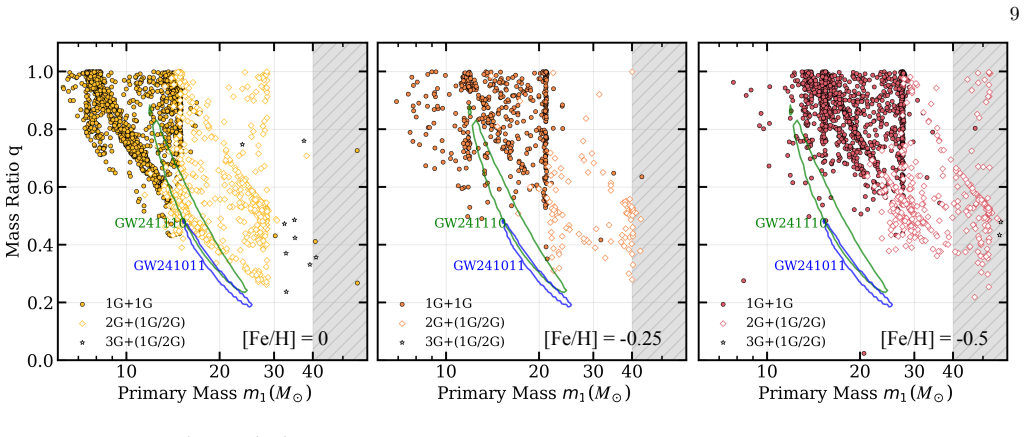
High-metallicity star clusters produce low-mass black hole mergers matching events like GW241011 and GW241110.
A machine-rendered reading of the paper's core claim, the machinery that carries it, and where it could break.
Core claim
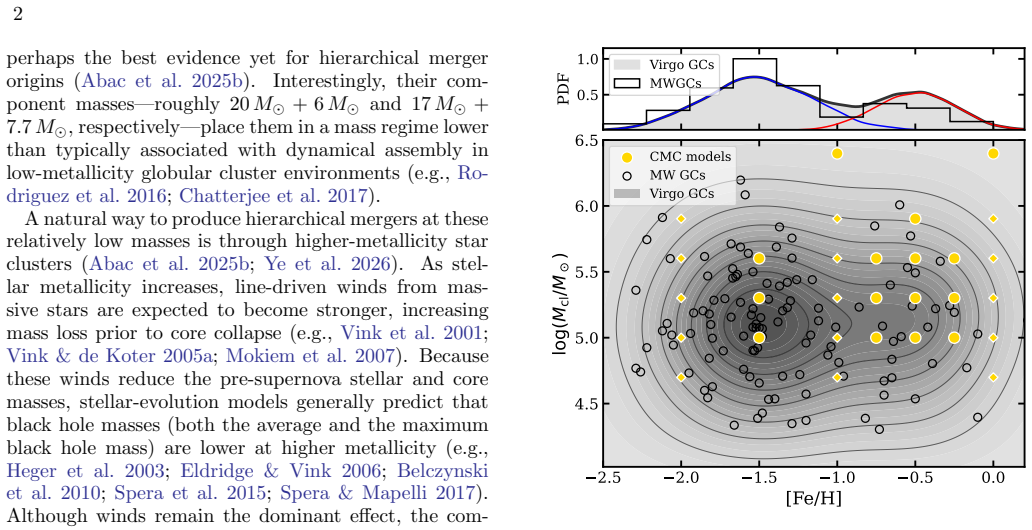
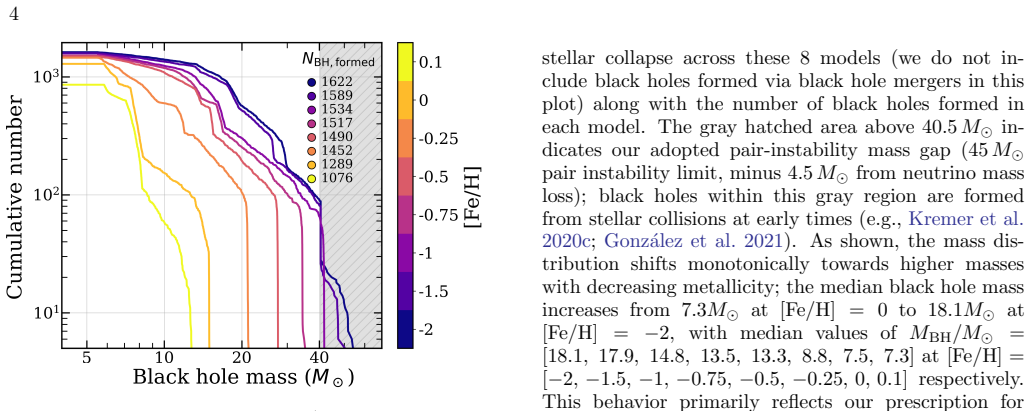
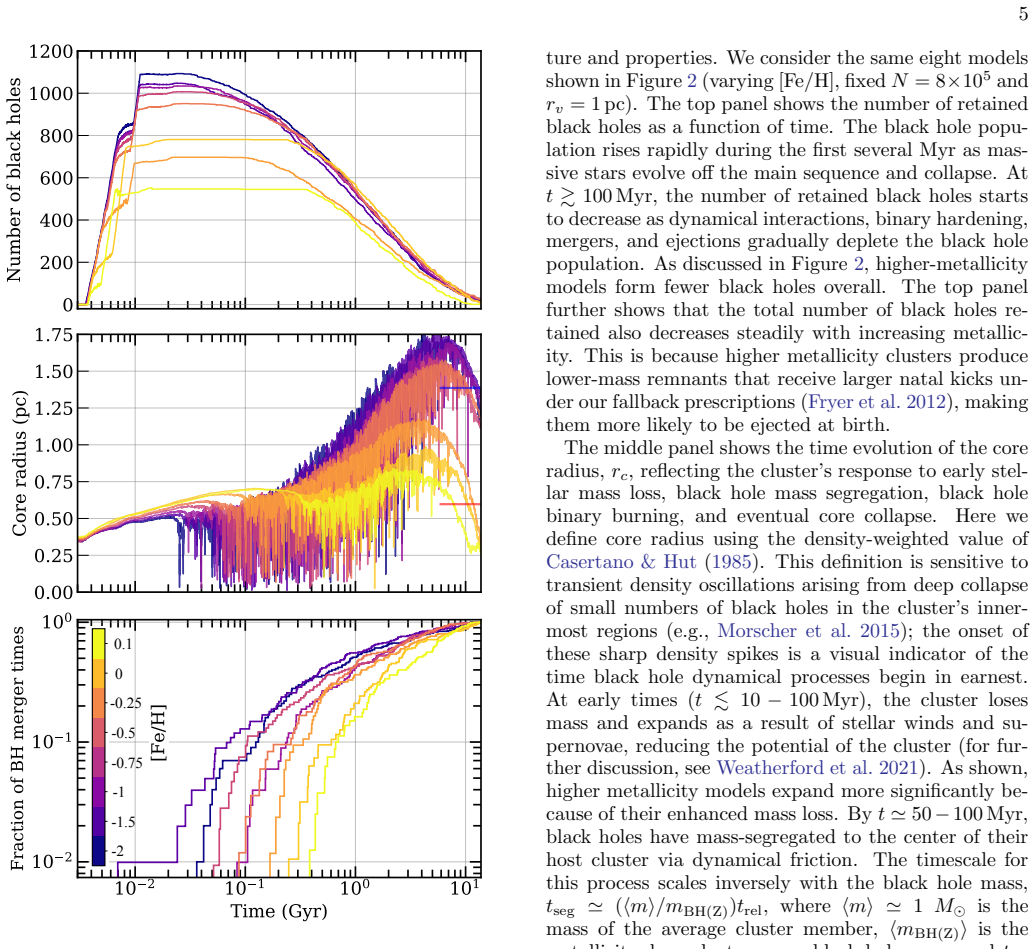
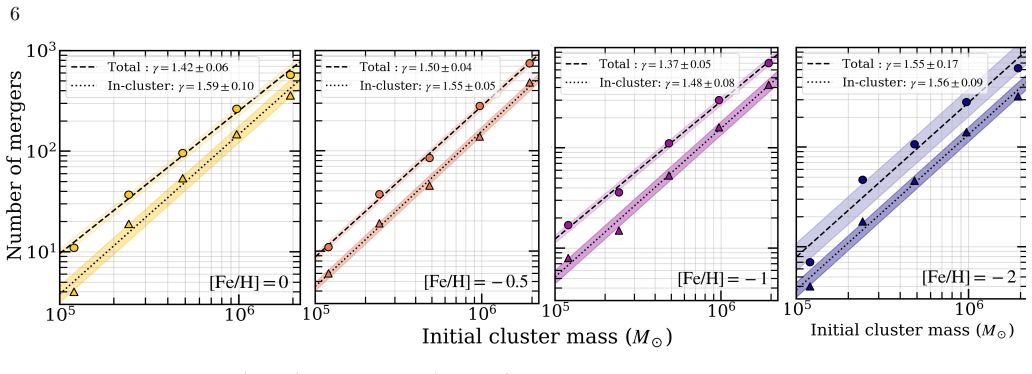
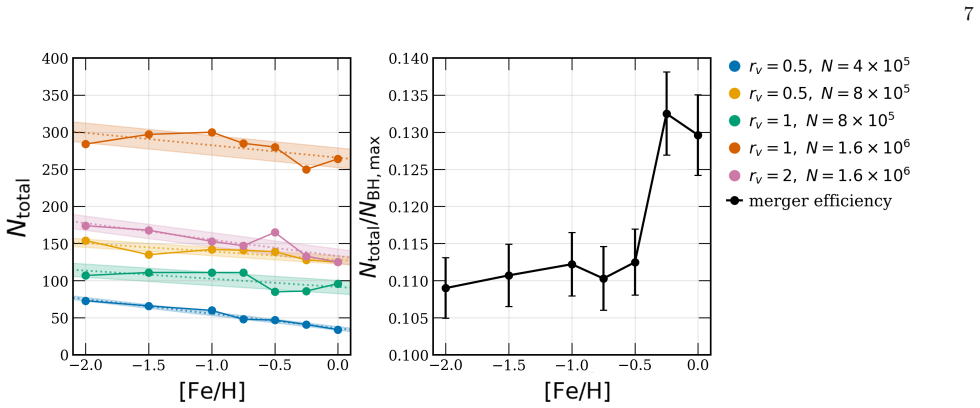
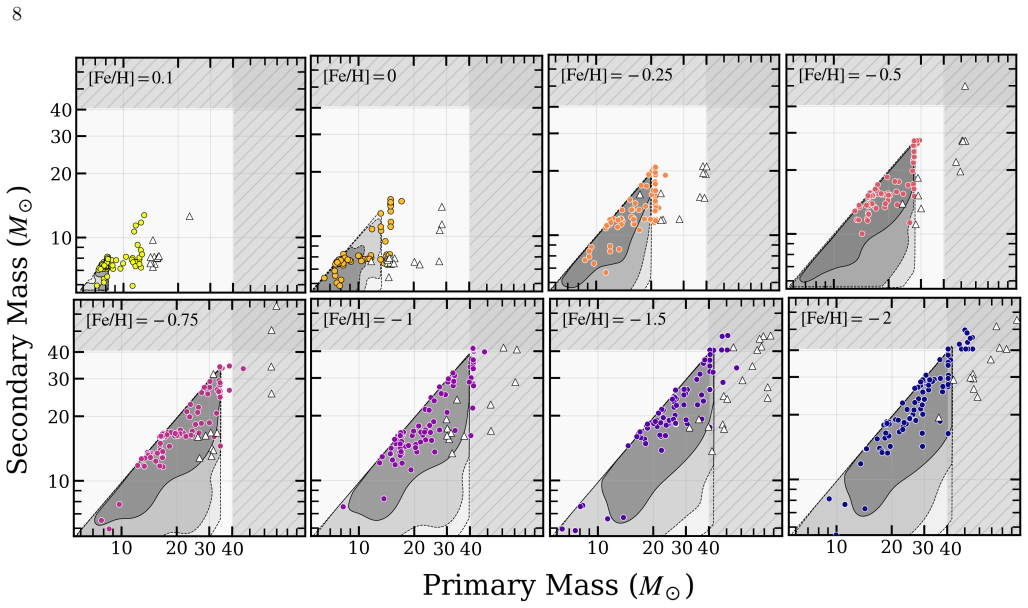
High-metallicity cluster models produce low-mass hierarchical mergers consistent with the mass ratios and component masses of GW241011 and GW241110. Metallicity has a significant effect on the mass function of black holes and black hole mergers, the total number of black hole mergers per cluster, black hole retention from natal kicks, the mass segregation time for black-hole-driven cluster dynamics, and the merger delay time distribution.
What carries the argument
Monte Carlo star cluster simulations with refined coverage in metallicity for clusters with [Fe/H] ≥ -1 that track stellar evolution, black hole formation, retention, and dynamical interactions.
If this is right
- Higher metallicity reduces the masses of black holes formed in clusters.
- Black hole retention after natal kicks decreases at higher metallicity.
- The onset of black-hole-driven mass segregation occurs later in high-metallicity clusters.
- Merger delay time distributions shift with metallicity.
- Low-mass hierarchical mergers become viable in high-metallicity settings.
Where Pith is reading between the lines
- The red versus blue globular cluster subpopulations may contribute differently to the overall gravitational wave merger rate.
- Future catalogs could reveal trends between merger masses and the metallicity of host galaxies.
- Population synthesis models for gravitational wave sources should incorporate explicit metallicity variations across cluster environments.
Load-bearing premise
The Monte Carlo code and its input physics accurately capture metallicity-dependent black hole retention and dynamics without dominant systematic biases from untested modeling choices.
What would settle it
A future LIGO-Virgo-KAGRA catalog that shows no population of low-mass hierarchical mergers preferentially associated with high-metallicity environments would falsify the claim that such clusters explain events like GW241011 and GW241110.
Figures
read the original abstract
Dense star clusters are a well-established environment for the formation of gravitational wave sources through dynamical interactions. Recent LIGO-Virgo-KAGRA (LVK) events such as GW241011 and GW241110 provide some of the best evidence yet for a dynamical origin. However, their relatively low component masses are in tension with predictions from low-metallicity globular cluster models (which typically produce more massive black holes), hinting that these events may have originated in higher-metallicity environments. Here we present a new set of Monte Carlo star cluster simulations with refined coverage in metallicity, focusing specifically on clusters with [Fe/H] $\geq-1$, similar to the ''red'' globular cluster subpopulation observed in most galaxies. We show that metallicity has a significant effect on the mass function of black holes and black hole mergers, the total number of black hole mergers per cluster, black hole retention from natal kicks, the mass segregation time for black-hole-driven cluster dynamics, and the merger delay time distribution. We also show that high-metallicity cluster models produce low-mass hierarchical mergers consistent with the mass ratios and component masses of GW241011 and GW241110, motivating the importance of high-metallicity clusters in the astrophysical interpretation of future LVK catalogs.
Editorial analysis
A structured set of objections, weighed in public.
Referee Report
Summary. The manuscript presents Monte Carlo simulations of dense star clusters at metallicities [Fe/H] ≥ −1. It reports that metallicity strongly modulates black-hole mass functions, merger rates per cluster, natal-kick retention, mass-segregation timescales, and merger delay-time distributions. The central result is that the high-metallicity (“red”) models generate low-mass hierarchical mergers whose component masses and mass ratios are consistent with the LVK events GW241011 and GW241110, thereby motivating a dynamical origin for these events in higher-metallicity cluster environments.
Significance. If the modeling assumptions prove robust, the work supplies a concrete astrophysical channel that can reconcile the relatively low masses of certain LVK events with dynamical formation, broadening the set of environments that must be considered when interpreting the growing catalog of binary black-hole mergers.
major comments (3)
- [Abstract and §4] Abstract and §4 (results on hierarchical mergers): the statement that high-metallicity models produce mergers “consistent with” GW241011 and GW241110 is presented without any quantitative measure (overlap integral, Kolmogorov–Smirnov statistic, or posterior probability) of the match in component masses and mass ratios; the claim therefore remains qualitative.
- [Methods (§2–3)] Methods (§2–3, stellar evolution and kick prescriptions): the reported BH mass function, retention fraction, and consequent low-mass hierarchical population at [Fe/H] ≥ −1 rest on a single set of metallicity-dependent wind, core-collapse, and natal-kick prescriptions inside the Monte Carlo integrator. No sensitivity runs with alternate wind scalings (e.g., updated Vink) or fallback-modulated kicks are shown, even though such changes are known to shift the upper BH mass cutoff by several solar masses and retention by factors of ∼2 at these metallicities.
- [§4 and discussion] §4 and discussion: no comparison is made between the simulated high-metallicity merger population and independent observational constraints on high-[Fe/H] clusters (e.g., BH retention inferred from X-ray binaries or dynamical mass-to-light ratios), leaving the weakest modeling assumption untested against data.
minor comments (2)
- [Table 1] Table 1 (simulation grid): the metallicity sampling is described only as “[Fe/H] ≥ −1”; explicit bin centers or a list of the discrete values actually run would improve reproducibility.
- [Figures] Figure captions: several panels compare “red” versus “blue” subpopulations but do not state the exact [Fe/H] thresholds used to define each subpopulation in the plotted curves.
Simulated Author's Rebuttal
We thank the referee for their constructive and detailed comments, which have helped us identify areas for improvement. We address each major comment point by point below, indicating revisions where appropriate.
read point-by-point responses
-
Referee: [Abstract and §4] Abstract and §4 (results on hierarchical mergers): the statement that high-metallicity models produce mergers “consistent with” GW241011 and GW241110 is presented without any quantitative measure (overlap integral, Kolmogorov–Smirnov statistic, or posterior probability) of the match in component masses and mass ratios; the claim therefore remains qualitative.
Authors: We agree that the consistency statement is qualitative. In the revised manuscript we will add a quantitative assessment in §4 (and update the abstract accordingly), for example by reporting the fraction of simulated mergers whose component masses and mass ratios lie within the 90% credible intervals of the LVK events and/or by performing a simple two-sample KS test on the relevant distributions. revision: yes
-
Referee: [Methods (§2–3)] Methods (§2–3, stellar evolution and kick prescriptions): the reported BH mass function, retention fraction, and consequent low-mass hierarchical population at [Fe/H] ≥ −1 rest on a single set of metallicity-dependent wind, core-collapse, and natal-kick prescriptions inside the Monte Carlo integrator. No sensitivity runs with alternate wind scalings (e.g., updated Vink) or fallback-modulated kicks are shown, even though such changes are known to shift the upper BH mass cutoff by several solar masses and retention by factors of ∼2 at these metallicities.
Authors: The adopted prescriptions follow the standard metallicity-dependent implementations in the Monte Carlo code (Vink wind scaling and fallback-modulated kicks). Performing a full suite of sensitivity runs would require substantial additional computational resources beyond the scope of the present study. We will, however, expand the methods and discussion sections to explicitly discuss the sensitivity of our results to these choices, citing literature on alternate wind and kick models and noting the expected direction of changes. revision: partial
-
Referee: [§4 and discussion] §4 and discussion: no comparison is made between the simulated high-metallicity merger population and independent observational constraints on high-[Fe/H] clusters (e.g., BH retention inferred from X-ray binaries or dynamical mass-to-light ratios), leaving the weakest modeling assumption untested against data.
Authors: We will add a dedicated paragraph in the discussion that qualitatively compares our predicted BH retention fractions and merger rates at [Fe/H] ≥ −1 with existing constraints from X-ray binary populations in metal-rich environments. We will also note the current scarcity of direct dynamical mass-to-light ratio measurements for high-metallicity clusters and the limitations this imposes on quantitative tests. revision: yes
Circularity Check
No circularity: forward Monte Carlo simulations compared to observations
full rationale
The paper runs Monte Carlo cluster simulations at specified metallicities using standard input physics (stellar evolution, kicks, binary interactions) and reports output distributions of BH masses, retention, merger rates, and delay times. These are compared to GW events for consistency. No equations, fitted parameters, or self-citations reduce any reported match to a quantity defined or fitted from the same data. The derivation chain consists of independent forward modeling whose outputs are not forced by construction to reproduce the target observations.
Axiom & Free-Parameter Ledger
Reference graph
Works this paper leans on
-
[1]
G., Abouelfettouh, I., Acernese, F., et al
Abac, A. G., Abouelfettouh, I., Acernese, F., et al. 2025a, ApJL, 993, L25, doi: 10.3847/2041-8213/ae0c9c —. 2025b, ApJL, 993, L21, doi: 10.3847/2041-8213/ae0d54
-
[2]
Abbott, B. P., Abbott, R., Abbott, T. D., et al. 2016a, PhRvL, 116, 061102, doi: 10.1103/PhysRevLett.116.061102 —. 2016b, PhRvL, 116, 241103, doi: 10.1103/PhysRevLett.116.241103
-
[3]
Abbott, R., Abbott, T. D., Abraham, S., et al. 2020, PhRvL, 125, 101102, doi: 10.1103/PhysRevLett.125.101102
-
[4]
Andrews, J. J., Bavera, S. S., Briel, M., et al. 2025, ApJS, 281, 3, doi: 10.3847/1538-4365/adfb78
-
[5]
2020, PhRvD, 102, 123016, doi: 10.1103/PhysRevD.102.123016
Antonini, F., & Gieles, M. 2020, PhRvD, 102, 123016, doi: 10.1103/PhysRevD.102.123016
-
[6]
2018, MNRAS, 478, 1844, doi: 10.1093/mnras/sty1186
Askar, A., Arca Sedda, M., & Giersz, M. 2018, MNRAS, 478, 1844, doi: 10.1093/mnras/sty1186
-
[7]
2017, MNRAS, 464, L36, doi: 10.1093/mnrasl/slw177
Askar, A., Szkudlarek, M., Gondek-Rosi´ nska, D., Giersz, M., & Bulik, T. 2017, MNRAS, 464, L36, doi: 10.1093/mnrasl/slw177
-
[8]
2017, MNRAS, 467, 524, doi: 10.1093/mnras/stw3392
Banerjee, S. 2017, MNRAS, 467, 524, doi: 10.1093/mnras/stw3392
-
[9]
Barmby, P., Holland, S., & Huchra, J. P. 2002, AJ, 123, 1937, doi: 10.1086/339667
-
[10]
Belczynski, K., Bulik, T., Fryer, C. L., et al. 2010, ApJ, 714, 1217, doi: 10.1088/0004-637X/714/2/1217
-
[11]
Belczynski, K., Kalogera, V., Rasio, F. A., et al. 2008, ApJS, 174, 223, doi: 10.1086/521026
work page internal anchor Pith review doi:10.1086/521026 2008
-
[12]
2016, A&A, 594, A97, doi: 10.1051/0004-6361/201628980
Belczynski, K., Heger, A., Gladysz, W., et al. 2016, A&A, 594, A97, doi: 10.1051/0004-6361/201628980
-
[13]
1944, MNRAS, 104, 273, doi: 10.1093/mnras/104.5.273
Bondi, H., & Hoyle, F. 1944, MNRAS, 104, 273, doi: 10.1093/mnras/104.5.273
-
[14]
Breen, P. G., & Heggie, D. C. 2013, MNRAS, 432, 2779, doi: 10.1093/mnras/stt628
-
[15]
2020, ApJ, 898, 71, doi: 10.3847/1538-4357/ab9d85
Breivik, K., Coughlin, S., Zevin, M., et al. 2020, ApJ, 898, 71, doi: 10.3847/1538-4357/ab9d85
-
[16]
Brodie, J. P., & Strader, J. 2006, ARA&A, 44, 193, doi: 10.1146/annurev.astro.44.051905.092441
-
[17]
2021, Nature, 589, 29, doi: 10.1038/s41586-020-03059-w
Burrows, A., & Vartanyan, D. 2021, Nature, 589, 29, doi: 10.1038/s41586-020-03059-w
-
[18]
1985, ApJ, 298, 80, doi: 10.1086/163589
Casertano, S., & Hut, P. 1985, ApJ, 298, 80, doi: 10.1086/163589
-
[19]
Chatterjee, S., Rodriguez, C. L., Kalogera, V., & Rasio, F. A. 2017, ApJL, 836, L26, doi: 10.3847/2041-8213/aa5caa
-
[20]
Verbunt, F. W. M. 2014, A&A, 563, A83, doi: 10.1051/0004-6361/201322714 12 T able 1.Summary of black hole formation and merger statistics across cluster models. The models indicated with an asterisk are models that were computed as part of the originalCMC Cluster Catalog. For consistency, with Kremer et al. (2020b); Mai et al. (2026), we preserve the same...
-
[21]
Cohen, J. G., Blakeslee, J. P., & Ryzhov, A. 1998, ApJ, 496, 808, doi: 10.1086/305429
-
[22]
M., Casares, J., Mu˜ noz-Darias, T., et al
Corral-Santana, J. M., Casares, J., Mu˜ noz-Darias, T., et al. 2016, A&A, 587, A61, doi: 10.1051/0004-6361/201527130 Di Carlo, U. N., Giacobbo, N., Mapelli, M., et al. 2019, MNRAS, 487, 2947, doi: 10.1093/mnras/stz1453
-
[23]
J., H´ enault-Brunet, V., Gieles, M., & Baumgardt, H
Dickson, N., Smith, P. J., H´ enault-Brunet, V., Gieles, M., & Baumgardt, H. 2024, MNRAS, 529, 331, doi: 10.1093/mnras/stae470
-
[24]
2023a, MNRAS, 518, 1057, doi: 10.1093/mnras/stac3140
El-Badry, K., Rix, H.-W., Quataert, E., et al. 2023a, MNRAS, 518, 1057, doi: 10.1093/mnras/stac3140
-
[25]
2023b, MNRAS, 521, 4323, doi: 10.1093/mnras/stad799
El-Badry, K., Rix, H.-W., Cendes, Y., et al. 2023b, MNRAS, 521, 4323, doi: 10.1093/mnras/stad799
-
[26]
Eldridge, J. J., & Vink, J. S. 2006, A&A, 452, 295, doi: 10.1051/0004-6361:20065001
-
[27]
Justham, S. 2019, ApJ, 887, 53, doi: 10.3847/1538-4357/ab518b
-
[28]
M., Sravan, N., Cantrell, A., et al
Farr, W. M., Sravan, N., Cantrell, A., et al. 2011, ApJ, 741, 103, doi: 10.1088/0004-637X/741/2/103
-
[29]
Fishbach, M., Holz, D. E., & Farr, B. 2017, ApJL, 840, L24, doi: 10.3847/2041-8213/aa7045
-
[30]
Fragione, G., Loeb, A., & Rasio, F. A. 2020, ApJL, 902, L26, doi: 10.3847/2041-8213/abbc0a
-
[31]
Fragos, T., Andrews, J. J., Bavera, S. S., et al. 2023, ApJS, 264, 45, doi: 10.3847/1538-4365/ac90c1
-
[32]
L., Belczynski, K., Wiktorowicz, G., et al
Fryer, C. L., Belczynski, K., Wiktorowicz, G., et al. 2012, ApJ, 749, 91, doi: 10.1088/0004-637X/749/1/91 Gaia Collaboration, Panuzzo, P., Mazeh, T., et al. 2024, A&A, 686, L2, doi: 10.1051/0004-6361/202449763
-
[33]
Gerosa, D., & Fishbach, M. 2021a, Nature Astronomy, 5, 749, doi: 10.1038/s41550-021-01398-w —. 2021b, Nature Astronomy, 5, 749, doi: 10.1038/s41550-021-01398-w
-
[34]
2018, MNRAS, 474, 2959, doi: 10.1093/mnras/stx2933
Giacobbo, N., Mapelli, M., & Spera, M. 2018, MNRAS, 474, 2959, doi: 10.1093/mnras/stx2933
-
[35]
2018, MNRAS, 475, L15, doi: 10.1093/mnrasl/slx203
Giesers, B., Dreizler, S., Husser, T.-O., et al. 2018, MNRAS, 475, L15, doi: 10.1093/mnrasl/slx203
-
[36]
Giesers, B., Kamann, S., Dreizler, S., et al. 2019, A&A, 632, A3, doi: 10.1051/0004-6361/201936203 Gonz´ alez, E., Kremer, K., Chatterjee, S., et al. 2021, ApJL, 908, L29, doi: 10.3847/2041-8213/abdf5b Gonz´ alez Prieto, E., Weatherford, N. C., Fragione, G.,
-
[37]
Kremer, K., & Rasio, F. A. 2024, ApJ, 969, 29, doi: 10.3847/1538-4357/ad43d6
-
[38]
Harris, W. E. 1996; 2010 edition, AJ, 112, 1487, doi: 10.1086/118116 —. 2009, ApJ, 703, 939, doi: 10.1088/0004-637X/703/1/939
-
[39]
Hartmann, D. H. 2003, ApJ, 591, 288, doi: 10.1086/375341
-
[40]
Heinke, C. O., Grindlay, J. E., Lugger, P. M., et al. 2003, ApJ, 598, 501, doi: 10.1086/378885
-
[41]
Hjellming, M. S., & Webbink, R. F. 1987, ApJ, 318, 794, doi: 10.1086/165412
-
[42]
Hobbs, G., Lorimer, D. R., Lyne, A. G., & Kramer, M. 2005, MNRAS, 360, 974, doi: 10.1111/j.1365-2966.2005.09087.x
-
[43]
Hong, J., Vesperini, E., Askar, A., et al. 2018, MNRAS, 480, 5645, doi: 10.1093/mnras/sty2211
-
[44]
Hurley, J. R., Tout, C. A., & Pols, O. R. 2002, MNRAS, 329, 897, doi: 10.1046/j.1365-8711.2002.05038.x Jord´ an, A., Peng, E. W., Blakeslee, J. P., et al. 2009, ApJS, 180, 54, doi: 10.1088/0067-0049/180/1/54
-
[45]
Kimball, C., Talbot, C., Berry, C. P. L., et al. 2021, ApJL, 915, L35, doi: 10.3847/2041-8213/ac0aef Kıro˘ glu, F., Kremer, K., Biscoveanu, S., Gonz´ alez Prieto, E., & Rasio, F. A. 2025a, ApJ, 979, 237, doi: 10.3847/1538-4357/ada26b Kıro˘ glu, F., Kremer, K., & Rasio, F. A. 2025b, ApJL, 994, L37, doi: 10.3847/2041-8213/ae1eeb
-
[46]
2026, in Encyclopedia of Astrophysics, Volume 3, Vol
Kremer, K. 2026, in Encyclopedia of Astrophysics, Volume 3, Vol. 3, 458–472, doi: 10.1016/B978-0-443-21439-4.00103-6
-
[47]
Rasio, F. A. 2019, ApJ, 871, 38, doi: 10.3847/1538-4357/aaf646
-
[48]
Kremer, K., Rui, N. Z., Weatherford, N. C., et al. 2021, ApJ, 917, 28, doi: 10.3847/1538-4357/ac06d4
-
[49]
Kremer, K., Weatherford, N. C., Hopkins, P. F., Rui, N. Z., & Ye, C. S. 2025, ApJL, 993, L34, doi: 10.3847/2041-8213/ae1233
-
[50]
Rasio, F. A. 2020a, in IAU Symposium, Vol. 351, Star Clusters: From the Milky Way to the Early Universe, ed. A. Bragaglia, M. Davies, A. Sills, & E. Vesperini, 357–366, doi: 10.1017/S1743921319007269
-
[51]
Kremer, K., Ye, C. S., Rui, N. Z., et al. 2020b, ApJS, 247, 48, doi: 10.3847/1538-4365/ab7919
-
[52]
2020c, ApJ, 903, 45, doi: 10.3847/1538-4357/abb945
Kremer, K., Spera, M., Becker, D., et al. 2020c, ApJ, 903, 45, doi: 10.3847/1538-4357/abb945
-
[53]
Kroupa, P. 2001, MNRAS, 322, 231, doi: 10.1046/j.1365-8711.2001.04022.x
-
[54]
Kundu, A., Maccarone, T. J., & Zepf, S. E. 2002, ApJL, 574, L5, doi: 10.1086/342353
-
[55]
Kundu, A., Maccarone, T. J., Zepf, S. E., & Puzia, T. H. 2003, ApJL, 589, L81, doi: 10.1086/376493 14
-
[56]
Lanzoni, B., Ferraro, F. R., Dalessandro, E., et al. 2010, ApJ, 717, 653, doi: 10.1088/0004-637X/717/2/653
-
[57]
Maccarone, T. J., Kundu, A., Zepf, S. E., & Rhode, K. L. 2007, Nature, 445, 183, doi: 10.1038/nature05434
-
[58]
Mackey, A. D., Wilkinson, M. I., Davies, M. B., & Gilmore, G. F. 2008, MNRAS, 386, 65, doi: 10.1111/j.1365-2966.2008.13052.x
-
[59]
Mai, A., Kremer, K., & Kıro˘ glu, F. 2026, ApJ, 998, 138, doi: 10.3847/1538-4357/ae2de5
-
[60]
2024, ARA&A, 62, 21, doi: 10.1146/annurev-astro-052722-105936
Marchant, P., & Bodensteiner, J. 2024, ARA&A, 62, 21, doi: 10.1146/annurev-astro-052722-105936
-
[61]
Mokiem, M. R., de Koter, A., Vink, J. S., et al. 2007, A&A, 473, 603, doi: 10.1051/0004-6361:20077545
-
[62]
Morscher, M., Pattabiraman, B., Rodriguez, C., Rasio, F. A., & Umbreit, S. 2015, ApJ, 800, 9, doi: 10.1088/0004-637X/800/1/9 O’Connor, C. E., Kremer, K., Agrawal, S., et al. 2026a, arXiv e-prints, arXiv:2606.14846, doi: 10.48550/arXiv.2606.14846 O’Connor, C. E., Kremer, K., & Rasio, F. A. 2026b, arXiv e-prints, arXiv:2604.02412, doi: 10.48550/arXiv.2604.02412
-
[63]
2011, ApJS, 192, 3, doi: 10.1088/0067-0049/192/1/3
Paxton, B., Bildsten, L., Dotter, A., et al. 2011, ApJS, 192, 3, doi: 10.1088/0067-0049/192/1/3
-
[64]
W., Jord´ an, A., Cˆ ot´ e, P., et al
Peng, E. W., Jord´ an, A., Cˆ ot´ e, P., et al. 2006, ApJ, 639, 95, doi: 10.1086/498210
-
[65]
Peters, P. C. 1964, Physical Review, 136, 1224, doi: 10.1103/PhysRev.136.B1224
-
[66]
Pooley, D., Lewin, W. H. G., Anderson, S. F., et al. 2003, ApJL, 591, L131, doi: 10.1086/377074 Portegies Zwart, S. F., & McMillan, S. L. W. 2000, ApJL, 528, L17, doi: 10.1086/312422 Portegies Zwart, S. F., McMillan, S. L. W., & Gieles, M. 2010, ARA&A, 48, 431, doi: 10.1146/annurev-astro-081309-130834
-
[67]
L., Chatterjee, S., & Rasio, F
Rodriguez, C. L., Chatterjee, S., & Rasio, F. A. 2016, PhRvD, 93, 084029, doi: 10.1103/PhysRevD.93.084029
-
[68]
Rodriguez, C. L., Hafen, Z., Grudi´ c, M. Y., et al. 2023, MNRAS, 521, 124, doi: 10.1093/mnras/stad578
-
[69]
Rodriguez, C. L., Zevin, M., Amaro-Seoane, P., et al. 2019, PhRvD, 100, 043027, doi: 10.1103/PhysRevD.100.043027
-
[70]
Rodriguez, C. L., Weatherford, N. C., Coughlin, S. C., et al. 2022, ApJS, 258, 22, doi: 10.3847/1538-4365/ac2edf
-
[71]
2018, PhRvD, 97, 103014, doi: 10.1103/PhysRevD.97.103014
Samsing, J. 2018, PhRvD, 97, 103014, doi: 10.1103/PhysRevD.97.103014
-
[72]
Samsing, J., D’Orazio, D. J., Kremer, K., Rodriguez, C. L., & Askar, A. 2020, PhRvD, 101, 123010, doi: 10.1103/PhysRevD.101.123010
-
[73]
Science , archivePrefix = "arXiv", eprint =
Sana, H., de Mink, S. E., de Koter, A., et al. 2012, Science, 337, 444, doi: 10.1126/science.1223344
-
[74]
2017, MNRAS, 470, 4739, doi: 10.1093/mnras/stx1576
Spera, M., & Mapelli, M. 2017, MNRAS, 470, 4739, doi: 10.1093/mnras/stx1576
-
[75]
2015, MNRAS, 451, 4086, doi: 10.1093/mnras/stv1161
Spera, M., Mapelli, M., & Bressan, A. 2015, MNRAS, 451, 4086, doi: 10.1093/mnras/stv1161
-
[76]
2019, MNRAS, 485, 889, doi: 10.1093/mnras/stz359
Spera, M., Mapelli, M., Giacobbo, N., et al. 2019, MNRAS, 485, 889, doi: 10.1093/mnras/stz359
-
[77]
Strader, J., Chomiuk, L., Maccarone, T. J., Miller-Jones, J. C. A., & Seth, A. C. 2012, Nature, 490, 71, doi: 10.1038/nature11490
-
[78]
Strader, J., Romanowsky, A. J., Brodie, J. P., et al. 2011, ApJS, 197, 33, doi: 10.1088/0067-0049/197/2/33
-
[79]
Janka, H.-T. 2016, ApJ, 821, 38, doi: 10.3847/0004-637X/821/1/38 The LIGO Scientific Collaboration, the Virgo Collaboration, the KAGRA Collaboration, et al. 2025, arXiv e-prints, arXiv:2508.18082, doi: 10.48550/arXiv.2508.18082
work page internal anchor Pith review Pith/arXiv arXiv doi:10.3847/0004-637x/821/1/38 2016
-
[80]
Usher, C., Forbes, D. A., Brodie, J. P., et al. 2012, MNRAS, 426, 1475, doi: 10.1111/j.1365-2966.2012.21801.x
discussion (0)
Sign in with ORCID, Apple, or X to comment. Anyone can read and Pith papers without signing in.