REVIEW 3 major objections 4 minor 30 references
LeanMem: Simple and Efficient Long-Term Memory for LLM Agents
T0 review · 3 major / 4 minor · reviewed 2026-08-05 · deepseek-v4-flash
Pith's one-line read An LLM-agent memory that routes dialogue into profiles, events, and records outperforms uniform-summarization memories on two long-context benchmarks, with equal or lower cost.
desk verdict Worth reading: the heterogeneous memory routing is a real idea with strong ablation support, but the headline accuracy gain is measured by a judge from the same model family as the backbone, so the magnitude is not yet trustworthy. read the letter →
The pith
A machine-rendered reading of the paper's core claim, the machinery that carries it, and where it could break.
The reading
What carries the argument
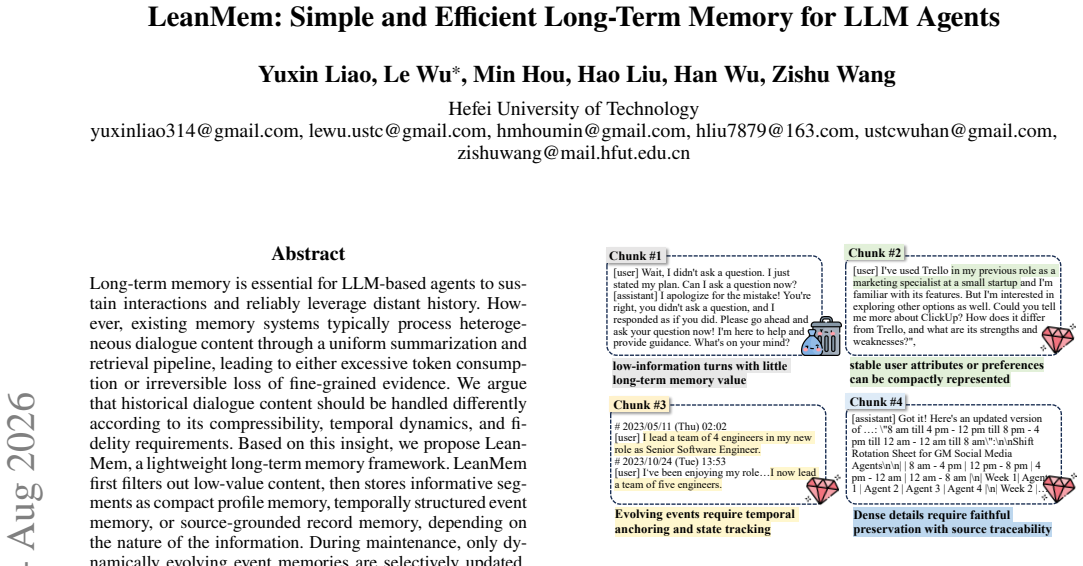
The carrying mechanism is a three-way write routing decision (Eq. 3–5): each topic segment is mapped to one of four actions—ignore, profile, event, record—by an LLM scheduler that evaluates stability, temporal dependence, and fidelity requirement, with temporal dependence and fidelity overriding stability when they conflict. The resulting heterogeneous memory bank M = M_profile ∪ M_event ∪ M_record is then maintained by a deferred event-consolidation buffer and queried via a per-query retrieval plan π_q = ⟨C_q, d_q, M_q, w_q, k_q⟩ that fixes memory types, weights, and retrieval depths; retrieval scores combine type-specific relevance with constraint matching. The record type's pointer to ori
What would settle it
Two concrete tests would settle it: (1) have human annotators label a sample of topic segments by intended route and measure agreement with the LLM scheduler; if agreement is low yet accuracy stays high, the routing labels aren't doing the work attributed to them. (2) Score the same generated answers with two different judge models (e.g., one from a different family) and with LoCoMo Category 5 (adversarial/unanswerable questions) included; if the reported accuracy gap shrinks to within judge disagreement, the headline margin is an artifact of the judge or the excluded questions.
Extended reading notes
Core claim
On the paper's own terms, the discovery is that the efficiency–fidelity trade-off in agent memory is not a single knob: it is a per-segment choice among representations of different granularity. LeanMem operationalises this as a write scheduler that scores each topic segment on stability, temporal dependence, and fidelity requirement, then routes it to profile, event, record, or ignore memory. Event memory is the only dynamic store; records remain immutable but traceable, so fine-grained evidence survives without being copied into summaries. Retrieval is then planned per query as a tuple of memory types, weights, and depths, and the retrieved evidence is reranked with type-specific relevance
Load-bearing premise
The entire accuracy gain rests on the LLM scheduler and planner making reliable routing and retrieval-budget decisions, and on the LLM judge measuring accuracy fairly; neither is independently validated beyond the end-to-end result.
Editorial extensions
If this is right
- Long-horizon agent tasks can keep detailed evidence cheaply by storing pointers to raw dialogue rather than summarizing everything.
- Memory systems can cut maintenance cost by not re-consolidating stable profiles and immutable records.
- Query-adaptive retrieval budgeting prevents expensive multi-hop retrieval for questions that need only a profile lookup, improving latency.
- The design transfers across closed and open backbone models (GPT-4.1-mini and Qwen3-8B), suggesting the gains come from the memory design rather than the model.
- The heterogeneous routing reduces construction tokens substantially compared with eager summarization methods such as A-Mem.
Reading between the lines
- The taxonomy suggests the method's advantage should be largest on conversations that mix stable facts, evolving states, and detail-dense artifacts; on purely chit-chat corpora the profile/event/record split collapses to mostly ignore/record, which predicts smaller gains—a testable prediction the paper does not make.
- Record memory's pointers keep raw dialogue retained indefinitely; to bound storage in truly unbounded conversations, some future compaction of old records would be needed, and the paper does not address when pointer retention should give way to summarization.
- Because the scheduler and planner are the same LLM as the backbone, the marginal cost of routing may drop further with a smaller distilled router; the paper's design separates representation from backbone, making this a natural extension.
- The category-level results imply a decision rule for practitioners: if a workload is dominated by knowledge updates and multi-session tracking, event memory evolution is the component to keep; if dominated by detail lookups, record memory and pointer traceback matter more.
Editorial analysis
A structured set of objections, weighed in public.
Referee Report
Summary. The paper proposes LeanMem, a long-term memory framework for LLM agents that routes dialogue segments into heterogeneous memory types—profile, event, and record—according to compressibility, temporal dynamics, and fidelity requirements, while selectively evolving only event memories and planning query-specific retrieval budgets. The authors report consistent accuracy gains over six baselines on LoCoMo and LongMemEval-S with both GPT-4.1-mini and Qwen3-8B, at lower or comparable token and latency cost, and provide ablations attributing the largest gain to the heterogeneous storage schedule.
Significance. If the reported results hold, the paper makes a useful and practical contribution: it challenges the uniform summarization-and-retrieval pipeline common in agent memory systems and shows that content-dependent routing plus selective evolution can improve accuracy while reducing cost. The ablations in Table 2 are informative, and the design is simple enough to reproduce. However, the central evaluation currently rests on an unvalidated LLM-judge protocol, and the headline accuracy gains—especially the +15.07 point result on LongMemEval-S—are not yet independently corroborated. The open-source backbone result (+2.80) is far smaller, so the evaluation protocol is load-bearing.
major comments (3)
- [Section 4.1] Accuracy is LLM-judged by GPT-4.1-mini, and the closed-source system also uses GPT-4.1-mini as the scheduler, planner, and answer generator. The largest reported gain (+15.07 on LongMemEval-S) is measured in this self-judged configuration, while with Qwen3-8B the gain over the strongest baseline is only +2.80. This asymmetry is consistent with a judge-backbone confound, and no human agreement study, alternate-judge check, or error analysis of the judge is reported. Since all accuracy numbers flow through this judge, the central claim is not independently validated. Please provide human-annotated agreement or an independent judge (e.g., GPT-4.1 or a different model family) on a sample.
- [Section 4.1] LoCoMo Category 5 (adversarial/unanswerable questions) is excluded, with the stated reason that it has no gold answers. This removes exactly the questions that test for hallucination and faithfulness. Excluding the hardest category may inflate the perceived advantage of a memory system that could fabricate details. The paper should report performance on Category 5 separately, or at minimum provide a human evaluation of unanswerable/adversarial cases, and justify why the exclusion does not limit the claim of improved answer accuracy.
- [Sections 3.2 and 3.4] The entire method depends on the LLM scheduler and planner correctly classifying segments into ignore/profile/event/record (Eqs. 3–5) and correctly choosing memory types and retrieval budgets per query (Eq. 8). The paper reports no agreement statistics, confusion matrices, or error analysis for these decisions. If the scheduler misroutes detail-critical content to the wrong memory type, the proposed fidelity advantage disappears. Please report routing accuracy on a labeled subset or an ablation that perturbs routing decisions, so readers can see how sensitive accuracy is to scheduler errors.
minor comments (4)
- [Table 1] The table has formatting typos: '157.604.56' and '95.3274.60' should be separated into token and accuracy values; text also contains '2.16,s' in Section 4.2.
- [Equation 2] The topic-boundary threshold coefficient 0.05 appears ad hoc. Please report sensitivity to this coefficient or justify the choice.
- [Appendix references] The text references Appendix A–D for baseline details, implementation details, and prompts, but the appendices are not included in the manuscript. Please ensure they are present in the final version or provide the essential details in the main text.
- [General] The abstract and introduction promise code and datasets in supplementary materials, but no artifact link or repository identifier is given. Please provide a stable link.
Circularity Check
No significant circularity: the central accuracy gains are benchmark-measured with fixed design choices and component ablations; the mild self-citation is not load-bearing.
full rationale
LeanMem's central claim is an empirical comparison on external benchmarks (LoCoMo, LongMemEval-S) against six baselines. The architecture—key-utterance filtering, topic segmentation, write scheduling into profile/event/record memory, selective event evolution, and query-adaptive retrieval planning—is fixed before evaluation; no parameter is fitted to the reported test accuracy. Equation (3) formalizes a write-scheduling objective, but the paper explicitly operationalizes it through fixed routing criteria rather than estimating C(·) and L(·) from outcomes, so it is not a prediction that reduces to its own fitted input. Equation (8) and the reranking score (9) are design mechanisms, not restatements of the Accuracy metric. Table 2's ablations isolate each component's contribution, most notably the storage schedule, showing the gain is tied to the proposed heterogeneous routing rather than to a hidden reuse of the benchmark labels. The only self-citation (Liao et al. 2026) appears in a general introductory sentence about memory enabling agents to retain knowledge and is not load-bearing for any derivation or uniqueness claim. The evaluation protocol uses GPT-4.1-mini as an LLM judge while GPT-4.1-mini also serves as a backbone in the closed-source setting; this is a legitimate external-validity concern about judge-backbone confounding, but it is not a circularity of the kind where a predicted quantity is equivalent by construction to its input. The paper's empirical results stand as measured on external benchmarks, so the circularity score is 0.
Assumptions & free parameters
free parameters (4)
- topic boundary threshold coefficient =
0.05
- similarity window size w =
unspecified
- event buffer capacity =
unspecified (predefined)
- per-query retrieval budget k_q =
chosen by LLM planner per query
assumptions (5)
- domain assumption Cosine similarity between adjacent sentence embeddings is a reliable signal for detecting topic transitions in dialogue.
- domain assumption User utterances carry all routing-relevant information, so assistant responses can be dropped from routing anchors without losing needed evidence.
- domain assumption Stability, temporal dependence, and fidelity requirement are sufficient and mutually distinguishable dimensions for choosing a storage form.
- ad hoc to paper LLM-judged accuracy with SimpleMem's protocol on LoCoMo Categories 1-4 is an adequate measure of long-term memory quality.
- domain assumption The additive reranking score in Eq. 9 with planner-supplied type weights validly combines relevance and constraint match.
Cite this review
Pith. "Pith review of LeanMem: Simple and Efficient Long-Term Memory for LLM Agents." pith.science (2026). https://pith.science/paper/TINYYCI4
@misc{pith2026260803463,
  author       = {Pith},
  title        = {Pith review of: LeanMem: Simple and Efficient Long-Term Memory for LLM Agents},
  year         = {2026},
  howpublished = {\url{https://pith.science/paper/TINYYCI4}},
  note         = {Machine review of arXiv:2608.03463}
}
read the original abstract
Long-term memory is essential for LLM-based agents to sustain interactions and reliably leverage distant history. However, existing memory systems typically process heterogeneous dialogue content through a uniform summarization and retrieval pipeline, leading to either excessive token consumption or irreversible loss of fine-grained evidence. We argue that historical dialogue content should be handled differently according to its compressibility, temporal dynamics, and fidelity requirements. Based on this insight, we propose LeanMem, a lightweight long-term memory framework. LeanMem first filters out low-value content, then stores informative segments as compact profile memory, temporally structured event memory, or source-grounded record memory, depending on the nature of the information. During maintenance, only dynamically evolving event memories are selectively updated, avoiding redundant consolidation of stable profiles and immutable records. During inference, LeanMem dynamically selects memory types and allocates retrieval budgets according to query-specific evidence demands, assembling relevant evidence on demand. On LoCoMo and LongMemEval-S with GPT-4.1-mini and Qwen3-8B, LeanMem improves accuracy over the strongest memory-based baseline in every setting, by up to 15.1 points, at the lowest or near-lowest construction cost, inference tokens, and latency. The code and datasets are included in the supplementary materials.
Figures


Figures from the paper (2 more)


Reference graph
Works this paper leans on
-
[1]
Advances in Neural Information Processing Systems , volume=
A-mem: Agentic memory for llm agents , author=. Advances in Neural Information Processing Systems , volume=
-
[2]
arXiv preprint arXiv:2510.18866 , year=
Lightmem: Lightweight and efficient memory-augmented generation , author=. arXiv preprint arXiv:2510.18866 , year=
-
[3]
arXiv preprint arXiv:2601.02553 , year=
SimpleMem: Efficient Lifelong Memory for LLM Agents , author=. arXiv preprint arXiv:2601.02553 , year=
-
[4]
Proceedings of the 62nd Annual Meeting of the Association for Computational Linguistics (Volume 1: Long Papers) , pages=
Evaluating very long-term conversational memory of llm agents , author=. Proceedings of the 62nd Annual Meeting of the Association for Computational Linguistics (Volume 1: Long Papers) , pages=
-
[5]
arXiv preprint arXiv:2410.10813 , year=
Longmemeval: Benchmarking chat assistants on long-term interactive memory , author=. arXiv preprint arXiv:2410.10813 , year=
-
[6]
Proceedings of the 2025 Conference on Empirical Methods in Natural Language Processing , pages=
Memory os of ai agent , author=. Proceedings of the 2025 Conference on Empirical Methods in Natural Language Processing , pages=
2025
-
[7]
arXiv preprint arXiv:2512.13564 , year=
Memory in the Age of AI Agents , author=. arXiv preprint arXiv:2512.13564 , year=
-
[8]
ACM Transactions on Information Systems , volume=
A survey on the memory mechanism of large language model-based agents , author=. ACM Transactions on Information Systems , volume=. 2025 , publisher=
2025
Show all 30 references
-
[9]
arXiv preprint arXiv:2504.15965 , year=
From human memory to ai memory: A survey on memory mechanisms in the era of llms , author=. arXiv preprint arXiv:2504.15965 , year=
-
[10]
arXiv preprint arXiv:2601.16872 , year=
From Atom to Community: Structured and Evolving Agent Memory for User Behavior Modeling , author=. arXiv preprint arXiv:2601.16872 , year=
-
[11]
Proceedings of the 31st ACM SIGKDD Conference on Knowledge Discovery and Data Mining V
Agentgen: Enhancing planning abilities for large language model based agent via environment and task generation , author=. Proceedings of the 31st ACM SIGKDD Conference on Knowledge Discovery and Data Mining V. 1 , pages=
-
[12]
arXiv preprint arXiv:2510.05520 , year=
CAM: A Constructivist View of Agentic Memory for LLM-Based Reading Comprehension , author=. arXiv preprint arXiv:2510.05520 , year=
-
[13]
arXiv preprint arXiv:2504.19413 , year=
Mem0: Building production-ready ai agents with scalable long-term memory , author=. arXiv preprint arXiv:2504.19413 , year=
-
[14]
Proceedings of the 2024 Conference of the North American Chapter of the Association for Computational Linguistics: Human Language Technologies (Volume 1: Long Papers) , pages=
GLiNER: Generalist model for named entity recognition using bidirectional transformer , author=. Proceedings of the 2024 Conference of the North American Chapter of the Association for Computational Linguistics: Human Language Technologies (Volume 1: Long Papers) , pages=
2024
-
[15]
arXiv preprint arXiv:2502.05589 , year=
On memory construction and retrieval for personalized conversational agents , author=. arXiv preprint arXiv:2502.05589 , year=
-
[16]
Proceedings of the 63rd Annual Meeting of the Association for Computational Linguistics (Volume 1: Long Papers) , pages=
In prospect and retrospect: Reflective memory management for long-term personalized dialogue agents , author=. Proceedings of the 63rd Annual Meeting of the Association for Computational Linguistics (Volume 1: Long Papers) , pages=
-
[17]
Vicinagearth , volume=
A survey on LLM-based multi-agent systems: workflow, infrastructure, and challenges , author=. Vicinagearth , volume=. 2024 , publisher=
2024
-
[18]
IEEE Access , year=
From llm reasoning to autonomous ai agents: A comprehensive review , author=. IEEE Access , year=
-
[19]
arXiv preprint arXiv:2602.23008 , year=
Exploratory memory-augmented LLM agent via hybrid on-and off-policy optimization , author=. arXiv preprint arXiv:2602.23008 , year=
-
[20]
Proceedings of the 64th Annual Meeting of the Association for Computational Linguistics (Volume 1: Long Papers) , pages=
APEX-MEM: Agentic Semi-Structured Memory with Temporal Reasoning for Long-Term Conversational AI , author=. Proceedings of the 64th Annual Meeting of the Association for Computational Linguistics (Volume 1: Long Papers) , pages=
-
[21]
Proceedings of the ACM Web Conference 2026 , pages=
HingeMem: Boundary Guided Long-Term Memory with Query Adaptive Retrieval for Scalable Dialogues , author=. Proceedings of the ACM Web Conference 2026 , pages=
2026
-
[22]
arXiv preprint arXiv:2602.06052 , year=
Rethinking Memory Mechanisms of Foundation Agents in the Second Half: A Survey , author=. arXiv preprint arXiv:2602.06052 , year=
-
[23]
Proceedings of the 64th Annual Meeting of the Association for Computational Linguistics (Volume 1: Long Papers) , pages=
MemSearch-o1: Empowering Large Language Models with Reasoning-Aligned Memory Growth in Agentic Search , author=. Proceedings of the 64th Annual Meeting of the Association for Computational Linguistics (Volume 1: Long Papers) , pages=
-
[24]
arXiv preprint arXiv:2509.10852 , year=
Pre-storage reasoning for episodic memory: Shifting inference burden to memory for personalized dialogue , author=. arXiv preprint arXiv:2509.10852 , year=
-
[25]
, author=
MemGPT: towards LLMs as operating systems. , author=. 2023 , publisher=
2023
-
[26]
Proceedings of the AAAI conference on artificial intelligence , volume=
Memorybank: Enhancing large language models with long-term memory , author=. Proceedings of the AAAI conference on artificial intelligence , volume=
-
[27]
Advances in neural information processing systems , volume=
Reflexion: Language agents with verbal reinforcement learning , author=. Advances in neural information processing systems , volume=
-
[28]
arXiv preprint arXiv:2501.13956 , year=
Zep: a temporal knowledge graph architecture for agent memory , author=. arXiv preprint arXiv:2501.13956 , year=
-
[29]
Advances in neural information processing systems , volume=
Hipporag: Neurobiologically inspired long-term memory for large language models , author=. Advances in neural information processing systems , volume=
-
[30]
arXiv preprint arXiv:2512.12818 , year=
Hindsight is 20/20: Building agent memory that retains, recalls, and reflects , author=. arXiv preprint arXiv:2512.12818 , year=
Reviewed August 5, 2026 · model on record in the stance chip above.
Discussion (0). Sign in to comment.