REVIEW 4 major objections 6 minor 67 references
Curvature-Aware Zeroth-Order Optimization for Memory-Efficient Test-Time Adaptation
T0 review · 4 major / 6 minor · reviewed 2026-08-16 · deepseek-v4-flash
Pith's one-line read The paper claims that a curvature-aware zeroth-order method (CAZO) adapts a pretrained ViT at test time using only forward passes, reaching 69.0% average accuracy on ImageNet-C severity-5 while using more than 70% less memory than…
desk verdict CAZO is a real improvement over vanilla ZO for forward-only TTA, but its headline accuracy depends on clean-source statistics and the paper has technical errors that need fixing. read the letter →
The pith
A machine-rendered reading of the paper's core claim, the machinery that carries it, and where it could break.
The reading
What carries the argument
The load-bearing object is the curvature proxy $\tilde{H}_t^{-1} = \operatorname{diag}\left(D_t / (1-(1-\nu)^t)\right)$, with $D_t = (1-\nu)D_{t-1} + \nu \hat{g}^2(\theta_{t-1})$, where $\hat{g}^2$ is the element-wise square of the CAZO gradient estimate. This diagonal matrix approximates the inverse Hessian diagonal on the fly and is used as the covariance of the Gaussian perturbation in the zeroth-order estimator $\hat{g}(\theta_t) = \frac{1}{k}\sum_{i=1}^k \frac{L(\theta_t+\epsilon u_i)-L(\theta_t-\epsilon u_i)}{2\epsilon} u_i$, with $u_i \sim \mathcal{N}(0,\tilde{H}_t^{-1})$, making the sampling anisotropic: less perturbation along high-curvature directions and more along flat ones. The other machinery is a lightweight adapter inserted at layer 3 of the ViT and a composite loss combining an entropy term with an MSE feature-alignment term that uses clean-domain feature statistics.
What would settle it
A decisive check: recompute the top principal subspace of the true Hessian during adaptation and compare it with the dominant directions of the diagonal EMA covariance used by CAZO; if the overlap is near zero, the curvature link is not what drives the gains. A second decisive check: run CAZO on ImageNet-C with only the entropy term, without clean-data feature alignment; the supplement reports 56.52%, only about one point above no adaptation, which would show the headline result depends on clean-domain statistics rather than on curvature-aware sampling.
Extended reading notes
Core claim
The central discovery the paper claims is a geometric fact about adaptation dynamics: during test-time adaptation of a ViT-B/16 with an early-layer adapter, the Hessian of the loss with respect to adapter parameters is persistently low-rank (top 20 eigenvalues capture more than 96% of the variance, with effective rank about 0.22% of the parameter dimensionality) and its dominant subspace rotates slowly between steps (projection ratio around 0.9). Building on that, CAZO estimates gradients by symmetric finite differences but draws perturbations from a Gaussian with covariance $\tilde{H}_t^{-1}$, where $\tilde{H}_t^{-1}$ is a diagonal matrix updated by an exponential moving average of squared gradient estimates. The paper claims this reduces the variance of zeroth-order gradient estimates enough that a forward-only adapter reaches 69.0% average accuracy on ImageNet-C severity-5, 65.3% in continual adaptation, and does so with about 1,695 MB of runtime memory versus 6,404 MB for TENT.
Load-bearing premise
The load-bearing premise is that the diagonal EMA of squared gradient estimates faithfully tracks the Hessian's dominant curvature subspace, and that the clean-domain feature statistics used by the alignment term are available at test time; if either gives way, the reported accuracy advantage over backpropagation methods collapses.
Editorial extensions
If this is right
- On the model-reset ImageNet-C severity-5 protocol, CAZO reports 69.0% average accuracy, higher than the BP-free baselines FOA (65.8%) and ZOA (67.5%) and higher than the BP-based TENT (59.8%), SAR (62.7%), and CoTTA (61.9%).
- In continual test-time adaptation without reset, CAZO reports 65.3%, above LCoTTA (62.3%), ETA (61.7%), and SAR (61.6%).
- CAZO's gradient estimation needs only forward passes, and its measured runtime CUDA memory is 1,695 MB versus 6,404 MB for TENT, a reduction of more than 70%; memory stays near-constant as the number of perturbations $k$ grows from 2 to 20.
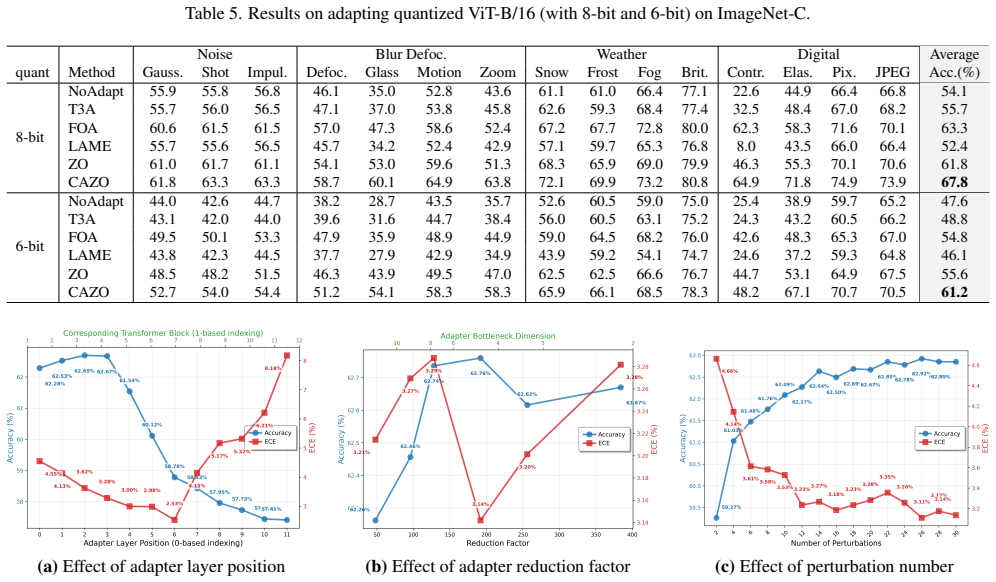
- Under 8-bit and 6-bit quantization, CAZO retains 67.8% and 61.2% on ImageNet-C, suggesting the approach transfers to low-bit on-device settings.
- The paper proves an $O(1/\sqrt{T})$ nonconvex convergence rate for CAZO, with constants depending on the curvature bounds $\beta_l$ and $\beta_u$.
Reading between the lines
- Extension: if the diagonal EMA is really tracking a slowly varying dominant subspace, the same curvature proxy could apply to other short-horizon black-box adaptation problems, such as online prompt tuning or continual learning with limited update budgets.
- Extension: the paper's entropy-only supplement (56.52% versus 55.5% no adaptation) implies the state-of-the-art claim is not yet established for true source-free test-time adaptation; a natural next test is to estimate the alignment statistics online from the test stream and check whether the accuracy gap persists.
- Extension: a rank-restricted Hessian sketch (for example, the top-20 directions) instead of a diagonal proxy would directly test whether the observed low-rank subspace, rather than axis-aligned curvature, is what carries the benefit.
Signed reviews
Editorial analysis
A structured set of objections, weighed in public.
Referee Report
Summary. The manuscript proposes CAZO, a zeroth-order (ZO) test-time adaptation (TTA) method. Its key empirical claim is that the Hessian of the adaptation loss is persistently low-rank and slowly varying; based on this, CAZO draws ZO perturbations from N(0, \tilde{H}_t^{-1}), where \tilde{H}_t is a diagonal EMA of squared ZO gradients. Only a lightweight adapter is updated, using forward-only finite differences. The paper reports state-of-the-art accuracy on ImageNet-C severity-5 (69.0%) and continual TTA (65.3%) with roughly 70% memory reduction relative to backpropagation-based methods, and it gives an O(1/sqrt(T)) convergence bound under smoothness and bounded-inverse-curvature assumptions.
Significance. If established, the method would be a useful forward-only alternative for memory-constrained TTA, and the empirical Hessian study in Section 4.1 is a valuable contribution. The code release and the breadth of benchmarks are strengths. However, the headline accuracy depends on a feature-alignment term using clean-source statistics; entropy-only CAZO reaches only 56.52% (Supplementary Table 7), close to the 55.5% NoAdapt baseline. The convergence proof also contains a miscalculated moment bound. These issues prevent the claims as stated from being accepted.
major comments (4)
- [Sec. 4.2; Supplementary Table 7] The headline result in Table 1 (69.0%) is obtained with the composite loss L_com = L_ent + L_align, where L_align uses feature statistics from clean data [40]. Under the identical protocol with an entropy-only loss, CAZO drops to 56.52%, only 1.0 point above the NoAdapt baseline (55.5%). Since standard TTA is source-free (only the pretrained model and unlabeled test data are available), the claimed state-of-the-art performance is not established for source-free TTA, and the paper does not disclose this dependence as a limitation. The authors should report the entropy-only result as the primary claim or explicitly state the requirement of clean-domain statistics.
- [Supplementary Sec. 8, Lemma 1 and Theorem 1] The bound E[||u||^4] = d(d+2)beta_u is incorrect. For u ~ N(0, \tilde{H}_t^{-1}) with diagonal entries bounded by beta_u, the correct fourth moment is (tr \tilde{H}_t^{-1})^2 + 2 tr((\tilde{H}_t^{-1})^2), which is at most d(d+2)beta_u^2, not d(d+2)beta_u. The proof of Eq. (20) drops the square on beta_u. Because Theorem 1 uses this bound in the learning-rate choice and in the variance term, the stated convergence guarantee and the conditioning condition beta_l^2 > beta_u are not valid as written. The O(1/sqrt(T)) rate may survive, but the constants must be recomputed with beta_u^2, and the proof requires a second-moment version of Assumption 2, which currently bounds only the first moment.
- [Table 1 and Table 2] The per-corruption entries for TENT and CoTTA are inconsistent across tables: TENT reports 2.7% on fog in Table 1 versus 66.5% on fog in Table 2, and CoTTA reports 15.6% on fog in Table 1 versus 52.2% on fog in Table 2. The reported averages (59.8% for TENT, 61.9% for CoTTA) and the claimed gains of +6.3% and +7.1% over these baselines are therefore not credible as reported. The authors should correct the entries and recompute the comparisons.
- [Sec. 4.1, Eq. (6), Assumption 3] The motivating observation is a low-rank Hessian whose principal subspace is non-axis-aligned (top eigenvectors in Figures 2 and 3), but the method uses a diagonal covariance diag(D_t / (1 - (1 - nu)^t)). A diagonal matrix cannot represent a rotated low-rank subspace. The paper provides no evidence that the diagonal EMA of squared gradients approximates the top Hessian directions, and Assumption 3 simply assumes boundedness of the diagonal entries rather than any relationship to the observed subspace. The link between the Hessian analysis and the actual sampling mechanism is therefore unverified; the authors should either justify the diagonal approximation or compare against a low-rank non-diagonal preconditioner.
minor comments (6)
- [Supplementary Sec. 8, Theorem 1 proof] The sentence 'Because E[L(θ_T)] ≤ L(θ*)' has the inequality reversed; the telescoping argument needs E[L(θ_T)] ≥ L(θ*).
- [Algorithm 1, lines 8-10 and Eq. (6)] There is an index mismatch: Eq. (6) defines D_t using \hat{g}(θ_{t-1}), while Algorithm line 9 says 'Update Hessian diagonal: \tilde{H}_t^{-1} ← (D_{t-1}, \hat{g}(θ_t))'. Please clarify whether the covariance used for sampling at step t is based on the gradient from the previous iteration.
- [Supplementary Eq. (29)] The final bound writes O(μ^2) where μ is undefined; this should be O(ε^2).
- [Section 6.4 heading and Table 3 caption] There are typos: 'pertrubation' should be 'perturbation', and 'competetive' should be 'competitive'.
- [Section 6.1 and Table 1] The text says the comparison includes the zeroth-order baseline ZO (RGE), but Table 1 does not report ZO; it appears only in Table 4. Please either add it to Table 1 or adjust the text.
- [Section 6.3, Table 5] The quantized experiments do not include ZOA even though related work presents ZOA as a concurrent ZO TTA method for quantized models; a comparison would strengthen the claims.
Circularity Check
No significant circularity: CAZO's convergence theorem and empirical gains are not equivalent by construction to their inputs.
full rationale
The paper's central derivation is an empirical method plus a convergence theorem, not a prediction derived from an assumed quantity. Theorem 1 (Eq. 21) is proved from L-smoothness, data variance, and bounded-preconditioner assumptions; the claimed O(1/sqrt(T)) rate is conditional on beta_l and beta_u and is not fitted to the reported 69.0% accuracy. The Hessian observation in Section 4.1 motivates but does not define the method; the diagonal EMA in Eq. (6) is an implementation proxy, and any mismatch with the non-axis-aligned low-rank subspace is a modeling gap, not a circular reduction. The composite loss in Section 4.2 includes an MSE alignment term using clean-source statistics from [40], and Supplementary Table 7 shows that entropy-only CAZO is 56.52%, much lower than the 69.0% reported with L_com. This is a genuine attribution and transparency concern about how much of the gain comes from the alignment term, and the paper could have labeled it as a limitation; however, Table 7 also shows that entropy-only CAZO outperforms the vanilla ZO baseline (47.32%) and FOA (44.90%) under the same protocol, so the curvature-aware sampling retains independent empirical content. The only self-citations ([10], [11]) appear as related-work and baseline entries and do not carry the load of the central claim. No equation in the paper is defined in terms of the quantity it claims to predict, and no fitted parameter is relabeled as a prediction.
Assumptions & free parameters
free parameters (5)
- EMA coefficient nu =
0.8
- Perturbation scale epsilon =
0.1
- Number of perturbations k =
20
- Adapter layer position =
3
- Adapter downsampling ratio =
384
assumptions (5)
- standard math The loss is L-smooth with respect to adapter parameters (Assumption 1).
- standard math Data variance is bounded: E_x[||nabla L(x;theta)-nabla L(theta)||^2] <= sigma^2 (Assumption 2).
- ad hoc to paper The diagonal entries of the estimated inverse curvature matrix H_tilde^{-1} lie in [beta_l, beta_u] for all t (Assumption 3).
- domain assumption The Hessian of the TTA loss is persistently low-rank and slowly varying across adaptation steps.
- domain assumption Clean-domain feature statistics are available to compute the MSE alignment loss.
Cite this review
Pith. "Pith review of Curvature-Aware Zeroth-Order Optimization for Memory-Efficient Test-Time Adaptation." pith.science (2026). https://pith.science/paper/TJW23EID
@misc{pith2026260812279,
  author       = {Pith},
  title        = {Pith review of: Curvature-Aware Zeroth-Order Optimization for Memory-Efficient Test-Time Adaptation},
  year         = {2026},
  howpublished = {\url{https://pith.science/paper/TJW23EID}},
  note         = {Machine review of arXiv:2608.12279}
}
read the original abstract
Test-time adaptation (TTA) aims to enhance the cross-domain performance of pre-trained models by adapting to unlabeled test data. While most existing TTA methods rely on backpropagation (BP) for finetuning, BP-free methods such as zeroth-order (ZO) methods are more desired in practical on-device scenarios. ZO methods rely only on forward computation, which can largely reduce the complexity and memory overhead of on-device deployment. However, ZO methods suffer from much higher variance compared with first-order methods in estimating the gradient. To address this, we propose an improved ZO method to substantially boost the performance of ZO optimization based TTA. First, we provide an observation to reveal the persistent low-rank Hessian structure of the loss during the adaptation process. Based on this insight, we then propose a loss-landscape curvature-aware zeroth-order (CAZO) method, which leverages a sliding-average estimation of the diagonal Hessian to construct a covariance matrix for anisotropic perturbation sampling. CAZO operates by freezing pretrained weights and optimizing minimal adapter parameters via forward-only passes based gradient estimation, which can substantially reduce the memory overhead compared to BP-based methods. Extensive experiments demonstrate that CAZO significantly outperforms existing TTA methods, achieving state-of-the-art performance while maintaining an excellent balance between accuracy and memory efficiency. Code is available at https://github.com/Hollyming/CAZO.
Figures


Figures from the paper (6 more)



Reference graph
Works this paper leans on
-
[40]
Test-time model adaptation with only forward passes
Shuaicheng Niu, Chunyan Miao, Guohao Chen, Pengcheng Wu, and Peilin Zhao. Test-time model adaptation with only forward passes. InThe International Conference on Machine Learning, 2024. 1, 2, 5, 6, 3
work page 2024
-
[1]
Parameter-free online test-time adaptation
Malik Boudiaf, Romain Mueller, Ismail Ben Ayed, and Luca Bertinetto. Parameter-free online test-time adaptation. In Proceedings of the IEEE/CVF Conference on Computer Vi- sion and Pattern Recognition, pages 8344–8353, 2022. 1, 6, 3
work page 2022
-
[2]
Contrastive test-time adaptation
Dian Chen, Dequan Wang, Trevor Darrell, and Sayna Ebrahimi. Contrastive test-time adaptation. InCVPR, 2022. 2
work page 2022
-
[3]
Shoufa Chen, Chongjian Ge, Zhan Tong, Jiangliu Wang, Yibing Song, Jue Wang, and Ping Luo. Adaptformer: Adapting vision transformers for scalable visual recogni- tion.Advances in Neural Information Processing Systems, 35:16664–16678, 2022. 7, 3
work page 2022
-
[4]
Sungha Choi, Seunghan Yang, Seokeon Choi, and Sun- grack Yun. Improving test-time adaptation via shift-agnostic weight regularization and nearest source prototypes. InEu- ropean Conference on Computer Vision, pages 440–458. Springer, 2022. 2
work page 2022
-
[5]
Adaptive energy alignment for accelerating test-time adapta- tion
Wonjeong Choi, Do-Yeon Kim, Jungwuk Park, Jungmoon Lee, Younghyun Park, Dong-Jun Han, and Jaekyun Moon. Adaptive energy alignment for accelerating test-time adapta- tion. InInternational Conference on Learning Representa- tions, 2025. 2
work page 2025
-
[6]
Imagenet: A large-scale hierarchical image database
Jia Deng, Wei Dong, Richard Socher, Li-Jia Li, Kai Li, and Li Fei-Fei. Imagenet: A large-scale hierarchical image database. In2009 IEEE conference on computer vision and pattern recognition, pages 248–255. Ieee, 2009. 3
2009
-
[7]
Test-time model adaptation for quantized neu- ral networks
Zeshuai Deng, Guohao Chen, Shuaicheng Niu, Hui Luo, Shuhai Zhang, Yifan Yang, Renjie Chen, Wei Luo, and Mingkui Tan. Test-time model adaptation for quantized neu- ral networks. InProceedings of the 33rd ACM International Conference on Multimedia, pages 7258–7267, 2025. 2, 6, 3
work page 2025
Show all 67 references
-
[8]
Model agnostic contrastive explanations for structured data.arXiv preprint arXiv:1906.00117, 2019
Amit Dhurandhar, Tejaswini Pedapati, Avinash Balakrish- nan, Pin-Yu Chen, Karthikeyan Shanmugam, and Ruchir Puri. Model agnostic contrastive explanations for structured data.arXiv preprint arXiv:1906.00117, 2019. 2
1906 arXiv
-
[9]
An image is worth 16x16 words: Transformers for image recognition at scale
Alexey Dosovitskiy, Lucas Beyer, Alexander Kolesnikov, Dirk Weissenborn, Xiaohua Zhai, Thomas Unterthiner, Mostafa Dehghani, Matthias Minderer, Georg Heigold, Syl- vain Gelly, Jakob Uszkoreit, and Neil Houlsby. An image is worth 16x16 words: Transformers for image recognition ...
2021
-
[10]
Brain- inspired online adaptation for remote sensing with spiking neural network.IEEE Transactions on Geoscience and Re- mote Sensing, 2025
Dexin Duan, Peilin Liu, Bingwei Hui, and Fei Wen. Brain- inspired online adaptation for remote sensing with spiking neural network.IEEE Transactions on Geoscience and Re- mote Sensing, 2025. 2
2025
-
[11]
Life- long test-time adaptation via online learning in tracked low- dimensional subspace
Dexin Duan, Rui Xu, Peilin Liu, and Fei Wen. Life- long test-time adaptation via online learning in tracked low- dimensional subspace. InThe Thirty-ninth Annual Confer- ence on Neural Information Processing Systems, 2025. 6, 3
2025
-
[12]
Optimal rates for zero-order con- vex optimization: The power of two function evaluations
John C Duchi, Michael I Jordan, Martin J Wainwright, and Andre Wibisono. Optimal rates for zero-order con- vex optimization: The power of two function evaluations. IEEE Transactions on Information Theory, 61(5):2788– 2806, 2015. 2, 3
2015
-
[13]
Stochastic first-and zeroth-order methods for nonconvex stochastic program- ming.SIAM journal on optimization, 23(4):2341–2368,
Saeed Ghadimi and Guanghui Lan. Stochastic first-and zeroth-order methods for nonconvex stochastic program- ming.SIAM journal on optimization, 23(4):2341–2368,
-
[14]
Sotta: Robust test-time adaptation on noisy data streams
Taesik Gong, Yewon Kim, Taeckyung Lee, Sorn Chottana- nurak, and Sung-Ju Lee. Sotta: Robust test-time adaptation on noisy data streams. InThirty-seventh Conference on Neu- ral Information Processing Systems, 2023. 2
2023
-
[15]
Optimizing large-scale hyperparameters via auto- mated learning algorithm.arXiv preprint arXiv:2102.09026,
Bin Gu, Guodong Liu, Yanfu Zhang, Xiang Geng, and Heng Huang. Optimizing large-scale hyperparameters via auto- mated learning algorithm.arXiv preprint arXiv:2102.09026,
-
[16]
Zeroth-order fine- tuning of llms with extreme sparsity.arXiv preprint arXiv:2406.02913, 2024
Wentao Guo, Jikai Long, Yimeng Zeng, Zirui Liu, Xinyu Yang, Yide Ran, Jacob R Gardner, Osbert Bastani, Christo- pher De Sa, Xiaodong Yu, et al. Zeroth-order fine- tuning of llms with extreme sparsity.arXiv preprint arXiv:2406.02913, 2024. 2
2024 arXiv
-
[17]
The cma evolution strategy: A tutorial
Nikolaus Hansen. The cma evolution strategy: A tutorial. arXiv preprint arXiv:1604.00772, 2016. 2
2016 arXiv
-
[18]
Completely de- randomized self-adaptation in evolution strategies.Evolu- tionary computation, 9(2):159–195, 2001
Nikolaus Hansen and Andreas Ostermeier. Completely de- randomized self-adaptation in evolution strategies.Evolu- tionary computation, 9(2):159–195, 2001. 2
2001
-
[19]
Benchmarking neu- ral network robustness to common corruptions and perturba- tions
Dan Hendrycks and Thomas Dietterich. Benchmarking neu- ral network robustness to common corruptions and perturba- tions. InInternational Conference on Learning Representa- tions, 2018. 5, 3
2018
-
[20]
Cubuk, Barret Zoph, Justin Gilmer, and Balaji Lakshminarayanan
Dan Hendrycks, Norman Mu, Ekin D. Cubuk, Barret Zoph, Justin Gilmer, and Balaji Lakshminarayanan. Augmix: A simple data processing method to improve robustness and uncertainty.Proceedings of the International Conference on Learning Representations (ICLR), 2020. 6, 3
2020
-
[21]
The many faces of robust- ness: A critical analysis of out-of-distribution generalization
Dan Hendrycks, Steven Basart, Norman Mu, Saurav Kada- vath, Frank Wang, Evan Dorundo, Rahul Desai, Tyler Zhu, Samyak Parajuli, Mike Guo, et al. The many faces of robust- ness: A critical analysis of out-of-distribution generalization. InProceedings of the IEEE/CVF internationa...
2021
-
[22]
Black-box adversarial attacks with limited queries and information
Andrew Ilyas, Logan Engstrom, Anish Athalye, and Jessy Lin. Black-box adversarial attacks with limited queries and information. InInternational conference on machine learn- ing, pages 2137–2146. PMLR, 2018. 2
2018
-
[23]
Test-time classifier adjustment module for model-agnostic domain generaliza- tion.Advances in Neural Information Processing Systems, 34:2427–2440, 2021
Yusuke Iwasawa and Yutaka Matsuo. Test-time classifier adjustment module for model-agnostic domain generaliza- tion.Advances in Neural Information Processing Systems, 34:2427–2440, 2021. 1, 6, 3
2021
-
[24]
Wilds: A benchmark of in-the- 9 wild distribution shifts
Pang Wei Koh, Shiori Sagawa, Henrik Marklund, Sang Michael Xie, Marvin Zhang, Akshay Balsubra- mani, Weihua Hu, Michihiro Yasunaga, Richard Lanas Phillips, Irena Gao, et al. Wilds: A benchmark of in-the- 9 wild distribution shifts. InInternational conference on machine learnin...
2021
-
[25]
Towards explaining dis- tribution shifts
Sean Kulinski and David I Inouye. Towards explaining dis- tribution shifts. InInternational Conference on Machine Learning, pages 17931–17952. PMLR, 2023. 1
2023
-
[26]
Becotta: Input-dependent online blending of experts for continual test-time adaptation
Daeun Lee, Jaehong Yoon, and Sung Ju Hwang. Becotta: Input-dependent online blending of experts for continual test-time adaptation. InProceedings of the 41st International Conference on Machine Learning, 2024. 2
2024
-
[27]
Entropy is not enough for test-time adaptation: From the perspective of disentangled factors
Jonghyun Lee, Dahuin Jung, Saehyung Lee, Junsung Park, Juhyeon Shin, Uiwon Hwang, and Sungroh Yoon. Entropy is not enough for test-time adaptation: From the perspective of disentangled factors. InThe Twelfth International Confer- ence on Learning Representations, 2024. 6, 3
2024
-
[28]
Tta-cope: Test-time adaptation for category-level object pose estimation
Taeyeop Lee, Jonathan Tremblay, Valts Blukis, Bowen Wen, Byeong-Uk Lee, Inkyu Shin, Stan Birchfield, In So Kweon, and Kuk-Jin Yoon. Tta-cope: Test-time adaptation for category-level object pose estimation. InProceedings of the IEEE/CVF Conference on Computer Vision and Pattern...
2023
-
[29]
Do we really need to access the source data? source hypothesis transfer for un- supervised domain adaptation
Jian Liang, Dapeng Hu, and Jiashi Feng. Do we really need to access the source data? source hypothesis transfer for un- supervised domain adaptation. InInternational Conference on Machine Learning, pages 6028–6039, 2020. 2
2020
-
[30]
A comprehensive sur- vey on test-time adaptation under distribution shifts.Inter- national Journal of Computer Vision, pages 1–34, 2024
Jian Liang, Ran He, and Tieniu Tan. A comprehensive sur- vey on test-time adaptation under distribution shifts.Inter- national Journal of Computer Vision, pages 1–34, 2024. 2
2024
-
[31]
Ttn: A domain-shift aware batch normalization in test-time adaptation
Hyesu Lim, Byeonggeun Kim, Jaegul Choo, and Sungha Choi. Ttn: A domain-shift aware batch normalization in test-time adaptation. In11th International Conference on Learning Representations, 2023. 2
2023
-
[32]
Swin transformer: Hierarchical vision transformer using shifted windows
Ze Liu, Yutong Lin, Yue Cao, Han Hu, Yixuan Wei, Zheng Zhang, Stephen Lin, and Baining Guo. Swin transformer: Hierarchical vision transformer using shifted windows. In Proceedings of the IEEE/CVF International Conference on Computer Vision (ICCV), 2021. 5
2021
-
[33]
Fine- tuning language models with just forward passes.Advances in Neural Information Processing Systems, 36:53038–53075,
Sadhika Malladi, Tianyu Gao, Eshaan Nichani, Alex Damian, Jason D Lee, Danqi Chen, and Sanjeev Arora. Fine- tuning language models with just forward passes.Advances in Neural Information Processing Systems, 36:53038–53075,
-
[34]
Evaluating prediction-time batch normalization for robust- ness under covariate shift.arXiv preprint arXiv:2006.10963,
Zachary Nado, Shreyas Padhy, D Sculley, Alexander D’Amour, Balaji Lakshminarayanan, and Jasper Snoek. Evaluating prediction-time batch normalization for robust- ness under covariate shift.arXiv preprint arXiv:2006.10963,
2006 arXiv
-
[35]
Obtaining well calibrated probabilities using bayesian binning
Mahdi Pakdaman Naeini, Gregory Cooper, and Milos Hauskrecht. Obtaining well calibrated probabilities using bayesian binning. InProceedings of the AAAI conference on artificial intelligence, 2015. 4
2015
-
[36]
Random gradient- free minimization of convex functions.Foundations of Com- putational Mathematics, 17(2):527–566, 2017
Yurii Nesterov and Vladimir Spokoiny. Random gradient- free minimization of convex functions.Foundations of Com- putational Mathematics, 17(2):527–566, 2017. 1, 2, 3
2017
-
[37]
Maintainingconsistentinter- classtopologyincontinualtest-timeadaptation
Chenggong Ni, Fan Lyu, Jiayao Tan, Fuyuan Hu, Rui Yao, and Tao Zhou. Maintainingconsistentinter- classtopologyincontinualtest-timeadaptation. InProceedings of Conference on Computer Vision and Pattern Recognition,
-
[38]
Efficient test-time model adaptation without forgetting
Shuaicheng Niu, Jiaxiang Wu, Yifan Zhang, Yaofo Chen, Shijian Zheng, Peilin Zhao, and Mingkui Tan. Efficient test-time model adaptation without forgetting. InInterna- tional conference on machine learning, pages 16888–16905. PMLR, 2022. 6, 3
2022
-
[39]
Towards sta- ble test-time adaptation in dynamic wild world
Shuaicheng Niu, Jiaxiang Wu, Yifan Zhang, Zhiquan Wen, Yaofo Chen, Peilin Zhao, and Mingkui Tan. Towards sta- ble test-time adaptation in dynamic wild world. InThe Eleventh International Conference on Learning Representa- tions, 2023. 6, 3
2023
-
[41]
Adapterhub: A framework for adapting transformers.arXiv preprint arXiv:2007.07779, 2020
Jonas Pfeiffer, Andreas R ¨uckl´e, Clifton Poth, Aishwarya Ka- math, Ivan Vuli ´c, Sebastian Ruder, Kyunghyun Cho, and Iryna Gurevych. Adapterhub: A framework for adapting transformers.arXiv preprint arXiv:2007.07779, 2020. 7
2007 arXiv
-
[42]
Do imagenet classifiers generalize to ima- genet? InProceedings of the 37th International Conference on Machine Learning (ICML), pages 5389–5400, 2019
Benjamin Recht, Rebecca Roelofs, Ludwig Schmidt, and Vaishaal Shankar. Do imagenet classifiers generalize to ima- genet? InProceedings of the 37th International Conference on Machine Learning (ICML), pages 5389–5400, 2019. 6, 3
2019
-
[43]
Taking the human out of the loop: A review of bayesian optimization.Proceedings of the IEEE, 104(1):148–175, 2015
Bobak Shahriari, Kevin Swersky, Ziyu Wang, Ryan P Adams, and Nando De Freitas. Taking the human out of the loop: A review of bayesian optimization.Proceedings of the IEEE, 104(1):148–175, 2015. 2, 3
2015
-
[44]
Zeroth-order optimization with trajectory-informed derivative estimation
Yao Shu, Zhongxiang Dai, Weicong Sng, Arun Verma, Patrick Jaillet, and Bryan Kian Hsiang Low. Zeroth-order optimization with trajectory-informed derivative estimation. InThe Eleventh International Conference on Learning Rep- resentations, 2023. 2
2023
-
[45]
Prac- tical bayesian optimization of machine learning algorithms
Jasper Snoek, Hugo Larochelle, and Ryan P Adams. Prac- tical bayesian optimization of machine learning algorithms. Advances in neural information processing systems, 25,
-
[46]
Ecotta: Memory-efficient continual test-time adaptation via self-distilled regularization
Junha Song, Jungsoo Lee, In So Kweon, and Sungha Choi. Ecotta: Memory-efficient continual test-time adaptation via self-distilled regularization. InIEEE/CVF Conference on Computer Vision and Pattern Recognition, 2023. 2
2023
-
[47]
Test-time training with self- supervision for generalization under distribution shifts
Yu Sun, Xiaolong Wang, Zhuang Liu, John Miller, Alexei Efros, and Moritz Hardt. Test-time training with self- supervision for generalization under distribution shifts. In International conference on machine learning, pages 9229–
-
[48]
Training data-efficient image transformers & distillation through at- tention
Hugo Touvron, Matthieu Cord, Matthijs Douze, Francisco Massa, Alexandre Sablayrolles, and Herve Jegou. Training data-efficient image transformers & distillation through at- tention. InInternational Conference on Machine Learning, pages 10347–10357, 2021. 5
2021
-
[49]
Autozoom: Autoencoder-based zeroth order optimization method for attacking black-box neural networks
Chun-Chen Tu, Paishun Ting, Pin-Yu Chen, Sijia Liu, Huan Zhang, Jinfeng Yi, Cho-Jui Hsieh, and Shin-Ming Cheng. Autozoom: Autoencoder-based zeroth order optimization method for attacking black-box neural networks. InProceed- ings of the AAAI conference on artificial intelligen...
2019
-
[50]
Certified zeroth- 10 order black-box defense with robust unet denoiser.arXiv preprint arXiv:2304.06430, 2023
Astha Verma, A V Subramanyam, Siddhesh Bangar, Naman Lal, Rajiv Ratn Shah, and Shin’ichi Satoh. Certified zeroth- 10 order black-box defense with robust unet denoiser.arXiv preprint arXiv:2304.06430, 2023. 2
2023 arXiv
-
[51]
Tent: Fully test-time adaptation by entropy minimization
Dequan Wang, Evan Shelhamer, Shaoteng Liu, Bruno Ol- shausen, and Trevor Darrell. Tent: Fully test-time adaptation by entropy minimization. InInternational Conference on Learning Representations, 2021. 1, 2, 6, 3
2021
-
[52]
Effortless active label- ing for long-term test-time adaptation
Guowei Wang and Changxing Ding. Effortless active label- ing for long-term test-time adaptation. InIEEE/CVF Con- ference on Computer Vision and Pattern Recognition, 2025. 2
2025
-
[53]
Learning robust global representations by penalizing local predictive power.Advances in neural information pro- cessing systems, 32, 2019
Haohan Wang, Songwei Ge, Zachary Lipton, and Eric P Xing. Learning robust global representations by penalizing local predictive power.Advances in neural information pro- cessing systems, 32, 2019. 6, 3
2019
-
[54]
Continual test-time domain adaptation
Qin Wang, Olga Fink, Luc Van Gool, and Dengxin Dai. Continual test-time domain adaptation. InProceedings of the IEEE/CVF Conference on Computer Vision and Pattern Recognition, pages 7201–7211, 2022. 2, 6, 3
2022
-
[55]
Zarts: On zero-order optimization for neu- ral architecture search.Advances in Neural Information Pro- cessing Systems, 35:12868–12880, 2022
Xiaoxing Wang, Wenxuan Guo, Jianlin Su, Xiaokang Yang, and Junchi Yan. Zarts: On zero-order optimization for neu- ral architecture search.Advances in Neural Information Pro- cessing Systems, 35:12868–12880, 2022. 2
2022
-
[56]
Robust test- time adaptation in dynamic scenarios
Longhui Yuan, Binhui Xie, and Shuang Li. Robust test- time adaptation in dynamic scenarios. InProceedings of the IEEE/CVF Conference on Computer Vision and Pattern Recognition, pages 15922–15932, 2023. 6, 3
2023
-
[57]
Tea: Test-time energy adaptation
Yige Yuan et al. Tea: Test-time energy adaptation. In IEEE/CVF Conference on Computer Vision and Pattern Recognition, 2024. 2
2024
-
[58]
How to robustify black-box ml models? a zeroth-order optimization perspec- tive
Yimeng Zhang, Yuguang Yao, Jinghan Jia, Jinfeng Yi, Mingyi Hong, Shiyu Chang, and Sijia Liu. How to robustify black-box ml models? a zeroth-order optimization perspec- tive. In10th International Conference on Learning Repre- sentations, ICLR 2022, 2022. 2
2022
-
[59]
Adanpc: Exploring non-parametric clas- sifier for test-time adaptation
Yi-Fan Zhang et al. Adanpc: Exploring non-parametric clas- sifier for test-time adaptation. InInternational Conference on Machine Learning, 2023. 2
2023
-
[60]
Delta: Degradation-free fully test-time adaptation
Bowen Zhao, Chen Chen, and Shu-Tao Xia. Delta: Degradation-free fully test-time adaptation. InThe Eleventh International Conference on Learning Representations,
-
[61]
On pitfalls of test-time adaptation.arXiv preprint arXiv:2306.03536, 2023
Hao Zhao, Yuejiang Liu, Alexandre Alahi, and Tao Lin. On pitfalls of test-time adaptation.arXiv preprint arXiv:2306.03536, 2023. 1
2023 arXiv
-
[62]
On the design of black-box adversarial examples by leveraging gradient-free optimiza- tion and operator splitting method
Pu Zhao, Sijia Liu, Pin-Yu Chen, Nghia Hoang, Kaidi Xu, Bhavya Kailkhura, and Xue Lin. On the design of black-box adversarial examples by leveraging gradient-free optimiza- tion and operator splitting method. InProceedings of the IEEE/CVF International Conference on Computer V...
2019
-
[63]
Second-order fine-tuning without pain for llms: A hessian informed zeroth-order optimizer.Pro- ceedings of the International Conference on Learning Rep- resentations (ICLR), 2024
Yanjun Zhao, Sizhe Dang, Haishan Ye, Guang Dai, Yi Qian, and Ivor W Tsang. Second-order fine-tuning without pain for llms: A hessian informed zeroth-order optimizer.Pro- ceedings of the International Conference on Learning Rep- resentations (ICLR), 2024. 2 11 Curvature-Aware Z...
2024
-
[64]
Dt = (1−ν)D t−1 +νeg2(θt−1), eHt = diag Dt 1−(1−ν) t , (8) Assumption(Restatement of L-smoothness).Assume the loss functionL(x;θ)isL-smooth respect to parameterθ
Convergence Analysis of CAZO Given a loss functionL(x;θ), wherex∈R n is the data andθ∈ Rd is the parameter, then the definition of the gradient of CAZO is eg(xt;θt) = 1 k kX i=1 L(xt;θt +ϵui)−L(x t;θt−ϵui) 2ϵ ui, withui∼N(0, eH−1 t ) (7) We further denote∇f(θ) =E x[∇f(x;θ)]. D...
-
[65]
Dataset and Model We evaluate our method on ImageNet-C, a benchmark dataset for test-time adaptation [19]
Experimental Settings 9.1. Dataset and Model We evaluate our method on ImageNet-C, a benchmark dataset for test-time adaptation [19]. ImageNet-C contains 15 common corruption types, each with five severity levels, yielding 75 cor- rupted versions of the ImageNet validation set...
-
[67]
More Experiment Details 10.1. Analysis of Hessian Matrix Properties in TTA Motivation Experiment DescriptionThis pilot study in- vestigates the structural properties of Hessian matrices during test- time adaptation (TTA). During experimentation, we employed a batch size of 32 ...
-
[768]
Furthermore, we evaluate our approach on three domain-shifted benchmark datasets: ImageNet-R [20], ImageNet- V2 [42], and ImageNet-Sketch [53]
The model is pretrained on the original ImageNet datasetv[6], and we evaluate its performance in the test-time adaptation setting on ImageNet-C. Furthermore, we evaluate our approach on three domain-shifted benchmark datasets: ImageNet-R [20], ImageNet- V2 [42], and ImageNet-S...
2012
Reviewed August 16, 2026 · model on record in the stance chip above.
Discussion (0). Continue with ORCID to comment.