REVIEW 2 major objections 4 minor 66 references
Commitment Before Realization: When Classifier-Free Guidance Becomes Unnecessary in Masked Diffusion Language Models
T0 review · 2 major / 4 minor · reviewed 2026-08-12 · deepseek-v4-flash
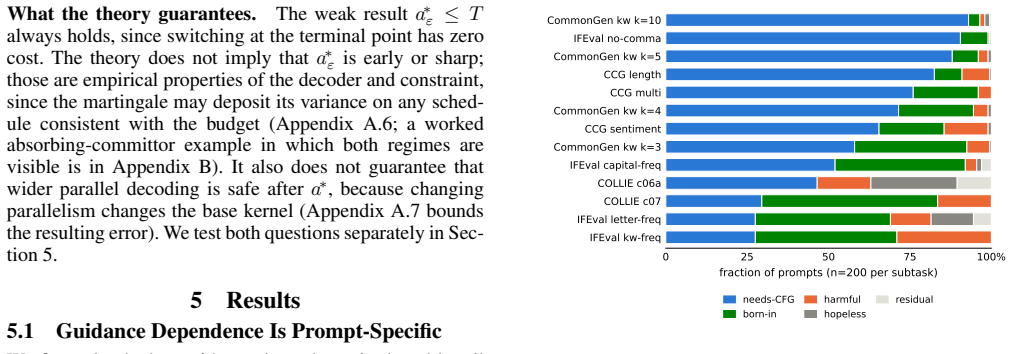
Pith's one-line read The paper claims that classifier-free guidance in masked diffusion language models can be switched off at an early per-prompt commitment horizon with no more than a 0.03 loss in constraint success on all 13 subtasks, even while most…
desk verdict Careful study of when CFG stops mattering in masked diffusion LMs; the headline noninferiority holds as a cross-fitted within-trajectory result but the abstract overreaches on deployment. read the letter →
The pith
A machine-rendered reading of the paper's core claim, the machinery that carries it, and where it could break.
The reading
What carries the argument
The load-bearing object is the commitment horizon $a^*_\varepsilon$, defined as the earliest switch point $t$ such that switching all remaining decoding from the guided kernel to the base kernel keeps terminal success within $\varepsilon$ of full CFG at every later switch point. Its definition rests on two committors — the base committor $q^0_t(x)$, the probability of eventual constraint satisfaction if all remaining steps use the unguided base model, and the guided committor $q^g_t(x)$ for continued CFG — whose difference is the remaining value of guidance. The theoretical engine is Theorem 1 (the base committor is a martingale under the base kernel) and the linear-response identity $$\frac{\partial}{\partial w}\mathbb{E}^{$K^{{g}}$_{t,w}}[$q^{0}$_{t+1}(X_{t+1})\mid X_t=x]\Big|_{w=0} = \operatorname{Cov}_{$K^{0}$_t(\cdot\mid x)}(\delta_t, $q^{0}$_{t+1}),$$ which says CFG's first-order effect at a step is exactly the covariance between its logit tilt $\delta_t$ and the next state's base-continuation success. Proposition 1 closes the loop by writing the switch-off cost as the expected accumulation of these local lifts. The horizon is estimated by freeze interventions — one recorded guided trajectory per prompt with $N=24$ continuation rollouts at each of seven grid fractions — and selection is separated from evaluation by cross-fitting.
What would settle it
Re-estimate each prompt's handoff time from several independently recorded guided trajectories rather than one, and evaluate the handoff on fully fresh rollouts that share no prefix with the estimating runs. If the paired handoff-minus-full-CFG difference has a lower confidence bound below −0.03 on more than one or two of the 13 subtasks, the prompt-level stability assumption — and the noninferiority that rests on it — is falsified. A cheaper companion check: the martingale theorem predicts zero drift in base-continuation success, so a large-sample estimate of $\mathbb{E}[q^0_{t+1}-q^0_t \mid X_t]$ that is systematically nonzero early in decoding would point to a broken estimator or Markov assumption.
Extended reading notes
Core claim
The paper's central claim is that the need for classifier-free guidance in masked diffusion language models is prompt-specific and front-loaded, and that it can be located precisely by a per-prompt commitment horizon $a^*$ — the earliest decoding step from which switching every remaining step to the base, guidance-free model reduces the probability of final constraint satisfaction by no more than a chosen tolerance $\varepsilon$. Defined through paired continuations from the same partial output, $a^*$ separates commitment from realization: at the median horizon the output is 55–78% masked, yet constraint success is already effectively decided. The paper supplies both a mechanism and a measurement: under the base decoder the success probability, or committor, is a martingale, and to first order each CFG step helps only through the covariance between its logit tilt and the successor committor; empirically, freezing each prompt at its own cross-fitted $a^*$ is noninferior to full CFG on all 13 subtasks at the prespecified margin $\varepsilon = 0.03$. The same boundary marks the start of a later regime in which wider parallel decoding costs little in constraint success — though fluency still degrades with width — and for failed trajectories, reopening already-written positions improves recovery whether the failure was a collapse out of a satisfying configuration or never reaching one.
Load-bearing premise
The load-bearing premise is that each prompt's handoff time, estimated from a single recorded guided trajectory plus a small number of continuation rollouts at each grid point, is a stable property of the prompt; if re-running the same prompt yields a noticeably different handoff time, the headline noninferiority may not survive fresh deployment.
Editorial extensions
If this is right
- Guidance can be handed off to the base model: on all 13 subtasks, switching at each prompt's own horizon keeps constraint success within $\varepsilon = 0.03$ of full CFG, so running CFG to the final step is not buying measurable constraint success for most prompts.
- Commitment precedes realization: at the median horizon 55–78% of positions are still masked, so later decoding decisions can be organized around the commitment state rather than the revealed text.
- A low-cost parallel regime opens after the horizon: widening the parallel block from $K=1$ to $K=16$ costs about 0.07 in success after handoff versus 0.25 under full CFG, though GPT-2 perplexity still degrades with width.
- Failed trajectories are repairable by reopening: remasking already-written positions and resuming guided decoding improves recovery for both collapse and hopeless failures, and the gain does not depend on which position-selection signal is used.
- The horizon can be localized without rollouts: a random forest on cheap per-prompt features matches the rollout-measured oracle in success (+0.015 [−0.001, +0.031] at $K=8$) at comparable forward-evaluation count, so long as it stays family-calibrated.
Reading between the lines
- The paper's own attribution gap (Appendix D) is the sharpest open thread: guidance applied only at detected local-transport events recovers only about 18% of the full-versus-base success gap on keywords, which suggests the terminal benefit of CFG flows through higher-order, multi-step, or support-shifting channels that the first-order covariance law does not see; isolating those channels is a dire
- Because the constraint family explains only about 10% of the variation in $a^*$ ($\eta^2 = 0.097$), most of the horizon's variability lives inside prompts; identifying which prompt features push the horizon earlier or later would be a testable extension that could make deployed gates prompt-adaptive rather than family-calibrated.
- The commitment-as-flatness view — outcome-level success stable while the token-realization distribution keeps changing — transfers naturally to continuous diffusion models and to other conditioning signals, where the same paired-continuation diagnostic could locate when guidance can be dropped; the paper does not make that transfer.
- The repair-by-reopening result is descriptive and explicitly lacks a counterpart in the transport theory; its implication that reopening any committed position helps about as much as reopening the 'right' one suggests revision capacity itself, not position selection, is the scarce resource in late-stage recovery, which is a testable hypothesis for constrained decoding.
Editorial analysis
A structured set of objections, weighed in public.
Referee Report
Summary. The paper studies when classifier-free guidance (CFG) is needed during masked diffusion language model decoding. It defines a prompt-level commitment horizon a* as the earliest persistent switch point at which switching all remaining decoding to the base model costs at most a tolerance epsilon in terminal constraint success. The theoretical section shows that the base committor is a martingale (Theorem 1), that the derivative of the guided one-step committor with respect to the guidance weight is a covariance with the successor committor (Eq. 11), and that the remaining guidance value is exactly the expected accumulation of local lifts (Proposition 1). Empirically, the paper estimates a* per prompt from a single recorded guided trajectory with N=24 continuations at each of seven grid fractions, uses cross-fitting to separate selection from evaluation, and reports that freezing at the estimated horizon is noninferior to full CFG on all 13 tested subtasks at a prespecified margin of 0.03. It also studies parallel decoding after handoff and repair by reopening committed positions, and shows that cheap rollout-free gate sources can approximately match the rollout-measured oracle.
Significance. If the central claim is read as a within-trajectory, cross-fitted statement, the paper is a careful and useful contribution. It separates the notion of constraint commitment from token-level realization, provides a clean martingale/covariance explanation of when guided steps can change terminal success, and backs its empirical claims with an unusually disciplined methodology: prespecified noninferiority margins, cross-fitting, hypergeometric half-splits, bootstrap inference at the prompt level, and explicit reporting of null controls and censoring. The theoretical identities in Section 4 and Appendices A are correctly derived; the paper is also commendably transparent about the limits of its own transport-law explanation and about artifacts found and corrected during the evaluation. The significance is tempered, however, by the gap between the formal prompt-level definition of a* and the trajectory-level estimator actually used, which matters for the deployment reading of the headline noninferiority claim.
major comments (2)
- [§3.3 (Definition 1) vs Appendix C.1–C.3] The formal commitment horizon is a prompt-level ensemble quantity: S_sw(t)=E^g[q0_t(X^g_t)] averages over guided prefixes. The estimator in Appendix C.1 records one guided trajectory per prompt, reconstructs states at seven grid fractions, and runs N=24 base and N=24 guided continuations from each; Appendix C.3 explicitly calls the resulting a* a trajectory-level estimate of the ensemble-averaged horizon. Cross-fitting in C.2 corrects post-selection optimism within those shared rollouts, but it does not correct trajectory-to-trajectory variability in the horizon. The paper's own fresh-deployment intention-to-treat results (Table 18, and Table 10 per subtask) show the symptom: at K=1, pooled handoff success is 0.69 versus 0.72 for full CFG, with per-subtask gaps of -0.06 (CommonGen k=10), -0.07 (CCG multi), -0.04 (CommonGen k=3), and -0.03 (CCG length); the survivors-only fresh deployment in Table 2 is closer (-0.01). The abstract and Section 5.2 say that freezing at 'each prompt's own cross-fitted horizon' is noninferior to full CFG at epsilon=0.03 on all 13 subtasks, which invites a prompt-level or deployment reading that the evidence does not yet support. The paper should either restrict the noninferiority claim to the cross-fitted within-trajectory census or provide a deployment-level analysis that re-estimates a* on fresh rollouts and reports intention-to-treat confidence intervals against the margin.
- [§5.2 and Appendix C.1] The estimator uses safety thresholds q0>=0.9 and qg-q0<=0.1 at every later grid point, while the formal definition (Definition 1) and the reported noninferiority margin use epsilon=0.03. These are not equivalent: a switch point with q0=0.90 and qg=0.95 has an empirical gap of 0.05>0.03 and yet passes the estimator's criterion, while a point with q0=0.85 and qg=0.87 (gap 0.02<=0.03) fails the q0 threshold. Since the noninferiority test in Table 1 is evaluated separately, this does not by itself invalidate that table, but the paper should state explicitly that the estimated a* is not the epsilon=0.03 object of Definition 1 and justify the estimator thresholds, or replace them with the formal tolerance on S_sw. The current wording makes the connection between the theory and the headline margin appear tighter than it is.
minor comments (4)
- [Appendix G] The sentence 'Section?? withdraws the two claims those results overturn' contains an unresolved cross-reference; the earlier claims are in Section 5.3 or Appendix F and should be cited explicitly.
- [Appendix I] There are two apparent typos: 'therefore report a* as a relational order parameter' is missing a subject, and 'rather th signal' should read 'rather than a signal'. These impede readability in an otherwise carefully written appendix.
- [Section 5.2 and Table 1] The text says that prompts that already succeed without guidance are excluded from the handoff analysis, while Table 1 reports results on the full n=200 census including born-in prompts. Please clarify how born-in prompts are assigned in the full-census freeze evaluation (for example, whether they are assigned a*=0) and how their presence affects the reported confidence intervals.
- [Figure 1] The caption correctly says the figure is illustrative, but the two failure-mode labels 'collapse' and 'hopeless' are used as technical terms before they are formally defined; a one-sentence definition in the caption or in Section 3.3 would help readers.
Circularity Check
The 'all 13 subtasks at ε=0.03' noninferiority claim is partly by construction: right-censored prompts (a*=T) contribute zero paired difference by definition, and one subtask (COLLIE c06a) has zero coverage, making its row a null control rather than a prediction.
-
self definitional
[Appendix C.5 (Prespecification of the noninferiority test); Table 10 caption; Section 5.2, Table 1]
"Primary estimand: the paired handoff-minus-full-CFG difference over the full n=200 prompt census of each subtask, with right-censored prompts (a∗=T) kept in the denominator at a paired difference of zero, which is their value by construction. ... COLLIE c06a has zero coverage—no prompt in that family ever reaches a persistent safe point—so the two policies coincide there by construction, and its row is a null control rather than a result. ..."
The headline 'noninferior to full CFG on all 13 subtasks at ε=0.03' is evaluated over the full census, but the estimand counts every right-censored prompt (a*=T) as a paired difference of zero because the handoff policy never switches and is therefore identical to full CFG by construction. The full-census contrast is thus a weighted average of the survivors' measured gap and these definitional zeros. The survivors-only results show that the 0.03 margin is not met on five subtasks, so the '13 of 13' claim is achieved by including the zero-by-construction censored subpopulation rather than by the fitted horizon's predictive content. For COLLIE c06a, the noninferiority row is entirely by construction since the two policies coincide on every prompt.
full rationale
The paper's theoretical derivation is self-contained and not circular: the martingale root (Theorem 1) is the tower property under the Markov assumption, Eq. 11 is the standard derivative of an exponential tilt evaluated at w=0, and Proposition 1 is an exact telescoping accumulation of local lifts. None of these depends on fitted parameters, and the local covariance identity is an independent mathematical fact about the guided kernel. The empirical handoff evaluation also has real independent content: the survivors-only paired contrast is read on held-out rollout halves through cross-fitting, so the main switch-cost estimate is not forced by the selection procedure. The partial circularity is localized to the noninferiority accounting: right-censored prompts with a*=T are kept in the primary estimand at a paired difference of zero by construction, which mechanically pulls all 13 rows above the ε=0.03 margin even though five subtasks miss that margin on survivors only. The paper is transparent about this choice, but the abstract's and Section 5.2's 'all 13 subtasks at the prespecified margin' wording leans on the definitional zeros, including the fully censored COLLIE c06a row that is a null control rather than a measured prediction. The trajectory-level estimate limitation noted in Appendix C.1 is a generalization concern, not a circularity, because fresh-rollout evaluation is genuinely out-of-sample.
Assumptions & free parameters
free parameters (5)
- noninferiority margin epsilon =
0.03
- guidance weight w =
2
- estimator thresholds =
q0 >= 0.9 and qg - q0 <= 0.1
- switch grid =
{0.05, 0.10, 0.15, 0.22, 0.30, 0.45, 0.60}
- rollout count N per cell =
24
assumptions (5)
- domain assumption Assumption 1: reverse process is first-order Markov
- domain assumption CFG is an exponential tilt of the base kernel
- standard math Finite state space (vocabulary and canvas)
- domain assumption Success criterion S is deterministic and judge-free
- domain assumption Base kernel K0 is a fixed reference
invented entities (4)
-
Commitment horizon a*
independent evidence
-
Remaining guidance value V_t(x)
independent evidence
-
Collapse failure mode
independent evidence
-
Hopeless failure mode
independent evidence
Cite this review
Pith. "Pith review of Commitment Before Realization: When Classifier-Free Guidance Becomes Unnecessary in Masked Diffusion Language Models." pith.science (2026). https://pith.science/paper/TKB5TNAH
@misc{pith2026260808082,
  author       = {Pith},
  title        = {Pith review of: Commitment Before Realization: When Classifier-Free Guidance Becomes Unnecessary in Masked Diffusion Language Models},
  year         = {2026},
  howpublished = {\url{https://pith.science/paper/TKB5TNAH}},
  note         = {Machine review of arXiv:2608.08082}
}
abstract
Classifier-free guidance (CFG) is usually kept on throughout masked diffusion language model decoding, although its benefit varies across prompts and over time. We study when CFG is actually needed by comparing, from any partial output, the probability of eventual constraint satisfaction under continued CFG and under base-only continuation. Their difference defines the remaining value of guidance. Guidance dependence is highly prompt-specific. Many prompts already succeed without CFG, while for others it provides no measurable benefit or can be harmful. For prompts that do benefit, the gain is often concentrated early. We define the commitment horizon $\astar$ as the earliest point from which switching all remaining decoding to the base model reduces final success by no more than a chosen tolerance. Under the base model, the corresponding success probability, or committor, is a martingale. To first order, CFG's per-step effect is governed by the covariance between the guidance logit direction and the successor committor. This gives a local account of when guidance can help, but it does not by itself locate the horizon. Among prompts with an observed preterminal horizon, $\astar$ is usually early and varies more within constraint families than between them. Freezing each prompt at its own cross-fitted horizon is noninferior to full CFG on all 13 subtasks at the prespecified margin, even while many tokens remain masked. This separates commitment from realization. The boundary also identifies a later region in which higher parallelism adds only a small cost in constraint success, although fluency still degrades with parallel width. For failed trajectories, reopening committed positions improves recovery in both failure modes.
Figures


Figures from the paper (7 more)


Reference graph
Works this paper leans on
-
[1]
arXiv preprint arXiv:2502.09992 , year =
Large Language Diffusion Models , author =. arXiv preprint arXiv:2502.09992 , year =
-
[2]
Advances in Neural Information Processing Systems (NeurIPS) , year =
Simple and Effective Masked Diffusion Language Models , author =. Advances in Neural Information Processing Systems (NeurIPS) , year =
-
[3]
International Conference on Machine Learning (ICML) , year =
Discrete Diffusion Modeling by Estimating the Ratios of the Data Distribution , author =. International Conference on Machine Learning (ICML) , year =
-
[4]
Advances in Neural Information Processing Systems (NeurIPS) , year =
Structured Denoising Diffusion Models in Discrete State-Spaces , author =. Advances in Neural Information Processing Systems (NeurIPS) , year =
-
[5]
arXiv preprint arXiv:2207.12598 , year =
Classifier-Free Diffusion Guidance , author =. arXiv preprint arXiv:2207.12598 , year =
-
[6]
Diffusion Models Beat
Dhariwal, Prafulla and Nichol, Alexander , booktitle =. Diffusion Models Beat
-
[7]
International Conference on Learning Representations (ICLR) , year =
Simple Guidance Mechanisms for Discrete Diffusion Models , author =. International Conference on Learning Representations (ICLR) , year =
-
[8]
What Exactly Does Guidance Do in Masked Discrete Diffusion Models
What Exactly Does Guidance Do in Masked Discrete Diffusion Models , author =. arXiv preprint arXiv:2506.10971 , year =
Show all 66 references
-
[9]
arXiv preprint arXiv:2507.08965 , year =
Improving Classifier-Free Guidance in Masked Diffusion: Low-Dimensional Theoretical Insights with High-Dimensional Impact , author =. arXiv preprint arXiv:2507.08965 , year =
-
[10]
NeurIPS Workshop on Mathematics of Modern Machine Learning (M3L) , year =
Classifier-Free Guidance is a Predictor-Corrector , author =. NeurIPS Workshop on Mathematics of Modern Machine Learning (M3L) , year =
-
[11]
Advances in Neural Information Processing Systems (NeurIPS) , year =
Guiding a Diffusion Model with a Bad Version of Itself , author =. Advances in Neural Information Processing Systems (NeurIPS) , year =
-
[12]
Advances in Neural Information Processing Systems (NeurIPS) , year =
Applying Guidance in a Limited Interval Improves Sample and Distribution Quality in Diffusion Models , author =. Advances in Neural Information Processing Systems (NeurIPS) , year =
-
[13]
International Conference on Learning Representations (ICLR) , year =
Eliminating Oversaturation and Artifacts of High Guidance Scales in Diffusion Models , author =. International Conference on Learning Representations (ICLR) , year =
-
[14]
arXiv preprint arXiv:2404.13040 , year =
Analysis of Classifier-Free Guidance Weight Schedulers , author =. arXiv preprint arXiv:2404.13040 , year =
-
[15]
arXiv preprint arXiv:2505.20199 , year =
Adaptive Classifier-Free Guidance via Dynamic Low-Confidence Masking , author =. arXiv preprint arXiv:2505.20199 , year =
-
[16]
arXiv preprint arXiv:2605.07701 , year =
Guidance Is Not a Hyperparameter: Learning Dynamic Control in Diffusion Language Models , author =. arXiv preprint arXiv:2605.07701 , year =
-
[17]
Journal of Statistical Physics , volume =
Towards a Theory of Transition Paths , author =. Journal of Statistical Physics , volume =
-
[18]
Annual Review of Physical Chemistry , volume =
Transition-Path Theory and Path-Finding Algorithms for the Study of Rare Events , author =. Annual Review of Physical Chemistry , volume =
-
[19]
arXiv preprint arXiv:2312.09236 , year =
A Framework for Conditional Diffusion Modelling with Applications in Motif Scaffolding for Protein Design , author =. arXiv preprint arXiv:2312.09236 , year =
-
[20]
Denker, Alexander and Vargas, Francisco and Padhy, Shreyas and Didi, Kieran and Mathis, Simon and Dutordoir, Vincent and Barbano, Riccardo and Mathieu, Emile and Komorowska, Urszula Julia and Lio, Pietro , journal =
-
[21]
arXiv preprint arXiv:2501.15522 , year =
Estimating Committor Functions via Deep Adaptive Sampling on Rare Transition Paths , author =. arXiv preprint arXiv:2501.15522 , year =
-
[22]
arXiv preprint arXiv:2602.05533 , year =
Conditional Diffusion Guidance under Hard Constraint: A Stochastic Analysis Approach , author =. arXiv preprint arXiv:2602.05533 , year =
-
[23]
arXiv preprint arXiv:2509.26488 , year =
dParallel: Learnable Parallel Decoding for dLLMs , author =. arXiv preprint arXiv:2509.26488 , year =
-
[24]
arXiv preprint arXiv:2601.02076 , year =
Deferred Commitment Decoding for Diffusion Language Models , author =. arXiv preprint arXiv:2601.02076 , year =
-
[25]
Findings of EMNLP , year =
CommonGen: A Constrained Text Generation Challenge for Generative Commonsense Reasoning , author =. Findings of EMNLP , year =
-
[26]
International Conference on Learning Representations (ICLR) , year =
COLLIE: Systematic Construction of Constrained Text Generation Tasks , author =. International Conference on Learning Representations (ICLR) , year =
-
[27]
arXiv preprint arXiv:2311.07911 , year =
Instruction-Following Evaluation for Large Language Models , author =. arXiv preprint arXiv:2311.07911 , year =
-
[28]
arXiv preprint arXiv:2212.10466 , year =
Controllable Text Generation with Language Constraints , author =. arXiv preprint arXiv:2212.10466 , year =
-
[29]
International Conference on Learning Representations (ICLR) , year =
Plug and Play Language Models: A Simple Approach to Controlled Text Generation , author =. International Conference on Learning Representations (ICLR) , year =
-
[30]
Yang, Kevin and Klein, Dan , booktitle =
-
[31]
, booktitle =
Li, Xiang Lisa and Thickstun, John and Gulrajani, Ishaan and Liang, Percy and Hashimoto, Tatsunori B. , booktitle =. Diffusion-
-
[32]
Advances in Neural Information Processing Systems (NeurIPS) , year =
Spontaneous Symmetry Breaking in Generative Diffusion Models , author =. Advances in Neural Information Processing Systems (NeurIPS) , year =
-
[33]
Nature Communications , volume =
Dynamical Regimes of Diffusion Models , author =. Nature Communications , volume =
-
[34]
arXiv preprint arXiv:2303.02490 , year =
Diffusion Models Generate Images Like Painters: An Analytical Theory of Outline First, Details Later , author =. arXiv preprint arXiv:2303.02490 , year =
-
[35]
, booktitle =
Chang, Huiwen and Zhang, Han and Jiang, Lu and Liu, Ce and Freeman, William T. , booktitle =
-
[36]
arXiv preprint arXiv:2602.09651 , year =
The Entropic Signature of Class Speciation in Diffusion Models , author =. arXiv preprint arXiv:2602.09651 , year =
-
[37]
International Conference on Learning Representations (ICLR) , year =
DiffuSeq: Sequence to Sequence Text Generation with Diffusion Models , author =. International Conference on Learning Representations (ICLR) , year =
-
[38]
Han, Xiaochuang and Kumar, Sachin and Tsvetkov, Yulia , booktitle =
-
[39]
Advances in Neural Information Processing Systems (NeurIPS) , year =
Likelihood-Based Diffusion Language Models , author =. Advances in Neural Information Processing Systems (NeurIPS) , year =
-
[40]
Advances in Neural Information Processing Systems (NeurIPS) , year =
Latent Diffusion for Language Generation , author =. Advances in Neural Information Processing Systems (NeurIPS) , year =
-
[41]
Conference on Language Modeling (COLM) , year =
A Reparameterized Discrete Diffusion Model for Text Generation , author =. Conference on Language Modeling (COLM) , year =
-
[42]
Advances in Neural Information Processing Systems (NeurIPS) , year =
Simplified and Generalized Masked Diffusion for Discrete Data , author =. Advances in Neural Information Processing Systems (NeurIPS) , year =
-
[43]
International Conference on Learning Representations (ICLR) , year =
Block Diffusion: Interpolating Between Autoregressive and Diffusion Language Models , author =. International Conference on Learning Representations (ICLR) , year =
-
[44]
International Conference on Learning Representations (ICLR) , year =
Scaling Diffusion Language Models via Adaptation from Autoregressive Models , author =. International Conference on Learning Representations (ICLR) , year =
-
[45]
Advances in Neural Information Processing Systems (NeurIPS) , year =
A Continuous Time Framework for Discrete Denoising Models , author =. Advances in Neural Information Processing Systems (NeurIPS) , year =
-
[46]
Advances in Neural Information Processing Systems (NeurIPS) , year =
Concrete Score Matching: Generalized Score Matching for Discrete Data , author =. Advances in Neural Information Processing Systems (NeurIPS) , year =
-
[47]
arXiv preprint arXiv:2407.15595 , year =
Discrete Flow Matching , author =. arXiv preprint arXiv:2407.15595 , year =
-
[48]
International Conference on Machine Learning (ICML) , year =
Generative Flows on Discrete State-Spaces: Enabling Multimodal Flows with Applications to Protein Co-Design , author =. International Conference on Machine Learning (ICML) , year =
-
[49]
arXiv preprint arXiv:2406.01572 , year =
Unlocking Guidance for Discrete State-Space Diffusion and Flow Models , author =. arXiv preprint arXiv:2406.01572 , year =
-
[50]
Vignac, Clement and Krawczuk, Igor and Siraudin, Antoine and Wang, Bohan and Cevher, Volkan and Frossard, Pascal , booktitle =
-
[51]
Chung, Hyungjin and Kim, Jeongsol and Park, Geon Yeong and Nam, Hyelin and Ye, Jong Chul , journal =
-
[52]
IEEE/CVF International Conference on Computer Vision (ICCV) , year =
Improving Sample Quality of Diffusion Models Using Self-Attention Guidance , author =. IEEE/CVF International Conference on Computer Vision (ICCV) , year =
-
[53]
, booktitle =
Sadat, Seyedmorteza and Buhmann, Jakob and Bradley, Derek and Hilliges, Otmar and Weber, Romann M. , booktitle =
-
[54]
arXiv preprint arXiv:2312.07586 , year =
Characteristic Guidance: Non-linear Correction for Diffusion Model at Large Guidance Scale , author =. arXiv preprint arXiv:2312.07586 , year =
-
[55]
International Conference on Learning Representations (ICLR) , year =
Denoising Diffusion Samplers , author =. International Conference on Learning Representations (ICLR) , year =
-
[56]
arXiv preprint arXiv:2111.15141 , year =
Path Integral Sampler: A Stochastic Control Approach for Sampling , author =. arXiv preprint arXiv:2111.15141 , year =
-
[57]
Diffusion Schr
De Bortoli, Valentin and Thornton, James and Heng, Jeremy and Doucet, Arnaud , booktitle =. Diffusion Schr
-
[58]
arXiv preprint arXiv:2402.16991 , year =
A Phase Transition in Diffusion Models Reveals the Hierarchical Nature of Data , author =. arXiv preprint arXiv:2402.16991 , year =
-
[59]
arXiv preprint arXiv:2310.17467 , year =
The Statistical Thermodynamics of Generative Diffusion Models: Phase Transitions, Symmetry Breaking and Critical Instability , author =. arXiv preprint arXiv:2310.17467 , year =
-
[60]
arXiv preprint arXiv:2602.04404 , year =
Theory of Speciation Transitions in Diffusion Models with General Class Structure , author =. arXiv preprint arXiv:2602.04404 , year =
-
[61]
arXiv preprint arXiv:2505.11278 , year =
A Fourier Space Perspective on Diffusion Models , author =. arXiv preprint arXiv:2505.11278 , year =
-
[62]
and Xiong, Caiming and Socher, Richard , journal =
Keskar, Nitish Shirish and McCann, Bryan and Varshney, Lav R. and Xiong, Caiming and Socher, Richard , journal =
-
[63]
Krause, Ben and Gotmare, Akhilesh Deepak and McCann, Bryan and Keskar, Nitish Shirish and Joty, Shafiq and Socher, Richard and Rajani, Nazneen Fatema , journal =
-
[64]
and Choi, Yejin , booktitle =
Liu, Alisa and Sap, Maarten and Lu, Ximing and Swayamdipta, Swabha and Bhagavatula, Chandra and Smith, Noah A. and Choi, Yejin , booktitle =
-
[65]
Lu, Ximing and West, Peter and Zellers, Rowan and Le Bras, Ronan and Bhagavatula, Chandra and Choi, Yejin , booktitle =
-
[66]
Qin, Lianhui and Welleck, Sean and Khashabi, Daniel and Choi, Yejin , booktitle =
Reviewed August 12, 2026 · model on record in the stance chip above.
Discussion (0). Continue with ORCID to comment.