Noncyclic geometric phase in three-level Ramsey interferometry for enhanced metrology
Pith reviewed 2026-06-27 00:05 UTC · model grok-4.3
The pith
Three-level Ramsey interferometry uses noncyclic geometric phase to amplify small signal phases into larger readout shifts.
A machine-rendered reading of the paper's core claim, the machinery that carries it, and where it could break.
Core claim
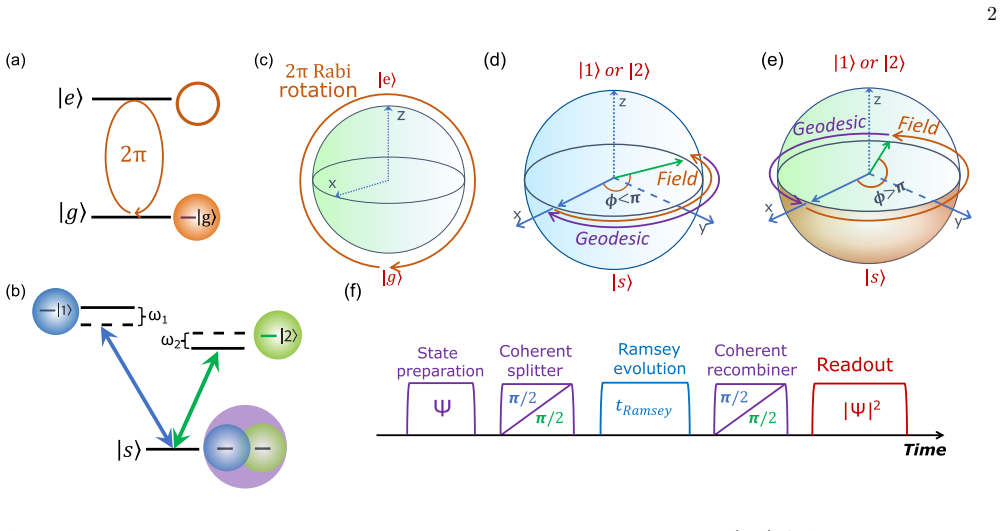
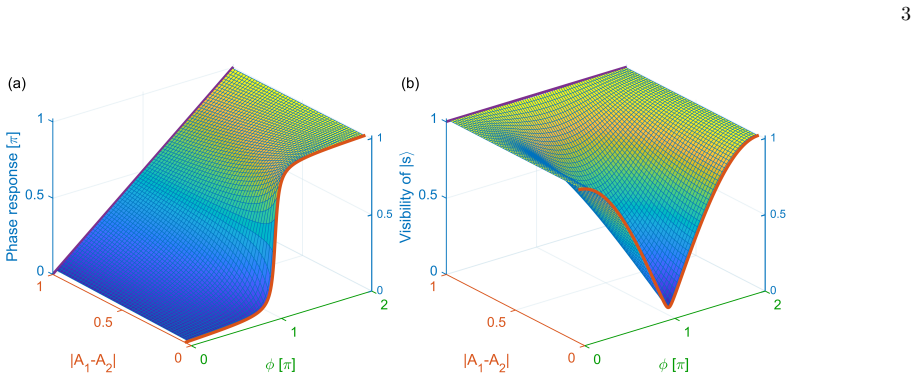
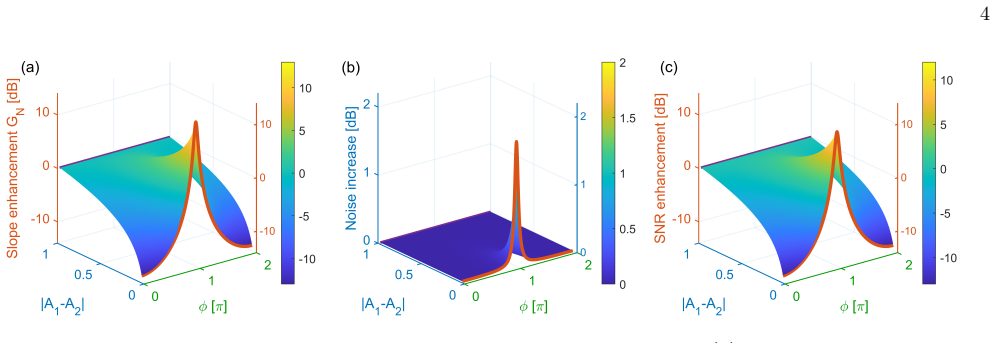
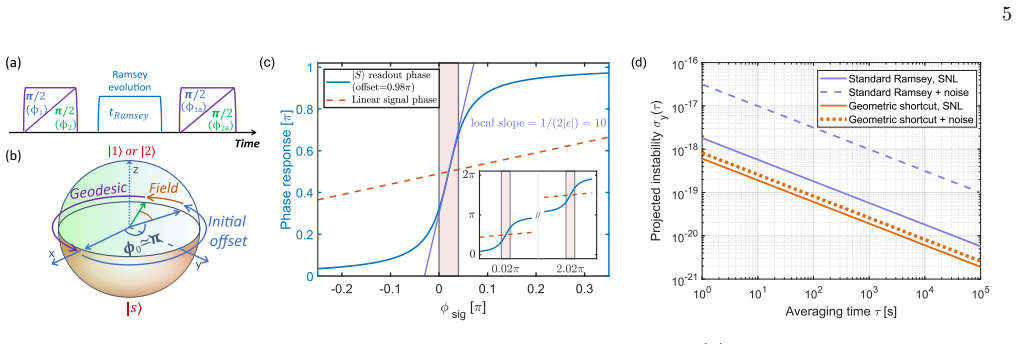
In three-level Ramsey interferometry the two internal paths that accumulate the signal phase interfere to produce a noncyclic geometric phase. Near the geodesic-closure transition a small accumulated signal phase therefore maps to a much larger shift in the observed readout phase. The paper quantifies the accompanying visibility loss and shows that, within a finite operating window and under technical-noise-limited conditions, the slope gain exceeds the visibility penalty to yield a net SNR improvement. Tuning an initial Ramsey phase offset positions this high-slope window at any desired point, allowing repeated sampling with shorter cycles and thereby a geometric shortcut to improved projec
What carries the argument
Noncyclic geometric phase generated by interference of two internal signal-collecting paths in a three-level atomic Ramsey sequence, with its sharp slope change at the geodesic-closure transition.
If this is right
- Net SNR gain appears in the technical-noise-limited regime once the high-slope window is used.
- Initial phase offset tuning moves the steep region to any chosen operating point.
- Shorter cycles can be repeated while preserving the amplified response, raising projected stability.
- The same multilevel interference route applies to any quantum platform that supports three-level Ramsey sequences.
Where Pith is reading between the lines
- The same geometric amplification could be tested in trapped-ion or superconducting circuits that already use multilevel encodings.
- Combining the method with dynamical decoupling might further extend the usable interrogation time inside the high-slope window.
- If visibility loss grows faster than predicted with increasing control imperfections, the net gain window would shrink or disappear.
Load-bearing premise
The three-level system can be prepared and driven so the two internal paths produce the predicted noncyclic geometric phase response, and technical noise remains dominant so the visibility-slope tradeoff actually improves performance without hidden decoherence or control errors.
What would settle it
Measure readout phase versus small accumulated signal phase while scanning across the predicted geodesic-closure point and check whether the local slope exhibits the calculated amplification factor.
Figures
read the original abstract
In a standard two-level Ramsey interferometer, the measured phase accumulates linearly during the interrogation time. Here, we introduce three-level Ramsey interferometry that employs a noncyclic geometric phase response to enhance phase sensing, with projected internal-path interference reshaping the mapping from accumulated signal phase to readout phase. Near a geodesic-closure transition, a small accumulated signal phase produces a sharply amplified readout-phase shift. We quantify the accompanying gain--visibility tradeoff and identify a finite operating window in which the amplified response yields a net signal-to-noise-ratio gain under technical-noise-limited conditions. By tuning an initial Ramsey phase offset, this high-slope window can be positioned at a desired operating point and sampled repeatedly with shorter cycles, providing a geometric shortcut to improved projected stability. More broadly, these results establish a multilevel Ramsey route to enhanced phase sensitivity in quantum platforms, where two signal-collecting internal paths interfere to produce a noncyclic geometric response.
Editorial analysis
A structured set of objections, weighed in public.
Referee Report
Summary. The manuscript proposes three-level Ramsey interferometry that exploits a noncyclic geometric phase arising from interference between two internal signal-collecting paths. Near a geodesic-closure transition, a small accumulated signal phase produces an amplified readout-phase shift. The authors quantify a gain-visibility tradeoff and identify an operating window where the amplified response yields net SNR improvement under technical-noise-limited conditions. An initial Ramsey phase offset is used to position the high-slope region, enabling repeated short-cycle sampling for improved projected stability.
Significance. If the technical-noise dominance and system-preparation assumptions hold with the claimed tradeoff, the work would establish a multilevel geometric route to phase sensitivity enhancement that avoids longer interrogation times, offering a potential shortcut to stability in atomic quantum sensors.
major comments (2)
- Abstract: the central claim of net SNR gain from the amplified response requires an explicit noise model, visibility calculation, and numerical example showing that the gain-visibility tradeoff actually improves SNR; none of these appear in the abstract, and the full text must supply them to substantiate the projection.
- The manuscript must demonstrate that the three-level preparation and driving produce the stated noncyclic geometric phase without introducing unaccounted decoherence or control errors that would cancel the projected stability gain when shorter cycles are used.
minor comments (1)
- Notation for the readout phase and geodesic-closure transition should be defined with an equation or diagram on first use.
Simulated Author's Rebuttal
We thank the referee for the detailed and constructive report. The comments highlight important points for strengthening the presentation of our results on three-level Ramsey interferometry. We address each major comment below and have revised the manuscript accordingly.
read point-by-point responses
-
Referee: Abstract: the central claim of net SNR gain from the amplified response requires an explicit noise model, visibility calculation, and numerical example showing that the gain-visibility tradeoff actually improves SNR; none of these appear in the abstract, and the full text must supply them to substantiate the projection.
Authors: We agree that the abstract should more explicitly reference the supporting elements. The full manuscript already derives the visibility as a function of the geometric phase accumulation and presents a numerical example (in the section on SNR analysis) demonstrating net gain under a technical-noise model where phase noise dominates over projection noise. In the revision we have updated the abstract to include a concise statement of the noise model (technical-noise-limited regime with tunable offset) and the quantified tradeoff, while expanding the main text with an additional explicit comparison of SNR with and without the geometric amplification for representative parameters (e.g., visibility 0.7 yielding 1.8 dB net gain). revision: yes
-
Referee: The manuscript must demonstrate that the three-level preparation and driving produce the stated noncyclic geometric phase without introducing unaccounted decoherence or control errors that would cancel the projected stability gain when shorter cycles are used.
Authors: The derivation of the noncyclic geometric phase is obtained from the exact unitary evolution of the three-level Hamiltonian under ideal coherent driving; the phase arises strictly from the interference term between the two internal paths and is independent of dynamical contributions. We acknowledge that real implementations will include finite coherence and control imperfections. In the revised manuscript we have added a dedicated paragraph analyzing the impact of decoherence: because the geometric amplification permits shorter interrogation times while maintaining the same accumulated signal phase, the total decoherence exposure per cycle is reduced, preserving a net stability advantage for coherence times exceeding a few hundred milliseconds (typical for trapped-atom systems). A full error-budget simulation with specific pulse shapes is noted as future experimental work but is outside the scope of the present theoretical proposal. revision: partial
Circularity Check
No significant circularity; derivation self-contained
full rationale
The paper presents a theoretical proposal for three-level Ramsey interferometry employing noncyclic geometric phase to enhance phase sensing. The abstract and described claims outline a new mapping from signal phase to readout phase near a geodesic-closure transition, with quantification of gain-visibility tradeoff and identification of an operating window. No load-bearing step reduces by the paper's own equations to a fitted parameter renamed as prediction, self-definition, or self-citation chain. The central results appear derived from standard quantum geometric phase formalism applied to the three-level system, without evidence of circular reduction to inputs. This is the expected outcome for a methods proposal whose validity rests on external experimental verification rather than internal self-reference.
Axiom & Free-Parameter Ledger
axioms (1)
- standard math Quantum mechanics governs coherent evolution and interference in three-level atomic systems under Ramsey pulse sequences.
Reference graph
Works this paper leans on
-
[1]
N. F. Ramsey, A molecular beam resonance method with separated oscillating fields, Physical Review78, 695 (1950)
1950
-
[2]
Shinjo, M
A. Shinjo, M. Baba, K. Higashiyama, R. Saito, and T. Mukaiyama, Three-dimensional matter-wave interfer- ometry of a trapped single ion, Phys. Rev. Lett.126, 153604 (2021)
2021
-
[3]
S. J. J. M. F. Kokkelmans and M. J. Holland, Ramsey fringes in a Bose-Einstein condensate between atoms and molecules, Phys. Rev. Lett.89, 180401 (2002)
2002
-
[4]
J. F. Barry, J. M. Schloss, E. Bauch, M. J. Turner, C. A. Hart, L. M. Pham, and R. L. Walsworth, Sensitivity op- timization for NV-diamond magnetometry, Rev. Mod. Phys.92, 015004 (2020)
2020
-
[5]
A. D. Ludlow, M. M. Boyd, J. Ye, E. Peik, and P. O. Schmidt, Optical atomic clocks, Rev. Mod. Phys.87, 637 (2015)
2015
-
[6]
Takamoto, I
M. Takamoto, I. Ushijima, N. Ohmae, T. Yahagi, K. Kokado, H. Shinkai, and H. Katori, Test of general relativity by a pair of transportable optical lattice clocks, Nature Photonics14, 411 (2020)
2020
-
[7]
M. S. Safronova, S. G. Porsev, C. Sanner, and J. Ye, Two clock transitions in neutral Yb for the highest sensitivity to variations of the fine-structure constant, Phys. Rev. Lett.120, 173001 (2018)
2018
-
[8]
Filzinger, S
M. Filzinger, S. D¨ orscher, R. Lange, J. Klose, M. Steinel, E. Benkler, E. Peik, C. Lisdat, and N. Huntemann, Im- proved limits on the coupling of ultralight bosonic dark matter to photons from optical atomic clock comparisons, Phys. Rev. Lett.130, 253001 (2023)
2023
-
[9]
Jiang, A
Y. Jiang, A. Ludlow, N. D. Lemke, R. W. Fox, J. A. Sher- man, L.-S. Ma, and C. W. Oates, Making optical atomic clocks more stable with 10 −16-level laser stabilization, Nature Photonics5, 158 (2011)
2011
-
[10]
Huang, B
Y. Huang, B. Zhang, M. Zeng, Y. Hao, Z. Ma, H. Zhang, H. Guan, Z. Chen, M. Wang, and K. Gao, Liquid- nitrogen-cooled Ca+ optical clock with systematic uncer- tainty of 3×10 −18, Phys. Rev. Appl.17, 034041 (2022). 6
2022
-
[11]
D¨ orscher, A
S. D¨ orscher, A. Al-Masoudi, M. Bober, R. Schwarz, R. Hobson, U. Sterr, and C. Lisdat, Dynamical decou- pling of laser phase noise in compound atomic clocks, Communications Physics3, 185 (2020)
2020
-
[12]
Schioppo, R
M. Schioppo, R. C. Brown, W. F. McGrew, N. Hinkley, R. J. Fasano, K. Beloy, T. H. Yoon, G. Milani, D. Ni- colodi, J. A. Sherman, N. B. Phillips, C. W. Oates, and A. D. Ludlow, Ultrastable optical clock with two cold- atom ensembles, Nature Photonics11, 48 (2017)
2017
-
[13]
Lange, N
R. Lange, N. Huntemann, J. M. Rahm, C. Sanner, H. Shao, B. Lipphardt, C. Tamm, S. Weyers, and E. Peik, Improved limits for violations of local position invariance from atomic clock comparisons, Phys. Rev. Lett.126, 011102 (2021)
2021
-
[14]
M. E. Kim, W. F. McGrew, N. V. Nardelli, E. R. Clements, Y. S. Hassan, X. Zhang, J. L. Valencia, H. Leopardi, D. B. Hume, T. M. Fortier,et al., Improved interspecies optical clock comparisons through differen- tial spectroscopy, Nature Physics19, 25 (2023)
2023
-
[15]
Aharonov and L
Y. Aharonov and L. Susskind, Observability of the sign change of spinors under 2πrotations, Phys. Rev.158, 1237 (1967)
1967
-
[16]
Rauch, A
H. Rauch, A. Zeilinger, G. Badurek, A. Wilfing, W. Baus- piess, and U. Bonse, Verification of coherent spinor rota- tion of fermions, Physics Letters A54, 425 (1975)
1975
-
[17]
Jaksch, J
D. Jaksch, J. I. Cirac, P. Zoller, S. L. Rolston, R. Cˆ ot´ e, and M. D. Lukin, Fast quantum gates for neutral atoms, Phys. Rev. Lett.85, 2208 (2000)
2000
-
[18]
M. V. Berry, Quantal phase factors accompanying adia- batic changes, Proc. R. Soc. Lond. A392, 45 (1984)
1984
-
[19]
Pancharatnam, Generalized theory of interference, and its applications., inProc
S. Pancharatnam, Generalized theory of interference, and its applications., inProc. Indian Acad. Sci., Vol. 44 (Springer, 1956) pp. 247–262
1956
-
[20]
Samuel and R
J. Samuel and R. Bhandari, General setting for Berry’s phase, Phys. Rev. Lett.60, 2339 (1988)
1988
-
[21]
Bhandari, SU (2) phase jumps and geometric phases, Phys
R. Bhandari, SU (2) phase jumps and geometric phases, Phys. Lett. A157, 221 (1991)
1991
-
[22]
Z. Zhou, Y. Margalit, S. Moukouri, Y. Meir, and R. Fol- man, An experimental test of the geodesic rule proposi- tion for the noncyclic geometric phase, Science Advances 6, eaay8345 (2020)
2020
-
[23]
Z. Zhou, S. C. Carrasco, C. Sanner, V. S. Malinovsky, and R. Folman, Geometric phase amplification in a clock interferometer for enhanced metrology, Science Advances 11, eadr6893 (2025)
2025
-
[24]
J. P. Lee, A. J. Bennett, J. Skiba-Szymanska, D. J. P. Ellis, I. Farrer, D. A. Ritchie, and A. J. Shields, Ramsey interference in a multilevel quantum system, Phys. Rev. B93, 085407 (2016)
2016
-
[25]
Godfrin, R
C. Godfrin, R. Ballou, E. Bonet, M. Ruben, S. Kly- atskaya, W. Wernsdorfer, and F. Balestro, Generalized ramsey interferometry explored with a single nuclear spin qudit, npj Quantum Information4, 53 (2018)
2018
-
[26]
S. C. Carrasco, S. Lourette, I. Sola, and V. S. Malinovsky, Dynamically enhanced two-photon spectroscopy, Phys. Rev. Lett.134, 163601 (2025)
2025
-
[27]
F. Kong, P. Zhao, X. Ye, Z. Wang, Z. Qin, P. Yu, J. Su, F. Shi, and J. Du, Nanoscale zero-field electron spin res- onance spectroscopy, Nature Communications9, 1563 (2018)
2018
-
[28]
Cerrillo, S
J. Cerrillo, S. O. Casado, and J. Prior, Low field nano- NMR via three-level system control, Physical Review Letters126, 220402 (2021)
2021
-
[29]
P. J. Vetter, A. Marshall, G. T. Genov, T. F. Weiss, N. Striegler, E. F. Großmann, S. O. Casado, J. Cerrillo, J. Prior, P. Neumann, and F. Jelezko, Zero- and low-field sensing with nitrogen-vacancy centers, Physical Review Applied17, 044028 (2022)
2022
-
[30]
Z. Li, X. Ye, X. Kong, T. Xie, Z. Yang, P. Zhao, Y. Wang, F. Shi, and J. Du, Zero-field quantum sensing via precise geometric controls for a spin-1 system, Phys. Rev. Appl. 21, 054011 (2024)
2024
-
[31]
A. G. Wagh and V. C. Rakhecha, On measuring the Pancharatnam phase. i. interferometry, Physics Letters A197, 107 (1995)
1995
-
[32]
A. G. Wagh, V. C. Rakhecha, P. Fischer, and A. Ioffe, Neutron interferometric observation of noncyclic phase, Phys. Rev. Lett.81, 1992 (1998)
1992
-
[33]
Sj¨ oqvist, Proposed interferometry test of noncyclic ge- ometric phase, Physics Letters A286, 4 (2001)
E. Sj¨ oqvist, Proposed interferometry test of noncyclic ge- ometric phase, Physics Letters A286, 4 (2001)
2001
-
[34]
Xiao, M.-C
D. Xiao, M.-C. Chang, and Q. Niu, Berry phase effects on electronic properties, Reviews of Modern Physics82, 1959 (2010)
1959
-
[35]
van Dijk, H
T. van Dijk, H. F. Schouten, W. M. G. Ubachs, and T. D. Visser, The Pancharatnam–Berry phase for non-cyclic polarization changes, Optics Express18, 10796 (2010)
2010
-
[36]
Rantaeskola, K
K. Rantaeskola, K. Saastamoinen, A. Norrman, Y. Chen, A. T. Friberg, and T. Set¨ al¨ a, Pancharatnam’s connection and geometric phase of partially polarized light, Optica 12, 62 (2025)
2025
-
[37]
J. J. Gil, Geometric phase of arbitrary Mueller evolu- tions and its two-level quantum analog, Optics Letters 51, 2624 (2026)
2026
-
[38]
Pezz` e, A
L. Pezz` e, A. Smerzi, M. K. Oberthaler, R. Schmied, and P. Treutlein, Quantum metrology with nonclassical states of atomic ensembles, Rev. Mod. Phys.90, 035005 (2018)
2018
-
[39]
Pedrozo-Pe˜ nafiel, S
E. Pedrozo-Pe˜ nafiel, S. Colombo, C. Shu, A. F. Adiy- atullin, Z. Li, E. Mendez, B. Braverman, A. Kawasaki, D. Akamatsu, Y. Xiao,et al., Entanglement on an optical atomic-clock transition, Nature588, 414 (2020)
2020
-
[40]
Zaporski, Q
L. Zaporski, Q. Liu, G. Velez, M. Radzihovsky, Z. Li, S. Colombo, E. Pedrozo-Pe˜ nafiel, and V. Vuleti´ c, Quantum-amplified global-phase spectroscopy on an op- tical clock transition, Nature646, 309 (2025)
2025
-
[41]
Kaubruegger, D
R. Kaubruegger, D. V. Vasilyev, M. Schulte, K. Ham- merer, and P. Zoller, Quantum variational optimization of ramsey interferometry and atomic clocks, Physical Re- view X11, 041045 (2021)
2021
-
[42]
Overton, J
M. Overton, J. Rubio, N. Cooper, D. Baldolini, D. Johnson, J. Anders, and L. Hackerm¨ uller, Adaptive, symmetry-informed bayesian metrology for precise quan- tum technology measurements, Physical Review Letters 136, 140801 (2026)
2026
-
[43]
M. D. Swallows, M. Bishof, Y. Lin, S. Blatt, M. J. Martin, A. M. Rey, and J. Ye, Suppression of collisional shifts in a strongly interacting lattice clock, Science331, 1043 (2011)
2011
-
[44]
Statistical distance and the geometry of quantum states,
R. Szmuk, V. Dugrain, W. Maineult, J. Reichel, and P. Rosenbusch, Stability of a trapped-atom clock on a chip, Physical Review A92, 012106 (2015). 1 Supplementary material for Noncyclic geometric phase in three-level Ramsey interferometry for enhanced metrology Zhifan Zhou and Yaxin Li Joint Quantum Institute, University of Maryland and National Institute...
2015
discussion (0)
Sign in with ORCID, Apple, or X to comment. Anyone can read and Pith papers without signing in.