REVIEW 4 major objections 6 minor 1 cited by
Geometry as a Missing Axis of Representation Quality: The Variational Geometric Information Bottleneck under Data Scarcity
T0 review · 4 major / 6 minor · reviewed 2026-08-04 · deepseek-v4-flash
Pith's one-line read This paper claims that adding curvature and intrinsic-dimension penalties to the information bottleneck makes latent geometry part of the generalization guarantee, so intrinsic dimension, not ambient dimension, controls sample complexity.
desk verdict The paper's central theoretical claim is asserted rather than proved, and the empirical evidence for the headline gains is missing; the framework is plausible but the manuscript is not yet a reliable contribution. read the letter →
The pith
A machine-rendered reading of the paper's core claim, the machinery that carries it, and where it could break.
The reading
What carries the argument
The object carrying the argument is the understanding functional U(φ)=I(φ(X);Y)−βC(φ), with C(φ) combining a Hessian-norm curvature penalty and an intrinsic-dimension penalty. The proof mechanism is the curvature-sensitive covering-number bound: for a compact d-dimensional submanifold of reach τ and sectional curvature at most κmax, the covering number grows like (1+cκmax/τ)^d ε^(−d). That multiplicative geometry factor converts into the d log(1+cκmax/τ) term in the generalization bound via standard covering-to-complexity arguments, while the Hessian penalty supplies the additive βκmax approximation error. The V-GIB implementation estimates these quantities with a variational surrogate for m
What would settle it
Compute the generalization gap for the same encoder family on one data manifold embedded in R^3, R^30, and R^300 while keeping the intrinsic dimension, labels, and training size fixed. If the gap rises with ambient dimension, Theorem 2.4's D-independence is wrong; if it stays flat, the intrinsic-dimension claim has direct support.
Extended reading notes
Core claim
The paper's central claim is Theorem 2.4: a minimizer of the unified objective has, with probability at least 1−δ, generalization gap bounded by C sqrt((d log N + log(1/δ))/N) + C′βκmax, with constants independent of the ambient dimension D. The first term is the paper's core thesis—once data are assumed to live on a compact smooth d-dimensional manifold, sample complexity is controlled by intrinsic dimension, not input dimensionality. The second term says curvature regularization itself costs an additive approximation error proportional to the regularizer weight β times the manifold's maximum sectional curvature κmax. From this, Corollary 2.7 orders encoders with equal empirical risk: the f
Load-bearing premise
The whole bound rests on Assumption 2.3—data supported on a compact smooth d-dimensional manifold with bounded reach and sectional curvature and a bi-Lipschitz encoder—and the paper's own Appendix A.11 concedes this may fail for high intrinsic dimension or non-manifold data.
Editorial extensions
If this is right
- Intrinsic dimension becomes the right complexity certificate: if Theorem 2.4 holds, adding irrelevant ambient coordinates should not raise the number of labels needed, provided the data still sit on the same low-dimensional manifold.
- Low-curvature bias substitutes for labels: the paper reports that curvature-regularized models reach the same accuracy with roughly 32% fewer examples on its synthetic setup, matching the theoretical reduction in sample complexity.
- Model selection by geometry: when two encoders tie on empirical risk, Corollary 2.7 says the one with lower estimated intrinsic dimension and lower curvature is the one to keep.
- A Pareto law for representation design: tuning the curvature weight β traces a monotone frontier between task information and geometric complexity, with marginal trade-off equal to β; the paper reports positive KL–curvature coupling and stable frontiers across datasets.
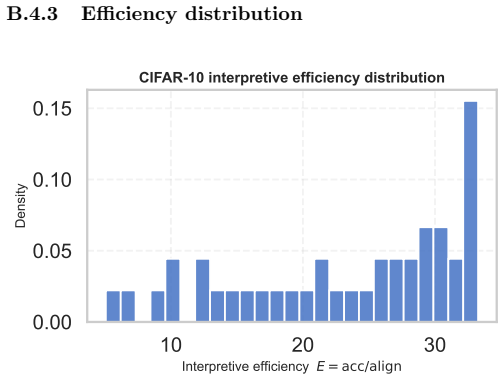
- Diminishing returns under more data: CIFAR-10 fractional runs show interpretive efficiency rising with data while curvature saturates, implying that once the geometry equilibrates, extra labels buy less.
Reading between the lines
- A direct test of the D-independence claim: embed the same synthetic manifold in spaces of increasing ambient dimension, keep d and the encoder's latent dimension fixed, and check whether the generalization gap stays flat as D grows; Theorem 2.4 predicts it should, and the paper's synthetic protocol could be extended to do precisely this.
- If the additive βκmax term is real, curvature regularization should have a U-shaped effect on generalization for data with high curvature: raising β from zero first reduces the statistical term by smoothing the latent manifold, then eventually hurts by paying approximation cost. A sweep of β on a known high-curvature dataset would expose the predicted minimum.
- Theorem 2.8's frontier could be used as a pre-training calibration tool: fit the information–curvature curve from a few values of β and extrapolate to predict the achievable task information at a target curvature before committing compute to full training.
- The framework's separation of encoder geometry from predictor complexity suggests a transfer test: a V-GIB encoder trained on one label set should transfer to a new task better than an equally accurate non-geometric encoder, because the latent manifold, not the label map, carries the reusable structure.
Editorial analysis
A structured set of objections, weighed in public.
Referee Report
Summary. The manuscript defines a structural-understanding functional U(φ)=I(φ(X);Y)−βC(φ), instantiates it as V-GIB, and claims non-asymptotic generalization bounds in which intrinsic dimension d and curvature κmax enter separately (Theorems 2.4 and 2.6). It also states an information–curvature Pareto frontier, estimator concentration results, and an alignment–efficiency synergy theorem. Experiments on Swiss roll, Fashion-MNIST, and CIFAR-10 with reduced label fractions are presented as validation.
Significance. If the theoretical results were established, the paper would make a useful contribution: quantifying how latent curvature enters sample-complexity bounds beyond standard intrinsic-dimension results, and showing curvature regularization as a substitute for labels. The paper also ships implementation details, a code link, and reproducibility diagnostics (Appendix A.10, A.12), which is commendable. However, the two load-bearing geometric results are not actually derived: the additive βκmax term is asserted, and the curvature covering factor in Lemma 2.5 is dimensionally inconsistent. The circularity in Theorem 2.17 further weakens the theoretical contribution. The empirical correlations are suggestive but are not presented with comparisons that would distinguish the claimed law from a generic accuracy-curvature correlation during training.
major comments (4)
- [Theorem 2.4 and Appendix A.2, proof sketches] The central new term C′βκmax in Theorem 2.4 is asserted, not derived. The proof sketch says 'imposing weight β on the curvature functional produces an additional approximation/stability error of order βκmax', and Appendix A.2 step (iii) repeats 'curvature-regularized encoders ... incur an additional approximation error bounded by C3βκmax' without specifying the constrained hypothesis class, the approximation error being measured, or a bound on it. This term is exactly what makes the claim 'geometry becomes part of the bottleneck criterion' non-trivial; without a derivation, Theorem 2.4 is only the standard intrinsic-dimension bound plus an unexplained additive constant. The authors should either prove this term from an explicit class of curvature-bounded encoders or state it as a conjecture and remove it from the theorem.
- [Lemma 2.5, Eq. (2)] Eq. (2) is dimensionally inconsistent. Sectional curvature κmax has units L^{-2} and reach τ has units L, so κmax/τ has units L^{-3}, yet it appears inside a dimensionless factor (1+c1 κmax/τ)^d. The Bishop–Gromov comparison stated in the appendix (Eq. (6)) gives a dimensionless factor 1+c_d κmax r^2, with r the ball radius; replacing r by τ does not yield κmax/τ. Since Theorem 2.6's d log(1+c1κmax/τ) term is obtained directly from Eq. (2), the curvature-aware deviation bound is unsupported. The paper needs a correct curvature-sensitive covering estimate (e.g., in terms of κmax τ^2) or a different mechanism by which curvature enters the rate.
- [Theorem 2.17] Assumption (iii) already asserts the conclusion of the theorem: 'if A(φ,ψ) ≥ A(φ′,ψ) then I(φ(X);Y) ≥ I(φ′(X);Y)' is exactly the claim that alignment increases predictive information. The proof derives I-monotonicity from this assumption and then defines μ* as the infimum where I becomes constant; existence of a finite μ* does not follow from boundedness and monotonicity, since a strictly increasing bounded function need not become constant. The theorem therefore does not establish an alignment–efficiency synergy; it re-labels an assumption as a result. Please state assumption (iii) as the substantive open condition, or provide a proof from more basic information-theoretic properties.
- [Proposition 2.11] The claim sup_φ |Î−I| = O((NK)^(-1/2)) is derived from Theorem 2.14 and Proposition 2.15, but neither result is uniform over φ. Theorem 2.14 bounds |bC_{N,K}−E[bC_{N,K}]| for fixed h, and Proposition 2.15 bounds the VIB surrogate for a fixed decoder class; no metric-entropy or union-bound argument over the encoder class is given. Pointwise concentration does not imply sup-norm concentration. Consequently, the uniform consistency of empirical maximizers does not follow. Please supply a uniform bound over a compact class with an explicit covering argument, or restrict Proposition 2.11 accordingly.
minor comments (6)
- [Table 3] Table 3 appears corrupted: rows contain overlapping entries, and the row for frac=0.20 seems to include an implausible epoch value '520' inconsistent with other rows. The table needs to be regenerated and checked.
- [Figure captions 1–3] Several figure captions contain raw '/uni...' escape sequences (e.g., Figure 1 and Figure 3 captions). These will render incorrectly in the published version and should be fixed.
- [Section 4.3, η_eff] The 'effective sample efficiency ratio' η_eff is used to support a quantitative claim ('roughly 32% fewer labeled examples') but is never formally defined in Section 3 or 4. Please provide its definition and estimation procedure.
- [§4.4 and §4.6, E(φ;N)] Interpretive efficiency is defined in Definition 2.2 as U(φ)/N, but in the CIFAR-10 tables it is reported as acc/align (e.g., 23.33). This is a different quantity; the notation should be reconciled or the tables relabeled.
- [References] Reference [6] is incomplete: it has no journal, arXiv identifier, or year. Also, citations [9] and [6] are used for covering-number estimates that are not standard consequences of those papers; please give precise statements.
- [Appendix A.11] The limitation note that 'geometric assumptions may fail for high intrinsic dimension or non-manifold data' is placed only in the appendix. Given that the main theory and the experiments on CIFAR-10 depend on Assumption 2.3, this caveat should be stated prominently in the main text and tested with the provided bdPR diagnostics.
Circularity Check
Alignment–efficiency 'synergy' is assumed in Theorem 2.17; intrinsic-dimension selection and efficiency ordering are definitional rewrites, so several advertised theoretical results reduce to their own inputs.
-
self definitional
[Theorem 2.17, assumption (iii) and its proof, Section 2.5]
"Assume that ... (iii) if A(ϕ,ψ)≥ A(ϕ′,ψ) then I(ϕ(X);Y)≥I(ϕ ′(X);Y), with strict inequality in the nondegenerate case; (iv) E(ϕ;N) is nondecreasing in I(ϕ(X);Y). Then µ→E(ϕ µ;N) is nondecreasing ... Proof: ... Assumption (iii) implies I(ϕ µ2 (X);Y)≥I(ϕ µ1 (X);Y), hence by (iv) E(ϕµ2 ;N)≥E(ϕ µ1 ;N)."
The advertised 'Alignment–efficiency synergy' is exactly the assumption that alignment order implies task-information order (iii), combined with the definitional monotonicity of E in I (iv). The proof's only real step (optimality ⇒ A is nondecreasing in µ) is a standard envelope argument; the claimed synergy itself is never derived. Thus the theorem's conclusion is its hypothesis, relabeled.
-
self definitional
[Proposition 2.9 and Theorem 2.12, Section 2.5]
"Define V(d ′) = sup_{ϕ∈Φd′} {I(ϕ(X);Y)−βC(ϕ)}. Then ... (b) adding a dimension penalty γd ′ yields d∗ ∈ arg max_{d′≤D} {V(d ′)−γd ′}. ... Proof. Partition F=∪Φd′. For fixed d ′, inf_{ϕ∈Φd′} J(ϕ) = γd ′ − V(d ′)."
V(d′) is defined as sup(I−βC) over the class Φd′, and J is defined as −I+βC+γd′. Therefore inf_{Φd′} J = γd′−V(d′) follows by substituting the definitions. The 'intrinsic-dimension selection' theorem and the 'curvature–information–dimension linkage' are algebraic restatements of J and V, not independently derived predictions.
1 more flagged steps
-
self definitional
[Corollary 2.7 proof, Section 2.4]
"By definition of E(ϕ;N) as a decreasing function of both d int and κ, E(ϕ 1;N)>E(ϕ 2;N)."
Interpretive efficiency is defined in Definition 2.2 as E(ϕ;N)=U(ϕ)/N with U=I−βC, so 'lower d_int and lower κ imply higher E' is true by construction. The corollary presents this definitional fact as a consequence of the sample-complexity bound, but the E-ordering half does not use Theorem 2.4 at all.
full rationale
The clearest constructional circularity is Theorem 2.17: the theorem's central claim—alignment improves efficiency—is assumed as condition (iii) (higher alignment ⇒ higher mutual information) and condition (iv) (higher information ⇒ higher efficiency), and the proof applies those assumptions verbatim. Similarly, Proposition 2.9 and Theorem 2.12 unfold the definitions of V(d′) and J; their conclusions are algebraic identities rather than derived selection laws. Corollary 2.7's efficiency-ordering component is a restatement of Definition 2.2. The curvature-dependent generalization theorems (2.4 and 2.6) are not circular in the same constructional sense—the additive Cβκmax term and the κmax/τ covering factor are asserted rather than derived, and the latter is dimensionally suspect—but those are unsupported-claim/correctness concerns, not reductions to inputs. There is no load-bearing self-citation chain; the external references are standard and not author-overlapping. Because several advertised theoretical results reduce by definition or by assuming their conclusion, but the paper's main generalization claim is not itself constructionally circular, the score is partial rather than total.
Assumptions & free parameters
free parameters (6)
- β (bottleneck/curvature weight) =
{10^-3, 5×10^-3, 10^-2}
- γ (curvature/dimension penalty weight) =
{0, 10^-4} synthetic; {0,10^-5,10^-4} CIFAR
- λ (predictor regularizer in Eq. 1)
- η_eff ('effective sample efficiency ratio') =
1.32 (average)
- K (Hutchinson probes) =
2 (train), ≥4 (eval)
- z_dim (latent dimension) =
{8,16}
assumptions (9)
- domain assumption Manifold hypothesis with regularity (Assumption 2.3): data supported on a compact smooth d-dimensional Riemannian manifold M ⊂ R^D with reach τ>0 and |κ|≤κmax
- domain assumption Encoder φ is bi-Lipschitz on M (Assumption 2.3 / A.1)
- standard math Loss ℓ bounded in [0,B] and Lipschitz; predictor g is Lg-Lipschitz (Thm 2.4 conditions)
- ad hoc to paper Curvature-regularized encoders incur an additive approximation/stability error C′βκmax (Thm 2.4 sketch, Thm 2.6, App. A.2 step iii)
- domain assumption Sub-Gaussianity of Hessian-vector products h_v(z)=v^T H_φ(z)v and per-sample MI contributions (Lemma 2.13)
- ad hoc to paper Theorem 2.17 assumption (iii): if A(φ,ψ)≥A(φ′,ψ) then I(φ(X);Y)≥I(φ′(X);Y)
- standard math Existence/uniqueness of maximizers, C^1 dependence, positive-definite reduced Hessian (Thm 2.8/2.10)
- standard math Covering estimates for submanifolds with bounded curvature N(ε)≤C_0(1+c_1 κmax/τ)^d ε^(-d) (Lemma 2.5, App. A.3)
- domain assumption VIB surrogate consistency: decoder family {q_ω} has Rademacher complexity R_dec(N) and Ĥ(Y) error negligible (Prop 2.15)
invented entities (4)
-
Structural understanding functional U(φ)
-
Interpretive efficiency E(φ;N)
-
Effective sample efficiency ratio η_eff
-
Alignment mutual information (empirical)
Cite this review
Pith. "Pith review of Geometry as a Missing Axis of Representation Quality: The Variational Geometric Information Bottleneck under Data Scarcity." pith.science (2026). https://pith.science/paper/TLJENBLT
@misc{pith2026251102496,
  author       = {Pith},
  title        = {Pith review of: Geometry as a Missing Axis of Representation Quality: The Variational Geometric Information Bottleneck under Data Scarcity},
  year         = {2026},
  howpublished = {\url{https://pith.science/paper/TLJENBLT}},
  note         = {Machine review of arXiv:2511.02496}
}
read the original abstract
We study latent geometry as an explicit component of representation quality in data-scarce learning. For an encoder (\phi), we define (Q_{\beta,\gamma}(\phi)=I(\phi(X);Y)-\beta\mathcal C(\phi)-\gamma d_{\mathrm{int}}(\phi)), combining task-relevant information with penalties for curvature and intrinsic latent dimension. Thus geometry becomes part of the bottleneck criterion, not only a post hoc diagnostic. Under smooth-manifold, loss-transfer, and estimator-concentration assumptions, we derive non-asymptotic low-label generalization bounds where intrinsic dimension and covering complexity enter explicitly. We characterize the information--geometry frontier and prove empirical-surrogate consistency. The analysis links encoder geometry to learning through latent covering numbers, loss-class entropy, and uniform deviation. We instantiate the theory as \texttt{V-GIB}, adding curvature and dimension penalties to variational bottleneck training. Real low-label benchmarks compare \texttt{V-GIB} with ERM, VIB, and ablations across (1%)--(20%) label fractions. Results show improved performance and reduced geometric complexity in several regimes, especially FashionMNIST and CIFAR-10, while confirming that no fixed regularizer is universally dominant.
Figures


Figures from the paper (3 more)


Forward citations
Cited by 1 Pith paper
-
Auditing Training-Free 3D Shape Retrieval with Diffused Geodesic Moments
DGM is presented as a seed-conditioned descriptor to audit protocols, showing that input field and aggregation dominate moment formulas, with GMSD-HKS achieving top scores on FAUST-Reg and TOSCA.
Reference graph
Works this paper leans on
-
[1]
Human-level concept learning through probabilis- tic program induction,
B. M. Lake, R. Salakhutdinov, and J. B. Tenenbaum, “Human-level concept learning through probabilis- tic program induction,”Science, vol. 350, no. 6266, pp. 1332–1338, 2015
2015
-
[2]
Matching 10 networks for one shot learning,
O. Vinyals, C. Blundell, T. Lillicrap, K. Kavukcuoglu, and D. Wierstra, “Matching 10 networks for one shot learning,” inAdvances in Neural Information Processing Systems (NeurIPS), 2016
2016
-
[3]
Model-agnostic meta-learning for fast adaptation of deep networks,
C. Finn, P. Abbeel, and S. Levine, “Model-agnostic meta-learning for fast adaptation of deep networks,” inProceedings of the 34th International Conference on Machine Learning (ICML), vol. 70 ofProceedings of Machine Learning Research, pp. 1126–1135, 2017
2017
-
[4]
Representa- tion learning: A review and new perspectives,
Y. Bengio, Y. LeCun, and G. Hinton, “Representa- tion learning: A review and new perspectives,”IEEE Transactions on Pattern Analysis and Machine In- telligence, 2013. review; see also arXiv:1206.5538
arXiv 2013
-
[5]
Pearl,Causality: Models, Reasoning and Inference
J. Pearl,Causality: Models, Reasoning and Inference. Cambridge University Press, 2nd ed., 2009
2009
-
[6]
Testing the manifold hypothesis,
C. Fefferman, S. Mitter, and H. Narayanan, “Testing the manifold hypothesis,”
-
[7]
Geometric deep learning: go- ing beyond euclidean data,
M. M. Bronstein, J. Bruna, Y. LeCun, A. Szlam, and P. Vandergheynst, “Geometric deep learning: go- ing beyond euclidean data,”IEEE Signal Processing Magazine, vol. 34, no. 4, pp. 18–42, 2017
2017
-
[8]
A global geometric framework for nonlinear di- mensionality reduction,
J. B. Tenenbaum, V. de Silva, and J. C. Lang- ford, “A global geometric framework for nonlinear di- mensionality reduction,”Science, vol. 290, no. 5500, pp. 2319–2323, 2000
2000
Show all 22 references
-
[9]
Manifold regularization: A geometric framework for learning from labeled and unlabeled examples,
M. Belkin, P. Niyogi, and V. Sindhwani, “Manifold regularization: A geometric framework for learning from labeled and unlabeled examples,”Journal of Machine Learning Research, vol. 7, pp. 2399–2434, 2006
2006
-
[10]
The in- formation bottleneck method,
N. Tishby, F. C. Pereira, and W. Bialek, “The in- formation bottleneck method,” inProceedings of the 37th Annual Allerton Conference on Communication, Control and Computing, pp. 368–377, 1999
1999
-
[11]
Deep variational information bottleneck,
A. A. Alemi, I. Fischer, J. V. Dillon, and K. Murphy, “Deep variational information bottleneck,”arXiv preprint arXiv:1612.00410, 2016. Presented at ICLR 2017
2016 arXiv
-
[12]
T. M. Cover and J. A. Thomas,Elements of Informa- tion Theory. Hoboken, NJ: Wiley-Interscience, 2 ed., 2006
2006
-
[13]
Maximum likelihood es- timation of intrinsic dimension,
E. Levina and P. J. Bickel, “Maximum likelihood es- timation of intrinsic dimension,” inAdvances in Neu- ral Information Processing Systems 17 (NIPS 2004), pp. 777–784, 2005
2004
-
[14]
A stochastic estimator of the trace of the influence matrix for laplacian smoothing splines,
M. F. Hutchinson, “A stochastic estimator of the trace of the influence matrix for laplacian smoothing splines,”Communications in Statistics – Simulation and Computation, vol. 18, no. 3, pp. 1059–1076, 1989
1989
-
[15]
Towards a rigorous science of interpretable machine learning,
F. Doshi-Velez and B. Kim, “Towards a rigorous science of interpretable machine learning,”arXiv preprint, vol. arXiv:1702.08608, 2017
2017 arXiv
-
[16]
Explanation in artificial intelligence: In- sights from the social sciences,
T. Miller, “Explanation in artificial intelligence: In- sights from the social sciences,”Artificial Intelli- gence, vol. 267, pp. 1–38, 2019
2019
-
[17]
V. N. Vapnik,Statistical Learning Theory. Wiley- Interscience, 1998
1998
-
[18]
Rademacher and gaussian complexities: Risk bounds and structural re- sults,
P. L. Bartlett and S. Mendelson, “Rademacher and gaussian complexities: Risk bounds and structural re- sults,”Journal of Machine Learning Research, vol. 3, pp. 463–482, 2002
2002
-
[19]
Chavel,Riemannian Geometry: A Modern Intro- duction (2nd ed.)
I. Chavel,Riemannian Geometry: A Modern Intro- duction (2nd ed.). Cambridge University Press, 2006
2006
-
[20]
Shalev-Shwartz and S
S. Shalev-Shwartz and S. Ben-David,Understand- ing Machine Learning: From Theory to Algorithms. Cambridge University Press, 2014
2014
-
[21]
A. W. van der Vaart and J. A. Wellner,Weak Con- vergence and Empirical Processes: With Applications to Statistics. Springer Series in Statistics, New York, NY, USA: Springer-Verlag, 1996
1996
-
[22]
Mine: Mutual information neural estimation,
M. I. Belghazi, A. Baratin, S. Rajeswar, S. Ozair, Y. Bengio, A. Courville, and R. D. Hjelm, “Mine: Mutual information neural estimation,” inProceed- ings of the 35th International Conference on Machine Learning (ICML 2018), pp. 531–540, PMLR, 2018. A Appendix: Technical De- t...
2018
Reviewed August 4, 2026 · model on record in the stance chip above.
Discussion (0). Sign in to comment.